
Jonathan Harnum's Blog, page 49
April 15, 2014
“There is No Magic Trick, You Just Have to Do It” (Stephane Wrembel on Practice)
Stephane Wrembel was one of 20 stellar professional musicians who shared his take on practice with me, and one thing he said sticks out more than anything else. He stressed that there is no magic trick, no gimmick, no special technique to practice. He said, “You just have to do it.”
Even after talking to so many people about practice, it’s not clear to me whether learning to practice can be taught. Everybody I spoke with said that, for the most part, they just had to figure out how to practice. It’s an intensely personal exploration. Still, I do believe that the more information you have while you’re learning, the better. Check out the latest video from Stephane Wrembel. It’s amazing to see great musicians play up close for a lot of reasons, but what always intrigues me is that, despite playing fast and intense music, great musicians like Stephane Wrembel look physically relaxed. Check it out.
Stephane also has some great rhythm section tracks over at his web site. They’re great for playing along with Gypsy standards. Well worth grabbing, and they’re all free.
In other news:
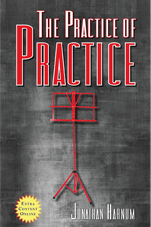
The Kickstarter for The Practice of Practice was successful! Thanks so much to all the awesome backers! Editing the book and printing hardcover copies is now in process and the book will be published in July ,2014. You can sign up securely to get a note and a discount when The Practice of Practice is published.
Related articles
 Stephane Wrembel: Music As ‘A Question Of Life And Death’
 Stephane Wrembel: Origins (Capsule Reviews)
 A Man of Many Influences
 Stephane Wrembel talks about the origin of the universe with his guitar



April 3, 2014
Kickstarting “The Practice of Practice”: Final Days (73%)
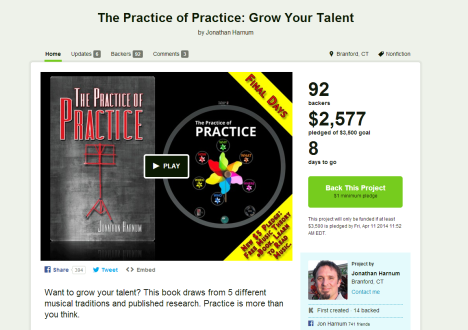
The Kickstarter for The Practice of Practice is in its final week and is at 73%. Learn about the book and see the pledge rewards on the book’s Kickstarter Page. Here’s how the project is doing:
Our Kickstarter Campaign is LIVE http://is.gd.cusuve
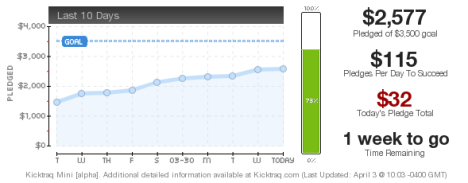
Current projections put the project at achieving 99% (see below) of the target goal. If you don’t know, a Kickstarter project has to reach 100% of its goal or the project isn’t funded.
I chose Kickstarter’s all-or-nothing model for two reasons: less than the goal just wouldn’t cover costs for editing and hardcover printing. And secondly, it’s fun to have a clear-cut, distinct goal to stretch for. The do-or-die model appeals to my sense of competition.
As for the book itself, the text is complete, and the latest paperback prototype of the book (the 4th) is in my hands and undergoing further design and editing tweaks before being sent to a professional editor.
Here’s how the project numbers look with one week to go. The project could sure use your support. Join the 92 people who have already backed it! If the project doesn’t reach its funding goal by April 11, the project fails, no hardcovers will be printed, and nobody gets any of the rewards. I hope you can join the party and help push the project to 100%!

Related articles
 Kickstarter VS Indiegogo Crowdfunding Stats
 Kickstarter
 I’m suffering from crowdfunding, Kickstarter and Indiegogo fatigue
 The Practice of Practice: Be a Better Musician, on Kickstarter!


March 16, 2014
Bill Frisell & Djelimady Tounkara
One of the best perks that comes from talking to superb musicians about practice is when they tell me about musicians they admire. When Sona Jobarteh talked about practice, she listed these musicians: Ballake Cissokho (Kora), Kasse Mady Diabate (Singer), Sekouba Bambino (Singer), and Djelimady Tounkara (Guitarist)
I’ve barely started checking them out and already, I’m entranced. I hope you will be, too. Here’s a tranquil little gem, Uele. It’s from a 2004 London performance. Playing are:
Djelimady Tounkara (guitar)
Bill Frisell (guitar)
Greg Leisz (steel guitar)
Jenny Scheinman (violin)
Sidiki Camara (percussion)
_____________________________________________________
Some of the best musicians in the world spoke with me about music practice. That information and much more are in my next book, The Practice of Practice. A Kickstarter campaign is LIVE for The Practice of Practice until April 11, 2014. Learn more about the book, and how it’s different from any other practice book, get the best deal, and help bring the book into the world. It’ll be fun. I promise. Watch the short video.
_____________________________________________________
Related articles
 Bill Frisell On JazzSet
 African Guitar Legends (pt. 1)
 Sona Jobarteh: Multi-Instrumental Musician
 Greg Leisz


March 12, 2014
The Practice of Practice: Be a Better Musician, on Kickstarter!

The Practice of Practice on Kickstarter
I’m super excited to announce that the fundraising campaign for my next book The Practice of Practice is live on Kickstarter. You can help raise funds for the publishing of the book, and get the best deals on the book at the same time. Learn more by visiting the campaign’s page where you can see a video explaining the project and why this book is unique, useful, and worth supporting.
If you get in on the action early enough, there are some super cheap pledge options.
I’ll be doing a lot of posts in the coming month to help with the campaign, but I promise they’ll be useful and interesting.
If you can’t help financially, I’d be just as grateful for a share on your blog or social media page, or if you’d send a link to the campaign to a musician, teacher, or parent who need a book like this. Thanks!




March 5, 2014
Sona Jobarteh: Multi-Instrumental Musician
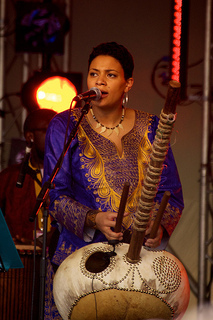
Sona Jobarteh
I’m super-duper excited to speak with Kora virtuoso Sona Jobarteh about practice on Friday. She’s amazing. Comes from a long line of Griot masters, a musical and cultural tradition from West Africa that is at least 700 years old. When Europe was at the tail-end of the Dark Ages, travelling Griot musicians were bringing news and ceremony throughout West Africa in the Mali empire.
Ms. Jobarteh has a beautiful voice, serious kora chops, and plays other instruments, too. If you saw the flick “Mandela: Long Walk to Freedom,” you heard her voice. Check out her music! I really like her previous album Motherland, and am just beginning to get into her most recent one, Fasiya.
Here’s a bit about Ms. Jobarteh from her web site :
Sona Jobarteh is the first female Kora virtuoso to come from a west African Griot family. Breaking away from tradition, she is a modern day pioneer in an ancient, male-dominated hereditary tradition that has been exclusively handed down from father to son for the past seven centuries.
The Kora is a 21 stringed African harp, and is one of the most important instruments belonging to the Manding peoples of West Africa. It can be found in Gambia, Senegal, Mali, Guinea and Guinea-Bissau. The kora, along with a handful of other instruments, belongs exclusively to the griot families of west Africa. Only those who are born into one of these families have the exclusive right to take up these instruments professionally. Sona, who was born into one of the five principal West African Griot families, has become the first in her long family line to break from tradition by taking up this instrument professionally as a female.
Don’t know what a kora is? It’s a 21-string harp from Western Africa, one of many venerable instruments from West Africa and important to life in the Malian empire for the last 700 years or more (info link). Here’s a picture:

A kora; a harp-lute used by Mandingo peoples in West Africa. (Photo credit: Wikipedia)
Ms. Jobarteh is living in the UK but is still closely tied to her ancestral home in Gambia, West Africa.
Related articles
 The mythic origins of the kora
 Introducing: Sona Jobarteh
 Rhythms of Africa
Do or Die
Rhythms of Africa
Do or Die Sadjo Sissokho – Afro mandinga kora player


March 4, 2014
2nd Place is the First Loser?
Of course I’m being sarcastic. This is a wonderful performance by 11-year-old Soo-Been Lee-Wieniawaski. The performance earned her 2nd place in the junior Yehudi Menuhin violin competition, which, I should be crystal clear, is an amazing accomplishment. Very impressive. As a general rule, solo violin isn’t my bag, but I very much enjoyed this performance. I hope “losing” didn’t affect Ms. Lee-Wieniawaski too badly.
That’s really the biggest risk with competition: the blow to the ego that often happens to everybody but the “winner.” With the right attitude, “losing” doesn’t matter, but that attitude–”failure” is a learning opportunity–is hard to come by, and not easily adopted. Losing or failing is especially damaging if you think musical talent is something you’re either born with or not. If you have that attitude, “losing,” and the pressure of trying to “win” can both be a fatal blow to life-long music-making.
My own philosophy, if it’s not clear yet, is that music shouldn’t be a competition, it’s a collaboration. That should carry extra weight because I’m a trumpeter. You’ve probably heard the joke that goes:
Question: How does one trumpet player greet another?”
Answer: They shake hands and each says, “Hi, I’m better than you.”
We’re human beings, so we’re gonna compete. It’s inevitable, especially when one of the routes to financial gain and artistic prestige can be a competition.

Kris Allen
The video above is from the finals of the junior division of the Yehudi Menuhin competition, a premier competition worldwide for violinists under 22. The winner of the junior division this year gets $7,000 and a 1-year loan of a fine Italian instrument courtesy of Florian Leonhard Fine Violins. The Senior 1st prize winner will receive US $10,000 and a 1-year loan of a fine Italian instrument courtesy of Christophe Landon Rare Violins. Who wouldn’t want that? Or consider that Kris Allen, the 2009 American Idol winner, received around $650,000, and the other 9 finalists get around $100,000 it’s easy to see why folks want to compete. Are they competing for art’s sake? Maybe, but not entirely.
Lots of people feel competition provides a giant horse-sized shot of motivation to practice long and hard. Some musicians thrive on that kind of competition, and seek it out. They’re motivated to train diligently for such competitions. Because it can be such a powerful motivator, and because these prizes are available, musical competition isn’t going away. Ever. And I don’t think it should.I love competition and am pretty competitive myself, whether it’s playing Scrabble, or my 14 years as a competitive swimmer. But music–at its rhythmically pulsing heart–is a collaboration, not a competition. What do you think?
Related articles
 Winners and Losers
 Winners Vs. Losers [Attitudes]
 Where has the British classical music talent gone?
 The Violin: How Versatile an Instrument Is It?
 How can musicians afford to buy such expensive violins?
 26 January – Stéphane Grappelli
 The Art of Yehudi Menuhin Episode 6
 Stolen Stradivarius Found By Milwaukee Police


February 14, 2014
Constrain Yourself: Creativity in Practice
One of the fascinating things I’ve discovered in the practice of master musicians from many genres of music is the role creativity plays in their practice. I’m convinced creativity is an essential component of practice, whether it’s inventing an exercise to work out some technique, or using songwriting to inspire you to do something over and over and over again, it’s the creative component that keeps you totally engaged in your practice. If you’re just running scales, or some other similarly mindless task, try injecting some creativity into the process. It’s a lot more fun.
Writers, musicians, visual artists, or any other person who relies on creativity for their well-being–whether spiritual, mental, or monetary–knows that ideas like

Jack White
inspiration, talent, or some other idea that makes us believe that things should be “easy,” are often more hindrance than help. It’s work. And that’s not a bad thing.
What’s great about hearing Jack White speak about his own process is learning about the constraints he puts on himself. There is also this gem about why constraints are so important, and how surfeit can suck the juice out of creativity:
Deadlines and things make you creative. But opportunity, and telling yourself, “Oh, you’ve got all the time in the world, all the money in the world, you’ve got all the colors in the palette you want; anything you want…. That just kills creativity.
If you’re overwhelmed by being “creative,” come up with severe constraints. If improvising is daunting, use only 3 notes. Heck, use just one note and focus on the rhythm. If there’s too much to practice, forget about everything, and focus on just one thing. One thing. Practice that. Tomorrow, choose another. Or choose the same thing and make it better still. ||:lather, rinse, repeat:||.
Want to learn more about creative music practice? It’s in the forthcoming book. Sign up to get an e-mail with a discount code when The Practice of Practice is published (June, 2014). To learn more about the book, check out a sample from The Practice of Practice.
Related articles
 How to Use Beatmaker Software to Make Your Own Music Beats
Embrace Constraints
How to Use Beatmaker Software to Make Your Own Music Beats
Embrace Constraints 6 Ways to Be Creative Under Pressure
 Musician, designer and artist Jack Vanzet is a man of many talents


February 6, 2014
Place and Practice: Singing Into a Waterfall
Where you practice matters. For example, singing at the top of your lungs into a waterfall might be the perfect place to practice if you want to become a great Pansori singer.
Intangible Asset No. 82 is a wonderful documentary that tells the story of Australian drummer Simon Barker’s quest to meet Korean shaman, master drummer, and grand-master improviser Kim Seok-Chul. During Barker’s journey he meets some interesting musicians, including Bae Il-Dong, a Pansori singer who practiced for seven years singing into a waterfall, living in a hut he built himself. Intrigued? In this preview, Bae Il-Dong will be the second person you see and hear. He’s hard to miss.
Intangible Asset No. 82 is on Netflix.
Related articles
 A Different Drummer
 50 Highly Anticipated Films At The 2014 Sundance Film Festival
 How to Learn Korean from K-Pop Songs
 Ten Most Influential Korean Movies


February 3, 2014
Getting Loopy: Elijah Aaron covers TLC’s “No Scrubs”
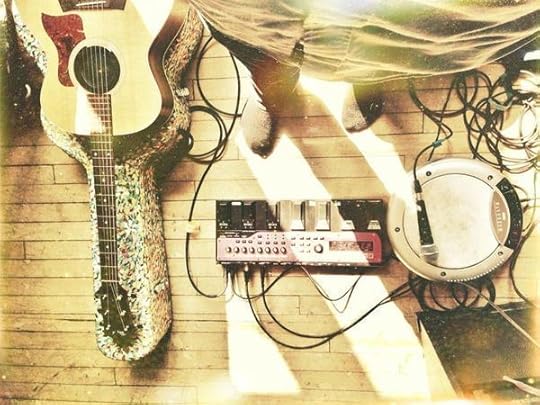 Loop pedals are such a great way to have fun while you practice, no matter what instrument you play. You hone your rhythmic skills, you focus on a short snippet of music at time, you can layer these snippets to your heart’s content, and best of all, you receive immediate feedback. I’ve been using a BOSS RC30, for a few years now, and love it.
Here’s Elijah Aaron showing us how it’s done right, with a cover of TLC’s No Scrubs. He’s using a lot of cool gear: an udu, a triangle, a djembe-ish drum, hi-hat, fiddle, his voice, and the gear that makes the looping possible, a BOSS RC50 Loop Station (capable of 3 independent loops). Good stuff!
Related articles
 Lives Changed After Hearing ‘Can You Hear That’?
 Going Loopy
 Top 5 Loop Station covers


January 25, 2014
Practicing Performance: How to Beat Stage Fright
Most professional musicians I’ve spoken with about practice believe that the performance is one of many forms of practice. Some use performance specifically as their only practice. For those who practice alone or are shy, a good performance requires skills that aren’t honed in the practice room. You’ve got to just get out there, do it, and learn from it. This fun TED talk by Joe Kowan is a perfect example of practicing performance, and using creativity to enhance practice.
Practicing performance is a chapter in my next book. If you want more details about practicing performance, using creativity in practice, and many other useful practice strategies pros use and research has tested, my next book, The Practice of Practice, will be done in March and out in April. It’s right around 250 pages right now, and it’s a good read, if I do say so myself. You can shoot me an e-mail to get a note when The Practice of Practice is available. click here
Related articles
 Embrace the Stage Fright
 Coping with Presentation Anxiety & “Stage Fright”
 Got Stage Fright? Get Excited




