
Jonathan Harnum's Blog, page 46
September 27, 2014
Tricky Sam Nanton: It Don’t Mean a Thing
Check out Tricky Sam Nanton's solo in the Duke Ellington band. He had a great vocal sound on the trombone that nobody has equalled since. His solo starts at 1:11. A short clip from some of the greatest pop musicians of the 20th century in the US. Info about the tune and some of the musicians below:
“It Don’t Mean a Thing (If It Ain’t Got That Swing)” is a 1931 composition by Duke Ellington with lyrics by Irving Mills, now accepted as a jazz standard. The music was written and arranged by Ellington in August 1931 during intermissions at Chicago’s Lincoln Tavern and was first recorded by Ellington and his orchestra for Brunswick Records (Br 6265) on February 2, 1932. Ivie Anderson sang the vocal and trombonist Joe Nanton and alto saxophonist Johnny Hodges played the instrumental solos. The title was based on the oft stated credo of Ellington’s former trumpeter Bubber Miley, who was dying of tuberculosis. The song became famous, Ellington wrote, “as the expression of a sentiment which prevailed among jazz musicians at the time.” Probably the first song to use the phrase “swing” in the title, it introduced the term into everyday language and presaged the Swing Era by three years. The Ellington band played the song continuously over the years and recorded it numerous times, most often with trumpeter Ray Nance as vocalist.
___________________________________
Back-To-School Specials On All Formats:
________________________________________________
Related articles
 Duke Ellington, The Wise Musician, and Cootie Williams
 The Best Thing I Ever Created: Derek Sivers
 Harlem’s Duke Ellington, Photograph By Lee Tanner (video)
 Where was jazz created?
 “The Harlem Footwarmers” And Duke Ellington
 Duke Ellington: Still Swingin’ in the 1950s (Review)
 Duke Ellington and his Famous Orchestra Stormy Weather 1940


September 25, 2014
If You Can’t Sing It, You Can’t Play It: Voice Lesson
One of the best tools for your practice is your voice. Faced with a tough part, if you sing it, you’ll be able to play it better because you’ll be able to hear it better. Singing the passage allows you to “own” it in a deeper way than by pushing buttons or keys on your instrument. This is just one of many strategies you’ll find in The Practice of Practice.
You don’t have to be a great singer to benefit from this kind of practice, but here’s a couple good videos on vocal tone production and breathing. If you’re a wind player, the breathing video is something you should know (and do). Make singing and chanting rhythms for tough sections part of your daily practice. It’s one of the best ways to get better faster.
___________________________________
Back-To-School Specials On All Formats:
________________________________________________
Related articles
 17 Singing Tips and Tools to Improve Your Voice
 Adorable Little Girl Singing ‘Frozen’ Song Gets SO ANGRY When Mom Laughs
 How To Improve Your Singing
 Sing a song!

September 23, 2014
Carnatic Sax, Mental Practice, and Amazing Drumming
Check out these Indian musicians (the sax playing starts around 13 minutes in, after the drum battle/conversation):
There is no movement without music. In some cultures there aren’t separate words for music and dance. Using the body to keep track, to groove, and to make better music is something all musicians do. The hand gestures you see in this video are one of the many ways Indian musicians manifest the music physically. Movement is also a great form of mental practice that great musicians in all traditions do away from the instrument. You should, too.
Here is some more Carnatic saxophone and bansuri (flute) playing:
I interviewed musicians from many musical traditions to learn about how they practice for the book The Practice of Practice. Learn more about how musicians in all traditions get better in the book.
___________________________________
Back-To-School Specials On All Formats:
________________________________________________
Related articles
 Together: Saxophone & Bansuri
 ‘Music is my love’
 When West meets East
 How Moon Hooch Helped Me Love the Saxophone Again
 6 Jazz Instruments For Beginners

September 21, 2014
The Fractal Nature of Goals and Music Practice
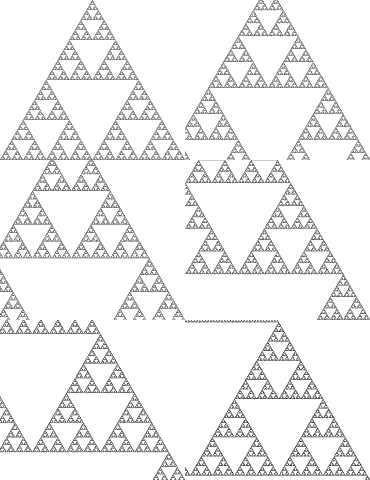
Animated Sierpinsky Fractal
Setting goals is one of the most powerful things you can do to get better at music or anything else. Some people write them down, some just have a vague idea of what they are, but we all have goals for nearly everything we do. Goals are covered in more detail in The Practice of Practice, but here’s a quick run-down.
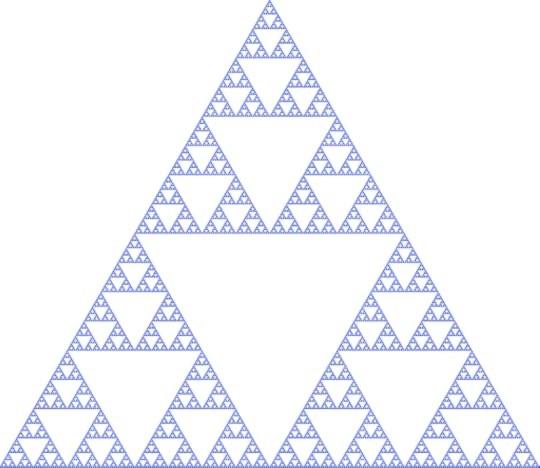
A Sierpinsky Triangle
Goals are like the cool animated GIF of a Sierpinsky fractal above: there are goals within goals within goals. It’s goals all the way down. The usual advice is to break goals down into long-term, mid-term, and short-term goals, but you can and should dive deeper, and consider smaller goals. Writing down long-term goals is a good practice, one you should revisit at least once a year. Mid-term goals are also good to have. For me those are from one year to a couple months away; short-term goals are usually within a month or 6 weeks. All of these goals are great, but the further away they are, the more abstract they become. The shorter-term goals become more and more concrete, there is actually something to do.
Goals that require immediate action are the most powerful. I call them immediate-goals, micro-goals, and nano-goals. Immediate goals are your goals for one practice session. Micro goals are your goals for a passage or a small section you’re trying to learn. A nano goal is one repetition.
The power of goals is their ability to focus your efforts with laser precision. If you can only spare 20 minutes of practice a day or less, spending some time on goals at every level of the fractal is a powerful tool. Writing them out will help, especially at first if you’re not used to thinking this way, but it’s not necessary. In fact, once you’ve gotten used to thinking about goals like this, skip writing out your goals, and spend the extra time on playing.
Related articles
 Goals as Fractals and Guerrilla Practice
 Sierpinski
 A fractal is a mathematical set
 Math Monday: Sierpinski tetrahedron
 The Sierpinski triangle
 David Foster Wallace, mathematician

September 19, 2014
A Growly Clarinet: Gypsy-style “Caravan”
Just this:
Charles Frechette (g), Giacomo Smith (cl), Damien Levasseur (g) at the Gypsy Jazz Festival in Samois sur Seine, 2012
The growly tone is produced by growling in the back of your throat while playing, at least that’s how I do it on trumpet. Great sound! There’s an absolutely wonderful version of Cootie Williams (trumpet) doing this Juan Tizol-penned tune.

Juan Tizol wrote Caravan. He played valve trombone in Duke Ellington’s orchestra.
Oh, and this:
___________________________________
Back-To-School Specials On All Formats:
________________________________________________
Related articles
 Physics, Trumpets, Innovation, and Why the Heck Your Horn Plays Out of Tune (it’s not you)
 Album of the Week: “It’s a Good Day” from Cyrille Aimée

September 17, 2014
The Percussion Instruments at the End of Your Wrist

Not long ago I posted a clip of John Coltrane practicing with a drummer (possibly Elvin Jones) and Elvin was playing his lap, and clapping. Using your hands, body, and voice to figure out and “own” a tough rhythm is just one of many strategies pros use to get better. Find more strategies and mindsets and other things pros use to get better in The Practice of Practice.
Another post introduced the importance of rhythmic skill, and how using a percussion instrument at the same time as your other instrument can add greater depth and rhythm to your ability on your main instrument. The video below combines all of that wonderfully in an epic a capella patty cake that is a promo, shot in one take (!) with Sony’s Mixia HD movie camera..
Here are links to the These are the musicians in this video: Sam Tsui, Alex G, Kurt Schneider and Alyson Stoner.
___________________________________
Back-To-School Specials On All Formats:
________________________________________________


September 15, 2014
10 Rules for Students and Teachers
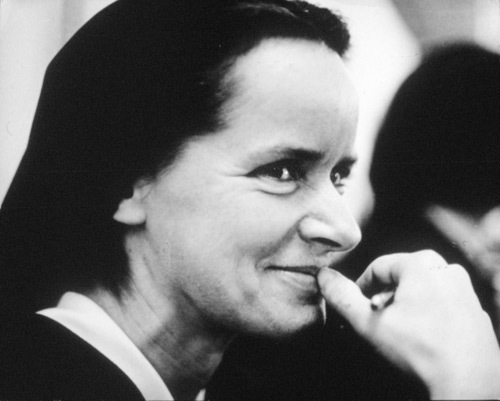
Sister Mary Corita (Corita Kent), artist
Sometimes attributed to composer John Cage, these rules were actually created by Sister Corita Kent, in 1967-68, and later taken up by the art department of LA’s Immaculate Heart Convent where Sister Corita went to school.
She’s got a wonderful book out called, Learning by Heart: Teachings to Free the Creative Spirit.
Maybe the list is attributed to composer John Cage because he’s quoted in rule #10…. Here they are:
_____________________________________
1: Find a place you trust and then try trusting it a while.
2: General duties of a student: pull everything out of your teacher. Pull everything out of your fellow students.
3: General duties of a teacher: pull everything out of your students.
4: Consider everything an experiment.
5: Be self disciplined. This means finding someone wise or smart and choosing to follow them. To be disciplined is to follow in a good way. To be self disciplined is to follow in a better way.
6: Nothing is a mistake. There’s no win and no fail. There is only make.
7: The only rule is work. If you work, it will lead to something. It’s the people who do all of the work all the time who eventually catch on to things.
8: Don’t try to create and analyse at the same time. They’re different processes. (aside: or, as Charlie Parker said, “Yeah, practice your ass off. But when you get up to play, forget all that and just wail.”)
9: Ber happy whenever you can manage it. Enjoy yourself. It’s lighter than you think.
10: “We’re breaking all of the rules. Even our own rules. And how do we do that? By leaving plenty of room for X quantities.” John Cage.
Helpful Hints: Always be around. Come or go to everything. Always go to classes. Read anything yoiu can get your hands on. Look at movies carefully, often. Save everything–it might come in handy later. There should be new rules next week.
John Cage’s beautiful piano piece, Dream (1948)
performed by Stephen Drury
_____________________________________________________
Below is another performance by John Cage himself. A classic in which he breaks the “rules,” a trait he was famous for. He was an excellent writer, too. Find his books and music here. Hope you enjoy the bonus Winston cigarette ad at the start of the video.
John Cage Performs Water Walk


September 13, 2014
Adopt a Drum: Practicing Rhythm

The bendir, a frame drum from North Africa (Photo credit: Wikipedia)
Rhythm is one of the most fundamental musical elements, in my opinion, one of the most important and most powerful. Unless we’re a drummer, our focus on rhythm often is overshadowed by other demands of the instrument or voice: tone production, fingering, intonation, and a host of other important things to think about. The metronome will help you with precision, but I think there’s a better way to really get deep into a rhythmic groove, and that’s by playing a percussion instrument. There are SO many to choose from. Learn more in Chapter 34: Rhythmning, in The Practice of Practice. Below are three of my favorite rhythm instruments I use in practice.
I’ve found that focusing exclusively on rhythm (though there are tone and technique aspects to rhythmic instruments, too!), helps my overall rhythm. Plus, it’s fun to learn to play a new instrument. The first, like the Farmer foot pedals, don’t take a whole lot of technique, but when you combine foot percussion with playing your main instrument, it opens up a whole new realm of independent movement that I’ve found to be a big help in both my guitar and trumpet playing. Maybe I”ll post a video later of how I use these. For now, check ‘em out:
Farmer Downbeat Pedal:
here’s an extreme, musical, and super-cool use of pedals by drummer Marco Iannetta:
_____________________
Djembe:
Djembe master Sidiki Dembele spoke with me about his experience of practice for The Practice of Practice. Here he is in a djembe duet (Sidiki plays first). For a most excellent app to practice djembe, check out Piti Piti Pa.
To play djembe well you have to learn the 3 sounds: slap, tone, and bass. Sounds easy, doesn’t it? Like any instrument, to get a good sound takes practice, but let me tell you, it’s worth it. Djembe is a super fun instrument. Below, another djembe master, M’Bemba Bangoura, teaches the three sounds of the djembe. Get a djembe here.
_____________________
Conga:
Another fantastic instrument that is fairly easy to play but, like everything, takes lots of study to master. You can benefit from any of these instruments right away, because their basic techniques are easy to do at a basic level, and then you can focus deeply on the rhythmic aspects. I love playing conga along with masters like Tito Puente and his congueros Mongo Santamaria, Ray Baretto, and others, like master conguero Carlos “Patato” Valdez. Below is another modern master, virtuoso Giovanni Hidalgo. Amazing! Below that are a few excellent beginning conga videos on how to play the tumbao. Get a conga here (don’t choose the “mini”).
___________________________________
Back-To-School Specials On All Formats:
________________________________________________
Related articles
 Cross-Training
 African Drums: Djembe
 Life Is Rhythm: Beat A Drum To Heal Your Health
 One Road to Improv: the Tongue Drum
 Coming out of Congo Square – Bamboula 2000
 The miracle of Latin jazz
 “American Sabor” – traveling Smithsonian exhibit explores Latino influence in American music

September 11, 2014
Motivation to Practice: Go With the Flow

English: Alberto Guerrero (standing) with Glenn Gould, circa 1945.
There’s a lot to like about the video of pianist Glenn Gould below. I’ve highlighted three things that happen in the video (see clips below).
As the great Robert Krulwich (of Radiolab and NPR) pointed out in a recent post, Gould appears to be deep in a Flow state, practicing Bach’s Partita #2.
For me, achieving Flow is one of the biggest motivators to continuing to practice, because it’s a transcendent experience and feels wonderful. Part 2 (of 6) in The Practice of Practice covers helpful aspects of motivation, including Flow, in greater detail. Some players, like drummer Allison Miller, told me that sometimes they’ll go into a practice session with no other goal beyond getting into that Flow state, or a meditative state.
Here’s what Mr. Krulwich said, and as to the last clause, I couldn’t agree more :
How one gets there — that’s still a mystery. Practice is important. Tenacity matters. Talent helps. When you find your “flow,” your brain changes. Dopamine and noradrenaline kick in, GABA neurons get suppressed; sex, hunger, thirst matter less, you are free to play more deeply with stream-of-conscious associations; you are chemically released and can now roam far and wide. Yes, you have no idea where you are or how this is happening; but that it’s happening must be one of the most wonderful experiences ever.
Another gem from this video is at 1:36 (cued up below), when Gould shouts, “Na!” at a mistake. You can see him bear down, sing more precisely, and practice that little flubbed passage again. It’s a golden practice moment, and a bit hard to catch, because it’s an error that only an expert in this music can hear.
Gould was infamous for being difficult to record because he usually vocalized when playing. It’s another trait most master musicians (no matter their instrument) do when playing: Oscar Peterson is another pianist who vocalizes comes immediately to mind.Singing is one of many mental practice strategies that pros in all genres of music use, covered in Part 6 of The Practice of Practice, chapter 31: Going Mental. Check Gould out at 1:59 when he actually gets up from the piano to sing a tricky bit of the Bach.
Finally, there is another important aspect of practice that’s often overlooked: the role of a teacher. Alberto Guerrero was one of Gould’s teachers (picured above), and it was Guerrero who taught Gould a simple practice technique, called “finger tapping,” that another of his students explains below. Learning on your own is great, and everybody does it, but a teacher can shave years of practice off with just a few tips. The different kinds of teachers for different stages of ability are covered in Chapter 14: Hot for Teacher, in The Practice of Practice.
___________________________________
Back-To-School Specials On All Formats:
________________________________________________
Related articles
 Glenn Gould’s Five Most-Watched YouTube Videos
 A gentle genius (just don’t ask him about Glenn Gould)
 The Art of Glenn Gould Episode 1

September 9, 2014
Yo-Yo Ma: “So whatever you practice for…that fails is all right, because we have a greater purpose.”

Yo-Yo Ma is a world treasure, and his perspective, playfulness, artistry, and educational inclinations make him one of my absolute favorite musicians. His Silk Road Project creates some of the most interesting musical collaborations I’ve ever heard. Check out the video below. I think you’ll agree. Below the video is a link to a wonderful interview with Yo-Yo Ma in which he talks about a wide range of topics, including–you guessed it–practice.
Discovering a new source of discussions with masters of their craft (musical or otherwise) puts me in such a good mood. These are superbly edited, with beautiful musical garnishes. Here is the link to the interview with Yo-Yo Ma.
MR. MA: So whatever you practice for on the engineering side that fails is all right, because we have a greater purpose. The greater purpose is that we’re communing together and we want this moment to be really special for all of us. Because otherwise, why bother to have come at all? It’s not about proving anything. It’s about sharing something.
and
MR. MA: You know, I remember, as a five-year-old — at the age when people want to, you know, say, when I grow up I want to — do whatever. I thought that what I really wanted to do was to understand.
I can’t wait to explore Ms. Tippet’s other discussions (over 600!) with other guests, like Bobby McFerrin, Rosanne Cash, Indigo Girls: Amy Ray and Emily Saliers, and a whole host of other topics, artists, thinkers, and do-ers.
___________________________________
Back-To-School Specials On All Formats:
________________________________________________
Filed under: How
Related articles
 Musical Fun with Yo-Yo Ma
 Joyful McFerrin!
 Yo-Yo Ma
 Yo-Yo Ma and Kathryn Stott’s 30-Year Tango


