
Jonathan Harnum's Blog, page 43
June 11, 2015
Boost Your Music Skills: Practice Book 81% Off
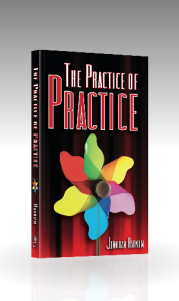
One Year Anniversary Sale:
The Practice of Practice
A quick shoutout for the one-year-anniversary discount on The Practice of Practice (Kindle edition) running for a week, from Thursday, June 11 to Thursday June 18, 2015. The discount starts at 81% ($1.99), rising in price every 32 hours until it’s back at full price. USA and UK only. Schedule below.
Learn more
Reviews
Buy One
________________________________
1
June 11 at 8:00 AM (PST)
32h
$1.99
81%
2
June 12 at 4:00 PM (PST)
32h
$2.99
71%
3
June 14 at 12:00 AM (PST)
32h
$3.99
61%
4
June 15 at 8:00 AM (PST)
32h
$4.99
51%
5
June 16 at 4:00 PM (PST)
32h
$5.99
41%
End
June 18 at 12:00 AM (PST)
Original list price $9.99


June 8, 2015
In Praise of Never Being Good Enough
“The instrument is always the boss. I don’t care how much you play on the instrument, it always surpasses what you can do on it. Even if you live to be a thousand years old, you still find yourself behind. The best way to fight it is to practice at every opportunity.”
Dizzy Gillespie
[image error]
Dizzy Gillespie, 2 December 1955, potrait (Photo credit: Wikipedia)
Music is endless, and there’s always more to practice, more to learn, more to do. The limitlessness can be intimidating, especially to beginners, or to those stuck in the “conscious incompetence” phase (one of four phases of musicianship/practice described in The Practice of Practice). But once you realize the fact, and make peace with it, having endless horizons to explore is liberating. Exciting, even. Then you just have to get started.
And keep going. World-famous cellist Pablo Casals, when an interviewer asked why–at age 90–he still practiced, Casals said, “I think I’m making progress.”
One way to make progress is short bursts of practice. As a kid, Dizzy was known to carry his horn with him everywhere he went. Jimi Hendrix took his axe everywhere, too, including his bed (he slept with it), and in the bathroom.
A great way to get in a quick burst of practice is to always have your instrument nearby. Quit wasting time online (well, except for this blog, right?), and get in a two-minute burst of practice.
In The Practice of Practice I call it “Guerrilla Practice.” Learn the details (and dozens more techniques for getting better faster) in The Practice of Practice.
Here are a few of my favorite clips of the Master in action.
An astounding 35 minutes from 1966.
Tracks:
Introduction by Humphrey Lyttelton
And Then She Stopped, 2:05
Tin Tin Deo, 7:23
Mmm Hmm, 16:10
No More Blues (Chega de Saudade), 21:20
Dizzy’s Blues, 32:55
Personnel: Dizzy Gillespie, trumpet, vocal; James Moody, tenor sax, alto sax, flute; Kenny Barron, piano; Chris White, acoustic double bass; Rudy Collins, drums.
____________________________________________
Check out Dizzy’s improv at 3:30
Dizzy Gillespie, trumpet; Barney Wilen, Stan Getz, tenor sax; Andy Laverne, piano; Rodney Jones, guitar; Mike Richmond, acoustic double bass; Mickey Roker, Billy Hart, drums, percussion at the Grand Parade du Jazz, Nice, July 14, 1978.
On the second segement Dizzy is accompanied by Hank Jones, Milt Hinton, J.C. Heard
____________________________________________
Dizzy Gillespie leads a powerful all-star sextet including Jon Faddis (also playing a similar upswept trumpet), vibraphonist Milt Jackson, bassist Ray Brown, pianist Monty Alexander, and drummerJimmie Smith in this appearance at the 1977 Montreux Jazz Festival, most of which was issued on the Pablo album Montreux ’77.


May 14, 2015
A Case for Learning by Ear: Young Jazz Wizard Joey Alexander
Joey Alexander is 11 in the video below, and he displays an artistry and control and musicality that few are able to achieve, no matter what their age. In the jazz tradition, he learned by ear, and listening to him talk about who he likes, you know he likes the heavies, and has absorbed them.
In school, learning by ear is usually not the way we learn music, and it’s too bad. Music is a language, it uses similar areas of the brain, and communicates emotion and feeling. Learning music the way we learn language, through imitation and experimentation, makes a lot of sense. He’s got some great advice and a champion’s attitude, too.
Listen to Joey Alexander to hear and see how powerful learning by ear can be.


April 15, 2015
Cover Yourself: “Creep” and “All About That Bass.” Covers by Post Modern Jukebox
Learning a tune by someone else is the 2nd oldest way to practice (the oldest being to just write your own thing). Here’s a fantastic cover of Radiohead’s Creep, done by Post Modern Jukebox. Below that, an equally superb cover of All About That Bass.


March 30, 2015
Zany Written Musical Instructions: “Shouting-in-the-pub Voice,” and Crazier…
Most musical directions are written in Italian. Percy Grainger and others began using their native language (gasp! the sacrilege!), because, why wouldn’t you? It’s what Italian composers did in the way-back because the musicians reading it were, well, Italian.
In addition to PDQ Bach, there are some other rather hilarious written instructions in written music. This post is a reblog of just such a zany collection, compiled by Kyle Macdonald over at ClassicFM. Stick with it ’til the end and the hilarious animated GIF acting out one such instruction.
A selection of our favourite composer performance directions, requests and musings. Just don’t ask us to play them.
Extremes
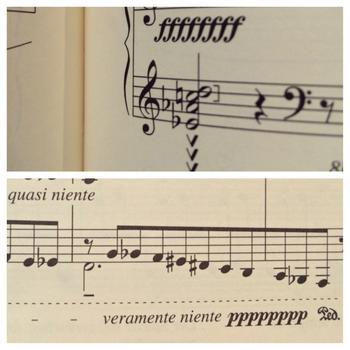
György Ligeti experiments with extreme volumes – aka “shouting-in-the-pub voice” and “shouldn’t-really-be-talking-in-the-library voice” – in his Etudes for piano.
image: http://i.imgur.com/gRMXOd2.jpg?1
Leggierissimo e legatissimo
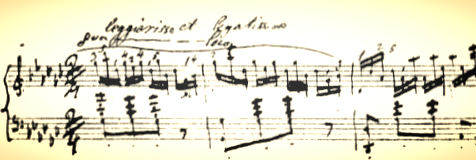
The great Romantic pianist/composer Chopin annotated his score leggierissimo e legatissimo (extremely light and delicate with a very smooth effect). Here’s a thought Friedrich, if you’re so keen on your piece being played light and smooth, how about re-evaluating your choice of SIX FLATS.
image: http://i.imgur.com/4qzAF4Z.jpg?1
Tempo
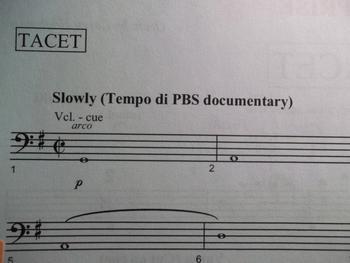
In the 1980s, Karajan was a particular fan of Tempo di Merchant Ivory.
image: http://i.imgur.com/gzb2UQt.jpg?1
 Erik Satie: Limp Preludes (for a dog)
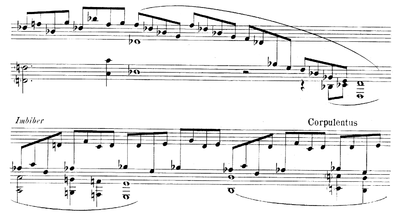
No survey of the bizarre in classical music is complete without a mention of this Parisian. In the field of directions, his offer some particular highlights, including Imbibet (drunken) and Corpulentus (Corpulent). You provide the wine, we’ll bring the pies.
image: http://i.imgur.com/W9yKnUw.png?1
More Drinking
While we’re on the subject, perhaps the finale involves waking up, head aching, next to a half-eaten kebab.
image: http://i.imgur.com/s4fDrFW.jpg?1

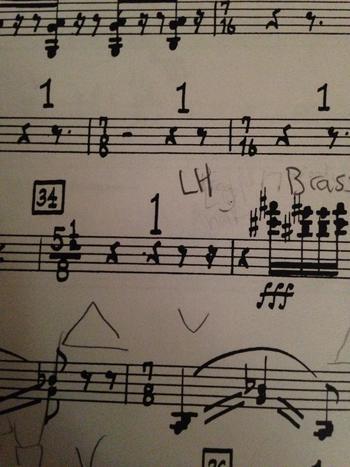
Counting to 5.5
Why this wasn’t notated in 11/16 will no doubt go down as one of the great mysteries of all music.
image: http://i.imgur.com/YJMxnJQ.jpg?1
Don’t you mean tactus-box?
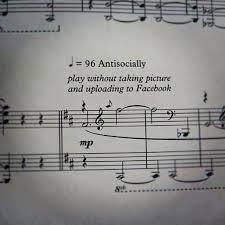
Facebook dislike
The wifi’s pretty dodgy in the orchestra pit anyway.
image: http://i.imgur.com/JqRoGDu.jpg
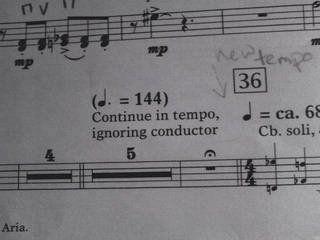
 The maligned Maestro
Also found at the top of every viola score (jokes).
image: http://i.imgur.com/NK76cq6.jpg
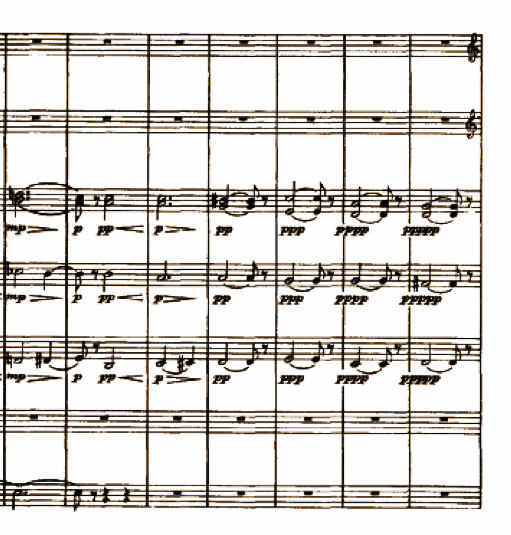
 How soft, Pyotr Ilyich?
Yep, even back in 1893 Tchaik was at it. It’s probably one of the most iconic performance directions ever, in one of the most devastating moments in symphonic music. Shh.
image: http://i.imgur.com/jv17RlF.png?1
 Tempi
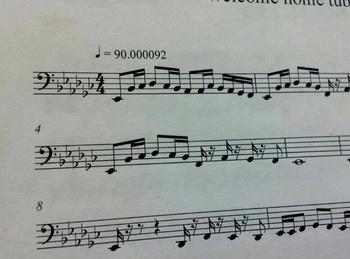
Tempi
When precision is important. Feel free to calculate the rallentando on the 3rd page. It’s dN/dt = -Nλ
image: http://i.imgur.com/53dduDS.jpg?1
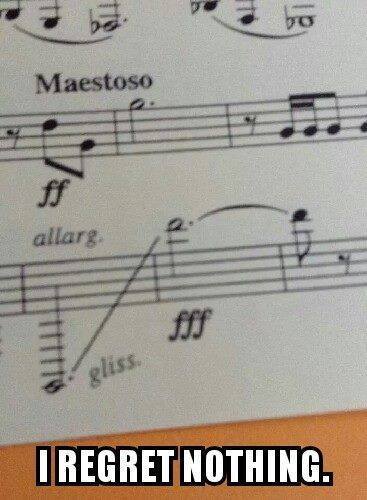
 Sometime you’ve just got to go for it…
image: http://i.imgur.com/l760hHd.jpg
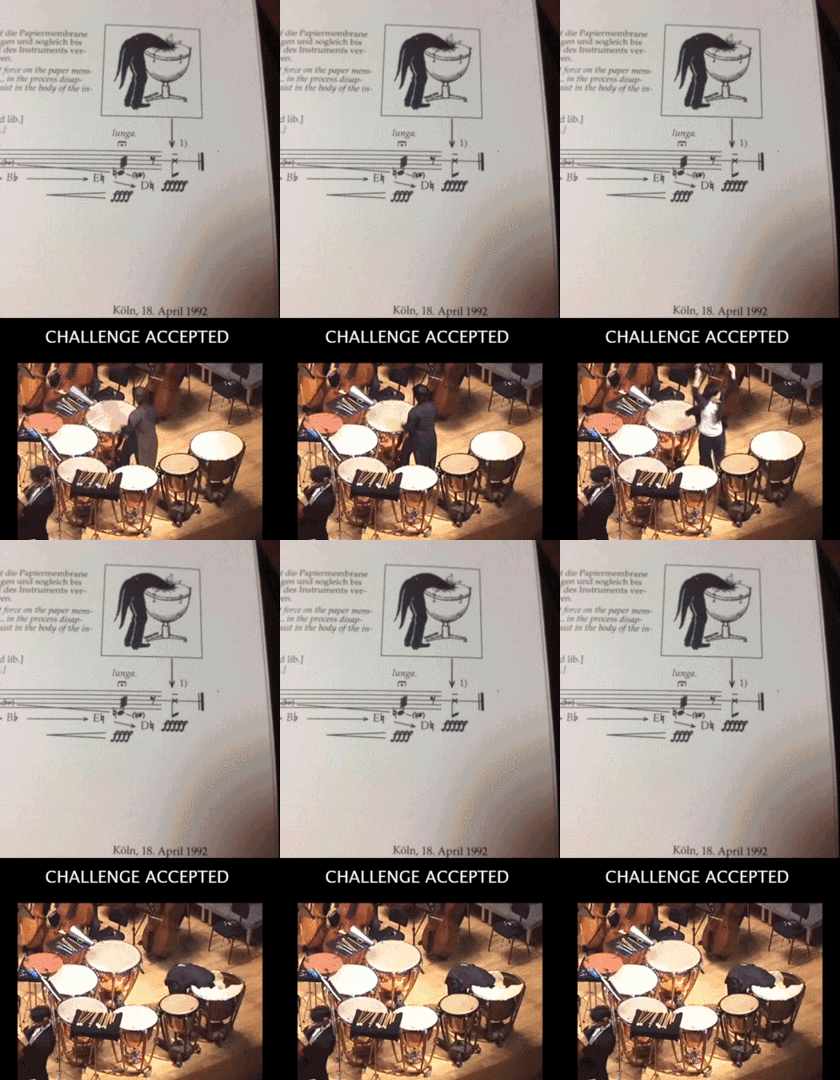
 And for the Finale…
image: http://i.imgur.com/a5tcfpz.gif
Read more at http://www.classicfm.com/discover/music/bizarre-performance-directions/#OlyWtmwuEd4gMsQ8.99


March 27, 2015
Sea Shanties and Rock: The Case for Listening Widely
Do you hold prejudices against certain music? Country, folk, rock, classical, or whatever?
Rest assured that labeling is just a form of marketing. Music is music. You know the good stuff when you hear it. Musicians who have been pigeonholed by marketers and record labels are all of them eclectic in their listening habits.
Charlie Parker (and many others) didn’t like the label “jazz,” because, “It’s just music, man.”
Here’s how a sea chanty influenced The Who…. I encourage you to listen widely and to challenge your stereotypes. Can you listen (all the way through) to some kind of music you “hate?” Try to find something useful within the unagreeable sounds: figure out the key, or the melody, or some other musical component. More importantly, ask yourself why you hate it. Make your case…..
A case for the point of eclecticism: The Who sings part of an a capella sea chanty before rocking out.


March 24, 2015
Cover Yourself: Victor Wooten, Young Derek Trucks & Joey Defrancesco Cover Stevie Wonder
Been thinking a lot about covering other musicians as practice. It’s not only one of the oldest ways to practice, it’s one of the best ways to practice. Don’t practice scales: practice imitating musicians you love.
Here’s a 15-year old stellar version of Stevie Wonder’s I Wish, featuring a young Derek Trucks, as well as the incredible skills of Victor Wooten and Joey Defrancesco. A recent note from a reader reminded me of Wooten’s entertaining Castaneda-esque book on music practice, The Music Lesson. I did a review of it some years ago here. It’s worth reading. Check it out!


March 19, 2015
Cookie Monster: Life Coach
If you can’t afford a “real” life coach to help you with your practice, I offer you Cookie Monster.


March 9, 2015
What Your Instrument Thinks (or, Frustration is Normal)

It’s normal to feel frustrated, especially if you’re pushing yourself. If you’re feeling the kind of rage this guy is feeling, it might be you’re pushing yourself too hard. He did the right thing by taking a break. He’d be wise to take a good long look at exactly what was making him mad, and why. Finding a solution or at least some answers to those questions will go a long way toward a more patient practice session, resulting in more progress, and most importantly, more enjoyment. Good luck!


March 7, 2015
Chick Corea: The Secret to Improving Your Rhythm & Time, Rhythmic Displacement, Not Getting Lost in the Form
Bobby Mc Ferrin and Chick Corea. New Orleans Jazz Fest 2008 (Photo credit: Wikipedia)
Some lessons from the master. Find more and subscribe over at Chick Corea’s website.
Find yourself getting lost in the form when you improvise? Corea and Stanley Clarke give you a tip:
And a tip on rhythmic displacement
Related articles
 Herbie Hancock and Chick Corea to tour together


![[image error]](http://commons.wikipedia.org/wiki/File:Dizzy_Gillespie_potrait.jpg)
![[image error]](http://commons.wikipedia.org/wiki/File:Bobby_McFerrin_and_Chick_Corea.jpg)