Amy Julia Becker's Blog, page 33
October 12, 2023
Never Enough
More with Amy Julia:
Addressing our Mental Health CrisisDevelop Your Spirituality by Starting SmallDomestic MonasteryFriday Favorites and AJB RecommendsSubscribe to my newsletter to receive regular updates and news. You can also follow me on Facebook , Instagram , Twitter , Pinterest , and YouTube , and you can subscribe to my Love Is Stronger Than Fear podcast on your favorite podcast platform.
The post Never Enough appeared first on Amy Julia Becker.


October 9, 2023
Penny in Her Own Words: Working at The Po Cafe
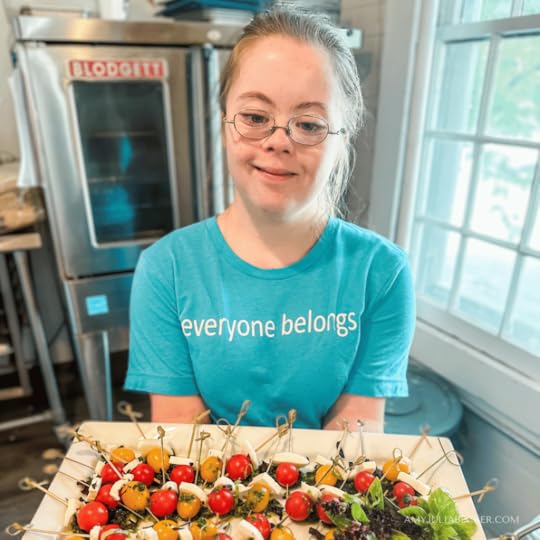
Penny had a chance to work at a local cafe for a few weeks in August and on Saturdays in September. She loved every minute of it (and hopes she will be able to work there again someday!) Here are her own thoughts on having a job and working:
Can you describe a typical day of work for you?
I wake up at 8 in the morning. For work you need to wear a T-shirt and jeans with sneakers. I help with whatever they need me to do like filling cups of dressings for salad,or filling sides of ketchup.
What has been the most challenging part of work so far?
If there is no customers or it’s very slow it’s hard to figure out what I am supposed to do.
What has been the most rewarding?
If you mean what has been the most exciting or what has been the most fun I would have to say filling cups of anything.
How does it feel to have a job?
It feels more grown up then what I am used to. I am going into my senior year so it feels good to have a job and to become more mature.
What are some things you are learning by having a job?
I am learning to communicate,asking what I could do next. I am also learning how to serve our customers.
Some people think it is too challenging for people with Down syndrome to have a job. What would you want them to understand?
They would need to understand the value of communication,the commitment to the job and speaking up if you need help.
More with Amy Julia:
Penny In Her Own WordsPenny in Her Own Words: What I Thought About Netflix’s Down for LovePenny Got a JobSubscribe to my newsletter to receive regular updates and news. You can also follow me on Facebook , Instagram , Twitter , Pinterest , and YouTube , and you can subscribe to my Love Is Stronger Than Fear podcast on your favorite podcast platform.
The post Penny in Her Own Words: Working at The Po Cafe appeared first on Amy Julia Becker.
October 8, 2023
Esteem Without Ego
“I’m really good at drawing.” It’s a very matter-of-fact statement made by Emily, a participant in the show Down for Love. She knows that this is something true about herself, something that she can do with confidence. She isn’t bragging. She isn’t looking for a compliment. She isn’t in any way trying to prove her superiority or even compare herself to people around her. She is just stating a truth about herself in the context of a life that is filled with both limits and gifts, challenges and opportunities, vulnerabilities and strengths. It struck me at that moment that she had high self-esteem without a corresponding ego.
Watching Down for Love helped me realize that there’s beauty in a lack of ego alongside a corresponding sense of esteem. Something deeply good and true emerges from humans who have esteem for themselves without ego. Who are able to love themselves as they love others.
Penny is also able to talk with straightforward candor about her abilities and her challenges. She can say that she needs modifications on some school assignments and that she is a good writer. She knows that she has challenges with change and that she is great at making a plan. And, as I’ve probably told you before, she also is able to laugh at herself when she makes a mistake, or when one of us points out a personality quirk. She has esteem without ego.
The late preacher and pastor Tim Keller said more than once that the gospel of Jesus doesn’t ask us to think less of ourselves. But when we are walking in the way of Jesus we will think of ourselves less. Perhaps that’s another way to say that when we find ourselves in Jesus, we will lose our self-protective ego without losing our self-esteem.
I’d like to develop a high sense of esteem for myself—and those around me—without an inflated ego. And I suspect my daughter, and the characters of Down for Love, are helping me to imagine what that would be like.
More with Amy Julia:
S7 E3 | Netflix’s Down for Love with Robyn PatersonPenny in Her Own Words: What I Thought About Netflix’s Down for LoveDown Syndrome and a Lack of EgoSubscribe to my newsletter to receive regular updates and news. You can also follow me on Facebook , Instagram , Twitter , Pinterest , and YouTube , and you can subscribe to my Love Is Stronger Than Fear podcast on your favorite podcast platform.
The post Esteem Without Ego appeared first on Amy Julia Becker.
October 6, 2023
Life’s Raging River
The rains have been intense around here lately. And these days our life as a family feels uncomfortably like this river. I’m wondering whether we just let the water run its course, or whether we take it as a warning that we need more margin in order to avoid a catastrophe.
Either way, we need to slow things down, but the pace of life in four different schools in October is, well, not slow at all.
I can’t slow the river. But I can take time every morning to reflect on the day that passed and the day ahead. I’m identifying anxiety and resentment. I’m noticing peace and joy. I’m reading the wisdom and truth contained in the Psalms. And I’m sitting in stillness in God’s presence (even though my thoughts often still feel like that roaring river). I’m learning, I hope, to trust in the one who says, “When you pass through the waters, I will be with you. And the winds and the waves shall not overcome you. Do not fear.”
More with Amy Julia:
Falling Off the May TreadmillSubscribe to my newsletter to receive regular updates and news. You can also follow me on Facebook , Instagram , Twitter , Pinterest , and YouTube , and you can subscribe to my Love Is Stronger Than Fear podcast on your favorite podcast platform.
The post Life’s Raging River appeared first on Amy Julia Becker.
October 4, 2023
Spiritual Practices Are Not About Performing for God
About twenty years ago, I had the opportunity to attend a free yoga class called “Yoga for All.” It was designed for beginners. No experience necessary. It was ¼ mile from our house. I didn’t need to pay for it. I didn’t even need to own a yoga mat. All I needed to do was show up. I had wanted to try yoga for a while, but I was unwilling to go.
I was afraid that I wouldn’t do it right. I was afraid other people would think badly of me. I was afraid I wouldn’t like it and I would be stuck there for an hour. I was afraid I would feel obligated to go back. But mostly, back to that first point, I was afraid I wouldn’t do it right.
Peter finally got me to try it. I loved it and I kept going back. Week after week after week. I eventually signed up for a local class in addition to this free one just so I could learn more. I started doing yoga on my own sometimes.
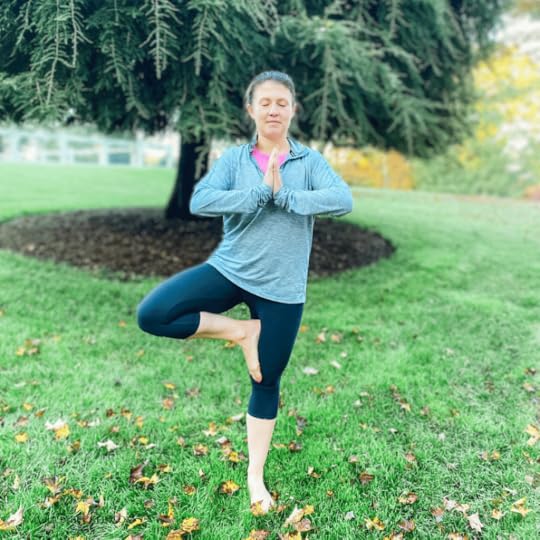
I never became an expert. I just liked it. I started to use breathing to help calm myself down. I paid more attention to places in my body that were asking for attention. I learned how to stretch and rest and receive care. (And let’s be clear—while tree pose is now comfortable for me, sharing a photo with the world of me practicing tree pose is a big stretch!)
Life with God is a lot like the practice of yoga. Whether we are talking about prayer, or Bible reading, or simplicity, or fasting, or any number of other things—spiritual practices are not about performing for God. They are not about achieving spiritual mastery. They are not about impressing anyone. They are not a matter of how much time you spend or how familiar you are with the topic. They are simply about receiving Jesus’ invitation to come and be with him.
More with Amy Julia:
S7 E2 | Anxiety: A Doorway to Your Best Self? with Curtis ChangS4 E4 | Spiritual Practices That Heal with Rich Villodas3 Practices to Follow Jesus and Cultivate Love7 Healing PracticesSubscribe to my newsletter to receive regular updates and news. You can also follow me on Facebook , Instagram , Twitter , Pinterest , and YouTube , and you can subscribe to my Love Is Stronger Than Fear podcast on your favorite podcast platform.
The post Spiritual Practices Are Not About Performing for God appeared first on Amy Julia Becker.
October 3, 2023
Five Years of White Picket Fences
Once, when I was speaking at a church, I was introduced as an “expert on privilege.” The person introducing me didn’t mean that I’ve done anthropological or sociological studies about elites or racial groupings or anything like that. What she meant is that when it comes to privilege—which I define as a set of unearned social advantages—I’ve got so much lived experience, it counts as expertise.
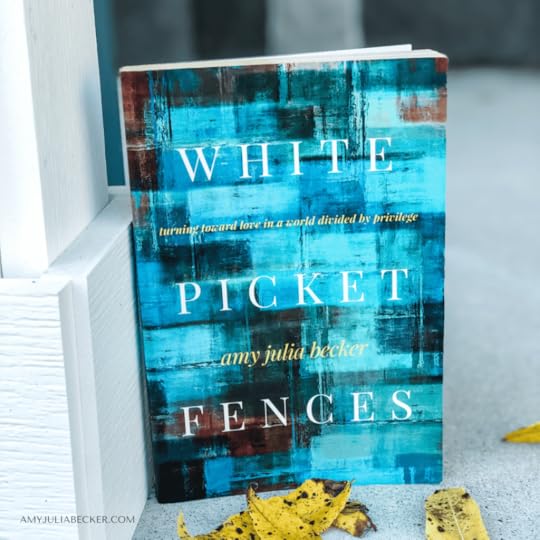
It was out of that lived experience that I wrote, reluctantly, White Picket Fences: Turning towards Love in a World Divided by Privilege, a book that turned five years old this week.
In a world that only seems more polarized as the years go by, I hope and pray these words will live on for the people who need it, people like me. I grew up within a network of unearned and unacknowledged advantages, and I believe that people like me can respond to the divisions with hope rather than despair. We can be a part of a movement toward healing.
And my prayer that these words might live on might very well have been answered in the most unlikely of ways.
I learned in August that my publisher, NavPress, was no longer planning to keep extra copies of White Picket Fences in their warehouse. They gave me two options: I could have all remaining books shipped to my house, or I could let them be thrown away. Instead, I reached out–to pastors, people running non-profits, and friends. I had 19 boxes of books available at closeout sale prices, and I wondered if anyone out there might want them.
Two months ago, it looked like White Picket Fences would disappear. Instead, here’s what happened. Within 5 days, all 19 boxes were claimed. Not one box remained, and no one who wanted a box was turned away. Those boxes were shipped out to places across the nation: Virginia, Florida, North Carolina, Maryland, Massachusetts, Georgia, Connecticut, Michigan, even to Canada.
I believe there are still a lot of people who could use a gentle invitation into a conversation about race, class, ability, and social division that leads us all—together—towards hope and healing. If you are one of those people, or if you know someone in that position, White Picket Fences might just be the place to start.
More with Amy Julia:
S5 E2 | God Has Something to Say About Privilege with Dominique Gilliard
Subscribe to my newsletter to receive regular updates and news. You can also follow me on Facebook , Instagram , Twitter , Pinterest , and YouTube , and you can subscribe to my Love Is Stronger Than Fear podcast on your favorite podcast platform.
The post Five Years of White Picket Fences appeared first on Amy Julia Becker.
October 2, 2023
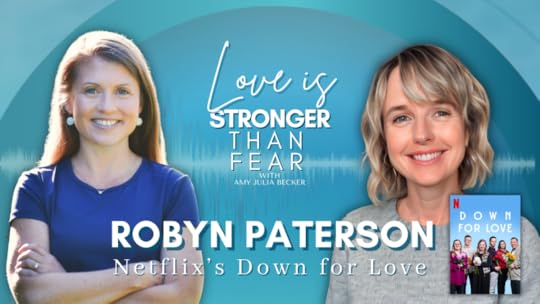
S7 E3 | Netflix’s Down for Love with Robyn Paterson
Have you watched the new show on Netflix called Down for Love? It’s a reality dating show for people with Down syndrome, and we’re celebrating the start of Down Syndrome Awareness month with a conversation with the producer of Down for Love, Robyn Paterson. We talk about:
How the show was createdThe diversity of the Down syndrome communityThe universal desire for love, relationships, and connectionBONUS CONTENT: At the end of the episode, I talk with Penny, our 17-year-old daughter who has Down syndrome, about her thoughts on Down for Love.___
FREE DOWNLOAD: 5 THINGS I WISH I’D KNOWN WHEN OUR DAUGHTER WAS DIAGNOSED WITH DOWN SYNDROME
___
TIME ESSAY: Doctors Don’t Know How to Talk About Down Syndrome
GUEST BIO:
“Robyn Paterson is a New Zealand-based producer, director and writer known for Down for Love (2022), Grand Designs New Zealand (2015) and In the Zone (2018). She works across various roles within multiple formats, including television factual, documentary & entertainment series, documentary feature, web-series, comedy, and drama. She has a background as an actress and presenter, and is the current president of the Directors & Editors Guild of Aotearoa New Zealand.”
___
Connect Online:
___
On the Podcast:
YouTube Channel: video with closed captions
___
Season 7 of the Love Is Stronger Than Fear podcast connects to themes in my latest book, To Be Made Well, which you can order here! Learn more about my writing and speaking at amyjuliabecker.com.
Note: This transcript is autogenerated using speech recognition software and does contain errors. Please check the corresponding audio before quoting in print, and note that the times displayed were generated before the introduction was added.
So I’m here talking with Robin Patterson and she is a producer of the producer of Netflix’s new show Down for Love. And she is joining me from New Zealand today. So Robin, welcome.
Robyn Paterson (00:36.906)
Thank you so much. It’s great to be here.
Amy Julia (00:39.026)
Yeah, thank you so much for being here. It was funny. We had a little bit of a just trying to figure out literally what time We each were talking from but i’m um, i’m coming in from wednesday afternoon and robin is coming in from thursday morning and It’s kind of amazing that we get to do that I wanted to start though. Um by just i’m sure we’ve got listeners to this podcast who have not seen down for love
Robyn Paterson (00:45.966)
Thanks.
Amy Julia (01:03.714)
which I will talk about because I’ve seen every episode and I’m thrilled with it. But I thought maybe Robin you could start by just telling us the story of how you came to create this show. Like how did you envision it? How did you go about making it? Because then that will also introduce people to the show itself.
Robyn Paterson (01:20.665)
Yeah, sure. There’s a little bit of a long story to that. The company responsible for the show is called Attitude Pictures. They are a New Zealand based company. I’ve worked, I’m actually a documentary filmmaker the majority of the time. And I have worked with Attitude on and off.
over the last few years in a freelance capacity directing some episodes here and there. And I had, I’d actually just come back into the country from Chicago because I had a film release over there and COVID struck, which changed a lot of things obviously for everybody. And for me that meant being based here.
Amy Julia (01:57.351)
Good.
Robyn Paterson (02:06.77)
New Zealand, in New Zealand, we were really lucky over that time that we didn’t have COVID in the community for quite a long time. And I ended up producing a series for Attitude, a series that’s been long running since, I think, 2005, which is a Sunday morning show here that each episode is about somebody living with a disability and that is in various different capacities. And obviously, over the years, that’s changed enormously.
Amy Julia (02:11.858)
Right.
Robyn Paterson (02:33.658)
from a magazine style show to more of a documentary style show. So I was working on that and the company owner, Robyn Scott Vincent, another Robyn, had the idea that she wanted to do something in the space of Down Syndrome and relationships. I had a background working in primetime TV, so I thought I could take that and actually make it something.
that could appeal to a wider audience and bring awareness to a wider audience. So I brought on board a creative team of people, including director Canada Bebridge, after developing the concept for Down for Love, which is really, I guess, along the lines of a dating show for people living with Down syndrome.
Amy Julia (03:02.31)
Yeah.
Robyn Paterson (03:25.818)
And the reasoning behind that was so that people living with Down Syndrome would be treated equally to other people, just as much right to a relationship. Before, while we were developing the concept though, I had a lot of consultation with people in the Down Syndrome community, participants, and Zandra Vaserina, who runs the New Zealand Down Syndrome organization here.
So we had a lot of conversation even before the concept came about in terms of what people were looking for in the community, what people’s frustrations were, and also what people wanted to see and also participate in. So there was a lot of conversation before that show came about. So sorry that’s a long-winded way of coming back to the show but that’s a little bit of background.
Amy Julia (04:16.506)
No, that’s what I wanted to hear because I think when I first heard about the show, I’m always a little bit wary as the mother of someone with Down syndrome. I just wonder how is, uh, Down syndrome going to be portrayed or is this going to be, um, a fully realized picture or is this going to be, I don’t know, kind of using people with Down syndrome as a prop. And I was, obviously I wouldn’t be talking to you if I wasn’t like,
Robyn Paterson (04:24.983)
Hmm.
Robyn Paterson (04:35.788)
Mm-hmm.
Robyn Paterson (04:41.142)
Yeah.
Amy Julia (04:44.378)
really excited about the way in which you approach the entire topic. But you can tell that there was incredible intentionality in the way you went about not just the kind of dating aspect of things, which is obviously kind of the hook for the show, like who’s going to end up with who and how is this going to be developed, but in really doing some of the background work on these individuals and their stories and their families and really showing both…
Robyn Paterson (05:03.242)
Yeah.
Amy Julia (05:13.994)
Yeah, the fullness of their lives, which we’ll get to talk about a little bit. But I wanted to start by just asking, like, how did you actually go about finding participants? Like, how did you find your, I mean, characters, for lack of a better word, because I know it’s reality, so they’re not characters like fictional characters, but they’re still kind of playing a role in some ways.
Robyn Paterson (05:29.484)
Yeah.
Robyn Paterson (05:32.802)
Well, first of all, thank you for saying that. Because that was super important to us, that was the approach of the show. And also that people living with Down syndrome were very much able to lead their own stories and not have their stories told by somebody. And that was a really key part to, you know, how we wanted to conceive of the show. In terms of how we went about finding people, and we were so lucky to find amazing people in the community.
Some people we knew already because we’d worked with them before. People like Carlos, we were familiar with his photography. He’d won awards for his photography. My sister actually runs an organization called Upside Downs, which is working with speech therapy for children with Down syndrome. And she had done a little bit of work with Carlos in terms of his poetry and bringing his poetry to younger people who also live with Down syndrome because he’s a bit of an inspiration.
to them there. He’s got an incredible facility for language in general. Lily, we had worked with before, we’re familiar with Lily. She’s an actress. She’d done plays that we had covered as a story. And Libby Hunsdale was a bit of a movie star. She had recently released a film, lovely film called Poppy, where she’d done a beautiful job as the lead actress.
So we were familiar with Libby as well. So we reached out to them, all of them were very keen to be involved. And beyond that, it was really the creative team. We had a researcher, two researchers who went out into the community, contacted community organizations. We put a call out to see if people were interested and people put their hands up. You know, there were a lot of people who were really keen to be part of it.
A lot of them expressed that they’d been looking for relationships and found it very difficult to find people or connect with people. So that’s another thing that we wanted to do was really help that process, whether or not people became part of the show or found a romantic partner through the show. We wanted to make sure that we were putting a lot of work into finding genuine pairings for people in terms of what their…
Robyn Paterson (07:56.994)
desires were in a partner, what their interests were as people and really trying to match people up very carefully so that even if they didn’t find a romantic relationship through the show that they would find a really solid friendship and people that they could have an ongoing connection with. We really wanted to stay away from, I know that sometimes in reality television people are sometimes paired for the drama of what will ensue or the fireworks.
Amy Julia (08:10.162)
Mm-hmm.
Robyn Paterson (08:24.654)
We really wanted to stay away from that and make sure that we were considering very carefully who we put together in the hope that they would form a genuine connection.
Amy Julia (08:30.39)
Mm-hmm.
Amy Julia (08:35.514)
Well, and it does, I mean, you see that just the both the genuine connection part as well as the Some of them end up in friendships. I’m not gonna give too much away here and others in romantic relationships and you also hear this kind of undercurrent of real desire for those Friendships and relationships and the fact that is a challenge even though once you kind of watch those forming you think
Robyn Paterson (08:45.902)
I’m sorry.
Robyn Paterson (08:54.236)
Hmm.
Amy Julia (09:00.69)
Oh my gosh, I would like to be friends with this person. There’s just a genuineness and a sincerity to all of them who are very different from one another. And yet that sense of just like a kind of open and vulnerable heart, I do think was a through line among like most of the characters. So anyway, I really, really loved them. And I did, I wanted to pause for just a minute and tell you a little bit of how I came to even know about the show. So I learned two of my…
Robyn Paterson (09:03.601)
Yeah.
Robyn Paterson (09:26.039)
Yeah.
Amy Julia (09:28.21)
friends who are middle-aged, like my age, single women who are not directly connected. I mean, they’re connected to me, but they do not have children with Down syndrome. They do not have siblings with Down syndrome. They do not have Down syndrome. They are the ones who told me, oh, my gosh, I have just binge watched the show. You have to watch it. And it was just what was really interesting. And it’s kind of what I was saying about that sincerity. Like, they were so as single women.
Robyn Paterson (09:47.682)
Wow. Oh wow. Wow.
Amy Julia (09:56.87)
They were so taken by the sincerity of the relationships as they were portrayed by the honesty and affection and people who are willing to say, I really want this. This is something that really matters to me or it’s been really hard. So it was almost like there was this beautiful idealism but also realism that they wanted love and didn’t know if it was gonna work out the way they wanted. And I had these friends who are in a very similar position
face of it, they do not appear to be the same. So you mentioned earlier wanting this to have kind of a wider appeal, like a broader audience. So I’m curious what you’ve known. It’s only been out for, I don’t know, a month. Is that right? Like it’s pretty, pretty recent.
Robyn Paterson (10:31.457)
Yeah.
Robyn Paterson (10:41.498)
Yeah, on Netflix, yeah, it actually aired in, but the strange thing is that this is going back in time a little for me because we actually filmed it in 2021. And it came out in New Zealand at the start of 2022. So it’s sort of reaching back in my memory now. But yeah, it’s so heartwarming to hear that because that is very much, I guess, our approach when we went into it is that the search for love.
Amy Julia (10:44.187)
Oh, okay.
Amy Julia (10:51.535)
Ah, okay.
Amy Julia (11:00.77)
Yes.
Robyn Paterson (11:10.53)
and relationships and connection, whether or not that’s romantic connection, is universal. It’s something that we all feel. It’s something that we all struggle with at times and have our ups and downs and our highs and lows and people living with Down syndrome or any disability, intellectual disability and they’re different. And that I guess is what we wanted to express through the show because it is something that we can all relate to.
Amy Julia (11:30.71)
Yeah, well, clearly that worked in terms of just my friends who responded so well to those initial viewings. And they said, you know, not only do you need to watch this, but I think you need to watch it with Penny. So as listeners to this show will know, but I have a daughter who’s 17 and has Down syndrome and her name is Penny. And so I asked her if she would watch this show with me and she was like.
Robyn Paterson (11:36.174)
Sorry, I’ve lost.
Amy Julia (11:56.226)
sure, and I think she was a little bit, you know, like, what’s it going to be like? But we ended up watching all five episodes together. And what was neat about it was, I mean, we just enjoyed it together. And it also was, I think there were two things that happened. One, it gave like a prompt for some conversations that I think both of us have wanted to have around dating, friendship, romance, like some of those types of questions and…
That’s just really helpful to have a prompt for that to be able to say, okay, who could you relate to and what did you feel when you saw this and what do you think about that? But also it made me think a lot about how important it is to how important storytelling is in shaping our imaginations for what is possible in life. And for most people who do not have Down syndrome.
there is an imagination around love and romance and marriage that’s just kind of handed to you by the culture. And that’s often not the case with people with intellectual disabilities and with Down syndrome in particular. And so I’m curious, like, I don’t know how you felt like, what gave you the freedom to imagine those possibilities?
Like, how did you have an imagination for that, if that makes sense? And I don’t mean imagination in the sense of, like, making up this story that couldn’t be true, just to being able to see something that actually could be true, but other people might not have eyes to see it. Does that make sense?
Robyn Paterson (13:08.915)
Yeah.
Robyn Paterson (13:15.178)
Yeah.
Robyn Paterson (13:21.49)
Yeah, absolutely. And look, I created a lot of the conversations we had in the, in the, in the, I guess, the origin process of the show. I had a lot of conversations with Sandra from the New Zealand Down Syndrome Association, and families in the community, just really talking about, you know, where people were at and their feelings around it, because we wanted, it was really important to us to get that right, I think, and to find the right level for that.
And what people expressed a lot of the time was the feeling, and this includes some of the people who became participants, was the feeling that, you know, there’s often a well-intentioned but overly protective bubble that’s put around people with intellectual disabilities, which they really feel limits their choices and their ability to have fulfilling relationships in the way that they see their siblings having.
Amy Julia (14:04.922)
Yes.
Robyn Paterson (14:15.518)
and other people around them and friends. And there’s a lot of reaching out and wanting that. Families also expressed that they felt they would love to encourage their children and help their children to, and I say children because a lot of them are talking about teenagers, but you know, in a lot in the case of Down for Love, of course, we’re talking about adults, we, you know, we had an 18 cutoff so that everyone was in that bracket. We, you know, and people saying that they
sometimes they were getting feedback from the community, like you shouldn’t be allowing your adult child to have a connection and people being concerned about that. But there was a real expression of a desire to have that conversation and to change that conversation and that narrative and to treat people equally in that regard and to empower people to be able to have fulfilling.
romantic and other relationships like anybody else. Zandra, sorry, I apologize for the dog barking. Do you want me to, can you hear that?
Amy Julia (15:22.859)
we can handle dog barking and I’m not sure anyone will be hearing it so not to worry.
Robyn Paterson (15:28.078)
We have a lot of construction happening in the neighborhood after the flooding at the moment and our dogs go a little bit crazy when the diggers arrive. But yeah, no, I was saying, you know, Zandra from the New Zealand Down Syndrome Association is very strong on that, you know, people should be empowered and they have every right to have relationships like everyone else. So I think that gave us the confidence going into the show that would really
you know, listened to the community on that one, and that we were really wanting to make that possible for our participants who were really expressing that desire. But it’s an important conversation. Sorry, there was a delay. Yeah.
Amy Julia (16:08.114)
Well, I love that and I think, yeah, that’s what I was gonna say. I mean, I have two different strains of thought from what you just said. One is just that it is, I do think the, I learned and it’s a pretty simple phrase, but the phrase the dignity of risk a couple of months ago as it pertains to like really how important it is as a parent who, and this is true for all of my children, but I feel it the most with Penny.
Robyn Paterson (16:14.675)
Yeah.
Robyn Paterson (16:32.766)
Oh sorry, I’ve lost the connection there. Can you hear me?
Amy Julia (16:37.138)
I’m so want to protect her. And there is such a sense of like, oh my gosh, you’re more vulnerable than other people. So I need to protect you more. And yet it is giving her the dignity that she is due to let her take risks. And that might be the risk of like preparing food, whether that’s like taking a piece of toast out of the oven and she might burn herself or cutting a pepper to eat for dinner, or the risk of a relationship, the risk of some sort of
Robyn Paterson (16:50.445)
Yes.
Amy Julia (17:05.638)
whether it’s physical or emotional, whether that’s rejection or acceptance, I mean, there are risks all involved there. And I think there has been such a sense of, as parents having to protect our children from this kind of big, scary world, and there is a conversation about, but what would it mean to actually equip and empower them to go into that world? And I think there’s more and more of that happening. And again, shows like this help us to actually imagine that could be.
could be possible. So I really appreciated that and thought a lot about it. And it again was a good prompt for me to be able to talk to Penny about some of those things, about what does it mean to feel in your body that you’re attracted to someone? What does it mean? There’s a lot of conversation around consent, whether that’s the consent to hold hands or to do something that’s much more physical between two romantically involved partners. So.
Robyn Paterson (17:48.008)
Yeah.
Robyn Paterson (17:55.749)
Oh.
Amy Julia (17:59.63)
I just really appreciated the way throughout, I mean, it really came throughout the show and there were early on, especially you had some conversations where you saw parents both grappling with how much are we gonna let them explore and do and also being like, yeah, we want them to be able to like really live their lives and we believe they can do that and deserve to be able to do that.
Robyn Paterson (18:11.056)
Mmm.
Robyn Paterson (18:21.646)
Thank you. Yeah, we really wanted to include that conversation with parents because that’s so relevant to the situation. And of course, it is challenging territory. I’m a mom. I understand. And we were also lucky enough to work with an organization here called To Be Frank, which is all about making romantic relationships and intimacy accessible to people living with all kinds of disability, including intellectual disability.
Amy Julia (18:48.358)
Yeah.
Robyn Paterson (18:48.91)
They do a lot of work, so we worked hand in hand with them as well. I’m glad you raised consent because that is a really key issue when it comes to these situations. And consent was something that we wanted to be really aware of as we were going into the process as well. And so, to be frank, we’re a wonderful organization to work with and to work with some of our participants on and off screen as we were going through the process to make sure that it was safe for everybody as well.
Because yeah, like you said, you know, there’s a lot of conversation to be had but what a lot of the feedback that we’ve had Along the way and since the show came out is that people have been having these conversations with their children with their Partners with their adults who have Down syndrome and that conversations been had more widely and I think that’s a positive thing
Amy Julia (19:44.154)
Yeah, I believe so. And another question I had, this is kind of a different tack, but this is not a documentary. And obviously you have some background in documentary filmmaking in the sense that you don’t have like, I’m gonna pull out, oh.
Robyn Paterson (19:53.826)
Sorry, you’ve cut out there.
Robyn Paterson (20:01.602)
So, sorry, I lost you there for a second, Amy. Do you mind repeating that question?
Amy Julia (20:04.326)
Oh, okay. Not at all. So what I was saying is this is not a documentary. You have a documentary background and there were decisions made to not pull out and say, let me tell you the viewer what Down syndrome is and let me explain the potential biases that people with Down syndrome face. There really was a sense of allowing characters to represent themselves.
Robyn Paterson (20:19.618)
Mm.
Amy Julia (20:31.382)
And then as a viewer, we either, you know, we think what we’re gonna think about it. And I’m curious like how you made those decisions, like just that decision not to make even parts of this documentary and really let it be a dating show.
Robyn Paterson (20:42.958)
Hmm.
Robyn Paterson (20:51.982)
Yeah, it was really important to me to find that balance because, you know, we wanted to, yes, make a dating show in that relatability to everybody and it’s recognizably a dating show. However, we also wanted to take that documentary lens to it so that we were taking more of a documentary approach when it came to allowing people to lead their own stories, filming people with their families a little bit.
putting, we were very cautious with the narrator voice so that was really, you know, sort of, I guess filling in gaps rather than leading the story or telling people what to think. That was important to us. And so for me, bringing on board Candida Beveridge as director was key to that. I wanted to bring on board another documentary filmmaker who really understood that sensibility and was going to maintain that approach as we were doing the filming.
I had previously, actually, I first met Candida when she interviewed me after a documentary film that I had put out about Zimbabwe because I grew up in Zimbabwe. And she was working for BBC World Service at the time. She’s originally from the UK. And that’s how we met. And then we’ve crossed paths a number of times since in our documentary work. So I knew that I could trust Candida to understand the sensibility that I wanted to carry through.
the show. And again, that was, I felt that was an important part of, I guess, safeguarding the community and that message and not wanting to apply that sort of reality construct and make it about entertainment. We really wanted to convey people’s own thinking and allow them and empower them to tell their own stories.
Amy Julia (22:39.774)
Yeah, it felt really respectful to me. And I think to Penny as well, because again, it was really interesting to hear her responses to the show because she did just talk about, I asked her some questions afterwards and she talked about how, and I’ve asked her before whether it matters to her to see people with Down syndrome represented in movies. And she’s been like, no, not really. Like I can relate to anyone, it doesn’t really matter.
But I think in this case, she actually did, I mean, she said, I felt really connected to this because I’m a person who has Down syndrome. And I did feel like I was able to really connect to the characters and just relate to them. So I appreciated the sense of respect and dignity that all the different characters were given. One other thing I wanted to ask you about,
Robyn Paterson (23:17.839)
Yeah.
Robyn Paterson (23:36.757)
Thank you.
Amy Julia (23:37.886)
There are a couple of different storylines that we get in the backstory of the characters. So I think it was Lily who very matter of factly tells, I guess in an interview format says that her parents were not able to take care of her and so she was adopted. And we have another kind of backstory of a young man with Down syndrome who has been adopted.
we meet other characters who’ve lost parents just to cancer and to other, you know, just real stuff. So there’s kind of this undercurrent in some of the stories of loss and of hardship. There’s also, I was really struck actually by Lily as well in terms of an undercurrent of joy and self-acceptance. Like there was just this sense of not being in any way egotistical, but having like high regard for herself, like in a, in a pot, in what I would say is a really positive way. So I was thinking about like,
Robyn Paterson (24:04.553)
Mm.
Robyn Paterson (24:10.962)
Mm.
Robyn Paterson (24:15.892)
Mm.
Robyn Paterson (24:23.52)
Mm.
Robyn Paterson (24:30.034)
Yeah.
Amy Julia (24:33.982)
She has high self-esteem, but as far as I can tell as a viewer, like low ego, like able to celebrate other people, able to admit her own mistakes, and able to like really think well of herself when she does something well. So I just loved the fullness of life for people with Down Syndrome, which is of course the fullness of life for people who are people. But I loved the way even in these just very small
Robyn Paterson (24:37.015)
Mmm.
Robyn Paterson (24:41.38)
Hmm.
Robyn Paterson (24:57.191)
Yeah.
Amy Julia (25:01.742)
It wasn’t like we had this long backstory about adoption or about death at all. And yet there was also this sense of like, yeah, these are real people who are dealing with real hard things and also who have joy in their lives. And I just really appreciated that full portrait of the fullness of their lives.
Robyn Paterson (25:22.202)
Thank you. Yeah, I appreciate hearing that. It was, you know, something that we really considered was wanting to show the diversity of the Down Syndrome community because as you said, like everyone’s community is diverse. It’s not one thing. And I think often, you know, in our experience of how people talk about sometimes and handle Down Syndrome, it tends to be lumped into one basket.
as if people are all the same. But of course, this isn’t the case with any community. There is so much diversity within it. And we really wanted to celebrate that and show that as well as part of, you know, I think these things, on the surface of it, you have a dating show, but we really wanted those layers of, I guess, awareness to come through in terms of people’s understanding.
And that was one of them was showing that sort of, I guess, diversity within the community. But it was also a key part of our casting process that we wanted our participants to have, to all have a degree of self-confidence because we were very conscious of vulnerability in going through any process, like any filming process for anybody, regardless of ability, is, it can be challenging. And we wanted to really make sure that anybody that we cast.
was able to and well supported enough in their families and lives to be able to handle the process and have a good experience.
Amy Julia (26:54.502)
Hmm. I’m curious for you personally, just, um, and you’ve obviously done work kind of in the space of working with people with disabilities in the past, but I am curious whether working on this project, um, how that affected you? Like, did it change anything for you in terms of how you see the world or the way you think about things, or was it more just an affirmation of things you already knew? Yeah. How did it affect you to be a part of this?
Robyn Paterson (27:20.31)
That’s a really interesting question. I mean, look, it’s impossible to be a part of the show and not be affected emotionally by everyone’s stories. I think all of us were as a team. I think it was one of the most heartfelt journeys that we went on and we really felt all of the highs and lows for our participants as they went through the journey. I think we were very, very invested emotionally in that journey with people. It was an interesting time because
This show was actually filmed shortly before COVID did enter the community finally in New Zealand towards the end of 2021. And just prior to that, we had actually done the majority of our filming just before that happened. And, but we ended up in a very long lockdown here in Auckland, just as filming ended. So all of our post-production was actually done remotely. I was in one place.
Director was in one place, editors was in one place, participants obviously all individually at home. So we were communicating remotely through that process, which was very strange. And then the second part of it was filmed after COVID within the community. So we were putting COVID protocols in place and filming a little differently with distancing and so forth. So it’s a little hard to untangle the emotions of that journey when all over the place.
But certainly it was an insight into, yeah, I mean, into so many things. And I think that journey that you go on with people, you know, sort of throughout, and the messages that we’re wanting the audience to take from it, were also really affirmed for us through the process of doing this. And I mean, I learned a lot. I learned a lot from everybody who was involved.
There’s always so much, you can know so much and you can consult so much, but there’s always so much new learning to be had when you actually undertake a journey like this. And yeah, it really opened my eyes to a lot of things.
Amy Julia (29:25.662)
Well, and you may have already answered this question, but the final question I was going to ask you was the only one that Penny wanted me to ask you. And I said, because I said to her, I was like, what do you want me to ask? I get to talk to the producer of the show. And she kept saying, I don’t know, I don’t know, after we watched each episode. And then we finally got to the end of the final episode and she said, I do have a question. And I said, well, what is it? And her question is, are you going to make another season? So that’s my question for you. Are you going to make another season? I’m sure you’ve been asked this
Robyn Paterson (29:50.614)
Hehehe
Amy Julia (29:55.398)
there is there’s a little bit of a cliffhanger on multiple relationships when we get to the end of the
Robyn Paterson (29:58.626)
Yeah. Yeah, look, that’s a really good question. And it’s a slightly complicated answer. The short answer is yes, there is another season underway. So, so yeah, so that is something to look forward to. The the slightly more complicated end of that is that unfortunately, none of us who are involved in the first season are involved in the second season. So it’s being made by an entirely different team of people.
Amy Julia (30:10.62)
Yay!
Robyn Paterson (30:28.306)
Um, the, yeah, there were a lot of changes at the company just, just after this, um, came out. Um, and, and a lot of us, um, sort of moved, including the executive producer, me, the director, the editor and so forth, we all, we’ve, we’ve moved on. Um, but there is a second season coming out and I’m sure they will continue what we started, um, and yeah, I look forward to seeing it like everybody else, so that will be, it’ll be interesting to see.
Amy Julia (30:42.449)
Okay.
Amy Julia (30:57.227)
That will be interesting just to compare. And I’m kind of glad to have that insider information whenever it does come out. But yeah, I do think it is assigned. My other friend to one of the women who told us in the first place to watch it was like, I really want to know what has happened to these different characters. And I like, I just want to know how they’re doing in their life now. So.
Robyn Paterson (31:18.021)
Yeah.
Amy Julia (31:21.606)
there is a sense of feeling really connected and invested in the stories, which I think speaks to the storytelling that you and your team were able to do. Obviously speaks to them as humans as well, but also to the ways you were able to convey something true about their stories.
Robyn Paterson (31:27.826)
Yeah.
Robyn Paterson (31:39.763)
Thank you so much. And it’s been an absolute pleasure to stay in touch with so many of the participants, even though we haven’t continued into the second season as a creative team. We all love hearing from so many of the participants who still contact us with updates and for chats and getting in touch. So that’s been really nice.
Amy Julia (32:03.838)
Mm.
Robyn Paterson (32:04.394)
hearing what they’re getting up to. And of course, we’re still in touch with the New Zealand Down Syndrome Association, who also keep us posted. So that’s been wonderful just to kind of stay. I won’t give away any spoilers, but yeah, there’s a lot been happening in so many of their lives. And it’s wonderful to have that connection ongoing.
Amy Julia (32:22.03)
Well, I may when we stop recording ask for a few spoilers, but we’ll leave it at that for now. And I will just say to everyone who’s listening, obviously, that I just highly recommend the show. And that is, it was a wonderful experience for me to watch with my teenager with Down syndrome. But I can speak on behalf of other
Robyn Paterson (32:27.239)
Heheheheheheh…
Amy Julia (32:45.362)
women my age at least and say that they really loved watching it too. And actually, both my son and my daughter, who are younger than Penny, watched not all five episodes, but also were really, felt really invested and wanted to know what was going to happen. So you made something beautiful and we are grateful, really grateful for it. Thank you.
Robyn Paterson (33:03.918)
Thank you so much. That’s so heartwarming to hear. I really appreciate it. We had, there was so much love poured into making it. So it’s wonderful to hear that.
Amy Julia (33:12.37)
Thank you.
SUBSCRIBE TO PODCAST
[image error]Apple Podcasts[image error]Spotify[image error]CastBox More!
More!
 Apple YouTube Spotify More!
 Learn more with Amy Julia:
To Be Made Well: An Invitation to Wholeness, Healing, and Hope S6 E15 | World Down Syndrome Day and Unexpected Gifts with Jillian BenfieldS6 E3 | Down Syndrome and Belonging with Heather AvisIf you haven’t already, you can subscribe to receive regular updates and news. You can also follow me on Facebook, Instagram, Twitter, Pinterest, YouTube, and Goodreads, and you can subscribe to my Love Is Stronger Than Fear podcast on your favorite podcast platforms.
The post S7 E3 | Netflix’s Down for Love with Robyn Paterson appeared first on Amy Julia Becker.
October 1, 2023
Penny in Her Own Words: What I Thought About Netflix’s Down for Love
October is Down Syndrome Awareness Month! To celebrate, Penny will take over my account once a week and share her thoughts about teenage life, having a job, school, and more, plus the congratulations letter she wrote to parents whose baby was diagnosed with Down syndrome. Today she shares her thoughts about the Netflix reality dating show Down for Love.
I’d love to hear how you would describe Down for Love to someone who hasn’t seen it before?
Down For Love is a reality dating show where people with Down Syndrome and other disabilites go on blind dates to try to find love.
What do you think it means to be “down for love”?
I think Down for love means you have Down Syndrome and are down to find a connection or love.
Who was your favorite character? Who was your favorite couple?
My favorite character is Libby because she has a lot of things in common with me. My favorite couple has to be Leisel and Braydon because all of their blind dates have been something creative and they connect more with each date.
Did it make you think about your own desire to date people?
Yes I do wish I had a boyfriend but right now I am enjoying single life.
Do you think it’s harder to find people to date because of having Down syndrome?
I have only had one boyfriend in my life which in a shortend version did not last long. It was pretty easy for me to find a guy because he also has some sort of disability. So we can connect in that way. We have been friends for a while and I think we are going to keep it that way.
Did you like the show? Why or why not?
Yeah I liked the show. I liked it because I could relate with trying to find a guy and trying to connect our intrests together.
What are some questions you have about dating and love?
Am I ever going to find love?
How do I know if a guy likes me more than a friend?
Does the guy feel the same way?
What if I like a guy but he just wants to be friends?
What are some fears you have or challenges you think you’ll face?
A fear ; getting rejected or not having the same intrests
Challenge: If I like a guy more than a friend but he only likes me as a friend
What are some things you’re excited about when it comes to dating and romance?
I am excited about trying to find someone who likes me for me or has the same intrests as me.
Would you recommend Down for Love? Why? Do you think it is only a show for people with Down syndrome?
I would recommend Down for Love because even though you may not have a boyfriend it can inspire you to ask someone and create a good first date. Other people who don’t have Down Syndrome can still watch it but maybe won’t feel as connected as people with Down Syndrome.
Tomorrow I talk on the LOVE IS STRONGER THAN FEAR podcast with the Down for Love producer, Robyn Paterson. She’s gives us a behind-the-scenes look at the show and some great insight. Plus, at the end of the episode, I talk with Penny about the show!
More with Amy Julia:
Penny In Her Own WordsHollywood, via Barbie, Still Doesn’t Know What To Do With DisabilityTIME | Where Are All the Children’s Books Featuring Kids With Down Syndrome?Subscribe to my newsletter to receive regular updates and news. You can also follow me on Facebook , Instagram , Twitter , Pinterest , and YouTube , and you can subscribe to my Love Is Stronger Than Fear podcast on your favorite podcast platform.
The post Penny in Her Own Words: What I Thought About Netflix’s Down for Love appeared first on Amy Julia Becker.
September 29, 2023
What I Wish I’d Known When Our Child Was Diagnosed with Down Syndrome
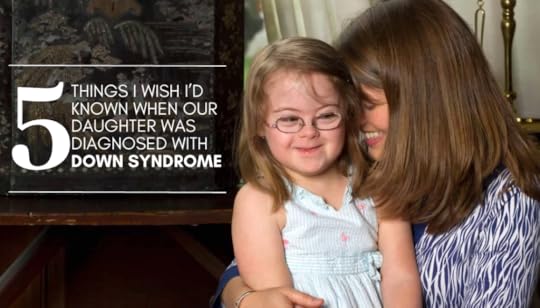 GET THE FREE DOWNLOAD
More with Amy Julia:
5 THINGS I WISH I’D KNOWN WHEN OUR DAUGHTER WAS DIAGNOSED WITH DOWN SYNDROMEBook: A Good and Perfect Gift: Faith, Expectations, and a Little Girl Named Penny Free Resource: Missing Out on Beautiful: Growing Up With a Child With Down SyndromeSubscribe to my newsletter to receive regular updates and news. You can also follow me on Facebook , Instagram , Twitter , Pinterest , and YouTube , and you can subscribe to my Love Is Stronger Than Fear podcast on your favorite podcast platform.
The post What I Wish I’d Known When Our Child Was Diagnosed with Down Syndrome appeared first on Amy Julia Becker.
September 27, 2023
3 Practices to Follow Jesus and Cultivate Love
If you are curious about the spiritual life, and about following Jesus, here are three practices that can help you begin or deepen that journey:
Lectio Divina.This is the practice of the slow, prayerful reading of short passages from the Bible. I would start with stories from the gospels and read a few verses slowly three times. The first time you read the passage, ask God to help you pay attention to one word or phrase. Then, after the second reading, ask the Spirit to reveal why that phrase stood out. Finally, on the third reading, ask how you can respond to it. Here are a few passages you can refer to as a start: any short portion of Matthew 5-7, Matthew 11:28-30, any portion of Luke 5, any portion of John 13-17.
Silent Prayer.
Silent prayer can be exactly that—simply sitting in silence in the presence of God. There are people who do this for twenty minutes, thirty minutes, an hour at a time. To be honest, that’s nearly impossible for me. My mind races to a gazillion other places and I get antsy and annoyed by my own distractibility really easily. So, if you are like me and the thought of sitting in silent prayer feels nearly impossible, you can also try to imagine yourself in the presence of Jesus for a very short period of time. Three minutes. Five minutes. Or you can take one word or phrase—Father, Peace, Savior, Be Still, Rest—and return to that word over and over again. And remember that every time your mind wanders from that image or word or phrase, you are invited to return to Jesus yet again.
Rest.
Many Jews and Christians throughout history have observed the Sabbath, a 24-hour time of rest. For some of us, this feels impossible. But what about an hour? What about taking an hour on a Sunday afternoon and turning off all your devices and forgoing any sort of work and just delighting in the presence of God?
Jesus invites all of us to come and follow him. These three practices are all ways for us to take him up on that offer and make ourselves available to love.
More with Amy Julia:
S4 E4 | Spiritual Practices That Heal with Rich VillodasS7 E2 | Anxiety: A Doorway to Your Best Self? with Curtis Chang12 Tips | How to Start Reading the BibleSubscribe to my newsletter to receive regular updates and news. You can also follow me on Facebook , Instagram , Twitter , Pinterest , and YouTube , and you can subscribe to my Love Is Stronger Than Fear podcast on your favorite podcast platform.
The post 3 Practices to Follow Jesus and Cultivate Love appeared first on Amy Julia Becker.