
Jeremy Keith's Blog, page 143
October 5, 2011
Ending September
September was quite a month. There were plenty of events that I attended right here in Brighton:
dConstruct,
Maker Faire,
Update and
Improving Reality.
In the middle of all that, I went to Tennessee for Breaking Development and Mobilewood.
I finished the month with a trip to Italy for the inaugural From The Front conference. It was a great little grassroots affair. It was basically a free event—there was an ostensible cover charge of ten euros just to ensure that people didn't sign up without showing up. That's why I waived my usual speaking fee (as an aside, if you're a conference organiser and you're thinking about asking me to speak for free at an event that charges hundreds of dollars/pounds/euros to attendees …don't).
I have to admit that the location of the event did make a difference. I jumped at the chance to return to Bologna. Jessica and I even managed to squeeze in a trip down to Florence. Pictures were taken.
The evening before travelling to Italy, before I packed my bag I had a chat with Jen for her podcast, The Web Ahead.
5by5 | The Web Ahead #3: Jeremy Keith on Everything Web on Huffduffer
We talked about a lot of stuff from the nitty-gritty of responsive web design workflows and processes to being future friendly in the face of the mobile browser landscape. We also discussed long-term digital preservation and the web's role as a storage medium for our collective culture. It sounds like a random grab-bag of topics, but in my mind all of this is connected.
I somehow managed to avoid even once mentioning a space elevator.
Tagged with
fromthefront
conference
thewebahead
podcast
interview
futurefriendly
ffly


September 30, 2011
Ten
On this day ten years ago I started this journal. There had been a site at adactio.com before that but it was a silly DHTML brochureware thing. That changed when I wrote my first blog post:
I'm not quite sure what I will be saying here over the coming days, weeks, months and years.
Ten years later this journal contains a decade's worth of notes-to-self. When somebody else finds what I've written to be interesting, that's a bonus …but I'm writing for myself (or, if I do ever imagine somebody else reading this, I imagine someone just like me—a frightening thought).
It has been a very rewarding, often cathartic experience so far. I know that blogging has become somewhat passé in this age of Twitter and Facebook but I plan to keep on keeping on right here in my own little corner of the web. I've been blogging now for 25% of my life.
This journal is one quarter as old as I am.
This journal is half as old the web itself.
Here's to the next ten years.
Tagged with
blogging
writing
anniversary
September 28, 2011
My links, my links (my lovely lady links)
Thank you for reading my journal here at adactio.com. I appreciate your kind attention.
I feel should point out that if you're only reading my journal (or "blog" or "weblog" or whatever the kids call it) then you're missing out on some good stuff over in the links section.
Just so you know, there are multiple RSS feeds you can subscribe to:
my journal,
my links,
my articles and
everything all together.
Now it might be that you're already subscribed to an RSS feed of my links through Delicious. Whenever I post a link to my own site, it automatically gets posted to Delicious too.
Or at least it did.
Despite the assurances from the new overlords of Delicious, the API appears to be kaput. That means my links and my Delicious profile are now out of sync. The canonical source for my links is right here on my own site so if you're currently subscribed to my Delicious RSS feed, I recommend that you update your RSS reader to point at the RSS feed for my links instead.
By the way, if you don't want to subscribe to the firehose of all my links, you can subscribe to a specific tag instead. For example, here's everything tagged with "futurefriendly":
And here's the corresponding RSS feed:
/links/tags/futurefriendly/rss
So feel free to explore the links section and do some URL hacking.
Tagged with
links
delicious
rss
homesteading
September 25, 2011
Improving Reality
Much as I enjoyed myself in Tennessee, it was shame to miss some of the Brighton Digital Festival events that were going on at the same time. I missed Barcamp and Flash On The Beach. But since getting back I've been making up for lost time, soaking up the geek comedy at The Caroline of Brunswick last Wednesday with Robin Ince and Helen Keen.
I also went along to the Improving Reality conference on Friday, which turned out to be an excellent event.
The title was deliberately contentious, inviting a Slavin-shaped spectre to loom over the proceedings after he closed dConstruct with his excellent talk, Reality is Plenty wherein he placed his boot on the head of Augmented Reality, carefully pointed his rhetorical gun at its temple and repeatedly pulled the trigger.
But AR was just one of the items on the menu at Improving Reality. The day was split into three parts, each of them expertly curated: Digital Art, Cinema and Gaming. In spite of this clear delineation of topics there were a number of overlapping themes.
I'm somewhat biased but I couldn't help but notice the influence of science fiction in all the different strands. I suppose I shouldn't be surprised. Science fiction sets expectations for technology and culture …and I don't just mean flying cars and jetpacks.
Mind you, this is something that cinema has always done. Matt Adams from Blast Theory asked:
How many romantic kisses had you seen before you had your first romantic kiss?
Or, on a more pedestrian level, everyone in the UK knows what an American yellow school bus is, even though they'll probably never see one. It's part of a pre-established world that needs no explanation. In the same way, science fiction is pre-establishing a strange world that we already inhabit.
José Luis de Vicente took us on a tour of some of this world's stranger corners.
He pointed us to the deserted Mongolian city of Ordos, a perfectly Ballardian location.
We also heard about the Tower of David in Venezuela. Intended as a high-rise centre of commerce but bankrupted before completion, it is now the world's tallest favela.
It reminds me of William Gibson's bridge.
It isn't hard to draw parallels between Gibson's Spook Country and the locative art presented at Improving Reality like Julian Oliver's mischievous creation The Artvertiser.
He describes his work as "jamming with reality"—much like Mark Shepard's Sentient Cities
But Julian Oliver is at pains to point out that that it's not just about messing with people's heads. He's attempting to point out the points of control that might otherwise go unquestioned. There's also an important third step to his process:
Identify the points of control in the infrastructure.
Hack it.
Show how it was done.
This stands in stark contrast to the kind of future that Aral outlined in his energetic presentation. He is striving for a world where technology is smooth and seamless, where an infrastructure of control is acceptable as long as the user experience is excellent. It's Apple's App Store today; it's the starship in Wall·E tomorrow (or possibly the Starship Opryland)—a future where convenience triumphs over inquisitiveness.
As Marshall McLuhan put it "there is no augmentation without an amputation." In Charles Stross's Accelerando that is literally true: when the main character—exactly the kind of superhuman cyborg that Aral envisions—has his augmentation stolen, he is effectively mentally and socially retarded.
Julian Oliver's battle against a convenient but complacent future is clearly shown with Newstweek where William Gibson, Umberto Eco and Philip K. Dick collide in a project that skirts around the edges of morality and legality, hijacking wifi connections and altering news headlines for the lulz.
Then there's Blast Theory's current work on the streets of Brighton, A Machine To See With. It's ostensibly another locative art piece but it may have more in common with a cinematic work like David Fincher's The Game.
It's all part of a long tradition of attempting to break down the barrier between the audience and the performance, a tradition that continues with the immersive theatre of Punchdrunk. This reminds me of the ractives in Neal Stephenson's The Diamond Age, a form of entertainment so immersive that when a troupe attempt to perform a traditional theatrical piece, they run into problems:
The hard part was indoctrinating the audience; unless they were theatre buffs, they always wanted to run up on stage and interact, which upset the whole thing.
It's a complete inversion of the infamous premier by the Lumière brothers of Arrival of a Train at La Ciotat where, so the myth goes, the audience ran from the theatre in terror.
It's probably a completely apocryphal story. But as the representative from Time's Up said at Improving Reality: "Don't let the truth get in the way of a good story."
Stories were at the heart of the gaming section of Improving reality. Stored In A Bank Vault, which is currently running in Brighton, was presented as part of PARN: Physical and Alternate Reality Narratives. These are stories where the player is empowered to become the narrator.
Incidentally, it was refreshing to hear how much contempt the game designers like Tassos Stevens held for the exploitationware of "gamification"—a dehumanising topic that was explored in Stross's superbly damning Glasshouse.
There were plenty of good stories in the middle section of Improving Reality too, which began with a look at the past, present and future of cinema from Matt Hanson. Matt's own remarkable work A Swarm Of Angels bears a striking similarity to "the footage" in Gibson's Pattern Recognition—both are infused with a spirit of fushigi.
The subject of film funding is currently a hot topic and it's unsurprising to see that much of the experimentation in this area can be found in sci-fi endeavours such as Iron Sky and The Cosmonaut.
Micropatronage can be very impowering. Where once we were defined (and perhaps judged) by the films we chose to watch and the books we chose to read, now we can define ourselves by the films and books we choose to fund. Instead of judging me by my what's on my bookshelf or my Last.fm profile, judge me by my Kickstarter profile. Kickstarter is one of those genuinely disruptive uses of the network that's enabling real creativity and originality to come to the surface in projects like Adrian Hon's A History Of The Future In 100 Objects.
This change in how we think about funding feels like the second part of a revolution. The first part was changing how we think about distribution.
Jamie King, director ofSteal This Film, hammered home just how powerful Moore's Law has been for film, music and anything else that can be digitised. Extrapolating the trend, he pointed to the year 2028 as the media singularity, when it will cost $5 to store every film ever made on a device that fits in your pocket. He evocatively described this as the moment when "the cloud settles at street level."
It's here, at the point where anything can be copied, where the old and new worlds clash head on in the battle for the artificial construct that has been so inaccurately labeled "intellectual property".
Once again we were shown two potential futures; one of chaos and one of control:
There's the peer-to-peer future precipitated by Bit Torrent and Pirate Bay where anyone is free to share their hopes and dreams with the entire world …but where no distinction is drawn between a creative work of art and a hate-filled racist polemic.
Then there's the centralised future of the iPad, a future where people will gladly pay money to climb into a beautifully designed jail cell. You can have whatever you want …as long as it has been pre-approved. So you won't, for example, ever be able to play Phone Story.
This second future—where your general-purpose computing device is broken—promises to put the genie back in the bottle and reverse the disruptive revolution in distribution and funding.
Thinking about it, it's no surprise that payment systems are undergoing the same upheavals as distribution systems. After all, money is just another form of information that can be reduced to bits.
The much tougher problem is with atoms.
Until recently this was entirely the domain of science fiction—the post-singularity futures of replicators and cornucopia machines. But even here, with the rise of 3D thing printing, our science fictional future is becoming more evenly distributed in the present.
Improving Reality closed with a talk from Alice Taylor wherein she demoed the work being done at Makie Lab:
We're making a new kind of toy: customisable, 3D-printed, locally made, and internet-enabled.
A year ago, this was a work of fiction by Alice's husband. Now it's becoming reality.
Just as Makie Lab envision a game that's an infinite loop between the network and the physical world, I think we'll continue to see an infinite loop between science fiction and reality.
Tagged with
ireality
brighton
conference
event
sciencefiction
scifi
gaming
cinema
film
art
digital
brightondigital
September 20, 2011
Mobilewood
Online communication is a wonderful thing but I firmly believe that there's enormous value to be had in getting together in meatspace for some proper face-to-face discussion. Take the gathering in New York of what later came to be known as HTML5 Super Friends. It was an intense two days of poring over the spec with really smart people. My brain hurt by the end of it but that was a small price to pay for such a rewarding experience.
When the finest minds in mobile recently gathered together in Nashville for the Breaking Development conference, the opportunity for extending the gathering was too good to pass up. By some clerical error, I was also asked along. Thus it was that I found myself in the company of these fine people in a secluded house in Tennessee:
Josh Clark
Brad Frost
Lyza Danger Gardner
Jason Grigsby
Scott Jehl
Scott Jenson
Bryan Rieger
Stephanie Rieger
Luke Wroblewski
We called it Mobilewood. It was a blast.


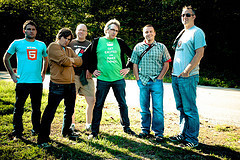

It wasn't all hot tubs and campfires—although there was plenty of both. We worked hard and played hard. Luke did a great job of structuring the event, wielding his managerial experience to make sure that we never got bogged down. We began with some ambitious discussions which led to more focused brainstorming which in turn led to a number of individual projects.
It became clear from fairly early on that simply focusing on mobile alone would be missing the bigger picture. Instead of being overwhelmed by the ever-increasing range of devices out there, we need to embrace the chaos and accept there will be even more devices—and types of devices—that we can't even anticipate. We should embrace that. Instead of focusing on whatever this season's model happens to be, we should be crafting our services in a robust way, striving for universal access tomorrow as well as today.
The first project to launch is a manifesto of sorts. It's a called to arms. Or rather, it's a call to be future friendly:
Acknowledge and embrace unpredictability.
Think and behave in a future-friendly way.
Help others do the same.
The future friendly site also contains a set of design principles, but they are the starting points for discussions rather than the end points for solutions. Consider them a work in progress.
You can also find a list of future-friendly resources that will most definitely grow over time—probably beyond the bounds of the site.
This is just the beginning. The future is ours to make—friendly.
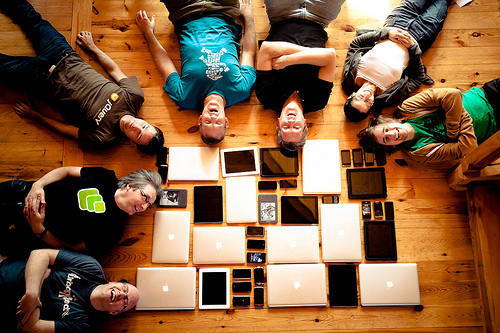
Tagged with
mobilewood
futurefriendly
bdconf
September 19, 2011
Detection
One of the recurring themes at the Mobilism conference earlier this year—and more recently at the Breaking Development conference—was the subject of server-side user-agent detection. I posed the question in absurdum on the Mobilism browser panel:
A useful tool for developers or spawn of Satan: which is it?
It's a contentious issue, as Alex's strident defence illustrates. Personally, I've never been a fan but that's mostly because of the long history of really, really bad UA-detection in the past. When I discussed this issue with Lyza we came to a détente, agreeing that there is nothing inherently wrong with server-side UA-detection: it's what you do with it that counts.
In their presentation at Breaking Development Bryan and Stephanie outlined the kind of detection that they have used. Crucially, it assumes a very basic small-screen default—rather than assuming a desktop browser—and later double-checks the profile on the client-side using feature detection.
Luke recently outlined another kind of cautious device detection that he's calling RESS: Responsive Design + Server Side Components, sending subtly-different DOMs to different classes of device. He also recently wrote about why Bagcheck has a separate mobile site and it strikes me that RESS could alleviate the concerns he mentioned regarding responsive design for Bagcheck.
I think that RESS could be a very useful technique as long as it assumes a safe default: a small-screen, low-bandwidth default. That way, any UA detection would be done against a fairly limited set of user agents: desktop browsers and maybe tablets. To me, that seems far more reasonable than trying to pattern-match against the sprawling jungle of mobile devices in the wild …not to mention the swampy morass of licensing issues with Device Atlas (and now WURFL too).
As ever, smart defaults are really important. Just as truly responsible responsive web design goes hand-in-hand with a mobile/content first approach, I think that any server-side detection should do the same. It completely inverts the problem space. Instead of thinking "How can I stop this nice-to-have content/functionality being sent to mobile devices?" you can assume a mobile device by default and then your question becomes "How can I make sure that this nice-to-have content/functionality is only sent to desktop devices?" (the answer probably involves some kind of conditional loading with JavaScript).
A thornier problem with server-side UA-sniffing is that, regardless of whether you're testing against a list of mobile devices or you're testing against a list of desktop devices, you're still committing yourself to an arms race. You are now obligated to keep your list of browsers up to date.
Still, the rate of desktop browser releases is a lot slower than the rate of mobile browser releases. So if a new desktop browser is released and it ends up being served a mobile-optimised DOM, I think that's better than inadvertently serving a desktop-optimised DOM to a whole bunch of mobile devices.
That's just my opinion of course. As ever, the standard disclaimer applies.
Tagged with
mobile
mobilism
bdconf
browsers
detection
responsive
ress
I, Interface
Asimov's three laws of robotics, though currently fictional, are an excellent set of design principles:
A robot may not injure a human being or, through inaction, allow a human being to come to harm.
A robot must obey any orders given to it by human beings, except where such orders would conflict with the First Law.
A robot must protect its own existence as long as such protection does not conflict with the First or Second Law.
One could easily imagine a similar set of laws being applied to field of user experience and interface design:
An interface may not injure a user or, through inaction, allow a user to come to harm.
An interface must obey any orders given to it by users, except where such orders would conflict with the First Law.
An interface must protect its own existence as long as such protection does not conflict with the First or Second Law.
Okay, that last one's a bit of a stretch but you get the idea.
In his later works Asimov added the zeroth law that supersedes the initial three laws:
A robot may not harm humanity, or, by inaction, allow humanity to come to harm.
I think that this can also apply to user experience and interface design.
Take the password anti-pattern (please!). On the level of an individual site, it could be considered a benefit to the current user, allowing them to quickly and easily hand over lots of information about their contacts. But taken on the wider level, it teaches people that it's okay to hand over their email password to third-party sites. The net result of reinforcing that behaviour is definitely not good for the web as a whole.
I'm proposing a zeroth law of user experience that goes beyond the existing paradigm of user-centred design:
An interface may not harm the web, or, by inaction, allow the web to come to harm.
September 15, 2011
Boston Global Scope
After giving my language-centric talk at the Breaking Development conference I found it interesting to listen out for the terms that attendees and speakers were using to describe desktop-centric websites. Some of the adjectives I heard were:
full site,
standard site,
regular site.
Once again, I think that this kind of language can constrain our approaches to web design and development. In truth, a mobile site should be the standard, full, regular site; you can still go ahead and add more stuff for the desktop environment, but to think of it as the canonical instantiation isn't helpful. It hinders our ability to think in a mobile-first responsive manner.
Jason made a great point in his closing talk at Breaking Development. He said that clients are always asking how much extra it's going to cost them to have a mobile site. But it should be the other way around. The mobile site ought to be the default and they should be asking how much extra it will cost to optimise for the desktop (which is not very much because, let's face it, the desktop environment is a piece of piss compared to mobile).
It can be tough to convince a client that a mobile-first responsive site is the right approach. It's always better to show rather than tell, but up until now there haven't been any poster children for responsible responsive design—much as I like the mediaqueri.es site, the majority of sites showcased are shrinking down from a desktop start.
This reminds of the situation with web standards ten years ago. There were plenty of great sites that has switched over from table layouts to CSS but they were mostly blogs and portfolio sites (again, take a look at mediaqueri.es). It wasn't until large commercial entities like ESPN and Wired.com were brave enough to make the switch that the CSS floodgates opened.
As of this week, we have a poster child for responsive web design: The Boston Globe. Actually, that does it a disservice …it's a poster child for excellence in web design and development best practices.
I was lucky enough to have Scott do a show'n'tell at my dConstruct workshop. Seeing the thought and care that went in to every step of the process was humbling. There were a lot of tough challenges but they kept their eye on the prize: universal access—regardless of what device you're using—without compromising on visual and interactive richness.
I'm going to let the site speak for itself but I just wanted to send my heartfelt congratulations to Ethan, Miranda, Scott, Todd, Patty and everyone else at Filament Group, Upstatement and the Boston Globe. Their hard work will benefit everyone designing and development for the web. Thank you guys.
Here are some reports in their words:
From the Boston Globe itself, here's a look at the strategy and business goals that informed the site.
Ethan wrote about his role in the process.
Upstatement have a beautiful portfolio page (itself responsive) showcasing the Boston Globe.
Patty documents Filament Group's experience with this project.
Lots of other people are writing about the Boston Globe launch, although much of the commentary focuses on the forthcoming paywall/fence rather than the design or technology. Jeffrey has written about the site, also comparing it to Mike's visionary work on ESPN back in the day.
I could go on and on about how well the site works on touchscreen devices, tablets and mobile phones of all kinds but I think the essence of what makes the site great is captured in Grant's screenshot of The Boston Globe site running on… an Apple Newton.
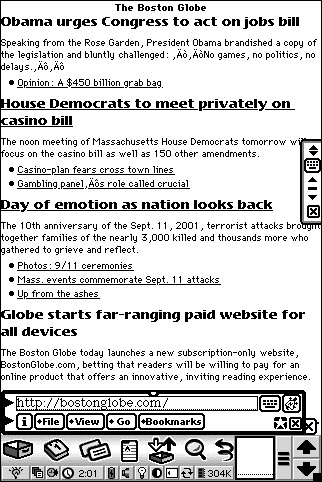
Tagged with
bostonglobe
responsive
mobile
design
development
oneweb
mobilefirst
September 14, 2011
The Language of the Web
The Breaking Development conference is wrapping up here on spacecraft Opryland One. It's been a wonderful experience. The conference itself was superbly curated—a single track of top-notch speakers in a line-up that switched back and forth between high-level concepts and deep-dives into case studies. I hope that other conferences will take note of those key phrases: "single track", "curated", "top-notch speakers" (see also: An Event Apart, dConstruct, Mobilism).
I opened the show with a talk that sounds controversial: There Is No Mobile Web. Actually, it wasn't as contentious as it sounds (I originally proposed a talk called Fuck The Mobile Web: Fuck It In The Ass—then it would've been controversial). You can download a PDF of my slides if you want but, as usual, they won't make much if any sense outside the context of the presentation.

My talk was concerned with language; Lakoffian political language in particular. When I say "there is no mobile web," I mean it quite literally: there isn't a separate world wide web for mobile devices. But by using the phrase "mobile web" we may be unintentionally framing the discussion in terms of separate silos for different kinds of devices (desktop and mobile) in a similar way that a term like, say, "tax relief" automatically frames the discussion of taxation as something negative. By subtly changing the framing from "the mobile web" to a more accurate phrase such as "the web on mobile" we could potentially open new avenues of thinking.
By the same token the phrase "one web"—which is the drum that I bang—is really a tautology. Of course there's only one web! But the phrase has political and philosophical overtones.
So I asked the assembled audience if we could come to an agreement: I'll stop saying "one web" if you stop staying "mobile web." How about …"the web"?
I also talked about the power of naming things, invoking the foreword I wrote for Ethan's book:
When Ethan Marcotte coined the term "responsive web design" he conjured up something special. The technologies existed already: fluid grids, flexible images, and media queries. But Ethan united these techniques under a single banner, and in so doing changed the way we think about web design.
I'm not invoking the Sapir Whorf hypothesis here, I just wanted to point out how our language can—intentionally or unintentionally—have an effect on our thinking.
One of the other phrases I discussed was "web app." The timing couldn't have been better. Fellow Breaking Development speaker James Pearce has just written a blog post all about defining what makes something a web app. It's very detailed and well thought-out but I'm afraid at the end of it, we're still no closer to having a shared agreed-upon definition. It's like the infamous Supreme Court definition of obscenity: "I know it when I see it."
My concern is that the phrase "web app" is wielded as a talisman to avoid best practices. "Oh, I totally agree that we should care about accessibility …but this isn't a web site, it's a web app." "I think that progressive enhancement is great …for websites; but this is a web app." The term is used as a get-out-of-jail free card and yet we can't even agree what it means. I call shenanigans. I don't think it is useful or productive to create an artificial boundary between documents and applications when the truth is that almost everything on the web exists on a continuum between the two poles.
Luke has published his excellent notes from my talk. You should read 'em. While you're at it, you should read all of the notes that he took at the conference.
Make sure you check out the notes from Stephanie's mind-blowing case study of browser.nokia.com. The slides are on Slideshare too.
As I said, the Breaking Development conference did an excellent job of balancing the practical with the inspirational. Stephanie's intensely useful case study was perfectly balanced by an absolutely incredible call to arms from Scott Jenson called Why Mobile Apps Must Die (and you thought my talk title was contentious), in which he expanded on his brilliant writings over on the Beyond Mobile blog.
The next Breaking Development event will be next April in Orlando. Single track. Curated. Top-notch speakers.
Tagged with
bdconf
nashville
opryland
mobile
language
webapps
oneweb
September 13, 2011
The country songs of distant Earth
I flew into Nashville on the weekend for the Breaking Development conference, which is proving to be excellent so far.
The event is taking place within the Gaylord Opryland (stop sniggering). It's a very unusual environment. At one point it was a theme park. Now it's a complex of hotel buildings, parks and restaurants all contained under a glass and metal ceiling. The whole place feels like it's hermetically sealed—the ideal place to hole up during a zombie apocalypse.
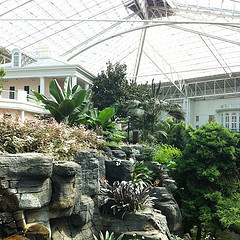
I've been inside this world since Saturday evening. I have memories of the outside world. I remember the feeling of a breeze on my face, the sun on my skin. I remember the cash-based monetary system used by the surface dwellers; so inefficient compared to the unique identifier contained in my room key.
I began to realise that, in the absence of any evidence that I was in fact still in Tennessee, it was entirely possible that this self-contained ecosystem was not necessarily earthbound. What if I'm in an orbital habitat? Or a generation starship?
I've been surreptitiously attempting to explore the shape of the complex—without drawing too much attention to myself (I think they're watching)—trying to figure out if I'm in a Stanford torus or, more likely, a Bernal sphere.
The builders have created a near-flawless illusion of the homeworld. The climate control has been consistent and the gravity is a perfect Earth 1. I'm a little nervous about the possibility of a meteor penetrating the shell and causing decompression problems, but I think they must have a phalanx of automated lasers on the outside hull to take care of that eventuality.
There are plenty of plants under the glass dome, which should ensure a renewable supply of food. Strangely, I haven't seen any animals (apart from fish) but most of the food available in the restaurant appears to be meat-based.
I don't know how long the voyage will last. I don't even know where our destination lies. But so far there are no hardships to endure. Our hosts are ensuring our psychological wellbeing with a plentiful supply of piped music …though why it is exclusively country music remains a mystery to me. We are, after all, a long, long way from Nashville.
Jeremy Keith's Blog

- Jeremy Keith's profile
- 56 followers

