
Eugene Volokh's Blog, page 77
July 9, 2025
[Ilya Somin] Courts Can Check, and Have Checked, Executives' Military Judgment
[Katherine Yon Ebright and Leah Tulin of the Brennan Center make the case against judicial deference to Trump's invocation of the Alien Enemies Act of 1798.]
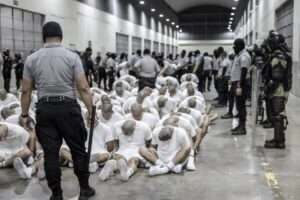 A prison guard transfers Alien Enemies Act deportees from the U.S., alleged to be Venezuelan gang members, to the Terrorism Confinement Center in Tecoluca, El Salvador. Mar. 16, 2025 (El Salvador Presidential Press Office)
Last month, Brennan Center attorneys Katherine Yon Ebright and Leah Tulin, and I submitted an amicus brief in the Fifth Circuit case of W.M.M. v. Trump, opposing the Trump Administration's use of the Alien Enemies Act of 1798 as a tool for peacetime detention and deportation of immigrants. Katherine is a leading expert on the AEA and its history. The brief was filed on behalf of the Brennan Center for Justice at NYU, the Cato Institute, prominent law-of-war scholar Prof. John Dehn, and myself.
Our brief was favorably cited by Fifth Circuit Judge Leslie Southwick in last week's oral argument in the case. Katherine and Leah have written this guest post addressing some key issues raised in the argument, and the AEA litigation more generally. I agree with virtually all their points! But what follows in the block quote is their work, not mine:
Last Monday, the Fifth Circuit heard oral argument in W.M.M. v. Trump, the first Alien Enemies Act challenge to make it to a circuit court in (somewhat) regular order rather than on an emergency motion. Among the issues raised in the case — which finds its way to the Fifth Circuit at the Supreme Court's direction rather than on a standard appeal — is the propriety of President Trump's invocation of the 1798 law to deport scores of immigrants he alleges are members of Tren de Aragua, a Venezuelan gang. As oral argument made clear, a central question is whether the judiciary may second-guess the president's determination that an "invasion" or "predatory incursion," a prerequisite for the law's use, is ongoing.
The Alien Enemies Act is a wartime law that affords the president tremendous regulatory, detention, and deportation power over noncitizens from hostile nations. It can be invoked when Congress declares war or when a "foreign nation or government" has perpetrated or threatened an "invasion" or "predatory incursion" against U.S. territory. On March 15, the president proclaimed that Tren de Aragua had perpetrated such an attack by facilitating unlawful migration and committing drug trafficking and other crimes. He referred to these acts as "irregular warfare" and attributed the gang's activities to the nation of Venezuela, which he called a "hybrid criminal state."
Common sense, of course, tells us that the nation is not being invaded by Venezuela and that gang violence, while a serious issue, is not war. Moreover, top administration officials, ranging from the CIA Director to the Chairman of the Joint Chiefs, have repeatedly told Congress the same thing.
No matter. In the Fifth Circuit, the government is arguing that the courts "must defer" to the president's proclamation, even if they disagree that an invasion or predatory incursion is underway. These matters, the government contends, are so heavily infused with political judgment that the courts are powerless to intervene.
The "political question doctrine" and other judicial deference doctrines have often precluded the courts' intervention in cases involving sensitive foreign policy and national security judgments. To that end, the Fifth Circuit judges expressed uncertainty about the permissible scope of review. Judge Oldham, in particular, asked whether any Supreme Court opinion supported the authority of the courts to "countermand the president of the United States in his determination regarding armed conflict" or to second-guess a chief executive, whether the president or a governor, in his identification of "an insurrection, an invasion," or other such events.
Petitioners' counsel, Lee Gelernt of the ACLU, rightly responded that the Supreme Court has repeatedly and specifically said that the judiciary may evaluate whether the Alien Enemies Act is properly invoked. Gelernt also discussed the Court's cases regarding law-of-war detention at Guantanamo Bay, in which the judiciary has carved out for itself a role in assessing whether detainees are in fact enemy combatants.
Beyond these examples, there is another line of cases that affirms the courts' power to overturn executive decision-making in sensitive matters of war, peace, and public safety. That caselaw begins with Sterling v. Constantin, a 1932 case in which the Supreme Court rejected a Texas governor's imposition of martial law. While acknowledging that the governor had broad discretion to proclaim an "insurrection" as "chief executive officer of the state and commander in chief of its military forces," the Court ruled that the governor's proclamation exceeded his authority. Because there was "never any actual riot, tumult, or insurrection" in reality, the governor's imposition of martial law fell beyond the "permitted range of honest judgment" an executive has for carrying out his constitutional obligation to faithfully execute the law.
Since 1932, Sterling's "permitted range of honest judgment" rule has been applied rarely but with great consequence. As those following the Alien Enemies Act invocation may know, the law was last used in World War II to intern 31,000 noncitizens of Japanese, German, and Italian descent. Several months after the United States entered the war, the Alien Enemies Act was complemented and quickly overshadowed by Executive Order 9066 — the authority used to incarcerate more than 120,000 Japanese Americans, including tens of thousands of U.S. citizens, on the West Coast. Applying the rule in Sterling, the courts prevented this second authority from being applied to German Americans on the East Coast.
In Schueller v. Drum and Ebel v. Drum, courts rejected claims of military necessity made by General Drum of Eastern Defense Command, who sought to apply Executive Order 9066 to target German Americans in Pennsylvania and Massachusetts. The judge in Schueller observed, "The normal civilian life of the area was being pursued . . . and it could not be honestly said that ordinary law did not adequately secure public safety." The military could not use an exceptional wartime authority — even one signed by the president and backed by the Congress — to dislodge constitutional rights when no "exigency of war" existed in fact.
Schueller and Ebel were decided in 1943, at a time of immense concern and uncertainty regarding the national security. They stood in stark contrast to the reflexive judicial deference on display in Korematsu v. United States, the 1944 Supreme Court case upholding Japanese incarceration on the West Coast that has since been rightly and roundly condemned as "wrong the day it was decided." Indeed, Schueller and Ebel have since been held out by some as evidence that German Americans were treated more fairly than Japanese Americans because of racial prejudice. But those decisions also stand out as powerful examples of the critical role that the judiciary can and should play in protecting individual civil liberties against unsupported claims of a national security threat.
There are other cases that support the authority of the courts to check "manifestly unauthorized exercises of power," even in wartime. Notably, Ex parte Milligan countermanded the president's approval of the use of military commissions in Indiana, citing "judicial knowledge that in Indiana the Federal authority was always unopposed." We discuss Sterling, Milligan, and other relevant cases in an amicus brief filed in the Fifth Circuit on behalf of the Brennan Center, Cato Institute, and law professors Ilya Somin and John Dehn.
But Sterling, and particularly Schueller and Ebel, should weigh heavily in this case, given the Alien Enemies Act's role in World War II internments and the breadth of the power the administration is trying to unlock through its use of the law in peacetime. A Department of Justice memorandum on the current Alien Enemies Act invocation mentions the possibility of warrantless house raids and summary deportations that bypass protections for refugees. When the facts are so clear, and the stakes of judicial deference are so high, the courts must exercise their independent judgment lest they sanction another mistake that will echo through our nation and legal community for generations.
I (Ilya Somin) have previously criticized Trump's invocation of the AEA as beyond the scope of the statute in a variety of writings. See, e.g., here, here, here, and here. I have also explained why Trump's AEA deportations violate the Due Process Clause of the Fifth Amendment.
The post Courts Can Check, and Have Checked, Executives' Military Judgment appeared first on Reason.com.


[Eugene Volokh] Privacy/Confusion Concerns Can't Justify Ordering Search Engines Not to Report on Court Case
From Judge Tanya Chutkan (D.D.C.) today in U.S. v. Tamberg:
Defendant Alexis James Andreas Tamberg pleaded guilty to transmitting threats in interstate commerce in violation of 18 U.S.C. § 875(c) based on a series of Facebook messages threatening President Donald J. Trump and Congresswoman Alexandra Ocasio Cortez. In light of Tamberg's extensive mental health issues, which contributed to his criminal conduct, the Government sought and the court imposed a sentence of time served and two years' supervised release…. Defendant filed a Motion to Alter Judgment, asking the court to enjoin search engines, specifically, Google and Bing, from reporting on this case…. Tamberg represents that public reporting by search engines "leads to confusion" because he and his father have similar names. Defendant's name is Alexis James Andreas Tamberg; his father's name is Andreas Tamberg. According to Tamberg, the search engines report the case as "United States v. Andreas Tamberg," which "has negatively impacted" his father's life.
The court concluded that Tamberg lacked standing to raise his father's interests, but also added this:
Even if Tamberg could assert his father's privacy interests, the court could not grant the requested relief. Court orders restraining media reporting on criminal proceedings are presumptively unconstitutional under the First Amendment.
Courts may "appropriately delimit what trial participants, including the accused, can say publicly," but have very "limited authority to restrict the speech of the press and other outsiders to the litigation." To restrain speech by nonparties, the speech must "present[ ] a 'clear and present danger to the administration of justice.'" The restriction must be narrowly tailored to serve a compelling government interest.
The Supreme Court has refused to restrict "publication of information that would have been available to any member of the public who attended an open proceeding in a criminal trial" based solely on privacy interests. Cap. Cities Media, Inc. v. Toole (1983); see, e.g., Cox Broad. Corp. v. Cohn (1975) ("Once true information is disclosed in public court documents open to public inspection, the press cannot be sanctioned for publishing it." (citation omitted)); Neb. Press Ass'n v. Stuart (1975) (Facts in criminal proceedings "are presumed to be in the public domain."); Sheppard v. Maxwell3 (1966) ("[T]here is nothing that proscribes the press from reporting events that transpire in the courtroom."); Craig v. Harney (1947) ("What transpires in the court room is public property … There is no special perquisite of the judiciary which enables it, as distinguished from other institutions of democratic government, to suppress, edit, or censor events which transpire in proceedings before it."); Globe Newspaper Co. v. Superior Ct. (1982) (holding "Massachusetts' mandatory rule barring press and public access to criminal sex-offense trials during testimony of minor victims" violates the First Amendment); Fla. Star v. B.J.F. (1989) (barring civil liability where a newspaper publishes truthful information which it has lawfully obtained).
The post Privacy/Confusion Concerns Can't Justify Ordering Search Engines Not to Report on Court Case appeared first on Reason.com.
[Irina Manta] "Why Jack Daniel's Can't Stop #WestElmCaleb and What Now?" Published
[How Changes in SCOTUS Trademark Doctrine Affect Viral Hashtag Campaigns (or Not)]
Together with my coauthor and former student Kavita Balchand, I recently published a law review article entitled "Why Jack Daniel's Can't Stop #WestElmCaleb and What Now?" in the William & Mary Bill of Rights Journal. It is available for download here, and this is the abstract:
The Supreme Court's recent decision in Jack Daniel's Properties v. VIP Products was hailed as a victory by trademark owners worried about infringement and dilution. Its holding weakened the potential protection that trademark parodies would receive via the fair use defense. That said, it remains difficult to use trademark law to stop many uses of marks that harm a brand, in an era in which a single negative viral hashtag campaign could spell disaster. Notably, hashtags including trademarks such as "#WestElmCaleb" and "#TinderSwindler" have spread in recent years and arguably brought disrepute to the named companies by connecting them to alleged predators of various stripes. Even with the Jack Daniel's holding going their way, trademark owners are unlikely to be able to act against most third parties who use their marks on social media in this manner, mainly because the use is descriptive and not for financial gain. Things are murkier when commercial entities make use of a hashtagged or previously-hashtagged term, as happened with "West Elm Caleb" when other companies began making references to the term in their messaging. West Elm would be going down an uncertain legal road by pursuing those claims, however, and meanwhile any claims against individual social media users would likely not only lose but also hurt the company with consumers. The solution for optimal brand management may largely lie in self-help: companies such as West Elm should prevent harassing and other unsavory behavior on the part of their employees on social media and in other communications in the first place, and companies such as Tinder must overhaul their safety practices to rein in predatory users. This Article proposes advances in employee policies and training to prevent trademark harms arising from employees' online behavior, and also gives guidance on dating apps' user problem. While Jack Daniel's might not be able to stop West Elm Caleb or the Tinder Swindler, the companies involved can take a real "shot" at it.
The post "Why Jack Daniel's Can't Stop #WestElmCaleb and What Now?" Published appeared first on Reason.com.
[Eugene Volokh] Douglass Mackey's Vote-by-Text Meme Conviction Reversed, Citing Insufficient Evidence of Conspiracy
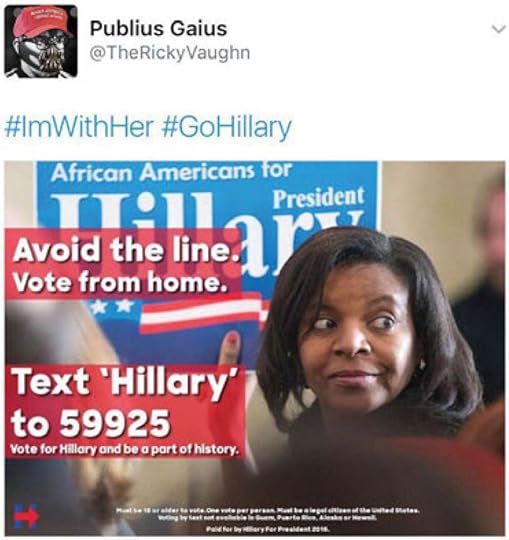
A short excerpt from today's long decision in U.S. v. Mackey by Second Circuit Judge Debra Ann Livingston, joined by Judges Reena Raggi and Beth Robinson:
On November 1 and 2, 2016, Defendant-Appellant Douglass Mackey … posted or reposted three "memes" on Twitter falsely suggesting that supporters of then-candidate Hillary Clinton could vote in the 2016 presidential election by text message. Based on these posts, a jury … convicted him of conspiring to injure citizens in the exercise of their right to vote in violation of 18 U.S.C. § 241.Mackey argues on appeal that the evidence was insufficient to prove that he knowingly agreed to join the charged conspiracy. We agree….
The parties do not dispute either (1) that Mackey posted the memes or (2) that his doing so independently would not be a crime under Section 241. Section 241 criminalizes only conspiracies between "two or more persons." As a result, the mere fact that Mackey posted the memes, even assuming that he did so with the intent to injure other citizens in the exercise of their right to vote, is not enough, standing alone, to prove a violation of Section 241. The government was obligated to show that Mackey knowingly entered into an agreement with other people to pursue that objective.
This the government failed to do. Its primary evidence of agreement, apart from the memes themselves, consisted of exchanges among the participants in several private Twitter message groups—exchanges the government argued showed the intent of the participants to interfere with others' exercise of their right to vote. Yet the government failed to offer sufficient evidence that Mackey even viewed—let alone participated in—any of these exchanges. And in the absence of such evidence, the government's remaining circumstantial evidence cannot alone establish Mackey's knowing agreement. Accordingly, the jury's verdict and the resulting judgment of conviction must be set aside….
To begin, the government presented no evidence that Mackey participated in the conspiracy's formation. The government put forth extensive evidence that other members of the War Room, as well as members of Micro Chat and Madman #2, distributed and discussed memes suggesting citizens could vote by tweet or text in the lead-up to the election. But notably absent from this evidence was a single message from Mackey in any of these direct message groups related to the scheme. Indeed, Mackey was not even a member of Madman #2 or Micro Chat from approximately October 5, 2016 through the election. And the record contains no evidence that Mackey posted any messages in the War Room in the two weeks before he tweeted the text-to-vote memes….
The government argues that even if there is no evidence Mackey participated in the planning of the conspiracy, if he viewed the messages related to the conspiracy, he had express knowledge that an agreement had been formed. And by posting the text-to-vote memes with knowledge of this existing agreement, Mackey "knowingly joined and participated" in the conspiracy. We conclude, however, that the evidence is insufficient to establish either of these points as well.
To be sure, nothing is amiss in the government's theory as to how it proved its case. For many conspiracies—whether formed in person or online—the defendant's conduct itself, considered in light of the surrounding circumstances, is highly probative of his knowing participation in the unlawful enterprise. For example, if members of an online message group discussed the details of a plan to commit a terrorist attack, and then another member of that group who did not post any messages went on to participate in that specific attack, the defendant's actions in carrying out the attack might well be enough to support the reasonable inference that he was aware of the group's plotting and knowingly joined the conspiracy….
But the reasonableness of the inference of knowing agreement from the government's circumstantial proof depends on the nature of that proof. Consider United States v. Bufalino (2d Cir. 1960). We famously concluded there that the government had offered insufficient evidence that suspected Mafia members—who gathered in Apalachin, New York, for a prearranged meeting—agreed among themselves, in the meeting's aftermath, that they would conceal that it had been planned in advance. We emphasized the plausibility of the alternative explanation that the participants, who explained variously to law enforcement or to grand juries that they were in the area, inter alia, to visit a sick friend, attend to business, or accompany another, might well have independently decided to lie out of self-interest. We reasoned that although it was possible, as the government argued, that the "lies were told pursuant to an agreement," "[t]here [was] nothing in the record or in common experience to suggest that it [was] not just as likely that each [participant in the meeting] decided for himself that it would be wiser not to discuss all that he knew." …
Here, the conduct at issue—posting text-to-vote memes similar to others circulating publicly online— does not in isolation show awareness of, much less knowing participation in, a conspiracy. The government does not contest that Mackey downloaded the memes from 4chan but argues that the inspiration to do so came from discussion in the War Room. This is possibly true. But the inference is speculative and the government relies largely on conjecture to rule out the alternative scenario: that Mackey's conduct was independent of any knowledge of the War Room discussions. Mackey did not send any messages in the War Room in the two weeks before his text-to-vote tweets, despite having actively participated in the group in the past. Moreover, there were "over 600 messages coming in per day in the War Room" and only 12 posts related to the alleged conspiracy, two of which were sent within one minute of each other and the other 10 within a 20-minute period….
Congress expressly limited Section 241's reach to conspiracies. There are several reasons why Congress may have done so—for example, that "[c]oncerted action both increases the likelihood that the criminal object will be successfully attained and decreases the probability that the individuals involved will depart from their path of criminality," or that "[g]roup association for criminal purposes often, if not normally, makes possible the attainment of ends more complex than those which one criminal could accomplish." But the critical point is that Congress made this choice—one it has declined to deviate from in the more than 150 years since Section 241's enactment.
Here, the government conceded that Mackey downloaded his text-to-vote tweets from 4chan. It failed to establish, in accordance with its theory of the case, that Mackey became aware of the text-to-vote memes in the War Room and tweeted them pursuant to a conspiracy launched there. That theory was possible, but so was an alternative one: that Mackey became aware of the memes independently and decided on his own to post them. There was no evidence from which a juror could "choose among [the] competing inferences" as to these two scenarios and resolve those inferences in the government's favor. Nor was there any basis in "common sense and experience" to do so. And without establishing that Mackey was at least aware of the War Room posts, the additional evidence (or lack thereof) was inadequate to show his knowing participation in a conspiracy.
The court therefore had no need to discuss the broader statutory or First Amendment issues discussed in my amicus brief.
Yaakov M. Roth (with Eric S. Dreiband, Joseph P. Falvey, Caleb P. Redmond, Harry S. Graver on the brief) of Jones Day represents Mackey. Thanks again to Russell B. Balikian & Cody M. Poplin (Gibson, Dunn & Crutcher LLP) for drafting my amicus brief (based generally on some thoughts that I'd expressed in this 2021 Tablet article).
The post Douglass Mackey's Vote-by-Text Meme Conviction Reversed, Citing Insufficient Evidence of Conspiracy appeared first on Reason.com.
[Mark Movsesian] More on Coercion in Mahmoud
[Implications for the Ten Commandments cases]
Some quick thoughts occasioned by Josh Blackman's post on coercion in Mahmoud v. Taylor, last Term's parental rights case.
As readers will recall, Mahmoud held that a Maryland school district violated the Free Exercise Clause when it rescinded an opt-out policy that had allowed parents to have their children excused from elementary school lessons featuring LGBTQ+-inclusive storybooks. The Court reasoned that the storybooks, along with classroom discussions that encouraged teachers to reinforce their messages, imposed psychological pressure on students to accept a normative view of sexuality—one that directly conflicted with the religious teachings the parents sought to instill. That pressure, the majority concluded, amounted to a substantial burden on the parents' religious exercise.
In a post yesterday, I noted what seemed like an ideological reversal in the case. In the school prayer context—for example, Kennedy v. Bremerton School District—it's typically progressives who emphasize the dangers of subtle coercion and impressionable students, while conservatives downplay those concerns. In Mahmoud, the roles flipped. The conservative majority focused on the psychological pressure placed on young children by state-endorsed messaging, while the progressive justices appeared less troubled by that dynamic.
So which side is being inconsistent? Perhaps both are simply responding to context. Or perhaps the concept of "coercion" is more manipulable than either side tends to admit.
Josh offers one way to reconcile Mahmoud and Kennedy: by distinguishing between pressure on students' religious beliefs versus their non-religious beliefs. Under this reading, Mahmoud bars the state from pressuring students to abandon religious teachings, but Kennedy permits exposure to religious ideas, even if the state implicitly favors them, so long as there's no coercion into belief.
I wonder if another, simpler distinction might do more work: the age of the students involved. Mahmoud concerned very young children—kindergarten through fifth grade—who are especially vulnerable to subtle cues from teachers. Kennedy, by contrast, involved high school students, who, in theory at least, are better equipped to resist classroom pressure—or have already learned to tune out much of what their teachers say. In other words, the Court might be drawing an implicit line based not just on the nature of the message but on the susceptibility of the audience.
Josh also rightly highlights a doctrinal frontier: the Ten Commandments display cases currently working their way through the lower courts. These raise hard questions for conservatives post-Mahmoud. In Stone v. Graham (1980), the Court struck down a classroom display of the Ten Commandments under the Lemon test. But since Kennedy, Lemon is out, and the Court has instructed lower courts to apply a "history and tradition" framework to Establishment Clause claims.
Even under that revised test, though, the state may not coerce religious belief. And if Mahmoud teaches that distributing LGBTQ+-affirming storybooks to elementary schoolers is too coercive, might a Ten Commandments display in the same setting pose a similar problem?
Courts may try to draw a line between passive and active messaging. One possible distinction appears in the European Court of Human Rights' decision in Lautsi v. Italy (2011), which upheld the display of crucifixes in public school classrooms. The Court reasoned that crucifixes were "passive symbols" and unlikely to indoctrinate students, unlike formal instruction. U.S. courts might adopt a similar distinction here. In Mahmoud, teachers were not just presenting material; they were encouraged to affirm the books' messages and correct students who disagreed. A silent wall display may strike courts as less coercive.
The post More on Coercion in Mahmoud appeared first on Reason.com.
[Eugene Volokh] Words "So Indefinite, Ambiguous and Incertain" That They Aren't Treated as Slanderous
This is a familiar principle in modern defamation law: Some words, however pejorative, are treated as too general to be the sorts of factual allegations that can count as defamation. I just came across the same principle in Marshall v. Addison (Md. Provincial Ct. 1773), and thought it formed a good illustration of how long Anglo-American law has been dealing with these questions:
THIS was an action of Slander. The declaration contained three counts. The first and second counts, for saying the plaintiff was "a rogue and villain, and that he had ruined many families, and the curses of the widows and children were on him," &c. "that he had wronged the defendant's father's estate, and cheated the defendant's brother Thomas." …
There are three heads under which the law may be divided with respect to actions of this nature.
1st. Words are actionable which charge a person with any offence which would subject him to corporal punishment.
2d. Words are actionable spoken of a person in his trade or profession, which would not be so if spoken of other persons, from a jealousy the law entertains, founded on public utility, in their favour.
3d. Words are actionable, which otherwise would not be so, if they have occasioned any special or particular damage to the party.
Rogue or villain are so indefinite, ambiguous and incertain, that they are always deemed words of heat, and not subjecting the person to any particular penalty; no action will lie. Cheat is equally so; for like rogue, a man may cheat in a thousand different ways without being subject to any action—as by charging goods at a greater price than agreed on—turning tobacco into money, and so again in tobacco—not allowing one man the general current prices for his tobacco, which are allowed to others. All these are cheats, and yet not punishable by corporal penalty….
Note that it's not clear that, at the time, the same rule would apply to libel (i.e., written rather than oral defamation): It may be that such pejoratives would have been actionable if written. Today, generally speaking, statements that are viewed as general expressions of condemnation, without a relatively concrete factual allegation behind them, wouldn't be actionable regardless of whether they were written or oral. (Of course, much depends on whether, in context, those words are seen as alluding to some specific misconduct.)
The post Words "So Indefinite, Ambiguous and Incertain" That They Aren't Treated as Slanderous appeared first on Reason.com.
[Eugene Volokh] Court Upholds Anti-Stalking Injunction Stemming from Public Pressure Campaign Over Allegedly Wrongly Withheld Cat
From the N.H. Supreme Court Thursday in D.V. v. R.G. (see also the newspaper coverage of the initial controversy; court records reflect that the parties are Valente v. Garcia):
The plaintiff owns a business near an apartment building in Manchester where the defendant lives. In June 2024, the defendant let her cat outside. The cat was apparently sick and dying. On the same day, the plaintiff's daughter found a cat on the plaintiff's property that appeared to be in poor health. The plaintiff took the cat in and spent several thousand dollars on veterinary care. [Note that defendant argues, in her appellate brief that the cat was "an indoor-outdoor cat who would wander the neighborhood"; she had taken the cat to the vet, who told her that the cat "may die in the upcoming weeks"; she brought the cat "home so he would live his last days with his family"; and she let the cat continue his daily routine, including his outside time, "because at the time, he was not in distress." -EV]
On Friday, June 28, the plaintiff learned that the defendant had lost a cat and went to the defendant's apartment to inquire whether the cat belonged to the defendant. Although the parties dispute what the plaintiff said or promised during that meeting, there is no dispute that, by the end of the day, the plaintiff refused to return the cat to the defendant. According to the plaintiff, she was concerned that, if the cat were the defendant's cat, the defendant had abused or neglected it. The plaintiff communicated to the defendant that she planned to consult with Manchester Animal Control when it opened the following Monday morning.
By Saturday, the defendant had made claims on social media that the plaintiff and her daughter had stolen her cat. [More facts below. -EV] The defendant also organized a protest outside the plaintiff's business. [Again, more facts below. -EV] … On Tuesday, when the plaintiff's daughter brought the cat, at the suggestion of the police, to the animal shelter, the cat had died. The defendant then claimed on social media that the plaintiff had killed the cat….
New Hampshire law allows courts to issue anti-stalking orders of protection, aimed at stopping defendants from
"[p]urposely, knowingly, or recklessly engag[ing] in a course of conduct"—defined to include at least two acts of communication—"targeted at a specific person""which would cause a reasonable person to fear" for the person's or family members' safetywhen such fear has indeed been caused.Plaintiff sought such an order, and the trial court issued it, banning defendant from "further acts of stalking"—which presumably forbade the defendant from repeating the behavior that she engaged in—and specifically banning defendant "from posting about Plaintiff and her business on any public social media accounts." The trial court reasoned (see pp. 22-23 of this PDF):
The Defendant recklessly engaged in a course of conduct targeted at Plaintiff when, on June 29, 2024 Defendant posted. "Your karma is going to come at you ten fold. Give him back like you said you would." On June 30, 2024, Defendant posted on public social media accounts the name of Plaintiff, her daughter, and the name of Plaintiff's business, along with information Defendant could reasonably foresee would, and did, inflame public outrage directed at Plaintiff. When individuals posted threatening statements in response to Defendant's original post. statements such as "Shawty take ya gun n go get ya fucking cat who tf these ppl think they are" and "Go take her daughter[.]"
Defendant expressed approval of these posts suggesting violence against Plaintiff and her daughter. Defendant's approval is evidenced by the Defendant's social media profile picture and a red heart on each post. Defendant weaponized public social media accounts against Plaintiff, which caused Plaintiff to reasonably fear for her and her family member's safety.
Defendant did this by repeatedly making posts with no legitimate purpose other than to inflame the public against Plaintiff and her business. "For a Defendant New Hampshire's stalking statute exempts only constitutionally protected conduct and conduct 'that was necessary to accomplish a legitimate purpose independent of making contact with the targeted person. RSA 633:3-a, II(a).['] Pursuant to RSA 633:3-a, IV, the defendant has the burden to show that his conduct was necessary to accomplish a legitimate purpose." Miller v. Blackden, 154 N.H. 448, 452 {2006). Defendant failed to satisfy her burden of proof to show that her conduct was necessary to accomplish a legitimate purpose.
Defendant's posts repeatedly, with the knowledge of Defendant, elicited statements of violence directed at Plaintiff such as, "I hope your shop burns down you racist ass bitch" and "Should've been your worthless carcass they found in the streets, Debbie. Fucking, disgusting, worthless, racist cat killer". "You should find a rope and hang yourself with it already". and "Disgusting ugly cunt karma is coming for you. And the fucking law. You evil bitch. I hope you die screaming and your little cunt Sabrina too." With full knowledge of the outrage incited by Defendant's posts, in July of 2024, Defendant posted multiple pictures of Plaintiff on public social media accounts.
By posting Plaintiff's photograph, full name, and the name of her business, Defendant knew, or should have known, her conduct would direct the threatening and hostile behaviors directly at Plaintiff, Plaintiff's daughter, and Plaintiff's business. Moreover, Defendant conducted a protest outside Plaintiffs business at which one protester made the statement, "Come out bitch, come out". Defendant failed to prove the protest outside of Plaintiffs business served any legitimate purpose.
"While a content-based restriction is presumptively unconstitutional, it has also long been 'well understood that the right of free speech is not absolute at all times and under all circumstances.' Chaplinsky v. New Hampshire (1942). There are certain 'utterances [that] are no essential part of any exposition of ideas, and are of such slight social value as a step to truth that an benefit that may be derived from them is clearly outweighed by the social interest in order and morality.' Chaplinsky. Accordingly, there are certain categories of speech 'the prevention and punishment of which have never been thought to raise any Constitutional problem.' Those categories of speech include 'advocacy intended, and likely to, incite imminent lawless action; obscenity; defamation; speech integral to criminal conduct; so-called 'fighting words'; child pornography; fraud; true threats; and speech presenting some grave and imminent threat the government has the power to prevent.' United States v. Alvarez (2012) (pluralitv opinion)[.]" S.D. v. N.B. (N.H. 2023).
While Defendant did not directly contact Plaintiff in all posts, "to construe the statute as not encompassing the Defendant's conduct—writing a message addressing the victim and posting it in a public forum but not personally conveying the message to the victim—would add limiting language that the Legislature did not include." State v. Craig (N.H. 2015). While "contact" requires more than merely creating a message, the language chosen by the Legislature requires only that a person act 'either directly or indirectly' to communicate with another." Defendant's posts tagged Plaintiff's business by name, and included Plaintiff's name and picture. The evidence submitted shows Defendant's behaviors were intended to target Plaintiff, whether directly or indirectly."
The New Hampshire Supreme Court agreed, reasoning:
[1. The statute] does not require proof that the defendant personally conveyed threats of violence to or concerning the plaintiff or a member of the plaintiff's immediate family, or expressly encouraged others to do so…. [It is enough that] the trial court found that she recklessly engaged in a course of conduct, targeted at the plaintiff, that caused the plaintiff reasonably to fear for her own safety and the safety of her daughter.
The defendant has presented no developed legal argument challenging the trial court's findings that she acted recklessly, that her actions constituted a "course of conduct" targeted at the plaintiff, or that her actions served no legitimate purpose. Nor has the defendant challenged the trial court's finding that her actions foreseeably inflamed public outrage toward the plaintiff….
[2.] The trial court determined that the defendant did not engage in constitutionally protected speech, and other than asserting that she has a First Amendment right to peacefully protest, the defendant presents no developed legal argument why her conduct, under the facts of this case, was constitutionally protected. Therefore, we decline to address it….
It looks like the defendant's counsel here might not have argued the case very well, by not adequately raising the First Amendment defense; here's the entirety of the section called "The Trial Court's Protective Order Violates the Defendant's Right to Free Speech Under the First Amendment to the Federal Constitution" from defendant's brief (see p. 14 of this PDF):
The Defendant testified that in her past she had participated in protests and understood that she must do so peacefully and must not intrude beyond public spaces.
The First Amendment to the United States Constitution prohibits the passage of laws "abridging the freedom of speech." U.S. CONST. amend I and applies to the states through the Fourteenth Amendment to the United States Constitution. Lovell v. Griffin, 303 U.S. 444, 450 (1938). Orders of a court punishing a person for peacefully protesting abridges that person's freedom of speech and should not have been used as grounds for the issuance of the Stalking Final Order of Protection The United States Supreme Court has stated that "above all else, the First Amendment means that government has no power to restrict expression because of its messages, its ideas, its subject matter, or its content." Police Department of Chicago v. Mosley, 408 U.S. 92, 95 (1972).
The Trial Judge's narrative in the stalking order discounts the Defendant's right to protest whereas the Trial Judge's analysis is contrary to the testimony of Officer Coughlin who responded to the scene and testified at the hearings on Day 1 and the testimony of the Defendant. The Trial Judge's findings improperly bolsters the insufficient evidence presented by the Plaintiff and her daughter at the hearings. In summary, the findings contained in the Trial Judge's narrative concerning the protest contradict the testimony at trial and is unsupported by the record.
Still, setting aside the weakness of the briefing in this particular case, query how a court should decide when such public pressure campaigns—whether involving in-person picketing, other shaming within the community, or purely Internet condemnation—serve a "legitimate purpose."
The issue of course comes up often. Consider, for instance, the controversy stemming from the publication of lists of names and photos of Harvard students who were allegedly linked to pro-Hamas-attack statements. Or, going back some years, consider the identification of the dentist who killed Cecil the lion, which apparently led to threats against the dentist. Or consider the various viral videos that show someone supposedly saying or doing something racist or sexist or otherwise sharply condemned by many people could have the same effect, and that lead to insults of and sometimes threats against the person being depicted.
Or consider what I think is the leading Supreme Court case on the subject, NAACP v. Claiborne Hardware Co. (1982), which stems from a 1966-70 black community boycott of white-owned stores in Claiborne County, Mississippi. The boycott organizers demanded that black customers stop shopping at those stores, and stationed "store watchers" outside the stores to take down the names of black shoppers who were not complying with the boycott. Those names were then read aloud at NAACP meetings at a local black church, and printed and distributed to other black residents. "As stated by the [trial judge], those persons 'were branded as traitors to the black cause, called demeaning names, and socially ostracized for merely trading with whites.'"
Some of the noncomplying shoppers were also physically attacked for refusing to go along with the boycott:
The testimony concerning four incidents convincingly demonstrates that they occurred because the victims were ignoring the boycott. In two cases, shots were fired at a house; in a third, a brick was thrown through a windshield; in the fourth, a flower garden was damaged. None of these four victims, however, ceased trading with white merchants.
The evidence concerning four other incidents is less clear, but again it indicates that an unlawful form of discipline was applied to certain boycott violators. In April 1966, a black couple named Cox asked for a police escort to go into a white-owned dry cleaner and, a week later, shots were fired into their home. In another incident, an NAACP member took a bottle of whiskey from a black man who had purchased it in a white-owned store. The third incident involved a fight between a commercial fisherman who did not observe the boycott and four men who "grabbed me and beat me up and took a gun off me." In a fourth incident, described only in hearsay testimony, a group of young blacks apparently pulled down the overalls of an elderly brick mason known as "Preacher White" and spanked him for not observing the boycott….
Various businesses sued, claiming that the boycott tortiously interfered with the businesses' relationships with their customers, including by frightening away some customers. (That is generally a legally viable sort of claim, setting aside the First Amendment objections.)
Yet the Court held that the First Amendment protected publishing the fact that the noncomplying shoppers were not complying with the boycott—despite the attempt to publicly shame people who were exercising their legal rights to shop at white-owned stores, the natural tendency of such behavior to coerce some people to go along with the boycott, and the eminently foreseeable consequence that there was some violence. Though "[p]etitioners admittedly sought to persuade others to join the boycott through social pressure and the 'threat' of social ostracism," the Court held, "[s]peech does not lose its protected character … simply because it may embarrass others or coerce them into action." And it doesn't lose its protected character even when a few of the listeners foreseeably act violently:
Respondents also argue that liability may be imposed on individuals who were … "store watchers" …. There is nothing unlawful in standing outside a store and recording names….
Only those people who themselves "engaged in violence or threats of violence" may be held liable for those incidents, the Court concluded; simply publicizing the noncomplying customers' names couldn't lead to liability.
Nor do I think that the result would have been different if the people's photos were included alongside their names. In a rural county that had 7500 black residents at the time (I looked this up in the Census data), identifying a person by name would have likely made it pretty clear to fellow residents who it was. And to the extent that the name was ambiguous, and the photo helped show which John Smith was being discussed, it would likely have been better and fairer if the photos could have been included, to avoid people ascribing one person's behavior to another.
I also don't think that the legal result should be affected by whether the information is posted on the Internet (which, in the Harvard pro-Hamas-attack speech example, might have distinguished the names being posted online from the names being displayed on a truck that was apparently being driven around Cambridge). It's true that Internet speech is generally visible by more people, so if even 0.01% of all readers act illegally based on it, that could still be a large number. But on the other hand, the speech in Claiborne Hardware was more likely to reach people's neighbors, who are much more capable of retaliating with real-world violence (as opposed to just nasty e-mails or threats) than are Internet users thousands of miles away.
To be sure, a dispute about a cat (even with an alleged "racist remark to the cat's owner") seems to be of a much lesser magnitude than one about a broad boycott of white-owned stores, or even about alleged pro-Hamas-attack sentiment among Harvard students. But I wonder whether the law can draw a line here, consistently with the First Amendment.
In any event, the New Hampshire case suggests that some judges are indeed open to trying to suppress public pressure campaigns that lead some listeners to threaten their targets (though, again, it's hard to know for sure how broadly they would apply that reasoning). I'd love to hear what our readers think about this sort of order.
Disclosure: I was accused last year by a self-represented frequent litigant of causing people to make threatening phone calls to her, when I published a long law review article that in a few passages identified her as the plaintiff in certain pseudonymous lawsuits. The litigant sought a "harassment restraining order" requiring me to remove her name from the online versions of the published article. Unsurprisingly, the Los Angeles Superior Court dismissed her pseudonymous case against me, and ordered that she be depseudonymized, though she is currently appealing those decisions. My views described above long predate that lawsuit.
The post Court Upholds Anti-Stalking Injunction Stemming from Public Pressure Campaign Over Allegedly Wrongly Withheld Cat appeared first on Reason.com.
[Eugene Volokh] Wednesday Open Thread
[What's on your mind?]
The post Wednesday Open Thread appeared first on Reason.com.
July 8, 2025
[Josh Blackman] Justice Thomas Avoids Substantive Due Process with Meyer and Pierce
[Thomas may attempt to recast Pierceas a Free Exercise case, but it cannot be understood in that fashion.]
On June 26, the Court decided Gutierrez v. Saenz. Justice Thomas wrote a thoughtful concurrence that explored the meaning of "liberty" in the Due Process Clause. In that concurrence, Thomas cast doubt on the doctrine of substantive due process. Yet, as I noted, Thomas was a bit cagey about Meyer v. Nebraska, and the right to raise children. I suspect that Mahmoud was on Thomas's mind.
On June 27, the Court decided Mahmoud. As I explained in this post, the Court resolved this case about parental rights with barely any mention of substantive due process. The Court is still suffering from Lochner-phobia. Everything was grounded in the Free Exercise of Religion. For example, Justice Alito wrote:
"[W]e have long recognized the rights of parents to direct 'the religious upbringing' of their children." Espinoza v. Montana Dept. of Revenue, 591 U. S. 464, 486 (2020) (quoting Yoder, 406 U. S., at 213–214).
Meyer and Pierce were not limited to "religious upbringing." Those precedents referred to upbringing of children, in all contexts.
Justice Sotomayor's dissent describes the majority opinion accurately:
Here, however, the Court's analysis makes no mention of substantive due process rights or the Fourteenth Amendment Due Process Clause. It instead asserts, simply, that "the burden in this case is of the exact same character as the burden in Yoder."
Justice Thomas wrote a concurrence in Mahmoud that hinted at substantive due process, briefly. Thomas explains that Yoder was based on Pierce v. Society of Sisters:
In reaching this conclusion, the Court relied heavily on its earlier decision in Pierce, which articulated "perhaps the most significant statements of the Court in this area."
And Pierce, in turn, was a substantive due process case:
While the Court did not decide Pierce on free exercise grounds,[FN4] the context in which Pierce arose confirms that it "stands as a charter of the rights of parents to direct thereligious upbringing of their children." Yoder, 406 U. S., at 233.
[FN4] The Court decided Pierce 15 years before it recognized that the First Amendment's free-exercise guarantee applies against the States. See Cantwell v. Connecticut, 310 U. S. 296, 303 (1940).
Griswold and other Warren Court cases tried to recast Pierce as a Free Exercise case, but that doesn't work. Lochner and Pierce are cut from the same cloth.
For reasons I do not understand, Justice Thomas doesn't cite his Gutierrez concurrence, or talk about Lochner. He may have made peace with a substantive due process right to raise children, but his cagey about the basis.
At bottom, the Justices don't want to talk about Smith, and they don't want to talk about substantive due process. But now that Dobbs overruled Roe, I do think there is some space to talk about facets of substantive due process that may be correct.
The post Justice Thomas Avoids Substantive Due Process with Meyer and Pierce appeared first on Reason.com.
[Josh Blackman] The Status of Smith and Yoder After Mahmoud
[The Court continues avoiding the Smith issue, but in an unexpected way.]
A few days ago, I asked if the moment for overruling Smith had passed. At the time, I had not yet read Mahmoud. (I am still making my way through the opinions.) Now, having read Mahmoud, I see a Court that is desperately trying to stay away from the resolving the validity of Smith.
Let me lay out some salient facts from Mahmoud. The government initially allowed parents to opt-out their children from being exposed to certain books. However, that opt-out was later removed. And, as Justice Alito observed, "[t]he Board member went on to suggest that the religious parents were comparable to 'white supremacists' who want to prevent their children from learning about civil rights and 'xenophobes' who object to 'stories about immigrant families.'" Yet, the school permits other types of opt-outs for non-religious reasons.
Based on the Court's precedents, I could see two possible ways to avoid Smith. First, the Court could follow Masterpiece Cakeshop, and find that the statements from the board member were impermissible animus against religious parents. This policy would not be neutral towards religion. That finding would trigger heightened scrutiny under the rubric from Church of the Lukumi. Then again, Justice Sotomayor suggests in Footnote 15 that the Board Member was not actually expressing hostility towards religion, so that argument may not have worked.
Second, the government allowed an exemption for religious parents, but then removed that exemption, even as other exemptions are present. These facts resembles Roman Catholic Diocese, Tandon, and Fulton, under the "most favored nation" approach. In other words, religion is being treated worse than non-religion. This policy would then not be generally applicable, so would be reviewed with heightened scrutiny. The Court even cited Fulton:
This robust "system of exceptions" undermines the Board's contention that the provision of opt outs to religious parents would be infeasible or unworkable. Fulton, 593 U. S., at 542.
But Alito discussed the exemptions at the back-end scrutiny analysis, and not at the front-end to determine whether strict scrutiny applies.
Yet, the Mahmoud Court did not take Door #1 or Door #2. Justice Alito expressly said he wouldn't even consider these arguments:
We acknowledge the many arguments pressed by the parents that theBoard's policies are not neutral and generally applicable. See Brief for Petitioners 35–44. But we need not consider those arguments further given that strict scrutiny is appropriate under Yoder.
Instead, Justice Alito took Door #3: Yoder. Alito explains that Mahmoud has the same "special character" as Yoder, so the Court follows that precedent.
Here, the character of the burden requires us to proceed differently. When the burden imposed is of the same character as that imposed in Yoder, we need not ask whether the law at issue is neutral or generally applicable before proceeding to strict scrutiny. That much is clear from our decisions in Yoder and Smith. . . . And we explained that the general rule did not apply in Yoder because of the special character of the burden in that case. 494 U. S., at 881. Thus, when a law imposes a burden of the same character as that in Yoder, strict scrutiny is appropriate regardless of whether the law is neutral or generally applicable.
Therefore, given this "special character," Yoder does not fall under the Smith rubric. Thus, you get to heightened scrutiny without discussing whether the law is neutral or generally applicable. I suspect this indirect route was necessary to keep Justices Kavanaugh and Barrett on board. They do not want to revisit Smith, and this approach allowed the Court to avoid that precedent.
Yoder has long been a favorite case for religious liberty litigants to cite, but I was always uncertain about its status. In Smith, Justice Scalia had to bend over backwards to distinguish away Yoder. Accordingly, I did not think Yoder had much play outside the narrow confines of that decision. The Burger Court was sympathetic to the Amish, but I doubt other religious groups would have gotten similar treatment. This case doesn't appear in the Barnett/Blackman casebook.
In Mahoud, the lower court limited the case to the unique circumstances of the Amish. The District Court "dismissed Yoder as 'sui generis and 'inexorably linked to the Amish community's unique religious beliefs and practices.'" Justice Alito, however, explained this was an error:
Although the decision turned on a close analysis of the facts inthe record, there is no reason to conclude that the decision is "sui generis" or uniquely "tailored to [its] specific evidence," as the courts below reasoned. We have never confined Yoder to its facts. To the contrary, we have treated it like any other precedent. We have at times relied on it as a statement of general principles. See, e.g., Espinoza, 591 U. S., at 486; Employment Div., Dept. of Human Resources of Ore. v. Smith, 494 U. S. 872, 881, and n. 1 (1990). . . .
Yoder is an important precedent of this Court, and it cannot be breezily dismissed as a special exception granted to one particular religious minority. It instead embodies a principle of general applicability,
In other contexts, I've explained that originalist judges can, in certain circumstances, decline to extend non-originalist precedents. But I think that can only be done where there is no otherwise controlling precedent.
In dissent, Justice Sotomayor explains that Smith's treatment of Yoder was not quite so positive:
The problem for the majority is that this is not what Smith said. Smith recognized that "[t]he only decisions in which we have held that the First Amendment bars application of a neutral, generally applicable law to religiously motivated action have involved not the Free Exercise Clause alone, but the Free Exercise Clause in conjunction with other constitutional protections." Only in such "hybrid situation[s]" does the Court set aside its neutral and generally applicable inquiry. Yoder, the Smith Court explained, was such a hybrid rights case because the parents relied on both their substantive due process rights to "direct the education of their children" and the Free Exercise Clause. Here, however, the Court's analysis makes no mention of substantive due process rights or the Fourteenth Amendment Due Process Clause. It instead asserts, simply, that "the burden in this case is of the exact same character as the burden in Yoder."
I'll return to the substantive due process point in another post. Justice Alito responds to the "hybrid" rights point briefly:
In Smith, the Court speculated that the general rule was not applied in Yoder because it "involved not the Free Exercise Clause alone, but the Free Exercise Clause in conjunction with other constitutional protections." We need not consider whether the case before us qualifies as such a "hybrid rights" case. Contra, post, at 35 (SOTOMAYOR, J., dissenting). Rather, it is sufficient to note that the burden imposed here is of the exact same character as that in Yoder. That is enough to conclude that here, as in Yoder, strict scrutiny is appropriate regardless of whether the policy is neutral and generally applicable.
I recently mentioned the "hybrid rights" doctrine in the context of FCC v. Consumers' Research. And it seems the Court has no interest in rehabilitating that Scalia-created doctrine.
What do we make of Mahmoud? The Court has gone all in on rehabilitating Yoder. Indeed, the Court has analogized Yoder to Tinker--something I'm not sure the Court has done before:
And the right to free exercise, like other First Amendment rights, is not "shed . . . at the schoolhouse gate." Tinker v. Des Moines Independent Community School Dist., 393 U. S. 503, 506–507 (1969). Government schools, like all government institutions, may not place unconstitutional burdens on religious exercise.
Alito repeats this point later in a quotable section:
As a result, the right of parents "to direct the religious upbringing of their" children would be an empty promise if it did not follow those children into the public school classroom. We have thus recognized limits on the government's ability to interfere with a student's religious upbringing in a public school setting.
There you have it. Religious students bring their religious liberty into the public school classroom. This sort of statement would have been unthinkable a decade ago. If the Court overrules Stone v. Graham or Everson, this sentence will be quoted. The Court has pivoted strongly here.
Moreover, the Court extends Trinity Lutheran to the context of denying benefits to religious children in public schools.
As we have previously held, when the government chooses to provide public benefits, it may not "condition the availability of [those] benefits upon a recipient's willingness to surrender his religiously impelled status." Trinity Lutheran Church of Columbia, Inc. v. Comer, 582 U. S. 449, 462 (2017) (internal quotations marks and alterations omitted). That is what the Board has done here. . . . Public education is a public benefit, and the government cannot "condition" its "availability" on parents' willingness to accept a burden on their religious exercise. Ibid.
Previously, I thought this doctrine was limited to private schools seeking benefits from the state. But now it extends further.
There are many doctrinal shifts in this case. Plus the Court crafted a dichotomy between coercion for the Establishment Clause and coercion for the Free Exercise Claus here. There is a lot more to consider.
The post The Status of Smith and Yoder After Mahmoud appeared first on Reason.com.
Eugene Volokh's Blog

- Eugene Volokh's profile
- 7 followers

