
Bill Jensen's Blog, page 6
June 9, 2014
Leading with Love: Building a Better Future

Will the future of work be filled with more love?
When Felix Maradiaga was 12 years old, he was a political refugee from his home country of Nicaragua. Alone, without his family, he escaped the civil war there, swimming the Rio Grande river to enter the United States. With a foster family’s help, he became the man he is today — one who returned to his home country to create jobs and new sources renewable energy for Central America. He is currently Managing Director, Pioneer Capital Partners.
As you read his story, could you dedicate your life to love in the degree he has?
He believes that’s the only path to an amazing and wonderful future for all of us.

"In my leadership training for activists, I teach Authentic Leadership. When you try to learn from others and understand their perspective, then you become a more diverse, flexible and authentic leader."
Tap Into Your Emotions
"You need to use the power of your emotions to make decisions. The way we’ve been trained in business school is that leadership is a set of attributes in which compassion, love and the search for truth are not that relevant. That it’s better to speak well and have the ability to influence. One of the key challenges in being a leader is to feel comfortable with ourselves and know ourselves and use love and compassion as your inner energy in how you mobilize people.
"Be willing to be called a traitor to your own tribe in order to advance reconciliation with others."
Release Your Inner Mandela
"That does not come from hard skills. It comes from the search for the Inner Mandela within ourselves — serving those that may have done harm to us, we can find a great source of inner peace and faith. Also, our leadership grows to a higher level.
Leading With Love
"In my companies, I have to deal with people who put my family into prison, and tortured my family. If I was not leading from love, my perspective and history might get in the way of my ability to build consensus and to help others.
"This has a powerful implication for every industry. If we try to lead thinking that everything is a fierce competition and we have to destroy our competitors, that may hurt our creativity. When you are in a state of emotional flow — when you feel comfortable with your emotions — you are more creative. When your ability to inspire others is based on love, your power grows.
"Especially in the developed world, those in positions of authority do not feel comfortable using their positive emotions. In using love as a force to mobilize others."
• • • • •
Want to participate in the Future of Work study?
Want early results and a possibility of winning a free copy of the resulting book?
Please take this brief survey now!


June 8, 2014
Innovation Is A Choice
Which path will you choose?
In 2004, Ayush Chauhan was laid up for a year from a pretty bad accident. That gave him the time to think about whether or not — as his friends and family assured him — he truly was living the middle class dream. He had gone through undergrad and grad school in two of the premier educational institutions in India. He’d landed a great job in banking.
And yet, like many of us, he felt he could do so much more than he was allowed to do within that job and that career path.

Despite angst and opposition from his family and friends, he chose a new path. Chauhan is now co-founder of Quicksand, a multi-disciplinary innovation consultancy with offices in New Delhi, Gurgaon and Bangalore, India. They help other innovators — Gates Foundation, Google, IDEO, Reebok and more — bring their ideas to targeted consumers and citizens.
Asking Big Questions, Every Day
Says Chauhan: “The innovation path is filled with very existential questions. An imagined future can be lost very quickly when you are caught in the drudgery of everyday tasks. To make that journey interesting, and to keep asking those big questions, is the biggest challenge….
"Am I going to create a sense of purpose that is larger than what the world is asking me to do today?
“Can I tie my mundane tasks to a sense of purpose that’s larger than what I’ve been asked to do?
“Also, to keep things interesting and vibrant, we must have some sense of autonomy. That allows us to create our individual future.
“If I have the autonomy to create my own future, and so does everyone I interact with, then we’re headed in the right direction.
“You also have to create a sense of adventure, unpredictability and bravado if you are on an innovation path.”
All of Us Are Unique
All Our Contributions Can Be Unique
Chauhan shared a simple story to drive home that each of us can contribute to those bigger questions, in our own way. “An apple tree once tried to answer the existential question, ‘What’s so great about me? I’m the same as every other apple tree.’ And yet that particular apple tree is the only one in that square feet of space, growing behind that house. That’s what made it unique. I think that’s what we’ve discovered about what makes our firm and us unique. There are other firms doing what we do, sometimes better than us, but what we are doing — with that client, at that point of time, where we are — makes us unique.
“If each of us can take that journey one step at a time and be true to our sense of purpose with each step, that makes each of us very unique.”
And… It all begins with a choice.
Chauhan had the “luxury” of a horrible accident to give him the time to make that choice. Most of us would not choose to go that route to decide to innovate.
Still, innovation is a choice. Not just once or twice in a lifetime. But every day.
Choosing to rise above our mundane To Dos. To imbue every To Do with sense of purpose that is larger than what the world has asked you to do.
• • • • •
Want to participate in the Future of Work study?
Want early results and a possibility of winning a free copy of the resulting book?
Please take this brief survey
Love Work, Hate Work: All Rides on These Two Things
Two Sundays ago, Tony Schwartz and Christine Porath released their latest research findings from the Energy Project, Why You Hate Work.
Among their top findings:
• 70% of us do not have regular time to think creatively or strategically
• 66% of us do not have the ability to focus on one thing at a time
Geez, will this ever get better?
An echo of why I wrote Simplicity almost 15 years ago...
We each need to be responsible for our own renewal, for our own focus.
I have been lucky enough to have spent the past two decades-plus helping people around the world with the tips and tools and techniques of simplicity. Yet, in the end, every keynote and workshop is always about something much bigger...
How to always love your work.
Super-simplified, that always comes down to two things...

Don't have time to think creatively or strategically?
Don't expect anyone to create that for you. You have to carve out, preserve and protect that time. You have to CHOOSE that as a personal priority. Every day, you are given an amazing gift — 1440 minutes to use as you choose. Most of us piss away those choices on feeling obligated to other people's agendas, or on feeling fearful if we don't make the politically-correct choice, or on worrying about how we'll be perceived or evaluated if we don't make the pressured-into choice.
And yet, 100% of the leaders I've met, worked with or interviewed say they never got that time to think as a new employee or mid-manager either. Throughout their career, they CHOSE to create that time to make sure they were never victims of the Tyranny of the Urgent.
Don't have the ability to focus on one thing at a time?
Create that ability.
Now.
No one's going to train you for that.
Even the best companies in the world aren't going to create that focus for you.
Developing that ability is each individual's responsibility.
Creating the ability to focus will always come down to a combination of two things:
• CHOOSING to be focused: To exercise discipline, to build healthy and productive habits, to say No to many things you'd like to say Yes to
• CLARITY. And that comes down to...
— Asking tons of questions until you understand, deeply
— Simplifying whatever comes at you down to its essence
— Whenever you share anything, work outwards from the simplified essence... Get to the core first, then layer details upon that
Sure, there are great tips and tools to help you with choices and clarity. But in the end, those two things come not from checklists or habits learned or best practices.
How to love your work always comes down to something deep within you.
The choices you need to make to be happy and love what you do, the clarity you need to stay happy and keep loving what you do...
That comes from within you.
A few of those tips and tools...
• Clarity: Great managers ask these three questions all the time
• Choices: The Crossroads of Should and Must
• Clarity: Simplifying all of 2014 to just three words
• Choices: Doubling Productivity: It Ain't the Tools
• Clarity: 3, 2, 1 Rule for an Awesome Day
• Choices: Suck Less Manifesto
Want to See? Really See? Use Kids' Eyes
Want the no-kidding truth about how you work?
See your work through your kids' eyes.
(Or through your niece's, nephew's, neighbor's or friend's kids' or grandkids' eyes.) Someone who truly loves you. And loves you enough to share with you an unvarnished of how you work.

The excerpt above is from a 9 year-old girl's reply to one of the surveys we've launched — from grade school kids up through Boomers who are about to retire — about the Future of Work.
Her replies: "I want to work differently than [my parents]." Why? "Because sometimes they work all the [way] over to midnight and sometime[s to] 3:00 in the morning."
We are just in the early stages of our study, yet one thing is already certain: Kids see a lot of what we don't always care to admit to ourselves. And they'll share those unvarnished truths if we are willing to ask them.
Here are four of the questions we are asking kids:
• Think about HOW people in your family work...
— Do you want to work just like they do?
— Do you want to work differently than they do?
• Please explain...
• What gets you most excited about learning something new?
• What's your dream about the future?
I invite you to ask your kids (or any kids you know well) any of these questions. Not for surveying purposes like us. To engage in deep conversation. To learn. To truly see your world through another lens.
If you'd like more than those questions, I invite you to discover how to write a legacy letter — a one-to-three page letter to someone you love about what truly matters at work and in life.
As a dear friend, Ayelet Baron, recently posted on Facebook: "We are governed by four invisible forces: love, death, power, and time. Whoever says ‘money' needs to go back to kindergarten." ~Paulo Coelho
• • • • •
Want to participate in the Future of Work study?
Want early results and a possibility of winning a free copy of the resulting book?
Please take this brief survey
Lessons from a Year of Productivity

One of my newest Millennial heroes is Chris Bailey, who spent one full year — May 1, 2013 to May 1, 2014 — focused on productivity.
He LIVED productivity for a full year. Interviewing productivity gurus. Immersing himself deep into productivity and great life practices.
And...His productivity hacks are awesome!
If you want a great checklist of ideas, I'd highly recommend his 100 Time, Energy and Attention Hacks to Be More Productive. He encourages us to steal liberally from his posts. (Thanks, Chris! I will definitely do so!)
If you're looking for the insights gained from this year-long project, I'd highly recommend his Top 10 Lessons I Learned from a Year of Productivity. That post includes a great four-minute video about living a productive life. (Geez, Chris, this is embarrassing! How did you get your shit so together at such an early age? I'm still learning so much of what you've already figured out!)
But don't just visit those links for the quick tips and then run. Linger a while where he details his ten immersive experiences...
1. Meditating for 35 hours over 7 days
2. Watching 70 hours of TED talks over 7 days
3. Eating only "soylent" for a week
4. Living in total isolation for 10 days
5. Working 90-hour weeks
6. Rotating between dressing formal, dressing casual and pajamas for 21 days
7. Being a total slob for a week
8. Using his smartphone for only an hour each day, for three months
9. Drinking only water for a month
10. Taking an afternoon three-hour siesta
For one year, his life was a sampling of the best of the best and the worst of the worst habits — all to teach us how to live a more productive and better life!
The key to all of it, as discussed in my other posts associated with this one...
Being productive begins and ends with the choices we make.
• • • • •
Want to participate in a new Future of Work study?
Want early results and a possibility of winning a free copy of the resulting book?
Please take this brief survey now!
We All Need Our Court Jester

The end of this month will find me speaking in Venice and Rome. I feel so lucky and blessed to have a client who keeps bringing me back to Italy.
A few years ago, I almost blew it all. They had invited me to speak about how the Millennials are challenging current thinking. I thought the best way to do this was to role-play as a Millennial — in the attendees' faces with truths, as GenY sees the truth. You can guess how that went! (Not well. Fortunately, all I got was a slap on the wrist: "Please don't do that again.")
Most of us do not like having our strongly-held beliefs challenged.
And yet, for our own safety, well-being, and to create a great future, we all need someone who will tell us what no one else will.
Medieval kings knew this well. Their court jesters were the only ones who were allowed to speak the truth to power, without worrying about the consequences.
Now, more than ever, in an era of constant disruptive change, we all need to get better at disrupting ourselves, failing forward and seeing what no one else does.
In a recent post for Inc magazine — Want Success? Surround Yourself with People Who Challenge Your Thinking — Kevin Duam listed five areas where we should seek out being challenged... Creating our own court jesters.
1. Find your Go To Contrarians. People who you trust well enough to speak the full truth to you and who see things differently than you. Seek their counsel on a consistent basis.
2. Go where the battles are and listen carefully to those you disagree with. Attend online forums and look at things through the lens of those who you might normally blow off, or mutter under your breath what idiots they are. Honor their views with a new sense of curiosity. You may find that changes your own views.
3. Engage in friendly debate. Not everyone enjoys this. But do it you must. Not to "win," but to more fully understand all sides to an issue.
4. Break bread with those who see things differently. The best way to ensure that friendly debates and conversations with contrarians do not lapse into hurt feelings, or worse, is to share a meal or wine, beers or coffee with those who see things differently than you.
5. Express gratitude, always. No matter how how the conversation goes, always assume that that person is truly trying to help you, and always truly appreciate the insights they offered. This gesture will keep good emotions going and great insights flowing.
Now, more than ever, we all need our court jesters.
Now, more than ever, we all need someone close to us who will challenge our thinking and speak truths we may not wish to hear.
May 5, 2014
Your Future: The Crossroads of Should and Must

Stop everything you are doing. Leave this page...
Take 20 minutes to read one of the wisest, most profound posts you'll ever see about your career — and your life. Read The Crossroads of Should and Must by artist Ella Luna.
She covers...
Why "choosing Must is scary, hard, and a lot like jumping off a terrifyingly high cliff where you can’t see anything down below” — and yet you still gotta do it.
Section 1: Choosing Must creates the kind of work that puts ripples through the universe
Section 2: Choosing Must often requires a leap of faith
Section 3: Choosing Must is a daily practice, a recurring choice
Among her closing sentences: "When we choose Must, what we create is ourselves....And today, you get to choose."
When you come back to this page — (I promise to make it worth doing so! ) — your head reeling with realizations, popping with possibilities... Let's drill deeper into that crossroad — to the profound truths that will determine your future:
> Most of the amazing future of work, that could be yours, depends on you choosing Must over Should
• "I must follow my passion."
• "I must be true to who I am."
• "I must speak up."
> Most of the crap and stupid stuff, that will hinder you, is because you chose Should over Must
• "I really should attend that stupid meeting."
• "I really should reply to all those emails."
• "I really should suck it up and sacrifice family time because..."
Let's dive deeper into...
What is the crossroad you're facing today, right at this moment?
While there are infinite variations, I have found there to be three major categories. Most of us fall into one or more of the following...
1. "Everything is pretty good. If Only..." Even in the best of situations, there's always something bugging us, or pulling at us, like a cross-wind that keeps blowing us slightly off course, making us work just a little harder than we think we should.
What I've found: Most of us reach first for a How To solution. An app. A tool. A set of "do this, then do that" instructions. Good move! Do that! Simply Google "How do I..." and you'll find tons of resources. But also dig deeper. The 80/20 Rule applies here: Eight out of every ten "If only's" you're experiencing need to be addressed through introspection: "What am I doing, or not doing, that's causing those crosswinds? What's within my control and power to change?"
If you do that introspection, you will find that you will use those tools and those how to's differently. That, mostly, what was required was a shift inside of you. (e.g., Most email overload can be addressed by a personal decision about who/what really really matters, and simply using filters accordingly.)
2. "It's time to take control. To change who has control of my time, my life." With disengagement scores consistently between 60% to 80%, clearly most of us feel this way. And yet... We keep staying disengaged! Blaming the economy, or our boss or our company. Stop that! Stop that now!! Take control, dammit! It's your life!
There are many ways to do this. Among them...
• Don't Fight Stupid: Simply stop over-investing in what matters to others, but doesn't matter to you. Stay laser focused on your top three priorities this year ... and accept that you'll get dinged occasionally for doing so. Fear not: You'll be happier in the long run.
• Divorce Your Job: This doesn't mean quitting. (At least not right away.) It means embracing your disengagement, AND actively doing something about it. Even if that's behind the scenes, while sticking it out at your current job. A dear friend, Ayelet Baron, is a perfect example of this. She speaks about how she fired herself from Cisco, but only after all that she was doing for them took a toll on her health and more. In a recent post, Making It Real: What Are You Doing? she provides a great checklist of questions for getting unstuck and moving on.
• Become an Activist Within The System: In the past few years, there has been an explosion of communities formed to create change from within. A sampling: Change Agents Worldwide, WorldBlu, Rebels at Work, HR Rockstars, Work Hackers, Management Innovation Exchange, Great Workplace Culture Initiative. Becoming an activist in communities like these will not only help make things better for all of us, but you will also find an immediate, personal, return on your investment. For either Don't Fight Stupid or Become an Activist: You will find that community members will give you the support you needed to spur yourself into action sooner, rather than later.
You may stay in your current job. Or you may find a different, better job. Believe it or not, that's not what matters. What matters is the refreshed, revised, reinvented attitudes and beliefs and actions you bring with you to work.
Whatever you do, learn from me and Ayelet, and my friends John and Rick. Don't wait until you get a severe wake-up call! My wake-up call was the death of my mom 20 years ago. Ayelet's was what business stress had done to her health. Rick was overextending himself with international travel until his wife was diagnosed with ovarian cancer. John was one of the last people to leave American Express's headquarters on 9/11, across the street from the towers, risking his life to ensure that all his co-workers were safe — only to be downsized by Amex a few months later. Do not wait for that kind of wake-up call! Take control before that happens to you.
3. "There's a song inside me that I've just gotta sing!" Do you have something inside you — a song, a painting, a book, a product, an idea, a passion — that makes your heart beat faster? That fills you with joy every time you think about it? Then now is the time!
There has never been a better time for you to strike out on your own! Sure, it's going to be a lot... A LOT... of hard work and struggle. (Here's an infographic on how two guys went from not being able to pay their rent to running a $10 billion company, Airbnb. Theirs is no overnight success story! They worked very hard, with next to no income for a long time.)
But if that song or painting is inside you, the hard work won't be what you'll remember. As Ayelet says: "The clock is ticking. We will never have this minute back again. What are you going to paint on that canvas?"

And to bring it all back to where we began... From Ella Luna...
If you believe that you have something special inside of you, and you feel it’s about time you gave it a shot, honor that calling in some small way — today.
Because there is a recurring choice in life, and it occurs at the intersection of two roads. We arrive at this place again and again. And today, you get to choose.
May 4, 2014
3 Steps to Awesome Creativity
This past weekend the 8th E.G. Conference was held in TED's old digs, Monterey, CA. (E.G. is similar to TED, only with deeper dives into creativity)
From this year's line-up of amazing speakers come some powerful insights into how best to explore and exploit your creative side, at work and in life.

1. If You Want to Create Something New,
Study the Past
As an undergraduate student, I was stupid. I didn't understand how the past could teach us to create new futures. Tim Jenison "gets" this. He's founder of NewTek, a digital graphics company that makes tools for average people to create movie-studio-level video effects. Jenison wanted to know more about the future of FX, so he journeyed into the past. He spent eight years studying how Dutch Master Johannes Vermeer created such photo-realistic paintings, beyond what anyone else had ever accomplished.
Through painstaking research and exacting experimentation, Jenison figured out that Vermeer most likely created his pieces by never painting the actual scene. He set up an angled mirror and replicated everything he saw through the very edge of that mirror. Penn & Teller and Sony Pictures produced a film about Jenison's journey, Tim's Vermeer. It's showing this week in a theater near you!
Creative Takeaway: The best way to create new rules, and new ways for doing things, is to deeply understand the old rules and old ways.
2. Every Creation is a Hero's Journey
(OK, I'm cheating. This is actually a 7-step process, rolled into one.)
At 26, Dr. Norman Seeff worked in emergency medicine in Soweto, South Africa. But he was troubled by the medical community's approach — no room for feelings or love. One day, he left that entire life behind him, emigrated to New York, and picked up a camera. He then built a career as the entertainment industry's go-to portrait photographer: From Tina Turner to Steve Jobs, from Steve Martin to Joni Mitchell, from Arthur Ash to Frank Zappa to Stevie Wonder.
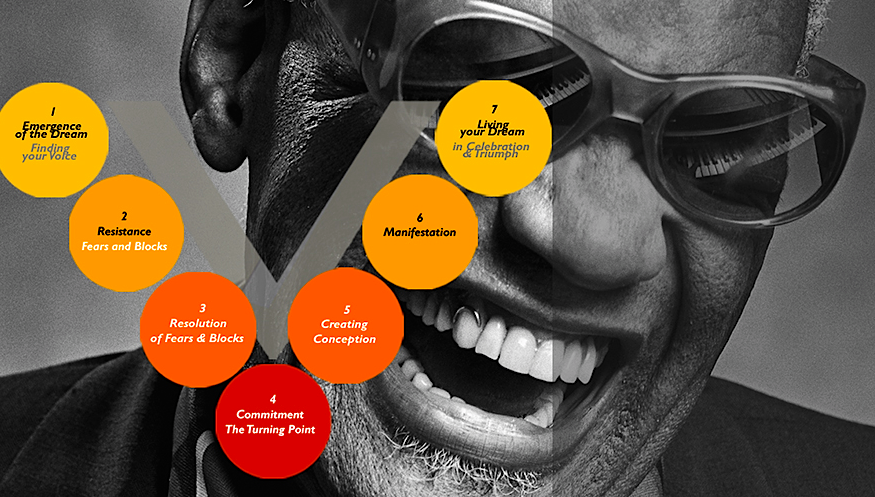
At E.G., Seeff shared his 7-step creative process. It is about life, not photography. It is about being deeply vulnerable himself, and creating a safe space for his subjects to open up about themselves. His process mirrors the classic hero's journey: Where the climax of the story(Step 4) is where the hero conquers his fears and the end of the story is living the dream...
1. Emergence of the Dream: Finding Your Voice
2. Resistance: Fears and Blocks
3. Resolution of Fears and Blocks
4. Commitment: The Turning Point
5. Creating Conception (the Aha)
6. Manifestation (Creation)
7. Living Your Dream in Celebration and Triumph
Creative Takeaway: While the act of creating something doesn't occur until 5/7ths into the journey, your creative process begins long before that. Powerful acts of creation take your willingness to let go of, or conquer, your fears and preconceptions (Steps 1-3), then taking yourself to the inflection point (Step 4) where you're actually ready to start creating.

3. The Hard Work of Relentless "What Ifs..."
(Again: Infinite number of steps, rolled into one.)
Alexa Meade is joyously self-effacing and openly shared her creative journey: "A couple years ago I became Internet famous for figuring out how to turn people into paintings. This was really a tough act to follow. What do I do next?" She then shared, step by step, how she went from nothing to the birth of two new products.
1. "When I’m stuck, I find things to play with. A couple months ago in a thrift store, I found this set of tiles. I became obsessed with playing with them. I don’t know what I’m doing with this."
2. "What if I did this?... And this?..."
3. "I stayed up all night. I had to do a 2am drive to Walgreens to get construction paper. They didn't have any, so I used colored file folders."
4. "What if I did this?... And this?..."
5. This is the point at which Meade hit Seeff's Turning Point. She really didn't think anything was going to happen. That all this effort was just a waste of time.
6. Then she went to a Maker Space and started laser cutting the pieces out of colored plexiglass.
7. "What if I did this?... And this?..."
8. Then she tried the pieces as interlocking refrigerator magnets
9. Then she went back to the simpler configuration of pieces and printed on them
10. Then she created ridges instead of printing the design
11. Breakthrough! Product 1: A puzzle for blind people
12. Breakthrough! Product 2: A system of puzzles for all ages
Creative Takeaways: The hard work of creativity is relentlessly asking "What if..." again and again — and pushing past the inevitable moment where the project seems to be going nowhere. Your big breakthrough is just past that point!
Also: Note that Meade's current creation isn't even in the same ballpark as her last! True innovators push themselves beyond creating variations of their last success. They truly begin with a blank page.
When applying all of the above to you — when you are the creation itself...
Study your past for the fears and blocks you should have or could have resolved, but didn't...
Move past them now: Create a new turning point in your own hero's journey.
And keep asking "What if...what if..." until you are living your dream.
Closing thought via Austin Kleon, author of Show Your Work:

Path to Best Manager on the Planet

When speaking, I have two different approaches to my slides:
1. Follow the Best Practice Rules: Big pictures, big headings, no bullets points, etc.
2. Break the Rules: Often, I begin not with the best "presentation" but with the best handouts... I work backwards from handouts that give everyone valuable information, that's still easily skim-able/readable, and leaves room for additional notes by the participants.
The attached is from one such presentation. Here's what I share verbally, that accompanies this slide...
Most of us no longer need managers — at least not in the way companies define the role, as in actively managing another person's activities.
Most of us need mentors, coaches, teachers, guides, facilitators, trouble-shooters, and the like.
But one of the biggest roles for all great managers is also the most neglected.
Most of us need someone to help us with barriers and roadblocks — whatever's hindering us from doing our best.
Great manager you are, if you see that as your role.
If you ask all your teammates these three questions every day.
And, most importantly, that means acting on what you hear! Your job is to help address those barriers so your teammates can be their best.
Best manager on this or any planet, that makes you!
Your Culture Is Your Future
On October 21, 2013, Brian Chesky, Co-founder and CEO of Airbnb, sent a letter to all their employees, detailing the most crucial advice he got from an investor, and, in turn, his commitment to them. He recently posted it publicly. The advice he got was " Don't F**k Up the Culture ."
He closes that letter with: "There are days when it’s easy to feel the pressure of our own growth expectations. Other days when we need to ship product. Others still where we are dealing with the latest government relations issue. It’s easy to get consumed by these. And they are all very important. But compared to culture, they are relatively short-term. These problems will come and go. But culture is forever."
Culture is Forever.
(Until you or somebody above you or next to you f's it up.)
In some ways this is commonsensical. We all believe in the power of culture to unite us in ways that make the impossible possible, to make even the hardest of work the most joyous work.
And yet most of us fall prey to they tyranny of the urgent. During those moments, we don't forget those shared values and priorities — we just allow them to momentarily slip in emphasis. We focus just slightly more on the value of delivering on the urgent.
No harm done, right?

Wrong.
Often: It's those micro-fractures that bring down cultures, not major violations.
I'm just beginning interviews for my next project, The Future of Work, and even after just a few interviews, a pattern is emerging: Culture is one of the biggest drivers of the future of work. Your culture is the biggest liberator of, or destroyer of, possibilities. Yours. And everyone's.
From a teammate in Malaysia, who works for California-based ServiceRocket: "I left for another job, but had to quickly return here. I'm now excited to come to work again. It's the people. It's how the culture is crucial to my development. It's insanely fun to work here!"
From a Global HR Director: "One of the biggest challenges we face is how we remain pure to our mission AND how we ensure that the perspectives from our colleagues — who we trust and who share our values — are part of the decision-making process.... Without losing our edge, because we spent so much time being inclusive. It's hard to achieve the best balance."
Your culture: For better or worse...
Is your future.
So... What can you do?
A lot. For starters...
1. Be the culture. Catch the tiny daily micro-fractures. I'm currently working on a cultural initiative with a small team. The project leader is the most people-oriented and culturally-oriented person I've ever met! And yet, he succumbed too. He tried to push a half-baked deliverable out our door — because he was momentarily consumed by the tyranny of the urgent. We stopped. We had a brief teleconference. And within 45 minutes, we figured out an approach that would answer the pressure he was feeling AND would still live the values of the cultural initiative.
Catching and addressing those tiny micro-fractures, daily, is the glue that holds cultures together. Cultures may be launched and reinforced from above, but the everyday work of culture is owned and delivered by each of us doing the thousands of little things that bring culture to life.
2. Every meeting: Help someone else. Every meeting: Be the culture. I learned this years ago from an SVP at Bank of America, Kathy McLeod. We had a full-day meeting scheduled with about a dozen people. We were so efficient, that we got most of our to do's done by lunchtime. Kathy pulled me aside and asked me to keep the meeting going until 3pm. Why?...I asked. She gave me specific people-development things to work on with every person there.
That's when the Aha hit me: Every time people come together is an opportunity for us to help develop each other, as well as reinforcing the culture! And once I got that, I figured out how to conduct meetings that way AND keep them short. It's all in how you ask questions, pulling more out of the people in the room. For tips on how to do that go here, here and here.
3. Contract with a mentor or colleague to "catch" you. Like my friend on the cultural initiative, all of us fall prey occasionally to the tyranny of the urgent. And it's hard for each of us to catch ourselves when it happens to us. Contract with your mentor or a couple of close friends: Ask them to point out when you fall prey. You'll be glad you did!
Finally, this thought...
Organizational cultures can be f'd up.
But your contribution to an amazing culture — you living your values, taking care to take care, and staying focused on what matters — nobody f's that up for you. Nobody else owns that.
Taking personal responsibility for a great culture is your great path to a great future. Within that company, and in the next one, and in your life.


