
Bill Jensen's Blog, page 8
March 17, 2014
TED Fellows 2014: Wooohoo!
 TED at 30 years Begins
PRE MAIN-STAGE TED EVENT
TED Fellows
The TED Fellows program is a global network of 300 innovators and trailblazers from a spectrum of disciplines. Every year, TED adds 40 additional amazing change-makers to join the pack.
Some Highlights...
Shubhendu Sharma
Reforestation Expert, India
Cars can teach forests how to grow
Sharma leveraged Toyota’s Heijunka and Kaizen standardized processes to forest-making, composting and more

Aziz Abu Sarah
Middle Eastern American peace activist that offers bridge-building tours led by both Israeli and Palestinian guides. e.g., Having tourists visit a Palestinian refugee camp: "Imagine if the one billion people who travel internationally every year traveled like this. Actually connecting with people. A Muslim group from the UK went to house of an [Israeli family], having Sabbath dinner together…realizing that 100 years ago their families came out of the same place in North Africa....
This is the future of travel."

Sergie Lupashin
Aerial Robotics Researcher, USA/Switzerland
In the sky! It's a bird... It's a plane...
Cue Camera 3!
Lupashin developed Photo Kite as he was inspired by 2011 Russian Federal elections photographers who took aerial photos of the protests. But those hovering devices were heavy, dangerous. The Photo Kite — a small quadra-copter is tethered to its owner with essentially a lightweight dog leash. During his session, Lupashin launched three at a time, with all three sending live camera feeds. Then he asked...
"If you had this, what would you do with it?"

Eric Berlow
Ecological Networks Scientist, USA
Best soundbites so far... When describing the Fellows network:
"Unexpected mismatches made in heaven."
Quoting Fellow Camilo Rodriguez-Bertran, who calls himself a...
"Cross-disciplinary collaboration slut."
The TED Fellows network software pictured at right can be found here.
TAKEAWAY...
Our future is in great hands.
And the best is yet to come!


Take a Stand: A St. Patty's Tale
For several years, just after college, I lived in Syracuse, New York. Not far from us was the neighborhood of Tipperary Hill, a mostly-Irish neighborhood for almost 200 years.
There's a lesson in that neighborhood about taking a stand for what matters to you...And never relenting!

To the best of my knowledge, it is the only place in our country with a traffic light where the green light is on top.
The city first installed traffic signal lights in 1925. Local Irish youths — pissed that the “British" red appeared above the "Irish” green — kept throwing stones at and breaking the red light. This went on for several years until both New York State and the city of Syracuse relented.
Since 1928, Tipperary Hill’s one traffic light has the green on top.
The point...
For whatever matters to you, take a stand. Be relentless.
(Hopefully, without breaking the law. But, who knows, maybe you can change the law!)
March 4, 2014
Innovation Through a New Lens
Innovation has become the fastest and biggest way to win in today’s tough marketplace. Not just with incremental improvements, but with powerful changes in the way you do things, compete, and grow your business.
But how do you get everyone involved? From your newest hire to your boss’s boss, as well as your customers?
Many of the Innovation Pied Pipers have it right: Innovation is everyone's job. No matter where you are in the hierarchy, you can think up important ideas. You can ask different questions. You can find simpler ways to do things! The sky is the limit! You can make ordinary opportunities extraordinary! You can do anything you set your mind to! Etc., Rah, rah, rah. All true... But...
Those same Pied Pipers are also naive! You've probably tried all that, once, twice, thrice and more... and gotten shot down — haven't you?! Everywhere I go, everybody already gets that their job is to innovate. Everybody wants to innovate! The core problem isn't the will or desire to innovate. It's corporate structures, cultures and more.
Unless you work for a best-of-the-best leader, or one of Forbes or FastCo's most innovative companies — your company's dedication to risk aversion and incremental, safe, predictable, tightly managed change may be the biggest barrier you have.

Let's take a new view of innovation.
A view where each of us takes a tiny chunk of accountability for smashing the barriers that hold us back. Let's, each one of us...
Create a Culture of Innovation
Making it easier for everyone
The secret is not focusing on innovation at all. It's in focusing on the enablers and anchors...the stuff that makes innovation happen — how you think, how you connect with people, how you share, how you sell ideas, and more.
Three steps...

Plan Your Own Innovator’s Journey
With any dimension of our lives, the only person who truly limits our actions is ourself.
> Understand that innovation is crucial to your own career path. No matter how uncomfortable it makes you to push against the status quo, you need to. Your career and livelihood is at stake
> Disrupt yourself. Check out the habits on pages 11, 23, 35 and 47 of Click, a freebie How To guide on disruption
> Find the causes or projects you're most passionate about. The best way to build your courage is to begin with something you really care about!
> Tap into your network. There's strength and safety in numbers. That could be your immediate team or your broader tribe or communities to which you belong.
> Start small. Every big journey (or project) because with a small, simple, single step.

Build the Space for Your Team to Innovate
For now, don't worry about pushing ideas upward. Your job: Make your team interactions a safe place for people to try new ideas, to experiment, to skin their knees and try again.
> Declare and maintain a safe space for experimenting. You may not be able to do this for anything beyond the borders of your team, but surely there are some things you can!
> Be the shit umbrella (as Flickr founder Caterina Fake said in Disrupt): If you manage people, your job is to protect them from Corporate Stupidity... Help them find easier ways to execute (or sometimes ignore) stuff from above, so they waste less of their time on stupid stuff.
> Build a process for rapid prototyping. Again, you may not be able to do this for anything beyond your team's boundaries...But within your team's activities you can explore ways for people to quickly try something new, put it out there, get feedback, improve it, and keep doing that again and again.

Become a Lifelong Student on How to Sell New Ideas
It doesn't matter whether you're a worker-bee or mid-manager in a large company, or if you're an solo entrepreneur. It doesn't matter whether you're selling innovation or shoes. Everybody who works must become masters of selling new ideas. Some basic tips...
> Never start with your needs or your idea. What matters most is NOT how you see the situation, but how the person you're trying to sell it to sees it. Always work backwards from the other person's needs.
> Yes, build a business case... (an analysis of why this idea will make money or save money)... But remember that whoever you are selling to is also a person. So...
> Focus on your decision-maker's carrot or stick. Every human being is motivated by avoiding pain (stick) and/or some reward that's enjoyable. Most often, the carrot is best. But remember to focus on what matters to THAT individual. You may bring your boss a great idea that will make lots of money and make her look good (carrot), but for her to sponsor it, she'd have to risk being judged by her peers (stick). In that case, her most important motivation may be that you present a safe way to pilot the new idea that reduces to near-zero the possibility that she may look bad.
> Some inexpensive How To tips: How to Work Smarter by Asking the Right Questions; Easy Ways to Build the Courage to Work Smarter; Selling You While Explaining Your Work
The new lens is that it's not enough to believe innovation is everybody's job and start coming up with great ideas.
Each of us also has a responsibility to apply that positive belief to removing the barriers to innovation, for ourselves and our teammates.
Think epic, but start small.
I Have Seen the Future of Work
The design of work and its changing nature is an amazing case study in both advances innovation and the continued resistance to innovation.
I have spent the past quarter century thinking, researching, and advising executives about THE FUTURE OF WORK. No one can accurately predict the future. But if we scan key trends, we get a clear picture of what we need to prepare for.
Here's a small sampling of great trend-trackers you should check out:
• Changing the World of Work (free ebook)
• Hack Work to Combine Peak Performance and Personal Purpose (Forbes)
• Work Hackers (Google community)
• Disruptive Power of Collaboration (McKinsey&Co)
• How to Find the Millennials Who Will Lead Your Company (Forbes)
One piece in one of those sources (ebook), perfectly synthesizes...
THE FUTURE OF WORK: NEXT 2-5 YEARS
4 Crucial Trends You Need to Know
The black type are the words of Carrie Basham Young, a GenYer who consults with companies on their social networking strategies. Her words (edited for space) take the form of a "Dear Leader" letter. The mustard type that follows is a summary of how those ideas are also indicators for a much larger trend.
Give me an "F." Four of them, actually.
1. Let Me Fail. Instead of prescribing the right way to accomplish a project, give me data, an intended outcome, and an open ear for questions. I need to fail to find the right answers. I need to encounter resistance. I need to stumble and admit defeat, and I need you to collaborate on a solution when I’m lost. Your confidence in me to fail and then rebound will build my trust in you.

FUTURE OF WORK TREND: I have seen the biggest battle for the future of work. It's not about the next big thing. It's about failure. Those companies and leaders who have built cultures of "failing forward" and rewarding "failing fast" and "iterate, iterate, iterate" are already embracing the future. Those that work overtime to mitigate all risks and manage for no failures are battling to stay in the past.
2. Make Me Figure It Out. Make me treat my job as a business, where I am the CEO and ultimately responsible. Force me to make the tough decisions while also doing the dirty work. If I need resources that you can’t provide, let me seek them out and negotiate. Ownership of the process and execution will give me pride in the outcome, engaging me as I feel the satisfaction of independent accomplishment.
FUTURE OF WORK TREND: I have seen the future of empowerment. It's treating employees more like entrepreneurs. Giving them the freedom to figure things out, but ALSO ramping up personal accountability for results. No place to hide! It's gonna be a very bumpy ride for laggards!
3. Give Me Freedom. I do need structure. But once I’ve proven my ability to assimilate into the basic expectations of corporate life, give me the freedom to work independently. Let me choose my tools, where I work, and how I allocate my time. Once I have earned your trust, I will thrive with the freedom to balance my priorities.
FUTURE OF WORK TREND: I have seen the future of work and the next battle for freedom will be around My Work My Way. (..."Let me choose my tools"...) Corp IT has to get a lot more user-centered...Fast!
(For more, see Corp IT: Duh! Finally?)
4. Encourage Me to Fight. Push me to stand my ground in the face of opposition, and back me up when I’m close to falling. It is in these enterprise email and conference call battles where I’ll learn to navigate our complexity. Imparting the nuances of our culture and the knowledge of our informal social network are the most powerful weapons you can give me.
FUTURE OF WORK TREND: I have seen the future of work and the winners will not only move to greater meritocracy (where the value of the idea is all that matters), but where those cultures also train and develop and support their teammates to be able to advocate for those ideas. Meritocracy is wasted if only the most skilled or loudest voice wins.
(For more, see Innovation Through a New Lens)
Want the data behind these and other trends?
• Ayelet Baron's slides: Are You Ready for the Future of Work?
• Work 2.0: Ten-Year Report
Corp IT: Duh! Finally?
Both the driver of today's biggest innovations and our biggest enabler in creating innovations is the explosion of new technologies! The future of work is inextricably linked to this technological revolution.
However...
More than 15 years ago, the Search for a Simpler Way ongoing study found that one of the biggest sources of workplace complexity, as well as many of its implementation and cultural problems, were due to shortcomings of Corporate IT: Their tools are too corporate-centered, not enough user-centered. (Users being the employees.)
Our follow-up in 2012 didn't find much improvement. Our Work 2.0 Ten-Year Report was titled Is Business at War with Its Workforce?
Could it be that 2014 is the year that Corporate IT finally gets it?
Is the future of work going to kinda, maybe, sorta really begin to happen?

McKinsey&Co's The Enterprise IT Agenda for 2014 called for lots of optimizing-this and resiliency-that... And, then, almost buried in the middle of the agenda comes something completely new...
• Advance end-user offerings to facilitate business productivity
Wow! That heading is followed by this admission...
"After all the attention paid to application hosting over the past several years, many infrastructure leaders have started to conclude that they need to increase the attention and focus they devote to innovating end-user capabilities."
Duh. Really? Could 2014 finally be the year in which we start addressing the problem that's destroying morale, productivity and business itself?
Let's hope so! But more importantly...
What can you do to help create this change and ensure that it happens sooner rather than later?
>
1. Adopt a change-advocate's attitude.
There is no reason you should accept tools and infrastructure that isn't as good as anything you can download onto your own phone. Stick to be the belief that everything should be as you-centered as your phone or tablet... And if it's not, stay dissatisfied! Then move onto 2, 3 and 4 below.
> >
2. Join forces with like-minded people.
Educate yourself. Join hack-work communities. Like...
• Work Hackers
• MIX: Management Innovation Exchange
• Social Business Software
• Change Agents Worldwide ...to name a few
> > >
3. Hack workarounds.
They can be big or small. Risky or risk-averse. Hi-tech or low-tech. Doesn't matter. What does is that you stop struggling with corporate-centered rules and tools if they don't help you do great work. As a how-to incentive, here's Josh Klein's and my book, Hacking Work, for FREE! Enjoy!
> > > >
4. Build your own app.
If there isn't a free or cheap open-source app for the hack/workaround you need, then build your own!
• AppMakr
• Infinite Monkeys
• iBuildApp
The punchline...
Don't wait for Corp. IT!
If they're just starting to be user-centered now, how long will it take them to actually do it? You deserve user-centered tools, now!
10 Simple Things You Can Do to Be More Innovative
 Great innovation begins with you. With the basics. With uncommon common sense.
Here are 10 Simple, Everyday Things You Can Do to Be More Innovative
1. Have fun! Tell a stupid joke. Be (appropriately) sarcastic. Ignore proper protocol. There's a scientific reason facilitators are taught to use ice-breaker exercises and most innovation exercises involve some kind of game. Humor and fun readies our hearts and minds to think differently.
2. Ditch more meetings. Basic facts... 1. You need more time just to think and be creative, instead of doing so much busy work. 2. About the only way most of us can find that time is to start getting out of some of those stupid meetings we're "supposed to" attend. (Tip: Emailed invitations: Always respond "Yes, Tentative." Then if the agenda isn't compelling enough, don't go! "Oops. Sorry. I was double-booked that hour." But as far as office politics: you gave the appearance of wanting to go.)
3. Ask more questions. Innovation and creativity don't begin with a pre-determined need. They begin with questions... "Why?" or "Why not?" or "How about?" or "What if?" or "Has anybody ever...?" or "What do you think?" or "What do our customers think?" or "What's your gut tell you?" or "How would you change it?"
4. Be the clarifier, the simplifier. Everybody's thinking outside the box and pivoting and strategic alliancing and, and, and. Resulting in: While everybody's smiling and nodding, thinking they're off on some innovative journey, nobody really knows what the hell was just decided! Be the one person in the room who cuts through it all and directly says (or uses this as a guide): "Tell it to me like I'm a sixth grader. What does that mean?" Then repeat what you heard back to be sure it makes sense to all: "So what you're saying is..."

5. Be the dot connector. If there's risk involved, nobody wants to be first. Yet there are no truly new ideas. Every innovation has some ancestor — somebody's tried something very similar to your new idea before. Be the one in the room who reassures everybody and connects the dots between past successes and what your team is about to try: "What we're trying to do is just like they did, only with this part inserted differently."

6. Be the taffy-puller. "Tell me more." Be the person who keeps pulling at good ideas, until they're great ideas.
7. Be the first follower. Derek Sivers gave a fantastic 3-minute TED talk where he explains that true leaders aren't necessarily the ones who initiate a new idea... They are the ones with the courage to leave the pack and be the first to follow a new idea.
8. Be a creative hard-ass. Your mantra: "We can do better." No matter how great something is, push for it to be greater-er.

9. Use the wisdom of the crowd. Nobody is as smart as everybody. Build a rough prototype and get it in the hands of customers or end-users. Let them play with it, break it, tell you what's wrong with it. You'll get where you need to go far faster with much greater innovations. (For more, see How to Pilot a Project)
10. Demand most from yourself. No matter what standards are set by those in charge, set one notch higher for yourself. With one asterisk to that... Know the tipping point where it's time to let go. Push yourself for your best effort and then be willing to let it go without it being "perfect."
How to Pilot a Project: 5 Lessons from the Renaissance
The best way to create something that's never been done before is to pilot it — test your ideas on a small scale.
But so many of us get caught up with corporate politics and other distractions, we lose sight of the best ways to pilot a project.
So, to learn how to do it right, let's go back almost 600 years to the Italian Renaissance.

INNOVATION CHALLENGE: The largest dome ever built at that time: The Duomo of Florence. (Built: 1446-1461) No one knew how to do it — how to make it structurally sound! The cathedral was designed in the previous century, but the dome was left as a "somebody will figure it out" hole in the roof.
Lesson 1. Your pilot project is rarely a clean slate. Often, you're stuck with bad code, or an outdated factory, or without the proper resources. Piloting often begins with "Somebody stuck us with this...How can we leverage that?"
THE COMPETITION: To win the commission, competing architects were asked to stand an egg upright on a piece of marble. (Google did not invent unique problem-solving new-hire tests!) Only Filippo Brunelleschi could do it. He blew on the egg to counter-balance the force of gravity. His competitors complained that they could have done that too. But they didn't rethink the problem. They lost. Brunelleschi got the commission.
Lesson 2. Everything about piloting a project requires you to think different. Everything.
THE DESIGN: The challenge was to design a massive dome, without buttresses or support columns, that would not collapse under its own weight. Eventually Brunelleschi figured out a herringbone design for the brick structure. By zig-zagging the bricks, each change in direction worked with gravity instead of against it. While that was the key design element, Brunelleschi didn't stop there. He invented a new hoisting machine to haul the bricks up to the top of the dome. He was issued a patent for a river transport vessel to bring supplies in. And more.
Lesson 3. There is always one main challenge to be solved... And then lots and lots of other challenges to be be overcome, to make your make main idea work.

BUILD SMALL, CHEAP, FAST WORKING PROTOTYPES: Everybody knows that this is commonplace in today's architectural, industrial and coding designs. But is that idea time-tested? Is that how it's always been done? Yup! Just two years ago, in 2012, under a construction site, Brunelleschi's mini-dome was discovered. As tech VCs now call it, he built a "proof of concept" to sell his idea — not just to all who had to approve it, but to the workers who would build it. They needed to know his dome wouldn't collapse on them!
Lesson 4. Piloting has forever included a Proof of Concept. It's what everybody involved needs in order to buy in.
PRODUCTIVITY DRIVERS: Think a continuous supply of pizza and Red Bull was thought up in Silicon Valley as a way to keep the troops chained to their desks? Think again. Brunelleschi didn't want his workers wasting time running up and down the stairs to eat. He brought food and wine to them. (Diluted just enough to keep them focused.)
Lesson 5. While piloting, food and drink will always be strategically used as both a motivator and a tool to keep the troops working harder.
February 18, 2014
Storytelling: The Ultimate Secret Weapon

HE FUTURE of business, strategy rollout and work may lie in the power of storytelling.
We have long known this because storytelling relies on how we, as human beings, make sense of things and connect with things.
Unfortunately, business and most senior execs fail to get this. They still impose corporate logic on all of us and then only use storytelling as a way to sell their logic.
For years they tried to sell that logic through Execution by Excel. They they put us through Death by Powerpoint, which is still the weapon of choice in killing our hearts and minds.
Finally, there's an app for that. Storytelling for the masses. Storehouse is an iPad app whose goal is "a visual storytelling medium...like Tumblr on steroids" where you can marry videos and visuals to text in a super-easy user-friendly way.
But here's the crucial question as to whether this app (or others like it), and storytelling overall, will actually be used in boardrooms and management meetings:
Will business and senior execs learn how to stop presenting
and start using stories?
For almost two decades, I've been teaching senior execs how to use the anatomy of storytelling to put their strategic plan on one page.
If storytelling is really going to run through every company's DNA, the people telling those stories will also have to understand storytelling structure. For that, let's look at the Seven Steps of Story Structure by John Truby from his book, The Anatomy of Story...

1. Weakness and Need: A hero with a weakness and a need that will carry the story through to the conclusion. See the problem? How many execs will admit that the hero of their story has a weakness or need?
^
2. Desire: Drives the story forward. In business, desire can be seen as Goals, Objectives
^
3. Opponent: The antagonist that wants the same thing as the hero. Business usually does a good job with this one.
^
4. Plan: Action going forward. Again, business usually excels at this
^
5. Battle: Going head-to-head with opponent. Again, business usually excels at articulating the battle
^
6. Self Realization: The hero realizes what he wanted wasn't what he needed. How many execs are willing to be this kind of human hero?
^
7. New Equilibrium: With Ahas, the world changes for the hero. In business, think of this as Mission/Vision
^
Will business and execs "get" this? I have seen it work! And when it does, it's amazing!
I've helped many companies, from manufacturers to financial institutions articulate their Burning Platform — a major weakness or need. Telling those truths was a powerful leadership tool!
I've helped the senior team of a major retailer realize that what they needed wasn't what they said they wanted. That Aha created an offsite of the top 100 execs and the moment where everyone shared their "true confessions" was one of the most powerful anyone there had ever experienced.
Storytelling is the ultimate secret weapon!
If...
If we are willing to be real.
Be vulnerable.
Be true.
Be human.
February 10, 2014
Choices, Choices, Choices: Focus!
In the 1990s we began the Search for a Simpler Way, an ongoing study into the complexities and too many choices (some good, many stupid) that are imposed on all of us in the workplace. My first book, Simplicity, focused on my first-wave of recommendations for dealing with this.
In 2004, Barry Schwartz authored a great book, The Paradox of Choice: Why More is Less, in which he detailed how too many choices hurts both the receiver (e.g., customer) and the sender (e.g., retailer).
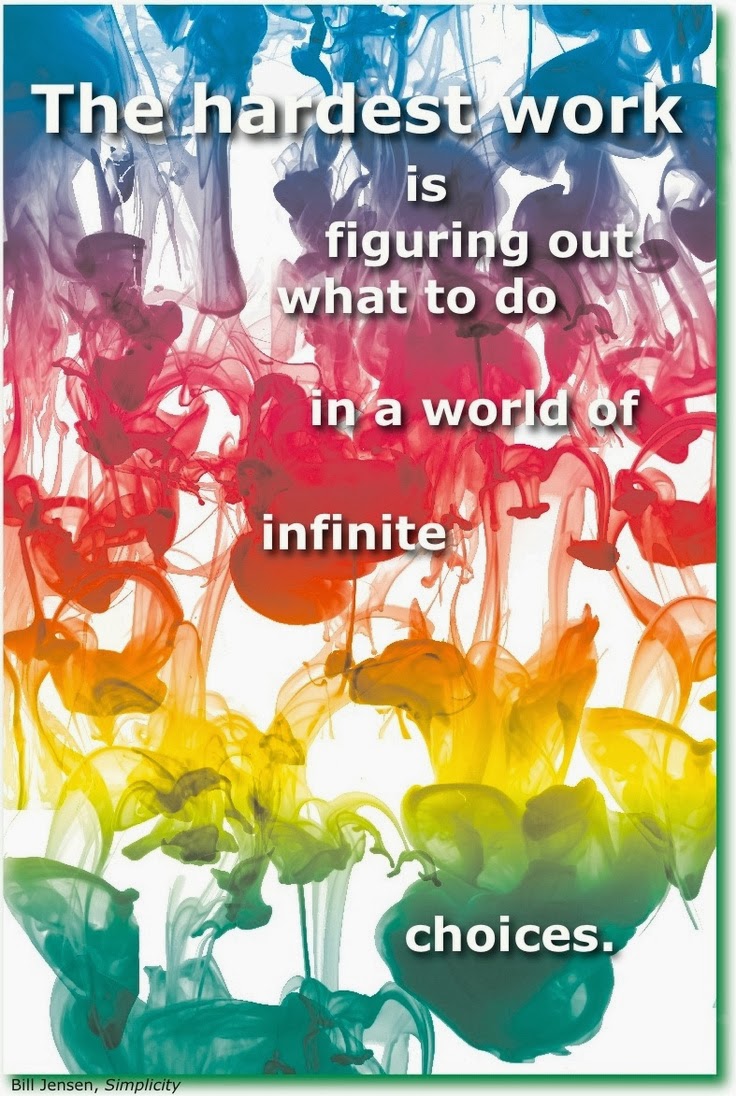
Now comes another study by Szu-chi Huang of Stanford Business School. Her findings add a nuance about different phases we enter when making choices. Early on in the decision process, a few more options help us. (e.g., Airline miles: Many ways to redeem them when initially signing up.) Later on, fewer options make things easier and are a bigger help. (e.g., The airline knowing the one or two things we want to redeem those miles for.) The hypothesis of her next study is that when you're in the middle of making those choices, your friends and community help to focus your choices.
What's all this research mean to you at work?
1. Your complex choices will only keep increasing.
(Even when companies think they've solved this with strategic focus and technology and more... Everybody having access to you all the time [and visa versa] and the crazy-insane rate at which information is increasing within companies means more choices per hour for you than ever before. And it's only going to get worse!)
2. Your ability to simplify and focus and cut through the clutter, day-in day-out, is hyper-crucial.
3. Your ability to make sense of things — super-fast — is one of your most crucial skills.
4. The future of work is going to force both companies and you to tailor a lot more tools and info-flows to your needs, so that you keep up with ever-increasing, more-complex choices.
(See Work 2.0 report)
Bottom line: The people who keep increasing their ability to focus and simplify will survive and thrive. The people who don't: Dinosaur meat.
February 3, 2014
Your Productivity Matters
Productivity — as defined in business ("the output of an industrial concern in relation to the materials, labor, etc, it employs") — is rigged against you.
It sets up a paradox, a conflict: Your productivity is only tracked against what's good for the company in the marketplace. Productivity, as defined by business, doesn't include what's good for YOU. Those are "soft" issues, that matter less (to most, but not all, companies). Then there's personal productivity...
Personal productivity, is how well, or poorly, your assets (time, attention, ideas, knowledge, passion, energy and personal networks/communities) are leveraged to create output for the company and for you. (See New Work Contract for more)
Nobody at your company is in charge of tracking this. Nobody measures it. Caring about personal productivity is buried in "soft" measures, like "engagement." For example: One would think that time would be a "hard" measure. (e.g., Producing one widget every five minutes). But nobody's tracking how stupid meetings waste your time. Or how much time you had to take away from your family to get that widget designed. Or whether or not you're wasting your own time with how you compose and reply to emails. (Tsk, tsk!)
If you wish to enhance your personal productivity you will need to be disciplined in how you approach your work. Your choices and skill-building determine your personal productivity each day.

...because it stops these sucks.
(Download any or all of these)


