
Bill Jensen's Blog, page 4
May 9, 2015
Hacking Your Future Training and Development
Some of It, Difficult. All of It, Powerful!

The New Normal
In case this isn’t abundantly clear already — you are the sole guardian,
administrator, judge and jury of what training and development you need.
Not HR. Not your boss. Not your company. They will guide you to T&D that
meets their needs, not necessarily yours. Do participate in whatever they
decide is mandatory, but don’t ever confuse that for what T&D is best for you.
Which means…
You’re In Charge of Your Ongoing Assessments
Never take any job or any project without first building your own assessment
toolkit and process. For the rest of your life, you will be responsible for
constantly re-assessing yourself. The best approach seem to be a
combination of…
1. Formal Assessment Tools
Leverage multiple assessments, not just one.
Here’s a sampling to get you started…
• DiSC: Personality
• Meyers Briggs: Personality
• Mind Tools: Leadership
• IMD: Leadership
• Leadership Circle: Leadership
• CCL Skillscope: Manager 360
• ProSpective: Career
• MAPP: Career
• What Color Is Your Parachute: Career
• iMap: Career
• Mind Tools: Communication
• Optimal Thinking: Communication
2. Two Mentors
• One who is twice your age (Or at least someone who is an old soul,
who has the wisdom of two lifetimes in one)
• One half your age (Or at least someone who is twice as daring and
bold and adventurous as you)
• Ask them each for feedback on your strengths and areas that
need improvement
• Compare and combine the results of both
3. Every Project: Seek Feedback
If it’s not automatically built-in, during and at the end of every project, ask
your teammates and/or clients: How was your experience? What could I have
done better? And don’t let them off the hook with easy “puff” responses.
You should be the one who is hardest on yourself. Keep following up until
you get a valuable insight.
Give Yourself Stretch Assignments
1. Seek out at least one project per year that pushes you far beyond
your comfort zone
2. At least once per year, attend an event that pushes you beyond
your comfort zone
3. At least once per year, attend an event that takes you outside
of your area of expertise
4. Continuously, donate time and talents to a cause or event or
group that’s far bigger than you
Publish, Create: Regularly
Not just to promote yourself. Not just to network and be seen. But to
continuously sharpen your unique POV, Point of View. Set a goal for yourself:
Each year, to become bolder or edgier — some form of being a you-ier you.
Simplify and Focus Your Year
One of the best versions of this, that I do every year, is Chris Brogan’s
My Year in 3 Words. An entire year in just 3 words. That will keep you focused!
Journal Online
Fast thoughts, continuous thoughts.
Journal Offline
Deep thoughts, time-out thoughts.
Write Your Eulogy
Or some form of long-term visioning: “At the end of my life, here’s
what I want to be remembered for…”
Some tools to get you started:
• Writing a Legacy Letter
• Eulogy Exercise Tool
• Build a Personal Mission Statement
• Life On Purpose
• David Brooks: TED Talk, Eulogy v. Resume
Then… Bring All That Together and Talk About It
• With your partner and family
• With your teammates
• With your boss/manager
Those conversations are where the magic happens!
You will hear things you never heard before. You will understand and realize
things you never understood or realized. The dots will begin to connect.
You will begin to shape your training and development around your life,
the way you want it to be.
That’s the moment where magic happens! That’s the moment where training
and development just becomes the way you life your life!
The post Hacking Your Future Training and Development appeared first on Simpler Work.


Are You a Tool of Your Tools?
Thoreau, the Visionary

In the mid-1800s, Henry David Thoreau wrote “Men have become tools of
their tools.” Oh, how prescient he was!
One day last week, I noticed that about a gazillion online friends felt compelled to selfie-ize their day: flying, eating, pouting, preening, pondering, talking,
unpacking, celebrating, conferencing and more. Which prompted me to
post this…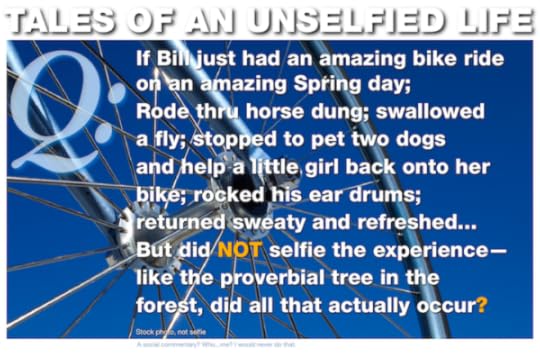
Don’t get me wrong. I’m as into the digital revolution as much as anyone.
I’m writing my next book with over 50 online readers, essentially
crowdsourcing the book before you see it this Fall. I’m one of IBM’s futurist
cohorts, helping them figuring out how we can all work smarter using
technology. I’m on the board for Chris Heuer’s amazing new and simple app —
Will Someone — that turns tasks into asks. I’m as guilty of e-addiction
as anyone.
Yet there’s these studies and factoids:
• Relaxing (unplugged) makes you more productive
• Smartphones make you more tired and unproductive
• One in five young adults admit to texting while having sex
That last one gets me the most. I mean, c’mon! If texting is more important
than your partner, that’s not good!
The real problem is that most of us have become tools of our tools! A simple
example: While it’s in decline (because of newer tools!) Microsoft’s Outlook
used to cause one of most companies’ biggest time-sucks — time spent in
meetings. Most people used the default scheduling block of one hour, even when
15 minutes would have sufficed.
Time to take back your time… And attention… And brainspace…
And soulspace… And life!
Some suggestions…
Take 5 Minutes to Figure Out What Matters
A five-minute exercise that helps create inner clarity.
(Wrote about this in last month’s newsletter.)
Once a Week, Schedule Non-Digital Time
No phone. No tunes. No videos. Just you and a book. Or a walk. Or a hammock.
Or drinks with friends who also abide to the non-digital rule.
You’ll be amazed at what you will feel!
Once Every 3-4 Months, Schedule Think-Big Time
By yourself, or with buddies. If taking notes, use nothing that requires
power or batteries. Just you and the proverbial “What if…?” question.
Audit Tech Time
For one week, keep track of how much time you spend on which tools.
Many who do realize “Something’s gotta change!”
Bottom Line…
Today’s tech and tools are amazing! Use them. Use them well.
Use them productively.
Just don’t become a tool of your tools.
The post Are You a Tool of Your Tools? appeared first on Simpler Work.
April 6, 2015
Future You Toolkit
Jumpstarting the Future You
I’ve been having a blast helping people prepare for the future of work!
Several corporate events this month, like keynoting for Ultimate Software,
number 20 among this year’s Best Places to Work.
Also there are two free and public events I’d like to invite you to attend.
Both will supply you with great insights into being the best you that you
can be over the next five years!
TED Talk, April 17: Simulcast live from Syracuse University, 5pm to 7pm ET.
Go here for more info. Teaser: “What makes you, you? Imagine unlocking every future you will ever experience with just that one question!” That’s how it begins. You’ll have to tune in for the rest!
I’m thrilled to be part of a group of most awesome speakers. Here we are at
a rehearsal last month. (Below.) No, I’m not being shunned by the group! When it was my turn to share my story, our coaches from Dale Carnegie had everyone turn so they could only hear me — forcing me to be more be more descriptive with the sights and sounds of my story.
Future of Work MOOC, April 20 to June 1: 6-week course on the Canvas
Network that is attracting students from all over the globe. Register here. My amazing co-conspirator is Jean Marrapodi, PhD, VP and Manager of Instructional Design for Citizens Bank, and our educational partner is Quincy College.
Topics include:
Week 1: The Future of Work: A New Lens
Week 2: The Future of Work: From the Crucible
Week 3: Reaching Out, Searching Begins
Week 4: Reaching Out, Searching Continues
Week 5: Reaching Out, Searching: Connect the Dots
Week 6: Design Your Future
Class and homework time: 2-4 hours per week
Both events guide you through the introspective journey that prepares you for the next five years. Please join me this month at both of these exciting events!
The post Future You Toolkit appeared first on Simpler Work.
IBM Futurist Cohort: My Ahas So Far
Opportunities to Rock the World
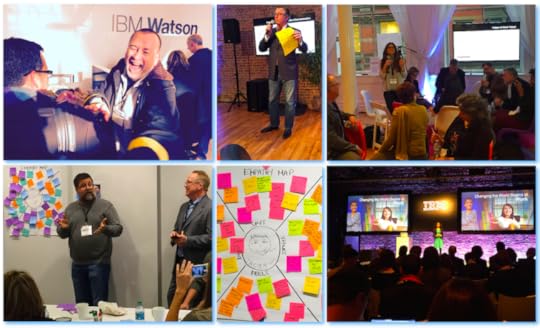
Six months ago, I was humbled and honored to be included among about
30 cohorts who are collaborating with and advising and sharing with IBM,
answering the big and bold question: What is the future of work? We are
also early-user-testers on IBM Verse, their new email platform that has been
completely reimagined for a new way to work.
It has been an exciting ride! Here are my biggest Ahas so far:
Old Ahas, Reinforced… and New Ahas.
Old Ahas, Reinforced
• Friends and friendships matter: Connecting with and staying closely
connected with a dozen-plus of the cohorts over the past six months has
been a source of constant joy!
• Storytelling is universal and super-crucial: As we brainstormed and
created new possibilities, storytelling was our main tool.
• Old school will work forever: Yes, everyone was constantly leveraging
the latest apps and capabilities in their phones and tablets… And yet, when
we worked on ideas in the same locale, the real work got done with
post-its and white-boards. Low tech will always work!
• Millennials and GenZ will reimagine the workplace: When we got
together for Verse’s launch, I was thrilled to see that one of the keynoters
was 15 year-old Maya Penn, who launched her first company when she
was 8 years old. Millennials and GenZ (and those who think that way) are
not beholden to today’s ways of doing things. They are going to completely
rock our world in the coming years!
Bill’s future of work insights shared at our NYC cohorts gathering
New Ahas
• Wakeup Call: I’m Just a Social Babe in the Woods. Until six months ago,
I thought I was holding my own in social media and in putting content
out there. Then I started hanging regularly with masters and social gods
like Bryan Kramer, Chris Heuer, Marsha Collier, Cheryl Burgess, Brian Fanzo,
Ted Coine, Mark Babbitt, Joel Comm, Daniel Newman, Denise Holt,
Shawn Murphy and more. Wow. I realized how much I had to learn! Not just
about how to leverage social media. But in the power of communities.
I really need to do more. Not to keep up with others, but to help others more
and also to maximize my own potential.
• Design Thinking Will Rock Our World. More than 20 years ago, no one
understood my shift from being a graphic designer to working in HR and
organizational design. I got nothing but hairy eyeball looks. And I just was
not able to explain the connections between the two that I saw in my head.
Now, mainly with the thought leadership of IDEO, the world is coming to see
what I could not explain way back when. The IBM team took us through a
half-day exercise in how they are leveraging design thinking for almost all major changes. At its core, design thinking is simply empathy. Putting yourself in the shoes of the user of your products or services. Exploring what she feels, thinks, does and says, and then designing your services from there. Design thinking is poised to make long-overdue major changes in user-centered design in most everything we use at work, play and in our lives!
• IBM is Showing Leaders How to Use Big Data.
But Will Leaders Follow? IBM’s Verse is a powerful user-centered
email program. It takes Watson’s big data horsepower and puts it at every
individual’s fingertips. So that email becomes far smarter and easier than it
it is today. In this post for IBM, I wrote about how Verse is setting new standards in tailoring information and tools to each individual’s needs and preferences —
something I called for 13 years ago in my book, Work 2.0. Technologists
have created the necessary tools. But will our leaders leverage them to their
full potential? Will our leaders create reimagined workplaces where big data
will help tailor all tools and processes to each individual’s needs?
I’m hoping! Stay tuned!
The post IBM Futurist Cohort: My Ahas So Far appeared first on Simpler Work.
What’s Your Best Question?
One perfect question trumps 1,000 great answers

One of my hero-buddies is Michael Bungay Stanier, who wrote the best-seller
Do More Great Work.
One of his wonderful ongoing projects is reaching out to leaders, consultants
and coaches, asking them: What’s your best question? This is such an
important topic! Because truly successful leaders may not always have the
best answers — that’s why they hire great teammates — but one of their most
crucial roles is to ask the absolutely right question at the right time.
That skill is one of the things that separates the best from from the rest.
In 16 video-taped episodes so far, Michael has compiled an amazing array of amazing people providing their best questions.
Here are my best questions in an episode I share with Dianne Coppola
and Cindy Clay.
Additionally: A couple years ago, I put together my 25 Perfect Questions.
How many of these could be your perfect questions?
ABOUT YOU
• What makes you… you?
• Who are you becoming?
• What would you do if you knew you could not fail?
• How are you, really?
• What is your ideal day like?
• What keeps you up at night?
• What is the proudest moment in your life so far?
• What’s the last totally crazy thing you did?
• What does being successful mean to you?
• What’s the most unexpected thing you’ve learned along the way?
• If you could call yourself five years ago and had 30 seconds,
what would you say?
• What is the biggest challenge in your life?
• What makes you laugh?
• What is the last thing you did for the first time?
• Why are you here, really?
BIGGER THAN YOU
• Who was the last person that changed your way of thinking?
(…Believing? …Feeling?)
• Who have you been completely vulnerable with? (…How? …Why?)
• What is the most valuable valueless thing you own?
• What is the best piece of advice you have been given?
• When you die, what do you want to be remembered for?
• What is your biggest regret?
BIGGER THAN ALL OF US
• What is justice?
• What is love?
• What cause (or belief, or value) would you be willing to die for?
• What really matters?
The post What’s Your Best Question? appeared first on Simpler Work.
February 22, 2015
What’s Your Legacy?
Top 3 Timeless Lessons

Last week I met with a friend I hadn’t seen in over ten years, someone who taught me so much about life. Amazing man.
Captain Rob Newson is now a Navy Fellow, serving on the Council on Foreign
Relations. A very high honor for strategic thinkers. Only four or five military
fellows are selected each year.
I first met Rob when he was Lieutenant Commander of Navy SEAL Team Seven. Our friendship resulted in him writing a letter to his then-teenage children titled Choose to Do What Is Right, Always.
Rob’s letter was one of thousands I collected from people all over the globe for my fourth book, What Is Your Life’s Work? The idea: Write a one- to three-page letter to someone you love about what truly matters in life and at work.
These became known as legacy letters — for the legacy the writers wished
to leave behind.
Fantastic insights from all! Like…
• Rob made sure that Aubrey, Chelsea and Craig knew that it’s never too late
to do the right thing
• John and Helen Harvey and their kids all wrote letters about pulling together
as a family, after John — a senior executive at American Express, who helped clear everyone out of their headquarters on 9/11 and away from the falling
twin towers — was laid off due to cutbacks
• 19 year-old Hoang Thi Ai wrote from the slums of Hanoi City, Vietnam about the joy of hardship, as she awoke at 1 AM every day to make tofu for her
family to sell
• Linda Stone, then a senior exec at Microsoft, wrote her top ten rules for women. (A powerful couple-page version of what another female tech exec would later call leaning in.)
What most fascinated me and the letter-writers was that they took on the
challenge to pay forward to their loved ones life’s most valuable lessons,
yet they found they also got something back. Nearly every one said they
learned more about their own priorities, choices and lessons learned by writing them down, and had new and amazing conversations with loved ones after
sharing those letters.
(Want to write your own letter? Go here for step-by-step how tos.)
After meeting with Rob last week, I re-read many of those letters wondering: With another decade of life experience and after asking thousands more about how they’ve made major life choices and about the legacy they wanted to leave… What are the top three timeless takeaways?
1. Your Legacy is Deeper Than You Think It Is
Like George Bailey in It’s a Wonderful Life, too many of us underestimate
the impact we have had on the world around us. But unlike George, you don’t have to jump off a bridge to discover the powerful web of events and people
you have affected. Spending time writing down and sharing what truly matters
to you will make that impact abundantly clear.
2. Too Many of Us Live An Unexamined Life
I have spent the past ten years asking many people variations of “What
makes you…you?” Most every person is super-appreciative of the opportunity
to reflect on that question. Most every person who wrote a letter or answered that question said they got more from the exercise than they ever would
have imagined. With conversation and examination comes clarity of ideas and purpose. With clarity of purpose comes greater commitment and passion about that purpose. With greater commitment comes greater meaning and fulfillment. Lead an examined life. You’ll be glad you did!
3. You Have an Infinite Well of Courage, Joy and Serenity Within You
Many of us encounter more disruption and chaotic change before our morning coffee than our ancestors may have encountered in a year! Crazy times!
The courage you’re seeking to deal with it all? The calmness you need to
let it flow past you and around you? All you need, and more, is within you.
Your own experiences give you all that you need. Release that courage by
sharing your experiences. Call upon those past moments to create all you
will ever need to face the future!
What’s Your Legacy?
Tell the world! Let us know!
The post What’s Your Legacy? appeared first on Simpler Work.
Listening: How to Not Suck
We all want greatness. Let’s start first with not sucking.
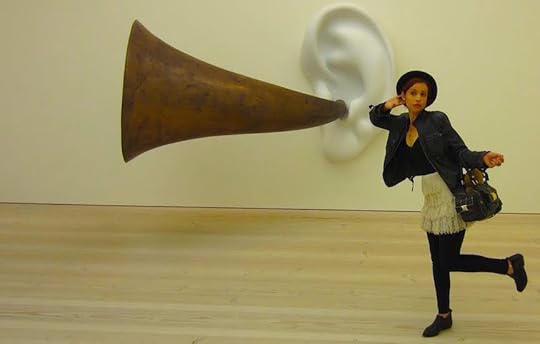
Before we can talk about how not to suck at listening, we must be truly
honest about how we currently suck. Badly.
The first of all 12-Step Programs is to admit you have a problem.
Here are two you need to own.
1. You suffer from ADD, Attention Deficit Disorder.
(Don’t feel bad or get defensive. So does everyone you know. We all do.
Welcome to the overloaded, too-much-coming-at-us 21st century!)
2. You often Listen to Object or to Add Your Two Cents, not to understand.
(C’mon, admit it. Again, you’re among the majority. Most of us do this
far too often.)
There. You have now taken the first steps towards not sucking.
Please remember though, the moment you forget those two admissions,
you’ll start to suck again. Got it? That’s how sucking/not sucking works.
Now we can begin.
There is already lots of great advice on this topic. Here, here, here, here,
here and here are a few examples.
Here is How to Not Suck, Simplified
1. Be present. Fully.
Phone down. Electronics off. Your eyes meeting speaker’s eyes.
2. Interruptus NOTus.
Let the speaker finish. Fully.
3. Got Notes?
Situation-dependent. Your spouse or kid telling you about his or her day:
Probably not a good idea to take notes! A business meeting: Probably a good idea! Note: If you wish to take notes electronically (tablet, etc.), make sure
you practice your capturing method until it’s as rote as writing with a pen.
Many people who take notes electronically focus mainly on capturing and
not the conversation. Also: Camera apps are great for capturing slide content while staying focused on what’s being said.
4. Recap for Understanding and Meaning.
BEFORE you share any of your thoughts, ask: “So what I think I hear you
saying is…” (or some variation of that), and give the speaker a chance to agree or help you understand differently than you thought you had. Repeat Steps 1-4 as needed.
5. Share, Respond?
BEFORE you share any of your thoughts, remember: That’s where listening stops. Silence is also OK! If you must share, the WORST thing you can do is shut down the conversation with “Yeah, but”s… (“But” is considered the Great Eraser, eliminating the other person’s perspective.) A better response is a two-parter:
• “I like…” (start with this one first)
• “I wonder…?” (frames your part of the conversation in a way that
furthers it instead of shutting it down.) (Source: IDEO/ExperiencePoint)
6. Finally: Make More Purple
The most crucial part of listening: Allowing what you’ve heard to affect your thinking, reasoning, conclusions, ideas. Let’s say your point of view is Red.
Let’s say the speaker’s is Blue. Even if you completely disagree, the conversation is still an opportunity to learn, to grow, to enhance your point of view. Constantly seek ways to make more Purple, incorporating other people’s thinking into
your own.
Not sucking is being totally present, continuously learning and
growing from others and to be your best.
The post Listening: How to Not Suck appeared first on Simpler Work.
The Perfect Speech: A Life in 3 Mins
Being concise with what truly matters makes it matter more.
We all remember Matthew McConaughey’s Oscar® speech a year ago
for his catchphrase close, “Well, alright, alright, alright!” But if you watch his full speech, you will see an entire life’s story, captivatingly told in three minutes,
with a clear beginning, middle and end.
Three Things I Need Each Day
• Something to look up to
• Something to look forward to
• Someone to chase
His structure perfectly captures the drama, joy and passion of three of life’s
most crucial purposes and values…
• Hope, gratitude and humility
• Future, optimism
• Challenges to inspire us to keep going
Life in three parts…Perfect!
He then tugs at our heartstrings and funny bones with quick stories
behind the first two…
• Look up to: “God has graced my life with opportunities that I know are not
of my hand or any other human hand.” … “It’s a scientific fact that gratitude
reciprocates.”
• Look forward to: “My family,” which includes his father watching from heaven dancing in his underwear with a cold beer in his hand.
The surprise and power came from the story behind his third point…
• Someone to chase: “My hero is me, in ten years.” At first there’s a gasp from the audience as they thought (as we all did) that he just derailed his humility. But then he turns that around: “Every day of my life, my hero is always going
to be ten years away….I’m not going to attain that….And I’m fine with that
because that keeps me with somebody to keep on chasing.” With that one little story, he summed up the best of competitiveness in the human spirit — that the true reward in the drive to be the best comes from uncovering the best version of ourselves.
The Takeaway for All of Us
For several years, for several of my books, I have been sneaking in a question for most every interviewee: “What makes you…you?” Without fail, every leader who has lived a life of purpose and passion has a three-minute(or so) story that conveys who they are and what drives them.
Can you convey who you are and what drives you in three minutes or so?
McConaughey’s structure is great — three things you need every day. So is “What makes you…you?” So is “What truly matters to you…and why?” So is
“How do you define success?” and “What tough choices have you made that now shape how you make new choices?”
Try it! You are likely to crystalize and clarify things that you knew in here, but didn’t always express out there.
And putting it out into the universe in a clearer and more concise way will surely bring you more of what you are chasing!
PS: Here’s the origins and explanation of McConaughey’s catchphrase
The post The Perfect Speech: A Life in 3 Mins appeared first on Simpler Work.
August 12, 2014
Eat Big Questions for Breakfast

It's never been more crucial to your career and life to ask the big, hairy, thorny, difficult, insightful, powerful, profound, get-to-the-heart-of-the-matter questions.
I've been studying how to make it easier to do great work for several decades now. After close to a million people surveyed and thousands of people interviewed, I've come to one undeniable conclusion...
True power and empowerment and controlling one's destiny comes not from seeking the best practice or best solutions... It comes from asking the right question at the right moment.
So, what's a great question look like, and when and how do you ask them, and what do you do with the resulting conversation? (Glad you asked!)
My good friend and fellow disruptive-simplifier, Michael Bungay Stanier, author of Do More Great Work, has asked a bunch of his friends and people he admires to share their One Best Question. As MBS says: One great question often unlocks the many answers you're seeking. Here are the One Best Questions he's posted to date, in 30-second video snippets...
• Is love available, even here? (And: a variation of same Q) (Sparks care, compassion)
• If not me, who? And: If not now, when? (The answer is almost always You! Now!)
• What are you really trying to make happen? (And: a variation of same Q)
• If you could have things go exactly the way you want, how would they go? (Articulate your vision)
• What would you do if you weren't afraid? (Kill fear and anything is possible!)
• [Silence... no question] (Create the space for others to fill in the blank)
• What if failure's not a deal breaker? (Asks us to be bold)
• What can you do now? (Helps to get you unstuck)
• How do I want them to feel? (Reinforces emotional connection)
• What qualities/values do you want to bring to this experience? (Moves accountability to that person)
• What can we do? (Gets us away from what we can't do)
• What have you seen something like this before? (Gets us unstuck)
• What's the bottom line? (Gets us to the point!)
• What would you do if your life depended on it? (Are you really doing what you want to do?)
• What have I done to improve so I'm better this week than last? (Short-term goals, improvements)
• What was the last time you said, thought, felt "I love my work?" (Shame on us if it wasn't recently!)
• What matters now? ("Now" provokes in-the-moment thinking)
• Who would you be without that thought? (Change our thoughts, we can change anything!)
• What's calling you? (Invites us to listen to what truly matters)
• What's that about? (Invites us to explore what's driving our thinking)
And three of my favorites that haven't been posted yet (Hey MBS, saving me for last? ;)
• What makes you... you? (Deep introspection, insights)
• How do you define success? (Most crucial daily question)
• 5 Words or Less: If you could send a message to your younger self, what would it be? (Reminds us what truly matters...and what doesn't)
Ask, and ye shall receive:
One great question unlocks all the answers you seek
> > > > >
Two final questions...About Tomorrow:
Want to participate in the Future of Work study?
Want early results and a possibility of winning a free copy of the resulting book?
Please take this brief survey
5 Epic Insights
"Today you gave me permission
to embrace what I thought was a failure in my life in a new way."
"What makes me, me...
is three hard battles with cancer.
I needed to hear this today."
"My biggest Aha was when you said I don't have to be the change agent — that I can create the conversation space for others to do that."
(Comments intentionally kept anonymous)

Last month I had the honor to deliver a webinar for Human Capital Media that elicited an outpouring of emotional responses like those above. Epic Insights: Five In-the-Mirror Moments Every Exec Needs to Know was based both on the research I did for my last books, Disrupt! and The Courage Within Us, as well as the amazing insights of leadership guru, the late Warren Bennis, who said that every great leader faced at least one crucible moment that forged who he/she was as a leader.
Here are some of the highlights from that webinar...Focused completely on the questions we must ask ourselves...

For the courage you need, you will likely need to draw on your crucible moment
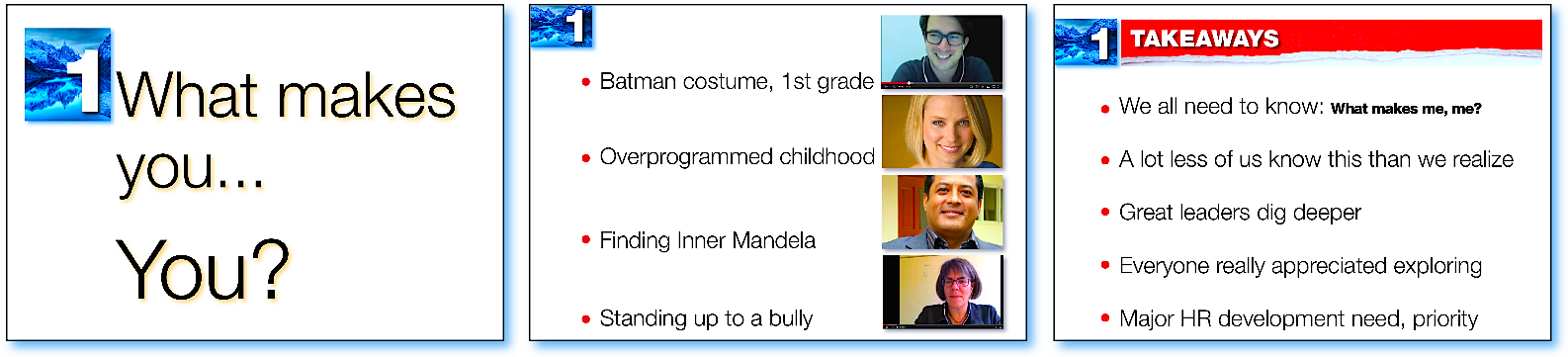
What's your crucible moment? What makes you... you?

Your degree of insane curiosity will definitely be critical to your success

If your company isn't making failure OK, you still have to!

Every single one of us needs to be Simplicity Champions

Bold is the new safe. Epic thinking is the new requirement
It's never been more crucial for you to drive yourself to experience these five in-the-mirror moments.
It's never been more necessary to know the answers to these five questions.
> > > > >
Two final questions...About Tomorrow:
Want to participate in the Future of Work study?
Want early results and a possibility of winning a free copy of the resulting book?
Please take this brief survey


