
3 Steps to Awesome Creativity
This past weekend the 8th E.G. Conference was held in TED's old digs, Monterey, CA. (E.G. is similar to TED, only with deeper dives into creativity)
From this year's line-up of amazing speakers come some powerful insights into how best to explore and exploit your creative side, at work and in life.

1. If You Want to Create Something New,
Study the Past
As an undergraduate student, I was stupid. I didn't understand how the past could teach us to create new futures. Tim Jenison "gets" this. He's founder of NewTek, a digital graphics company that makes tools for average people to create movie-studio-level video effects. Jenison wanted to know more about the future of FX, so he journeyed into the past. He spent eight years studying how Dutch Master Johannes Vermeer created such photo-realistic paintings, beyond what anyone else had ever accomplished.
Through painstaking research and exacting experimentation, Jenison figured out that Vermeer most likely created his pieces by never painting the actual scene. He set up an angled mirror and replicated everything he saw through the very edge of that mirror. Penn & Teller and Sony Pictures produced a film about Jenison's journey, Tim's Vermeer. It's showing this week in a theater near you!
Creative Takeaway: The best way to create new rules, and new ways for doing things, is to deeply understand the old rules and old ways.
2. Every Creation is a Hero's Journey
(OK, I'm cheating. This is actually a 7-step process, rolled into one.)
At 26, Dr. Norman Seeff worked in emergency medicine in Soweto, South Africa. But he was troubled by the medical community's approach — no room for feelings or love. One day, he left that entire life behind him, emigrated to New York, and picked up a camera. He then built a career as the entertainment industry's go-to portrait photographer: From Tina Turner to Steve Jobs, from Steve Martin to Joni Mitchell, from Arthur Ash to Frank Zappa to Stevie Wonder.
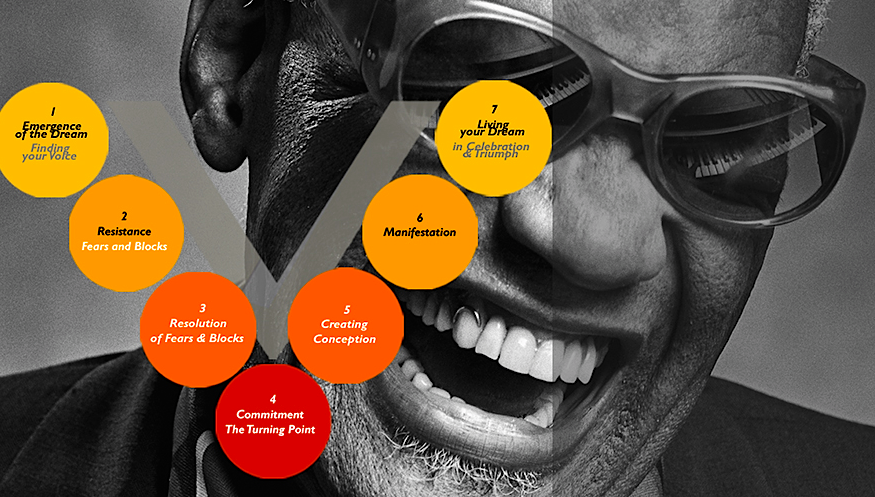
At E.G., Seeff shared his 7-step creative process. It is about life, not photography. It is about being deeply vulnerable himself, and creating a safe space for his subjects to open up about themselves. His process mirrors the classic hero's journey: Where the climax of the story(Step 4) is where the hero conquers his fears and the end of the story is living the dream...
1. Emergence of the Dream: Finding Your Voice
2. Resistance: Fears and Blocks
3. Resolution of Fears and Blocks
4. Commitment: The Turning Point
5. Creating Conception (the Aha)
6. Manifestation (Creation)
7. Living Your Dream in Celebration and Triumph
Creative Takeaway: While the act of creating something doesn't occur until 5/7ths into the journey, your creative process begins long before that. Powerful acts of creation take your willingness to let go of, or conquer, your fears and preconceptions (Steps 1-3), then taking yourself to the inflection point (Step 4) where you're actually ready to start creating.

3. The Hard Work of Relentless "What Ifs..."
(Again: Infinite number of steps, rolled into one.)
Alexa Meade is joyously self-effacing and openly shared her creative journey: "A couple years ago I became Internet famous for figuring out how to turn people into paintings. This was really a tough act to follow. What do I do next?" She then shared, step by step, how she went from nothing to the birth of two new products.
1. "When I’m stuck, I find things to play with. A couple months ago in a thrift store, I found this set of tiles. I became obsessed with playing with them. I don’t know what I’m doing with this."
2. "What if I did this?... And this?..."
3. "I stayed up all night. I had to do a 2am drive to Walgreens to get construction paper. They didn't have any, so I used colored file folders."
4. "What if I did this?... And this?..."
5. This is the point at which Meade hit Seeff's Turning Point. She really didn't think anything was going to happen. That all this effort was just a waste of time.
6. Then she went to a Maker Space and started laser cutting the pieces out of colored plexiglass.
7. "What if I did this?... And this?..."
8. Then she tried the pieces as interlocking refrigerator magnets
9. Then she went back to the simpler configuration of pieces and printed on them
10. Then she created ridges instead of printing the design
11. Breakthrough! Product 1: A puzzle for blind people
12. Breakthrough! Product 2: A system of puzzles for all ages
Creative Takeaways: The hard work of creativity is relentlessly asking "What if..." again and again — and pushing past the inevitable moment where the project seems to be going nowhere. Your big breakthrough is just past that point!
Also: Note that Meade's current creation isn't even in the same ballpark as her last! True innovators push themselves beyond creating variations of their last success. They truly begin with a blank page.
When applying all of the above to you — when you are the creation itself...
Study your past for the fears and blocks you should have or could have resolved, but didn't...
Move past them now: Create a new turning point in your own hero's journey.
And keep asking "What if...what if..." until you are living your dream.
Closing thought via Austin Kleon, author of Show Your Work:


No comments have been added yet.


