
David Tallerman's Blog, page 2
April 26, 2024
Drowning in Nineties Anime, Pt. 137
For the first time in a while, and possibly the last time in a while, we have a theme, though not quite so ambitious a one as I'd hoped for. I was going for "lousy Western adaptations of anime kids' films", but Madman ruined that with a nice, respectful release - curse them! - and so we're stuck with just "anime kids' films", three of which happen to have been treated with hefty amounts of contempt by their distributors. Ah well! Let's have a look at The Dog of Flanders, Time Fighters in the Land of Fantasy, Junkers Come Here, and The Secret of the Seal...
 The Dog of Flanders, 1997, dir: Yoshio Kuroda
So low was my enthusiasm for The Dog of Flanders that it's been sitting on my shelf for literally years. And that had little to do with the film itself, though I'll admit that the subject matter didn't entirely grab me - and more on that in a moment. But primarily, it was to do with the knowledge that, in a bid to transform Japanese children's entertainment into American children's entertainment, distributor Pioneer had done a right old number on the film. That didn't account for the choice to go with a non-anamorphic, letterboxed print, mind you, but it certainly must have been the logic behind going dub-only and putting an unusual degree of effort and expense into said dub, up to and including casting actual famous actor Robert Loggia in a major role*. And it explains also - while making no less gross and unforgivable - the decision to heavily re-edit the footage, lose 11 minutes from a hardly bloated 103-minute running time, and replace the ending with a sappy montage.
The best case scenario, then, was great material mangled into a less than ideal form. Yet, on top of that, the original source for this - by which I mean not the beloved 1975 TV series that director Kuroda remade here but the 1872 novel A Dog of Flanders - sounds, in synopsis, like so much nineteenth-century misery porn, and that's a subgenre I've no fondness for at all. It can be done well, like anything, and Japanese cinema has produced more than its fair share of great but horrifyingly depressing kids' entertainment, largely thanks to their national disinclination for sheltering the young'uns from the sort of harsh realities that might scar their tender minds for life. But that brings us back to the Pioneer problem, and their bid to sand all the sharper edges off a work that, on paper, consists of not much besides sharp edges.
Pioneer, as it turns out, certainly do deserve a ton of blame, and while they couldn't quite wreck The Dog of Flanders, it wasn't for a lack of trying. However, for its first half, when the film is largely operating in a slightly gloomy but generally warm and kindly slice-of-life mode, the damage is minimal. Of the leads, Brady Bluhm as our ill-fated protagonist Nello is perfectly fine, Loggia brings some real sweetness and gravitas to the part of Nello's grandfather, and only the brilliantly named Debi Derryberry, as Nello's fiscally mismatched chum Alois, is actively harmful, leaning into a schmaltzy, juvenile mode that the film itself has little interest in.** And the narrative, buoyed by Kuroda's sensitive directorial touch and some simply designed but subtly lovely animation, trundles along absorbingly, keeping its focus firmly enough on its core human cast and titular pooch Patrash that it's almost possible to ignore the thunderclouds of tragedy gathering on the horizon.
Even when those tragedy-clouds burst, it's not like everything that's been working up until then simply vanishes. Nevertheless, I did find that last third something of a slog, and not a very rewarding slog at that. But this is probably the point to admit that I can't imagine loving the Japanese version of The Dog of Flanders either, or that it could fix my biggest issue. The fact is, me and The Dog of Flanders were never going to be on the same wavelength, since for all its kindly humanism, it seems awfully determined to find something noble and uplifting in the suffering of Nello and Patrash, even though most of it is caused by awful rich people and a society built from the ground up to ensure that they'll almost invariably win and the likes of Nello will likely as not get crushed, no matter how good-hearted, honest, and talented they may be.
It's possible that the 11 minutes of cut footage mostly consisted of furious Marxist sabre-rattling, but I think it's likelier that they were just scenes that might make small American kids feel sad. Whatever the case, the re-edited ending is a disaster, transforming the message from one I already wouldn't have a great deal of sympathy with - something like "It's terrible that good people suffer, but what can you do, plus it's all part of God's plan" - to one more along the lines of, "It's terrible that good people suffer, but as long as little rich girls get to grow up and be happy nuns, we needn't worry about it too much." There are those, I'm sure, who'll find even the American cut adorable and heart-rending; if you've a soft spot for classic Japanese children's films and can bear with a mildly unsatisfactory dub, that might be you. And yet, politics and all else aside, I think most viewers will ultimately be left feeling short-changed by a work that was so obviously sabotaged by its distributer out of a lack of faith in its audience.
 Time Fighters in the Land of Fantasy, 1984, dir's: Hiroshi Sasagawa, Jim Terry
If we absolutely have to have anime heavily mangled to fit Western markets, then, for me, Time Fighters in the Land of Fantasy is one of the less obnoxious ways to go about it, taking a goofy bit of entertainment for Japanese kids and transforming it into a goofy bit of entertainment for American kids in such a fashion that the result is effectively a new thing that can't really sully the reputation of the original.
Time Fighters in the Land of Fantasy is the second of two movies mashed together out of footage from the long-running, much-adored seventies show Time Bokan, though with such drastic liberties taken that it almost seems justifiable that Jim Terry gets a sole director credit on the IMDB page. And already I've gone and called Time Fighters in the Land of Fantasy a movie and given it more credit than it really deserves, since reconstructing a TV show with, presumably, not much in the way of ongoing narrative into a coherent feature film is way beyond the level of ambition that anyone brought to this project. Rather, we get bits of a half-dozen episodes, with something of an introduction to get us past the fact that we're already well into what story there is and a vague sort of conclusion that can't even wrap up the sole plot thread we've had dangling in front of us for the last hour and change and hints at further adventures that were never to come. With hacking together ninety minutes of cogent storytelling from 60-some TV episodes off the cards, the actual localisation comes down to erasing as much of the Japanese-ness as possible by renaming everyone and everything*** and then plastering on lots of songs, because songs are a thing kids' movies have, right?
The dub is fine, mostly, with decent work from everyone who gets to put on a silly voice - that includes the villains, clear highlights, the professor whose genius for inventing half-assed time travel devices is the prime mover for everything that goes on, and a pair of talking parrots - and competent work from everyone else, barring Kathy Ritter as female lead Starr, who gets the sole character trait of "simpering". And only now do I discover that Ritter was also playing pretty much every other female character, including the main villain, my favourite performance by far, so I can't be too hard on her, but my gosh is Starr grating. She also gets the absolute worst of a batch of songs that never rise past tolerable, a soapy love ballad directed, worryingly, at her grandfather; though, to its credit, it's one of the rare moments where the soundtrack does more than describe exactly what we're watching but with some execrable wordplay to conjure up a pretence of humour. Thank goodness, then, that none of them last for more than a minute or two.
So not an adaptation for the ages, then, for all that it's more harmless than not. But the creators made one good choice, at least, and that was the show they picked to build their parvum opus out of. Time Bokan is a wacky bit of fluff for kids, but it's good at being that, with a ton of visual imagination and joyful energy and wholehearted commitment to cartoon logic; really, the fact that we have characters time travelling into fairy tales is evidence enough of that. And this was, and remains, the only incarnation of Time Bokan to reach the States (barring the much later OVA Time Bokan: Royal Revival, covered here) so it's nice to get a glimpse of what it had to offer. The problem is that by the 45-minute mark, we've had that, and with a format every bit as inflexible as most early children's TV shows, the remainder is merely more of the same except with increasingly grating music. At 60 minutes, I suspect I'd have been quite kindly disposed to this, and I still sort of am, but I was also ready for it to stop well before it did.
 Junkers Come Here, 1995, dir: Jun'ichi Satô
After such a very long time spent reviewing vintage anime, you'd think I'd have a pretty comprehensive grasp on what was out there. The last time I was blindsided by the existence of a DVD release was with Hermes: Winds of Love, and that turned out to be because it's an enormously terrible film made by an honest-to-goodness cult to spread their crazy about, and the world had sensibly responded by quietly pretending it didn't exist. But lo, here we are with Junkers Come Here, a film that somehow managed to pass me by for the longest time, for no reason I can put my finger on. It's simply never talked about in vintage anime circles, and at first I blamed that on its being out of print and / or only ever released in Australia, but no, there was a US release, and while it does indeed appear to be no longer in circulation, copies are easy to come by at sensible prices.
So, with all of that, it's got to suck, right? Well, no, it's actually very good indeed, and only falls a little shy of greatness. That's almost entirely down to one thing, which we may as well get out of the way: Junkers Come Here is kind of slow, and kind of awkward in its pacing, and probably didn't quite need all of its 105-minute running time to accomplish the stuff that it does so well. I recall reading - and I can't find where, so it's possible I've got this wrong - that the film was originally released in short episodes and subsequently cobbled together into a movie, and whether or not that's the case, that's certainly how it feels. Most scenes are strong in their own right, but sometimes they play out fractionally longer than they need to or reiterate information we've already absorbed or just suck air from the pacing at points when forward momentum would do the movie more favours.
These are, mind you, all fairly innate problems to the anime slice of life genre, and Junkers Come Here is absolutely that, first and foremost, with a gentle vein of comedy humming along in the background and a mounting shift towards heavy drama past the mid point. Our heroine is 11-year-old Hiromi Nozawa, perched so awkwardly on the cusp of young adulthood that she doesn't even have the capacity to be wowed at the fact that her pet schnauzer Junkers can talk and, as she'll eventually learn, perhaps also grant wishes. So I guess we need to add magical realism to our list of genres, as well, except that Junkers Come Here is as grounded as a tale of a girl and her talking dog could hope to be, and while it thankfully doesn't lean too hard into the customary "is this animal really talking or is this child just desperately lonely" business, it wouldn't take much massaging to convey these same events without any supernatural elements whatsoever.
Because, oh yes, Hiromi is desperately lonely, though that's a slight spoiler, I guess, since it takes the major events of the film to force her to confront the isolation she feels, as in short order she learns that the live-in tutor she has a crush on will soon be leaving to marry his girlfriend and that the parents she almost never sees are contemplating a divorce that would place them on different continents. That's as much plot as there is, barring the occasional magical intervention from Junkers: the bright, smart, precocious Hiromi is forced to acknowledge her own mounting pain and so to act upon it, if she possibly can. And heck, that sounds rough doesn't it? But partly because Hiromi is exceedingly likeable and self-aware and partly because we always have Junkers on hand - one of the more charming and least anthropomorphised talking animals you're likely to come across - it's never out-and-out depressing, though it's perfectly possible you'll shed a tear or two before the end.
Barring a single sequence towards the end, this isn't the sort of material that demands to be animated, and despite the presence of a heavy-hitter director in the shape of Jun'ichi (Sailor Moon) Satô, Junkers Come Here rarely gets up to anything too flashy. The designs are simple and appealing, while the animation - which looks awfully rotoscoped in places, whether or not it was - is only as complex as it needs to be to sell the reality of the film's settings, and sometimes even that's a bit much for the budget. Nevertheless, with its soft storybook backgrounds, distinctive characters, and careful balance of realism and abstraction, it's about as good as you could hope for from a non-Ghibli film aimed principally at children. And indeed, that was an aspect I found especially satisfying by the end: though we might make comparisons, most obviously to Kiki's Delivery Service, Junkers Come Here is that rare anime work in the for-kids-but-good-enough-for-adults-to-love-too genre that doesn't feel terribly indebted to Ghibli's overwhelming presence. It's very much its own thing, and regardless of the slightly lethargic pace and the odd animation hiccup, that thing is lovely, thoughtful, and insightful, handling difficult subject matter with exactly the right combination of delicacy and brusque honesty.
 The Secret of the Seal, 1992, dir: Norifumi Kiyozumi
It's easy to see the thinking behind The Secret of the Seal. The 1992 anime film Tottoi was already based on a Western source, a series of novels by Italian author Gianni Padoan, and the end result could, if you squinted, pass quite comfortably as an American movie. Said squinting would require glossing over a few details, like an exceedingly unhurried pace and a level of violence towards the end that probably wouldn't have made the cut if this had begun as an American project, but on the plus side, there were none of the usual inconveniences that came with transporting anime to the US market, like everyone having unacceptably non-European names and skin tones. Granted, the island of Sardinia, where almost the entire film is set, was probably about as alien to the average American kid, but distributor Celebrity Home Entertainment certainly don't seem to have been inclined to overthink such an apparently easy win.
Nor did their ambitions stretch to anything beyond the most shabby, barebones of translations, with one exception: there are a couple of original English-language songs on the soundtrack, and though both are gratingly awful and lyrically destitute, they probably cost at least something. Indeed, while it may be my natural bias in assuming that Japanese composers are by and large less crass and lazy when it comes to this sort of thing, I'd be willing to bet that quite a chunk of the soundtrack was replaced: a tune near the start that couldn't sound more like hold music if it tried has the definite stink of Western tinkering to it, whereas the odd piece later on is legitimately pleasant and works to enhance the visuals rather than providing a tooth-grinding distraction.
But that, anyway, is as ambitious as things get. The dub is mostly ghastly, full of adults pretending badly to be children, and since that accounts for most of the cast and since Christine Cavanaugh's take on our protagonist Tottoi is an extreme low point, that's a definite problem. Granted, rotten dubs are to be expected with this sort of thing, but Celebrity Home Entertainment decided to take things a step further. Presumably at some point The Secret of the Seal was presented in some sort of serialised form, or possibly they just had no faith in their material, because every few minutes, one of the characters narrates a comment along the lines of "As much as everything seemed fine, disaster was around the corner!" Not one of these adds any information the film doesn't otherwise provide, a couple of them are flat-out lies, and every time it happens, it kills whatever momentum has been building.
Which, admittedly, is never much. As fun as it would be to get terribly indignant about how Celebrity Home Entertainment ruined a masterpiece, the truth is that they took a mediocre movie and made it into a bad movie. The plot, such as it is, follows the bland Tottoi as he and his little sister get dragged off to his father's Sardinian homeland after their mother's death from "pollution-related illness" - the second indication we get, after an opening shot of smoke-belching factories, that the film doesn't intent to be remotely subtle in its environmental message. And, to be clear, I'd have no problem with that if its environmental message was a coherent one, but sadly it's just the usual kiddie-movie claptrap. Tottoi finds a mother seal and her cub, though he's been told they've been made extinct by intensive fishing, and his stupidity and spinelessness nearly get them forced into captivity, until the film eventually has to wrap itself up with a happy ending that falls apart when you think about it at all. And though credit is deserved for not anthropomorphizing its non-human characters and having the sense to acknowledge the threat an adult seal poses, the moral still ends up as the same one these things almost always trot out: "We have to protect animals, so long as it doesn't cost us anything much and so long as they're mammals and not something we find weird and unattractive, like octopi, because screw those guys!"
Combine that ill-thought-out moralising with a crawling pace and animation that, barring the odd nice underwater sequence, screams made-for-TV, and indeed, made for TV by people who weren't inclined to put in the work necessary to make this anything special - just how do you make the stunning vistas of Sardinia look this bland? - and you have a movie that's tough to recommend. Add in the efforts of Celebrity Home Entertainment, though, and it becomes almost impossible to imagine an audience that might find any measure of joy here. Perhaps you could use it to teach your kids what not to do if they have any interest in becoming conservationists? Failing that, you're left with a mediocre anime movie drawing on what was likely a mediocre book, and rendered less than mediocre by a distributor who never once seem to have considered that not worsening their source material might be an option.
-oOo-
Given that my express goal was to review a bunch of anime that was mishandled by its US distributors, I suppose this was never going to produce much in the way of classics, so probably it's for the best that I had to fill out the post with something that was treated with more respect and also happened to be rather wonderful and a clear standout: Junkers Come Here is a really good children's film that ought to be better known, so at least I have that to recommend. And The Dog of Flanders certainly has its virtues, even in the form that Pioneer chose to release it, so I guess the moral here is that all anime children's films ought to be about dogs, or something? Or, at any rate, not about seals or parrots.
* A magnificently misguided choice if, like me, you first discovered Loggia through David Lynch's Lost Highway, a performance that doesn't exactly scream "kindly grandpa."
** Disappointingly, Sean Young, as her barely credited adult counterpart, does nothing to set things right.
*** The only example of this that actively annoyed me is perhaps the most necessary: at one point, the villains get a shape-changing tanuki robot to ride around in, and so adamant is Time Fighters in the Land of Fantasy that what we're looking at is a cat that we even get a song to that effect.


March 31, 2024
Drowning in Nineties Anime, Pt. 136
Okay, so it's another all-VHS-only batch, with nothing that anyone except the most hardcore of vintage anime fans would be likely to have heard of, excepting, just possibly, an adaptation of a work by the exceedingly famous Rumiko Takahashi. But so what, I say! Everything's probably up on YouTube, and we've long since established that a few real gems slipped through the DVD net, so there's always reason to be hopeful. And sure enough, there are a couple of treats in this batch, along with probably the single most enjoyable piece of vintage anime I've watched in months - though, as you'll see, enjoyable for absolutely all the wrong reasons!
This time around: Wanna-be's, Junk Boy, Crystal Triangle, and One-Pound Gospel...
 Wanna-be's, 1986, dir: Yasuo Hasegawa
There's not a lot of anime set in the world of pro wrestling, so that's one thing Wanna-be's has going for it right off the bat, and given how much time I spend grumbling about how the medium had a tendency to rehash subject matter well beyond the point of reason or good taste, an unusual setting is a definite plus. Granted, Wanna-be's does squander that advantage pretty heavily, as if certain themes were so ingrained into the anime mindset of the era that to leave them out was practically inconceivable, and so we end up with a show about professional wrestlers being secretly trialled on super-soldier drugs by an evil corporation in which the climax involves a deliriously dumb-looking monster that the plot hasn't set up even slightly. But that still leaves us with roughly half the 45-minute running time devoted to a topic that feels quite fresh, and that's more than can be said for the majority of these shorter OVA movies.
Originality, of course, is no guarantee of quality, but in this instance, it does work out that way: Wanna-be's is invariably at its best when it's inside the ring. That's partly because the action is a strength, but it's notable how much less true that is when it involves that aforementioned dumb-looking monster, so it's fair to say that the wrestling is the key ingredient. And I don't know that you even need to like or care about wrestling for that to be the case, given that I've never been much of a fan and, perhaps more so, how little this has to do with the real-world sport. In Wanna-be's, you see, professional wrestling is one hundred percent real, and our heroines just want a fair fight, so that when their antagonists, the Foxy Ladies - who, inevitably, are neither foxy nor very ladylike - cheat constantly and shamelessly, we're meant to find this weird and shocking rather than par for the course. It's a bit of a hurdle to get over if you've seen any wrestling at all, but it proves to be the right approach, since we end up with the best of both worlds: the fights are ridiculously violent and over the top, yet there's still a measure of dramatic tension, since we're expected to believe that our heroines really are being horribly mauled, the more so because the opening sequence is a false start with a different pair of protagonists who end up on the wrong side of the Foxy Ladies and their shenanigans.
So some fun wrestling scenes in a wrestling-themed anime, and that's definitely a win, but the running time and the misjudged monster battle ending mean that we only actually get a couple of them, which is unfortunate given that nothing else works anywhere near as well. Wanna-be's has a fair bit of talent behind it, enough to nudge it into the realms of just-above-average animation-wise, with some appealing Kenichi Sonoda designs for its stars, mechanical designs from the soon-to-be-more-famous Shinji Aramaki, and direction from Yasuo Hasegawa, of Riding Bean and Megazone 23 fame, and all of them make the most of what they have to work with. But what they're working with is an overstuffed script that never finds an organic way of marrying the wrestling stuff with its evil corporation side plot, and instead lets them trundle along next to each other until they're suddenly mashed together in the final third, to the benefit of neither.
Maybe, then, I'm giving Wanna-be's too much credit for dipping into subject matter we don't see much of, in anime or elsewhere, and maybe I'm a sucker for stuff like this - it reminded me of Ayane's High Kick and the Grappler Baki OVA, both of which I liked a fair bit - but I had quite a lot of time for this one. It's daft, energetic, and full of personality, and that remains true all the way through; I can't exaggerate how cheesy and out of place that final monster is, yet I don't know that I'd swap it out if I had the option, because what kind of vintage anime fan would turn their nose up at professional wrestlers battling a boggle-eyed slime monster? Well, a more sensible one than me, obviously, and if that's you then stay clear, but just know that you'll be missing out on a pretty good time.
 Junk Boy, 1987, dir: Katsuhisa Yamada
If you're not wholly sold on Golden Boy, the six-episode series that follows lecherous genius Kintaro through a series of adventures that play out like The Littlest Hobo if the littlest hobo was a sex pest, then, "It's like Golden Boy but with a less likeable protagonist and only 45 minutes long" is unlikely to be much of a pitch. And sure, Junk Boy got there first, but history has no end of duff prototypes that would go on to spawn infinitely better finished articles. At any rate, it's apparently impossible to discuss Junk Boy in any way that isn't a comparison with its near namesake; I couldn't find a single review that made the effort, so I'm certainly not about to try. Nope, Junk Boy is the lousy version of Golden Boy by inarguable consensus, and if you already suspected, as I do, that the first couple of episodes of Golden Boy were the lousy version of that particular setup, there's no obvious reason to be giving this one a chance.
But Drowning in Nineties Anime isn't about doing what's obvious, or sensible, or likely to be of interest to anyone on the planet other than me, it's about reviewing every last bit of nineties and nearly-nineties anime out there for my own weird amusement, and so here we are, with a title that, for once, the consensus has dead to rights. Yes, Junk Boy is Golden Boy but worse in every meaningful way. And yet, I confess, there were a few minutes at the start where I dimly hoped this might prove not to be the case, or at least that Junk Boy was enough of its own thing that the derogatory comparisons were slightly missing the point. Because from the off we're encouraged to sympathise with Kintaro, even if we're unable to condone his pervy antics, whereas Junk Boy spends a good half of its brief running time seeming quite happy for us to regard its protagonist Ryohei Yamazaki with the same revulsion and contempt that everyone in the cast does.
Who can blame them? Ryohei is a completely wretched human being without the slightest hint of self control, who gets his big break on the staff of the nonsensical magazine "Potato Boy" thanks to his unerring ability to get an erection at the slightest provocation, making him the ideal candidate to pick which saucy pictures they ought to publish in what we're led to believe is pretty much the Japanese version of The New Yorker, only with much more porn. This is inordinately dumb, but since we're laughing at Ryohei rather than with him, that doesn't altogether stop it being funny in places, and I was beginning to wonder if I mightn't have stumbled on not Golden Boy's crappy progenitor but its subtle antithesis, a show about a creep that absolutely knows he's a creep and discourages us from showing him the least glimmer of sympathy. Well, Junk Boy sure suckered me, and in so doing - and abruptly positioning Ryohei as a valid love interest for Potato Boy's star reporter - effectively sets itself on fire and runs around screaming for the remaining twenty minutes.
Narratively, then, Junk Boy is mostly irredeemable, but on one point I'll break from the consensus: it looks pretty good, and director Katsuhisa Yamada makes capable use of his medium to keep things visually interesting, even beyond the basic visual interest of lots of scantily clad women and a "hero" with a semi-permanent boner. Making Ryohei an out-and-out cartoon amid a generally quite realistic cast isn't the most outlandishly imaginative of ideas, but it works, and does more than the narrative itself to sell his slender redemption arc, since it's inherently easier to sympathise with someone who begins to look basically human than someone whose mouth takes up half their face. Goodness knows, that's not a reason to watch it, since we've covered dozens upon dozens of works that featured solid, well-directed animation without being actively painful to spend time around for a good portion of their length, but it made it harder to flat-out hate, so there's that.
 Crystal Triangle, 1987, dir: Seiji Okuda
The thing with movies that are so bad they're good is that they're hard to spot in the moment: either films that are actually just flat-out lousy get awarded a cult status they don't deserve or else the true works of misguided genius are ignored due to their obvious and abundant flaws. And so we come to Crystal Triangle, a title that received no love whatsoever back in the day and vanished without a trace, not being picked up for a DVD release by even the notoriously undiscriminating U. S. Manga Corps. And yet, with the benefit of an awful lot of hindsight, Crystal Triangle is a joy, treating with stony-faced seriousness a plot so deliriously preposterous that it's impossible to predict from scene to scene and often from shot to shot. It reminded me quite a bit of Spriggan, a film that gets away with its bonkers narrative by distracting us with superlative animation and some of the better action scenes ever animated, and Crystal Triangle, with its middling budget and decidedly action-averse hero, isn't capable of pulling that same trick. But that's OK, because who would want to be distracted from a tale that opens with the news that the biblical ten commandments were merely a footnote to the real message God intended for humanity and then proceeds for ninety minutes to find the absolutely weirdest approaches to material that never stood a hope of being anything except weird.
Now, to be fair, when I say that Crystal Triangle is bad, it's this commitment to pushing a fundamentally ludicrous setup in all the silliest directions whilst at the same time apparently failing to notice how mad it's being that I'm referring to and not the actual craft on display. I mean, the script, obviously, is an hallucinatory mess that feels like something an AI might throw up after watching too many of those "What if God was an alien and the pyramids are really cosmic radio antenna?" so-called documentaries; but that aside, it's apparent that everyone knew what they were doing, even if they failed to realise what a lunatic exercise they were doing it in service of. It may never approach the heights of Spriggan, but not much does, and judged by realistic standards, it looks quite nice, with distinctive character designs, detailed backdrops, some imaginative direction from Okuda, and the odd sequence that genuinely impresses, such as the massive dogfight that takes up quite a chunk of the finale.
Then again, I can see why those contemporary reviewers failed to notice such virtues, since to acknowledge how well animated said dogfight is requires dealing with the fact that it's happening in the first place, and and why, and what other lunacy is going on at the same time, and since you've already been making those sorts of mental gymnastics for over an hour by that point, it's probably easier to dismiss it all as shonky crap and move on to something less intellectually demanding. Still, not every experience in life needs to be easy, and not every masterpiece needs to be rational or coherent, and sometimes it's fun to watch something going off the rails with unstoppable, fearless determination. Crystal Triangle is exactly as hard to find as you'd expect of a VHS-only anime that was forgotten almost as soon as it was released, but that's not to say you shouldn't flog one of your less useful organs to get a copy, because this thing deserves a cult following that consists of more than just yours truly.*
 One-Pound Gospel, 1988, dir: Osamu Dezaki
I realise it's perhaps a ridiculous thing to say about someone who's had such immense success and influence, and whose three biggest hits are all readily purchasable on Blu-ray, but I feel like Rumiko Takahashi has been done a bit dirty in the West when it comes to the availability of the anime adaptations of her works. Because, sure, Urusei Yatsura and Ranma 1/2 and Inuyasha are great, and much-loved, and easy to come by, but what about Maison Ikkoku, eh? And, for our current purposes, what about her splendid shorter works, so many of which came out on VHS back in the day only to vanish into the ether?
I don't know that One-Pound Gospel is definitely the best of them - Mermaid Forest is awfully worthwhile, and its sequel Mermaid's Scar is arguably even better - but it is, at any rate, a thoroughly delightful bit of work and amply good enough that you'd think someone would have wanted to get it out there on DVD, especially with the benefit of Takahashi's name being attached. Yet now it's thoroughly lost and largely forgotten, and while we've had to wrestle with bigger and more tragic injustices over the years here at Drowning in Nineties Anime, still, it's sad that something so sweet and charming and top-to-bottom well crafted should suffer so crummy a fate.
If I had to guess at a reason, other than the likeliest one of sheer bad luck amid a confused and competitive market, I'd say that maybe One-Pound Gospel's misfortune was to be neither fish nor fowl in a world where it's always easiest to sell something when you can easily tell people what it is. And when that's a romantic, lightly comic boxing drama, it might already seem as though you have at least one genre too many for the average viewer, the more so when one of the participants in said romance is a nun. Oh, and also the boxer in question, Kosaku Hatanaka, has an eating disorder that's wrecking his burgeoning career, which is what brings him into the orbit of the kindly but somewhat fiery Sister Angela, and already we have a lot of wheels spinning for a work of less than an hour in length.
Yet everything fits together elegantly, with the main narrative thrust coming from everyone around him - increasingly including Sister Angela - trying to persuade Kosaku to stop pigging out before bouts to the point of making himself sick, and then the romance building steadily in the background, and the comedy hovering around the edges, rarely rising to laugh-out-loud funny but keeping something that could easily be a bit grim and off-putting gentle and warm. One of Takahashi's great virtues as a writer is to never set herself above her characters, even when they're being dreadful, and One-Pound Gospel's protagonists are considerably easier to be on side with than the likes of, say, Urusei Yatsura's Ataru. No jokes are aimed at Kosaku's uncontrollable love of food, nor at Sister Angela's slightly muddled faith, for all that we can see that these two have flaws they really need to move beyond if they're ever to succeed in their chosen paths. Indeed, what's really surprising is how seriously One-Pound Gospel takes the boxing material and the travails of making a career out of so physically demanding a sport; never is it taken for granted that Kosaku necessarily should keep fighting, and his decision whether or not to do so is as much a source of narrative tension as the more obvious matter of his pre-bout gluttony.
None of this is the sort of relative subtlety I'd necessarily associate with director Osamu Dezaki, but working under the pseudonym of Makura Saki, as he does here, seems to have lightened his touch somewhat, and the only real bursts of his characteristic style come in some painted stills towards the end. Kenji Kawai's score is similarly unimposing, and the animation, while consistently good, is rarely showy. The only truly standout aspect is some striking character work on the two leads: both of them are so pleasant to look at that the designs practically sell the romance in themselves, since who wouldn't fall in love with such an adorable pair? And, really, the same goes for One-Pound Gospel itself, in that I struggle to imagine how anyone could spend the better part of an hour with this little charmer and not come away feeling awfully warm and snuggly towards it.
-oOo-
That felt like a good batch, in spite of the presence of Junk Boy, and even Junk Boy redeemed itself in some small degree by being marginally better than I was expecting, or at least better animated. But both Wanna-be's and One-Pound Gospel were thoroughly enjoyable, and indeed among the better short OVA movies I've come across, and their obscurity is exceedingly unearned. Though not so much as that of Crystal Triangle, a masterpiece of absurdity so wondrous that it ought to be taught in elementary schools. Seriously, go watch Crystal Triangle this very moment, every second of your life that you spend without experiencing its delights is a waste you'll regret. And certainly don't go and check the actual score I've given it on on the index pages, because it's totally an 11 out of 10, honest.
* Oh, and a Blu-ray release. Get right on it, please, Discotek!
March 4, 2024
Drowning in Nineties Anime, Pt. 135
I'm emphatically not going to make a habit of reviewing series here, but I am very bad at saying no to people, and especially when those people have done considerably more to bring readers to this blog that I practically go out of my way not to promote than I ever have. So when Winston Jackson asked me nicely to cover the first two seasons of the Slayers TV show, I foolishly committed to twenty hours of watching, something I justified to myself on the grounds that I still had the two OVA sets to cover, and I'm a sucker for a theme post. And so here we are with Slayers: Book of Spells, Slayers: Excellent, The Slayers, and Slayers: Next...

Slayers: Book of Spells, 1996 - 1997, dir: Hiroshi Watanabe
It's early days, of course, but if there's better Slayers out there than the three OVA episodes contained here, I'm going to be very surprised indeed, because it's an absolutely stonking collection. And already I'm struggling to pin down quite why that is and wondering if I've maybe just been away from the franchise for too long and nostalgia's kicking in, because, after all, there's nothing terribly new here. In the first episode, a mad sorcerer tries to persuade Lina to be part of the monstrous chimera he has his heart set on and along the way creates a battalion of Naga the Serpent clones; in the second, the pair are tasked with training up a weedy young lord by his exceedingly overprotective mother; and in the third, they set out to retrieve a magic mirror with the power of creating a physically identical but temperamentally opposite duplicate of whoever appears in it, and guess which pair of magic-flinging heroines are going to be its first victims?
Set out like that, there's even a bit of crossover between the first and third episodes, and those two are definitely the strongest; the middle one gets a little bogged down reprising the same gag, though it's a perfectly fine gag. But you'd think that, with a bunch of Naga clones in one episode and a magical duplicate not an hour later, a certain sense of repetition might creep in, and that the similarity barely registers while you're watching is a testament to how much these ninety minutes of Slayers goodness are firing on all cylinders. I had a lot of time for the films, even the films that weren't altogether great, but most of them felt a touch stretched. Thirty minutes, on the other hand, turns out to be the perfect delivery mechanism for this stuff, with the extra room over TV episode length letting the stories develop in slightly weirder, twistier ways and jokes to be built up with more loving care. And what jokes! Even when they're obvious - pity the viewer who doesn't hear about that magical mirror and immediately guess where things are heading - the way they play out is downright flawless.
There are a bunch of reasons for that, and I don't want to downplay what excellent work series regular Watanabe is up to on the direction front or how extremely solid the writing is, but Slayers: Book of Spells is a heck of an example of how top-quality animation can sell a gag for maximum effect. These OVAs look remarkably good for what they are, with a level of complexity and detail that feels like overkill for some goofy fantasy comedy, except that there are times when having the budget to do a joke real justice is completely game-changing. Take the first episode and the mob of Naga the Serpents: the extra budget lets Watanabe push the absurdity levels up as far as they'll go, and there's a particularly splendid sequence that goes on for quite some time, one that feels like showing off at the same time as it gets funnier purely by virtue of refusing to end. Plus, even when it's not benefiting the humour, the artistry makes Slayers: Book of Spells a joy to be around, meaning that the jokes aren't stuck doing all the heavy lifting. The same goes for a fine soundtrack, and the last episode actually puts itself on hold a couple of times just to let tracks play out, which would be annoying if they weren't such catchy tracks. Really, there's nothing to complain about here, and a high point for Slayers is a high point for comedy fantasy in general; I'd be hard pressed to think of anywhere I've seen that subgenre done better.
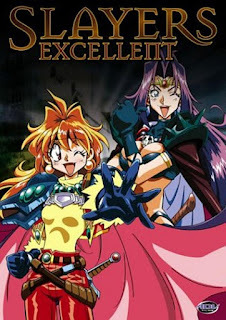 Slayers: Excellent, 1998, dir: Hiroshi Watanabe
The worst thing I have to say about Slayers: Excellent is that it's not quite so across-the-board strong as Slayers: Book of Spells, and I think that comes down more or less entirely to production values. Book of Spells felt like an OVA, in that indefinable way that suggests everyone was shooting a mite higher than they could reasonably have done for even a top-tier TV episode, whereas Excellent never quite hits that same level. I mean, it obviously is an OVA, because the episodes run to thirty minutes and the animation is undoubtedly a notch above what the average TV show would have been capable of in 1998. Though even that's ever-so-slightly damning praise; it's fair to propose that 1998 wasn't so good a year for anime budgets as 1996 was, and the whole project just feels that little bit cheaper.
But that's a trivial concern when all's said and done, and the more so if you're not the kind of person who fusses over lavish animation, in that the batting average for good Slayers stories here is comfortably on a par with and perhaps a fraction above what Book of Spells had to offer. And in one way at least, it has more of an OVA vibe: whereas BoS was content to offer up a trio of standalone tales that could, with a spot of trimming, have fit comfortably into a TV show, Excellent presents something more significant, in the shape of the very first meeting of bickering frenemy sorceresses Lina Inverse and Naga the Serpent, and in so doing provides a thread to tie its three episodes loosely together.
Granted, that seems like more of a big deal than it ends up amounting to, since Lina and Naga's first meeting, entertaining as it undoubtedly is, merely serves as a jumping-off point for an adventure that could as easily have been set later in the befuddling Slayers continuity. The benefit is more that we get a slightly new slant on a relationship that by this point had already been explored extensively and perhaps had few places left to go: seeing Lina getting exasperated with Naga's eccentricities for the first time has a definite charm, and meeting Naga - one of my favourite characters across all of anime - afresh is definitely a delight. Indeed, the focus is generally skewed toward Naga this time around, and that's no bad thing, whichever character you happen to prefer, in that not even the most devoted fan could argue there's a lack of Lina Inverse across a franchise where she's the one consistent element.
Ultimately, all a three episode Slayers OVA has to do is offer up three really good Slayers episodes, and Excellent pulls that off comfortably. The first, which flings the pair together and then sets them both up against a vampire, and the second, which sees Lina serving as bodyguard for a wealthy merchant's daughter who's constantly reminding her of Naga, are definitely the strongest, with the third falling back on the by this point rather too tried-and-tested trope of placing the two on opposite sides of a conflict, though "battling seamstresses" is at least a novel angle. Regardless, what all three get right is what Slayers is best at, taking a relatively straightforward-seeming fantasy concept and then cranking it up and swerving it askew until what you're left with is something hilariously unpredictable, and that's enough for Excellent to largely live up to its name.
 The Slayers, 1995, dir: Takashi Watanabe
With the films and OVAs behind me, two things about this first season of the Slayers TV series took me by surprise, and neither in a good way.
The first really oughtn't to have: obviously a TV show wasn't going to have a film or OVA budget and so, equally obviously, it was going to look cheap by comparison. But quite this cheap? The Slayers does pick up to a degree as it goes along, but its early episodes are rather shabby even by the standards of televised anime in 1995, with no end of obvious cost-cutting and a general feeling of being rushed and small-scale. It's not the biggest of deals, and there are some compensations, in the shape of a nice, watercolour-esque aesthetic and some expectedly appealing character designs. Yet, all things being equal, this isn't a show where the visuals are much of an asset.
The second surprise was a nastier one: The Slayers has a plot. Obviously, it's not altogether true to suggest that the films and OVAs didn't have plots, but they certainly didn't have ones that dragged on for 26 episodes, and even when they ran to, say, the length of a feature film, they were made up more of silly digressions than what we traditionally think of as story. Truth be told, it simply hadn't occurred to me that a Slayers property would think to do otherwise. I'd assumed the TV series would consist of one-and-done adventures or, at most, short arcs that allowed for plenty of diversions along the way. So that The Slayers, for the most part, settles down to the telling of a single tale that occupies some nine or so hours of screen time was something I was wholly unprepared for.
I suspect that would always have been a problem, given that finding the balance between committing to a core narrative and dabbling around the edges was almost always something anime struggled with throughout the nineties. However, there are ways it could have gone much better than this, and the reason is entirely straightforward: the story is neither interesting nor well told. It's the most boilerplate swords and sorcery fare imaginable, and even that would be fine if The Slayers was more than casually interested in pointing out how silly the clichés it trades in are. There's a bit of that - this is still Slayers, after all - but what we see far more of is the plot and comedy standing at odds to each other with very little interconnection. There are whole episodes that pass with barely a joke, and what we get instead is a lot of deeply average fantasy fare revolving around a hackneyed big bad with predictable villain goals, and a good deal of action, this being where the limits of the animation make themselves most distressingly evident.
If that were all there was to The Slayers, this would certainly have ended up being the negative review it's surely looked like until now. Thank goodness, then, for a middle section that does manage to largely bin the main plot in favour of goofing off and making dumb jokes and generally being comedy-fantasy rather than a fantasy show that occasionally jams the brakes on for a quip or reaction shot. And that aside, the main reason those better episodes work is that they focus on The Slayers' core strength: even when it's being somewhat dull, it's doing so with better-than-average characters. Not as much as I'd have hoped, I admit: the supporting cast largely merge into a blob of similar roles and abilities and comic functions and only rarely get the chance to shine. But Lina Inverse is one of anime's finest protagonists, and the dumb-as-pencil-shavings Gourry, our other main lead, makes for a satisfying foil. With the pair of them at its heart, The Slayers manages to stay mostly fun and always likeable, and that in turn saves some of its more humourless patches from becoming a chore. I'd hoped for much better, but if you're happy with a Slayers entry that puts its fantasy ahead of its comedy - and I know many people even prefer it that way - then there's a tolerable diversion to be had here.
 Slayers NEXT, 1996, dir: Takashi Watanabe
I can't prove that the makers of Slayers NEXT travelled in time, read my review of the first season, and went out of their way to fix all their previous mistakes this second time around, but it surely does seem like quite the coincidence given how precisely this evolves in all the ways I'd have hoped it would. Although, thinking about it, you'd imagine they'd have gone back a little further and sorted the issues with the first season too, or possibly bought a bunch of shares in Facebook and become billionaires, or something, and okay, maybe it's actually a coincidence given that my complaints were fairly obvious ones, but nevertheless, it's always nice to feel your grumbling has been taken on board.
Most obviously, this is a matter of animation that, while nothing stellar in the grand scheme of things, is a considerable step up and thus finally working in service of the show rather than against it. Partly that means being generally easy on the eyes, and partly it's about action and spectacle that are genuinely exciting, but most important is that the show's visuals are front and centre in selling the humour. This is a huge boon for something that relies so heavily on character-driven gags and reaction shots - though, regarding the latter, never so heavy-handedly as in the first season, where they frequently felt as though the creators had realised minutes had gone by without a joke and they really ought to throw the audience something.
Granted, the humour is still mostly grounded in playing the fantasy setting relatively straight and then pulling the rug out with an acknowledgement of how basically silly this all is, but there's more going on this time around, and the balance is infinitely better. Though again the general drift is away from light-heartedness in the last few episodes, before that point there's much more out-and-out comedy, and even after the plot has shifted to the forefront, there never comes a point where what we get is effectively a straight fantasy show with the occasional wink to camera. Plus, that plot, while still far from ground-breaking, feels considerably more thought through, with some satisfying twists and turns and enough shorter arcs with their own focus that it never seems as though we're slogging towards an inevitable end.
It's also a narrative that does far better by its characters, making everyone distinct and giving us clear reasons to care about them. In theory, I'm unsold on the idea of a developing romance between our two leads, acid-tongued sorceress Lina Inverse and thinking-impaired swordsman Gourry, but the show makes it work, just about, and that's really the weakest element on the story side, while the biggest win is probably Martina's advancement from uninteresting villain to lead comic relief. If everyone besides those three gets slightly shorter shrift, that's not altogether a bad thing: where the first season felt as though it was perpetually expanding its cast to no real purpose, here the tighter focus gives everyone a degree of individuality even when they're not doing anything terribly meaningful.
For all that Slayers NEXT is reliably good, though, and gets better as it goes along, I'd have to concede that there are only a handful of standout episodes or truly memorable moments. But that aside, my only real frustration - barring my doubts over that dubious romantic pairing! - is the extent to which knowledge of the first season is a prerequisite at points, not the wisest move when you've done such a fine job of showing up everything that didn't work in said first season. Yet stacked against those modest failings is the reliable pleasure of hanging out with a bunch of thoroughly likeable characters as they goof around and have ludicrous but still fairly thrilling adventures, and given that that's precisely what I'd ask of a Slayers TV series, I really can't complain too hard.
-oOo-
It saddens me that the one thing here I haven't much nice to say about is the original TV show, which no doubt many people are extremely fond of. And I really was wondering if I hadn't been overly harsh until the second season came along and proved itself to be so obviously better in every meaningful way. Then again, it's worth pointing out before we go that, from what I've seen, there's really no such thing as bad Slayers, and that's a nice note to end on, isn't it?
January 29, 2024
Drowning in Nineties Anime, Pt. 134
What was that I said last time about trying to avoid exclusively covering obscure VHS-only releases? But while I've failed miserably, we do have a title of note this time around, one of those that frequently comes up in "How the heck did this never get a DVD release?" conversations, so at least we're likely to get one hit from among Explorer Woman Ray, Grey: Digital Target, DNA Sights 999.9, and The Adventures of Kotetsu...
 Explorer Woman Ray, 1989, dir: Hiroki Hayashi
Everything that works in Explorer Woman Ray, and everything that doesn't - which is considerably more - is present from its opening prologue. Before we're introduced to our titular explorer woman, we meet two teenaged girls, Mai and Mami Tachibana, out on what looks to be a pleasant train journey through some vaguely South American country. But, shock! Barely have we had time to get our bearings before the seeming peasants in a passing truck are whipping out automatic weapons, leaving the twins to fight for their lives in an action sequence that's fun and ingenious, but so much less so than it ought to be because the animation is horribly wonky, and which makes little sense in retrospect given that there'll be endless scenes later where the baddies are careful not to shoot at the pair because their goal is to steal the artefact they're carrying.
So lots of action, then, and most of it perfectly fine on paper, and almost all of it undermined by animation so frequently bad that it feels genuinely unfinished, along with a plot that's full of nagging inconsistencies and gaping plot holes. Where do we go with all that? I could outline a bit more of the story, but Explorer Woman Ray doesn't care about it, so there's no reason we should. It's connective tissue for the action scenes, which isn't a problem in itself, except that we really do need something to hang onto, and the only cast members with anything close to a clear motivation are Mai and Mami, who want to get rich and then grudgingly decide to side with nominal hero Ray.
I say "nominal" because the twins get more screen time and because I'm honestly unsure what Ray is out to accomplish or whether she's in the right. The show gets a couple of relatively sympathetic bad guys, who aren't above killing people to meet their goals but would rather avoid doing so if they can, and all we see of what drives Ray is that she wants to stop them, but it's difficult to tell from the onscreen evidence whether the villainous Rig Veda's villainous plan is actually all that villainous. He wants to reawaken the technologies of an ancient race, but who knows, maybe that's a good thing? The first temple that gets destroyed (like all fictional archaeologists, Ray is dire at keeping ancient structures from being destroyed) makes it rain, and, annoying as it can sometimes be, rain isn't inherently evil.
All of which is to say that the plot is dumb and broken; but I could spend half a day reeling off good vintage anime titles with dumb, broken plots, and the thing that unifies almost all of them is how they aren't actively annoying to look at. There are moments in Explorer Woman Ray that work visually - someone clearly put their heart into some of the water shots - but they never last for more than a few frames, then things fall apart again. Sometimes that means an absence of shading, and routinely it means a lack of inbetweening, but most often it's that the characters drift so off-model that you start wondering if there were models or if the animators were getting instructions like, "Remember the woman with the dark hair? Draw her." Weirdly, the villains fare slightly better, whereas Ray hardly looks the same in two consecutive scenes and the twins are nearly as bad. And of course none of those problems are mutually exclusive, so we get a ton of scenes where everything goes wrong all at once.
I don't know that all this makes Explorer Woman Ray bad, exactly. Or, no, I do know that, but it's relatively easy to discern a version of this material that could have worked better, and we get enough glimpses that it's hard to hate what we ended up with. Whatever its failings, it's bursting with energy and its intentions are noble enough: an hour's worth of over-the-top, Indiana Jones-aping action is a fine idea in theory and one that's hard to botch entirely. Explorer Woman Ray isn't the worst conceivable version of itself, and it's evident it was made by people who cared for the material and had some sound ideas: director Hiroki Hayashi would go on to make the wonderful Sol Bianca straight after this, so the man wasn't without talent. But something clearly went very wrong here, and while it's certainly appropriate that watching Explorer Woman Ray feels like digging through the wreckage of an ancient disaster hunting for a little treasure, there's nowhere near enough there to warrant the effort.
 Grey: Digital Target, 1986, dir: Satoshi Dezaki
All credit to Grey: Digital Target, it has a story to tell and has put considerable thought into how to tell it, and it's a story worthy of the investment, one that feels, especially in the early going, as though it might be something really special. Grey doesn't quite get there, mainly because the more answers we get, the more familiar its sci-fi tropes start to become, but it does enough that even once we can see the proper shape of where everything's heading, it's hard to feel too disappointed.
That's mostly because the world-building is terrific all the way through, achieving the thing that science fiction rarely pulls off or even seems to realise it ought to be aiming for of presenting us with a reality that feels fundamentally not our own and so keeping us always a little off-kilter, as though we're tourists in a foreign country frantically trying to catch up enough to not embarrass ourselves. Grey gets to this in a couple of ways, and one of them is admittedly terrible in theory. There are a lot of unfamiliar nouns flung about, for places, things, and concepts, and while most of them can be figured out with a bit of thought, we're never really specifically told their meaning, or anyway not until we really ought to have got there by ourselves. It's perhaps the laziest route to getting that sense of alienation, but here it's used as well as can be, in so much as it never feels as though the writers are bombarding us with all of this terminology; rather, it's coming from the characters themselves, for whom mutual understanding is generally a low priority. And that gets us to the second, much better way in which Grey keeps us at arm's length from its setting, the one that's genuinely impressive: from the beginning, we're thrown in with these characters and given only what information they share among themselves, which isn't much.
The reason all of this matters enough that I've devoted a full paragraph to it is partly that Grey: Digital Target is, more than anything, a mystery, in that the principle goal of its narrative is to keep us guessing as to what's really going on for most of the running time, but partly - and more excitingly - because all of this stuff is essential to how and why it works. As we're introduced to our antihero, Grey, he's walking away from a skirmish that's cost the rest of his squad their lives, and we soon learn that this is a regular enough occurrence that Grey has earned himself a reputation as a grim reaper. He's a consummate killer but a lousy team player, as becomes extremely evident once he's sent back into action with a new squad. But by then, we're already coming up against some bigger questions, like who is he actually fighting, and why does nobody seem terribly concerned about objectives beyond how much killing gets done and how many vehicles get destroyed, and what's all this talk of classes and citizenship, and why does no one appear to care about anything besides that last one when surely the others are way more important?
It's unfortunate that, three and a half decades after its release, the average viewer with more than passing experience of science-fiction will get out in front of Grey well before its end, because the story, the mystery, the steady unravelling of this strange and exceedingly dystopian future, is nearly all the film has going for it. The animation is entirely so-so, the designs are pretty goofy and all over the place (though I suspect that was at least partly intentional, and it does kind of pay off from a narrative perspective) and the action, of which there's a lot, is rarely very exciting, though its extremely blunt approach to violence still packs a punch. Grey: Digital Target is a title I'd love to be able to declare a lost classic, because its goals are admirably lofty, and it's a heck of a shame both that time hasn't been kind to it and that the budget wasn't there to give us the best take on this material. Still, science-fiction films that make a real stab both at telling a fresh tale and doing so in an unfamiliar fashion are rare enough that, if you've any fondness for the genre, it comes awfully close.
 DNA Sights 999.9, 1998, dir: Masayuki Kojima
DNA Sights 999.9 feels very much as though it starts and ends in the midst of a much bigger story, with major events that might well have been as or more interesting than what we've watched off there to either side. And the tale it does manage to tell is one that our protagonist Tetsuro stumbles through without much agency or thought, being batted around by allies and enemies and his own unearned and unasked for abilities, until everything wraps up with an outrageous deux ex machina and some vague promises of how much excitement lies ahead.
But you know what? I've had a similar reaction to just about every Leiji Matsumoto adaptation I've seen, to the point where I've come to view it as almost more of a feature than a bug. Well, the whole "bigger story" thing anyway; that's definitely a chief characteristic of much of Matsumoto's genre work, and surely a part of why it's so loved, given how excited folks have been known to get about shared universes and suchlike. I'm absolutely not one of those people and I'd much rather my 45-minute OVAs have the decency to provide a beginning, middle, and end, and yet - perhaps because I've got so conditioned to Matsumoto - I couldn't really hold it against DNA Sights 999.9.
In part that's because, whatever's happening from moment to moment, for all that it frequently feels random and unmotivated and needs to be hurriedly followed by a burst of explanation for us to follow along at all, it's generally entertaining and frequently outlandish, as for instance when a bunch of amorphous beings from beneath the Earth's crust abruptly because a major plot element despite us having been given not the slightest indication until then that they existed. But they're a cool concept and - this being the other crucial point - they look pretty great, since the animation is mostly very good indeed, and director Kojima, who'd go on to get some tremendous work on his CV, understands how to make Matsumoto's shtick work in motion. Along with ensuring the spectacle is properly spectacular, he makes the wise choice of letting Matsumoto's goofier character designs hang around in the background while keeping Tetsuro and most of the other core cast members that bit more realistic, enough to anchor the show in some sort of concrete reality without losing any of the innate charm.
Normally, then, this would be an easy recommendation, barring the usual caveats about the difficulties of hunting down a lost, forgotten title that never got as far as a DVD release. And yet I do think - and I'm a little sad to say it about something I thoroughly enjoyed - that DNA Sights 999.9 is for existing Matsumoto fans only, if only because the ending relies so utterly on tangential knowledge of his wider works, and probably even then solely for Matsumoto completists. And if that's you, you've probably, by definition, already seen it; but if you haven't, hey, here's a likeable little slice of Matsumoto fiction wrapped up in cracking production values to round out your not-quite-complete collection.
 The Adventures of Kotetsu, 1996, dir: Yûji Moriyama
When you've watched absurd quantities of vintage anime, it's easy to get a bit overly cynical and to come to a title like The Adventures of Kotetsu feeling you've seen it all before, when, in truth, it's not doing anything drastically wrong. Well, it is doing one thing drastically wrong, and that's incessantly showing its 14-year-old female protagonist in various states of undress, and for that matter it's true that there's nothing here that the average viewer well versed in nineties anime won't have come across somewhere else, so maybe I was being just the right amount of cynical, but... Look, let's start over, shall we?
The point I think I was trying to make is that The Adventures of Kotetsu is fine for what it is, accepting that what it is is pretty sleazy and inconsequential and quite obviously a taster of a longer manga. We get, within its two episodes, a sort-of-complete story, in that all of the major conflicts have been resolved and its cast are in meaningfully different places from where they started. Predictably, this is most true of Kotetsu herself, whose actual name is Linn Suzuki and whose nickname comes from the brother, Tetsu, that she arrives in Tokyo from Kyoto in search of and then forgets about for the remainder of the running time. She's also on the run from the ancient witch who's been teaching her the proper use of the demonic sword she's somehow in possession of, and rapidly finds herself roped into the affairs of Tetsu's former employer, detective Miho Kuon, who's got herself into some supernatural bother thanks to the case she's working on, and my goodness does The Adventures of Kotetsu have a lot of flailing plot threads once you stop to think about it.
The Kuon plotline gets wrapped up somewhat, though largely off-screen, and the business with Linn's master / mentor is a major element of the second episode and allows for the semblance of a proper ending, and I guess we can write the whole Tetsu thing off as a way in to the actual narrative, though it feels as if it must have been considerably more important in the manga. But whichever way you shake it, The Adventures of Kotetsu has a lot of plates spinning for what's essentially an excuse for a bunch of fights and bare boobs - the two of which, by the way, are in no way mutually exclusive.
Most of the nudity, as I mentioned, is exceedingly creepy given that Linn is portrayed as a particularly immature 14-year-old. That portrayal fits with the logic of the character, since we're led to believe she's grown up in isolation from the modern world - the show seems to think Kyoto is some sort of time tunnel to ancient Japan - and provides for some laughs, many of which arrive in the dub via Kay Hest's decision to play Linn with a posh English accent that's somehow funny in and of itself; but none of that makes up for how uncomfortable it makes the incessant gawking. Thankfully, the action side of things fares better: Yûji Moriyama, who handled all the first run of Project A-Ko sequels and peaked with Macross Plus, knows his way around this kind of material and injects plenty of energy into what could easily have felt inconsequential and too familiar.
And those, really, are the two poles of The Adventures of Kotetsu: on the one hand, Moriyama has the sense to keep the pace fast and those energy levels high, and the animation, while never actually impressive, is good enough not to hamstring his efforts. But on the other, while it's easy to imagine this developing its own personality with a couple more episodes, especially given how the second makes small strides in that direction, what we actually got brings nothing new to the table and distinguishes itself only by how exceedingly eager it is to show off a mostly naked 14-year-old girl at every opportunity. And ending on a statement like that doesn't leave much room for a recommendation, so I won't try, except to note that if you're in the mood for 45 minutes of hectic, pervy supernatural action comedy, The Adventures of Kotetsu does a satisfactory job of ticking all those boxes.
-oOo-
As you've probably realised by now, or else new all along, Grey: Digital Target was our ringer here, and I can definitely see why there's still a lot of fondness out there for what in many ways would have been a fairly minor science-fiction title at the time: it may not stick its landing or fully nail its execution, but there are some splendid, resonant ideas in there, along with a distinctive vibe that really lodges itself in the memory. And as predicted, it was the only proper recommendation this time around, though I did at least enjoy everything, which is always a win.
December 31, 2023
Drowning in Nineties Anime, Pt. 133
I'm still trying hard to keep these posts from degenerating into nothing except deeply obscure VHS-only releases, but that's obviously proving a bit difficult given that deeply obscure VHS-only releases are about all I have left to cover. Nevertheless, we do have one exception this time around, in the shape of the OVA of the 80's sci-fi adventure series Zillion, and it's a bit of a corker, too. But does the fact that it's been deemed worthy of a shiny Blu-ray release mean it's better than three other titles that will probably never get anywhere near such a prestigious treatment? Let's take a look at Zillion: Burning Night, Rail of the Star, Dragon Slayer, and Dog Soldier: Shadows of the Past...
 Zillion: Burning Night, 1988, dir: Mizuho Nishikubo
There's an essay to be written about the outsided influence of director Walter Hill's bewildering '50's-styled, cyberpunk-presaging, neo-noir action movie Streets of Fire on the anime scene. Heck, it probably has been written, but I can't be bothered to find out and I'm not about to dig too deep and reveal my ignorance. For our purposes, though, suffice to say that Bubblegum Crisis, which in itself would go on to be enormously influential, homaged its opening scene and much of its style about as enthusiastically as it's possible to homage anything. Or so you'd think had you never seen Zillion: Burning Night, which came out a year later and goes even further in riffing on that wonderful opening sequence, then continues to lift the entire rest of the plot as well, albeit dropped into a setting that's just as weird a mishmash in its way as anything Streets of Fire managed.
All of which might come as quite the surprise to the viewer who'd made their way through Zillion the TV show's 31 episodes and came to this 45-minute OVA expecting more of the same. For Zillion was a fairly standard teen-oriented sci-fi action affair whose main distinction would have been its close association with laser tag guns and Sega video games had it not had the good fortune of being made by the team that was just about to become the mighty Production I.G. Though, actually, that's a little unfair: Zillion certainly looks far better than a late eighties anime TV show has any right to, but it's actually pretty delightful on all fronts and an unusually great example of something that could easily have been not remotely great, with some ingenious plotting, exciting action, and charming character dynamics.
Zillion: Burning Night sort of has all of the above. The animation is perhaps a slight step down, which seems counterintuitive for an OVA from a time when that really meant something, but then, you could step down pretty far from Zillion and still look plenty good, and Burning Night certainly does nothing to embarrass itself. On every other front, however, it feels very much like an attempt to carry over something of the vibe of the show but as little as possible of the actual content, which is why the heroic White Nuts who we last saw saving their home planet from aliens are now band members trapped in a bizarre steampunk Streets of Fire pastiche. And even beyond that obvious strangeness, there's something awfully tongue in cheek and subversive going on, as though everyone's secret goal was to see how far they could bend the format and still keep it just about recognisable, up to and including taking five minutes to stop the action dead and sit two characters down to delve into the show's gender politics.
This was always going to work for me, since one of my very favourite things about anime is that willingness to mess around with existing properties in silly and probably hopelessly uncommercial ways, and Zillion: Burning Night is one of the more outrageous examples of that tendency I've come across. Obviously, if you're the sort of viewer that would prefer to be offered more of what you've enjoyed, its likelier to be hugely annoying, both in how fundamentally different it is from Zillion the TV series and how amused it seems with itself over that fact. So thank goodness Burning Night is fun and goofy and thrilling enough that you can, if you want, simply watch it as just another late-eighties OVA that stands pretty much on its own two feet. And if you're yet to come across either the show or the OVA - which, surely, most people haven't, since they're hardly well-known in the West - then Funimation's complete and sensibly priced Blu-ray set is absolutely worth taking a chance on.
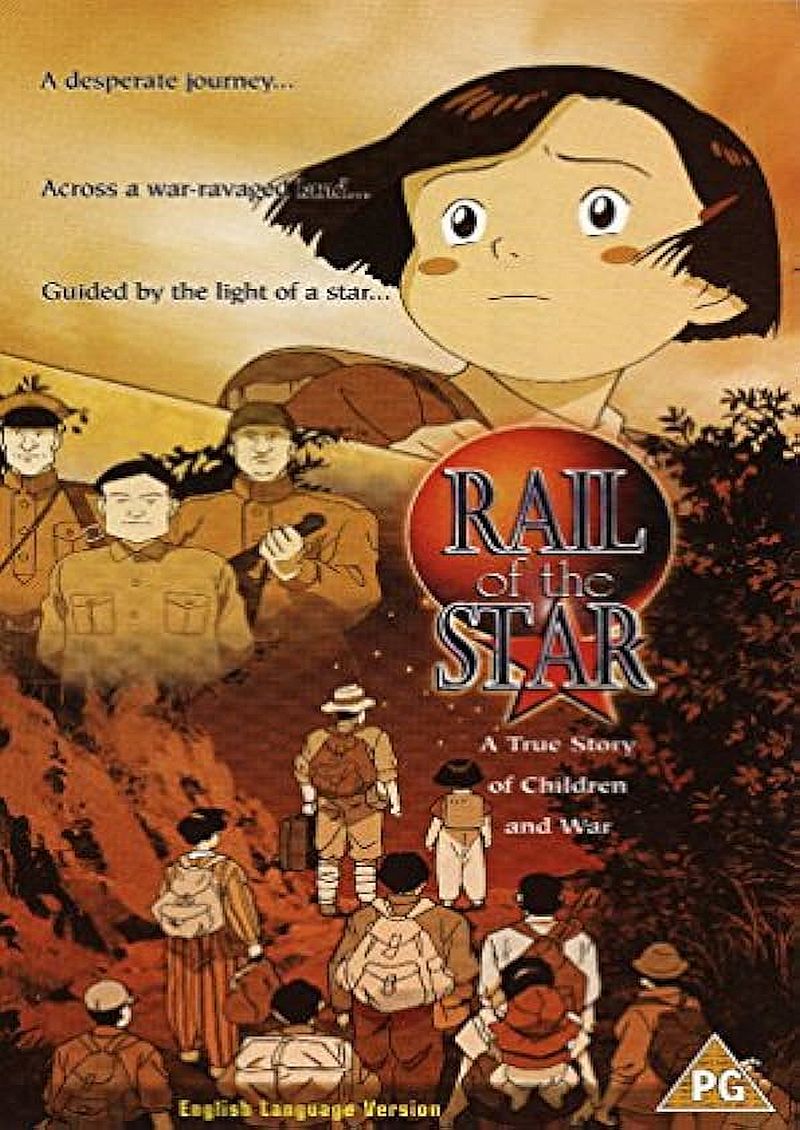 Rail of the Star, 1993, dir: Toshio Hirata
Pretty much everything that works in Rail of the Star is down to the narrative, and that's going to be all the truer for the viewer who's at least reasonably interested in the historical events it narrates and in the slant it takes to those events. Based upon an autobiographical novel of the same name by Chitose Kobayashi, it covers her childhood as the daughter of well-off parents living in Japanese-occupied Korea, from a little before the opening of World War II to the aftermath of the war's end, by which point the Kobayashi family are impoverished, grieving, and desperate to escape from a country that has good reason to hate them and no interest in making their lives anything but horribly difficult.
This places Rail of the Star both squarely in that subgenre practically unique to Japan, the tale of civilians suffering through the losing of a war told through the eyes of children, and somewhat off to one side, in that Chitose sees little of the actual military conflict and is touched by it only indirectly until after its end, as, for example, by her father going off to serve. Mostly, though, Chitose's story runs in parallel to the war, as her life gets increasingly bent out of shape by the global events happening just out of her, and so our, view. And arguably even that isn't the core of the thing; though some reviews would have you believe otherwise, the thread uniting most of Rail of the Star's scattered and episodic narrative is Chitose's slow awakening to the fact of Japan's oppression of the Korean people and her own culpability in that simply by being part of a family that's done pretty well out of the arrangement until recently.
Admittedly, this is sometimes frustrating. Since we're mostly bound to Chitose's perspective, the Kobayashis are nearly always front and centre and the Koreans who enter their lives hover on the periphery, helping or hindering and rarely coming into focus. And though Chitose lived through some incredibly dramatic and heartrending events, there's nothing particularly unique about her or her family, and as protagonists they're not the most inherently interesting of people. We'd like to learn more about those around her, and that's truest of the maidservant who, in one particularly gut-wrenching scene involving a misplaced clothes pin, she indirectly brings harm to. That's surely part of the point, though, and I don't know that being blunter in its themes or more overt in introducing information that Chitose couldn't have known or comprehended would help things any - yet it leaves us with a narrative that's unsatisfying and shapeless in all the ways lived experiences are, albeit with a brief framing narrative that goes a good way to tying everything up in a manner the central story can't.
Still, a mixed bag for the average Western viewer, I'd think, and all the more so for the Western viewer uninterested in or actively hostile to the tale it's telling and its very particular context. And as I said at the start, that's really the best that Rail of the Star has going for it: the animation is awfully barebones for a feature film, reminding me of nothing more than the Animated Classics of Japanese Literature series, and though Koichi Sakata's score has its strong moments, it also has a tendency to be cloying and manipulative. Likewise, the cast are fine without anyone leaving too much of an impression and Harata, as a director, seems quite happy making sure that everything gets from A to B without necessarily trying to play scenes for all they're worth. Whichever way you shake it, then, Rail of the Star isn't on a par with classics like Grave of the Fireflies and Barefoot Gen, or even the similar but more recent Giovanni's Island; but come to it with realistic expectations and there's an often moving, often fascinating account to be found of events that I, for one, knew almost nothing about going in.
 Dragon Slayer, 1992, dir: Noriyuki Nakamura
In a way, what I found most frustrating about Dragon Slayer isn't that it wasn't better, but that it was as good as it is. Because, after all, there's a definite quality ceiling on something like this - that being a prequel to a JRPG video game that couldn't possibly be drawing upon more hackneyed elements if it tried, and, moreover, a prequel that's doomed to drag itself toward a non-conclusion that is, in fact, the beginning of the proper story everyone felt was worth telling. You could gin that up with the most glorious animation ever drawn by human hands, you could hire the finest of voice casts, you could bring in the most skilled writer and director, and what you ended up with could almost certainly never rise above "not too bad, considering."
The Dragon Slayer we got does not contain the most glorious animation, nor the finest voice cast, nor the most skilled writer or director, but you can tell, at least, that everyone was making a proper go of it. Certainly the thing looks pretty respectable, especially around the character work, and Urban Vision's dub is that rarity of the form that's something of an asset, with generally commendable actors finding just the right blend of tones for the material, which veers between leadenly serious fantasy cliché and mildly silly light-heartedness that's invariably more entertaining. Indeed, we could have done with more of that: the balance as it stands is fine for the tale everyone was stuck with telling, but nudging that in a goofier direction could have paid dividends. Alternatively, a shift further towards horror might have paid off: Dragon Slayer flirts with the genre, with the stock monster enemies being closer to demons than to, well, stock monsters, and one gloriously creepy moment near the start leaves you with hopes the remainder has no intention of meeting.
What's worse is that there's one element amid the rote "young hero sets out to avenge his dad and rescue his mum from the all-conquering big bad with the aid of his plucky chums" tripe that verges upon being novel and interesting, and wouldn't you know it but it's introduced bare minutes from the end and not remotely explored? I won't give it away - Dragon Slayer does deserve better than that - but suffice to say that there are the makings of a properly unusual romantic entanglement here, and I'd much rather have watched that story play out.
Ultimately, I feel bad for a creative team who were handed something of a poisoned chalice and had the decency to make what they could of it, and likely the drifts into humour and horror and relationship weirdness were their way of acknowledging that they had to do something to enliven what would otherwise be stunningly over-familiar. And yet I can't help wondering why they didn't go further. Maybe the answer is merely the limitations of a 40-minute run time, since even the most unoriginal of stories still needs to be kept on track, and that doesn't leave much room for doodling in the margins. But if there's a moral to be had here, it's that when your margin-doodling is the only memorable ingredient of your otherwise utterly cookie-cutter product, you might as well go for broke, because the alternatively is making reviewers three decades later grumpy, and nobody wants that.
 Dog Soldier: Shadows of the Past, 1989, dir: Hiroyuki Ebata
My hope for Dog Soldier wasn't that it would be good, since that seemed an awfully long stretch based on the cover art and back-of-box description, but that an anime Rambo knock-off from the tail end of the eighties couldn't fail to be kind of fun-bad. And in this I was to be badly frustrated, since Dog Soldier isn't really that committed to ripping off First Blood and its sequel at all - though it does so enough to make clear that the similarities aren't accidental - and isn't very much fun, bad or otherwise. Like so many OVAs from the period, it's just kind of there, though it manages to shoot itself in the foot harder than most.
The story takes a while to coalesce, and this is actually a plus point, since the chaotic opening is as good as Dog Soldier will ever get. A frenzy of middlingly well animated action eventually gets around to introducing us to our hero, Japanese-American former Green Beret John Kyosuke Hiba, now a construction worker, who finds himself dragged by ludicrous coincidence into the attempted kidnapping of a beautiful female scientist carrying an experimental cure for the HIV virus. Events rapidly grow more convoluted, as said scientist apparently assists in her own capture, and who can the American authorities recruit to bring her back - along with the cure, which they want more because an enemy power could use the immunity it would grant to weaponise AIDS than through any humanitarian instinct - other than our hero? I mean, anyone else, obviously, but Hiba hates and distrusts the authorities and from their point of view is thoroughly disposable, regardless of his impeccable service record, and wouldn't you know it but he has a personal connection both with the scientist and the head of the organisation that's abducted her, so he's the one who gets dropped onto an island of unfriendlies to get the job done.
That's already a lot of setup for what really feels like it ought to be an action title, but we're not done yet: we still need to have the central love triangle explained to is in copious detail, or at least by copious flashbacks to the same snatch of footage, and we've already learned why Hiba lost faith with the US military, along with some muddled stuff about his general backstory that strongly suggests the filmmakers viewed America in the same way the average American of the time would have viewed, say, Libya. And that's the big problem: there's too much story and none of it's particularly fresh or special, and even if it was, it's never developed enough to be interesting in and of itself or to complement the present-day narrative. Or to put that another way, it wastes a lot of time that could be devoted to what surely any viewer would be here for, that being the action that, once we get out of that enjoyable opening, is barely a feature.
It helps not at all that we never get a sense that Hiba is especially good at soldiering, since the plot needs him to fail so we can have our full 45 minutes of running time. We're told he's exceptionally competent, but we barely see it, and Ebata further muddies the waters by turning him and his buddy (who serves no purpose beyond an early spot of exposition) into out-and-out cartoons at certain points, amid an otherwise fairly realistic cast, so that he spends probably more time being a buffoon than he does being the badass we're assured we're meant to be watching. Humour's a weird thing to even try for in such a title, and its brief presence is the clearest sign that nobody thought to sit down and figure out what this was meant to be, leaving us with an action title with barely any action, far too much narrative busywork, and a routine lack of anything for a viewer to latch onto, let alone enjoy.
-oOo-
I'd say that Rail of the Star's been done a little dirty, first by not getting much of a positive reception back in the day - and falling foul of the "How dare the Japanese talk about their own wartime experiences in a way that doesn't make them look like total monsters" crowd, who've even managed to get their hands on its shockingly off-topic Wikipedia entry - and then, subsequently, by being denied a more modern release that it warrants at the very least for the uniqueness of its material. Although, since it's awfully easy to imagine a better take on that material, I guess the injustice isn't all that, especially when there are a handful of similar movies that are flat-out masterpieces. At any rate, Zillion: Burning Night is terrific fun, and well-deserving of its rather baffling presence on Blu-ray, so there's that.
November 25, 2023
Drowning in Nineties Anime, Pt. 132
Having a couple of posts with stuff that's readily available was obviously too good to be true, and so here we are, breaking with that trend about as hard as we can with another bunch of VHS-only titles, most of which are pretty obscure even by that already pretty high bar. But wait! There's a twist! My perhaps-unfair criteria for judging these releases that never made it past the humble medium of video tape has been whether or not they actually deserved to do so, or whether languishing on an extinct medium was an appropriate fate. But that's all out of the window this time, because I'm happy - or, I guess, sad - to declare that everything here comfortably clears that requirement. This is all good anime, and the question is more of how good and why the fates chose to bury these treasures in the mists of time and defunct media.
So, with thumbs pointed firmly upward, let's have a look at Leda: The Fantastic Adventure of Yohko, Kabuto, Blue Sonnet, and Final Fantasy: Legend of the Crystals...
 Leda: The Fantastic Adventure of Yohko, 1985, dir: Kunihiko Yuyama
Leda: The Fantastic Adventure of Yohko is at once as unoriginal as a piece of fantasy could hope to be and a complete delight, and I think the explanation for that apparent contradiction comes down to one thing. It's possible to imagine a live-action version of this same material that might just about work, if only because the designs for the cast, locations, and particularly for the technology are one of the few elements that bring something distinctive to the table; but being animated, and being mostly very well-animated, is what makes The Fantastic Adventure of Yohko shine.
Kunihiko Yuyama went on to have a weird old career that involves a quite horrifying number of Pokémon movies, but there's the odd bit of great work on his CV prior to that, and one of the common elements to his best efforts is a real understanding of how to play to the strengths of his medium. Here, Yuyama constantly switches up techniques to pull out what's best for a given scene, or even a given handful of frames, and is happy to sacrifice a bit of visual consistency if that means an action beat is more exciting or the introduction of a new setting is more giddily fantastical. This is perhaps most noticeable in the opening sequence, possibly the most visually lovely The Fantastic Adventure of Yohko will be throughout its perfectly paced seventy minute runtime, and during which you might easily jump to the conclusion that you were in for an artsy romance rather than a sci-fantasy adventure full of transforming giant robots and boob armour and talking dogs.
Because, oh yes, one of the relatively tiny number of main characters is a talking dog, and that proves yet another illustration of what Yuyama is up to on the animation front, because said verbose canine, Lingam, gets an altogether different art style from our teenage heroine Yohko, who in turns looks not much like the villainous Zell. That approach can easily go wrong, and I've grumbled before now about works where it very much looked like all the designers were in different rooms and never spoke to each other, but in The Fantastic Adventure of Yohko it simply feels right in a way that trying to hammer a single aesthetic onto those three very different characters couldn't.
Still, there's no getting around the fact that chucking a talking dog into your sci-fi swords and sorcery movie is kind of goofy - which is probably all for the good. As I started off saying way back when, The Fantastic Adventure of Yohko, stripped to its bare bones, couldn't be much more cliched if it tried, with Yohko getting transported to another world whose head villain has designs on conquering her own and quickly discovering her chosen one status while buddying up with a team of allies to set things right. And even within that, it's not like there are many twists on the formula, though there are individual details - like how the central McGuffin isn't a sword or somesuch but a piece of music Yohko's written to woo the guy she's crushing on - that add a nice bit of texture.
Don't come to The Fantastic Adventure of Yohko for strikingly original fantasy storytelling, then, but also don't let that lack of originality be a reason not to seek it out. And the same, surprisingly, goes for the aforementioned boob armour, which turns out to be about as sexualised as Yohko ever gets in a story that actually winds up feeling slightly progressive by the standards of 1985. Even if a big part of her motivation is the attentions of a boy who possibly doesn't know she exists, she still gets to be tough and brave and decisive, and there's a terrific scene towards the end where all those elements come together and we get to see how much she's grown across the relatively brief running time. It's characteristic of a film that's wonderfully well thought out in its every detail, and even if that's in service of a plot you can predict every beat of, that still adds up to something utterly charming.
 Kabuto, 1992, dir: Buichi Terasawa
Not for the first time, I find myself baffled as to why UK distributor Manga put out some absolute dross in their budget Collection range and yet failed to relicense some of their better VHS titles for DVD. Because Kabuto - or Raven Tengu Kabuto in the US, or Raven Tengu Kabuto: The Golden-Eyed Beast in its original title - feels like the very epitome of what The Collection was about, except for the part where it's pretty good.
And, OK, "pretty good" is hardly gushing praise, but it's a hell of a lot further than I'd go for the likes of Vampire Wars, and Kabuto, to its credit, gets there by exceeding its inherent limitations in a few unexpected and satisfying ways. We could grumble about the animation, for example, but I never feel good about doing that when a title is obviously pushing its budget to the limits in the hands of a director who's going out of their way to make interesting visual decisions. Kabuto has its fair share of style, and roughly half the time it looks great thanks to some detailed, realistic designs; so long as nobody moves too much, it's actually quite splendid in places. The flipside is that the action suffers the most, and the action could have done with some flashy animation since it's the aspect Terasawa has the least grasp on, with every sequence boiling down to variations of one character swinging their sword or otherwise doing something violent and another character dying unpleasantly, with not much in the actual way of fighting.
This is frustrating, since good action would have really elevated a title that has quite a lot of the stuff. Fortunately, Kabuto is such a busy genre hybrid that it's allowed to let a few aspects slide, even ones that theoretically ought to make or break it. It's nominally a samurai drama, but very much at the end of that spectrum that wouldn't be at all upset if you mistook if for a Spaghetti Western, though that's not as easy as it might be when it also chucks in a fair bit of science-fiction and tops the whole weird confection off with a heavy dose of horror. Those last two are where Kabuto really threatens to excel, though the brief running time never quite allows it to get there. Still, there's some absolutely terrific imagery scattered around, getting great mileage from the incongruity of muddling genre material into what, for most of its running time, would function quite happily as historical drama.
That's all for the good, because strip out the genre shenanigans and you have the most basic of tales left behind, one enormously familiar to any viewer who's seen more than the slightest bit of classic Japanese cinema: our hero, Kabuto, returns to the village of his youth to find it taken over by bad folks and sets out to rescue his childhood sweetheart from her captors. But the familiarity is easy to ignore when the head villain is actually a perpetually naked villainess of the most cackling and self-amused sort and her hench-weirdos are a guy who seems to have wandered in from a samurai-themed version of The Terminator and a genius inventor smart enough to have harnessed advanced robotics while everyone around him thinks horses are pretty high-tech. Oh, and Kabuto himself can sprout wings and fly, because apparently there's a martial arts school that lets you do that, and heck, even Manga's dub is quite respectable for a change, and all in all, trivial and flawed though it is, Kabuto is about as thoroughly and delightfully nineties anime as you could hope to get.
 Blue Sonnet, 1989 - 1990, dir: Takeyuki Kanda
It's not like I need to be reminded of why I love vintage anime, but still, every so often it's nice to be, and usually what does it isn't the really mind-blowingly terrific stuff but a title that absolutely nails the nuts and bolts. So it was with Blue Sonnet, a five-part OVA that, from its plot synopsis, couldn't sound more generic if it tried and probably wasn't a good deal fresher back in 1989. The 16-year-old Sonnet Barge is both a psychic and a cyborg, and she's in the employ of an organisation called Talon, working under the transparently evil Dr. Josef Merekes, but poor Sonnet, who's never known anything except misery and abuse, isn't well equipped on the moral compass front. So when she finds herself sent to Japan to stalk innocent-seeming high school girl Lan Komatsuzaki, who may or may not be another powerful psychic, she finds nothing about the situation especially suspicious, except for how posing as a normal teenager means that people are suddenly showing her the sort of kindness and decency she's been so deprived of until now.
Actually, I seem to have unintentionally made that summary a bit less cliched than I intended, and in doing so touched upon one of the things that makes Blue Sonnet special in the face of so many apparently commonplace ingredients. Though it has all the graphic violence and nudity you'd expect from a 1989 OVA about battling psychic warriors, the source material in this case was actually a Shōjo manga, and perhaps that's why it goes down the unusual route of treating its twin heroines like actual human beings and letting in some genuine notes of emotion and tragedy. By the mid point, I was quite shocked to realise how caught up I was in the fates of Sonnet and Lan, and by the end I was fairly stunned to look back and see how much ground had been covered in the space of two and a half hours. Blue Sonnet uses its running time exceedingly well, and does as good a job as any title I can recall of making each episode self-contained and meaningful whilst also gradually building the wider conflicts and setting up what's to come. Though it's hard to notice in the early running, when the show is largely aping a typical high-school drama, there's no real flab anywhere, and though there are a couple of hefty diversions - part three is a neat retelling of some of the best bits of Ringu, except for how it got there first by a couple of years - everything ends up pointing in the same direction, even if it's only to make some of the later character choices feel believable and impactful.
All of this is wrapped up in animation that's never a great deal better than it needs to be, and Kanda is hardly show-offy in his direction, but he does a fine job of ensuring that the budget goes where it needs to and that the art is always working in service of the storytelling. It's hard to say whether the same is true of character designs that look as if they've wandered in from a good decade prior, and no doubt there'll be viewers who feel they overly date the material. For me, they worked just fine, sometimes by injecting an air of innocence to the proceedings and sometimes by seeming thoroughly incongruous as limbs are torn off and heads explode. Blue Sonnet, incidentally, has some exceptionally well-used gore, especially by the none-too-subtle standards of 1989, doling it out just enough that it feels shocking and consequential and selling us on how powerful its protagonists are rather than conjuring up a world where stubbing your toe is enough to make you explode in a shower of blood.
It's fair to say that Blue Sonnet caught me in precisely the right mood, which is to say, when I was absolutely ready for something pulpy but not dumb, and it's also fair to say that nothing here is what I'd call objectively great, barring a shockingly catchy opening theme and a generally splendid and well-used score. There are aspects, such as the sequence that runs under that terrific opener, wordlessly depicting some of Sonnet's overwise barely touched upon childhood traumas, that might be bold and heartfelt or tacky and exploitative depending upon the eye of the beholder, and perhaps, there and elsewhere, the truth lies somewhere between those two poles. Or maybe it's truer to suggest that Blue Sonnet is quite capable of being bold, heartfelt, tacky, and exploitative by turns, and sometimes all those things at once, and that's probably even a big part of why it works so damn well.
 Final Fantasy: Legend of the Crystals, 1994, dir: Rintaro
We've covered any number of titles whose absence from any medium more modern than VHS tapes is strange and frustrating, but here at last we come to one where it's downright inexplicable. The very fact that Legend of the Crystals is the first attempt to adapt the enormously long-running and popular Final Fantasy JRPG series to the screen would, you'd think, be enough in itself; but add in the fact that this was directed by Rintaro, of Galaxy Express 999 and The Dagger of Kamui and Metropolis fame, among much else, and cap that off with animation by the famed studio Madhouse, and you're into the realms of the truly baffling.
Or rather, there's one obvious explanation, and that would be that everybody involved was so embarrassed by what they'd come up with that they decided to disappear it from the world as well as they could. I can't say for sure that wasn't what happened, but if it was, they were enormously bad at judging their own work, because Legend of the Crystals is a strong effort by everyone's standards. Rintaro had and would go on to produce things that were more creatively interesting and visually spectacular, but there's not much on his CV so consistently good, especially when this bucks his usual trend of getting so caught up in the imagery that he lets the story get away from him. By his and Madhouse's standards, there's not much here that's terribly showy, but the animation is reliably impressive, the framerate is high even for an early nineties OVA, and the integration of the marvellously designed characters with some simply coloured but especially detailed backgrounds is really standout stuff. And as for the Final Fantasy series, well, the next time Square took a stab at this would be with uncanny-valley-fest The Spirits Within, and enough said about that.
Though, no, let's say one more thing. Among the more obvious ways in which The Spirits Within missed the mark was by doing nothing with the Final Fantasy license besides throwing in a few arbitrary references and emulating its busy, over-cooked approach to narrative lore, something ill-suited to the limitations of a feature film, while later attempt Advent Children would learn from that mistake but arguably go too far in the other direction by hewing so closely to its source material as to be incomprehensible to anyone but the existing fanbase. And that's all the more embarrassing when Legend of the Crystals got it right first time, acting as a sequel to Final Fantasy 5 but with a mostly new cast, allowing it to tell its tale without getting too bogged down in worldbuilding or exposition.
It helps, in fairness, that it's as boilerplate a tale as can be, but it helps considerably more that the cast are pretty wonderful, with the definite highlights being Rouge the kinkily underdressed sky pirate with a passion for stealing anything not nailed down and her opposite number, the brash and bulky Valkus, whose better judgement quickly falls foul of his developing a massive crush on her. The leads are slightly less fun, though they do better than their counterparts in many an actual Final Fantasy game, and speaking of which, I'm baffled at how any series fan could fail to love this when the female lead is a summoner who can only summon Chocobos! Admittedly, that's a sure sign that Legend of the Crystals isn't taking its Final Fantasy-ing as seriously as it might, and if you prefer the games at their more angsty, this probably isn't for you. For everyone else, though, it's a delightfully light-hearted gem brought to life with splendid animation by a director with talent and vision to spare, and I'm genuinely bewildered as to why it's been allowed to muster away in the VHS dungeons the way it has.
-oOo-
Man, what happened there, huh? Did nineties anime companies not want to make money? Did they really prefer to put out junk and leave splendid titles to gather dust? Or is it just that I don't have the faintest idea how anime licensing works and there were actually vast and complicated factors that consigned these gems to the trashcan of history? Who knows? Given that I'm not willing to go the extra mile and do some actual research, not me!
[Other reviews in this series: By Date / By Title / By Rating]
October 20, 2023
Drowning in Nineties Anime, Pt. 131
Unlikely as it seems, we have another post of stuff that's readily available - nay, readily available on blu-ray, no less! - and I'll be amazed if that ever happens again, but for now, let's wallow in the joyous fact that lots of great (and, OK, some not so great) anime is still being put out on shiny disks and take a look at Mobile Suit Gundam 0083: The Afterglow of Zeon, Project A-Ko 4: Final, NG Knight Lamune & 40 DX, and All Purpose Cultural Cat-Girl Nuku Nuku DASH!...
 Mobile Suit Gundam 0083: The Afterglow of Zeon, 1992, dir: Takashi Imanishi
I'm not convinced there was ever a possibility of cutting a two hour movie from the thirteen episodes of Mobile Suit Gundam 0083: Stardust Memory that was remotely as successful as that seminal OVA series. Stardust Memory wasn't always the paciest or the most concise show, but then, that willingness to slow down and build its world and characters, or just pause for a stunner of an action sequence, was the source of many of its virtues, and I've never been a fan of the breakneck storytelling that characterises much of the Gundam franchise, especially when it comes to these compilation films. However, there are definitely ways in that could have worked, and it's evident that the creators of The Afterglow of Zeon put some thought into the question rather than simply stripping out everything remotely unessential and lashing whatever was left together as best they could.
I mean, that is a thing they did, it's just not the only thing. And therein lies the problem: any one approach might have succeeded, but The Afterglow of Zeon tries its hand at three that I counted, if we include the aforementioned path of least resistance. Which, actually, isn't quite what's happening anyway, given that the film does do away with quite a bit that was, if not crucial to the plot, then at least pretty useful in regards to making it followable: it's fair to say that Imanishi's take heavily favours the material he himself directed, which means an emphasis on the second (and, for me, the slightly weaker) half and an opening that hits the ground running way too hard.
So that's one angle. But initially it looks as though Afterglow of Zeon might be up to something considerably more interesting, as we're greeted with narration from Nina Purpleton and by far the clearest explanation of the one-year war and the Gundam-verse I've encountered. And that got my hopes up for a version of Gundam 0083 told through Nina's eyes, since the ill-use of her character was perhaps my biggest bugbear with the OVA's telling. Saddled with the thankless dual role of love interest and exposition-deliver, Nina was probably doomed from the off, but the directions she's taken in the last few episodes are frustratingly nonsensical and ripe for a revision that clues us in to what the heck she was thinking beyond Stardust Memory's "Boy, women sure are emotional to the point of being downright crazy, huh?" Which makes it all the more annoying that Nina's narration ends up as nothing more than a lazy way to plaster over some of the wider story gaps, leaving the sense that she was picked more because everyone agreed that Rei Sakuma had a nice voice.
That leaves us with one last approach, and perhaps the most potentially exciting, and this one Afterglow of Zeon does follow through on somewhat, though I came to suspect that again it was more from necessity than creative choice. A take from the antagonists' perspective is sitting right there, and it's not as though Gundam hasn't dabbled plenty in that sort of thing, but here it could really have paid dividends since they do have some legitimately good points: given that the tale begins with the revelation that the Federation have been developing atomic superweapons in secret, their moral high ground is severely lacking. But though Afterglow of Zeon feels more balanced than Stardust Memory did, that never particularly leads anywhere, presumably because to really delve into the motivations and morality of the Delaz Fleet would have required the production of new footage.
Which, in a review that so far has been a bit unduly harsh, leaves us with the one thing Afterglow of Zeon couldn't hope to screw up even slightly. It may not be the best possible two-hour version of Mobile Suit Gundam 0083, but it's still Mobile Suit Gundam 0083, and that's some pretty great bones to have. The animation hasn't got any less glorious, the character and mecha designs remain some of my favourites anywhere in Gundam, and in general the visuals outshine almost everything else from the time, looking remarkably fresh and current even some three decades later. The same goes for Mitsuo Hagita's thrilling score, the strong cast, and the largely excellent work of both directors: this could only ever have gone so far wrong, and while it takes a fairly good stab at times, that leaves a somewhat mangled, not always easily followed version of two hours of fundamentally excellent Gundam.
 Project A-Ko 4: Final, 1989, dir: Yûji Moriyama
I can't be sure whether these Project A-Ko sequels have improved with each entry or whether they've just worn me down, but Project A-Ko 4 was comfortably the one I enjoyed the most. And again, I don't know if that's the same as being the best; Plot of the Daitokuji Financial Group had an infinitely clearer story and Cinderella Rhapsody played around much harder with what it meant to be a follow-up to the original A-Ko. Indeed, narratively Final is quite the mess, and it's difficult to judge how much of that is a deliberate harnessing of the first entry's chaotic energy and how much is simply that nobody was quite sure what story they were telling or how to keep it in line with the demands of wrapping up threads from the preceding two. Which is something Final concerns itself with more than I'd have expected, meaning that borderline-mute love interest Kei is back from Cinderella Rhapsody and this time romancing A-Ko and B-Ko's teacher Miss Ayumi, much to their mutual chagrin, which in turn is enough to wind up the eternally annoying C-Ko, who had good reason to suppose she was back to being the centre of everyone's attentions.
Oh, and also there's a massive alien fleet approaching Earth for reasons unknown, though they'd be more obvious were it not for the various red herrings that writer Tomoko Kawasaki throws in to obfuscate things. Really, the plot is far from a strength in and of itself, but since it's merely a vessel for delivering gags and amusing nods to other media, more so even than Project A-Ko's was, it proves to be just what's needed. Really, it's that return to being anarchic for its own sake that makes this such a joy, and the sense of fun that was never 100% there in the last two is back in full force. This feels like the work of people who at once have huge affection for the property they've created and no qualms whatsoever about blowing it all to pieces if the result is the tiniest bit funnier. So we get perhaps the most random smorgasbord of references yet, from an hilarious mockery of Kimagure Orange Road: I Want to Return to That Day to classics of Japanese cinema to The Graduate, and on and on, with no end of cameos to be spotted if you're quick enough with the pause button.
Arguably, none of that makes Final a necessary watch, and for all the efforts to provide a true and definite conclusion, this takes us nowhere Project A-Ko hadn't already and indeed doesn't really do much to slam the door on further sequels. If there's any real finality here besides the title, it's in the pervasive sense that the creative team knew they'd drained all the mileage from the franchise they could and were ready to bring the roof crashing down, which is admittedly just the right sort of note for the series to go out on. That faint air of wheel-spinning is enough to make it that bit less satisfying than the original was, as is the inconsistent animation, and yet I struggle to imagine the viewer who enjoyed Project A-Ko and didn't also get a kick from this - which is weird given that, way back in March 2017, I was that selfsame viewer. But here in 2023, and even with the somewhat weak start of Plot of the Daitokuji Financial Group, I definitely can't stand by my earlier dismissal of these sequels, the more so given how loving and lavish Discotek's Blu-ray releases have been, so I guess that leaves us with an across-the-board thumbs up for all things A-Ko-related.
 NG Knight Lamune & 40 DX, 1993, dir: Naori Hiraki
NG Knight Lamune & 40 DX is at least better than NG Knight Lamune & 40 EX. It has more of a story than "new villain appears, heroes defeat new villain", and thus rises above the laziest possible level of plotting. It also has the decency to ignore basically everything that happened in the previous OVA, which has the advantage that the romantic developments between our protagonist Lamune and Princess Milk have been forgotten and we don't have to endure another ninety minutes of them angry-flirting with each other. Not that the alternative, whereby Lamune and his pun-loving pal Da Cider's sole motivation is to cheat on their respective girlfriends with a pair of random women, is better in any meaningful sense, but it does have the advantage that this time everyone's bickering for a vaguely sensible reason.
Oh, but we're already deep into the realms of faint praise! Well, faint praise is all that NG Knight Lamune & 40 DX is going to earn itself, I'm afraid, but I was genuinely glad that the plot was up to something, even when that something didn't work in much of a meaningful fashion. The alluring ladies that Lamune and Da Cider have their sights set on are named Gold Mountain and Silver Mountain, because why wouldn't they be, and they're obviously up to no good, though not so obviously that the show doesn't hang onto that revelation as a half-hearted third act twist. And because that setup wouldn't fill a single episode, let alone three, we also get some business involving a Wacky Races-off with some other prospective suitors, Milk and her sisters chasing their deceitful beaus disguised as Sailor Moon and the Sailor Scouts - well, Sacred Scouts if you believe the lawyer-proofed subtitles - and a bit of time jumping through past episodes that would probably have meant more if I'd seen the TV series, though it's not as if the writers do much with the concept besides raising questions about the ready availability of time-travel-inducing rocks that they haven't the faintest interest in addressing.
What they are interested in is providing a brief and bouncy slice of silly, slightly lecherous fun, and with a bar set that low, it's almost impressive that NG Knight Lamune & 40 DX can't flop over it a little higher. The character designs don't help - Ramune and Da Cider, in particular, seem to look markedly worse than they did a mere two years ago - but the animation quality is the main culprit. Mostly it's just doing the show no favours, but there are points where its cheapness and lack of ambition cause actual damage; once you notice that almost every shot with Gold Mountain and Silver Mountain is actually just one lot of character animation mirrored, it's annoyingly hard to ignore, and the last episode spends so long set against a featureless, abstract void that I forgot where the climatic battle was meant to be happening.
Nevertheless, there are laughs to be had, and since that's the bare minimum we can ask of what's primarily concerned with being funny, NG Knight Lamune & 40 DX manages to hobble its way past the finish line. Then again, it's hard to say if anyone else would laugh at those gags, the more so since they're never developed beyond the point of being gags: the Sailor Moon stuff always made me chuckle, but objectively it's just there, without ever, say, delving into the differences between the NG Knight Lamune & 40 and Sailor Moon franchises for comedic effect - the exception being serpentine mascot character Heavy Meta-Ko's impersonation of feline mascot character Luna, because a snake dressed up as a cat is inarguably hilarious. If you agree, you might find some enjoyment here, and it should at any rate provide a bit of fun for fans of the series, which is further than I'd have gone for NG Knight Lamune & 40 EX.
 All Purpose Cultural Cat-Girl Nuku Nuku DASH!, 1998, dir: Yoshitaka Fujimoto
It's honestly kind of impressive how badly the makers of All Purpose Cultural Cat-Girl Nuku Nuku DASH! screw up what you'd think would be a largely unscrewupable premise. The original Nuku Nuku OVA isn't any kind of classic, but it's fun, likeable, and fairly ingenious, while having the decency not to lean too heavily on its central concept-stroke-gag, that our heroine is an android with the brain of a cat. The TV series that would follow five years later and air a few months before DASH! doesn't get things quite so right, if only because it sands off a lot of the sharper edges, but it's a pleasant enough diversion, and if nothing else it feels as though everyone understood what an audience might want to get out of a show about an all-purpose cultural cat girl.
DASH!, which is strictly speaking some sort of alternate-universe retelling, since there's no way to square its particulars with either of the previous iterations, has its own ideas about what the property ought to be, and every last one of them is terrible. I assume it began somewhere around, "But what if we made it darker and edgier," as so many entertainment industry meetings did in the late nineties, and went from there, digging ever deeper holes for the show to stumble into. What if Ryunosuke Natsume, previously the pre-teen son of Nuku Nuku's inventor Kyusaku Natsume, was aged up to the point where there could be some sort of love interest between him and Nuku Nuku? And what if Nuku Nuku herself was, like, really hot, in the very specific sense of that phrase meaning "has whopping breasts"? And what if, when she wasn't jiggling about doing superhero antics, she was quiet and subservient and mostly devoid of personality, acting as an unpaid maid for the Natsume family? And, oh, yeah, what if the whole thing with Ryunosuke's parents being divorced went out the window, but mum Akiko still worked for the evil Mishima corporation, though no longer as their CEO, and what if that was no longer any source of contention and indeed was accepted by basically everyone, even though Mishima were still the villains of the piece?
If the downgrading of Akiko Natsume is the most galling change from the OVA, what with Akiko being the best thing about it, the changes to Ryunosuke are the most annoying. That's because this new version of Ryunosuke is utterly dreadful, from his screamingly late-nineties design to, well, his entire personality. In a win for realism and nothing else, Ryunosuke reacts to the arrival of an attractive girl in his household more or less exactly as you'd expect a teenage boy to, lusting after her, getting increasingly jealous and possessive on the basis of a relationship that exists almost entirely in his own head, and failing to pay any actual attention to Nuku Nuku as a person to such an extent that he never for a moment suspects that she might, in fact, be both a robot and a cat or that she's the same person who keeps saving him from various Mishima-related shenanigans, only minus the wraparound sunglasses and spray-on leotard.
That broken core relationship is what pushes DASH! towards unwatchability, but it's not as though any of the stuff around it is picking up the slack. Kyusaku is as irrelevant to this telling as Akiko is declawed, the humour is largely absent and almost never funny, and the plot that we get in its place is generic sci-fi junk of the sort that didn't feel altogether fresh when Bubblegum Crisis did it so much better a decade earlier. And it probably won't surprise anyone at this point that the music is unmemorable, the designs are ugly, and the animation is barely functional and only gets that far by reusing every drop of footage it can get away with. I try to always find at least one positive, so I ought to mention that the manner in which everyone simply accepts how Mishima use the city as their personal weapons testing ground is kind of amusing, but that's how far I'm having to reach to find anything nice to say about a title that had the answers handed to it on a plate and chose instead to scribble rude pictures all over the test sheet.
-oOo-
Whew, not much of an argument for buying vintage anime blu-rays, huh? Except that three out of the four releases here come packaged with other, better titles (I'm assuming in the case of VS Knight Lamune & 40 Fire, but surely something on there must be some good) and both Mobile Suit Gundam 0083 and the All Purpose Cultural Cat-Girl Nuku collection remain well worth your time, even if not for these particular entries. And the one thing that gets a disk all to itself was pretty great, so I guess the survival of physical media is justified after all. Phew!
[Other reviews in this series: By Date / By Title / By Rating]
September 30, 2023
Drowning in Nineties Anime, Pt. 130
The Irresponsible Captain Tylor! It's a classic and much-loved nineties anime show, and up until now it hasn't seen any real mention on this blog because I don't cover TV shows, except for the one or two times when I have because I got confused or someone asked me nicely. At any rate, that's not an excuse for not getting to the subsequent OVA series, and if I have one at all, it's that its reputation isn't especially great and the box set has been sitting unattended on my shelf for rather a long time. But what kind of review series would Drowning in Nineties Anime be if we cared about reputations? So it's finally time to work through the four volumes of the DVD release, those being An Exceptional Episode, The Rules of Being 16 / The Samurai's Narrow Escape / The High-Tech Opposition / White Christmas, If Only The Skies Would Clear, and From Here to Eternity...
 The Irresponsible Captain Tylor: An Exceptional Episode, 1994, dir: Kōichi Mashimo
It wasn't my original plan to review the ten OVA episodes of The Irresponsible Captain Tylor in chunks, but having watched the first two, it's already obvious that treating them as a single entity would be a useless exercise. For those first two episodes, jointly known as either An Exceptional Episode (which is what we're going with) or Tylor's War are, to all intents and purposes - and especially when presented the way Nozomi did on the release I have, with the intermediate credits snipped out - a follow-up movie to the Irresponsible Captain Tylor TV series, and I'd be very surprised if the remaining eight continue on from it in any direct way.
Now, this is as good a place as any to admit that I've never been the world's biggest Irresponsible Captain Tylor fan. It's one of those shows that I have a ton of respect for, that I'd unhesitatingly recommend, but that I never quite clicked with. So it was quite the shock to settle down with An Exceptional Episode and almost immediately be hit by a flood of nostalgia and warm affection for its sizeable cast. That cast was always the heart of the show, of course, but in retrospect I wonder if part of my issue was that having so many people to keep track of and care about left it feeling a touch unfocused, just as the likeable hanging out that was its baseline made the shifts into actual drama sometimes seem more annoying than rewarding.
So it's to An Exceptional Episode's credit that it sidesteps both those failings, setting up a crisis that's suitably major but broad enough in its particulars that we can still spend most of the running time watching the cast bounce off each other, which is all the more fun here since characters who never got to interact before are thrust together in new and interesting combinations. The film - and I know it's not quite that, but it seems dumb to consider it anything else - also pulls off the neat trick of both capitalising on the growth that occurred over the course of the show and sneakily resetting crucial aspects, since we can hardly have ninety minutes of story about an irresponsible captain who doesn't behave irresponsibly and is unreservedly trusted by his crew of loveable eccentrics. Really, the heart of the tale is a mystery, one kept both from us and the cast and focused on why Tylor is back to being a shady goofball who seemingly puts everyone's lives in danger, and though the outlines are obvious from early on, the details are intriguing and significant enough to provide a solid narrative spine.
What's not on offer is much in the way of action, which is fine because that's hardly The Irresponsible Captain Tylor's forte, but it does mean the animation never really gets to impress. If there was extra money here, as you'd expect from an OVA from 1994, it seems mostly have gone into making the character animation sing, which is arguably just as it should be. But the caveat is that there's nothing to distract the viewer who wasn't coming directly from the show, not when so little effort is made to reintroduce the cast and setting or to recap recent events, which from the perspective of someone who tends to blunder into OVAs without the requisite foreknowledge would normally be a turn-off. However, since I did the groundwork for once, I can confidently say that if you are familiar with the show, this is up there with the very best episodes, and perhaps even a touch better than any of them.
 The Irresponsible Captain Tylor: The Rules of Being 16 / The Samurai's Narrow Escape / The High-Tech Opposition / White Christmas, 1995, dir: Naoyuki Yoshinaga
I said in regards to the last episodes that they were a pleasant reminder of how enjoyable the group dynamics in The Irresponsible Captain Tylor could be. The four standalone episodes that followed, produced by a different studio and a different creative team, were a reminder of the curious flipside of that, which is that I don't have much time for most of the characters when they're on their own. The thing is, and bear with me as I try and expand upon a really obvious point, but the core of the show is Justy Tylor, the man whose irresponsible attitude to nearly everything throws the overwise standard sci-fi milieu he resides in into chaos. So it follows that the purpose of everyone around him, to a greater or lesser extent, is either to react to Tylor or to create situations for him to resolve in his inimical fashion. That's truer of some of them than others, for sure, and the series got some good mileage from digging below the surfaces of its cast, but still, is separating them off for solo adventures really the way to go? I'd argue not, and lo and behold, director Yoshinaga and the team at Studio Deen gave me ample evidence.
The Rules of Being 16 is the most substantial of these four episodes, with a bit of dramatic weight to it and a bearing on the wider Tylor narrative. But for all that, the story of how teenaged emperor Azalyn finds herself meeting up with an old friend who's been left traumatised by events that her father and the Raalgon empire in general were directly responsible for strays a bit too close to rehashing ideas and incidents we've already seen quite often by this point, and as recently as the previous OVA episodes. I can't imagine the viewer who, having got this far, won't be able to predict exactly how Azalyn behaves - like a sixteen-year-old girl who couldn't really care less about emperoring, basically - and the true mystery is how she keeps pulling this stuff and not getting violently deposed.
On the plus side, it's the second-nicest-looking of the four, with some detailed, sensitive character animation across gorgeous backgrounds, both of which take something of a dip as we move into The Samurai's Narrow Escape and The High-Tech Opposition, which get up to more ambitious stuff and so end up showing the cracks in the budget more. It seems reasonable to treat these two as a pair because they both do exactly the same thing: take minor characters that have had minimal development until now and chuck them into a thirty minute action movie. The first focuses on fighter pilot Kojiro, and tries to cook up a Top Gun-style conflict which doesn't succeed since Kojiro's only remotely interesting trait, his phobic aversion to women, is wholly absent, and without that he's just your stereotypical hot-headed pilot type. Whereas The High-Tech Opposition has even thinner characters, in the shape of the Soyokaze's marines, but gets to have more fun with them, humour being something that's been extremely lacking up until this point. It also has a stronger concept - albeit one Ghost in the Shell: Stand Alone Complex would go on to do vastly better - and better action, and generally feels more in tune with what makes The Irresponsible Captain Tylor tick.
But ultimately, what made The Irresponsible Captain Tylor tick was the irresponsible Captain Tylor, and it's no surprise that his return makes for the best episode. White Christmas feels like the sort of thing the TV show did on a regular basis, with Tylor being thrust into a situation and making everything much weirder by responding in ways no-one would expect: in this case, it's an attempted Christmas Eve date with Yuriko, which has the added benefit that we get some nice development for her and the long-suffering Yamamoto. Essentially, though, it's our titular protagonist who's the star, and in a low-key, uneventful fashion that's perhaps a better fit for the character than the more extreme scenarios the TV series tended to traffic in. It also helps that White Christmas is a pleasure to look at, with some terrific backgrounds conjuring up a night-time city that's at once tangible and dreamy, familiar and alien, and a perfect setting for the woozy, bittersweet tale being spun.
One genuinely satisfying episode out of four isn't much of a success rate, especially when that one isn't up to anything especially fresh, and all in all this feels like a distinct step back from the superb start that was An Exceptional Episode. I respect the intent of splitting up the cast and then using them to glimpse at what the strained peace between humanity and the Raalgon Empire looks like from a variety of angles much more than I enjoyed the actual results, in part because none of these four stories are very illuminating on that front and three of them aren't that strong on their own merits. It's a decent idea not delivered as well as it might have been, and yet the results are perfectly fine and end on their strongest notes, so this middle stretch is at least worth sticking with, and I'm curious to see whether all its setting up pays off as we hit the final stretch.
 The Irresponsible Captain Tylor: If Only The Skies Would Clear, 1996, dir: Naoyuki Yoshinaga
 I'd got my hopes up for another two-parter, given how excellent the last one we had was - and also how much the one-and-done episodes weren't working for me - and so it was quite the disappointment to discover that the two episodes of If Only The Skies Would Clear are practically as standalone as the preceding four had been. By this point, in fairness, there's finally a proper shape starting to form that implies all of these apparently separate incidents are building towards something, and this time around there are some definite links and continuity, and yet we're still essentially looking at two more independent tales, each with a different focus, and if the wider narrative's gaining momentum, that's not to say it's doing so with any haste.
All of this is truest of part one, which focuses on Yuriko, who finds herself the target of enemy agents whose motives are kept purposefully unclear - though given that the introductory text has been hinting heavy-handedly that there are factions on both sides eager to restart the war and they basically admit that's what they're up to, perhaps the intrigue isn't so intriguing as all that. Nevertheless, it's a better-than-average episode and another visual winner: someone on the animation team evidently knew a thing or two about drawing gorgeous cityscapes! And it's another step forward in developing Yamamoto as more than comic relief, which is handy for the even stronger second part, which sees him gaining and losing his first command in rapid succession. Logically, I'm not convinced it holds together - even in a world as unreasonable as The Irresponsible Captain Tylor's, what happens is transparently not his fault - but it still packs an emotional punch on behalf of poor Yamamoto and conjures some modest thrills, and in general the character work finally pays off on some of what the preceding episodes have been striving to set up.
So arguably If Only The Skies Would Clear is more of the same of what these OVAs have been delivering post An Exceptional Episode, except more effective, in part since the emphasis on character over action or comedy is coming to seem more natural and in part because, if the wider plot direction is still nebulous, at least it feels as though there is a direction. Problems remain though, and it was with these two episodes that I realised what had been bothering me on the animation front, which I've felt I was reacting harshly to given that in many ways they look more than respectable. The issue, though, is the low frame rate, and specifically its combination with designs that lean so heavily into realism. It's not that the slightly jerky animation is egregious by the standards of mid-90s anime, and with less detailed designs it would pass mostly unnoticed; but these latter episodes are trying to look classy, as befits the more serious and grown-up storytelling, and it's hard to do that when your characters are jolting awkwardly around the screen.
As we get near the end, I continue to find that I like what these Yoshinaga-directed OVAs are gunning for in theory more than I'm enjoying the execution, though the gap has definitely narrowed with this so-called two-parter. And arguably the bits that do work prove that we only need a little of Tylor for that to be enough; we're three for three now on episodes where he's appeared without being the main focus and all have worked better than the preceding three that sidelined him altogether. If the goal was to prove that The Irresponsible Captain Tylor can function without its irresponsible captain, I'm afraid that didn't succeed at all, but at this point I'm ready to accept that the supporting cast and wider universe have enough depth to carry some solid storytelling.
 The Irresponsible Captain Tylor: From Here to Eternity, 1996, dir: Naoyuki Yoshinaga
If you're going to spend six episodes sloooowly building up to your epic conclusion, you'd better make damn certain that your epic conclusion is actually epic, and not, say, tedious, repetitive, and inconclusive. I've certainly had my issues with the preceding parts of Naoyuki Yoshinaga's set of OVAs, but I was willing to forgive all if that setting up had paid off, even as I'd come to suspect it probably wouldn't. There's no satisfaction in being right on that front: From Here to Eternity is a truly dispiriting affair, acting as though things we've already figured out for ourselves are fascinating and mysterious, laboriously retreading ground to make sure we get how the preceding parts fit together, and substituting scenes of people talking at each other for practically everything that's fun and appealing about the Irresponsible Captain Tylor franchise.
The reason for all this, so far as I can tell, is that there was content to be bridged in the novel series and somebody somewhere was both determined that it must be bridged and, presumably, convinced this would all pay off in more Irresponsible Captain Tylor stuff down the line, which is why we have eight - eight! - episodes establishing a new threat we learn barely anything about. That's the really disastrous part, and there really is no getting around it, the more so since it's basically all that was going on in the previous two episodes, which worked in large part because they felt as though they were raising questions that were about to be paid off. And the rest, which is the reignition of the conflict between the United Planets Space Force and the Raalgon Empire, is better more or less by default, but that's not to say it's much good. We've been told at length said conflict was inevitable, then spent far too long watching pieces being nudged into place and conspirators conspiring and everyone wearily acknowledging that there was never much future in this peace business, and by this point it feels more like characters being pushed into doing what they have to for the plot to advance.
I won't say that this material couldn't have worked, though I will say that it couldn't possibly have sustained this sort of running time - trim the lot down to a couple of hours and you'd immediately solve half its problems - but at any rate, Yoshinaga wasn't the right director to do it justice. It takes a special talent to make scenes of people plotting, or talking about other people plotting, or just plain old expositioning, interesting, and Yoshinaga hasn't the knack at all. I found myself thinking often about Mamoru Oshii, a director who followed up a lively, comedic, action-packed show with a slow-burn political drama that ditched most of what seemed essential about the franchise in question (that would be Patlabor) and ended up with a stone-cold masterpiece. Yoshinaga isn't Oshii, or anywhere close, and he frequently has no idea how to keep talky scenes visually interesting or to differentiate them from each other, so that large stretches of From Here to Eternity become a sludge of indistinguishable material delivered in indistinguishable fashion.
At least the animation and designs remain pretty nice, even if you could count the scenes in which they're used to their best advantage on two hands. There are moments when From Here to Eternity jolts into life, and they're a pretty clear indication of one of the things that went most wrong here, in that whenever Tylor and crew are the focus, these episodes improve considerably and even nudge up against being pretty good. Strip out everything else and you'd have maybe ten minutes of footage - it's truly astonishing how little this second set of OVAs care about Tylor and often seem actively embarrassed to have him around - but you'd have a decent little mini-movie that pays off on some of what the TV series left hanging. Ultimately, though, it seems that the goal here was to set up a bright future for the Tylor franchise regardless of whether that meant sacrificing much of what had drawn viewers in the first place, and while I respect the willingness to take risks on something different, I dearly wish someone had figured out how to make the alternative interesting or satisfying.
-oOo-
So it turns out the reputation was deserved, or even a little overgenerous, since while I'd heard that these OVAs were too serious and plot-heavy, nobody bothered to mention that they squander any good will they might have otherwise accumulated on a non-ending that makes all the build-up seem downright absurd. Ah well, at least An Exceptional Episode lived up to its title, though that does mean that I have to recommend the set as a whole despite not having much good to say about quite a lot of it.
[Other reviews in this series: By Date / By Title / By Rating]
August 22, 2023
Drowning in Nineties Anime, Pt. 129
It's been a while since we looked at a stone-cold classic around these parts, but with the last of the rebuild films, Evangelion: 3.0+1.0, finally about to get a UK release and so bring the whole saga to its long-delayed conclusion for those of us on this benighted isle - well, until Anno decides to start over again, anyway! - it seems like as good a time as any to take a look at the last film that promised to wrap up Evangelion, a mere two and a half decades ago.
And now that I think, that's not even the only exciting ending to a classic series that would go on to be heavily rebooted we have this time around, and there was probably a great themed post to be had here, but the other two titles have completely blown it, so I guess we're stuck with the hotchpotch that is Neon Genesis Evangelion: The End of Evangelion, Hermes: Winds of Love, NG Knight Lamune & 40 EX, and Birdy the Mighty: Final Force...
 Neon Genesis Evangelion: The End of Evangelion, 1997, dir's: Hideaki Anno, Kazuya Tsurumaki
It's hard to think of anything more pointless to review that The End of Evangelion. Not only are there the usual caveats that come with a film adapting a hugely popular series - if you like the show you'll probably like the movie, if you haven't seen it you'll have no idea what's going on, and all that - but End of Evangelion goes a step further, in that, true to its title, this is literally the culmination of 26 episodes of television. Or rather, of 24, for, as we discussed back when we looked at Neon Genesis Evangelion: Death (True)², there were those who objected to the original ending so vociferously that Hideaki Anno would eventually opt for a do-over that effectively supplants what came before. Except, this time around, there'd be no question of muddling through with a limited budget: this would be a true cinematic release, and just in case anyone doubted it, studio Gainax consolidated their own considerable expertise with support from the mighty Production I.G.
As is well known, The End of Evangelion would not turn out to be the fix that many of the fanbase were craving, and really, what would that even have meant? In all its incarnations, Evangelion is a work born of many, varied, and fundamentally contradictory influences. Probably what audiences of the time essentially wanted was an ending that would do justice to the giant robot show they'd had every reason to believe they were watching for at least the first half of the show, and though it was abundantly apparent by 1997 that Anno had been more interested in interrogating and deconstructing the genre, that remains the sort of project that could be brought to some sort of coherent ending. Indeed, there's quite a large chunk of running time where it looks as though this is precisely what The End of Evangelion is offering, and there are good reasons that its climatic action sequence is legendary both for its thrillingly visceral action and its exemplary animation.
Only, that action climax comes not even halfway through the film, and once it's done, so are any pretensions of being a story about giant robots, deconstructionist or otherwise. Well, OK, that was probably too much to ask for, but at least we might get some explanation of the series' vast and bewildering cosmology, right? And sure, that's another thing The End of Evangelion does, sometimes with startling bluntness, as though Anno was a little annoyed with fans for having failed to follow along, or perhaps for having failed to realise that the precise details were never terribly important. At any rate, there are answers to be found, but they're not of the satisfying kind, and again, how could they be?
But you know what stood absolutely no hope of wrapping up in a satisfying manner? That would be Anno's study of mental illness, and specifically of depression, and more specifically of that particular brand of depression so crushing and numbing that it makes you want to erase yourself from existence just so you don't have to endure another moment. This is where we meet young Shinji Ikari, and this is where he spends pretty much the whole of the film, so terrified of being hurt or of hurting others that he's almost entirely immobilised. And any illusions that Anno was somehow trying to make amends with the fanbase evaporate entirely in the final third, which is very much the last episode of the TV show, a deep dive into Shinji's fractured mind and tormented heart, but more so and pushed to the limits of what late nineties anime was capable of being. Which brings us, I think, to why it's inconceivable that a version of The End of Evangelion should wrap up neatly: how do you tie a bow on soul-killing depression? Yet it's here, paradoxically, that Anno comes closest to being candid with us the viewer, and here that there are answers to be found, however rough, painful, and ultimately inconclusive.
There are, I'm sure, many who'd consider The End of Evangelion's contradictory aims and arguable inability to offer a satisfying take on any of them as a fault and even a fundamental failing. I'm not one of those people. I find its wild swinging for the fences, its inscrutability, its seeming hostility towards the audience and itself, its mix of the grand and the grubby, the sublime and the pathetic, to be utterly hypnotic. As I said when we covered Death (True)², I can't pretend to be at all objective about Neon Genesis Evangelion, a work that affected me profoundly and that I love more or less unconditionally, despite fully recognising its flaws, and so there was never any likelihood of my not loving The End of Evangelion. Yet, with all that bias acknowledged, I'd still argue, as impartially I can, that it's a masterpiece anyone with the faintest interest in anime owes it to themselves to experience.
 Hermes: Winds of Love, 1997, dir: Tetsuo Imazawa
Generally, I find that anything that's described as "So bad it's good" is just plain old bad, and yet every so often you hear about something that, at the very least, sounds as though it might be bad in such thoroughly weird and unlikely ways that it's hard to look away from. And it was with that in mind that I got a bit disproportionately excited when I discovered the existence of Hermes: Winds of Love. I mean, it's rare enough at this stage that I stumble upon a vintage anime title that I've never so much as heard of, but one that was made by an honest-to-goodness cult to promote their religion by inserting their deity of choice into a tale of Greek mythology and, presumably, hoping everyone would fail to notice? That's not something you happen upon every day.
Said cult is, according to my half-hearted Wikipedia research, named Happy Science, and has quite the track record of inserting their god into places where he / she / it doesn't belong, so from their point of view, mythical ancient Greece was perhaps as good a fit as any. But for the viewer who has to watch this nonsense? Not so much so. Because, while there was never going to be a great or even an especially good version of Hermes: Winds of Love, it's the necessity to serve as a medium for a set of beliefs that, however much they're explained to us in ponderous detail, don't make a lick of sense, that really shoves it down into the depths of wretchedness. When it's merely called upon to be a somewhat over-earnest tale of Greek heroes contextualised with a surprising amount of realpolitik, it trundles along quite happily, with the odd sequence - as, for example, Theseus's confrontation with the minotaur - rising to the level of genuinely exciting.
And throughout its first half, this is all Hermes: Winds of Love is up to, with only occasional clues - such as the opening shot of a golden feather composed with shockingly poorly integrated CGI - to hint at what awaits. But here we get to the other enormous problem, which is the animation. Find stills of it and you might imagine that said animation is rather decent and even above par for the time, but you'd be deceived. It's evident there were talented people working here, presumably among the key animators since solitary images often impress, but the inbetweening is dreadful and sometimes barely there and gestures as simple as people waving are routinely mucked up, with anything more complex - horses, say, of which there are a predictably large number - going wildly off the rails.* And even that's not really the heart of the problem; anime, after all, has been finding ways around such issues since it began. No, the problem is that rather than adopt the usual shortcuts where we'll barely notice them, in dialogue, crowd scenes, and the like, the makers throw their limited resources uniformly at everything, meaning that the badness is evenly spread and consistently ruinous.
The goal, I think, based on the character designs and the historical action adventure / musical format (yes, it's also a musical, and precisely one song is some good) was to ape what Western animation was up to at the time, except with a fraction of the budget, and thus we get a film that manages to be actively painful to watch rather than one that mostly looks okay and shines when it needs to. That gets us back to the core of the thing, which is that it was presumably intended to appeal to as many potential converts as possible, drawing in both Western and Japanese audiences with a tale and approach to animated film-making drawn from the former culture while still being essentially Japanese enough to play in the home market. And you know what? A version of Hermes: Winds of Love that didn't need to be religious propaganda - that didn't stop dead to sermonise dully at us, that didn't devote what feels like roughly three hours to developing its cosmology at precisely the point when it was already running low on steam - might have pulled that off in a modest fashion.** But of course such a version could never have existed, and what we actually got is pretty much rubbish and way less trashy fun than it ought to be.
 NG Knight Lamune & 40 EX, 1991, dir: Koji Masunari
It's not for me to tell Discotek their business, but if it was, I might wonder why, having decided to release the TV series NG Knight Lamune & 40 and its follow-up VS Knight Ramune & 40 Fire, they would make NG Knight Lamune & 40 one release and lump its two OVA sequels in with VS Knight Ramune & 40 Fire. Then again, I'd probably also want to ask why they'd consider releasing either in the first place, given that, as far as I know, only the OVA to VS Knight Ramune & 40 Fire ever saw the light of day in the West, existing as a rather disreputable oddity under the title of Knights of Ramune.
The answer to the second question is beyond my guessing, but the answer to the first, I imagine, was that NG Knight Lamune & 40 was the much longer show, meaning that bunching all the OVAs in with VS Knight Ramune & 40 Fire leaves two releases of identical episode count. Great for lovers of symmetry, not so great for people who were after the entirety of the first show without buying two Blu-ray sets, and mildly annoying for those of us who might want to review NG Knight Lamune & 40 EX with some context and aren't remotely wealthy enough to splash out on both disks. Although, let's be honest, it's not as if I've ever been shy about reviewing OVAs without much knowledge of their accompanying series, and only occasionally has it caused problems, what with nineties anime having a tendency to be pretty formulaic and all that.
And wouldn't you know it but NG Knight Lamune & 40 EX is formulaic as all get-out. Indeed, its main failing as an OVA sequel is a thoroughly familiar one, in that it spends far too long re-establishing a status quo for characters whose arcs have all ended and who, in this case, have no real reason to be interacting with each other. Our hero, Baba Lamune, was whisked off to the magical land of Hara-Hara World to save it from the evil Don Harumage, and presumably he got the job done, since when we eventually join him, after the emergence of a new crisis in Hara-Hara World, he's back to being a normal high-school kid; so normal, in fact, that he's apparently forgotten all about his adventures, much to the chagrin of his former flame Princess Milk.
The pair's subsequent bickering will go on to take up about ninety percent of NG Knight Lamune & 40 EX, or so it felt, but the exact ratio hardly matters given that my tolerance for the whole business had been exhausted by the end of the first scene. It's not as if everything surrounding Lamune and Milk and their I-guess-we-have-to-call-it-a-romance is especially wonderful, but everything else is certainly better: they're the dullest members of the cast, Milk especially since she does effectively nothing, and when her sister Cocoa can build giant monster truck tank things out of scrap and brainwashed antagonist Da Cider has a talking snake living in his shoulder pad, you do have to wonder if the focus is really in the right place. All told, the Lamune and Milk stuff feels a lot like filler in a plot that already consists almost entirely of filler.
The main compensation for the thin story and the annoying central pairing - not to mention some cheap animation and the odd rather ugly design, especially when it comes to the various robots that occupy a big chunk of the third and final episode - is a measure of goofy charm and a healthy dose of random weirdness, like whatever the heck was going on with that snake. It's not a lot, nor enough to make NG Knight Lamune & 40 EX worth recommending, but it keeps most of the running time on the side of mildly amusing, so that's something.
 Birdy the Mighty: Final Force, 1996 - 1997, dir: Yoshiaki Kawajiri
Back when I covered the first half of U.S. Manga Corp's two volume set of the Birdy the Mighty OVA, I proposed that all this second half had to do was stick the landing and maintain the high quality level that had been established. And it does both of those things, so it's probably unfair that it left me feeling a tiny bit dissatisfied. But let's come back to that and focus on the positives, because they're considerable. Everything that worked in volume one, Double Trouble, works equally well here: the animation remains terrific, especially during the imaginative, well-staged action sequences, and the concept - regular human Tsutomu is stuck sharing a body with badass space cop Birdy Cephon Altirra and together they have comic mishaps and try and foil an alien plot - is obviously just as good as it ever was. What dragged down Double Trouble a touch, the annoying end theme and generally lacklustre score, along with some weak comedy that did little but put the brakes on the show's momentum, is no worse here, and in the latter case probably better, since there's less room for distractions as we move into the climax.
But it's there, insomuch as there's a problem, that the problem lies. Birdy the Mighty sets a lot of plates spinning and by the start of the fourth and final episode, I was already getting concerned that it wasn't going to wrap up even slightly. That turned out not to be the case, thank goodness, and the ending is probably the best compromise that could have been come to under the circumstances, satisfactorily resolving the central crisis and dealing with a major villain while leaving some hefty loose threads flapping as to the who, what, and why of the bigger conspiracy we kept getting glimpses of. What we're given is a self-contained story, it's just that there's no attempt made at hiding that there are plenty more adventures in store for our protagonists.
Well, there were and there weren't, but as far as nineties anime went, this was all we'd ever get, and it's hellaciously frustrating, even as it's clear things could have been an awful lot worse. But for once the blame doesn't lie with poor sales, creative differences, behind-the-scenes crises, or anything like that, and director Kawajiri and writers Chiaki J. Konaka and Yoshiaki Kawajiri were arguably making the most of the hand they'd been dealt. Because Masami Yuki's manga, upon which the OVA was based, had come to a close nearly a decade earlier, having lasted a mere three years. I don't know how far it got plot-wise, but given that it ran to all of a single volume, I doubt there was much more material to adapt had anyone wanted to. So while you might argue that it wasn't terribly fair to incorporate so much that would lead nowhere, it was at least true to the source.
But here's the kicker, and what leaves me with distinctly muddled feelings when it comes to Birdy the Mighty: fifteen or so years later, Yuki would decide to take another crack at his irresistible concept, and he got an awful lot further that time, which presumably is why the year that second run concluded saw the release of the series Birdy the Mighty: Decode. And Birdy the Mighty: Decode is not only a fine bit of TV anime in its own right, it would recover much of the ground of the OVA with largely the same cast of characters, meaning that all those outstanding questions do sort of wrap up, just not where they ought to. For while I like Decode plenty, I do slightly prefer Kawajiri's take, which is more fun and upbeat and content to imply a lot of what Decode would expand to slightly unnecessary lengths. And that leaves us with a largely top-tier OVA that ends on a somewhat frustrating note that's almost more unsatisfying for the knowledge that any answers you might want are out there in a great but not quite as great TV series. The obvious answer, of course, is to watch both and appreciate each on its own merits, and yet it sure would have been lovely to have a few more episodes of something this delightful.
-oOo-
I suspect that most people who read these posts don't even know that I keep scores for the titles I review, since those scores are hidden away on the summary pages, so I may as well point out here that Neon Genesis Evangelion: The End of Evangelion is only the fourth ten out of ten rating I've given in 130 posts and somewhere around 520 reviews. I don't know if that's a controversial conclusion; I guess it will be with quite a few people, given how often I've seen Neon Genesis Evangelion declared to be hugely overrated. But hey, they're wrong, it's a masterpiece if ever there was one, so there!
[Other reviews in this series: By Date / By Title / By Rating]
* Granted, a little of the blame ought to go to the reliably awful Image Entertainment and a ghastly non-anamorphic print that's so ugly I hardly know how to describe it, though "very green" gets us some of the way there.
** But probably not, given what a rough ride the superficially similar and infinitely better Arion received.
July 28, 2023
Drowning in Nineties Anime, Pt. 128
As I've noted before, the flipside of reviewing stuff that's as thoroughly out of print as, say, a title that was only ever released on VHS entire decades ago is that it barely feels immoral to suggest that perhaps hunting down a maybe-not-strictly-legal copy on YouTube would be a bad idea. So it sucks that I've managed to find something that's not even available there and that's it's actually pretty decent. Yup, probably ought to have put some more thought into this whole availability issue before we got quite this far down the rabbit hole! Still, it's much too late now, so why not have a guess at what you'll potentially never be able to watch out of Samurai Spirits 2: Asura Zanmaden, God Mars: Untold Legend of Seventeen, The Girl From Phantasia, and Akai Hayate...
 Samurai Spirits 2: Asura Zanmaden, 1999, dir: Kazuhiro Sasaki
The OVA Samurai Spirits 2 is the follow-up to what was unleashed in the US as Samurai Shodown: The Motion Picture, one of the most irredeemably awful releases we've covered here, and is thus the second anime adaptation of the beat-em-up video game series known alternately as Samurai Shodown and Samurai Spirits. Unlike the film - or, if we're being more honest than ADV were, the TV special - Samurai Spirits 2 has no pretensions to telling a standalone story, and instead slots in between a couple of the games: Wikipedia suggests that it serves primarily as setup for Samurai Shodown 64: Warriors Rage, which is puzzling given that Samurai Shodown 64 came out a year earlier than the date provided by IMDB for the OVA. Frankly, it's hard to be terribly sure on the details given that this second title was never picked up outside of Japan, and the DVD that did eventually turn up in the US appears to hail from Hong Kong judging by the subtitles' alternately loose and over-literal approach to the English language.
With all of that, there's no reason to suppose Samurai Spirits 2 would be anything other than dreadful, and it's frankly ridiculous how much that isn't the case. Really, its obligation to both sequelling a story that it feels almost no need to fill us in on and prologueing a second story that, presumably, was regarded as much more important to series continuity than this one should be quite enough to sink it. And yes, Samurai Spirits 2 is confusing in its broader details, but its script - written by who I don't know because there really isn't a lot of information out there about this one - does an admirable job of filling in the necessary broad strokes and giving each of its cast members sufficient introduction that we understand their essential personality, skills, and motivations. And all of this is greatly assisted by designs that immediately fill in most of the remaining gaps: I may never have understood what precisely the main antagonist was up to, for instance, but I was never in any doubt about how evil, dangerous, and yet flat-out cool he was.
Still, any fighting game should be capable of having instantly readable character designs and building a simple narrative around them: especially by the end of the nineties, that sort of thing was the bread and butter of the genre. That Samurai Spirits 2 has actual themes, though, ones that are emotionally absorbing and resonant, that's a more unlikely bar for it to somehow dive over. Yet as much as it was obvious there was plenty I was missing out on, at its core was a clear and heartfelt fable about one young woman trying to live with kindness in a violent, pitiless world. Nakoruru, the closest we have to a protagonist among a busy cast, finds the former-and-possibly-still villain Shiki and insists on giving her the benefit of the doubt, despite everyone's protestations that death is both the best she deserves and the only way to keep her from further horribleness - and that, really, is our plot for just under an hour.
Arguably, it's not much, but it's enough, and it's delivered with admirable seriousness and restraint, though not so much so that there isn't space for some surprisingly satisfying moments of light-heartedness along the way. And it's also delivered with some genuinely excellent animation, not exactly lavish but full of the sort of thoughtful details that suggest a team who were fully invested in their work, and set against backgrounds that do a marvellous job of portraying an historical Japan that feels distant and threatening and indefinably other. Even the opening and closing themes are a delight, and I really have no complaints beyond the inscrutable references to series lore, which makes it all the more frustrating that I'm singing the praises of something that's all but unavailable to an English-speaking audience. Uh, sorry, I guess, but the alternative would be to not heap praise on of one of the finest video game adaptations I've encountered, one so good that it barely matters that it's based on a video game at all, and that would be a crying shame.
 God Mars: Untold Legend of Seventeen, 1988, dir: Masakatsu Iijima
My heart sank as I watched God Mars: Untold Legend of Seventeen, and not because it wasn't good - no, quite the opposite! What got to me was that Masakatsu Iijima was knocking it out of the park through scene after scene, and yet his name didn't ring any bells. Was this yet another anime director who got to prove himself a master of the form precisely once before vanishing into the long grass of TV work or simply disappearing from the industry altogether?
Yes and no, as it turned out: Iijima did get one other stab at directing a feature-length work, and lo and behold, it was Yu Yu Hakusho: Poltergeist Report, which I also praised for being strikingly well-directed. There, what leaped out at me was Iijima's unusual grasp of using 2D animation to represent three-dimensional spaces, and that's certainly a virtue of Untold Legend of Seventeen, though this time around it was far from being all that impressed me. Indeed, Iijima kept coming up with new ways to do that: here a wildly original way of introducing a giant robot, there a sequence of silhouetted figures against firelight establishing a moment of human connection that we know is about to be violently torn apart, and on and on throughout the just-under-an-hour's running time. Moreover, never does the direction veer into style for style's sake. Rather, it genuinely feels as though Iijima has agonised over every shot, figuring out how best to let the visuals support the story and how to stretch the animation accordingly.
Without that, I don't know that there'd be half so much here. Certainly, it's easy to imagine a take on this basic content that didn't distinguish itself at all. Released six years on from the TV series, God Mars: Untold Legend of Seventeen is a curious creature, part reboot, part retelling, and part prologue. Throughout the first half, I assumed it was simply that last, since the focus here is on protagonist Takeru's brother Marg, who was so ill-served by God Mars: The Movie, and particularly on his life as part of the local resistance that's battling, with obvious futility, against the evil Emperor Zul. Perhaps simply by virtue of being new material, or as new as that old chestnut a resistance drama can be, this first half proves to be Untold Legend at its best, leaving the last twenty minutes with nothing to do besides retell crucial moments we've already seen before.
Even there, though, Iijima proves triumphant, since his take on what should be overly familiar scenes is so much better than what we've previously had. And while that's partly due to the visuals and partly to the somewhat modernised designs and greatly to do with the grittier, harsher atmosphere, it's the character psychology that benefits most. I'd struggle to explain how that's the case, since all the cast are still essentially cyphers on paper, yet everyone benefits - bar Zul, I guess, since there's less place here for him and his cackling lunacy. But Marg, unsurprisingly, feels a thousand times more fleshed out, Roze gets more of a satisfying arc despite appearing for maybe a total of five minutes and hardly speaking, and Mars / Takeru, with even less screen time, benefits perhaps the most, getting to be believably heroic and confused and grief-stricken in what's little more than a cameo.
There's simply nothing here that's not an improvement: Reijirō Koroku's lush orchestral score takes on much of the emotional heavy lifting while being gorgeous in its own right, and Keisuke Fujikawa's script is admirably light-handed given the material, rarely spelling out what we can be left to figure out and feel our way into ourselves. The closest I have to a grumble is a strikingly abrupt ending, and even that turns out to be purposeful, as the film briefly, tragically, flicks back to an earlier moment, adding in one last layer of grief and humanity to Marg's short, cruel life. So the only real problem is that to get the most from Untold Legend you'll have to at least watch God Mars: The Movie, and while much inferior, that's still pretty decent, so things could be worse.
 The Girl From Phantasia, 1993, dir: Jun Kamiya
I'll say this in the favour of The Girl From Phantasia, the ever-inconsistent ADV put in some genuinely impressive efforts. That's most noticeable in the picture quality, which is positively mind-blowing for what was only ever a VHS release - and yeah, I know the image there says DVD, and no, I don't know why, but if you'd sat me in front of this and told me it was a DVD, I wouldn't have questioned you. Then there are the subtitles, which are actually applied with some ingenuity in a fashion I can't say I've come across elsewhere, and while the translation was too loose for my tastes, it was readily apparent that some thought had gone into figuring out how to make jokes work in a different language. Heck, even the box design is quite nice, and that was something ADV got wrong as often as not. And perhaps most astonishingly, there are extras at the end, and they include the entire storyboard, a bonus that must have been practically unique at the time and yet goes oddly unmentioned on the back of the box.
And if all of this seems like a weird angle to focus on, then it's because I have nothing much to say about The Girl From Phantasia and suspect that no one else would either, because it's all of a standard TV episode in length and as boilerplate as boilerplate can be. If there's one aspect that distinguishes it from a hundred similar titles, it's some nice animation from the company that would go on to become Production IG and not long after this would produce some of the finest work in that field the world has ever seen, and while we're roughly a million miles from that point here, their fingerprints are evident in the unusual care and relative realism that went into the character animation, the standout feature of an OVA that generally looks that bit better than you might expect.
But a show about a dorky guy whose life is invaded by a cute but annoyingly supernatural girl that's he alternately bickers with and lusts after is, let's face it, something that's going to need rather more than good animation and nice presentation to make it stand out from the crowd, and The Girl From Phantasia has more or less nothing. There are hints of interesting world-building, but inevitably they never get to be more than hints, because how much can you really set out in 25 minutes? And in fairness, Kamiya and his team cram in a fair old bit, enough that there's actually a story here with a beginning, middle, and end, some mildly engaging conflict, a dash of characterisation and even a character arc of sorts, and a brief but action-packed climax: this surely must have been intended as the setup for further adventures, but it's not obnoxiously obvious about the fact. Other than the extreme familiarity, and the brief length - and, care of ADV, an added dash of misogyny that was the main thing that put me off the subtitles - there's nothing here that's actively bad, and while it's happening, it's all quite charming. It's just that there isn't a single reason to seek out The Girl From Phantasia thirty later when there are so many titles that did the same but more so and better.
 Akai Hayate, 1992, dir: Osamu Tsuruyama
Akai Hayate starts with a pretty neat setup, and I only wish I'd known going in that it would dump that setup after one episode to chase off in other directions for two of its four episodes, because perhaps then I wouldn't have found those two episodes quite so frustrating. Still, for the first thirty minutes, things run smoothly and intriguingly enough, as we're introduced to the titular Hayate and his sister Shiori, who are on the run due to Hayate having just murdered their father for reasons we won't learn until much later. And while patricide is generally frowned on, it's an even bigger deal when you happen to be the scion of Shinogara, a secret organisation of ninjas who've been running Japan from behind the scenes for hundreds of years. As we join Hayate and Shiori, they and the two companions who've decided to go on the lam with them have just been caught up with by those assassins in creepy masks that seem to crop up in most anime that features ninjas, and in the subsequent ruckus, Hayate is mortally injured saving his sister's life. Possibly figuring she owes him one, he decides that the only solution is to use his powers to transfer his soul into her body, so that he can possess her if she's ever in trouble, which inevitably she is before the first episode's done.
Needless to say, all of this seems like it's going to be important, or heck, even the actual story Akai Hayate intends to tell. It's as jarring as you might expect, then, when the second episode drops Hayate and Shiori more or less entirely, to focus on another of the Shinogara escapees and what we'll soon discover is a much wider conflict for control of the nation, which by episode three will have drawn in yet another secret organisation and moved on to a third protagonist. All the while, Hayate and Shiori drift around, barely in the background, lost amid a too-large cast and a plot that imagines that watching characters we've barely been introduced to, let alone grown attached to, backstab and manipulate each other is somehow intrinsically interesting.
Perhaps it even might be if you went in expecting that rather than a tale of body-sharing ninja siblings; "secret organisations vie for power in the shadows" is less of a fresh setup, but it's hardly been done to death. But while I suspect a rewatch will be more satisfying, the execution is still lacking, even putting aside how muddled the storytelling frequently gets. Tsuruyama, who has a fascinating CV but apparently no other directorial experience, brings little to the material, with his most distinguishing characteristic being a tendency to overuse close-ups and mid shots, making everything feel cramped, even the frequent action scenes. And even when the action isn't let down by poor choices or the never much more than decent animation, it still has a tendency to devolve into what I've dubbed special move tennis. For reasons that are never explained and probably don't stretch much past "What does our target audience expect to see?", all of the main cast have a super-powered shadow form they can adopt, seemingly whenever they like, and of course those shadow forms come with flashy powers that they can blast at each other and so end fights without any of that messy business of actually fighting.
In that sense and others, Akai Hayate reminded me of another largely forgotten OVA, Hades Project Zeorymer*, in that it feels caught between two stools, on the one hand looking back to a goofier and more carefree era of anime when characters in cool suits or giant robots firing off special moves at each other was enough and on the other pre-empting the relatively greater complexity, the darker tone, and the increasing brutality and cynicism that came to dominate a lot of genre anime throughout the late eighties and nineties. Like Hades Project Zeorymer, it routinely gets the wrong end of both sticks, while working just well enough to feel like an intriguing failure; at any rate, it definitely lands amid that handful of titles whose absence from DVD feels really puzzling, and the parts that succeeded were strong enough that its lack is mildly annoying.
-oOo-
That one threw up a couple of the nicest surprises I've had here in a while, in that there was basically no reason to be hopeful for either Samurai Spirits 2 or God Mars: Untold Legend of Seventeen, let alone to imagine they'd be such a pair of mostly-forgotten gems. Whereas The Girl From Phantasia I did have some vague expectations of - I can't remember why! - and falls into that most frustrating category of things that aren't even interestingly bad. And that only leaves Akai Hayate, which happens to be the title that doesn't appear to be anywhere on YouTube with English subtitles, and which was certainly novel and decent enough to deserve at least that slender cultural legacy.
[Other reviews in this series: By Date / By Title / By Rating]
* Reviewed on this site as Zeoraima, because nobody seems to agree what the thing is called.


