
David Tallerman's Blog, page 42
February 4, 2014
To End All Wars: Month 1
I promise I'm not going to do a post for every month of new novel To End All Wars, because that would be hugely boring to read and hugely boring for me to write, especially given that all the ones after this would basically be along the lines of "Hey, I just wrote a load more of To End All Wars." I seem to remember doing something like that with as-yet-to-be-finished second novel War For Funland and it wasn't a whole load of fun. But getting the first month of a new book under your belt is a thing, right?
Plus, there's a wider significance to the fact that January has gone well (which it has), and that's that it was my first month of writing full time. It's taking a degree of figuring out, because - and it took me a little while even to realise this - I've effectively started a new job, and there's always a learning curve with that. In these particular circumstances, the learning curve involves working out just how much I should be doing and when and in what order, what breaks to take and of what duration, just how much coffee it's sensible to consume in one day, whether half past nine at night is an entirely sensible to time to be knocking off and, oh, stuff like that. I'm guessing this will all sound familiar to anyone who's taken the leap into self-employment: suddenly I'm my own boss and I have to decide what amounts to a reasonable day's (or month's, or year's) work, and also to take the flack if it doesn't get done or turns out not to be enough.
But that sounds negative, and it hasn't been at all a negative experience so far, so let's concentrate on the good stuff. I met my target for To End All Wars, which is 20'000 a month at a rate of 5000 words a week, and as I hoped it wasn't at all a stretch; the only time I came close to struggling was when the research got a bit wacky and out of hand, as discussed last week. Of course 5000 words a week isn't a huge amount, in fact it's about what I was doing on Crown Thief and Prince Thief around full time work, so as hoped I got a load of other stuff done too; much WW1-related reading, a new short story of a little under 7000 words, much redrafting and assorted other odds and sods. It's still not what I'd like to be managing, but it's enough at least to prove to myself I have the discipline I need to make this full-time writing thing worthwhile.
As for To End All Wars - which I seem to remember suggesting this post was about - well, it feels good so far. I'm deeply immersed in WW1 history and getting deeper with each passing day, and I have an excuse to watch Downton Abbey that isn't "everyone else in the country is watching it so probably I should too." I don't know how I'd have written it around a job, though. Those two months I set aside for planning and research are really paying off now; it's a hell of a reassurance to have a solid plan and some sound knowledge of the period to fall back on.
In short, I'm a sixth of the way in and right now it feels like one sixth of the book I'd hoped to write, which by coincidence is just what I'd have hoped to be saying at this point.
Plus, there's a wider significance to the fact that January has gone well (which it has), and that's that it was my first month of writing full time. It's taking a degree of figuring out, because - and it took me a little while even to realise this - I've effectively started a new job, and there's always a learning curve with that. In these particular circumstances, the learning curve involves working out just how much I should be doing and when and in what order, what breaks to take and of what duration, just how much coffee it's sensible to consume in one day, whether half past nine at night is an entirely sensible to time to be knocking off and, oh, stuff like that. I'm guessing this will all sound familiar to anyone who's taken the leap into self-employment: suddenly I'm my own boss and I have to decide what amounts to a reasonable day's (or month's, or year's) work, and also to take the flack if it doesn't get done or turns out not to be enough.
But that sounds negative, and it hasn't been at all a negative experience so far, so let's concentrate on the good stuff. I met my target for To End All Wars, which is 20'000 a month at a rate of 5000 words a week, and as I hoped it wasn't at all a stretch; the only time I came close to struggling was when the research got a bit wacky and out of hand, as discussed last week. Of course 5000 words a week isn't a huge amount, in fact it's about what I was doing on Crown Thief and Prince Thief around full time work, so as hoped I got a load of other stuff done too; much WW1-related reading, a new short story of a little under 7000 words, much redrafting and assorted other odds and sods. It's still not what I'd like to be managing, but it's enough at least to prove to myself I have the discipline I need to make this full-time writing thing worthwhile.
As for To End All Wars - which I seem to remember suggesting this post was about - well, it feels good so far. I'm deeply immersed in WW1 history and getting deeper with each passing day, and I have an excuse to watch Downton Abbey that isn't "everyone else in the country is watching it so probably I should too." I don't know how I'd have written it around a job, though. Those two months I set aside for planning and research are really paying off now; it's a hell of a reassurance to have a solid plan and some sound knowledge of the period to fall back on.
In short, I'm a sixth of the way in and right now it feels like one sixth of the book I'd hoped to write, which by coincidence is just what I'd have hoped to be saying at this point.


January 29, 2014
On (Hopefully Not Re-) Writing History
My new, currently underway novel, working title To End All Wars, will be my first serious go at writing historical fiction - and by serious I mean, not set in some vague ye olden days or Lovecraftian times or whatever period the Damasco books were meant to be based on. No, I'm talking about proper history, with an extra dose of period veracity: the First World War to be exact, and June 1916 onwards to be even more exact. And I'm trying to get into the habit of being exact, because that obviously is a thing you need to do when you write historical fiction. In fact, I've spent most of the last week driving myself a little crazy with exactitude.
Everything was going swimmingly until I had to transport my protagonist from the trenches of the Somme to - well, let's just say for reasons of not spoilering a book I haven't even finished yet to an undisclosed location somewhere in England. I won't go into details of what a horror it was figuring out the logistics of an intercontinental journey that might conceivably have happened a hundred years ago, partly because I'm still suffering from slight research PTSD, but suffice to say that I spent an awfully, disproportionately long time hunting for the most obscure bits of information. There were a couple of days, in fact, where I felt like I was spending fifteen minutes in research for every minute of writing time. Seriously, are there really people out there who do this all the time?
Except that on the good days, when the research isn't driving me crazy - and the good days have been by far the majority - I've got to admit that I'm really enjoying it. It's nice to be a historian again, after too long away, and World War One is a fascinating, if frequently heart-breaking, subject. Also, struggling through that bad patch has made me think a little more realistically about what I can and should be trying to achieve. I've consoled myself with the fact that if my protagonist doesn't need to know something then I don't need to know it, that if I can't find something out in a half hour's research then it may well be because no one knows, and with the sad fact that there's almost no one left alive who can speak definitively about events that occurred an entire century ago.
In short, then, while I desperately hope I can get the big stuff right, from now on I'm going to make more of an effort not to sweat the little stuff.
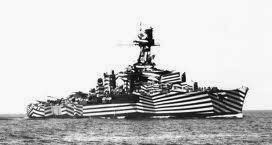 History at its most improbable and awesome.
And in the meantime,
I did at least get dragged off into some interesting historical back alleys. The whole experience, in fact, was possibly justified just by the discovery of dazzle ships, which may just be the single most gloriously mad thing humanity has ever produced. If you don't believe me, look right, or read this, or just do a quick image search.
Right. Now I'm going outside to Dazzle Camouflage my house.
Everything was going swimmingly until I had to transport my protagonist from the trenches of the Somme to - well, let's just say for reasons of not spoilering a book I haven't even finished yet to an undisclosed location somewhere in England. I won't go into details of what a horror it was figuring out the logistics of an intercontinental journey that might conceivably have happened a hundred years ago, partly because I'm still suffering from slight research PTSD, but suffice to say that I spent an awfully, disproportionately long time hunting for the most obscure bits of information. There were a couple of days, in fact, where I felt like I was spending fifteen minutes in research for every minute of writing time. Seriously, are there really people out there who do this all the time?
Except that on the good days, when the research isn't driving me crazy - and the good days have been by far the majority - I've got to admit that I'm really enjoying it. It's nice to be a historian again, after too long away, and World War One is a fascinating, if frequently heart-breaking, subject. Also, struggling through that bad patch has made me think a little more realistically about what I can and should be trying to achieve. I've consoled myself with the fact that if my protagonist doesn't need to know something then I don't need to know it, that if I can't find something out in a half hour's research then it may well be because no one knows, and with the sad fact that there's almost no one left alive who can speak definitively about events that occurred an entire century ago.
In short, then, while I desperately hope I can get the big stuff right, from now on I'm going to make more of an effort not to sweat the little stuff.
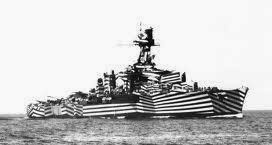 History at its most improbable and awesome.
And in the meantime,
I did at least get dragged off into some interesting historical back alleys. The whole experience, in fact, was possibly justified just by the discovery of dazzle ships, which may just be the single most gloriously mad thing humanity has ever produced. If you don't believe me, look right, or read this, or just do a quick image search.
Right. Now I'm going outside to Dazzle Camouflage my house.


