
Brenda Seefeldt Amodea's Blog, page 18
January 11, 2022
I Know Teens Lie to Me
Your teen lies to you too. But it’s not in that nefarious, disrespectful way.
I meet with the teens from my church (as well as any graduated teens who still want to meet with me!) for one-on-one times as often as possible. During these times together I always ask probing questions. There is not much small talk. I’m taking advantage of these moments to find out what is really going on inside of their heads.
This is why I know they lie to me. They answer my probing questions more often with what I want to hear.
Not because they want to please me but because this is who they want to be.I am asking them questions so they can put words onto the why of their decisions. Or what this decision may lead to in two years. Or is this what they really meant with that decision?
Because of adolescent development, and more specifically brain growth, these are all new experiences and new thoughts. This is why the laws of the land protect teens. My questions and time with my teens are designed to help them give words to thoughts they may be having deep inside their heads or thoughts they may have never had at all. I’m intentionally providing them a safe space with me to ask those questions and help them have words for what is happening inside of them as they are growing up.
I also effuse exuberant praise when I see the good decisions. I intentionally go over the top because I want the teens to know very clearly that those questions, those thoughts, those decisions are in the right direction.
I also realize that teens have one life at church with me and an entirely different life at school and maybe a different life with you, parent. This is normal adolescent development. This hasn’t changed in 40 years of youth ministry.
This is why I have believed for a long time and have put into practice the two things in my control that will help teens bring their divided lives together: my nosy conversations (which no one says no to) and intergenerational relationships with the many beautiful people in my church.
I know teens lie to me. It is a part of faith formation.Your beloved lies to you too. Because they do want your approval but are also filled with self-doubts. Heck, even their bodies are uncertain and are failing them in adolescence. They desire affirmation from you–as they don’t have the words to tell you what is really going on. Because they know about their fake life and don’t want it but don’t know what else to do. Because they are afraid of seeing your face fall in disappointment.
One teen shared with me:
I feel as if I need to be perfect for my Dad. I feel like I need to be “perfect” because he came to this country for me and has given me everything and I sometimes take him for granted. He has sacrificed so much for me and I let him down at times. When I let him down, I apologize and feel so guilty. I begin to cry to myself and just think of how much I’m a “let down.“ –Cathy, age 17
Do you see Cathy in your teen?
Or this 12-year old who asked to be anonymous:
I feel like I need to be perfect for everybody in all I do and that puts soooooooooooooooooooo much pressure on me. I’m sooooo worried about what others think about me. I cried when I got a 98% on a test. I’m always working towards perfection. I’m also really depressed all the time. Even when I’m supposed to be having fun.
Age 12. Struggling to put words to the crazy talk that is deep inside of her.
Parent, I know your heart just broke. I know your insecurity to parent your teen just ratcheted up too many levels. I know you feel like you will fail your teen—or already have. Pause for a moment. Recognize the fear that is involved. Don’t let fear lead.
Help give your teen words. Some ideas are in that article. (I love that article one of the early ones I wrote.) Have those taxi drive times. Say the magic words of “tell me more.” Try.
Like I have grown to understand, I realize that teens lie to me. I realize that it is a part of their faith formation. I intentionally put teens into situations where they may lie to me so I can help them process those deep down thoughts they are afraid to think of.
Remember always, you are a great safety net your teen has to fall into. You will always be their first safety net. Parent, you can also recognize your teen’s lies and help them grow through it so shame does not take root. This is holy tension for you—defined as the discomfort of being stuck in between but knowing that if you can make a brave vulnerable decision something holy is going to happen.
Something holy is going to happen. I promise.
Photo by Annie Spratt on Unsplash
The post I Know Teens Lie to Me appeared first on Bravester.


January 5, 2022
You need to be vulnerably seen. When it feels safer to be a rock.
I don’t like this discomfort either. I didn’t think my life would end up this way. I didn’t think I would feel so many emotions. I shouldn’t be feeling this emotion. It’s not supposed to be this way.
These are my thoughts now at times. Definitely my thoughts when I was single. When I was single I shook my fists a lot at God with my “supposed to’s.” God and I made a “deal.” I went into full-time ministry and he was supposed to provide a partner for me.
Very very very thankfully I was wise enough to not accept any partner. I waited and waited and waited for the right match. As I lived in my discomfort.
But I didn’t become a rock. A rock never hopes, connects, or is brave.I have chosen brave faith. This is my brave decision to brave decision to brave decision. This is trusting God with time over my “supposed-to’s.” This also means I chose the brave decision to be vulnerably seen. This also means I was hurt.
Meanwhile do not be afraid to lean into the discomfort. That sounds like such a horrible sentence, but…
“In fact, most of us were never taught how to hold discomfort, sit with it, or communicate with it, only how to discharge or dump it, or to pretend that it’s not happening. If you combine that with the instinctual avoidance of pain, it’s easy to understand why off-loading becomes a habit. Both nature and nurture lead us to off-load emotion and discomfort, often onto other people. The irony is that at the exact same time that we are creating distance between ourselves and the people around us by off-loading onto others, we are craving deeper emotional connection and richer emotional lives.”
Brene’ Brown, Rising Strong, p. 51
How are you off-loading? Particularly when you are lonely?
Meaningless hook ups? Drinking wine by yourself? Watching more porn by yourself? Contorting yourself so you are desperately hanging on to someone? “Crazy busy” so no one sees you but also so everyone thinks you are important? What are you doing that I didn’t mention?
You need to be vulnerably seen. When it feels safer to be a rock.“The irony is that at the exact same time that we are creating distance between ourselves and the people around us by off-loading onto others, we are craving deeper emotional connection and richer emotional lives.”
A rock feels like protection—and you have too many emotions right now. Being vulnerably seen feels too squishy.
But your armored-up, rock-of-a-self is too harsh. May I push you to lean into a squishier you?
Not a doormat. Not unboundaried. Not using your discernment (part-brain, part-instinct, part-Holy-Spirit ). Not lying to yourself. Leaning on your team. Staying in this holy tension. Not jumping to a conclusion to protect your heart before something becomes reality.
Here’s a checklist for your squishy self. In Aundi Kolber’s book, Try Softer (recommended), she lists for us what safety feels like.
Look for these things:
Safety in our bodies feels solid, responsive, and aware.Safety in our relationships feels like connection, vulnerability, and trust.Safety with God feels like connection, belonging, and mystery.None of that says be a rock. There is a lot of squishiness in connection, vulnerability and trust, belonging and mystery. But isn’t your soul warmed at the thought of safety?
This is true for you too. I have learned (thank you, time) that I am hard-wired to overcome.
My challenge to you has been laid before you. Are you sufficiently provoked so that your smashed heart can become a passageway for receiving and returning love? Along the way of this brave ride of love, you will connect with other brave riders of love and meet your match. What an adventure—full of safety—that will be.

Do you need a little bit more convincing? Here are some notes from Dr. Brene’ Brown about what your armored-up, rock-of-a-self looks like:
When we’re in fear, or an emotion is driving self-protection, there’s a fairly predictable pattern of how we assemble our armor, piece by piece:
I’m not enoughIf I’m honest with them about what’s happening, they’ll think less of me or maybe even use it against me.No way am I going to be honest about this. No one else does it. Why do I have to put myself out there?Yeah. Screw them. I don’t see them being honest about what scares them. And they’ve got plenty of issues.It’s actually their issues and shortcomings that make me act this way. This is their fault, and they’re trying to blame me.In fact, now that I think about it, I’m actually better than them.People think it’s a long walk from ‘I’m not enough’ to ‘I’m better than them,’ but it’s actually just standing still. In the exact same place. In fear. Assembling the armor. – Dare to Lead: Brave Work, Tough Conversations, Whole Hearts, pp. 51-52
Yikes.
Read also: Be Brave and Get Curious About What is Happening in Your Soul

The post You need to be vulnerably seen. When it feels safer to be a rock. appeared first on Bravester.
January 4, 2022
Who Do You Ask to be in Your 5:1 Ratio Group for Your Teen
This is my Brave Parenting drumbeat. Especially as a 40-year youth ministry veteran. I have given all of my adult life to the spiritual formation of teenagers and this is what I know is the best way to pass on your faith to your teen. You set up your teen with the best adult voices in his/her life. Statistically (which has been repeated in many studies over the past 20 years) the best ratio is five adults to your one teen. You intentionally find those five adults.
I’ve mentioned in other articles here how I love to read these statistical reports. In other articles I’ve broken down the insights for you so you don’t have to read those reports. Here is one short video that supports this 5:1 ratio statistically. The correlation is undeniable.
You’ve been convinced that you do need to intentionally find these five people for your teen. But who do you choose? Do you choose the paid youth pastor? Do you choose your crazy brother, that favorite uncle?
I’ll let the statistical numbers guide you. These come from a Springtide Research report called The State of Religion & Young People 2020: Relational Authority. As you read each one, pause and think back to when an adult did this for you when you were between the ages of 15 and 25.
83% say they are more likely to take advice from someone who cares about them.79% say they are more likely to listen to adults in my life if I know they care about me.65% say a person’s expertise doesn’t matter if they don’t care about me.84% say they will trust someone who remembers what was shared.82% say they will trust someone who will take the time to hear.78% say they feel listened to when people show they understand what they’ve been through.80% say they feel listened to when people show they care about them.91% say an interaction is meaningful when they feel like they are being listened to.81% say they feel listened to when people seem genuinely curious about what they have to say.73% say they feel listened to when people ask questions about what they’ve had to say.80% say they feel listened to when people remain present and engaged as they speak to them.75% say they feel listened to when they are allowed the space to say what they need to say without anyone else interjecting.78% say they feel listened to when people remember what they’ve said after some time has passed.82% say they feel listened to when they see action taken after making a suggestion or complaint.79% say they trust someone who shares things about their life.80% trust those who understand their lived experiences.87% say they trust someone who tells them what is going on and makes they feel included.85% say that their trust in someone grows when that person takes action that responds to that young person’s needs.82% say they trust someone who does what they say they are going to do.83% say they trust someone who takes action to fix things when they’ve caused harm.80% say they trust someone who admits when they are wrong.87% say they trust adults who take time to foster relationships.81% say they will trust someone whom they believe cares about them.84% say they trust someone who not only knows a lot but also uses that knowledge to help them.80% say they are more likely to trust someone who knows what it’s like to experience what they’ve been through in their own lives.As you read through this list, did you remember those adults who helped you during this age? Maybe one or two you haven’t thought about in quite a while? Take a moment to write down the names of those people you thought of. Put this list some place special, like your Bible or your journal.
How about going a step further and Google those people. Can you find an address for them? If so, send them a thank you note sharing what you have remembered. (I’ll make it easy for some of you. My address is 309 Commerce Street, Occoquan, Virginia 22125.)
As you read through all of those statistical numbers, did people who you know currently also pop into your head? People who you think you might ask to be part of this 5:1 ratio? Write those names down too. Take the time to pray over those names. Then ask these people.
The choice doesn’t always have to be the paid youth pastor. Because we are “paid” to have this authority, we are too often seen as “just doing our job” by being nice to them. Plus youth pastors come and go too frequently. They might not be around from when your teen is 15 to the age of 25.
Don’t shy away from asking someone who lives five states away. If this person’s name popped up and continued to pop up over your extended prayer time, ask. Technology allows for deep conversations. Sometimes teens actually prefer text conversations over face-to-face conversations. Let the two of them figure out how they will talk. You just ask this person and give them permission to nosily pursue.
Ask these people to nosily pursue. Trust who you are asking to do that well.
Don’t let your own parenting insecurity get in the way. You are doing one of the best parenting moves by intentionally setting this up. Pat yourself on the back for that. Give yourself some peace that you are not the only one who cares about the faith formation of your teen.
Read here about the research findings that those who are religious are flourishing–in this crazy culture moment. Parent, you have a lot to do with this. I’m sure your heart’s prayer is for your teen to take his/her faith decision into adulthood and to live a life that is flourishing.
Are you inspired? Did these real stats inspire you? I hope so.
The post Who Do You Ask to be in Your 5:1 Ratio Group for Your Teen appeared first on Bravester.
Seeking Adults Who Will Answer Questions
The Huffington Post has this fascinating and long article about the “Millennial nuns.” Barna Group has called the group of 20somethings who hold a deep and personal faith “Faith Exiles.” These brave faiths warms this youth pastor’s heart. I believe this is also the hope you have for your teen.
The author of this Huffington Post article is absolutely fascinated by this group—and a bit envious. She shared this insight about her own memory as a teen back in the 1990s:
During my teens, I worried a lot about whether what I was doing was right. I liked the idea of saying the shema, a simple Jewish prayer you chanted at meaningful moments. It seemed to give life anchor points. I mocked but also envied Christian friends of mine who wore those “What Would Jesus Do” bracelets; the thought of having a single question you could ask yourself to resolve all of life’s myriad dilemmas felt clarifying.
Teens and young adults do hunger for clarity. As our world becomes more and more pluralistic and confusing.
I have a long habit of reading statistical reports on teens. Barna Group and Springtide Research are my two favorites. As a favor to you, busy parent of a teen, I’ll read the findings and give you the wisdom.
Springtide Research’s 2021 report is called “Navigating Uncertainty.” This is that seeking for clarity in our pluralistic and confusing world. This report found an amazing and encouraging finding.
(The report can be found here.)
Right now is messy. Social media, pandemic-living, cancel culture, rampant loneliness, political polarization while those divided politicians still spend trillions of future dollars. This is on top of the normal messy of simply growing up.
Thankfully research is showing that teens and young adults don’t feel the need to fix the problem immediately. They are okay with bearing the problem, breathing deeply, journaling through the problem or getting out in nature to find the space needed to handle the problem. 51% of ages 15 to 25 say they are comfortable with not having all of the answers. The majority are comfortable with uncertainty.
In Dr. Brene’ Brown’s words, they understand that the rumble is okay. The rumble defined is:
A rumble is a discussion, conversation, or meeting defined by a commitment to lean into vulnerability, to stay curious and generous, to stick with the messy middle of problem identification and solving, to take a break and circle back when necessary, to be fearless in owning our parts. https://brenebrown.com/articles/2019/05/01/lets-rumble/
I call this holy tension which I define as the discomfort of being stuck in between but knowing that if you can make a brave vulnerable decision something holy is going to happen. I find holy tension throughout the Bible stories. When I feel it happening in my life, I know God is making me aware of something.
Teens and young adults aren’t looking for a solution for uncertainty– which is not only a fact of life of maturing, it is also a fact of our cultural moment. According to the research,
Young people are looking for relationships built on presence and listening, not advice and fixing. Just let them talk.
Read also: Make Time for the Wandering Mind
Young people are seeking adults who will let them talk and answer those questions.From the research, 71% say they are religious; 78% say they are spiritual. Notice those high numbers when we have media that tells us of pluralistic faith and faith deconstruction. Both of these are true.
Of those who identified as “very religious,” 40% say they found connecting with their faith community helpful during challenging or uncertain times. This is you, parent. This is also the 5:1 ratio of people who have intentionally given your teen. This is who is in your circle.
(Sigh that it is only 40%.)
You can turn to pp. 54-55 in the report to read the details but these are the summary findings:
Young people are uncertain.They aren’t turning to religion.But they are religious.Those who are religious are flourishing.These are the Faith Exiles. This is who you want to raise. Have hope. You and the people you put in your teen’s life are the difference maker.
Young people are seeking adults who will let them talk and answer those questions.Also from the report:
58% say they don’t want to be told answers about faith and religion. They want to discover their own answers.54% say religious institutions try to fix my problems instead of just being there for me.45% say religion is about certainty and doesn’t welcome uncertainty, doubt and questions.With the people you have given to your teen, give your teen the freedom to talk and ask their questions. To give words to their doubts. To feel safe enough to express their uncertainty and then find out that an uncertain faith is a brave faith. To provide “along the way” experiences of what faith looks like. To share stories of times when it felt like God had abandoned yet time has proven how close God always was. How faith is grown memory to memory. Random conversations with lots of listening, some sharing, that all provide clarity.
As a youth pastor, I want to repeat that paragraph but this time screaming it at you. Do you hear me?
Another finding from Springtide Research. From their March 2020 report (note: before pandemic life began) entitled Belonging: Reconnecting America’s Loneliest Generation found that just adding one trusted adult in the life of a young person dramatically decreases the sense of loneliness and isolation. They found a direct correlation between the number of trusted adults in a young person’s life and that young person’s sense of meaning and purpose. That sounds like flourishing to me—tied to faith.
I mention this 5:1 ratio often. Here are the numbers to back that up from the same Springtide Research report. 50% of young people who say they have no mentors say their life has no meaning or purpose. Compare that to 70% who have at least one mentor say their lives have meaning and purpose. This number jumps to 85% for those who say they have two to four mentors. If you have that 5:1 ratio, the number jumps to 91%. The correlation is undeniable.
Those who are religious are flourishing–in this crazy culture moment. Parent, you have a lot to do with this. Find your people for your teen and give them permission to listen and answer questions. Trust your people.
The post Seeking Adults Who Will Answer Questions appeared first on Bravester.
December 30, 2021










December 21, 2021
Jesus Writes in Our Dirt
I re-read one of my favorite books again. This one was published in 1989. I’ve re-read this book so much that the spine is broken. I’m amazed yet again by these thoughts. I’m amazed—with this look back—at how much the author John Fischer has influenced my brave faith.
For example, these beautiful words from the chapter “In the Dirt”:
Suddenly righteousness and self-defense turned to dirt in the mouth, and one by one, the dust of departing feet rose and fell back to earth.
And what was Jesus doing during this exodus? Was he watching, gloating, viewing with pleasure the turnabout he had wrought with one well-placed sentence? No. He didn’t see a thing, for he immediately went back to work on his diary in the dirt—this mysterious earthbound exposition.
Only this time it was even more significant, for he left the Pharisees to ponder his words. He delivered his verdict of truth and then removed himself from the situation.
Jesus knew what the outcome would be; he didn’t have to watch. He would talk to whoever was left—whoever was ready and willing. He always allows people the right to come to their own conclusions. No one can be forced to learn before he is ready.
Who knows how long the woman stood there watching him bent over, busy in the dirt? She could have gone too, but she didn’t. Something about him held her. Perhaps she was ready. Finally Jesus straightened up again, and as if returning from some faraway place, spoke to her. ‘Woman, where are they? Has no one condemned you?’
‘No one, sir,’ she said.
‘Then neither do I condemn you. Go now, and leave your life of sin.’
Jesus, the only one who was without sin, the only one ever with the right to throw the first stone, didn’t.
Instead, he wrote on the ground.
And he continues to write in the dirt of every life that stands before him accused. He holds no stones; instead, he is a master artist capable of working with the most earthbound of mediums.
He is practiced in the art of working with the dust of the ground, so he can bend over and write the most beautiful stories on the dust of a life—your life, my life—any life, that is, that doesn’t walk away. –John Fischer, True Believers Don’t Ask Why, p. 100-101
Maybe this is why I teach this story out of John 8 so much. I am so drawn to what Jesus is writing in that dirt, in that dirt of my life. Because my brave decisions and my broken heart are quite the beautiful story.
I was inspired by this in 1989. That is before my marriage, before my boys, before my 25 years of being a youth pastor at one church, before starting a church, before arrests and prison and other unmentionable smashed heart times.
I have decided I’m in need of a Savior, the one who writes beauty in the dirt of my life. The dirt the flower grows through.
Dirt is never still. Never just a pile of dirt doing nothing. As dirt sits waiting for things to be planted and grown, there is still action happening invisibly and silently. Microorganisms are breeding, moving, and eating. Wind and sun and fungi and insects are dancing a delicate dance that leavens the soil, making it richer and better, readying it for planting. (I learned that from Tish Warren Harrison, Liturgy of the Ordinary, another re-read of mine.)
This is the dirt of my life that Jesus is using to write into my story.
Donald Miller has a new book coming out. (Finally, he’s a fave of mine, another re-read.) It’s all about how we are the writer of our stories. Not fate. Not God. We are the one who gets to make the brave decisions—or not.
This is where God is as we write our stories:
What if, instead of writing our stories, God has invented the sunrise and sunset, the ocean and the desert, love and various forms of weather and then handed us the pen to write the proverbial rest?
What if we are much more responsible for the quality of our stories than we previously thought? What if any restlessness we feel about our lives is not in fact the fault of fate, but the fault of the writer themselves and that writer is us?
What if the broken nature of life is a fact, but the idea we can also create something meaningful in the midst of that brokenness is an equal fact? –Donald Miller, Hero on a Mission, p. 4
God made the dirt too for my story. This dirt that is full of life even when it feels like a pile of nothing.
It is up to me to make the brave decisions. It is up to me to lean into the vulnerability, endure through the holy tension, and live this brave and beautiful life. I make the decision that when my heart gets smashed and I can’t get out of bed, I decide to get up. My life is a mix of beautiful and painful. I am very okay with that. My dirt is good and I see Jesus writing in it. I’m not walking away.

(Photo credit from Pixabay)
The post Jesus Writes in Our Dirt appeared first on Bravester.
December 14, 2021
Those Uncomfortable Emotions are Okay to Feel. For Your Teen. And for You.
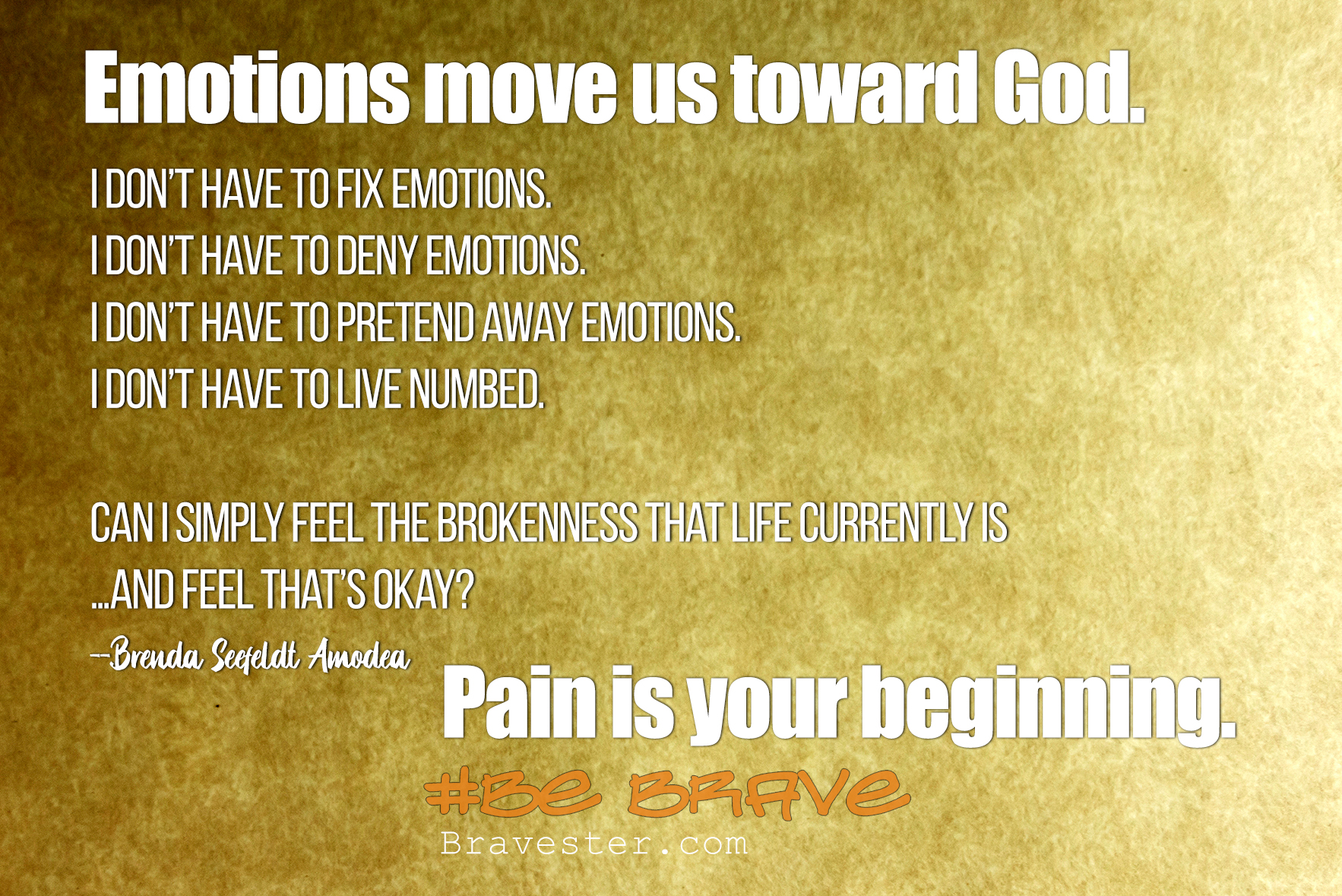
A Bravester faith realizes that all emotions move us towards God. All of them—the good ones, the awe-inspiring ones, uncomfortable ones, the negative ones, and the ones that entrap us with repetitive and destructive behaviors. According to neuroscience, emotions are tunnels and God has a thing about meeting us in the messy middle of those tunnels. He loves to show up in the midst of chaos and repeat his loud message of “I will never leave you nor forsake you.”
Too many of us like to numb our emotions, to keep these emotions under control or shoved down. For teens, they are experiencing the complex feel of these emotions for the first time. This is a normal part of adolescent development. But the teens don’t know that. All they know is they are feeling a lot. Sometimes it is a lot of good feelings. Sometimes it is a lot of negative feelings—and this scares them. Too often words aren’t put to these times and then shame sets in.
Constant access to digital devices has allowed teens to escape the uncomfortable emotions like boredom, loneliness, or sadness by numbing themselves with their devices so often in hand. Now we’re seeing what happens when an entire generation has spent their childhoods avoiding discomfort. Their devices have replaced opportunities to develop mental strength, to move through those emotional tunnels and mature. They haven’t learned the words to feel through these emotions and they haven’t learned coping skills from the wise adults who surround them.
Happiness is emphasized so much in our culture that some parents think it’s their job to make their kids feel happy all of the time. Teens then grow up believing that if they don’t feel happy all of the time, something must be wrong—something must be wrong with them. That creates inner turmoil. Teens haven’t learned to understand that it’s normal and healthy to also feel sad, frustrated, guilty, disappointed, bored, and even sometimes angry. And that there are wise and tried coping skills to help all of these emotions move you towards wholeness.
Some of that unvoiced inner turmoil is that teens feel like they have failed. Our culture also doesn’t allow failure. Teens do survive failure–and grow from it.
Too many parents began believing that their role is to help kids grow up with as few emotional and physical scars as possible. Parents have become so overprotective that their kids will never learn the coping skills needed to deal. The result is too many teens are growing up believing they’re too fragile to cope with the realities of life. Again, often unvoiced. (Where’s my device so I can cope?)
You, parent, are also dealing with uncomfortable emotions like guilt and fear. Parenting teens is so intimidating and so often makes you feel like a failure. Instead of you feeling those uncomfortable emotions and moving yourself through those tunnels–which always leads to God’s faithfulness–you change your parenting style. You helicopter, you lawn mow, you bull doze. You feel so guilty saying no that you back down and give in. Inadvertently you are teaching to numb these uncomfortable emotions which is teaching your teen to do it also.
I hope you don’t feel shamed. I want you to feel inspired because you do love your teen and want them to mature.
So how do you teach your teen to develop mental strength? Here’s some things you can do because you are inspired:
Find that 5:1 ratio for your teen. Give these people permission to answer the hard questions and to be trusted by your teen.Do not be jealous of these people. These people are your greatest gift to your teen, even if you feel insecure at how much your teen likes them over you.Listen without interruption. Allow space for your teen to ramble. I know you want to pass on your wisdom—and you will be able to, see below—but just putting words to what’s unvoiced helps so much.Don’t minimize the small stressors or the silly stressors.Intentionally minimize your negative self-talk—the out loud stuff you say as well as your inner voice. Your teen is watching and hearing.Learn to recognize when your teen needs to take a break from life. Breaks can include a random coffee together or an extra hour of Netflix.Physically move your body with your teen. So often something as simple as physical movement loosens up the crazy talk inside brains–and sometimes the crazy talk gets voiced to you while the body is moving.Be okay with yourself to say no so your teen does not get overscheduled.Use your taxi drive times to talk about some of the hard things you are seeing happening in your teen’s life. The good thing about taxi drive times is your teen knows they are going to come to an end when you get to your destination. He/she isn’t trapped in this uncomfortable conversation with you. This will help your teen put words to what’s inside his/her head quicker and to hear your wisdom.Be praying for God to give you the discernment to identify the triggers you see in your teen. Eyes open. Ears open to the Holy Spirit. When you see a trigger, go on a taxi drive time and talk about it.At your family dinner time, ask about the “highs and lows” for the day. What this little talker is doing is letting your teen know that it is okay for a low to have happened. It is so okay that it actually happens every day in some form.Eyes open to how isolated your teen is keeping him/herself and then creatively find ways to break those isolating habits. More prayers for Holy Spirit discernment.Practice a practice of gratitude. Learning to pay attention to the good parts of life can improve quality of life over time. All the science says so.You do feel how all of these are possible, right? Wonderful.
The post Those Uncomfortable Emotions are Okay to Feel. For Your Teen. And for You. appeared first on Bravester.
December 13, 2021
The Story of 1,000 Brave Decisions (More or Less)
Written by Jake Stewart
Ever since becoming a legal adult in 2008, I’ve taken a number of personal risks that I wasn’t sure would pay off.
I went to a private (very expensive) university despite having limited finances, a large student debt load, a learning disability and, at times, crippling mental health struggles.
I moved out of my parents’ house to take a correctional officer job in an unfamiliar land, surrounded by inmates who wanted to see me get played—and certain staff who wanted to see me fail.
I had bariatric surgery to aid my lifelong struggle against obesity. I did this despite the discouragement of some well-meaning people, on top of the natural anxiety that comes with any major medical procedure.
Yet, somehow, all those risks eventually paid off.
But for three weeks in September 2021, I took what could arguably be my largest step yet in personal growth. Using my own money, vacation time, logistics, and planning, I took a solo trip to five different countries in Europe. This was the first time I had been out of the country as an adult, as well as the first time doing so alone!
This trip did not happen on a whim. It was something I had been planning for the better part of three years. Prior to surgery, I could not fit into a single airplane seat due to my size. This, coupled with my intense desire to see the world with my own eyes, is what got me to take the radical step of having my stomach physically reduced. I promised myself that if I could fit into an airplane seat again, I would reward myself with my dream trip to Europe.
And now, here I was, touching down on the tarmac of Charles de Gaulle International Airport in Roissy-en-France!
As I disembarked that Delta A330-300 and entered the jetway, I carried with me a weighty mix of emotions. On the one hand, I was excited because I was visiting a land that I had only dreamt of visiting in the past, with all kinds of fun, exciting, and awe-inspiring sites worked into my itinerary!

But I was also terrified because, for the first time in my life, I was alone in a country that was so culturally distinct from my own, in a city I was entirely unfamiliar with, surrounded by a language of which I had next-to-no knowledge. As I was now over three thousand miles away from home, I had no “easy escape” to quickly return home if I became overwhelmed. Even more than when I moved away from my parents’ house to start my own career, I was fully and truly alone.
During that first day in Paris, I could only describe myself as a ball of nerves. Despite clearing passport control with ease (with a stamp I now value more than gold!!!), I had almost eleven hours between my flight landing and my check-in time at my Airbnb. During this time, I would have to figure out where to store my bags, as well as navigate the Paris public transit system. On top of this, the nine-hour plane ride had left me very sleep-deprived and—I realized too late—badly dehydrated.
Though I managed to find a private company where I could store my bags until check-in time, it took only a few hours before I felt myself getting dangerously close to a nervous collapse. My heart was pounding against my chest with anxiety, and I was feeling physically light-headed from dehydration. These two factors combined to create a certain paranoia, where I felt like every person I walked past was staring at me, as if they somehow knew I was a foreigner. I distinctly remember hurriedly sitting down on the magnificent front steps of the Palais Garnier, my arms and hands visibly trembling, wondering if I’d made a huge mistake in coming here.
But then, I did something that would have been quite out-of-character for me only a decade prior. Instead of breaking down, I decided to take care of myself. I reminded myself that this trip was my victory. Was I going to enjoy it or regret it? The decision was obvious.
I immediately stood up, walked to the nearest Starbucks and ordered some food, a coffee, and some iced water. Within an hour, I felt refreshed, awake, and excited once more! The day ended with me taking a guided tour of the Palais Garnier before finally arriving at my Airbnb. I hadn’t been there long before I finally collapsed in utter exhaustion, but feeling exhilarated all the same.
For the next three weeks, I travelled from France to Italy, to Vatican City, to Poland, back to France, and a day-trip to London before finally returning to Charles de Gaulle Airport for the journey home. I made this trip something worth treasuring for the rest of my life. I took more than two thousand photos, met countless people (including some fellow tourists), saw some world-famous sites, walked more than 16,000 steps per day, and ended up with four beautiful stamps in my passport.

Aside from the obvious reasons, the success of this trip has a uniquely special meaning for me. I recall the first time I flew on a commercial flight by myself. I was 18 years old and was flying from Minneapolis to visit a friend in Phoenix. My mother was absolutely convinced that I couldn’t handle it on my own and attempted to micromanage me via cellphone during most of my flight itinerary. Even though she passed away less than a year later, I have always remembered—and seethed at—that experience every time I’ve flown on a commercial plane. The success of this trip shows that she was categorically wrong to doubt my ability to navigate my way not only though an airport, but through an entirely new continent, filled with language barriers and cultural differences I knew almost nothing about.
I took the jump into the unknown, and came out the other side healthier and stronger because of it.
BE BRAVE!
-Jake Stewart
Read also from Jake, I Used to See God as a Toymaker.

The post The Story of 1,000 Brave Decisions (More or Less) appeared first on Bravester.
December 7, 2021
Romance is in the Growing Relationship
We all love the grand gestures stories. Maybe because movies have “trained” us to swoon at them. Or maybe even simpler reasons, we love being on the receiving end of a grand gesture because for one moment we know for sure that we are worthy of love. Or if you are the one who loves to plan the grand gestures, you love knowing that you have found someone worthy of your love.
Or maybe because it gives you something wonderful to put in your social media feed. That’s another topic we should talk about at another time.
But grand gestures do not make a relationship. Grand gestures are an unsustainable path.

The real of romance is the time it takes to grow a relationship. Time. You find your love for a lifetime over time. Most often that happens in the time and work that a marriage takes. This stuff is certainly not social media-able.
Somehow (and I will explain) marriage becomes the place where romance actually happens.
Moving through time and mystery together grows that love for a lifetime.The mystery is the discovering the who of each other. It is discovering you in this growing process. It is the vulnerability you hate about dating. It is liking the other enough to stay curious. It is not trying to put this person into your self-perceived box of who you want to marry on the first several dates. Curiosity requires vulnerability because you must surrender to uncertainty/mystery. Which means anything is possible—like this could be your love of a lifetime.

Certainty is certainly more comfortable. Curiosity requires time.
Grand gestures give you certainty for a short time. Then the vulnerability creeps back in.
Life happens in time. When something hard happens, a bond grows when your boyfriend/girlfriend decides to help you carry your pain. It is a romantic bond. You have learned something beautifully deep about this person. It opens your vulnerability. It opens your heart to love. Whatever sucky thing that smashed your heart happened, you will have learned a lot about this person you are dating. Time gave you that gift. If your other is afraid of your pain, avoids your pain, gives you platitudes, time also gave you a gift to end this relationship.
Not that you need to go through a life tragedy to know if he/she is the one. My honest prayer for you is to be spared a life tragedy.
Time reveals someone’s actual faith practice. In the getting-to-know part of friendship, pre-dating, early dating stages, these are some questions you may find yourself answering often. When did you become a Christian? How would you describe your faith life? How do you know Jesus is real? I understand why these questions are asked but these are intimate questions. Intimately personal. Intimacy should not be a part of your relationship this early.
You and your relationship with Jesus is also mixed with time and mystery. It is often hard to put words to this. And now you are being asked this so someone you may not have met yet can figure out if your faith is good enough.
This is the stuff you learn about a person over time–when time gives you the space to share this intimate part of your life. This helpful thought has little to do with romance unless you find yourself swooning to be in love with someone who loves Jesus possibly even more than you.
Moving through time and mystery together grows that love for a lifetime.Of course, you may choose to live together first as a way to continue the time and get to know each other better. But why does nearly every study say that a marriage is a different commitment than living together? Why do you know of so many sad stories of couples who tried living together only to find out that then this was a bad match?
Marriage has a “commitment” feel to it. Like the backdoor is closed. We are legally stuck together. You are deciding to have to grow with your other through the good and the uncomfortable and the hard that life just cuts in and gives us.
Through conversations and adventures and memory-making, through conflict and resolution, through navigating what life throws at the two of you, through time and mystery you will find your love for a lifetime. Romance is in the growing relationship. All of this.
Then you marry and you really get to know each other. The mystery decreases (how does he smell like that?) and time settles in. Romance is in the growing relationship that is full of the mundane.
The romantic grand gestures come and go in marriage. That leaves a lot of time left before and after the grand gestures. Do you like being with your beloved in those other times? In those boring times? In those hard times? Do you ever catch yourself “netflixing and chilling,” being bored with what’s on the TV, and still finding joy in being with your beloved? Those realization moments are romantic.
Romance is found in the mundane. It is in those everyday moments of life that is moving so fast and here you sit exhausted on the couch and your beloved is next to you still holding your hand.
The real romantics imagine graying and sagging and wrinkling as the beauty to look forward to. (Did your heart skip a beat when you read this?)
I’m nearing 25 years of marriage to whom some would describe as an unromantic guy–because he sucks at grand gestures. A grand gesture to him is speaking my love language of acts of service and giving me a whole day of acts of service. Our reality is when you are married for 25 years and you own a home, cleaning and fixing the home is the mundane. His to-do list shouldn’t get to be as long as it is but such jobs are not a priority in his life. My nagging has never changed this so many things get left undone for long lengths of time. Until he goes on this whirlwind of repairs. That’s a grand gesture in this marriage. I wish this would happen more!
Like with other grand gestures, there is a lot of before and after the grand gestures. It in this mundane time that John and I grow to love each other more. The graying and sagging and wrinkling are our long story of our years of handling all of our brave decisions and heartbreak together.
Dr. Henry Cloud teaches, “Love is built through soul-to-soul connection, shared values, commitment, resolving conflicts and hurts, tenderness, sacrifice, forgiveness, giving, displays of character, spiritual comparability and sharing — things that all have something important in common: time.” (Dr. Henry Cloud, email, March 13, 2021)
I hope this takes some of the anxiety off of dating. Because you won’t know any of this by the second date or the 20th date. Be yourself. Get to know your new cute and interesting friend. Make the memories. Grow together. Face the conflict and learn resolution skills. Time and mystery will help you figure out if this person is a worthy love for a lifetime and that is when the romance really starts.
Read also: What is the Right Pace of Growth for a Relationship?
The post Romance is in the Growing Relationship appeared first on Bravester.
December 2, 2021
Jesus Hears Lots of Crazy Talk
My bestfriend told me that one. It was on the day her husband was diagnosed with cancer. There were a few days between the biopsy and getting the results. She’s a nurse and saw the biopsy results early and knew. Yet didn’t know until the doctor said the words. During those few days her mind raced full of crazy thoughts and crazy prayers about funerals, finances, single-parenting, etc. Thoughts she only shared with Jesus even if it was crazy talk.
Jesus heard it all.
There is the crazy talk Jesus hears when we say those awful and horrible things to ourselves. You know those words you say to yourself that you would never say to anyone else.
Jesus hears that too.
There is the crazy talk of justifying the hustle you are continually justifying.
Jesus hears that too.
There is the crazy talk about self-doubt: about the fear of making mistakes in your work, your parenting, your relationships. Do you know anyone who has never made a mistake in work, parenting or relationships? Yet you think you are supposed to be above all humanity and never make a mistake. You have decided that the only way you can be of value is to be unhuman. This is where that crazy talk leads you.
Jesus hears that too.
Jesus hears the 107th rendition of the story that doesn’t leave your head about how that one person has wronged you. This is that story that spins and spins and keeps you awake at night.
These thoughts might begin as your prayers. Then they turn into this rambling and jumbling mess of crazy thoughts. You are so tired of this story draining you of so many emotions. You are so tired of not sleeping at night. Jesus hears them all—and draws close to you anyway.
Jesus, the one standing before the Father interceding on our behalf gets to hear all of this crazy talk. Yet never leaves us or abandons us or rolls his eyes at us.
Who then will condemn us? No one—for Christ Jesus died for us and was raised to life for us, and he is sitting in the place of honor at God’s right hand, pleading for us.
Romans 8:34
See, we aren’t even condemned for this.
Jesus listens and draws close to you anyway.
Too often it is you who has chosen to hide in your shame. (Read more.) Jesus never has hidden himself from you.
Why does Jesus love us so when he hears all of this crazy talk in our heads? Will we ever mature? Will we ever really trust him?The answer is it doesn’t matter. I hope we all mature. I hope (which is why I write and teach) we all make small, deliberate tweaks to our thinking because we choose to give God more credibility than everyone else.
Meanwhile Jesus hears all of this crazy talk.
You are heard. And God does respond. Not with shame or condemnation. But with the larger story of his love so you can make the brave decision to brave decision to brave decision to make those small, deliberate tweaks to your life.
You are heard. God responds. Keep on talking to God.

The post Jesus Hears Lots of Crazy Talk appeared first on Bravester.


