
Ross Lawhead's Blog, page 10
February 7, 2013
Rewriting Poetry II
So last post we read the original poem and got a sense translation sorted out. Now we’ve got to make it sound like poetry again. Which means finding a verse form for it, which means taking a step away from it to see what we want the thing to look like as a whole, that is, what we want the overall effect to be.
The four line version of the poem is the short version. The long version is forty-two lines long — seven stanzas of six lines each. It kind of takes the theme of the poem and develops it in more detail, being a bit more didactic with the moral and illustrating what it means. As a poem in and of itself, that’s fine, but forty-two lines is way too long for my book, at least for where I want this poem to be. Looking at the long poem in detail (I’m not going to post it here since it’s too long for even a blog, you’ll have to just take my word for what I say about it), there are three main meaning of the word ‘earth’ that it plays with. 1) Meaning mortal man, 2) meaning treasure (ie gold, diamonds, etc. 3) meaning workable land that gives food (food also meaning earth). The absolute maximum I think people would tolerate is three stanzas, if they weren’t too long. If I could get these three senses into three stanzas, then that would work great.
But there’s a fourth stanza I want to stick at the end to twist the theme of the poem around. I’ve already decided that it would be best for the story to stick this last stanza in another character’s mouth at a later point in the book. But that’s a problem too — by subverting the meaning of the original verses it may sound like a different poem altogether, and therefore a kind of cheat. There needs to be some way to tie it together with the rest of it — something like a recurring motif. I remember one of my favorite poems by e e cummings called “Jehova buried, Satan dead” which uses the same line at the end of each stanza, but in the last stanza those same words take on a completely different meaning. It would be great to borrow that trick. So now the last line has become the most important, so we should write that one first.
All that the poem is saying — long version or short — is that all that we are is earth, all that we value comes from the earth, and everything that we have and everything that we are will one day return to the earth. So to put the meaning in meter:
And so all that is earth to the earth will return.
Which is nice and neat. In technical terms this is ternary verse (three syllable groupings) in anapaest form (two unstressed followed by a stressed). If we kept to this meter, things would turn out fine. But it’s a little florid for my tastes, and kind of runs counter to the bareness of the poem’s subject. Could we maybe boil it down into iambic verse (two syllable groupings, one unstressed followed by a stressed)?
And all that’s earth to earth returns.
Yes, we can! We had to use a contraction, which isn’t great, but this is a much more forceful pace. It will work provided we can hang the rest of the poem around this structure. Let’s go back to the beginning and work it through. After about an hour, this is what I got:
The Earth takes earth from out of earth,
That’s earth that’s took with woe.
The earth will bring that earth to earth,
And to that earth will show.
And earth will lay earth in the ground
In earth will earth earth stow.
So what is earth to earth returns;
All earth to earth must go.
That’s a pretty solid and faithful reworking and I’ve kept strictly to my meter, but I can see a lot of problems with it anyway. For a start, it’s longer than the original, which I’m not overly happy with. The problem is that Middle English is not as efficient as Modern English, specifically with regards to articles and so we need to add more indicators to like ‘from’, ‘out of’, ‘that’, etc. I managed to make every other line only six syllables long instead of eight, but then had to reiterate the last line to round that out — which again isn’t great. I’ve also used the word ‘earth’ seventeen times in one stanza, and I’m asking myself serious if that’s too many times. And finally, I’ve chosen to rhyme one sound only — the ‘O’ every other line. If I want to keep this as it is, I’m going to need to stick to picking four words that rhyme together in the next two stanzas (if I’m to have three).
Which is the problem I’ll be facing tomorrow.


February 6, 2013
Rewriting Poetry I
For the final book of the Ancient Earth series, I’ve been mulling over what poetry to write for it. Book 1′s poetry was all fantastical (less in some cases than others) which was meant to open up the story into new areas, to expose the characters to new ideas, as was appropriate for a book whose main theme was boundaries (and crossing them). Book 2′s poetry was darker, it was menacing, but in an oblique way. It was very sing-song and even playful in its verseform, but the meaning ran counter to that. They were songs of seduction. Only the bad characters used poetry in book 2.
Book 3′s poetry needs to reflect the themes of this final book. A few months ago I came across a book published by the very excellent and noble Early English Texts Society, which contained about ten different versions of what apparently must have been a fairly popular poem called ‘Erthe upon Erthe’, or ‘Earth on Earth’. It is a very simple little ditty, but it deals with quite large universal themes. It fit the viewpoint of one of the characters of the book, and I found a place where it would put an interesting spin on the development of a certain set of other characters.
Of course, it needs to be rewritten because it’s in Middle English (circa 1307) which is a bit hard for most people to wrap their heads around. This is what the earliest form of that poem is.
Erþe toc of erþe erþe wyþ woh,
Erþe oþer erþe to þe erþe droh,
Erþe leyde erþe in erþene þroh,
Þo heuede erþe of erþe erþe ynoh.
If you sound it out, you can actually get the sense of what it is saying, and it’s got an absolutely lovely cadence. Remember that ‘þ’ is an unvoiced ‘th’ (like ‘thin’, not ‘then’), and that there are no silent ‘e’s — they should be pronounced with an unstressed ‘ah’ sound. Oh, and that last ‘u’ is really a ‘v’. Go ahead, and read it to yourself. I’ll wait.
Isn’t that delightful? It has a natural swing to it, like a nursery rhyme. Here’s a sense translation in modern English. It’s not a lot different (except no pleasant swing).
Earth took from earth earth with woe,
Earth other earth to the earth drew,
Earth laid earth in an earthen trough,
So had earth of earth earth enough.
There is some mild debate over the origin of the poem, and current opinion seems to insist it comes from Latin, and it may have originated there — we ultimately just don’t know. However, although it rhymes, it is also laid out in alliterative verse — the exclusive poetical form of Old English –where the word ‘earth’ is the only alliterated word. Its ambiguous treatment of the word ‘earth’, which means at different times in this poem 1) a man, 2) the ground, 3) treasure, and 4) a burial pit (the earthen trough), is very reminiscent of Old English riddles. If the idea came from Latin, the Anglo-Saxons certainly made it their own, and even though it is now written in Middle English there are only 16 different words in it, most of those have very similar OE analogues or are identical (for example, the ME ‘erthe’ = OE ‘eorthe’, ME ‘droh’ = OE ‘droh’). If I were to lay money on it, I would say that there is a lost and forgotten Old English version of this poem/riddle that this one is based on, which was later expanded on (more on that in the next post).
The subject matter also seems a straight line from Ecclesiastes 12:7 (‘Then shall the dust return to the earth as it was: and the spirit shall return unto God who gave it.’) and the whole ‘dust to dust, ashes to ashes’ bit from funeral services, which I’ve just found out isn’t actually from the bible. But the poem doesn’t have any sort of redemptive spiritual aspect, as it stands, so it’s as likely that this Anglo-Saxon/pre-Anglo-Saxon notion influenced the English burial service as the other way around.
None of which actually helps me with rewriting the poem, but I find it interesting, and does make me feel better about giving it to a character that was present during the Anglo-Saxon period, but who skipped out on the Medieval one altogether.
NEXT TIME: Reworking, Recasting, Expanding.
February 1, 2013
Confessions of a Bad Poet
“If a thing is worth doing, it is worth doing badly.”
So says G K Chesterton, who did many things but rarely did them badly. He isn’t saying that we should not strive to do things well, but only that if something worth doing, then it should be done regardless of our capacity to do it well or not.
However, I have found that there is something to be said for doing something deliberately badly. Writing poetry is a natural compulsion for me, but I have rarely enjoyed it so much as when I deliberately wrote bad poetry. The poetic artform is in a bad position at the moment, enlarged and glutted on its own importance, swelled with hot air as the stream of consciousness and the unstaunched flow of mere surface thought has replaced artistic constraint and rigorous reworking. Generations of children in schools have been drilled in poetic appreciation — and this is exactly where the trouble originates. They are taught everything about poetry except how to say ‘I don’t like this one’. Individual taste is denegrated — if you don’t like it, then you don’t understand it. Personal opinion is obliterated, and without prefence there can be no true appreciation.
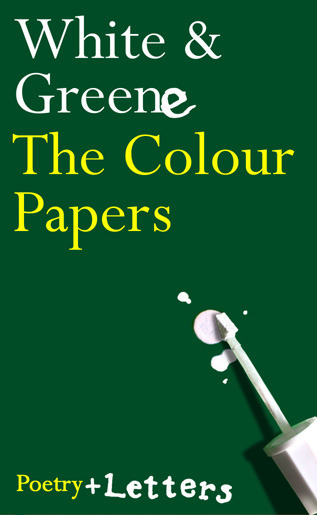
What’s the remedy? Bad poetry. Only by writing truly awful verse can we rectify this situation. Hold up poetry that is indisputably awful for everyone to ridicule and revile, and the balance may be reset. The tools used to recognise bad poetry are a good many of the ones to recognise good poetry. And so it was with this aim that my writing partner Russell Thompson and I began to write The Colour Papers, almost four years ago now. And we created the characters of David White and Horace Greene in order to bring not just humour and satire, but also a light of objective sanity into the world of poetry. Bad poetry, unlike good, must be completely indiscriminate and we found ourselves lampooning the poets we admire as much as the ones that we don’t, and found a greater appreciation for both.
Volume 1
We published the first Colour Papers book ourselves, at the end of 2009. We had a big launch, sold a couple hundred copies, and actually managed to break even on the costs, which would have been beyond the dreams of our fictional alter egos. We then immediately started writing book two, and while we did we decided that such complete artless awfulness could not only be kept between the two of us and some few hundred of our nearest friends — its true home was the internet! And so, we’ve decided to serialise volume two on its own dedicated webpage, posting the letters at two week intervals, all of them for free to read online. Volume one is now available to buy as a hardcopy and for the first time also to download as an ebook. A preview of the first two chapters can be found here.
Please read our bad poetry and the absurd correspondences that attempt to justify it, and seriously consider passing what you read on. You can join the facebook fan page through this link, and get updates through twitter by following this one.
Not all poetry is good. Much of it is very, very bad. And it has been sobering to find that a great deal of poetry is even worse than we can intentionally write it, but that will not stop us from trying even harder, and going to even greater lengths, to write the very worst poetry possible.
December 31, 2012
Books I Read in 2012
So this year I must have decided I had something to prove to myself, and possibly to everyone else around me who made comments on how many books I buy. To justify myself, I decided to try to read an average of one book a week — 52 in total for the year. I made it, but it was tough. Over half of them were read in the last three months when I unexpectedly found a lot of free time on my hands. Some of them had been started in previous years, so it was also a shelf-clearing exercise. I won’t be doing it again this next year, but I do have another book-related resolution that you can read about tomorrow.
Skulduggery Pleasant, Derek Landy
How to Read Books for Pleasure in an Age of Distraction, Alan Jacobs
The Man Who Was Thursday, G K Chesterton
Grendel, John Gardner
Fahrenheit 451, Ray Bradbury
The Vesuvius Club, Mark Gatiss
The Saragossa Manuscript, Jan Potocki
The Ministry of Fear, Graham Greene
Doctor Who: The Gallifrey Chronicles, Lance Parkin
The Hunger Games, Suzanne Collins
World War Z, Mark Brooks
Catching Fire, Suzanne Collins
The Sisters Brothers, Patrick DeWitt
Loitering With Intent, Muriel Spark
David Copperfield, Charles Dickens
The Confidential Agent, Graham Greene
Our Man in Havana, Graham Greene
The D. A. Breaks a Seal, Erle Stanley Gardner
Scoop, Evelyn Waugh
Isolarion, James Attlee
Bring Up the Bodies, Hillary Mantel
Abraham Lincoln, Vampire Slayer, Seth Grahame-Smith
The Diving Bell and the Butterfly, Jean-Dominique Bauby
Under the Garden, Graham Greene
Mockingjay, Suzanne Collins
The Spirit Well, Stephen Lawhead
The Woman in White, Wilkie Collins
Love Over Scotland, Alexander McCall Smith
The Magic Christian, Terry Southern
The Defendant, G K Chesterton
War Horse, Michael Morpurgo
Science and Literature, Aldous Huxley
The Big City (or The New Mayhew), Alan Atkinson, Ronald Searle
Different Seasons, Stephen King
Love in the Ruins, The Adventures of a Bad Catholic at a Time Near the End of the World, Walker Percy
Three Men and a Maid, P G Wodehouse
Star Wars: Tempest, Troy Denning
The Consolation of Philosophy, Boethius
The Giant, O’Brien, Hillary Mantel
Oliver Twist, Charles Dickens
The Etymologicon, Mark Forsyth
Kirby: King of Comics, Mark Evanier
Marvel Comics: The Untold Story, Sean Howe
The Hammer and the Cross, Robert Ferguson
Doctor Who: Shada, Douglas Adams & Gareth Roberts
The House on Haunted Hill, Shirley Jackson
Bambi vs Godzilla, David Mamet
75 Years of DC Comics: The Art of Modern Mythmaking, Paul Levitz
Star Wars: Exile, Aaron Allston
The Invention of Hugo Cabret, Brian Selznick
A Storm of Swords: 1 Steel and Ice, George R R Martin
Diary of a Nobody, George and Weedon Grossmith
December 5, 2012
Book 2 – A Hero’s Throne – Out Now!
 An Ancient Earth Book 2 — A Hero’s Throne — is now available to buy!
You can order it on my BOOKS PAGE (but I and the book industry would prefer it if you ordered it through your local bookstore).
You can read a preview of the book on my publisher’s website HERE.
Book 2 – A Hero’s Throne – Release Date
The release date for An Ancient Earth Book 2 has been confirmed as January 1st, 2013.
You can preorder it on my BOOKS PAGE (but I and the book industry would prefer it if you ordered it through your local bookstore).
We did everything we could to try to get this out before Christmas! At least you’ll have something to spend your book vouchers on, though.
Advertising Logarithm Fail
I get the below email from Amazon suggesting I buy my own book about once a week now, in the lead up to Christmas. They obviously know who I am. I’ve even linked my account to the author page as the person who’s written that book. (The other five books on the list are my dad’s.)
Baffling.

December 1, 2012
My Twitter Posts
 A recent call with my publisher regarding marketing has led me to rethink the way in which I use Twitter — I’ve decided not to use it more, but not to use it for marketing.
Instead, I’ve decided that I will use my alloted 140 characters to post an excerpt of what I’ve written on the given day. It may be from my fantasy series, it may be from my Colour Papers series, it may be from something else entirely. Hopefully it will be good reading.
A very reluctant self-promoter, this is a way in which I can ‘raise my profile’, as the marketing jargon has it — of connecting and giving something of interest directly to you, the reader, without making every small message a vie for attention or a petition for your money. (I think far too highly of each one of you to act so crassly!)
This will be the only time I post an explanation. Everyone already on Twitter will have to pick this up on the fly! I’ve just posted the first one. Follow me at @rosslawhead
October 30, 2012
Bitter Cake or The Deliberate Vacancy
 I had been waiting the release of J K Rowling’s new book The Casual Vacancy with more interest and confidence than many. I had very little reserve or doubt that it would be a good tale and well told. Although an avid enjoyer of the Harry Potter series, what I appreciated from those books were not what most people seemed to be enjoying from them. I thought that Rowling’s bold plots and deft characterization were worth paying attention to, if her practical ability to put them across was rather weak — the way she was telling the story was more accomplished than her technical ability to portray that story on the page. The wizards and witches, the wands and robes, the spells and mythical creatures were, for me, neither here nor there. The genuine mysteries in the first three books, the themes of war in the next three, and the perfect denouement of the last which completely unraveled the entire universe that she had created, which so few authors are willing to do (especially with such a proven commercially viable property), was truly masterful. Not that the dressings of the books — the pidgin-Latin spells, the chimney travel network, the broomstick athletics — is not worthy enough to be enjoyed, it should absolutely be enjoyed, but there were so many of them, and they were so attractive, that they often obfuscated the enjoyment of what lay beneath them, like too many candied sweets and gumdrops on a birthday cake.
So what would her follow-up adult novel be like? That’s what millions of fans worldwide were interested to know. Unable to discern whether Rowling’s powers lay in her frivolity or some sort of right-place-right-time happenstance, I could see why they would be cautious. But since I had been able to strip away the layers on top and see an intelligent and confident, if not always efficient, structure underneath, that she would be perceived to go from strength to strength, and her next work of fiction would prove to be very enjoyable indeed.
I was very wrong.
I’ll say at this point that I have only read 140 pages of The Casual Vacancy‘s 500 and I am unlikely to read any more. The strong and intelligent plot and the brazen ending may still be there, but what Rowling has replaced the sugar and decoration of her previous books with is so bitter and unpalatable that it is literally sickening to continue reading this book. I had known to expect the swearing and approached it philosophically. It’s not something that particularly rattles me and the use of what Aldous Huxley called ‘the Anglo-Saxon tetragrammaton’ didn’t phase me in the least in the early chapters. It was Rowling making a statement that playtime was over and we were down to serious business now. For that reason I was actually encouraged by its presence. However, the foul language has just been relentless. Her point made Rowling doesn’t slacken off the obscenities, she actually ramps them up, stringing them together in capital italics, as if she’s desperately trying to win a bet or set a record.

Popular response to A Casual Vacancy one month after its release, taken from Amazon.com on Oct 30, 2012.
One rationalization is that she is portraying the people who use such language accurately — that the artist is a slave to beauty, and beauty is truth — but the truth of that statement is that she’s not. Having grown up in the sort of environment Rowling is writing about (the state schools, the nearby council house development) I know it is true that the characters she writes about often swear, but they do no do it so constantly.To use bad language is only to express one’s emotions and thoughts more intensely — the language itself is not meant to give offense by the people who use it, but it is meant to portray the strength of the swearer’s feelings towards the object that he/she is swearing about. It is casual, and it is most often unconscious. Rowling’s use of bad language is anything but casual, it is positively ostentatious. She festoons her pages with the most forbidden of words shoehorned into the most awkward of places so that it is jarring to come across them, even if you are familiar in hearing them in everyday conversation. The only other author I know who applies such creativity to the application of his blue prose is Stephen King, but he is usually aware enough to know when to stop egging the pudding. The truth about ‘bad language’ is that you can choose yourself how much you care about it, how much you get worked up about it. Words have the power you give them and if no one was offended by these words then there would be no reason ever to use them. But if Rowling’s case is that these words have no meaning, then why does she use them so relentlessly? Knocking you in the face with them page after page after page?
And then there are all the penises. If someone were inclined to finish reading the book and would be willing to keep a tally list of all the male characters and all the penises that Rowling comments on, I would be interested in knowing if there is a male member of a male member of her cast that she does not comment on. She seems to feel it very important to tell us where and what all the penises are doing in each scene, but for no purpose that I can divine. Again, I could say that she has ostentatiously festooned her prose with penises, sticking them into all sorts of inappropriate places, and often with puzzling physiological commentary. Not to put a fine point on the subject, or to drive it home, but early on we are told that a young schoolboy’s heart and balls ached at not being able to catch a glimpse of a girl that he’s in love with. I find this intolerably bizarre for two reasons. Firstly, that the heart can ache after a love is well established, but why does Rowling think that genitals experience the same painful yearning? And secondly, why has no one told her that they don’t?
 But these are surface elements, the dressing, the garnish. The magic words of Rowling’s previous work has been replaced with words of similar power but less joy, and the magic wands have lost any sort of metaphorical dignity. What was sweet and syrupy in her previous fiction is now sharp and makes the throat gag. The criticism for anyone commenting negatively on this new book is that they begrudge Rowling’s entrance into a more high-brow arena — that she has taken away our toys and turned us out of the playroom and we through our infantilism are hurt at the slight. This is only a Potemkin Village argument, because to dig past all this surface unpleasantness is to still find no reward. Every scene details some new tragedy to some character. Unpleasant word follows unpleasant deed follows unpleasant thought. We are given so few reasons to like any character and so few opportunities to do so. Those who are most unpleasant the most is said about. Anyone who is not inwardly or outwardly abusive to those around them are apparently of no consequence to the author because she disdains to give them much of a part in the story at all. As I’ve said, I’ve only read 140 pages and in the remaining 360 I could easily be convinced that something clever and intelligent happens, but I shan’t read it for myself because I feel I’ve already paid too high a price.
Because Rowling has broken the only cardinal rule of fiction. Above meaning and morality, above truth and beauty, above technical ability and above even God and all his angels, fiction must be entertaining. That is not to say that fiction must be happy, pretty, and always pleasant, for there are many, many ways to distract and delight. But returning to this book has become a dread, and that to me is unforgivable. Not to strain a comparison, but that’s what the Potter works were, start to last, in every considered element, they were completely entertaining — if criticism ever was made about them in fact, it was that they were entertaining to a fault. And so, to distance herself from her previous success Rowling has created a book that is deliberately vacant of any entertainment at all.
The Deliberate Vacancy
I had been waiting the release of J K Rowling’s new book The Casual Vacancy with more interest and confidence than many. I had very little reserve or doubt that it would be a good tale and well told. Although an avid enjoyer of the Harry Potter series, what I appreciated from those books were not what most people seemed to be enjoying from them. I thought that Rowling’s bold plots and deft characterization were worth paying attention to, if her practical ability to put them across was rather weak — the way she was telling the story was more accomplished than her technical ability to portray that story on the page. The wizards and witches, the wands and robes, the spells and mythical creatures were, for me, neither here nor there. The genuine mysteries in the first three books, the themes of war in the next three, and the perfect denouement of the last which completely unraveled the entire universe that she had created, which so few authors are willing to do (especially with such a proven commercially viable property), was truly masterful. Not that the dressings of the books — the pidgin-Latin spells, the chimney travel network, the broomstick athletics — is not worthy enough to be enjoyed, it should absolutely be enjoyed, but there were so many of them, and they were so attractive, that they often obfuscated the enjoyment of what lay beneath them, like too many candied sweets and gumdrops on a birthday cake.
So what would her follow-up adult novel be like? That’s what millions of fans worldwide were interested to know. Unable to discern whether Rowling’s powers lay in her frivolity or some sort of right-place-right-time happenstance, I could see why they would be cautious. But since I had been able to strip away the layers on top and see an intelligent and confident, if not always efficient, structure underneath, that she would be perceived to go from strength to strength, and her next work of fiction would prove to be very enjoyable indeed.
I was very wrong.
I’ll say at this point that I have only read 140 pages of The Casual Vacancy‘s 500 and I am unlikely to read any more. The strong and intelligent plot and the brazen ending may still be there, but what Rowling has replaced the sugar and decoration of her previous books with is so bitter and unpalatable that it is literally sickening to continue reading this book. I had known to expect the swearing and approached it philosophically. It’s not something that particularly rattles me and the use of what Aldous Huxley called ‘the Anglo-Saxon tetragrammaton’ didn’t phase me in the least in the early chapters. It was Rowling making a statement that playtime was over and we were down to serious business now. For that reason I was actually encouraged by its presence. However, the foul language has just been relentless. Her point made Rowling doesn’t slacken off the obscenities, she actually ramps them up, stringing them together in capital italics, as if she’s desperately trying to win a bet or set a record.
Popular response to A Casual Vacancy one month after its release, taken from Amazon.com on Oct 30, 2012.
One rationalization is that she is portraying the people who use such language accurately — that the artist is a slave to beauty, and beauty is truth — but the truth of that statement is that she’s not. Having grown up in the sort of environment Rowling is writing about (the state schools, the nearby council house development) I know it is true that the characters she writes about often swear, but they do no do it so constantly.To use bad language is only to express one’s emotions and thoughts more intensely — the language itself is not meant to give offense by the people who use it, but it is meant to portray the strength of the swearer’s feelings towards the object that he/she is swearing about. It is casual, and it is most often unconscious. Rowling’s use of bad language is anything but casual, it is positively ostentatious. She festoons her pages with the most forbidden of words shoehorned into the most awkward of places so that it is jarring to come across them, even if you are familiar in hearing them in everyday conversation. The only other author I know who applies such creativity to the application of his blue prose is Stephen King, but he is usually aware enough to know when to stop egging the pudding. The truth about ‘bad language’ is that you can choose yourself how much you care about it, how much you get worked up about it. Words have the power you give them and if no one was offended by these words then there would be no reason ever to use them. But if Rowling’s case is that these words have no meaning, then why does she use them so relentlessly? Knocking you in the face with them page after page after page?
And then there are all the penises. If someone were inclined to finish reading the book and would be willing to keep a tally list of all the male characters and all the penises that Rowling comments on, I would be interested in knowing if there is a male member of a male member of her cast that she does not comment on. She seems to feel it very important to tell us where and what all the penises are doing in each scene, but for no purpose that I can divine. Again, I could say that she has ostentatiously festooned her prose with penises, sticking them into all sorts of inappropriate places, and often with puzzling physiological commentary. Not to put a fine point on the subject, or to drive it home, but early on we are told that a young schoolboy’s heart and balls ached at not being able to catch a glimpse of a girl that he’s in love with. I find this intolerably bizarre for two reasons. Firstly, that the heart can ache after a love is well established, but why does Rowling think that genitals experience the same painful yearning? And secondly, why has no one told her that they don’t?
But these are surface elements, the dressing, the garnish. The magic words of Rowling’s previous work has been replaced with words of similar power but less joy, and the magic wands have lost any sort of metaphorical dignity. What was sweet and syrupy in her previous fiction is now sharp and makes the throat gag. The criticism for anyone commenting negatively on this new book is that they begrudge Rowling’s entrance into a more high-brow arena — that she has taken away our toys and turned us out of the playroom and we through our infantilism are hurt at the slight. This is only a Potemkin Village argument, because to dig past all this surface unpleasantness is to still find no reward. Every scene details some new tragedy to some character. Unpleasant word follows unpleasant deed follows unpleasant thought. We are given so few reasons to like any character and so few opportunities to do so. Those who are most unpleasant the most is said about. Anyone who is not inwardly or outwardly abusive to those around them are apparently of no consequence to the author because she disdains to give them much of a part in the story at all. As I’ve said, I’ve only read 140 pages and in the remaining 360 I could easily be convinced that something clever and intelligent happens, but I shan’t read it for myself because I feel I’ve already paid too high a price.
Because Rowling has broken the only cardinal rule of fiction. Above meaning and morality, above truth and beauty, above technical ability and above even God and all his angels, fiction must be entertaining. That is not to say that fiction must be happy, pretty, and always pleasant, for there are many, many ways to distract and delight. But returning to this book has become a dread, and that to me is unforgivable. Not to strain a comparison, but that’s what the Potter works were, start to last, in every considered element, they were completely entertaining — if criticism ever was made about them in fact, it was that they were entertaining to a fault. And so, to distance herself from her previous success Rowling has created a book that is deliberately vacant of any entertainment at all.
Ross Lawhead's Blog

- Ross Lawhead's profile
- 31 followers

