
Lydia Syson's Blog, page 9
September 27, 2013
The cave hospital, at last.
‘This hospital is in a cave. When Felix heard, she imagined a storybook kind of cave, where dragons lurk on piles of gold at the end of winding tunnels. Theirs is a great horizontal gash in the rock face of a hillside, an unhappy open mouth. But its roof is solid stone. And it won’t be far from the fighting.
 ‘On uneven rocky floors the orderlies have done their best to recreate a ward, with staggered lines of camp beds on several levels. At one end is the food store, and the kitchen – a scrubbed wooden table and a vast cauldron bubbling on a fire, big enough to feed a coven of witches. A few stone walls, built like the terraces that step down to the valley below, offer more protection.
‘Kitty and Felix climb back up the stoney path to the cave. 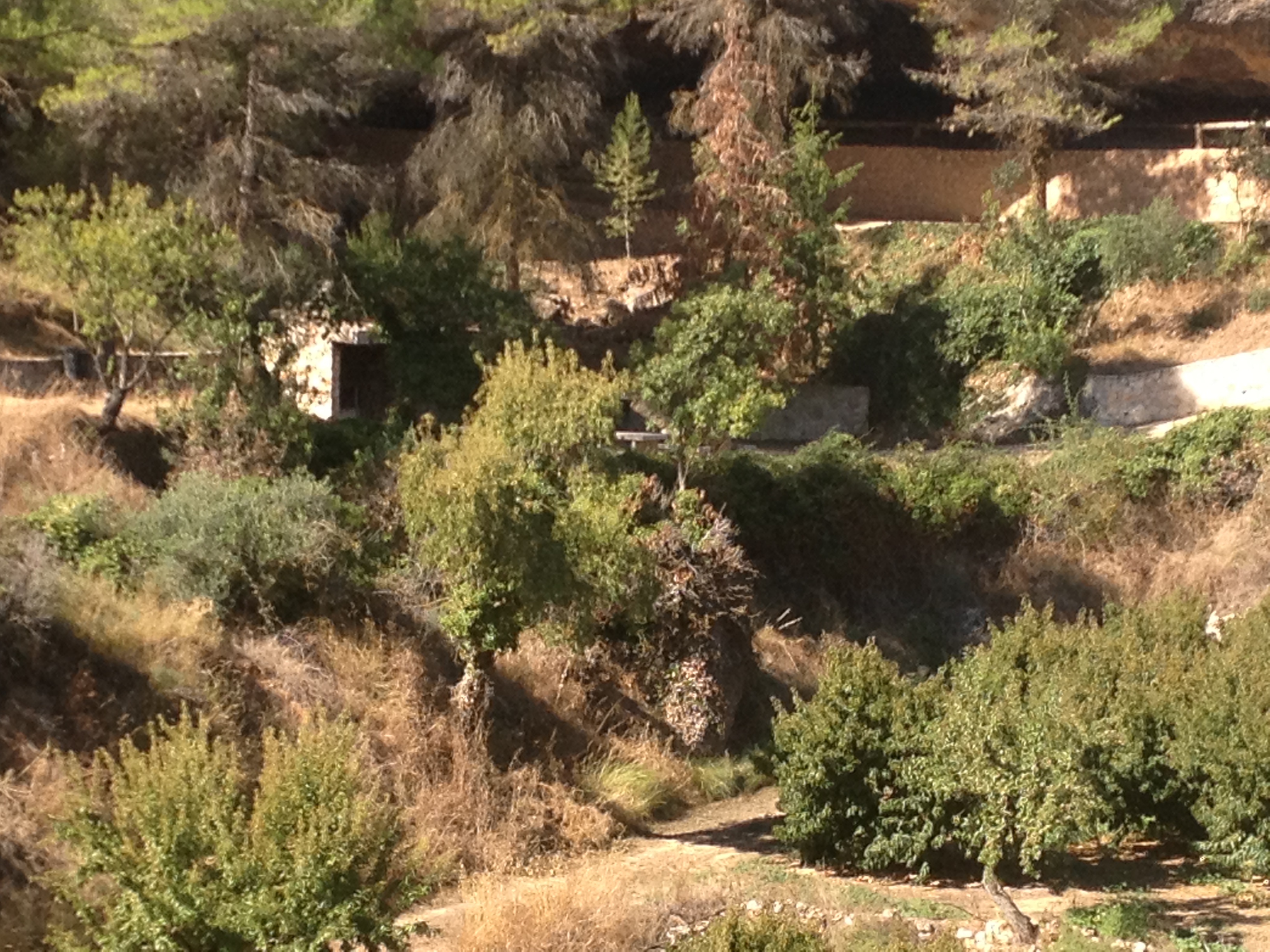 In the olive grove, they pass the triage tent – the equip – and the transfusion lorry. A group of men in vests and dungarees are busy getting stretchers ready. Piles of wooden poles lie waiting to be fed through canvas. Trucks and ambulances nearby have bonnets up, and legs stick out from under chassis, as drivers carry out last-minute checks and repairs. The vehicles have a dead, hollow feel to them without their windscreens. Some have been smashed out by bombs, the others removed on purpose. The flash of sun on glass is an instant giveway to the enemy air force. Even moonlight shows up a windscreen.’
A World Between Us, pp. 229-230
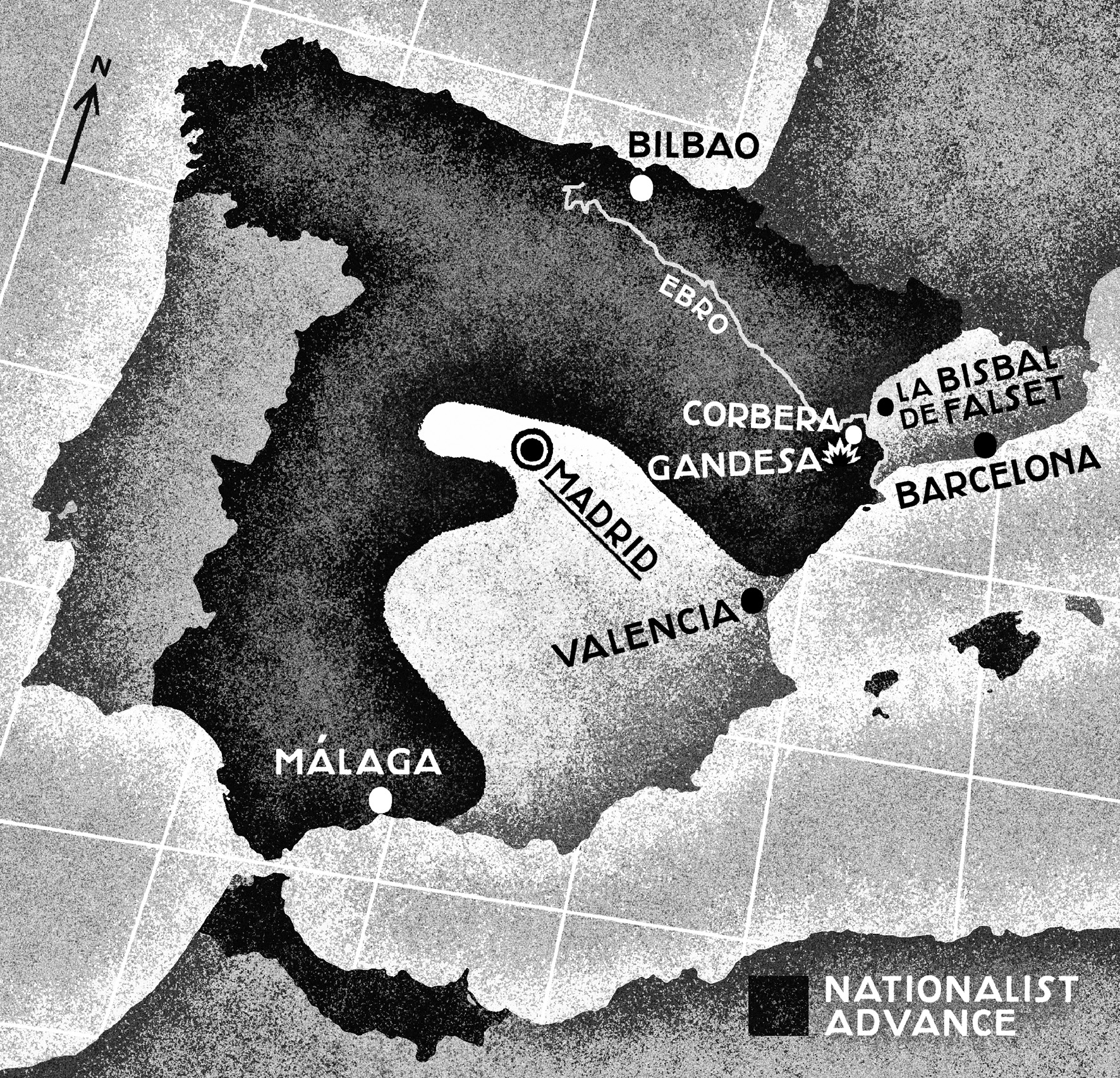
I’m always envious of writers who have the luxury of travelling to all the settings of their fiction, breathing in the smells, feeling the textures of actual places and the quality of the air. Tramping round Romney Marsh and absorbing its peculiar atmosphere was an important part of writing That Burning Summer which is coming out this Thursday. But when I was working on A World Between Us, I had neither the time, money nor confidence of certain publication to travel to all the different places Felix, Nat and George find themselves in the course of the book. My biggest regret was not being able to get to the cave hospital near the village of La Bisbal de Falset in Catalonia, where Felix is stationed in early summer, 1938, during the preparations for the planned Ebro offensive.
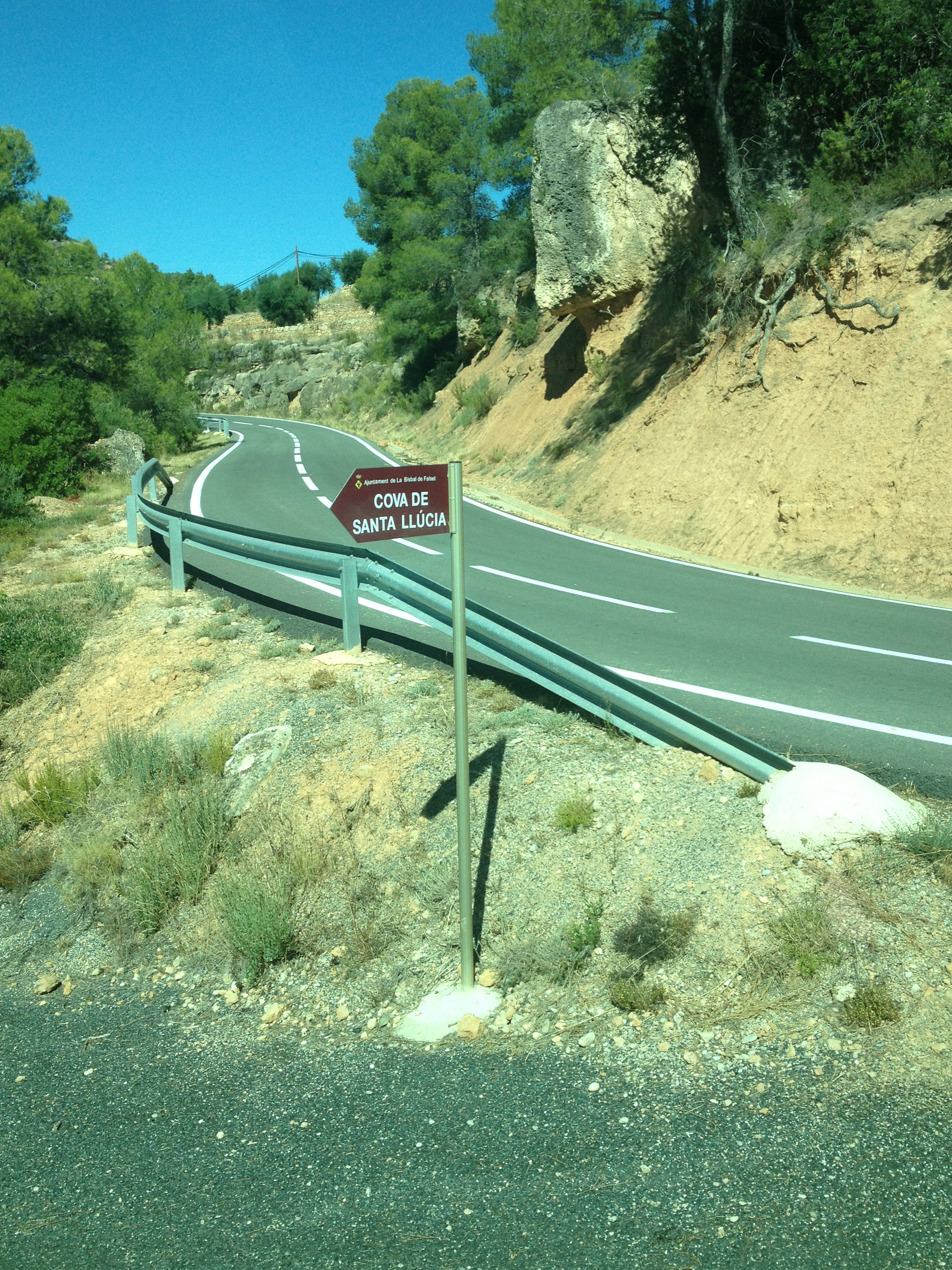 Last Saturday, thanks to the tour of the region organised by the International Brigade Memorial Trust to commemorate the British Battalion’s involvement in this battle, my ambition was finally realised. I was both nervous and excited as the coach wound its way up from the river Ebro – a far longer journey than I’d imagined. Of course seventy-five years ago it would have felt longer and bumpier still for the wounded soldiers who travelled in battered ambulances or on the backs of mules, on bomb-cratered roads, enemy aircraft always overhead. They would have already endured an arduous and terrifying river crossing, rowed across at night in local boats, or brought across the few pontoons which hadn’t been swept away when Franco’s forces opened the floodgates just a few days into the attack.
The Battle of the Ebro was the Spanish government’s l ast great effort to win back the territory lost in the retreats of spring 1938 (see AWBU, pp 211-218), when the Nationalist rebels had broken through to the Mediterranean, dividing Republican territory in two, and establishing the river as a frontline. Alun Menai Williams, a sanitario (medic) with the British Battalion described it as ‘Twelve weeks of organized, unyielding, mass slaughter.’
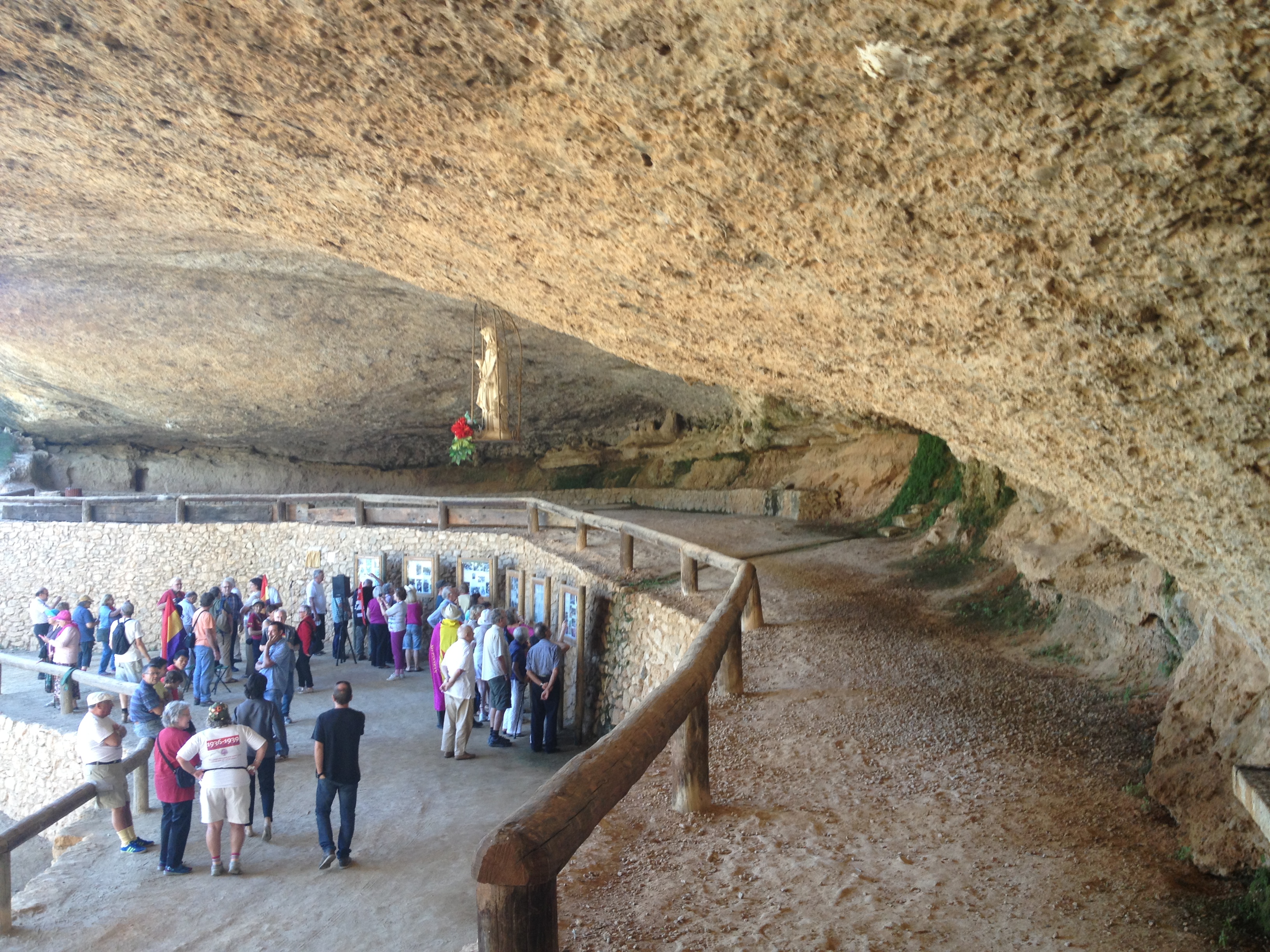 I felt extremely privileged to be able
 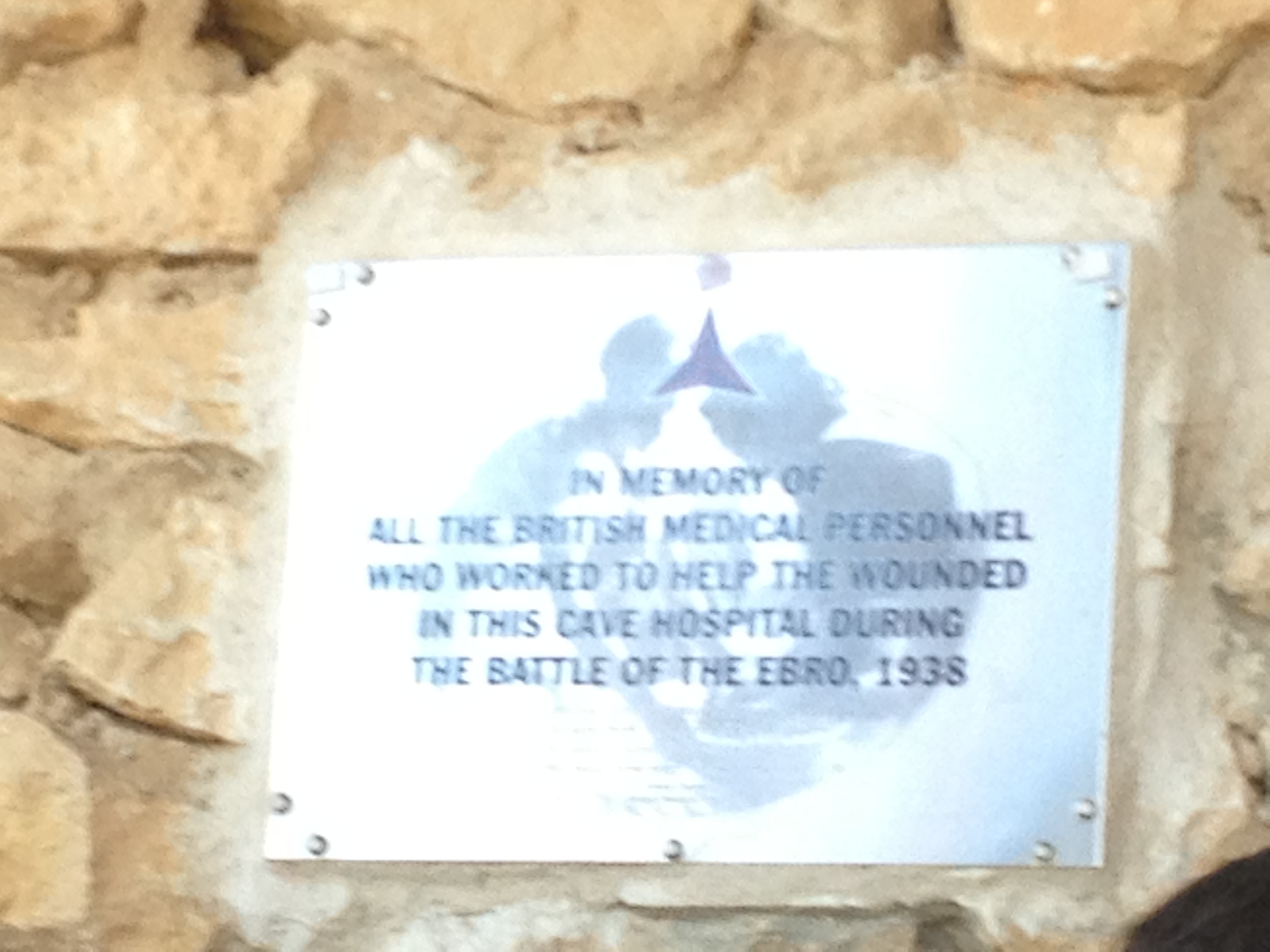 to participate in a ceremony organised by No Jubilem La Memòria celebrating the restoration of a (sadly vandalised) plaque commemorating all the British medical personnel who worked in the cave in 1938. Villagers and visitors from Britain, Ireland, America, Portugal and Puerto Rico were welcomed by the mayor of La Bisbal de Falset, Sergi Masip, who introduced his predecessor, Enric Masip. He remembered being taken to the hospital at the age of 5 by his uncle, about ten years after the war had ended. It was all overgrown and forgotten, but the spring which had provided the hospital’s water supply still flowed, and maintained its healing reputation. (It is dedicated to St Lucia, patron saint of sight.) We learned of the struggle to reclaim the cave for the village, so that it could become a site of remembrance for local people and the wider world.

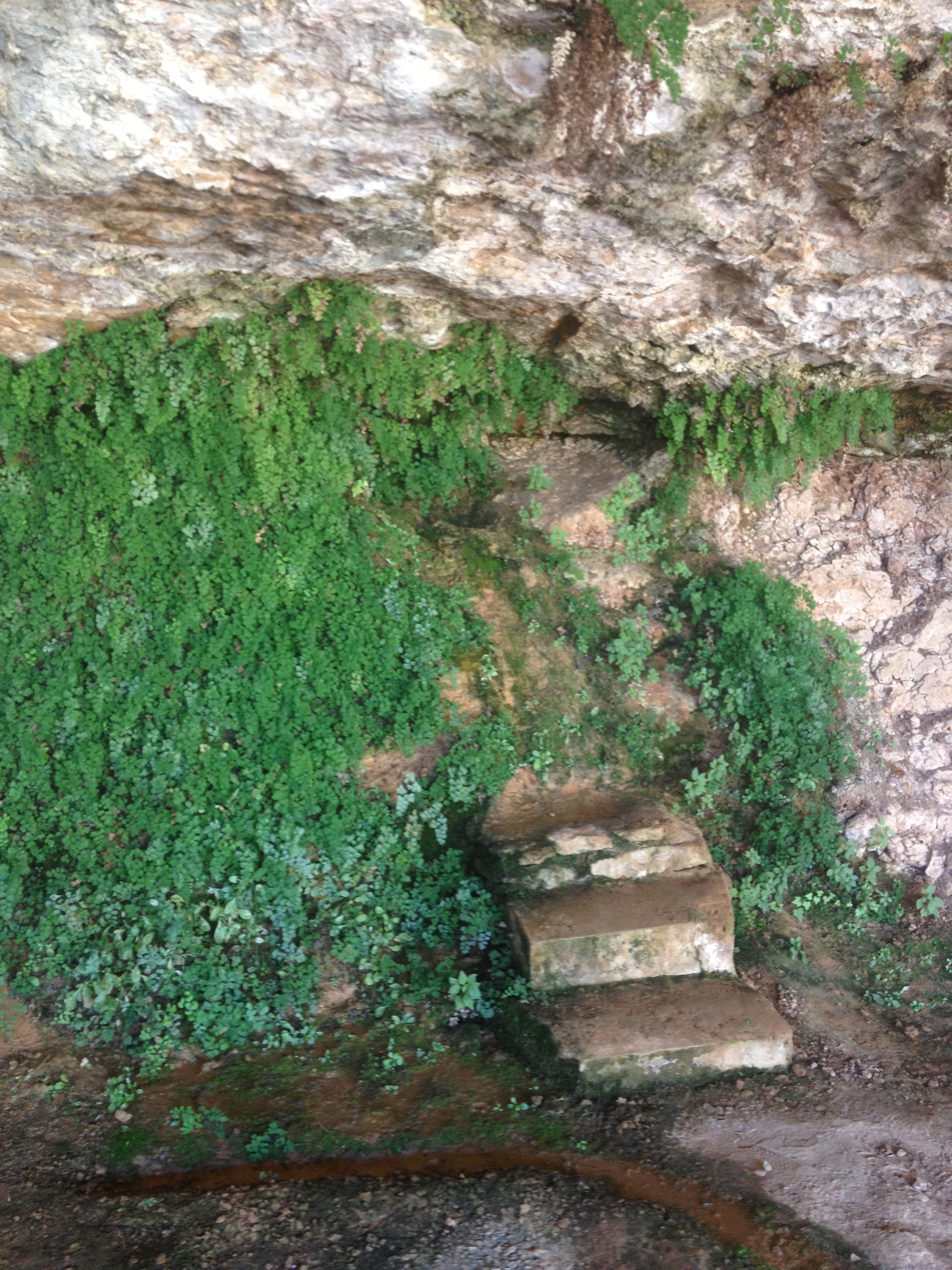
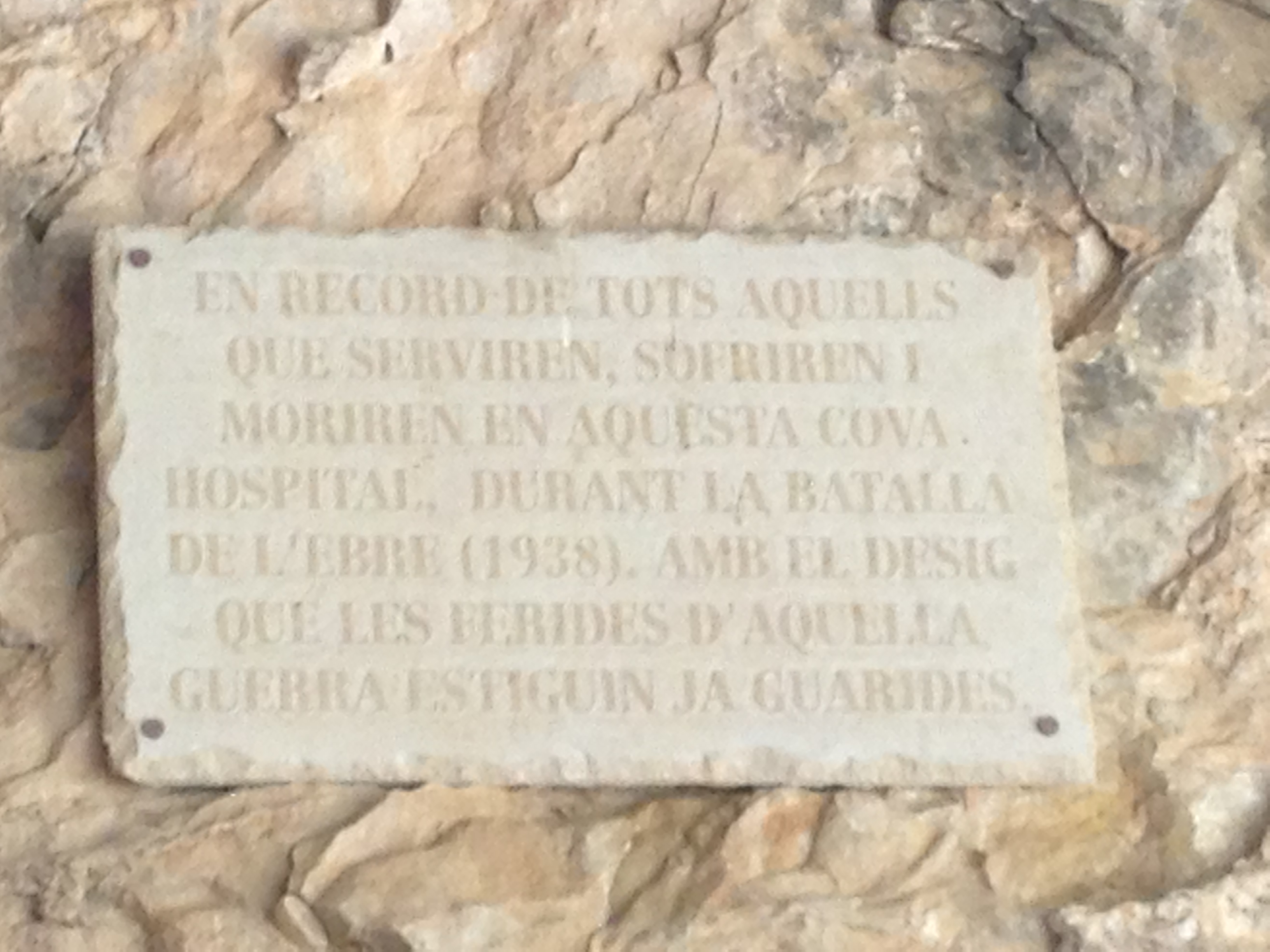

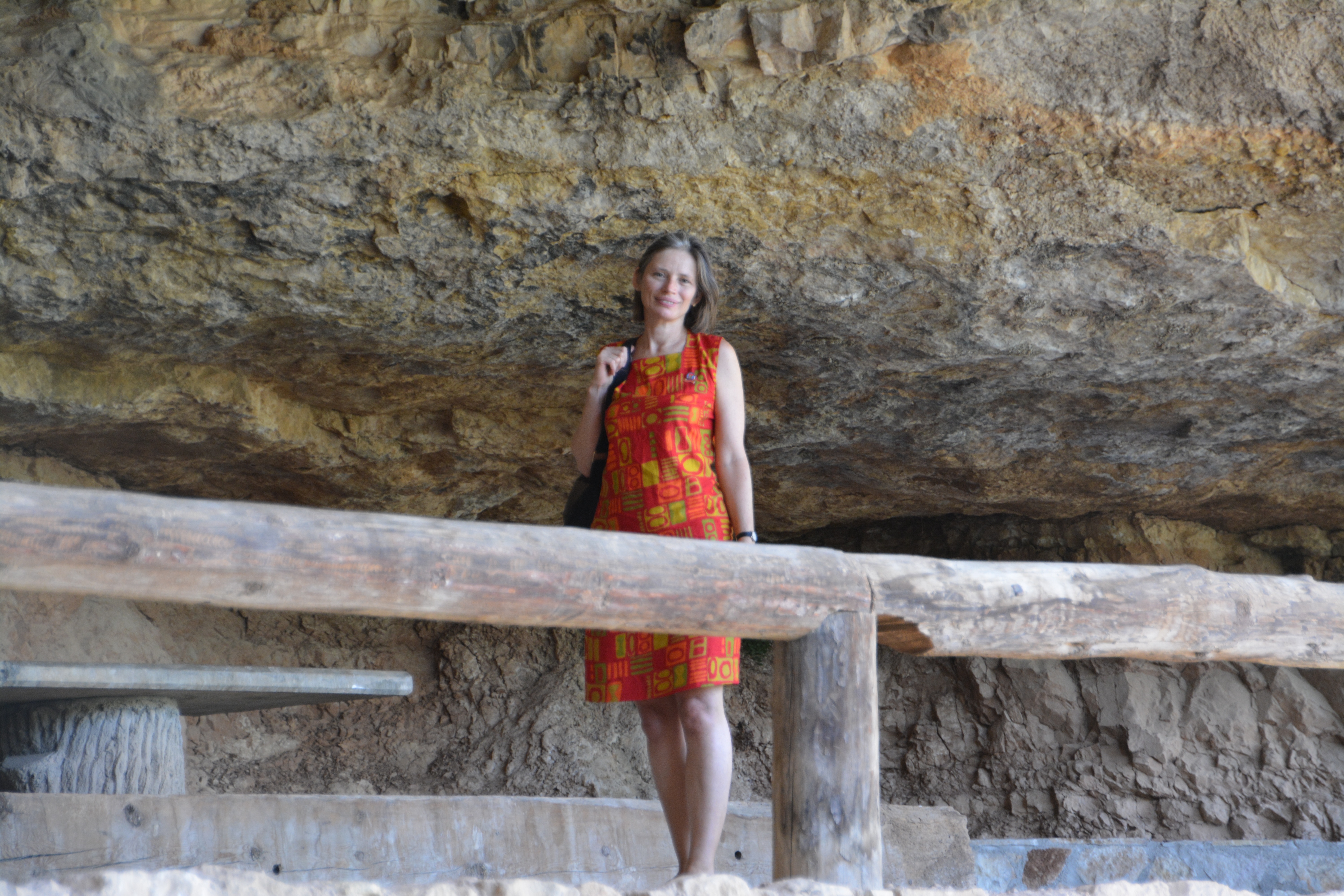

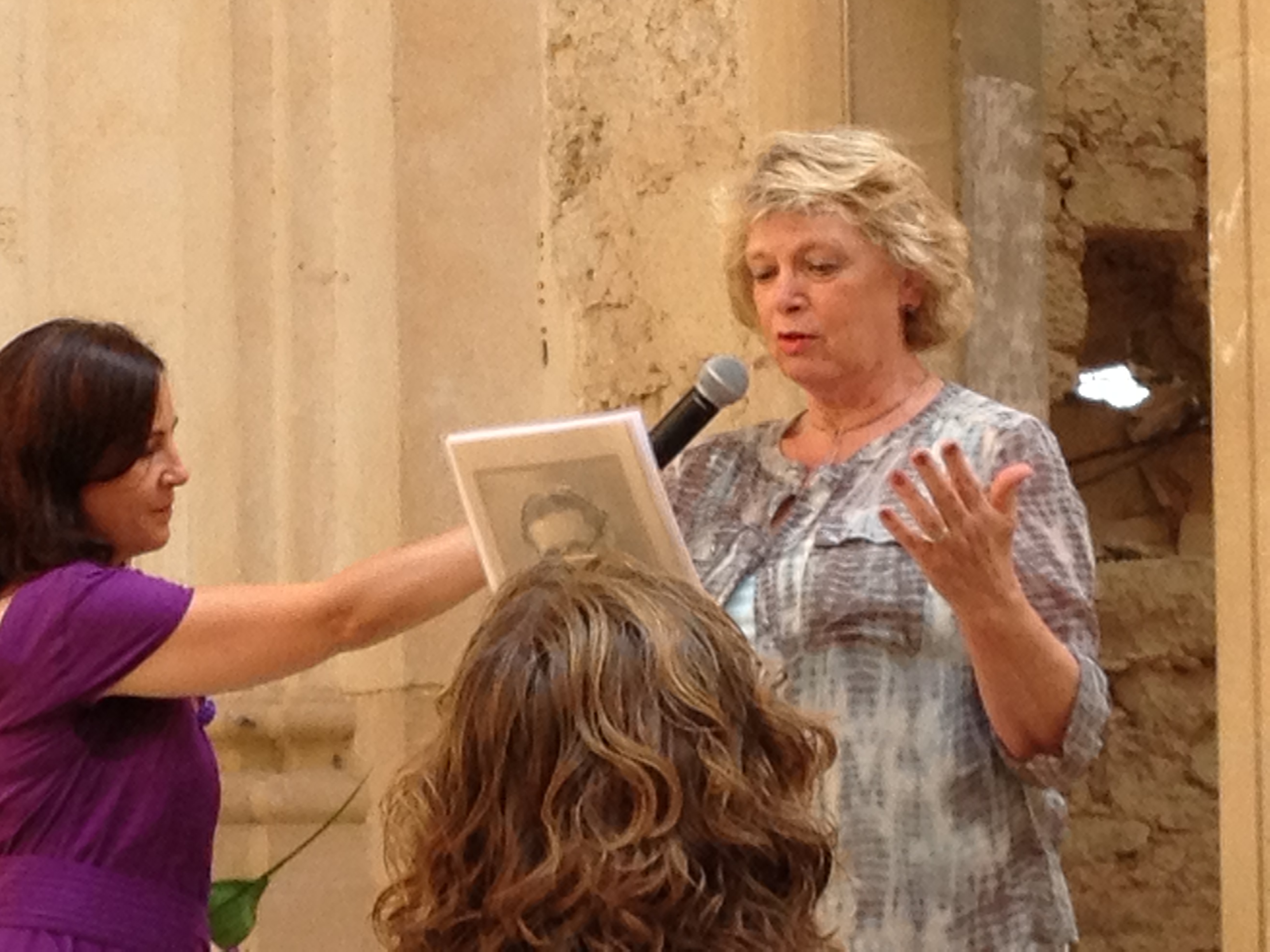
Sadly, Angela Jackson, one of the founders of NJLM, could not be there. Her work on the subject of women in the Spanish Civil War, the cave hospital and nurse Patience Darton who worked here (pictured on the plaque with Spanish nurse, Aurora Fernandez – see also image below) is superb. I felt a poor substitute, but was honoured to give a talk after the ceremony about what it was like to work as a nurse in the cave during the war – valiantly translated by Almudena Cros of the AABI – alongside Peter Crome, son of Len Crome, the chief medical officer of the IB’s 35th division, and also Enric Masip, 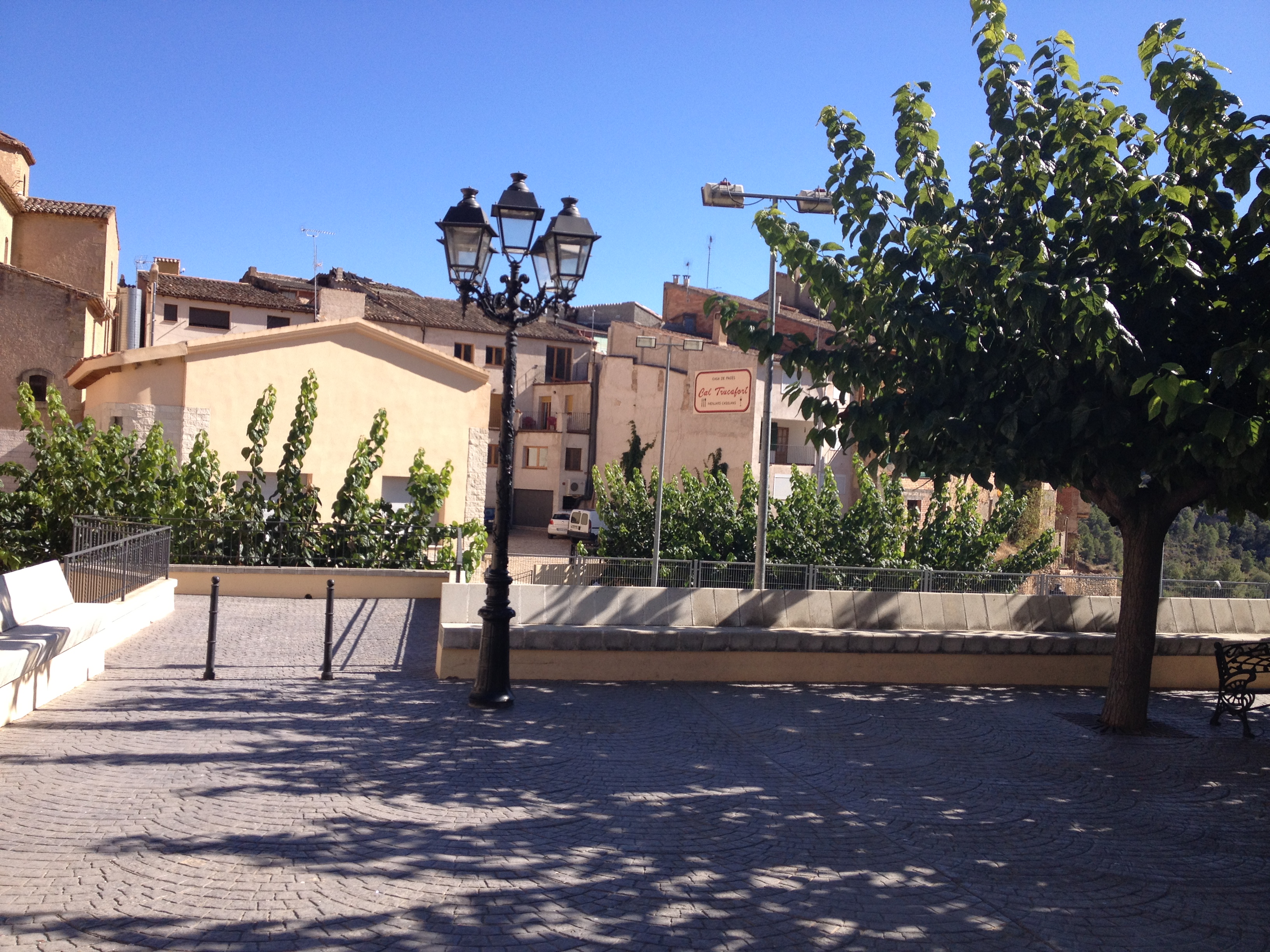 who explained the rich symbolism of hall in which we spoke. During the repressive Franco era, organising its construction and maintaining it as a communal cultural centre with elected officials was an act of defiance in itself, a way of keeping democracy alive in this small part of Spain at least.
My talk went something like this:
When I began thinking about A World Between Us, all I knew for certain was that my opening had to be at Cable Street – which I knew about from the stories of my grandfather, Jack Gaster. One of the most important advances in medical terms made by the Republican army during the war was in blood collection and transfusion techniques – and this too was something that quickly suggested a powerful narrative thread to me. But as soon as I had listened to the interviews in the Imperial War Musem sound archive with Patience Darton (Edney) and Reggie Saxton (sadly very poor quality sound – but there’s a transcript) – and learned, among other things, of the direct arm-to-arm transfusions that took place right here – this cave hospital fixed itself in my head as the place where I wanted the story to finish. Of course the idea or slogan ‘they gave their blood’ was a vital message in the propaganda efforts of Republican supporters outside Spain. At the time I started writing, teenage fiction was dominated by vampire stories – Twilight etc. Writing about real blood, real sacrifice, in a story rooted in the experiences of real people felt singularly appropriate.
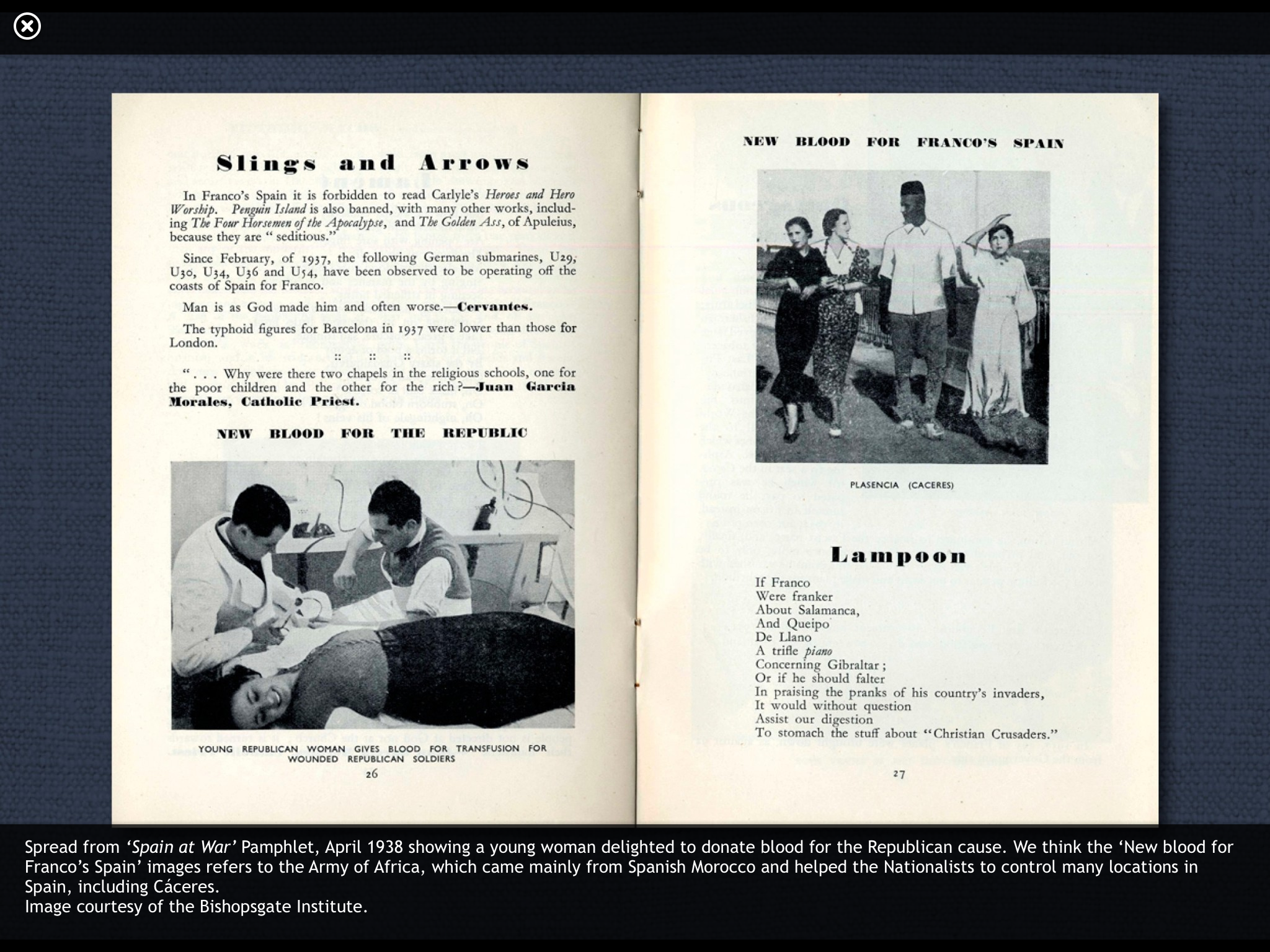
Screenshot from ‘A World Between Us’ iBook
The image of this gash of a cave in the hillside, which sheltered not just Spanish Republican soldiers, Brigaders and local villagers but Nationalist soldiers too – there were a lot of Italian prisoners of war treated here – was particularly rich in symbolism. The experience of working here, at this critical point of the war, seemed to have provoked some of the most intense and vivid descriptions – from nurses, doctors, administrators and visitors.
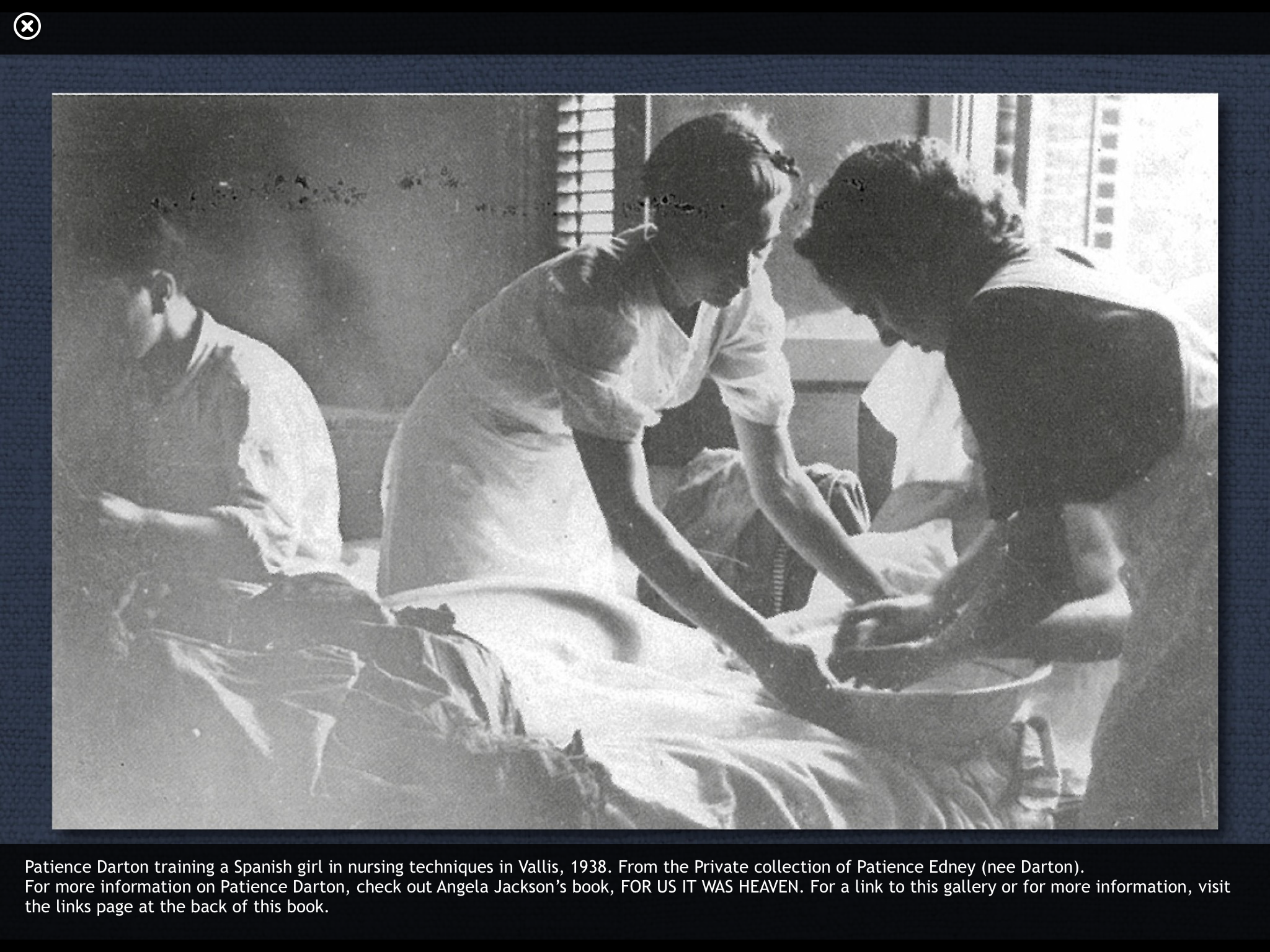
Screenshot from ‘A World Between Us’ iBook
Last week I went through the notes I’d made three and a half years ago, and re-read Angela Jackson’s book Beyond the Battlefield, and I was struck afresh by the strength of emotion – in accounts of Patience Darton, Leah Manning, Nan Green, Winnifred Bates in particular. The hospital was set up here at a point at which there was much renewed optimism – the Republican army had regrouped for a huge offensive, attempting to retake the ground lost in the retreats. The Ebro offensive was an open secret, and Nan Green, Patience and others all refer to the thrilling sense of growing anticipation, excitement building as roads were widened in the dead of night, local people filled in potholes with branches, and more troops arrived – Nan Green refers to an eerie silence, broken only by the swish of lorries and the chink of metal on rock. The sound which clearly stayed with Patience Darton all her life was that of the soldiers singing – but she talks of them as kids, children – the last call-up, known as the babybottle brigade, were fifteen and sixteen. ‘Can you hear the children singing?’ And she speaks movingly of the contrast between their optimistic voices as they went down to cross the river to the battlefields, and the smashed-up bodies that returned.
She descibes a typical day – actually a typical night, because that was when the injured and dead could most safely be collected, and even with the hospital so close to the fontline, it was still often too late, too long after battle. – so she would try to sleep in the day. She’d get up around 4 in the afternoon, and ‘traipse along’ to her mates, the British drivers, who couldn’t move during the day either. They were a particular support – they’d brew up, and they were good at getting hold of – or ‘organising’ things for the nurses – food, and blood, and medical supplies, and they kept all the machinery going. They were absolutely brilliant improvisers. And when she started work in the evening – there was no dusk, she says, nightfall was sudden and it was pitch dark very early – the first question was always which patients had survived from the night before. Nurses going off would say ‘oh so and so’s alive, or gone’. Joan Purser was another nurse whose interview is in the IWM sound archive: she mentions the cave quite fleetingly, along with the railway tunnel hospitals at Flix, but Patience makes it clear how incredibly valuable she was – ‘one nurse was marvellous – if Joan was on you knew they’d be better when you next saw them.’
Although they had a generator – also kept going by the drivers – and the operating theatre section of the cave could be lit (but I could see no evidence today of where the single lightbulb had once hung) in the ward area the only light came from oil lamps, and it was very hard to see.
As you saw, the ground was very uneven so the metal beds were all higgledy-pickledy – some account say there were 50, some 100, some 150 – and in the dark, the nurses were always banging their shins on them, and tripping over ‘these damn beds’ – they couldn’t get them into straight lines. One of the other advances of this war that’s become standard procedure was a sophisticated system of triage…so patients were ‘sorted’ in tents down below, and the cave received only the very worst cases, that couldn’t be moved any further or needed immediate operations – fractures were plastered up with the new ‘open’ technique and send to rear hospitals.
It was hard to get the patients up the steep path. 50% were without a pulse when they arrived, their veins flat, and the nurses had nothing with which to measure blood pressure. They became very expert at getting needles into collapsed veins – lots of patients needed saline drips or transfusions – and equipment was gradually getting more sophisticated. Most of the injured were mostly headcases, chestcases (not much could be done for them) and abdominals. Unfortunately the abdominals weren’t allowed even water – this was a misunderstanding – torment to arrive thirsty from the battlefield.
Patience describes 4 operating tables with 2 or 3 surgeons working at once through the night – new surgeons were sent from Barcelona to this hospital, because the Brigades’ ‘own’ doctors were up at the front organising evacuation (under Len Crome). There was definitely an issue of trust – I realise looking back at my notes, this must have been what sparked my sabotage plot – as nurses weren’t sure if these new doctors were really on side. ‘We didn’t know what their politics or their quality was’. She says:
‘There were enough of us to make sure subsequent treatment cd be done properly. they did a lot of sabotage on purpose. Like what? Not proper sterility on purpose in the rearguard hospitals because nearly all the doctors were pro-Franco. They got caught on wrong side, and couldn’t resist marvellous surgery. Surgeons can’t resist marvellous surgery’
She then goes on to describe their brilliance at abdominal cases in particular:
‘Spanish surgeons might go through the curls of intestine 20 times – they’d pull them all out and have a look… sometimes they’d cut out a whole lot and join them up. They were very good at that.. sometimes they’d sew them all up. They were marvellous at abdominals.. they’d take out miles and miles of intestine looking for holes from bullets or bits of shrapnel.’
The noises from the patients were clearly incredibly distressing – there was never enough morphia so they weren’t doped enough. The headcases were the worst for noise (‘there was not much you could do except try to keep them still’) and often used to pull their bandaging off – in fact the getting slightly better patients were the hardest to manage – ‘you didn’t want to tie them down, but ended up using up stretcher bearers staying with them.’
Patience remembered one Spanish headcase raving all night, making marvellous political speeches…(here again she referred to the ‘children singing’ in the background). Patience is interesting on the importance of everyone’s different roles. I’ve already mentioned the support nurses had from the drivers. The stretcher bearers were clearly invaluable for reassuring patients – particularly those soldiers who weren’t used to being bossed around by a woman. Many weren’t had never seen an actual doctor before, so they called out for a ‘healer’ - curandera, as Spanish nurse Aurora Fernandez remembered – a wise woman with herbs. Patience describes her team of stretcher bearers as her ‘own trained pets’. But there were internal battles, for example over blankets – because when patients died, the people responsible didn’t want to put them in the earth with nothing round them. It was also easy to lose blankets to patients being evacuated to rearguard hospitals, and then there was also no hope of getting them back.
A lot of the work, other than replacing drips and dressings, was about simple comfort. Just letting patients know you were there. Made so much harder by language barriers. Yiddish was often a useful lingua franca, but a particularly poignant and heartbreaking moment was the death of three Finnish volunteers. As they died, nobody could speak to them in a language they could understand. All three died strapped up, hardly able to breathe, with very deep chest wounds. Patience said: ‘Oh I’ll never forget them. They were such beautiful creatures. Great blonde things.’
Winnifred Bates had a similar reaction as she travelled round the medical units on behalf of the Spanish Medical Aid Committee, checking on the welfare of the nursing staff. She visited the cave hospital in the course of this duty, later using her photographs and descriptions of it very effectively in fund-raising pamphlets:
‘Men died as I stood beside them. It was summer time and they had been in long training before they crossed the Ebro. Their bodies were brown and beautiful. We would bend over to take their last whispers and the message was always the same. ‘Tell them to fight on till the final victory. ‘ It is so hard to make a man and so easy to blast him to death. I shall never forget the Ebro. If one went for a walk away from the cave there was the smell of death.’
Ending on a more positive note, I’ll give the last word to Aurora Ferndandez – who learned her skills from the British nurses – nursing was traditionally done by nuns in Spain before the war, and of course they were rarely on the Republican side. This was the spirit I wanted to convey in my book, that I found so endlessly inspiring:
‘The wonderful team of British doctors and nurses together with the Spanish and other nationalities…never worked in better harmony…The bombing was terrible…We had so many casualties we had to evacuate even the most serious cases. And here again I admired the efficiency of the British team, their spirit of sacrifice. They knew no tiredness, they went on and on, and all of us, as if commanded by the same goal to do our utmost, knew no rest day and night.’
(Download the ‘A World Between Us’ enhanced multi-touch iBook for iPad for more background material about the history behind the novel.)
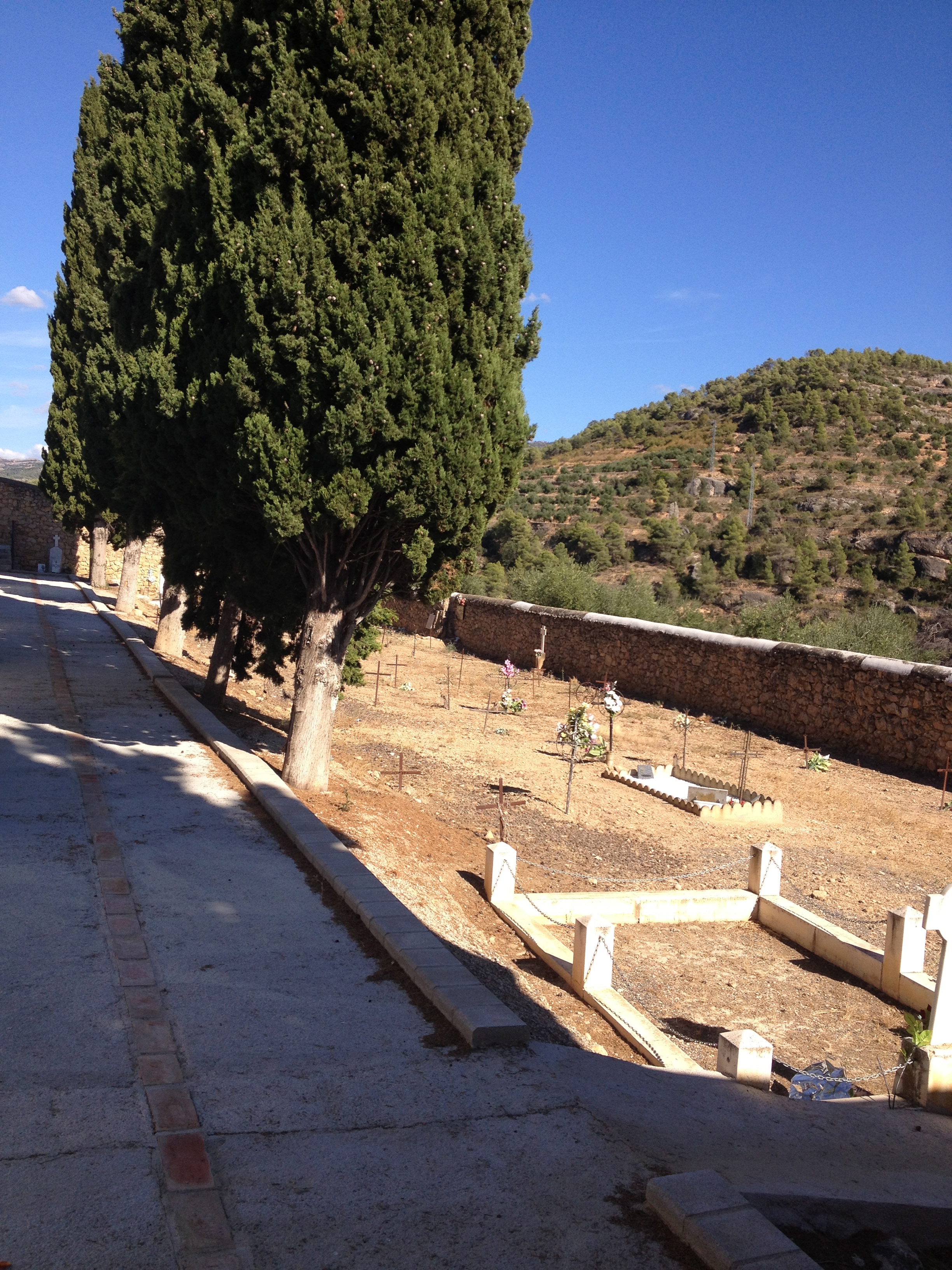
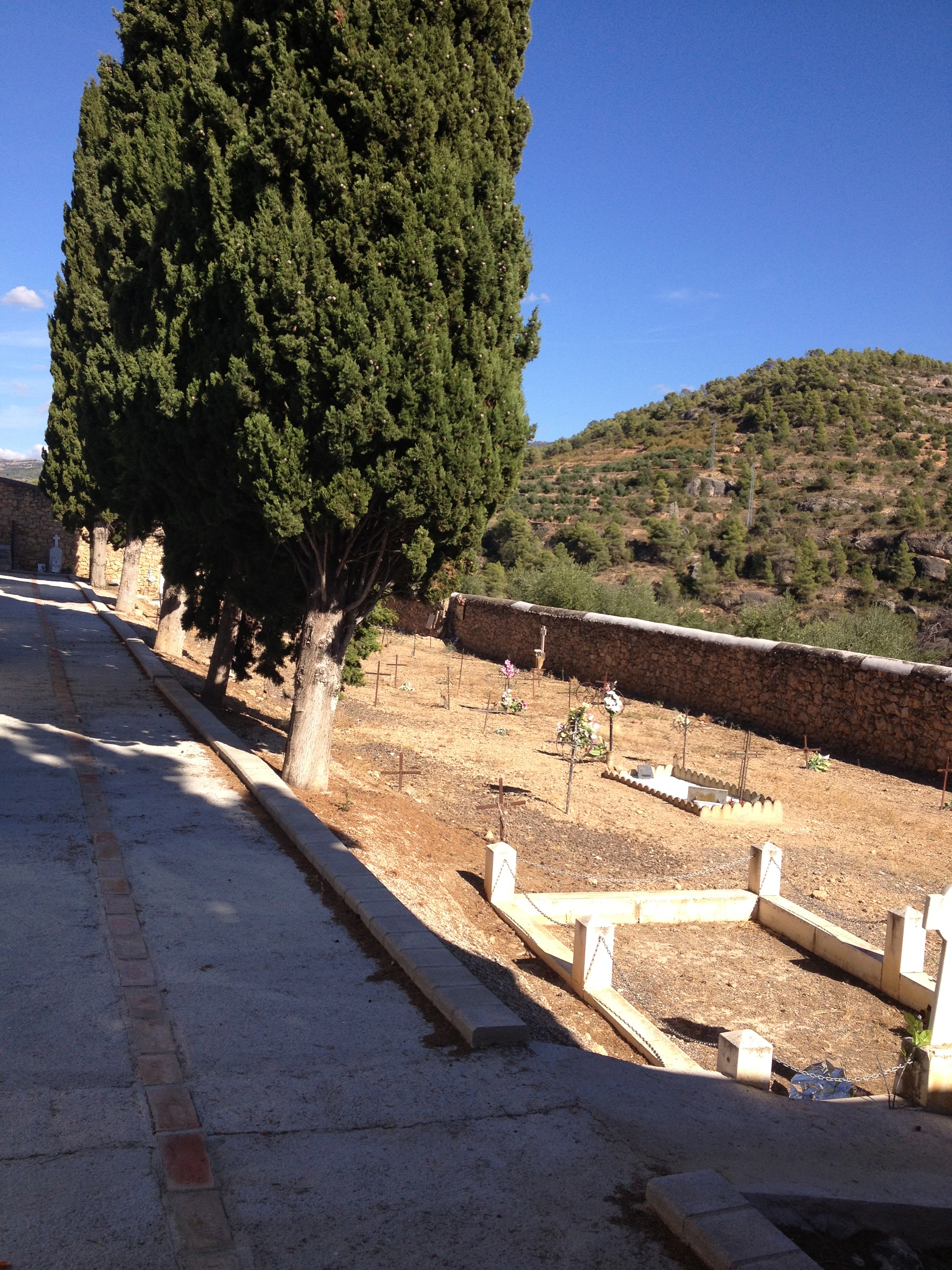
The communal grave in the village cemetery where many of the dead were buried could not be marked until long after Franco’s dictatorship had ended. We went to lay flowers there, but unfortunately found the gates locked. Richard Baxell, historian of the British Battalion, who gave talks and lectures throughout the tour, as well as answering question after question, is also an expert climber.


September 26, 2013
Remembering the Battle of the Ebro, September 1938
‘On the other side of the river, spirits are high. They’ve driven Franco’s forces from the steep hillsides outside Corbera. But everyone knows Fascist reinforcements will soon arrive and it’s no surprise when the crash and boom of bombardments steps up a day later. The men scan the skies, and wonder if the German and Italian planes have got the trick of breeding. Nat sees fear rising in the eyes of lads who have not fought before, and he does his best to steady their nerves.
These rocky slopes give little reassurance.‘
A World Between Us, p. 234.
The old town of Corbera remains a ruin.
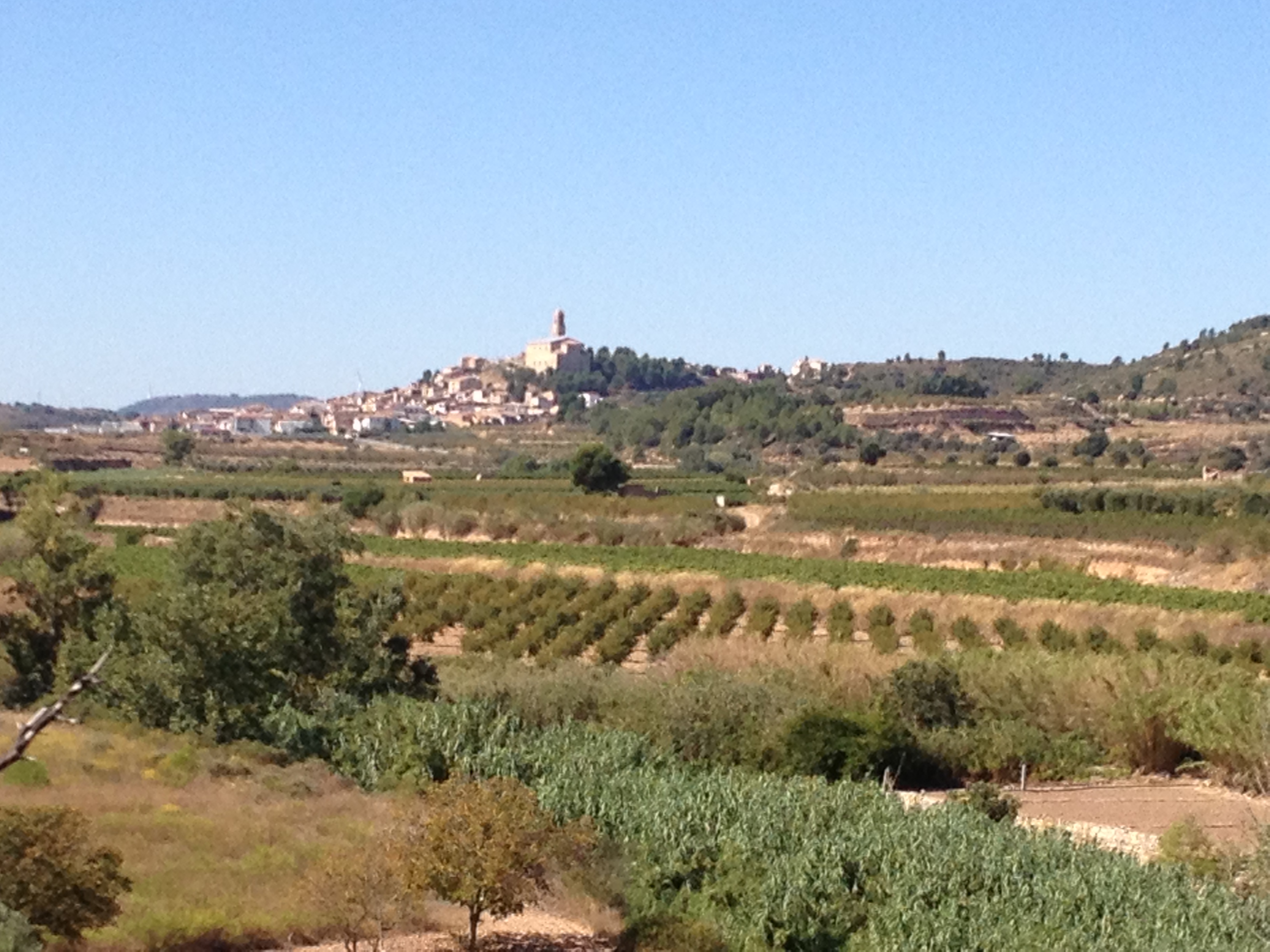
It was bombed 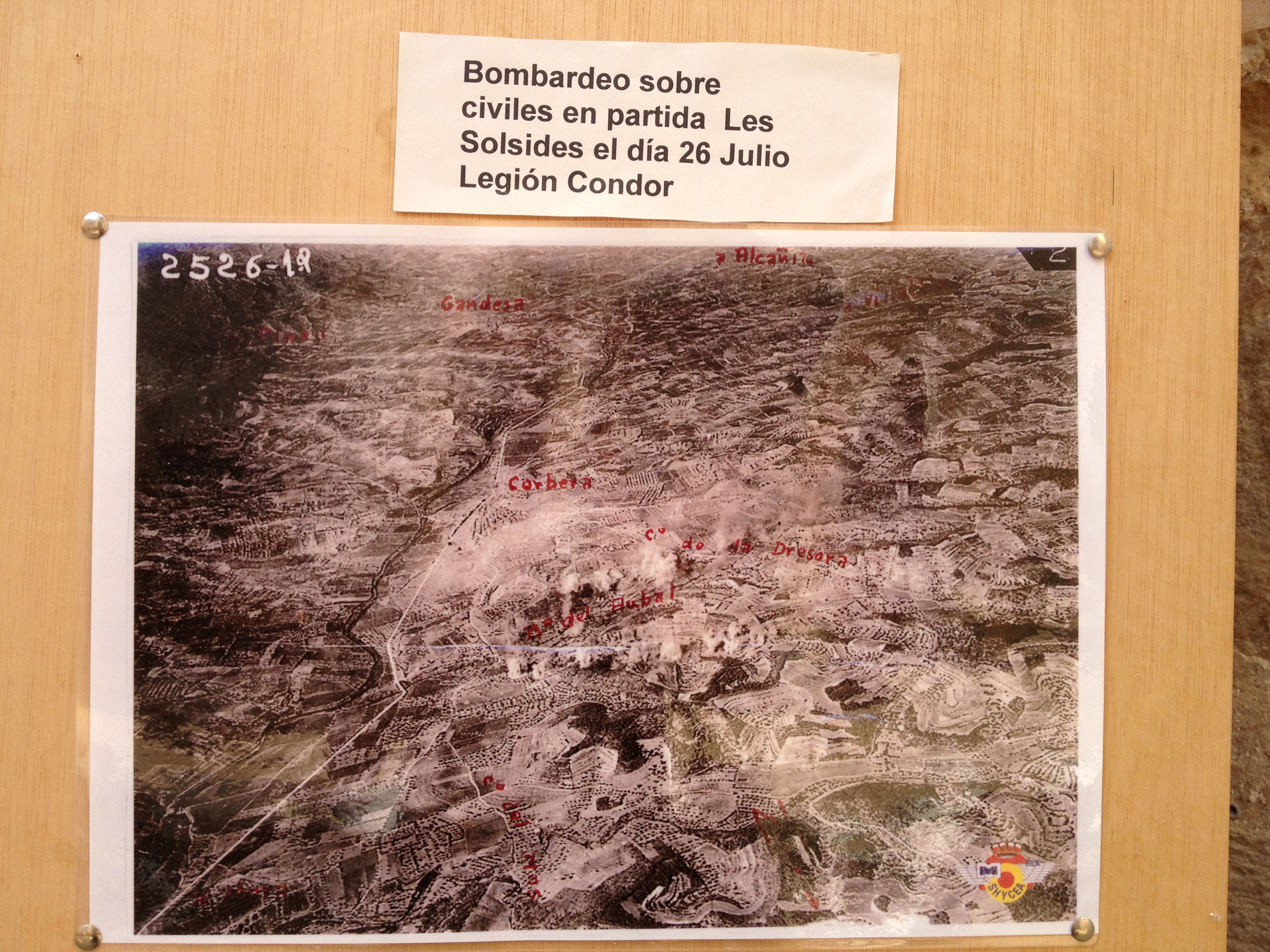 to destruction by the Nationalists seventy-five years ago in the tragic final stages of the Spanish Civil War. Now the Poble Vell stands as a poignant reminder of the cruelty of this conflict, a memorial both to several thousand people who once lived here, and to the tens of thousands who died fighting on the battlefields around. Many of them were boys of just fifteen or sixteen – the so-called Baby Bottle Brigade, La Quinta del Biberón, whose singing as they leave for the front is heard by Felix and Kitty. (AWBU, p229) The silent streets of Corbera Old Town house a series of artworks – an ‘alphabet of freedom’ – while a new exhibition in the roofless church allows visitors to absorb the story of the war from the perspectives of Spaniards and international volunteers alike.
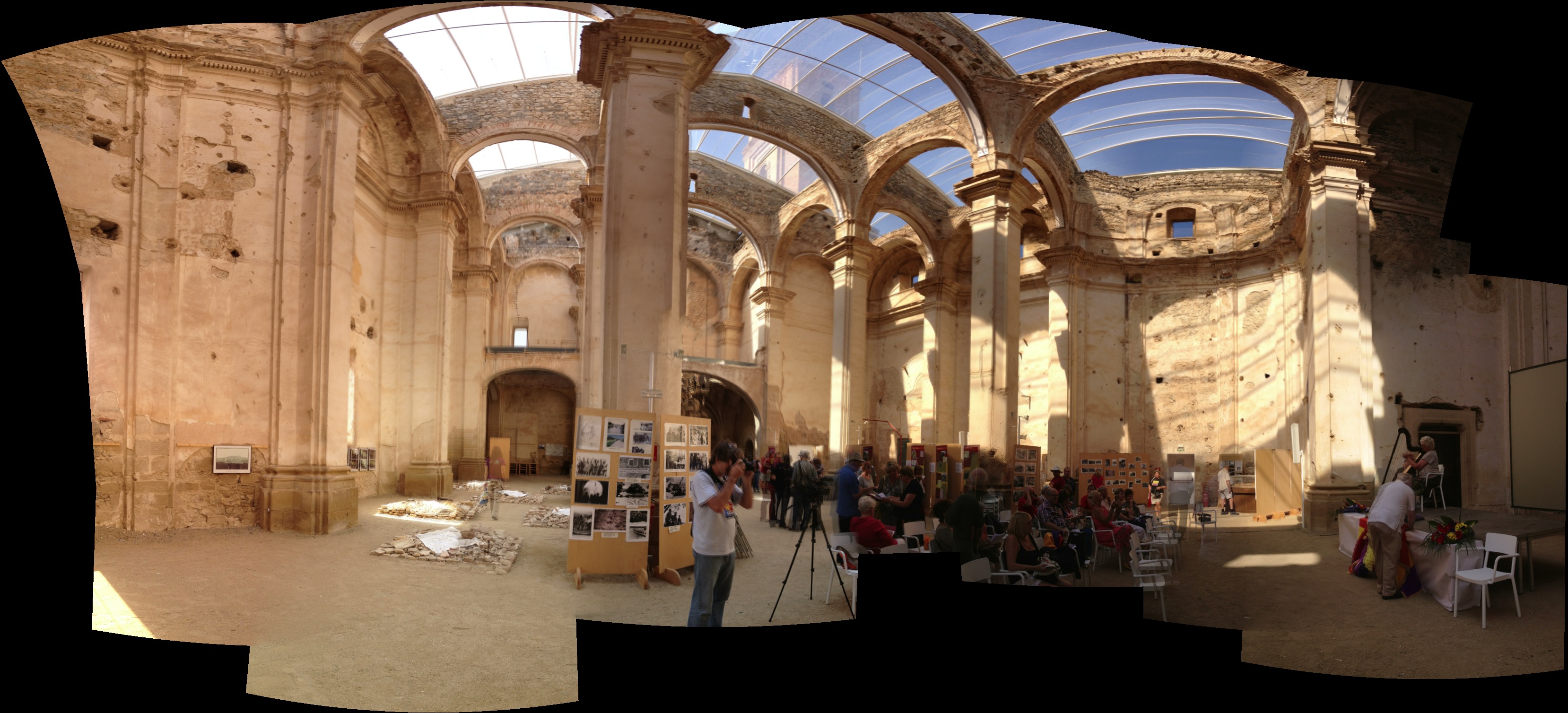 At a moving ceremony I attended here a few days ago, on the anniversary of the last day of fighting for the British Battalion of the 15th Brigade, relatives of Brigadistas and Spanish Republican soldiers testified to their commitment to keeping alive the memories of those dark
 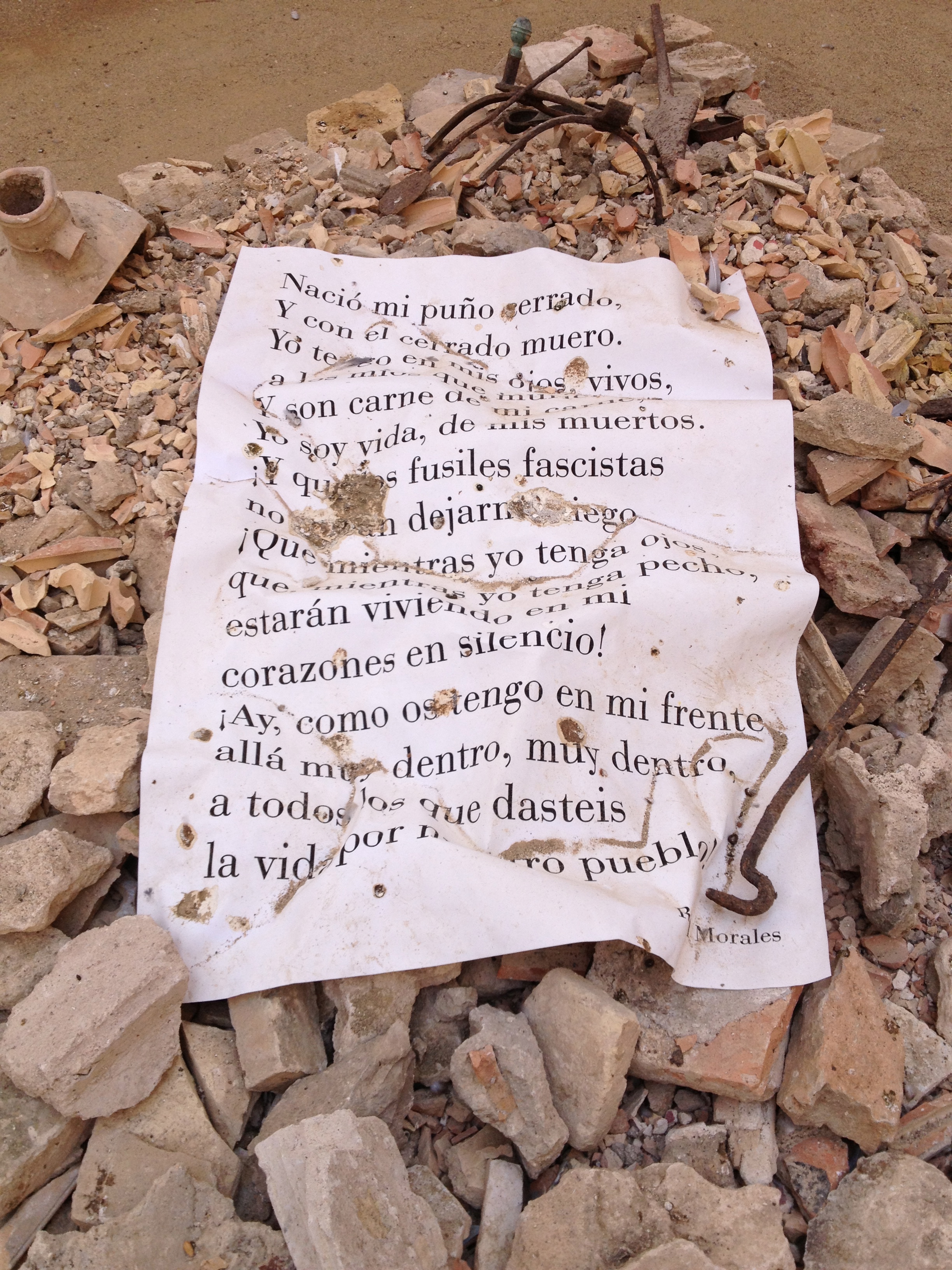 days. Jordi Palou, director of the organisation Memorial Democràtic, spoke of the increasing need to demonstrate solidarity in the face of the rise of violent Fascist attacks in Europe today. During the five days I’ve just spent in the Ebro region, I’ve been struck by repeated tales of vandalism to so many physical commemorations of the 1930s struggle for democracy: in some places, locals keep the exact location of graves and memorials a closely guarded secret for this very reason. Security has been a concern in the design of the new plaque that was unveiled just outside the church, at a beautiful spot overlooking the valley where some the worst of the fighting took place. Its inscription is in Catalan, English and Spanish. (Under Franco, you could not speak Catalan in public.)
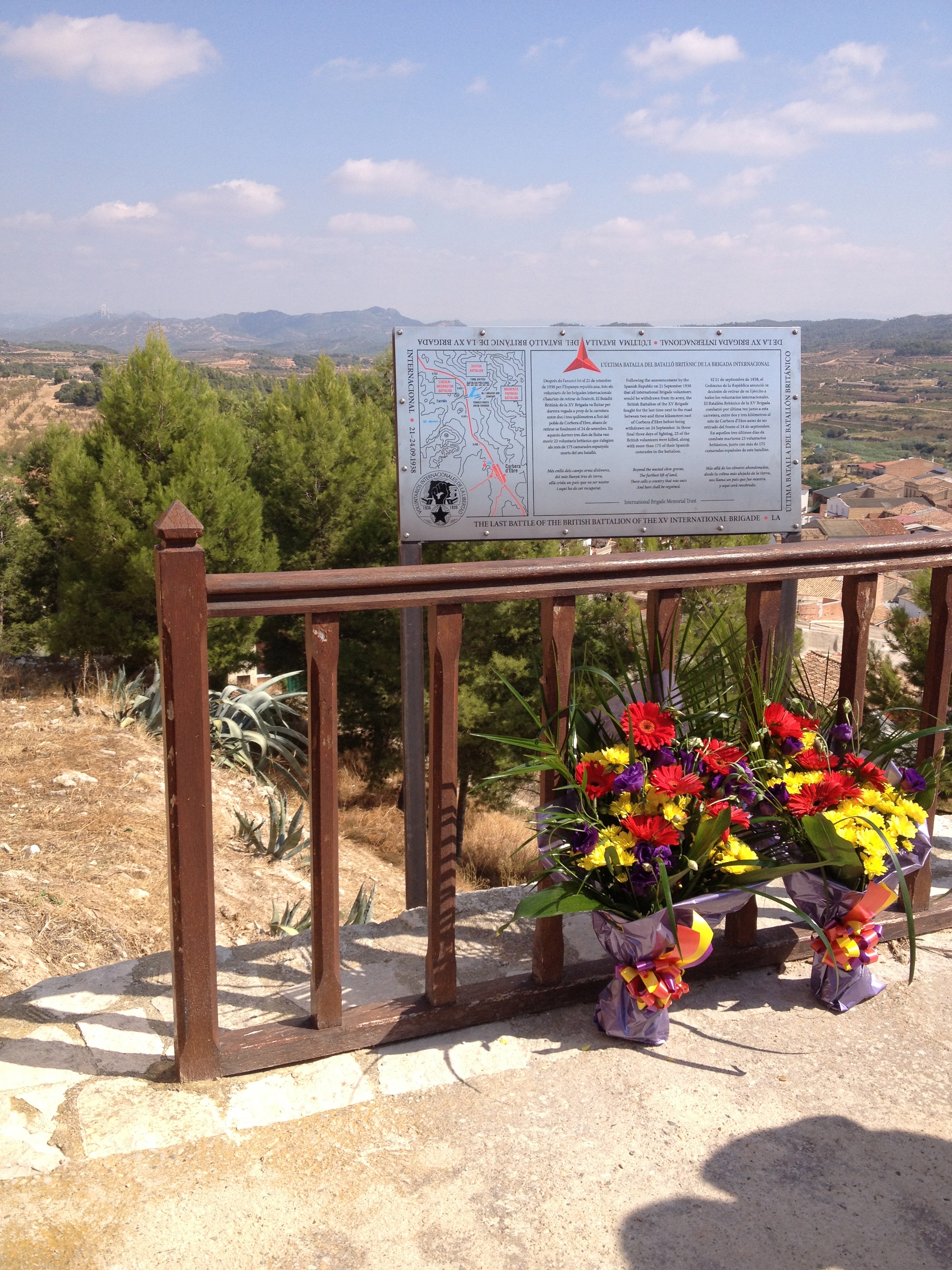
Following the announcement by the Spanish Republic on 21 September 1938 that all International Brigade volunteers would be withdrawn from its army, the British Battalion of the XV Brigade fought for the last time next to the road between two and three kilometres east of Corbera d’Ebre before being withdrawn on 24 September. In those final three days of fighting, 23 of the British volunteers were killed along with more than 175 of their Spanish comrades in the battalion.
Then follows the final lines of Cecil Day-Lewis’ poem, ‘The Volunteer‘:
Beyond the wasted olive-groves
The furthest lift of land,
There calls a country that was ours
And here shall be regained.
Volunteers came to Spain in their thousands to fight for equal rights and social justice for all. Vicente Gonzàlez, President of the Asociacion de Amigos de las Brigadas Internacionales, spoke of the spirit of altruism that brought them here, in ‘the biggest act of international solidarity in human history’. Yet even while the International Brigaders were dying alongside the men, women, and children of Spain, the ‘democratic’ governments of Britain and France were doing deals with Hitler and Mussolini in Munich, as Jim Jump of the IBMT reminded us.
Jim stressed the importance of preserving the principles for which the International Brigades were prepared to give so much. ‘We still carry these values in our hearts’, he said. This memorial and others will contribute to transmitting the Brigaders’ ideals to future generations.
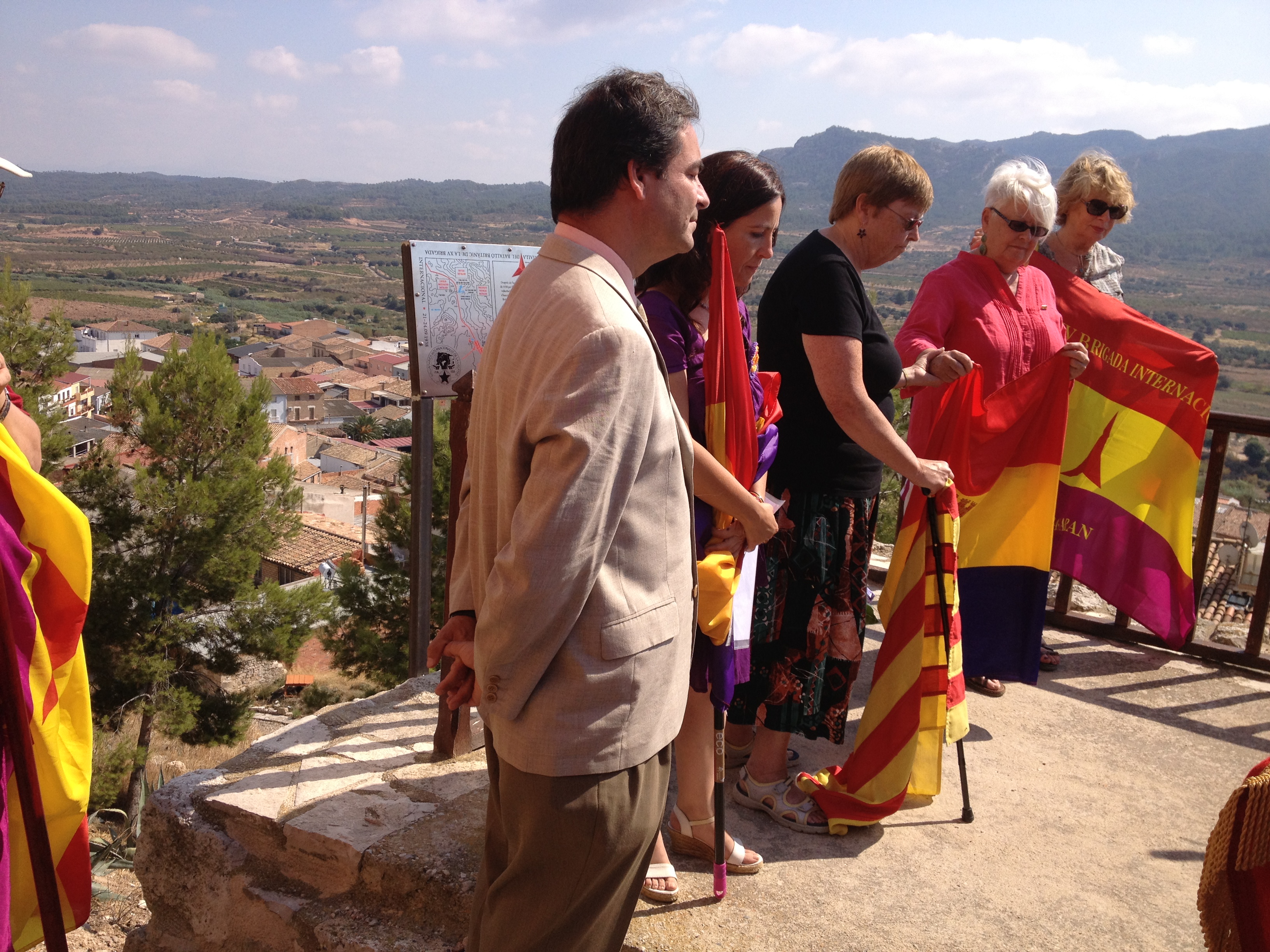 Mary Greening, IBMT secretary, was one of two children of British Brigaders who unveiled the plaque. She had already read from the memoirs of her father Edwin Greening, which capture vividly the utter and unremitting horror of the fighting. Jo Yurek, the daughter of Abraham Lincoln Brigadista Steve Nelson, made the point that everyone should have the right to know their personal history. This is a human right, she said, which has been denied to too many.
For some, it’s a journey that has just begun. Geraldine Puxty found her mother’s 1938 diary by chance earlier this year. Although she was aware that her formidable aunt Kath (Hobbs) had nursed in Spain, she knew little about her uncle Al, and was intrigued by a diary entry made on December 7th:
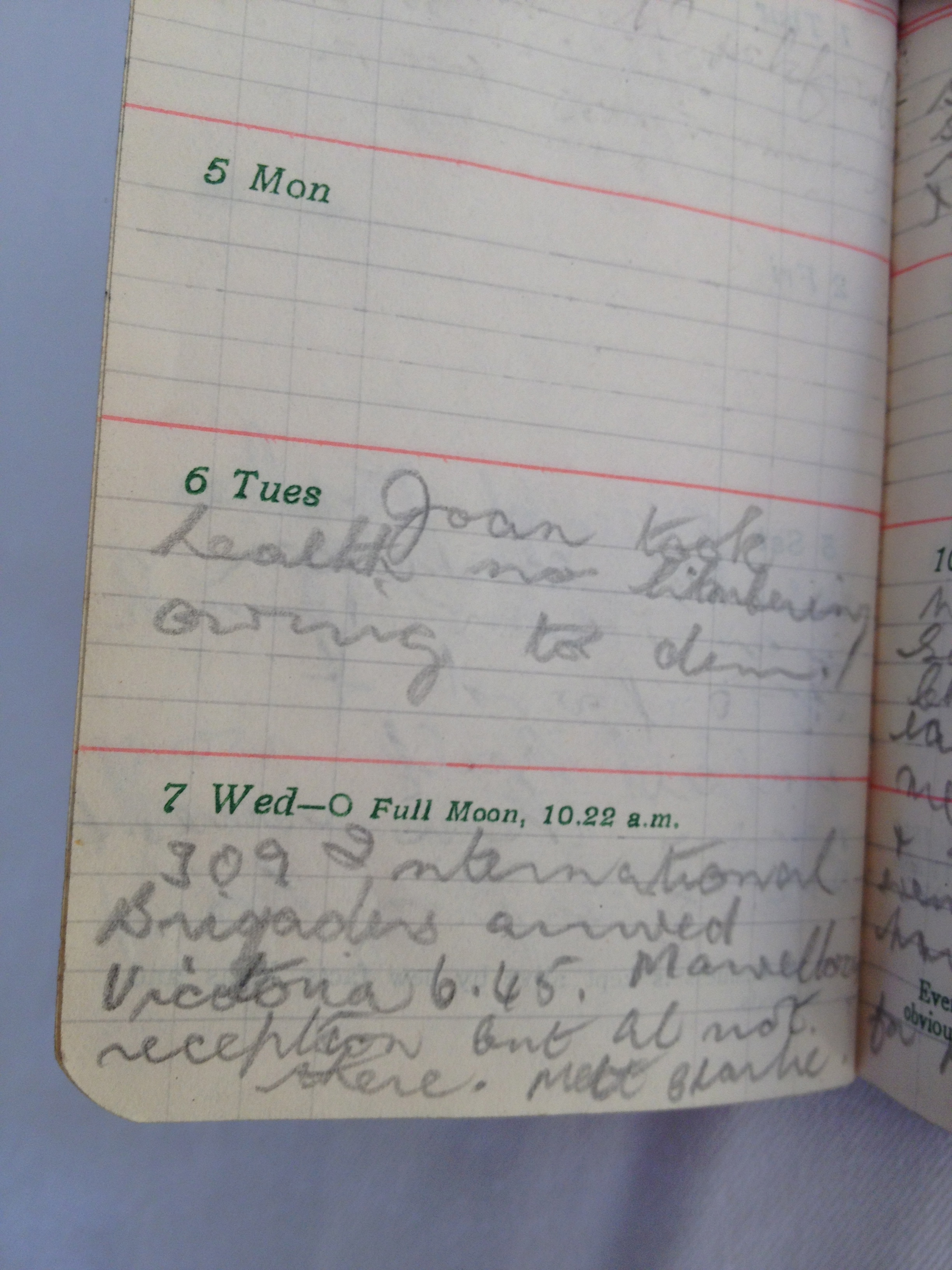 ‘International Brigaders arrived
  Victoria [Station] 6.45. Marvellous reception but Al not there.’
He never did come back. Uncle Al, as Geraldine knows him, never knew his niece: he died of wounds sustained here on the very last day of the fighting, and lies, like so many other victims of this war, somewhere in Spanish soil in an unmarked grave. Aged 19, Albert Hobbs, a comfortably-off mechanic from Maldon, arrived just in time to fight the bloodiest battle of the Civil War, 115 days of hellish attrition. He’d tried and failed to persuade Geraldine’s father to volunteer with him. She has spent the past week piecing together the fragments of his story, looking for his name on lists.
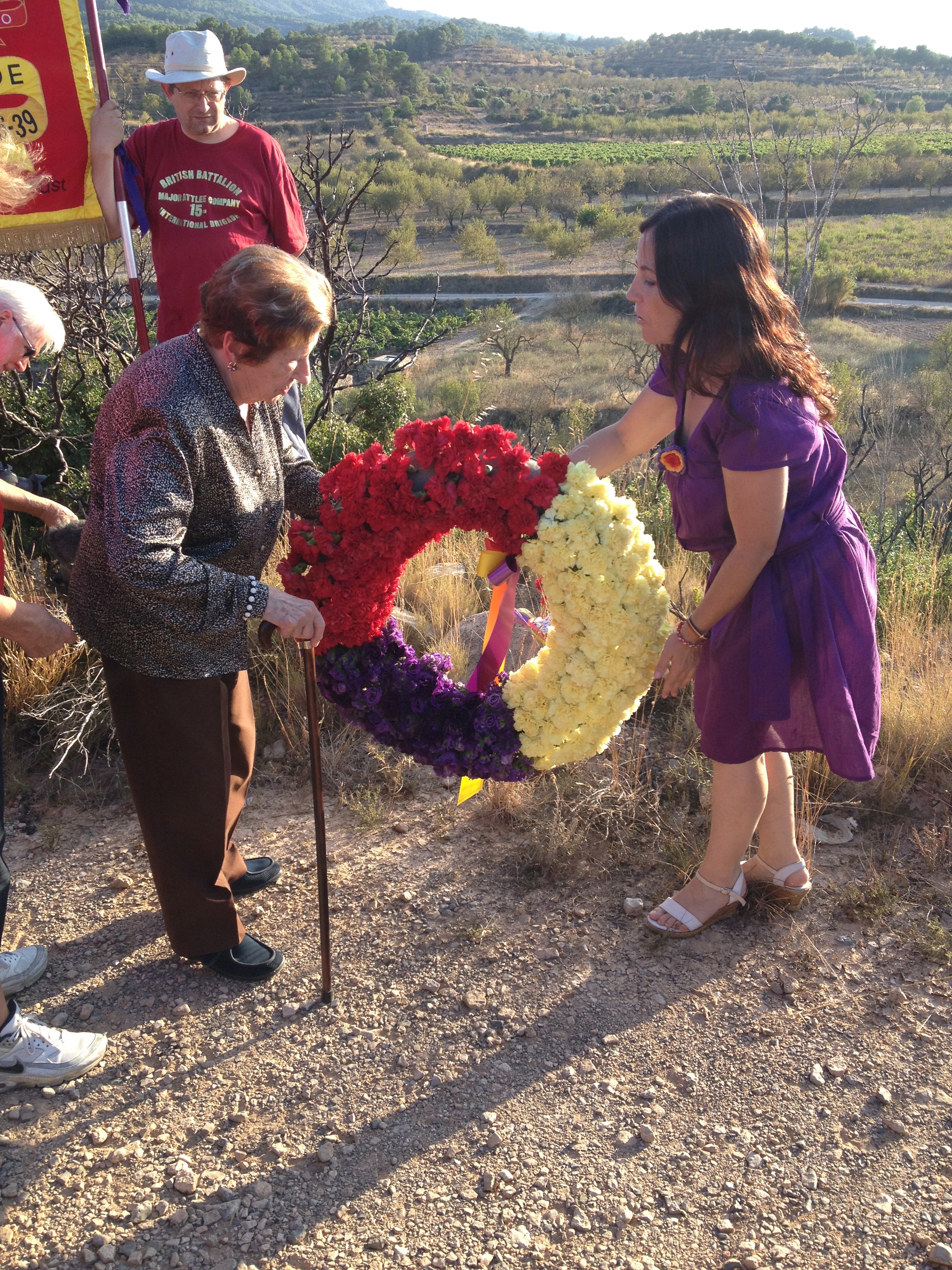
Later that afternoon, Geraldine collected some earth to take back to  the family grave in Essex, at the British Brigaders last battle position, where a wreath and flowers in the Republican colours were ceremonially laid. Gideon Long, grandson of Sam Wild, the British Battalion’s final commander, spoke of his own journey of discovery and its significance to him, and finished with the words of journalist Martha Gellhorn (The Face of War, 1959), written after twenty years of defending the ‘Causa’:
I am tired of explaining that the Spanish Republic was neither a collection of blood-slathering Reds nor a cat’s-paw of Russia. Long ago I also gave up repeating that the men who fought and those who died for the Republic, whatever their nationality and whether they were Communists, anarchists, Socialists, poets, plumbers, middle-class professional men, or the one Abyssinian prince, were brave and disinterested, as there were no rewards in Spain. They were fighting for us all, against the combined force of European fascism. They deserved our thanks and our respect and got neither.
Finally, of course, there was singing: ‘The Internationale’ and ‘There’s a Valley in Spain called Jarama’. Brenda O’Riordán, daughter of Irish volunteer Michael O’Riordán of the Connolly Column, also sang ‘The Minstrel Boy’. You’ll find the words here, but do also listen to her recording of that song and you will understand why tears were so close to the surface as the shadows lengthened.
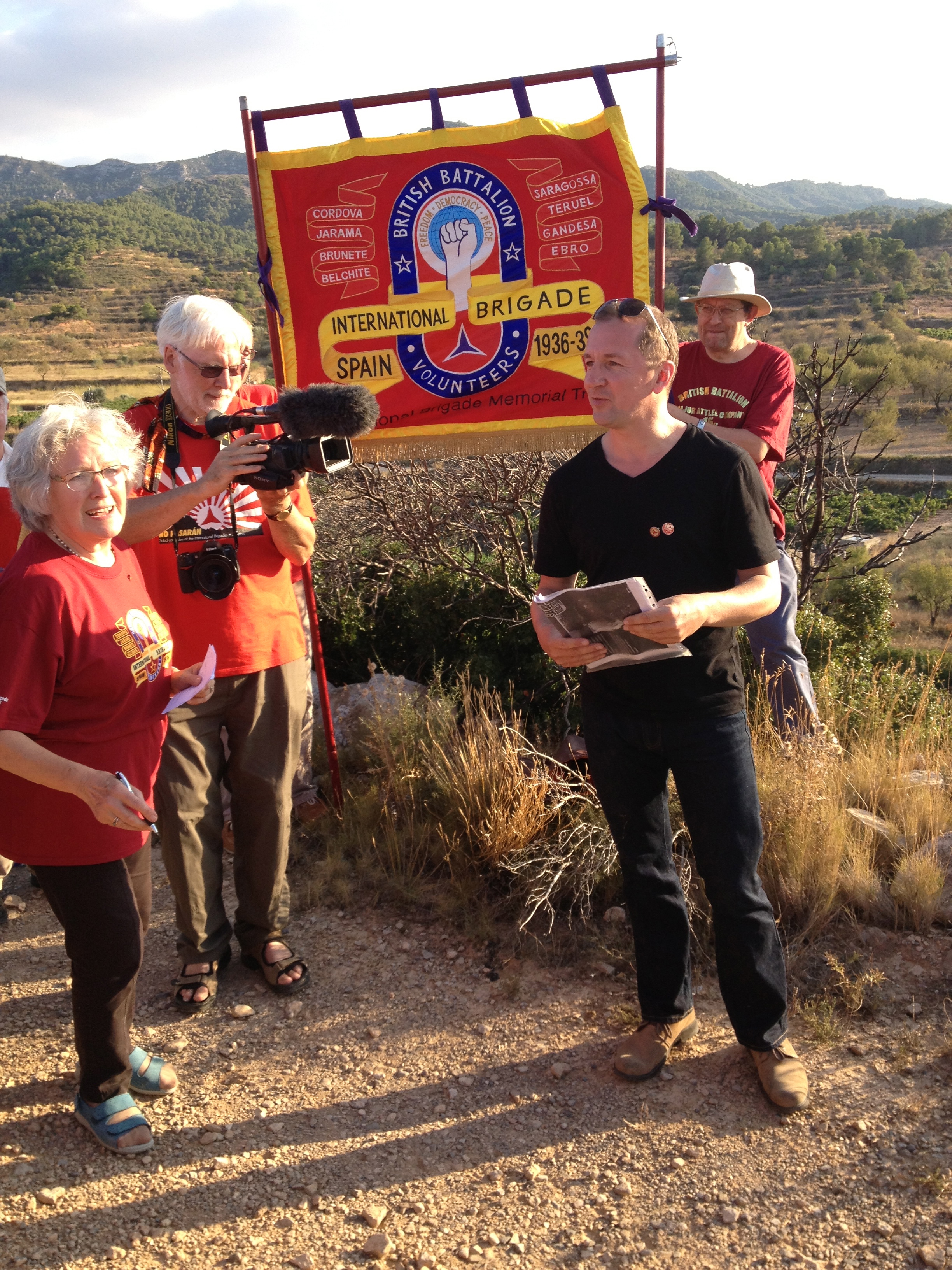
I’m extremely grateful to all the individuals and organisations which worked together to make this and related events in the region this past week possible: the International Brigade Memorial Trust, the Asociación de Amigos de las Brigadas Internacionales, No Jubilem La Memória, the Friends of the Abraham Lincoln Brigade & ALBA, Memorial Democràtic, the Municipal Archive and the History Museum of Cambrils. The energy, commitment and passion of Duncan Longstaff and Almudena Cros in marshalling the troops and getting us all from place to place with grace and humour were quite astonishing. More stories and images to follow over the next few days, and further information about Tuesday’s commemoration here. If you’d like to support the work of the IBMT, why not become a member?
September 10, 2013
In praise of cross-fertilisation
In the past week my work as a writer has taken me to Edinburgh to participate in a conference on transgressive sexualities in the eighteenth century, to the opening of a new exhibition at London’s Guildhall (Victoriana: The Art of Revival) and on Friday, to my first ever football match – England at Wembley, no less. Before the game, a lively Moldovan folk band swapped tunes and dance styles with English brassplayers and bodypoppers. There is a theme here, I promise you.
 Politeness and Prurience was organised by Edinburgh’s History of Art department, but speakers came from a wide range of other fields too, including literature, history, costume and fashion. Professors, post-grads, curators and others spoke on spouters and fops, kid gloves and cross-dressing, marriage and macaronis, teapots and textiles, not-so-secret lesbians, queer connoisseurs and castrati. It was, as you can imagine, a rich mix indeed.
My own contribution, a paper on the origins  of Dr James Graham’s obsession with the visible and the unseen, and the connections he made between sex, sight and electricity, hailed the much-maligned doctor as the epitome of interdisciplinarity. He brought together new ideas and techniques from areas as diverse as natural philosophy, glass manufacture and interior design to create a crowd-pleasing, health-giving spectacle that was entirely one-of-a-kind.
Interdisciplinarity has been a buzzword in academic circles for a decade and more. Cross-fertilisation is another way to put it, particularly appropriate in relation to the doctor who lectured on ‘generation’ – in other words, reproduction – as well as following on nicely from last month’s post. It’s been my guiding principle for years, and maybe my excuse for not getting a ‘proper’ job. But actually, a fellow-speaker I met in Edinburgh put it better when I apologetically tried to describe my ‘career’ over lunch: “You’re a truffle-hunter!” she said.
I can’t deny it. Forget high-flown theories promoting creativity across disciplinary divides… whatever I’m exploring – whether it’s an academic journal, a sound archive, a marsh or a collection of poetry, whether I’m pursuing a thought triggered by a chance conversation on the top of a bus or at a conference – I’m always on the look-out for that idea which will spark something else off.
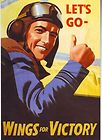 This week I’m teetering on the edge of a number of different projects. On Thursday we’re filming for next month’s launch of That Burning Summer, so I’m thinking about invasion, desertion, spies and moral fibre (and falling in love, of course). I’ve drawn on the work of military, cultural and local historians for that book, and I’m putting the finishing touches to a section on background resources on this website. Next week I’m off to the battlefields of the Ebro, and will finally make it to the cave hospital where the last section of A World Between Us is set, and see the very river Nat had to cross, the hillside where he fell. I’ve a talk to prepare for that trip. And I’m also starting work in earnest on a new book, immersing myself in an entirely new place and time: nineteenth-century Paris. The starting point: a late night encounter with my great-great-grandmother in the pages of a biography of a war correspondent, found on Google Books. The other truffle? The work of a Cambridge musicologist on 1871 Paris opera.
As I’ve said elsewhere, fiction for children and young adults is a particularly fertile literary arena for mixes and mash-ups, both in inspiration and form.
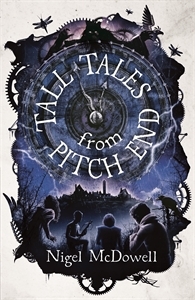
(Guess who designed this cover?)
This summer I’ve read and loved Railsea – my first steampunk novel – drawn in by China Miéville’s response to Moby Dick (and indeed Joan Aiken) rather than his multitude of Arthur C Clarke Awards, and now I’m enjoying Tall Tales from Pitch End, in which Nigel McDowell brings together beautifully two elements which have long had me in thrall – dark Irish fairy tales and clockwork automata. Clearly time to stop pretending I’m not much interested in fantasy.
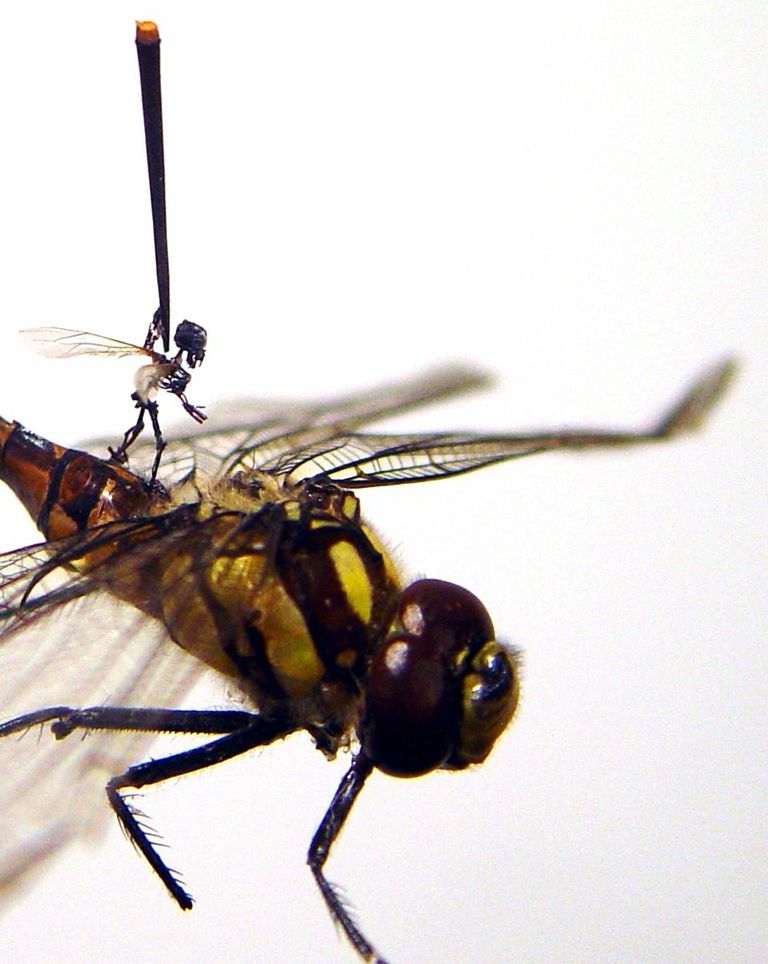
Which brings me back to that exhibition at the Guildhall, billed as ‘a multimedia, multisensory engagement with our vision of the past.’ (My invitation came through my involvement with CWISL.) The neo-Victorians on offer include Mat Collishaw, Paula Rego, Yinka Shonibare, Grayson Perry and Rob Ryan. It’s a lot of fun, more than 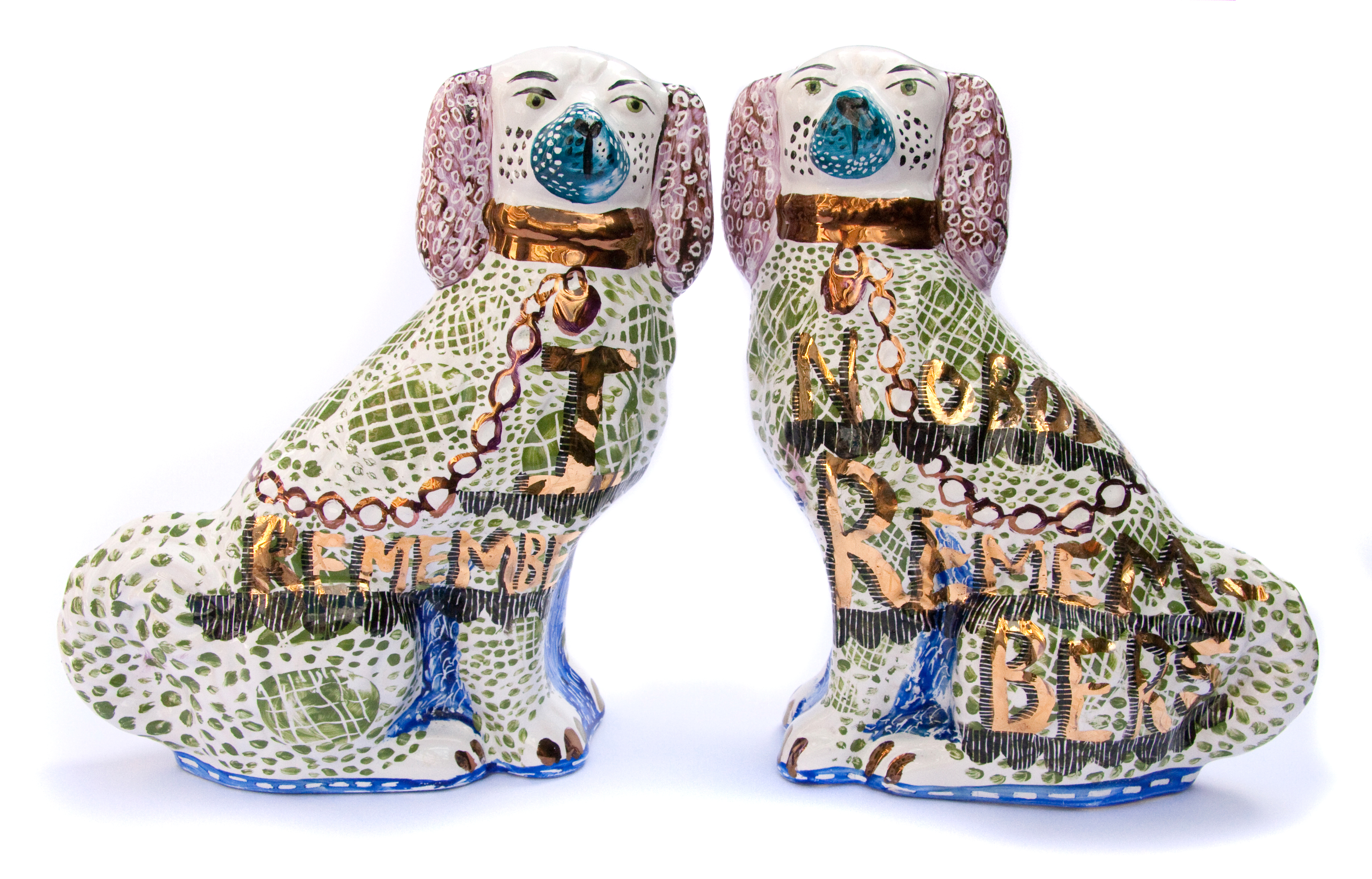 a little kitsch (no surprise there), and at times genuinely unsettling – thoroughly recommended. Get a glimpse of the Roman amphitheatre in the basement while you’re there. I was intrigued by an installation? an intervention? apparently attacking Victorian sentimentality – quite literally: a nineteenth-century marble statue permanently resident in the Guildhall is divebombed by a mobile mass of hybrid creatures. The artist Tessa Farmer spent quite some time explaining the narrative of ‘Mignon, ambushed by a Mob of Fairies’, delightfully evading my questions on the technicalities of constructing ‘fairies’ and their vehicles from dead insects, shrew bones, hedgehog spines and wasps-nests.
While on the subject of rich mixes, I should explain that my invitation to Wembley came from Philosophy Football, purveyors of fabulous t-shirts and organisers of an event I’m taking part in later this year to commemorate the return of the International Brigaders to Britain, hosted by the East End cinema and ‘cross-culture centre’….called Rich Mix. And who should I find myself sitting next to at the football but Heather Barnett, artist, educator and project leader of Broad Vision, the University of Westminster’s Art and Science interdisciplinary Research project? Now I want this wallpaper.

September 9, 2013
7th December 2013: No Pasaran! A Night to Remember
The British Battalion of the International Brigades arrived home 75 years ago, to be greeted by huge crowds at Victoria Station. Celebrate these heroes and heroines with the International Brigade Memorial Trust and Philosophy Football at No Pasaran! A Night to Remember! at Rich Mix, 35-47 Bethnal Green Road, London E1 6LA. Theatre, discussion, comedy, music and recitation – not to mention an A World Between Us event at 4.30 pm. Book here for the evening and/or the afternoon activities or call 01273 47272. Don’t leave it too late – tickets are selling out fast!
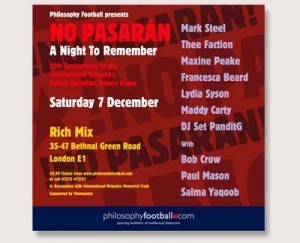
Supported by Thompsons Solicitors.
I’ll be doing a special FREE event for young people from 4.30-5.30 pm at Rich Mix – an illustrated talk and discussion with readings and music on the background to A World Between Us.
Also…
Seminar: Indignados, Spain and Lessons of Global Protest With Olga Abasolo, activist in Los Indignados and Paulo Gerbaudo, author Tweets and the Streets:Social Media and Contemporary Activism. From 3.30-5.30pm, organised with the journal Soundings. FREE.
PLUS! Guided walk round the Anti Fascist Heritage of London’s East End. Led by David Rosenberg of East End Walks and author of Battle For The East End: Jewish Responses to Fascism in the 1930s. Walk starts 1.45pm (not at Rich Mix) and ends at Rich Mix for 5pm.
Note: If you intend to join one of the afternoon activities, you can have supper at Rich Mix in their excellent café. Doors for the evening show opening at 6pm.
4th October 2013: ‘That Burning Summer’ launch party
Come and celebrate at Review Bookshop, Peckham, 7-9 pm…but do let me or Evie Wyld know that you’re planning to come so we don’t have to have ration cards!
Email: lydia.syson@hotkeybooks.com or review@btconnect.com
13th October 2013: Wood Green Literary Festival
Step back in time with me and Catherine Johnson, fellow-Londoner and award-winning children’s author. We’ll talking about writing and researching historical London, discussing atmosphere, place and how to tune into echoes of the past – and of course we’ll be sharing thrilling 18th century medical stories alongside tales from East End battlegrounds. Sunday 13th October at 2pm
Noel Park Primary School
Gladstone Avenue
Wood Green
London
N22 6LH
Visit the Festival site for more details of this and a host of other enticing events.
September 8, 2013
September 5, 2013
A WORLD BETWEEN US reviews

Christmas book pick in The Observer , The Telegraph , The Morning Star & Radio Suffolk, Teen book club choice on The Guardian Children’s Book website, recommended as a ‘hot read’ on teen website Sugarscape.
Please follow links for full reviews….
‘A World Between Us is an outstanding debut novel for teenagers…what Syson captures so well is a sense of heartbreaking courage, comradeship and lost innocence…Thoroughly researched and beautifully written, for what I suspect is a crossover rather than a strictly teen audience, Syson’s novel convinces with a light touch and a flair for vivid detail…Picasso’s Guernica continues to bear witness to that city’s tragic fate; this accomplished wartime romance will enthral while reminding you why he painted it.’
‘A fantastic historical fiction debut set in the Spanish Civil War, featuring a wonderfully passionate and resourceful heroine. Recommended.‘
The Bookseller, 24-31 August 2012 (Pick of the Month)
‘Lydia Syson creates a vivid picture of Spain during the Civil War in this tense and harrowing novel, partly inspired by her own family history. Carefully-researched and rich with fascinating period detail, A World Between Us is a compelling story of politics and passion, bravery and love.’
‘a multi-layered story about politics, nationalism and the rose-tinted desire to create a better and more equal world. A very thought-provoking and engrossing novel, with real message for all of us in our current period of conflict.’
‘Lydia Syson transfers the love triangle to the Spanish civil war, a period underexplored in young adult fiction given the youth of many of the international volunteers who travelled to Spain to fight against Franco.
The stoicism of the underequipped International Brigades and the joys of an unexpected advance, the arrival of longed-for supplies or a rare uninterrupted night’s sleep are conveyed as well as the terror and eventual despair that becomes routine.
Jewish East End printer Nat, nurse Felix and journalist George, who travel to Spain separately in 1936, are driven by their own desires as well as by their shared cause.
The core love story, with all its near misses, coincidences and fleeting encounters, is given higher stakes by its setting. Equally absorbing is the relationship between Felix and the untrained Spanish nurse she takes under her wing, revealing the climate of suspicion and fear of “enemies within” that develops as the war grinds on. Syson brings history alive through careful detail.‘
‘The strong narrative of this engaging historical novel keeps the reader hooked, but as well as entertainment there’s a lot to be learned …there’s death and betrayal, fear and sadness within these covers. We are prompted to think about the nature of compromise and how war requires tough decisions to be made. is a well-written novel for teenagers but has crossover appeal that many adults would enjoy.’
‘As love story, history and gripping drama…it’s a book that works on all levels…Highly recommended.’
Read full review at Morning Star
‘…paints a vivid picture of the Spanish Civil War…gripping romantic adventure for teenagers… useful for those wanting to broaden their revision of the [years leading up to World War 2]‘
‘Syson’s style is subtle and gorgeous, she melts you into another time and place…I found it compelling reading… I think this is a nigh-perfect YA read. It’s engaging, pulsing, beautifully written and doesn’t shy away from complicated facts and tough history.’
Read full review on Jane’s Picture House book blog
‘I loved it beyond words. I’m not the biggest fan of historical fiction at all, but A World Between Us and the way in which Lydia Syson brings us this story about the Spanish Civil War and these amazing characters has inspired me. I read this book and I immediately made myself a pledge to read more history, to find out about time periods and world events that I’ve never been exposed to before. It’s an exciting prospect…I highly recommend A World Between Us!’
Read full review on Fluttering Butterflies book blog
‘Syson does a wonderful job of melding historical detail with the lives and loves of her characters. The brutality of the fighting, dealing with bombings, and tending the war-wounded are told compellingly, as is the psychological strain Felix, Nat, and George experience. If you enjoyed Elizabeth Wein’s Code Name Verity or Michelle Cooper’s Montmaray books and are looking for another fabulous YA historical novel, I heartily recommend you pick up A World Between Us.’
Read full review on Oxford Erin book blog
‘I had to keep reminding myself to breathe as my eyes moved along the pages. It had never crossed my mind before that historical fiction could be this gripping…’
Read full review: The Star (Malaysia)
‘if you want an intense, beautiful book that will make you physically melt whilst reading it, then look no further…’
Read full review on Anna Scott Jots book blog
‘A terrific read‘
‘A Pat Barker-esque love story set in Civil-War Spain…Syson’s writing is saturated with colour and detail…’
Jewish Chronicle, 30 November 2012
‘The novel assumes little knowledge of the civil war on the part of the reader and Syson skilfully ties many of the core themes and events of the war into the romantic plot line. There are insights into the roles of nurse, reporter and International Brigader – the three main characters of the novel – alongside atmospheric descriptions of training, battle and medical care. We learn about Britain’s policy of non-intervention, as well as the part played by the press in shaping public opinion. Syson’s book shies away from stereotypical descriptions of Spain and Spaniards; no mentions here of fiery tempers and flamenco. Instead some of the historically significant features of the civil war are addressed. Witnessed at first hand is the bombing of Guernica, the first time civilians in Europe were targeted in an aerial attack. The widespread use of blood transfusions at battlefield hospitals, one of the medical advances made during the war, is also explored as the narrative unfolds…Thankfully, however, the text of the novel is never over-burdened with historical context, and the focus of the narrative stays firmly on Felix and the two men in her life. With key questions unanswered until the final chapters, the reader is kept engaged with the fate of our strong and passionate heroine.’
International Brigade Memorial Trust Newsletter, Issue 33, Autumn/Winter 2012
‘I will admit I haven’t read that many historical books. But this really was amazing! It has a great, brave heroine who by far is my favourite character, I really loved her! Nat and George are great characters too, all very unique and stand out from other book characters from other book characters. The story was absolutely brilliant too, with lots of drama because of the love triangle and the World Famous War! It ticks all of the boxes for my idea of a great book; Love, Heartbreak, adventure, drama… The perfect book to curl up with!’
Read full review on Books & Writers Jr, 18 September 2012
‘The historical detail is fantastic and worked seamlessly into the story. It never drags and I missed a fair few hours of needed sleep, I found it so gripping.’
Read full review on The Book Monkeys, 30 March 2013
‘…quite different from anything I’ve read in recent years…For all the blood and guts in A World Between Us, reading it made me happy. While it is a story about war and ideologies, first and foremost, it is a love story. And it is the people in this story who really count. While the story says a lot about humanity and war, it also reminds us that people are individuals with a huge capacity for passionate love…Teens may enjoy it as a passionate love story peppered with a war story. Others may enjoy it as an impassioned and fictionalised political history. And then there are those other readers, some who will be much older, the former comrades and compatriots across the world, who may shed a wrenching tear while rousing a smile for the way that some things were – and the way that things still could be.’
Read full review on We Sat Down blogspot 1st October 2012 ( + Q & A with Lydia)
‘I found myself completely swept away with the romance and relationships between the three characters as they struggled through adversity. It was like watching one of those epic war movies from my child hood. Simply beautiful…It is definitely a crossover novel which adults would enjoy just as much as teenagers.’
Read full review on Serendipity Reviews
‘Packed full of passion – both political and of all other kinds – this is a harrowing, thrilling and romantic account of the Spanish Civil War and the lives of three young volunteers who sign up to fight in it.’
Julia Eccleshare on Lovereading 4 Kids
‘a beautifully written but fast-moving narrative which tells the day-to-day story of the Spanish Civil War in intimate detail…This book opens a door for young people to that obscured history in a way that is emotionally powerful, exciting and accessible.’
Jewish Socialist - The Magazine of the Jewish Socialists’ Group
‘One of the startling aspects of British people going to take part in the Spanish Civil War was their age, like Nat and Felix in this book, many of them were teenagers when they made that decision. Lydia captures the horror of war, and for me reading Felix’s story as a nurse on the frontline gave it a potency that is quite different from reading about a battle.’
Read full review on Lipstick Socialist blog
‘…what I liked most about A World Between Us was how incredibly well Lydia Syston explained the history and politics of the Spanish War…the historical detail is beautifully described and came to life really vividly.’
Read full review on Paper Parks book blog
‘It is hard to believe this is Lydia Syson’s first novel, as ‘A World Between Us’ is such a finely-crafted and spellbinding book.’
‘Well crafted and well written, this novel delivers an attractive mix of romance and rebellion that will appeal to a modern teen audience but it offers a great deal more than the often rather vapid offerings aimed at this readership. It is set against a war that they might well know little about but which marked an important moment in the struggle for freedom against the forces of fascism. A time when young men and women their age went out to fight and die for a cause that ultimately culminated in the Second World War and which resonates to the present day. No Pasarán! (They shall not pass.) A cry they need to know. We forget it at our peril.’
Celia Rees in Armadillo
‘A fascinating insight into the brutal Spanish Civil War; so often overshadowed by the events of WW2. The violence, the hatred and the destruction are all there, along with the idealism and the politics. This is not just the moving story of Felix and Nat, but also of the Spanish people and those many fighters who gave their lives for their beliefs.’
‘This is a beautifully written story about love and loss that will appeal equally to adults as to teenagers.’
Schoolzone (@www.readingzone.com)
‘From the first sentences of this remarkably good first novel we are in the midst of action…Lydia Syson writes a rollicking book of the adventures of love awakened and lost in war…The book cleverly explains not only the Spanish war but deeper politics in a way young persons can understand…a very fine, important book for teenagers…superb.’
Read full review at Historical Novel Reviews
‘A World Between Us is a book that you will find yourself gripped and enthralled by. The fast pace is sure to keep you interested and it is clear to see that the book has been well researched. A thoroughly enjoyable read.’
Read full review at Cuckoo Review
Catherine Larner’s review on Radio Suffolk
Sanne Vliegenthart’s review on Railroad Reads/BooksAndQuills
The teen website Sugarscape recommends A World Between Us as a ‘hot read’.
That Burning Summer: links and background resources
Interested in exploring any of the history, ideas or places in That Burning Summer? Here are some good starting points – books, short stories, websites, online articles, films, museums etc, all loosely grouped by theme, many of which obviously overlap. Clearly, this is far from definitive. But all proved useful in different ways while I was writing the novel.
Romney Marsh
Edward Carpenter: Romney Marsh at War (1999)
Anne Reeves and David Eve: Sheep-Keeping and Lookers’ Huts on Romney Marsh (1998)
Brian Ferry & Dorothy Beck: Dungeness before 1960: The Landscape and the People, 2004
Stuart Hilton, Kent and Sussex, 1940
Museums on Romney Marsh: http://www.theromneymarsh.net/visitors/museums.htm#Lydd_museum
The Romney Marsh Historic Churches Trust – and a good if slightly out-of-date article by Sophie Campbell about visiting the churches.
Brenzett Aeronautical Museum Trust http://www.brenzettaero.co.uk/Brenzett_Aeronautical_Museum_Trust/Home.html
Find out more about the history of smuggling on Romney Marsh. (And more info here.)
Lack of Moral Fibre/Flying Fatigue
Joanna Bourke: Fear – a Cultural History (Virago 2005)
Jonathan Croall: Don’t You Know There’s A War On: Voices from the Home Front (Hutchinson 1988)
Allan D. English: A Predisposition to Cowardice? Aviation Psychology and the Genesis of ‘Lack of Moral Fibre [Source: War & Society, Volume 13, Number 1, May 1995 , pp. 15-34(20)]
Ben Shepherd: A War of Nerves: Soldiers and Psychiatrists, 1914-1994 (Pimlico, 2002)
C. P. Symonds, ‘The Human Response to Flying Stress: Lecture 1: Neurosis in Flying Personnel‘, The British Medical Journal, Vol. 2, No. 4326 (Dec. 4, 1943), pp. 703-706
Home Front & Spies
Home Front: BBC – WW2 People’s War - Spy Fever & Kent
Graham Greene, ‘The Lieutenant Died Last’ (Old Bill Purves, the poacher, meets a parachute corps) (short story in Collier’s Weekly, June 29, 1940, which inspired Cavalcanti’s film Went the Day Well? - here’s an article on its publication history)
Graham Greene, The Ministry of Fear (Heinemann, 1943; Vintage, 2006)
Jean Rose Freedman, Whistling in the Dark: Memory and Culture in Wartime London (University Press of Kentucky, 1999)
ed. Neil Hanson with Tom Priestley, Priestley’s Wars (Great Northen Books, 2008)
Nicolas Hawkes, The story of J.B. Priestley’s Postscripts (2008)
N.B. This is available from The J.B.Priestley Society. (If only this Archive on Four and this series were still available – fingers crossed for repeats soon. In the meanwhile, do read this post by Alison Cullingford, Librarian of the Univeristy of Bradford’s Special Collections, where the Priestley Archive is housed.)
Naomi Royde Smith Outside Information: A Diary of Rumour, (1941) (The Spectator‘s review of this in 1941is worth quoting: ‘Londoners now have to suffer what the inhabitants of Madrid once patiently endured – visits from the well-meaning who take back highly coloured accounts of their experiences.)
Berry Mayall & Virginia Morrow, You Can Help Your Country: English children’s work during the Second World War, (Institute of Education, 2011)
Sadie Ward, War in the Countryside, 1939-45, (David & Charles, 1988)
Ina Zweiniger-Bargielowska, Austerity in Britain: Rationing, Controls and Consumption 1939-1955, (OUP, 2002)
Donald Thomas, An Underground at War: Spivs, Deserters, Racketeers and Civilians in the Second World War, (John Murray, 2003)
A.G. Street From Dusk till Dawn (1943: republished by Oxford Paperbacks in 1989 with subtitle ‘The Sedgebury Wallop Home Guard Platoon Prepare for War’)
Norman Longmate, How we lived then: a history of everyday life during the Second World War, (1973; 2002)
Anthony Livesey, Are we at war? Letters to the Times 1939-45, (1989)
Trustees of the Mass Observation, Nella Last’s War: The Second World War Diaries of ‘Housewife, 49′, (Profile, 2006)
Angus Calder,The People’s War: Britain 1939-1945 (Pimlico new ed. 1992) and The Myth of the Blitz (Pimlico new ed 1992)
Midge Gillies Waiting for Hitler: Voices from Britain on the Brink of Invasion, (Hodder, 2006)
Juliet Gardiner, Wartime Britain 1939-1945, (Headline, 2004)
DVDs: The Complete Humphrey Jennings Vol 2: Fires Were Started (includes The Heart of Britain, Words for Battle, Fires Were Started & The Silent Village) BFI
The Next of Kin, (1942)
Invasion
Peter Fleming Invasion 1940: An account of the German preparations and the British counter-measure, (Rupert Hart-Davis, London 1957)
Richard Overy, The Battle of Britain: Myth and Reality, (Penguin, 2010)
Antoine de Saint-Exupéry, Flight to Arras, (First published as Pilote de guerre, 1942; the translation I used was by William Rees, first published by Penguin in 1995)
Iréne Nemirovsky, Suite Française, (Vintage, 2007)
Timothy Snyder, Bloodlands: Europe between Hitler and Stalin, (Vintage, 2011)
Richard C. Lukas, Did the children cry?: Hitler’s War Against Jewish and Polish Children, 1939-1945, and Forgotten Holocaust: The Poles Under German Occupation, 1939-1944 (both Hippocrene, 2001)
Halik Kochanski, The Eagle Unbowed: Poland and Poles in the Second World War
Mark Mazower, Hitler’s Empire: Nazi Rule in Occupied Europe (Allen Lane, 2008),
Aviation history and archaeology
Dilip Sarkar, Missing in Action: Resting in Peace? (Ramrod, 1998)
Aircraft crash sites – information from English Heritage
To Dig or Not to Dig? History Today
R.A.Saville-Sneath Aircraft Recognition (A Penguin Special first published 1941: reproduction editions easily available)
Polish Pilots in the Battle of Britain
Lynne Olson & Stanley Cloud, For Your Freedom and Ours: The Kosciuszko Squadron – Forgotten Heroes of World War II, (2004)
Robert Gretyngier, in association with Wojtek Matusiak, Poles in Defence of Great Britain, July 1940-June 1941 (London, Grub St, 2001)
Josef Zielnski, Polish Airmen in the Battle of Britain, 2005 (A very useful book, with a short chapter on every airman, but not easy to get hold of)
Adam Zamoyski, The Forgotten Few: The Polish Air Force in World War II (1995, Pen & Sword Aviation, 2009)
Kenneth K. Koskodan No Greater Ally: The Untold Story of Poland’s Forces in World War II (Osprey, 2011)
Arkady Fiedler, 303 Squadron: The Legendary Battle of Britain Fighter Squadron (2010)
F.B.Czarmomski, They Fight for Poland: The War in the First Person, (1941 – Front Line Library)
Patrick Bishop, Fighter Boys: Saving Britain 1940, (Harper, 2003)
Jonathan Falconer, Life as a Battle of Britain Pilot, (The History Press, 2007)
Battle of Britain monument…find out about the Polish airmen.
RAF Museum online exhibition on Polish Pilots
Polish Institute and Sikorski Museum
Battle of Britain heritage trail
Pacifism and Conscientious Objection
Peace Pledge Union website – especially the Conscientious Objection Project
Frances Partridge, A Pacifists War (Hogarth Press, 1978)
Kenneth Mellanby’s Guinea Pigs article
Caroline Moorehead, Troublesome People: Enemies of War: 1916-1986 (London: Hamish Hamilton, 1987)
Rachel Barker, Conscience, Government and War, (Routledge & Kegan Paul, 1982)
Denis Hayes, Challenge of Conscience: the Story of the Conscientious Objectors of 1939-1949, (Published for the Central Board for Conscientious Objectors, Allen & Unwin, 1949)
Sonya Rose, Which People’s War? National Identity and Citizenship in Wartime Britain, 1939-1945, (OUP, 2004)
Felicity Goodall A Question of Conscience (1997) reprinted as We Will Not Go to War: Conscientious Objection during the World Wars by The History Press, 2010.
Clifford Simons, ed. The Objectors, (Times Press: Anthony Gibbs & Phillips)
Martin Ceadel ’A Legitimate Peace Movement: The case of Britain, 1918-1945′ in Challenge to Mars: Essays on Pacifism from 1918 to 1945 ed Peter Brock & Thomas P Socknat, (Toronto: University of Toronto Press, 1999)
Any questions? Broken links? Other suggestions? Please do get in touch via the comments or email me.
20th-25th September 2013: Battle of Ebro 75th anniversary commemorations in Spain
The last section of A World Between Us is set during the opening stages of the Battle of the Ebro, the longest and bloodiest battle of the Spanish Civil War, towards the end of which the International Brigade volunteers were sent home. On Saturday 21st September I’m honoured to be speaking at the Cave Hospital at La Bisbal de Falset (where Felix and Nat are reunited in my novel) along with Richard Baxell and Peter Crome, son of the Republican Army 35th Division Chief Medical Officer, Len Crome. It’s part of an IBMT/AABI tour of the region, which will include visits to key battlefield positions such as Hill 481at Gandesa, the Hospital de Sang Casa de Sant Josep, and the unveiling of a commemorative plaque at Corbera d’Ebre. Find out more about the history of these places and the events of 1938 at the website of Espais de la Batalla de l’Ebre.


