Kelsey Timmerman's Blog, page 54
May 4, 2011
Give Like Bill Gates: Our First Quarter of Glocal Giving

Our daughter Harper. When you become a parent you have less time to give to change the world, but more of a reason.
—
Last year I learned a lesson in giving by giving $10 every Tuesday for the entire year. Here's what $520 taught me.
Now I'm searching for a better way to give. So, I've decided to start giving like Bill Gates.
No, no, I'm not going to single-handedly end a disease with my billions hundreds of dollars. What I mean is that I'm going to give smarter and more intentionally. I'm not privy to the inner workings of how the Gates Foundation works, but I'm pretty sure they don't get a set of return address labels in the mail from a not-for-profit and decide on the spot to write a check for a few million in support of the cause. No, they have a budget and a goal for what they want their giving to accomplish.
We should too.
Quarterly Meetings
Annie, my Melinda, and I sat down at the end of the first quarter as we plan to do from here on out and discussed how much we want to give. We decided to give 4% of our income each quarter, splitting our income between a local and a global cause.
Global Mothers
Then we discussed what causes we want to support. Since Annie is due with our second child this month (Yikes that's real soon! Do we have enough diapers?!?) we decided to find a global organization that supports pregnant women and reduces infant mortality. I was familiar with the good work that Partners in Health and Dr. Paul Farmer have done to help mothers and children around the world. We had donated to them before and decided to do so again.
We're the lucky parents of a healthy two-year-old little girl already and hope to be the proud parents of a healthy little boy soon. Annie and the baby are healthy so far, with less than three weeks to go. While parents-to-be always have health concerns in the back of their minds, our biggest concerns are if we'll have the nursery ready, the hospital bag packed, the diapers bought, and everything else ready to go. Health is so easy to take for granted, but the last thing that should be. Each year 350,000 mothers die from complications during child birth or pregnancy.
Instead of giving to Partners in Health in one lump sum, we opted to give monthly for a year. This gives PIH a better idea of what to expect from us next month and allows us to have a longer relationship with the charity.
Local Poverty
The local organization we chose to support was Teamwork for Quality Living. We've given to them in the past as well. I volunteer with the organization that runs the Circles program. Folks living in poverty take a 16-week "Bridges out of Poverty" class and then get matched with two to four members of the community interested in helping them (not financially) along their journey. I've see the amazing results and lives changed first hand.
I plan on creating and sharing a Glocal Giving Guide soon, but right now I should get to work. In order to be able to donate, you gotta make some money here and there. 4% of $0 = $0.
How do you give?
—
Join the Go Glocal Project


April 29, 2011
If you are what you watch, I'm a card-carrying member of the NRA & a potsmoking terrorist

I noted on a friend's facebook wall that I was watching Al Jazeera English. Another commenter couldn't believe any self-respecting American would watch Al Jazeera. No doubt, he thought I was a terrorist. (If only he knew about my anti-flatulence underwear!) I'm not sure why seeking out and watching one of the largest and most-respected networks closest to the heart of much of the world's major current events, is a bad thing. But there you go. Terrorist. Me.
Anyhow this got me thinking about the stereotypes of media outlets and what where we get our news says about us.
(forgive me as I share a few stereotypes)
If you watch Fox News you are conservative red neck who likes to shoot guns like Yosemite Sam.
If you watch MSNBC, you are pot-smoking, tree hugging, communist or Nazi or Socialist or Greenpeace terrorist.
If you watch CNN, you are a pot-smoking closet liberal who secretly desires to change your first name to Wolf.
If you read the Wall Street Journal, you are a soul-crushing businessman who would sell puppy smoothies if you could turn a profit.
If you read the USA Today, you have the attention span of a hummingbird.
If you read the New Yorker, you are either a well-educated person of the world or an elitist.
If you watch Al Jazeera you are an ululating terrorist who wears Death-to-America pajamas.
Anyone want to take a crack at CBS or ABC or any other network or newspaper?
I don't necessarily believe these stereotypes, but I know one thing for sure: If you are getting all of your news from one source, from one perspective, or one geographic region, you aren't getting the whole story.
Maybe I'm a bit schizo, but in the course of a week I get news from all of these sources. I'll switch from Rachel Maddow to Bill O'Reilly to Jon Stewart (not news but closer than most news orgs). I fired a gun only once; it scared the bejeesus out of me. I've never smoked pot, although in college I had a roommate growing it in his closet.
What does that make me?
The world is complex and the more angles we can see it from the better glocals we can be.
April 27, 2011
Glocal Challenge #1: Boycotting American News (but not news about America)
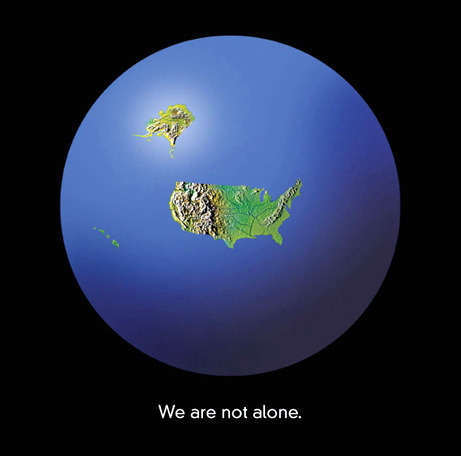
Welcome to the first Glocal Challenge of the Go Glocal Project!
Let's do this!
What does Timbuktu think of you?
Do you read any newspapers based in developing countries ? Me neither. What if we did? How would seeing how the world sees us change the way we see ourselves?
Conor Friedersdorf had an interesting piece in the Atlantic Monthly comparing CNN, MSNBC, and Fox News, to Al Jazeera. The American mainstay cable network sites' headlines were filled with royal wedding news, puppies, and sex, while Al Jazeera had headlines about the press in Iraq, women's rights in Bahrain, and war crimes in Sri Lanka.
Are we really that self-centered and shallow?
Friedersdorf writes:
If Americans felt an appropriate degree of responsibility for the actions of its government, its citizens would be consuming world news at an unrivaled pace. Human nature being what it is, however, folks whose daily lives are mostly unaffected by the actions of other countries remain relatively ignorant of world affairs. In contrast, residents of less powerful countries have a much bigger appetite for news.
…we're a nation ultimately governed "by the people," and collectively, we've precious little interest in what's going on far from our borders.
I'm not going to pretend that I'm above all of this. I check the HuffPo daily . Every night before bed I browse the "most emailed" stories in the NY Times on my iPhone, as if "most emailed" means "most important."
We're only as informed as our news, right? But what is "our" news. There's no reason we can't seek news beyond our borders. So…
Glocal Challenge #1
Find three quality international news sources (preferably based in different regions of the world) and make them (or at least try to) my sole source of news-gathering for an entire week.
It looks like Al Jazeera should make the list. Do you have any other recommendations? If so, let me know asap?
I'll report back next week.
April 25, 2011
Touron Goes Glocal: Announcing The Go Glocal Project
The Go Glocal Project
What happens in our community happens to the rest of the world. And what happens to the rest of the world happens to us. The global is local. The local is global. In tough times we must be global citizens as well as local citizens, neighbors and volunteers as well as donors. We need to Go Glocal.
If you agree with this just go ahead and join the Glocal Project now. We've got a lot of work to do.
Ways to Join:
Sign up for the Go Glocal Project's monthly newsletter – more ways to go glocal and sneak peeks about what's to come.
Join The Go Glocal Project's Facebook Page
If you're a blogger and would like to host participate in the Glocal Project go here
Let's do this! Why…
We live in tough times
In 2010 the number of unemployed worldwide grew by 34 million people. Sixty-four million people fell into extreme poverty. Families face foreclosures and states and countries near bankruptcy. As we near the 50th anniversary of President Johnson's "War on Poverty," the proposed 2012 national budget will likely include cuts that literally leave the poorest Americans out in the cold. Seven out of ten students in my hometown of Muncie, Indiana, receive subsidized lunches. In tough times it's only natural to look inward. The closer to home the problems, the harder it is to see a world beyond them. I know this all too well. I've been going through a bit of worldview crisis myself.
We can't focus on global poverty without focusing on poverty in our own community. But so often we focus on one or the other. Only 3% of all giving in the United States goes to international aid – far too little. And there is rising sentiment to give only locally to face our own problems. Recently-elected Congressman Rand Paul is calling for an end to all U.S. foreign aid. In turn, Philosopher Peter Singer says we should find the most cost-effective method in which our financial gifts save a life and give 1-5% of our income, but this method ignores giving locally.
If we think only globally we ignore the problems that surround us because our "first world problems" pale in comparison to the developing world. If we think only locally we ignore the life and death reality of extreme poverty. If we think glocally, we strike a balance, and acknowledge that what happens in the bubble we live in effects others and what happens outside that bubble effects us.
Why care?
Our local goes global.
Donations to the largest American charities declined 11% in 2009 while food prices around the globe soared 43% causing 82 million more people to go hungry. Americans bought less clothes and unemployed garment workers in Cambodia turned to prostitution.
The global becomes local.
We spend hundreds of billions of dollars each year fighting poverty around the world. We've spent more than a trillion dollars fighting the War on Terror.
Because it's our responsibility.
We are more educated than 95% of the rest of the world. One-sixth of the world lives on less than $1.25 per day. Herbert Simon, a Nobel Prize-winning economist and social scientist, estimated that "social capital" (a functioning government, access to technology, abundant natural resources) is responsible for at least 90% of what people earn in wealthy societies like the United States. Warren Buffett said, "If you stick me down in the middle of Bangladesh or Peru, you'll find out how much this talent is going to produce in the wrong kind of soil." We were born in the right kind of soil.
Where we give our time and money says more about us as people than where we earn our paycheck. How we define our world and our place in it will define our future.
Are you ready to Go Glocal?
Do I have to drink Kool-Aid?
Nope, sure don't.
The Glocal Project will be our journey to answer questions like :
What are our responsibilities as a local and global citizens?
How much money should I give to what kind of causes?
How much of myself should I give?
How can I be a better neighbor to the dude living next door with the dog that craps in my yard and to the single mother in Uganda who is HIV and feeds her kids by making hooch for the nearby bar.
The project will explore subjects such as aid, volunteering, and community and global development. I'll seek out experts and feature guest bloggers on these subjects. I'll feature glocals, share my experiences, and put together resources that I hope you'll find useful, such as (works in progress) how to be a Glocal Volunteer, Glocal Traveler, and a Glocal Consumer.
The heart of the project will be the Glocal Challenges. These will challenge us to see our own community in a new light, while at the same time expanding how we define "our community." Some of us are more global citizens than local citizens and vice versa. The Glocal Challenges seek to balance our worldview.
This will include challenges, such as:
The Poop in Your Yard, The Pizza in Your Living Room: Remember your neighbor with the pooping dog? What if you invited him over for pizza and learned his last name? In fact, what if you made a point to meet everyone whose home you can see from your front door?
What Does Timbuktu Think of You?: Do you read any newspapers based in developing countries? Me neither. What if we did? How would seeing how the world sees us change the way we see ourselves?
Don't Eat This, Don't Eat That: Do you know what it's like to feel hungry? I'm not talking the late-night-I-could-really-go-for-a-pizza hungry, but actual hunger pangs? Whelp, here's your chance, let's go hungry together.
Not in My Backyard – Do you know the poverty statistics in your own community? They might surprise you, and likely not in a good way.
I'll post a challenge and sum up my experience a week or so later. Share your experiences in the comments of the Challenge post so we can all learn from them.
I wanna go glocal!
Great. Did you sign up for the newsletter? Did you join the facebook page?
Bloggers
Let's Go Glocal together!
Share your experiences participating in the Glocal Challenges on your blog, and I'll link to your post and select my favorite(s) to highlight. Maybe I'll name you the Glocal of the week, send you a badge for your blog or button for your shirt to wear around, or maybe I'll just think even more highly of you. Who knows?
I'm hoping all of our experiences combined will encourage more folks to look at the their world, near and far, in a new light. Also, by the end of the project, we'll have a pretty cool resource for anyone else wanting to try out the challenge.
Write your post, email or tweet me the link, or just leave it in the comments
Teachers/Professors/Students
Want to do your own Go Glocal Project? Awesome! I'd be happy to help you develop class projects, visit your class in person or virtually. Email me at Kelsey@kelseytimmerman.com and let's start brainstorming.
I can't control the impact forces like globalization have on my life, but I can control the impact my life has on the world.
April 21, 2011
An Open Letter to the Parents of Daughters Who Wish to Travel the World
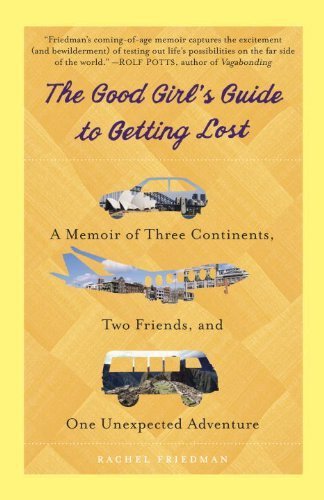
I hope Annie and I raise a daughter with the confidence to take on the world, but thinking about my kid – especially my daughter Harper – traveling as far and wide as I have, scares me a little. I'm not proud of thinking the "especially my daughter" thoughts. It seems wrong thinking that Harper would be any less capable of handling traveling solo than my yet-to-be born son, but I feel like there are just more challenges out there for girls. I sent a note to Rachel Friedman, author of The Good Girls Guide to Getting Lost, asking her to set me straight. She does so in this guest post.
Ladies and gentlemen, moms and dads, and girls, I present to you Rachel Friedman.
An Open Letter to the Parents of Daughters Who Wish to Travel the World
Dear Parents:
It's me, Rachel. We haven't formally met. I am not a licensed medical or psychological professional. I'm only a writer – a profession that requires little in the way of legitimate qualifications. Still, I hope you'll hear me out. I've heard that your daughters – young women in their late teens and early twenties – have of late been considering the idea that they might be of the constitution and comportment to have some adventures. Maybe your daughter is a new high school graduate or in the middle of her college years or just graduated from some ivy-covered university where she spent hours poring over literature and philosophy and debating gender performance. Your daughter is educated and free-spirited and full of wonder, thanks in large part to the opportunities you have provided her.
 Now, I know, parents, you wish for your daughters' happiness. And what better way, you might be thinking, to secure her happiness than to secure her, well, her security. A good, steady job. A nice boyfriend or girlfriend. Early entry into a 401K plan. You might want these things for her. We are nearing graduation time after all and after graduation comes "real life."
But your daughter has different ideas. She has developed a mind of her own during her studies, has gotten ideas from books that lead her to believe that perhaps another kind of education awaits her after graduation – the kind that involves leaping into the great unknown, of setting out on a journey. She has heard talk of cheap student fares and raucous hostels, whispered rumors of Incan ruins at dawn and dingoes at dusk. And she is intrigued. More than intrigued. Dear parents: brace yourselves: your daughter wants to travel the world.
I know you want to encourage her in this endeavor. You do. But you're worried. Fair enough. It's a daunting prospect to watch your daughter strap on a backpack and strut off to Europe or Australia or maybe even South America. First off, you're worried she might get hurt. You're good feminist parents who have raised an independent young woman who believes she can do anything. And she can. So maybe you're feeling a little guilty for fretting more about her than you do would a son, who might get hurt, but who does not typically have the additional prospects of bodily violation. It would be naïve not to acknowledge that men and women move differently through the world. When I was with a man in South America, no local looked twice at me. When I was alone or with my female friend, my every move was catalogued with a series of whistles and whispered comments. Only once in my travels did this talk extend into anything physical, when I was groped on a street in Bolivia. I won't lie: this was scary. Did it traumatize me? No. Did it upset me? Yes. Did it ultimately make me stronger? Absolutely. Your daughters are smart and they are capable. They will be cautious when necessary, just like they would in the U.S., and they will be okay.
You might be worried that if you let your daughter go abroad, she will never return home. Well, statistically speaking, most of us do come back to our home countries. It's true that once your daughter is a well-seasoned traveler, the idea of residing in other countries might become more appealing to her. She might, as I did, meet a partner from another country and decide to navigate a life between two places, which is a rich and complicated life. But even if she decides to stay abroad, this will be her choice. It will be what makes her happy.
You might fear your globe-trotting daughter is "lost." Your daughters' friends who are staying in the U.S. already have great jobs in finance or as assistant teachers or they are entering graduate programs. But your daughter has chosen the life of a nomad. She is wandering aimlessly (at least, this is your impression) instead of settling into a career and utilizing her very expensive education. She's falling behind her peers! No, she's not. She's getting a valuable second education whose importance cannot be overstated. If she comes home and gets a job at 25 instead of 22, she will only be better equipped with a diverse set of experiences and the marketable ability to interact with diverse sets of peoples. It is also less likely that she will wake up at 30 or 40 and realize she has spent decades at a job she hates. This is because in her early twenties she will have taken the necessary time to explore the world and herself, so her decisions about the direction of her life will be more thoughtful – less about what she should do than what she desires to do.
You want to keep your daughter close, to protect here. If she's abroad and something goes wrong, you worry that you won't be there to rescue her. You're right. Travel in general, and the gap year(s) in particular, are about independence and self-reliance. You have done all you can to nurture and prepare your daughter. Now you have to let her go, out into the wide, wild world – out into her own glorious life.
Sincerely,
A Daughter Who Has Traveled the World
—–
Thanks Rachel! I'm sure I'll re-read this over and over in the years to come. To all the traveling girls out there, I salute you.
If you liked what you read here, definitely check out Rachel's new book The Good Girl's Guide to Getting Lost.
April 20, 2011
Garment "factory in a box"
I had the pleasure of meeting Michael of Faces Behind the Label recently in LA. His passion for migrant workers and his knowledge of the garment industry mean he's uniquely positioned to make a big impact. I talk about the great potential that the garment industry has to be an important tool in lifting people out of poverty. This is EXACTLY what I mean.
Faces Behind the Label has developed a "Factory in a box" model, which seems like a great idea. Basically, they build a garment factory inside a shipping container and move it to an area where a few jobs could have a big impact.
Click here to view the embedded video.
April 18, 2011
The problem with "Three Cups of Tea" and the 60 Minutes attack
"It's a beautiful story and it's a lie," said Jon Krakauer at the beginning of yersterday's 60 Minute piece attacking Greg Mortenson, his books Three Cups of Tea and Stones into Schools, and the Central Asia Institute.
It didn't stop with Krakauer.
"Totally false. He's lying," said a man pictured as a terrorist in Three Cups, but who is actually a respected academic in Pakistan.
"Greg uses CAI as his private ATM," claimed a former board member of CAI.
"Grossly exaggerated."
"Outright fabrication."
"A steaming load of horseshit peppered with corn kernels of wisdom." Me.
Thee Cups of Lies
After a failed summit attempt of K2, Mortenson stumbled into the village of Korphe where he was nursed back to health and promised a little girl he would return to build a school.
How touching.
Too bad it didn't happen like that. Mortenson admits to having "compressed time" and 60 Minutes even showed a pre-book article by Mortenson for the American Himalayan Foundation with the true order of events: Mortenson hiked off K2 just fine and first stepped foot in Korphe a year later.
Compressed time equals lying. So does reordering events or any other time shenanigans that don't involve a flux capacitor, 1.21 gigawatts of power, and a Delorian.
Nothing drives me crazier than a short author's note at the beginning of a book stating that some of the events have been reordered for the narrative's sake, still Three Cups should've had one.
(Warning: Some of the following has been reordered to make my life more interesting in an effort to sell more books.)
I was on SCUBA at 200' and I couldn't feel my body. There was a great white to my right, a hammerhead swimming straight at me, and I was circled by 200 reef sharks. The heart of the diver next to me gave out. He drowned in his own blood. Another diver gave up on life and let his regulator fall from his mouth. I shoved it back, grabbed him by the tank, and navigated my way through the sharks to the surface. It was just another day at the office. And, oh yeah, I was five.
(The following paragraph has every shark I've ever seen in it, and recounts nearly every dramatic experience that has happened in my 800+ dives. And I was five, one time.)
Hey, lazy! Here's an idea. Ever heard of verb tense? You can use it to talk about things that happened before, during, or even after an event. It's like time travel, but you don't have to lie to the reader and you aren't in danger of causing a rip in the fabric of time. You should try it sometime.
I was especially disappointed that David Oliver Relin's name wasn't mentioned. Did 60 Minutes try to contact him? I can understand Mortenson – not a writer – being lazy and compressing the narrative, but Relin studied at the prestigious Iowa Writers' Workshop and should have more than enough writing tools and ethics to not "compress time" of real life events.
60 Minutes also claimed Mortenson wasn't captured by Taliban fighters for eight days. They interviewed a few of his "captors." This seems a little less provable on both sides. After all, what happens in Waziristan, stays in Waziristan.
Stones into Thin Air
60 Minutes visited thirty some schools that CAI claimed to build and support and found that half of them were either no longer being used, were built by someone else, were supported by someone else, or never existed in the first place.
Ouch! What good is building a school if it's not being used?
Which brings us to the money trail. 60 Minutes poured into CAI's 2009 tax return and found some pretty ugly findings:
The group spent more on promoting Mortenson's books than on educating girls in Afghanistan and Pakistan.
Mortenson gets $30K/talk, but CAI pays his travel expenses to speaking engagements. That doesn't make sense. I get paid a fraction (a fraction!) of that for speaking and schools always pay my travel expenses.
60 Minutes' 20-minute hack job
This is a big story. It involves a national hero, one of the bestselling books of the decade, and claims of lies and fraud. This story is so big that 60 Minutes dedicated a whopping 20 minutes to it. If they would've focused on some of the known truths in addition to some of the maybe falsehoods, the piece should've been twice as long.
The segment ends with a quote from Krakauer: "He's not Bernie Madoff. I mean, let's be clear. He has done a lot of good. He has helped thousands of school kids in Pakistan and Afghanistan….He has become perhaps the world's most effective spokesperson for girls' education in developing countries. And he deserves credit for that…"
The show spent 19 minutes and 30 seconds lobbing grenades at Mortenson and in the very last quote they add, "he might be lying about a lot of stuff, but he's done a lot of amazing things too." They should've visited a school that was up and running to get the opinions of teachers and students who had been impacted positively by Mortenson.
Mortenson earns $180K salary from CAI and gets 50-cents for every book he sells not to mention a $30K honorarium for speaking. If Mortenson is fabricating schools out of thin air and using CAI as "his personal ATM" what is he doing with all that money? I've heard that Mortenson spends more than 200 days in central Asia each year. The piece does a good job of tackling the If and the Maybe, but they don't touch on or speculate on the Why. Is he just a greedy bastard who likes to caravan around Taliban controlled regions for shits and giggles? That doesn't make any sense to me.
Yes, 60 Minutes poked a lot of holes that needed poking in Mortenson's story, but they left plenty of holes in their own.
My Take
I'm not surprised that parts of Mortenson's story have been altered from reality. As a writer I roll up to the crossroads of truth now and again. It can be really tempting to alter a story a bit. In an early draft of Where Am I Wearing? I altered when we bought a flatscreen TV for our home. It had little relevance to the story and no one would ever know differently, but every time I came to the part about the TV, it bugged me. I knew. It would've been easier to just leave it as it was, but I changed it.
As a writer, or as a kindergartner, for that matter, you have to know that if you don't tell the truth all the time then everything you do or say will be doubted.
Now we're doubting the good that Mortenson has done. And no doubt he's done a lot of good. The fact that the military often consults with Mortenson is more than enough endorsement for me that he is doing some of what he claims to do and, at the very least, really knows what he's talking about.
Last summer I was invited to talk in Columbus, Indiana. The town was using Three Cups of Tea for their annual community reading program. They couldn't afford Mortenson, but they could afford me. I was honored to stand in his place. Still am. If half of what he's written is true, he's a great man.
I suspect we'll discover in the next few weeks if he's greater than his flaws.
What's your take on the Mortenson story?
–
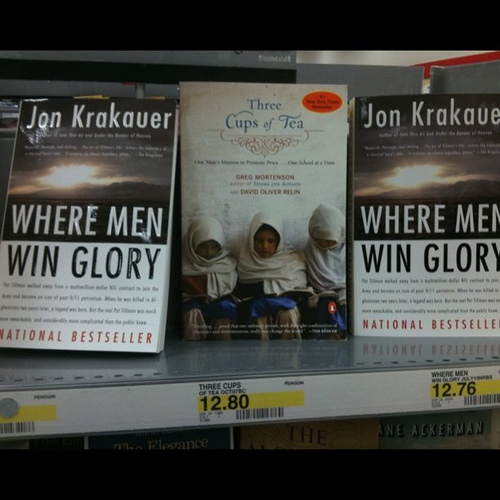
I was at Target yesterday and found the placement of these books to be rather ironic.
April 15, 2011
Join me in supporting wounded veterans
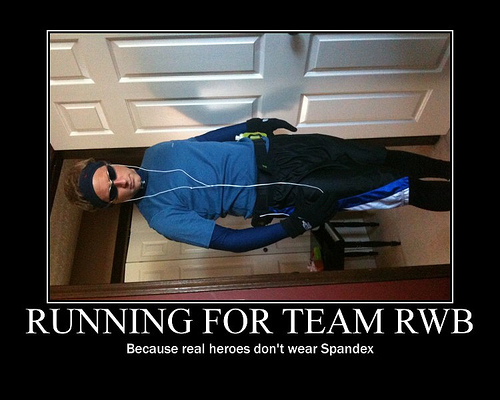
Odysseus Runs for Team Red, White, and Blue
Donate here to support our wounded veterans
Leaving your family isn't easy. I leave mine for a month or two at time. That's a tough goodbye. Each time I'm faced with it, I think about the men and women of our military. They are gone for much longer and traveling to lands far less welcoming.
Returning home is always sweet. I return with my hair a bit longer, a few pounds missing, and some great stories. Annie usually cuts my hair within a few days, a couple weeks eating dessert puts the weight back on, and I stew over the stories making them readable. It takes next to no time for me to be back to normal.
But that's not always the case for our soldiers.
They said goodbye. They went to war. Some of them returned injured or traumatized. Reintegrating into society can be a challenge.
I don't think about the sacrifices soldiers make and their struggle to adjust to being home nearly enough.
Do you?
Well, here's a chance for both of us to show our support.
I'm participating in the American Odyssey — a relay run from Gettysburg to D.C. — with Team Red, White, and Blue and could use your support. Here's what Team RWB is about and why we chose our team name:
We named our team Team Odysseus Runs for TRWB because we think there is a strong metaphoric relationship with Team RWB veterans, and its mission.
Team Red, White & Blue's vision is to transform the way wounded veterans are reintegrated into society when they return from combat and exit their position in the Active Duty force, Reserve or National Guard
and the symbolic importance of their journey. Just as Odysseus, the legendary Greek King of Ithaca and the hero of Homer's epic poem The Odyssey — infamous for tricking the Trojan's by hiding in the Trojan horse, encountered numerous obstacles and trials – he is ever hopeful that he will return home to his wife and son.
At Team Red, White & Blue we feel it's our time – our turn – to give back to these heroic Americans who have risked so much and may have a long journey ahead of them. We propose a different kind of veteran support, one that is rooted in a deep understanding and willingness to listen to veterans and their families, and aid in their reintegration into the society they fought so honorably to defend and protect. Our special community of athletes advocates and supporters (corporate, non-profit and individual) are all committed to serving those who have served our great nation. Together with wounded veterans and their families and friends, we will develop meaningful, one-on-one relationships that will have lasting meaning and impact.
The Goals
My Goal: To not get lost. To not get abducted or molested or abducted and molested by civil war ghosts somewhere in the woods outside Gettysburg at 3 A.M.
Our Goal: My buddy Larry created this page on First Giving to raise money for Team RWB.
The Reward: When we raise over $500, I will post a photo of me sitting on my throne in my front yard. Here's my throne…

April 13, 2011
Kenyans run from poverty…

I run myself to death.
Read my piece in the Christian Science Monitor about my experience running with world class Kenya Runners in the running capital of the world, Iten, Kenya, which sits at a breathless 8,000′.
Not one of my better ideas.
I guarantee you will burn calories reading it. Leave a nice comment over on the Monitor's site, please.
(Spoiler alert: I touch an Olympian!!!!)
April 11, 2011
69, Bangkok, and other things that are hilarious to high school students

"How many people does it take to sew together a single pair of blue jeans?" I ask the audience of 500 high schoolers. It's 8:00 AM and the fact that a bunch of hands go up is a testament to the beginning of my presentation filled with fart jokes and encounters with deadly venomous snakes. (If I ever stumble upon a farting venomous snake, I'll have struck pay dirt. For now I work with the stories I've got and they seem to work pretty well.)
The guesses come: 5, 25, 8, 9…
"Let's have one more," I say. I point to a boy in the top row.
"69!"
The entire high school giggles like Beavis and Butthead. The sad part is that Mr. 69 won the tote! (The answer is 85.)
After the large presentation I visited a class where Bangkok warranted giggles, yet when I slipped and said, "we all need to just start giving a shit," the entire class looked at their teacher as if he were going to send me to the principal's office.
High schoolers: their inner thoughts are X-rated, but from 8-4 every day they live in a PG-World.