Kelsey Timmerman's Blog, page 55
April 8, 2011
TOMS responds and I make an offer
In case you didn't see the comments in the last post, TOMS responds! And then I respond to TOMS and make a super-special offer.
(I out Taylor as a TOM employee in my response. I got his last name from his email address. Here's the proof.)
April 7th, 2011 | 11:50 am Taylor said:
If you would look at the actual facts of what happens when they are made, not just where, you would see the truth. TOMS uses multiple countries to make their shoes. The fact is, TOMS has factories in the same countries they give their shoes. Like Ethiopa. Here's a thought, even the same factory with the same workers paid the same amount as SoleRebels. The reasoning for this is so they CAN provide jobs in the countries they serve. Not every shoe is made in China. The model of giving is one that is sustainable. The goal is to continue to give shoes to the same kids as they grow. Yes poverty is the main issue, but a guy can't solve the world's poverty issues, so why not do what he can to help those stuck in poverty. I would suggest learning all the facts about a company before writing a blog about them. It only shows ignorance.
And my response, along with a special offer that I hope TOMS takes me up on.
April 7th, 2011 | 12:59 pm Kelsey Timmerman said:
Taylor, thanks so much for chiming in. I think it's important up front that we establish that you work for TOMS (I Googled your name), which makes it extra cool that you are chiming in.
I don't want to or mean to be a TOMS basher. I think you can agree that this post is a lot more balanced than a lot of your critics. I didn't get into the whole gifts are bad aid discussion. I believe that TOMS does create awareness and gives folks an opportunity to connect with people who live much different lives than themselves.
That said, I would be more than happy to take a look at the facts, if you could point me to them. I checked the TOMS site and at the bottom of the very long FAQ page, I found this:
–
FROM TOMS SITE:
Manufacturing
Where are TOMS manufactured?
TOMS currently manufactures in Argentina (Giving shoes only), China, and Ethiopia (Giving shoes only).
How does TOMS ensure its manufacturers adhere to human rights standards?
We require that the factories operate under sound labor conditions, pay fair wages and follow local labor standards. A code of conduct is signed by all factories. Our production staff routinely visits these factories to make sure they are maintaining these working standards. We also have third parties audit the factories at least once a year to ensure they adhere to proper labor regulations. http://www.intertek-labtest.com/services/auditing/intertek_compliance/?lang=en
—
That doesn't exactly refute my arguments in this post. The truth is facts are hard to come by in the shoe business. I've visited the factories of Deckers (Simple, Tevas, UGGS) and I've seen how difficult it is for companies to adhere to their own ethical standards. As for Intertek, they seem to focus more on quality of shoes than quality of the workers' lives.
If someone at TOMS would agree to answer my questions, I would be more than happy to begin a discussion. Heck, I would be thrilled to visit the factories and give you the opportunity to prove me wrong. I'll write an article for a nice big glossy magazine and call it "The Truth About TOMS" and you can put all of your critics to rest. What do you say?
I would love to see TOMS lead the way on the sourcing issue. Check out Patagonia's footprint Chronicles. How awesome would it be if TOMS started to share the story of the workers making the shoes in addition to the people they are handing them out to?
My offer stands, give me access and I'll give you the chance to shut up your critics. I think you'll find that I have a history of giving folks a fair shake. As you consider this know that I will ask questions like: What percent of your shoes are made in China? And then I'll want to visit the factories on my own and talk with the workers.
If you're game, I'm game.
Again, thanks for the comments and I hope this is the beginning of an enlightening, fact-filled discussion.


April 6, 2011
The problem with TOMS shoes & its critics
[image error]
"Can anyone think of a brand that will talk about the workers who make their products and seeks to make a positive impact on the workers' lives?"
I often ask this question when I talk to students across the country. The students look around the room before finally someone raises their hand, and, even though I've told them 10 times already that there is no need to raise your hand, they'll say…
"Um…TOMS shoes?"
Most students have heard of TOMS shoes and their Buy One Give One (BOGO) model — when you buy a pair of shoes they give a pair to some poor kid in some far corner of the world who doesn't have shoes.
Usually a few pair of students are wearing TOMS and they slowly begin to nod like they are contestants on Family Feud and grandpa just gave a good answer.
"Okay…" I say. "Where were your TOMS made?"
This is when things get a little socially awkward. Many folks who wear TOMS do so without socks. Studies show that someone wearing TOMS is 10 times more likely to have stinky feet.
Reluctantly the student slips off her shoe and searches for a tag.
"China," she says, as the students sitting nearby pass out onto the floor. "They…were…made…in…China."
That's when the reality of TOMS begins to sink in. See, for the past 40 minutes I've been talking about garment workers around the world who I met on my Where Am I Wearing? adventure, including the couple in China that made my TEVA flip-flops. They work 100 hours per week, have to clock-out and return to work, and haven't seen their son who lives in their faraway home village in three years.
Then we have the give a man a fish or teach a man to fish discussion, which I undoubtedly flub up and say, "It really comes down to the give a fish or teach a fish discussion." (And really, if we could teach fish to jump in the boat isn't that the best solution?) Then I have to get the analogy back on track and bring it home with the example of the Ethiopian shoe company, SoleRebels.
Impact of a job > impact of a free pair of shoes
SoleRebels employs around 100 workers. They pay three times the typical wage in Ethiopia. The company covers healthcare costs and sends the workers' kids to school. It's a universal truth that garment workers and shoemakers don't want their kids to grow up to be garment workers and an education can ensure that.
The young Ethiopian woman who founded SoleRebels, Bethlehem Tilahun and I discussed TOMS.
"If you give a kid shoes," she told me, "they wear out or they grow out of them, and then what do they have? If you give the kid's parents a job, the whole family will always have shoes."
Yes, someone giving you a pair of shoes would sure be nice if you didn't have a pair. But a job that allows parents to send their kids to school could change your family tree forever.
Let's say that every worker at SoleRebels has five kids (the fertility rate of Ethiopia). The workers send all five kids to school and since they have an education they don't grow up to be shoemakers. They do something that pays better and they send their five kids to school. A job, a good job, has an exponential impact. Within a few generations the 100 jobs at SoleRebels have impacted tens of thousands of people. Within six generations, the jobs have impacted millions. Now imagine if SoleRebels sold as many shoes as TOMS. This isn't just life-changing stuff, this is possibly country-changing, poverty-fighting stuff.
Shoelessness is a symptom of poverty
I met Black Mycoskie the president of TOMS shoes last year and had the opportunity to hear his story. It's an amazing story. He was in Argentina playing polo (I had a little trouble relating to the polo piece of the story) and accompanied a group of foreigners who were dropping off used shoes to a village. The experience changed Blake. He couldn't believe that something like a pair of shoes could mean so much. Barefoot kids in this village weren't allowed to go to school. Blake wanted to do something. He got with some local shoemakers in Argentina and had them make a few hundred pairs, which he hauled back on the plane to LA. He went store-to-store trying to sell them along with his BOGO model. A store picked them up, the LA Times did a story, and then the whole TOMS phenomenon exploded. Nordstroms was calling him up trying to place an order for thousands of pairs and Blake had to tell them that all he had was one duffle bag worth of shoes under his bed.
TOMS is a business that has become a movement, so much that it's the first thought that blips into a student's mind when talking about socially conscious purchases.
I don't have a problem with TOMS, in fact, I believe they are more socially conscious than many of the shoe brands out there (that's not saying much). They reach students and get them thinking about people in our world who can't afford the luxury of a pair of shoes. If every person who slips on a pair of TOMS stops for a moment and thinks about that level of poverty, it can only lead to good things.
The One Day Without Shoes Movement promoted by TOMS took place yesterday. All around the country folks were walking around barefoot in solidarity with folks who well, are barefoot. Here's a hilarious post about a fella doing it in New York. But the criticism of the movement from the "Hand-outs are bad aid" folks are valid and you can read them on my new favorite blog, Good Intentions Are Not Enough. The problem isn't that people don't have shoes. It's that they don't have the means to buy shoes.
The problem isn't shoelessness. The problem is poverty.
A takeaway from the One Day Without Shoes movement of, "we need to give shoes to these poor shoeless people," isn't useful. But getting more people to think about poverty on this level is important and I think that's something that the TOMS critics miss. I always say step #1 is getting people to give a shit.
However, I do wish that TOMS would not just give shoes on the back end, but give quality jobs on the front end. Then impact of TOMS, unlike like a pair of shoes, wouldn't wear out.
April 4, 2011
Heartbeat
Either I have super hearing or one can hear a baby's heartbeat by placing your ear on a pregnant woman's belly. To be clear, that someone was my wife.
Thump-Thump-Thump
I listened intently to my little boy's heart. My ear to Annie's belly like a cowboy with his ear to the ground listening for coming troubles. Then he kicked me in the ear.
We could have our hands full with this one.
April 3, 2011
Interviewed by the Spiritual Book Club

One of the reasons I try to avoid writing about religion is because it can often be divisive: If you don't believe what I do, well then, you are wrong. So at first I was hesitant to agree to an interview at the spiritual book club, but then I read what they were about:
www.spiritualbookclub.com is an on-line global community of kindred spirits who explore spirituality through books, music, discussion, and ways to get involved in doing good things globally…Often in talking about religions, there can be disagreement about this philosophy or that. Spirituality covers a broader turf. Those who attempt to lead spiritual lives get a sense that it's about trying to be faithful, trying to understand, and accepting that there are things that will never be answered in this lifetime.
It's a quick and fun interview complete with my answer to "Name a place in the world where you feel spiritually 'connected?'"
April 1, 2011
A thousand words (X 2)
A display at our dermatologist's office in Muncie.
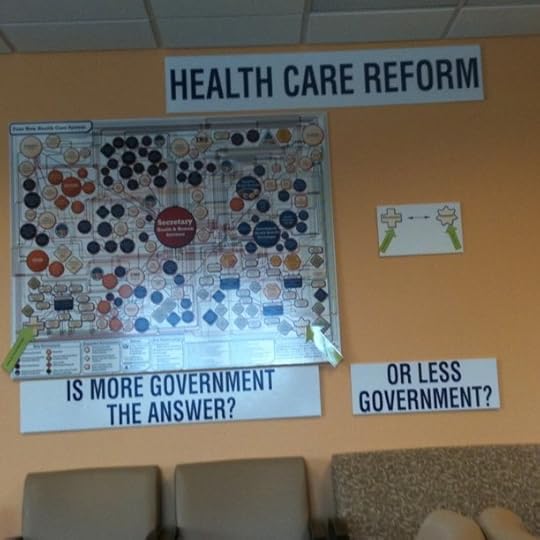
I bet the doctor doesn't have a $6,000 deductible. Whether you are for against the message of the sign, I think we all can agree that we'd rather not have our doctor's hit us with their political beliefs. Might as well have Rush Limbaugh playing in the waiting room.
The most appropriate store name ever?
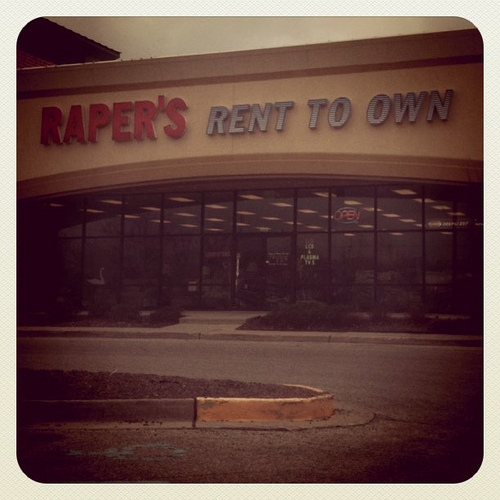
By the time you own something from a rent-to-own place, you've paid more than three times what you would have paid if you just bought it in the first place. At least this store isn't trying to hide anything.
March 25, 2011
100 years since the Triangle tragedy
[image error]
A hundred years ago today 146 people scrambled toward the exits attempting to flee the inferno that had enveloped the Triangle Shirtwaist factory.
The exits were locked. The women were trapped in the factory and they were trapped in a world that didn't value them beyond their piece count.
The only way "out" was the windows. Women hand-in-hand jumped to their death.
I've read about the tragedy in countless books, but none of them paint the tragedy with more humanity than Robert Pinsky in his poem "Shirt." I appreciate poetry more when it's read aloud, so give this a listen. The poem begins at 2:49, but his comments before will be of interest to any engaged consumer.
Click here to view the embedded video.
Here's a short passage to show you the powerful words within.
At the Triangle Factory in nineteen-eleven.
One hundred and forty-six died in the flames
On the ninth floor, no hydrants, no fire escapes–
The witness in a building across the street
Who watched how a young man helped a girl to step
Up to the windowsill, then held her out
Away from the masonry wall and let her drop.
And then another. As if he were helping them up
To enter a streetcar, and not eternity.
The Triangle Shirtwaist factory fire changed our country. Or did it? The narrative goes that people pulled together, unions were formed, better working conditions and better pay were demanded, and eventually gained.
Yet in a recent Op-ed in the Washington Post current secretary of Labor, Hilda L. Solis, writes:
Combating garment sweatshops is, sadly, still on the labor secretary's agenda. In the past fiscal year, the department's Wage and Hour division conducted 374 investigations and collected $2.1 million for 2,215 workers, primarily in the major U.S. garment centers of Southern California and New York. In these cases, vulnerable immigrant workers have been deprived of minimum-wage pay, overtime pay and safe working conditions — all the haunting echoes of Triangle.
–
Solis also compares the Triangle fire to the recent disaster at the Upper Big Branch mine in West Virginia:
Both Triangle and Upper Big Branch became calls to action. New York quickly implemented groundbreaking workplace safety laws and regulations, including fire exits. But nearly one year after Upper Big Branch, the Mine Safety and Health Administration, part of the Labor Department, still needs additional tools that only Congress can provide. And OSHA needs better tools, such as stricter penalties against employers who put their workers' lives at risk, and stronger protections for whistle-blowers.
In both cases, if these workers had a voice — a union — and the ability to speak up about conditions, these events probably could have been prevented, because unions play an important role in making workplaces safer. In both cases, they had tried to organize and faced virulent opposition.
–
The Triangle fire and the Upper Big Branch explosion a century later make clear to me that workers want and need that voice — about wages and benefits, yes, but about more, too. Collective bargaining still means a seat at the table to discuss issues such as working conditions, workplace safety and workplace innovation, empowering individuals to do the best job they can. And it means dignity and a chance for Americans to earn a better life, whether they work in sewing factories or mines, build tall buildings or care for our neighbors, teach our children, or run into burning buildings when others run out of them.
Curse all you want about autoworkers making $50 an hour leaning on a broom, but unions aren't something we should let slip away. Unless of course, you believe that corporations always have our best interests in mind. Some of them do, but others would prefer to let their workers fall before watching their bottom lines fall.
And as Solias writes, "We must always be a nation that catches workers before they fall."
—
Support garment workers around the world, be an engaged consumer.
March 23, 2011
Lessons from a flooded living room
I've been in deep water before.
I've filled my lungs to the point of embolism and swam to 100' feet beneath the ocean's surface. I grabbed sand to prove I made it to the bottom and swam for the surface. Swimming to 100' is the easy part. Swimming back is the hard and essential part. My legs grew heavy with lack of oxygen. My hand oozing with sand broke the surface first.
That felt like deep water.
I turned the water on and plugged the drain. I left to get diapers, diaper rash crème, pajamas, and my daughter Harper. By the time I returned the bath was half full. If she rolled over on her belly to blow bubbles, her head would be submerged.
The water was too deep.
I've fished offshore. Where the continental shelf slips beneath the Atlantic the water turns a primordial purple.
This is the deepest water.
I've been in deep water before, but never like this. I'm standing in front of my mailbox and water laps at my thighs. I bend over searching for the storm drain with one hand and craning my head out of the water. I remove a single chestnut and the sucking begins. A whirlpool more than 3' deep slurps away like some underground monster trying to drain my entire street in one huge gulp.
Lightening flashes and reflects off of water standing where there was once driveways, streets, and front yards.
When the tornado sirens go off, I look to the sky in disbelief. If I were in a movie, I would raise my fists into the driving rain and shout, "is this all you got!" But I'm not in a movie. Even if I did have flood insurance, I wouldn't thumb my nose at any higher power.
What we've got is quite enough, thank you very much.
I'm in deep.
Rising water, a sinking ship
My 2-year-old daughter Harper woke-up at 1AM. I was still in my office, putting the final touches on my four-day speaking itinerary in Missouri. I slid into her bed and stroked her hair until she was fast asleep. It was the last I would even consider shutting my eyes for the next 40 hours.
In your house water sounds should come from your bathroom and your kitchen, but never the hallway. I got to the bottom of the steps and saw Annie staring at water seeping under the front door onto our brand new wood laminate flooring and pouring down into the floor vent.
"Towels, T-shirts, anything that soaks up water!" I passed out the orders like a captain on a sinking ship. I opened the garage door to assess the situation. Shoes floated by. A wave of water swept across the floor.
I slammed the door shut and stuffed it with towels and garbage bags.
But the damn water was unstoppable – in it came.
–
"911 Emergency…"
"Yes," I say, "my house is flooding."
"Sir, we are busy. All of our units are out. Just try to stay comfortable."
I hang up. Stay comfortable?!?! What part of my house is filling up with water don't you understand? Isn't there a checklist for something like this? Shutoff your power? Grab your pets? Use your seat cushion as a flotation device?
After clearing the drain, the water began to recede, but the rain came down even faster and the drain clogged once again. I unclog it and run into our backyard to check the creek. It's on the rise too. If nothing changes, we're going to have bigger concerns than our new flooring.
I run inside.
Annie always complains about my vast T-shirt collection. "Why does one person need so many T-shirts?" The collection is strewn about the floor. Every university I speak at gives me a T-shirt. Muskingum University is soaked, so is Elmhurst College. Wingate University is well on its way.
"Get Harper and go into the half-bath (our only interior room), the tornado sirens are going off. "
Annie comes down with a sleepy-eyed, stinky-breathed Harper in her Christmas pajamas even though it's February.
I fight the water alone while Annie and Harper sit in the closet-sized bathroom. I put garbage bags over the vents to stop the water from flowing in. I run back out to the drain. Clogged again!
The rain continues. The creek rises. Water begins to come out of the vents in the living room. First the kitchen was lost, now the living room.
Back inside I make the call. "Where's Oreo (the cat)? Get her. We're taking you guys down to the neighbors."
The captain orders an "abandon ship."
We shuffle off into the soggy night. Annie hauls Oreo in her tiny tote. I'm holding Harper to my chest, shielding her from the rain with a jacket. Harper squeezes a clueless Monkey in the crook of her elbow, and chatters sweetly to him about water. We slog through front yards and landscaping like prowlers while our higher-ground neighbors sleep in their warm beds to the pitter-patter of the rain on their roofs.
Slosh by slosh we leave our home. It's a hopeless feeling, abandoning the only place on earth we own to forces beyond our control.
Going down with the ship
With Annie, Harper, and Oreo on dry land, I wade back to monitor the drain and do what I can.
"La, La, La, La…La, La La, La…Elmo's world." The plush Elmo floats through the living room face down, singing as if he doesn't have a care in the world. A bare-bottomed baby doll silently drifts in the current flowing around the entertainment center. I grab them both and toss them in the upstairs hallway, which looks onto the downstairs.
I slog through the living room past thousands of dollars of furniture, saving $5 toys that my daughter likes to hug.
I stop and look around. What now?
In the triage of my life's clutter, I deem nothing else worth saving. Everything important is high and dry.
—-
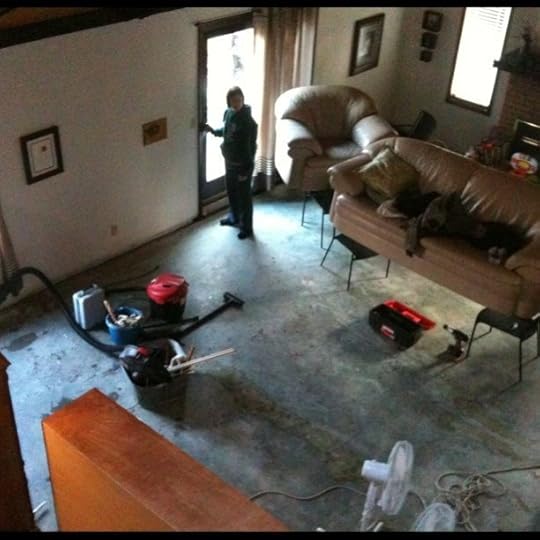
A tour of our house post-flood
Good news. We don't have flood insurance, but because the water backed up at an off-property storm drain insurance is covering us. We've been living between our home and an apartment now for about three weeks. Today, the first of the new flooring is being put down. We're replacing all of our floors. I'm sitting in my office, surrounded by furniture from every room in the house, being serenaded by a chorus of banging hammers, painters jamming to classic rock, saws, and the sweet tinkle of tile.
A question for you
If you're living room was flooding what would you grab first?
March 21, 2011
A song I didn't "get" until I was a parent
A confession: I have a Rod Stewart channel on Pandora. Harper and I listen to it every night when I giver her a bath.
The first song that came on tonight was Rod Stewart's "Forever Young."
And when you finally fly away
I'll be hoping that I served you well
For all the wisdom of a lifetime
No one can ever tell
But whatever road you choose
I'm right behind you, win or lose
Forever Young, Forever Young
I've known the song for years, but I really never felt the lyrics until I became a parent.
Another confession: I saw Rod Stewart in concert…with my mom!
So there I sat at the side of the tub staring all sappy-eyed at Harper, and she gave me her cheese smile. A knot grew in my chest as I thought about the day she would head off on her own, perhaps to travel the world. I thought about that moment and how I hoped we would have imparted all the lessons she would need.
The knot tightened.
And then Harper farted tiny little stink bubbles. She sniffed them, said "What was that?" and then she giggled.
—
So here's the music video of "Forever Young."
Honestly, the video kind of ruined the song for me.
In the beginning Rod is holding his son, and I can't decide if he's standing in the middle of the road about to be run over or sitting in the back of a pickup truck. His hair is moving a bit so I suppose it's a pickup driving at 120 mph or some other ungodly speed that it would take to even slightly move his hair – it being so full of product.
Once I realized he was in the bed of a truck I though, "Oh my God, what an awful parent. Someone should call Child Protective Services on Rod Stewart!" Speeding down the road sitting on the tailgate with your son is way worse than Britney Spears driving with a kid on her lap. At least Britney's kid was in the car!
Also, men shouldn't wear shoulder pads unless they are playing football.
March 18, 2011
Message in a Bottle Reading Series
Once upon a time authors shared their work at independent book stores filled with folks who loved books. The big boxes killed the radio star…I mean the independent book stores. Writers were forced to arrange readings at the big box stores who begrudgingly stuck the writer in the corner and did nothing to promote the event.
Here's my reenactment of the big box experience vs. a book club visit…
Click here to view the embedded video.
Today, the big boxes are dying too.
What now?
The writing community needs to pull together to shine the light on local writers. The Midwest Writers (who have a new website, and are accepting registrations for their awesome summer conference) are hosting a new reading series in Muncie: The Message in a Bottle Reading Series.
If you are in Muncie, you should come out. I'll be sharing the story behind this picture…
Cathy Shouse will be reading from her book on the home of James Dean and Garfield, Fairmount, Indiana. And my favorite local reporter, Ivy Farguheson will also be reading some of her recent work.
The details
Time
Saturday, March 19 · 9:30am – 11:00am
Location
Blue Bottle Coffee Shop
206 S. Walnut
Muncie, IN
More Info
Come at 9:30 a.m. to mingle and get your caffeine fix. Readings start at 10 a.m. and will last until 11 a.m.
Featured writers
* Ivy Farguheson, Star Press reporter, shares her personal writings
* Cathy Shouse, author of Fairmount: Images of America,reflects on the community that spawned James Dean and Jim Davis
* Kelsey Timmerman, author of Where Am I Wearing?, tries to keep pace with world-class Kenyan runners
If you plan to come or you have questions, email MWW director Jama Bigger at midwestwriters@yahoo.com.
This is a free event sponsored by the Midwest Writers Workshop. Refreshments available for purchase.
The song that inspired the title…
Do what you do and make the world better doing it
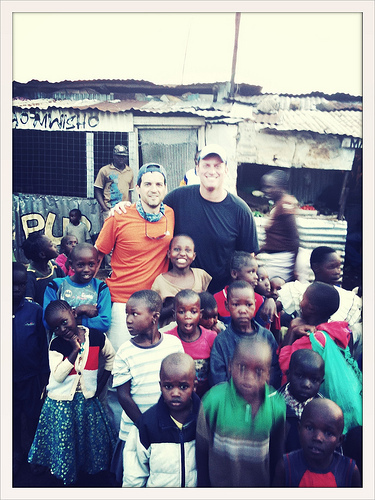
(Justin in Kenya with photographer Brian MacDonald)
I get compliments all the time on my blog. I wish they were all on the writing, but more times than not they are on design. This quickly leads to a discussion on how awesome the design firm that worked their magic here is.
If I had an ounce of artistic ability, if I could write instead of scrawl my name, if I could draw anything, I would beg for a job at Rule29. That's about the highest compliment that I can dish out because, you know, I don't want a real job. Every chance I've had to work with them has been loads of fun. If I had to have a boss, and, again I don't really want one, I would want Justin Ahrens, the head dude at Rule29, to be it. If for no other reason than the way he wields a sword…
R29 Shorts: Sword Skillz from Rule29 on Vimeo.
For Justin and Rule29 life and work are one. What Justin believes in his life, he believes in his work. He uses his abilities and the talents of his staff to impact the world in the best way possible.
If you've ever looked at this blog and thought the design looked spiffy, you should meet Justin. His recent in-depth interview in Stated Magazine is a great way to do it.
Justin in Stated:
It's a great day to be a designer when you talk to someone and they tell you that the work that we've done has helped them support a program that is saving kids' lives. That's pretty awesome. I used to joke around with the designers when a client did not like their design and I'd say, "It's not like we're saving lives." And now, we have that opportunity. It's a cool thing to be able to say.
Justin is Spiderman
When I address students I always encourage them to put their abilities to use for the greater good.
"With great power," Uncle Ben told Peter in Spiderman, "comes great responsibility." If you are a college graduate you are more educated than 94% of the rest of the world and that should come with some responsibility. Whatever your talent is there is someway that it can be put to use in your own community and around the world.
Justin is putting his superpowers to use. That said, I never want to see the dude in lycra.