
Kelsey Timmerman's Blog, page 56
March 10, 2011
American clothing companies shouldn't even try
I've been asking people where they are wearing for about two years straight now. But George Stephanopoulos asks it and folks start stripping in Grand Central Station. It must be his impish TV-ready good looks.
Anyhow, people don't know where they are wearing. I had the pleasure of talking with a few fashion/design classes recently and they didn't even know. If they don't know, no one does. Except me. Right now I'm watching the Colbert Report about to hop into bed and my underwear were made in Nicaragua. How about you?
When it comes to clothing American consumers should try.
[image error]


March 9, 2011
How to be an engaged consumer
I'm speaking at the Progressive Jewish Alliance tonight in LA. I'll be sharing some thoughts on how to be an engaged consumer, so I though I'd share them here too.
What we buy impacts our world for better and worse. Things like sweatshops and child labor are symptoms of the immense poverty that exists in our world. I believe the apparel industry should play an important role in lifting families out of poverty, but it has a long way to go.
Here are a few tips and tricks on how to be an engaged consumer.
How to think
Check the tags of your clothing everyday before you put them on. Take a moment and think about the hard work, sacrifice, and skill that went into making your garments. If you can't locate the country on a map, find it.
Become a brand champion – Be intentional about what you buy. Don't buy on a whim. Checkout the brands or the stores before you buy to see if their ethics line up with yours. Find a brand and support it.
Visit Patagonia's Footprint Chronicles
Listen to my report on an Ethiopian shoe manufacturer changing lives one job at a time.
How to make a difference
Arrange for your group/class to chat with garment workers at the first living wage factory in the developing world – the Alta Gracia factory in the Dominican Republic. Chat with a garment worker
Encourage your city, county, school, or university to purchase products made in factories approved by the Worker's Rights Consortium.
What would Jesus buy? Check out the Christian argument for Just Purchasing: Practicing Our Faith at the Market.
Where to shop
SoleRebels – company pays 3-times typical wage in Ethiopia, sends children of employees to school, shoes are made out of recycled tires, supports indigenous weaving tradition
Patagonia – One of the largest companies willing to have an honest discussion about where their clothes come from.
Ethix Merch – A host of ethical products for your company.
Cotton of the Carolinas – My favorite T-shirt! From shirt to dirt the manufacturing process doesn't leave the Carolinas.
Discover ethical companies and great deals (think Groupon with a conscience) at Roozt.com.
The Sweatfree Communities Shopping Guide
March 7, 2011
LA here I come
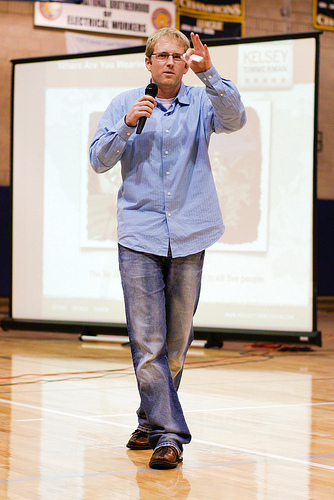 I have a confession. I've never been to Los Angeles. I know that might be hard to believe, what with all my Hollywood good looks and all, but it's true. (Of course I did spend 12+ hrs of my life at the airport that I'll never get back, but that doesn't really count.)
That's about to change.
This week I'll be in the LA-area speaking to three different groups, two of which are open to the public. If you are in the area, stop in and say "Hi" or heckle me. The question I'm really loving being heckled with right now is, "What 'bout 'merica? We had jobs. We made stuff. Now look at us. We need to get them jobs back from those job-hungry foreigners." Please ask that.
Wednesday 3/9
Progressive Jewish Alliance – Not open to the public
Thursday 3/10
I'm free until the evening. I'm open to meet for a coffee or a chat or a beer. Just give me a holler.
Friday 3/11
California State Channel Islands – CSU Channel Islands, 12-2 PM @ MALIBU HALL 100 Camarillo, CA
Saturday 3/12
Faces Behind the Label – 12-3 p.m. at "The Hub" 18842 Teller Avenue Irvine, Ca.
March 3, 2011
STLCC-Meramec Goes Glocal!
Today and Friday I'm speaking to the students at St. Louis Community College – Meramec. If you happen to be one of the students who heard me speak today, this post is for you.
I want this post to be a place where you can share experiences and thoughts about what it means to be a glocal living in St. Louis.
What opportunities and organizations are their in your area that need volunteers?
What opportunities are there for the Meramec community to reach out to the world (study abroad programs, cultural exchanges)?
Here are a few of the resources I mentioned during my presentation today:
Glocal Travel Guide/The Go Glocal Project's Facebook Page
Go Meramec Magic!
February 28, 2011
The Show Me Your (underwear) State

This week my hectic, but oh so fun, spring speaking schedule kicks off. Here's my complete spring schedule and updated speaking info.
I'll be driving tomorrow for about 7 hours and could use some company. If you want to chat about writing, traveling, underwear, or all the above, send me an email kelsey@kelseytimmerman.com or a tweet @kelseytimmerman and we'll set a time between 12-7 EST to chat.
If you are in the St. Louis or Columbia area stop by and say, "Hi!" Both events are open to the public.
Stephens College (Columbia U)
Tuesday March 1st (6PM) at Kimball Ballroom of Lela Raney Wood Hall, 6 N. College Ave. The event is free and open to the public. For information, call 876-7111.
Checkout this story about me in the Columbia Tribune. I was wearing all "Made in Mexico" when I gave the phone interview. That doesn't happen very often.
St. Louis Community College – Meramec
Thursday, March 3 at 7 p.m. in the Meramec Theatre. Admission is free; seating is general admission. More details.
February 27, 2011
Runners of Iten on the World Vision Report

My new piece on attempting to run a half-marathon with world-class Kenyan runners at 8,000′ is hitting stations around the country this week. Listen to it now or risk never learning if I live through the experience.
I'd love for you to share your thoughts on the piece, the runners, or running in general over at the WV Report's site.
February 23, 2011
American Workforce Needs to be Sluttier
Maybe there's a reason corporations are looking elsewhere. The American worker puts out less and wants paid more. As Jon Stewart puts it on the Daily Show we once did it all day and all night, seven days a week, in every room, even the ones without fire exits.
Take it away Jon…
The Daily Show With Jon Stewart
Mon – Thurs 11p / 10c
American Workforce Makeover
www.thedailyshow.com
Daily Show Full Episodes
Political Humor & Satire Blog
The Daily Show on Facebook
February 22, 2011
Why more people will care about the earthquake in New Zealand than the revolution in Libya
 About 200,000 thousand Americans traveled to New Zealand last year. Total tourist arrivals to the country were more than 2.5 million.
In turn, Libya saw a grand total of 50,000 tourists. Few were from the United States because the Libyan government had a ban on American tourists until June of 2010.
Been there
My reaction to the quake in New Zealand was much greater than that of when I heard about the chaos and the violence in Libya. I know that it's silly to compare a natural disaster with political upheaval – the acts of men vs acts of nature – so why is it that military aircraft (reportedly) gunning down civilians doesn't leave me as concerned as an earthquake?
I spent two months in New Zealand in 2002, hitchhiking thousands of miles and landing hundreds of rides. When I think of New Zealand I think of a Kiwi farmer, a rafting guide, a window deliveryman, a single mom, and many others who let me into their lives. My adventure began in Christchurch, so it has a special place in my New Zealand experience. Seeing crumbled building after crumbled building in Christchurch on the news moves me.
Saw it on the news [image error]
Besides that I've been there, those pictures on the news play a part too. More of us will be moved by the protest in Egypt than the one in Libya because we saw it on TV. I criticized reporters like Lester Holt and Anderson Cooper for becoming part of the story, but if they were on the ground in Libya capturing stories and faces, we'd all care a lot more about what's going on there.
I also think that Moammar Gadhafi would have been less like to order Libyan aircraft to gun down protesters if there were more reporters on the ground. When the world is watching, less people die.
It's only natural to care more about a place more when you've been there, but that doesn't make it right.
What recent news story has hit closest to home for you?
February 21, 2011
Unwritten views on the fight for unions in Wisconsin

Source: US Bureau of Labor Statistics

Data from this mind-blowing chart
1911 Triangle Shirtwaist factory fire – 146 workers killed

What have unions ever done for us?
Click here to view the embedded video.
Paul Krugman on the power struggle in Wisconsin:
You don't have to love unions, you don't have to believe that their policy positions are always right, to recognize that they're among the few influential players in our political system representing the interests of middle- and working-class Americans, as opposed to the wealthy…
There's a bitter irony here. The fiscal crisis in Wisconsin, as in other states, was largely caused by the increasing power of America's oligarchy. After all, it was superwealthy players, not the general public, who pushed for financial deregulation and thereby set the stage for the economic crisis of 2008-9, a crisis whose aftermath is the main reason for the current budget crunch. And now the political right is trying to exploit that very crisis, using it to remove one of the few remaining checks on oligarchic influence.
So will the attack on unions succeed? I don't know. But anyone who cares about retaining government of the people by the people should hope that it doesn't.
February 18, 2011
My near-death SCUBA diving experience in Key West

I wrote this a while back as part of a piece on the lobster divers of Nicaragua who suffer many dive-related injuries. Legend has it that the divers' injuries result from an encounter with a pale-skinned mermaid known as the Liwa Mairin. It is said that she haunts the depths and punishes those who take too many lobster. The victims of the Liwa Mairin, the wheelchair bound and the zombies, are what drew me to Puerto Cabezas. A few years ago I almost became one of them.
I hope other divers can learn from my experience. Nitrogen Narcosis nearly killed me. It's no laughing matter.
–
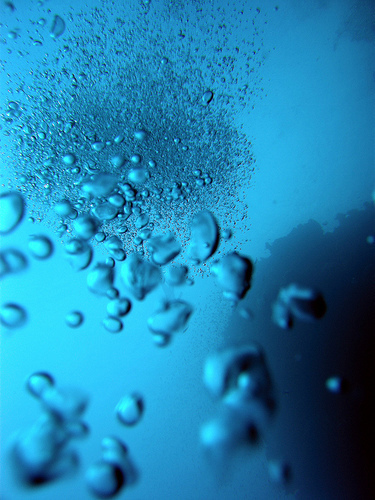
Bubbles burst forth from my regulator – the sound of distant bowling pins falling over, a cry for help. And with each cry, I was one breath closer to my last.
Suspended in limbo, 130 feet from the surface and nearly 100 feet to the sandy bottom, I watched the bubbles. They playfully danced around each other expanding, breaking, conjoining, chaotic, but always up. The ever-changing surface glimmered above – where air meets water, where life meets death.
From the beginning this day was different from others I had spent working as a SCUBA instructor in Key West. Aboard the Island Diver, technical dive gear pitched with the rolling of the Atlantic. Back-up plans for contingency plans were discussed. We were hosting a dive event sponsored by Skin Diver magazine. The magazine had recruited a group of beginner divers to train, advance, and transform into "Tec-Divers" – divers certified for depths exceeding 100 feet and breathing special mixtures of air. This dive was a culmination of months of training.
With double tanks, large lights, and a spider web of hoses, the divers had claimed the majority of space on the boat. My equipment on the port stern looked shabby and overly simple – one tank, half as many hoses. It was hard to believe we would be diving on the same shipwreck.
My job was to tie up to the wreck, The Kurb. I had done this two days previously and I had had no trouble, but, again, this day was different. On my first time I had jumped in with a line that I hooked to the wreck and then swam back to the surface; I had completed the task with ease. On this fateful day I hopped in with nothing but a lift bag. I was to swim to 130 feet where I would find the exhaust tower of the ship with a line already connected to it. I was to fasten the lift bag to the line and fill it with air from my regulator, causing it to float to the surface. The Island Diver then would see the bag, pull up the line, and clip into it.
Five minutes before arriving above the ship I started to feel a bit anxious. Normally, I didn't dive deeper than 90 feet. I could swim the shallow wrecks and reefs off Key West with my eyes closed, but the Kurb was still new. And deep.
The air in a SCUBA tank, like the air we breathe is 21% oxygen and 79% nitrogen, but our bodies don't use nitrogen and, under the increased pressure of being underwater, nitrogen accumulates in the tissues of our body. The deeper divers go and the longer he stays the more nitrogen bubbles accumulate. When a diver is at depth, this isn't a problem, but sooner or later he has to ascend.
 Most dive instructors use a bottle of soda to demonstrate this process. The bubbles in the soda are invisible when the cap is on and its contents under pressure. When the cap is twisted off – or the diver ascends – the pressure is released and the gas comes out of solution to form bubbles. In soda the bubbles give our soft drink bite, but, in diving, bubbles can accumulate around joints and the spinal cord. Pain in the joints, unconsciousness, paralyzation, and death can all result. These types of injury are known as decompression sickness and are commonly referred to as "the bends."
I was not afraid of the ocean or its creatures, but bubbles worried me. I nervously drank water till my stomach and bladder were full and then I drank some more. Each drink of water was a safeguard against bubbles. When a diver is dehydrated, bubbles accumulate more readily.
The boat slowed to an idle and I donned my gear and stood on the dive platform at the stern, staring up at Captain Roy. When he gave the signal I took one giant step backward and began the descent.
Sky diving in space – that's what it's like to sink as quickly as possible with no bottom and no wreck in sight. Down, down, as I fell through the water my eyes searched for something on which to focus. Head first I aided gravity with a few kicks of my fins. It was important to find the ship before the current blew me off its location. The water from the depths rushed up to meet me, growing colder and darker with each passing foot.
The tower, first a ghostly dream, became more defined as I closed the distance. The line was attached on the support beam between two stacks. A current ran from the bow to the stern of the wreck; I kicked against it to stay in place as I began to pull the ends of the line up. The line from the towers ran down onto the deck below where it snaked in and out of wreckage. When I tried to pull up the line, it became ensnared. I jerked it and cursed through my regulator when it didn't come free.
The tops of the stacks were at 130 feet. At that depth I could stay down for around five minutes without being concerned about "the bends".
What should I do? Abandon my duty and return to the surface, to the boat full of newly trained tec-divers and one Skin Diver magazine writer, in shame?
A certain machismo exists in the diving world. I blame Sea Hunt and James Bond with their underwater wrestling matches. Divers often brag about how deep they've been. I had never been deeper than 130 feet and to kick down to the deck at 150 feet, where the pressure was five times the surface pressure, was a foolish thing to do, and would be giving in to a whole other kind of pressure – peer pressure.
Against my better judgment, I swam to the deck as fast as I could and freed the line. Back at the stacks I recovered both ends in my hands and attached the lift bag. I filled the bag with air and watched it rocket to the surface – triumph – before jerking to a halt well below the surface – defeat. I looked down at the deck of the ship and saw the line caught again.
That's when my brain stopped.
"Nitrogen narcosis," I always remember to bring it up to my students since the topic is good for a few chuckles. "It's like being drunk…a feeling of euphoria. If at anytime you feel this during a dive, ascend slowly until you are at a depth where you no longer feel it." Jacques Cousteau referred to it as the "rapture of the deep," elevating the phenomenon to boogie man status. Like the boogie man, stories circulate in the diving community:
"I heard of a guy who had been diving for thirty years that got "narced" really bad; the poor fella didn't know which way was up and swam into the abyss to his death. His body was never recovered."
"Did you hear about the guy who had a few too many nitrogen cocktails and forgot to keep his regulator in his mouth? He tried to give it to a fish. Can you imagine that? He drowned with half a tank's worth of air left."
The exact cause of nitrogen narcosis is not known. Scientists believe that it is the result of nitrogen's increased partial pressure at depth interacting with neurological processes. The effects can be greatly enhanced by a build up of carbon dioxide, which happens when you exert yourself by doing things like kicking against a current. Euphoria, unexplained fixations, anxiety, unconsciousness, can all be a result of narcosis. Small problems can quickly become big ones.
I hung on the line near the tower. Minutes passed and I did not move or think.
 That's when she came – my very own Liwa Mairin. She was fat and ugly, a Volkswagen with fins that divers in their right mind would recognize as a goliath grouper. With a menacing grimace on her face, she swam to within a few feet.
Then she talked, "Bark! Bark!" Her words were felt as much as they were heard.
My consciousness crept out of its silent prison and I looked at my gauges.
"Where had the time gone?" I thought. My dive computer started to flash things I had never seen before. It was telling me that since I had been so deep for so long, I should immediately ascend to a certain depth for a certain amount of time. This is referred to as a decompression stop.
"Where had the time gone?" The computer's reports were not good. My estimated amount of air left was less than the amount needed to make the necessary decompression stops.
My conversation with myself continued.
"This is not good."
"Calm down."
"I am calm."
"Breathe nice and easy."
"I am."
"What should I do? I need more air."
Thoughts came slow and were interrupted by minutes of blackness.
I clung to the rope and stared up at the surface. I could muster no solution and with a calm resolve, I pondered my death. I would run out of air spit out my regulator, and my lungs would fill with salt water and I'd sink. My grip would lessen on the line and finally let slip. The current would carry me away.
My gaze went from the surface toward the wreck. The bright orange lift bag floated in mid-water and gave me an idea. I pulled out my knife and cut the line that prohibited the lift bag from surfacing. Upon reaching the surface it would signal my location to the boat, and that there was a problem. It rocketed up like an out of control balloon. Before reaching the surface it flipped, releasing its pocket of air and sunk to the bottom. I watched it fall, slowly spiraling, drifting like a limp body forever lost in the ocean's current.
"Go up or you're dead. Go up!"
The eerie part was that death neared and I wasn't afraid. I knew I wasn't in my right mind, but there was nothing I could do about it. I thought about how the narcosis was my ultimate curse, yet my altered mental state was a sort of blessing. I would die, but at least I would die peacefully.
When I heard the boat, I watched its dark shadow on the surface as it passed over and paused before motoring away. A small portion of its shadow remained. It moved, had arms, and legs. It came down, grabbed my arm and led me to the surface.
It wasn't until I reached the surface and saw the fear in the eyes of the divers and of Captain Roy that I became afraid. I had been to 150 feet and my total bottom time was near 30 minutes, about 25 minutes longer than I should have been down. As the narcosis subsided, my thoughts turned inward. I imagined the nitrogen bubbles floating around, piling up around my spinal cord. At any moment I might lose consciousness forever. I might die. I grew pale and began to shake. My right foot went numb.
The Island Diver met the Coast Guard back on the island and I was transported to the naval station where I spent six hours in the hyperbaric chamber that would crush the bubbles until they had been exhaled
I emerged from the chamber bubble free, but bubbles leave a mark. My left elbow ached for weeks – a scar left by nitrogen gas. Occasionally to this day when I am nervous, stressed, or exhausted, my elbow will ache.
I had training. I had top of the line equipment. Yet I still found myself in a situation in which, if I had not been treated properly, I faced death or paralysis.
But I was lucky.
Each year countless Miskito divers aren't.
What's the closest you've been to checking out?


![[image error]](http://whereamiwearing.com/goto/http://images.digitalmedianet.com/reuters/OLUSTOPNEWS_iptc/2011-02-20/2011-02-20T181452Z_01_BTRE71J1EOU00_RTROPTP_2_NEWS-US-LIBYA-PROTESTS-dmn350.jpg)