Kelsey Timmerman's Blog, page 52
June 9, 2011
The ONE app that could change the world
The ONE campaigns to end poverty released their new app today in the iTunes store. Looks like a very cool way to be an engaged glocal. I'll let you know what I think about it after I used it a bit.


TOMS Glasses: an eye for an eye?
"I had a very simple idea with a desire to help," Blake Mycoskie, founder of TOMS shoes, told the TOMS employees in what appears to be a garage in Santa Monica.
That desire started with giving a pair of shoes to someone in need for every pair purchased form TOMS. I've offered up my thoughts on TOMS shoes before – shoelessness isn't the problem, poverty is – and now I thought I would examine the next venture in the TOMS business, which was revealed on Tuesday…glasses.
"With every pair purchased," he said. "TOMS will help give sight to a person in need. One-for-One…from this day forward TOMS isn't a shoe company, it isn't an eyewear company, it is the one-for-one company."
Good for TOMS
My initial thought was, "Good for TOMS."
Like Blake, I've seen my fair share of folks with vision problems while I traveled around the developing world. Sometimes a simple cataract surgery can be the difference between blindness and being unemployed. Helping someone see can help them become educated or get a job to support their family. Otherwise they are disabled in a world that really isn't very nice to someone with special needs. (There are not crosswalk beepers in Bangladesh. There aren't even any crosswalks. Crossing the street with unimpaired vision is dangerous enough.)
The cause is worthy and, in my opinion, more impactful than a pair of shoes. And the need is there. Over 500 million people around the world need vision correction, but have no access to it. Unlike shoes, prescription glasses or the services of an ophthalmologist can't be found just around the corner in a lot of places and, if they can, those living on less than $2 per day likely cannot afford either.
Double Vision
TOMS isn't the first company to tackle vision issues in the developing world with the one-for-one model. Warby Parker sells $95 prescription glasses and promises, "Buy a pair, give a pair: for every pair of glasses sold, we provide one to someone in need."
Wow, that sounds familiar. Blake has championed the one-for-one movement for a few years now and encouraged other companies to follow suit. Warby Parker was obviously inspired by TOMS and now their inspiration has become their competition.
Blake discusses Warby Parker in Fast Company
TOMS non-prescription sunglasses cost $135, which makes the Warby Parkers much more affordable for customers. But this begs the question, if I buy a pair of TOMS glasses for $135 or a pair of Warby Parkers for $95, which purchase does the most good?
The one-for-one fog
No one knows. This is the heart of problem of the one-for-one model: no transparency. These are privately owned companies and they don't have to open their books like not-for-profits do. For all I know, the amount of "good" my purchase does, might not be any "gooder" than adding $1 onto my purchase at PetSmart when I buy kitty litter for Oreo. In dollars and cents one-for-one could equal 1 for .1.
I would love to see TOMS, Warby Parker, and any other one-for-one companies tell their customers how much of their purchase will go to the cause that they are using to market their products.
What does it cost to put prescription glasses on someone on the other side of the world? Joshua Silver invented a pair of self-adjusted eyeglasses (he adjusts them to fit his prescription in a few seconds in the Ted talk below) that cost $19.
So yes, vision is a major problem that needs addressed. But until companies like TOMS who are using the cause to sell their products, become more transparent, we won't see how much good they are doing.
The biggest problem with TOMS glasses
Max Headroom called…he wants his shades back.

June 6, 2011
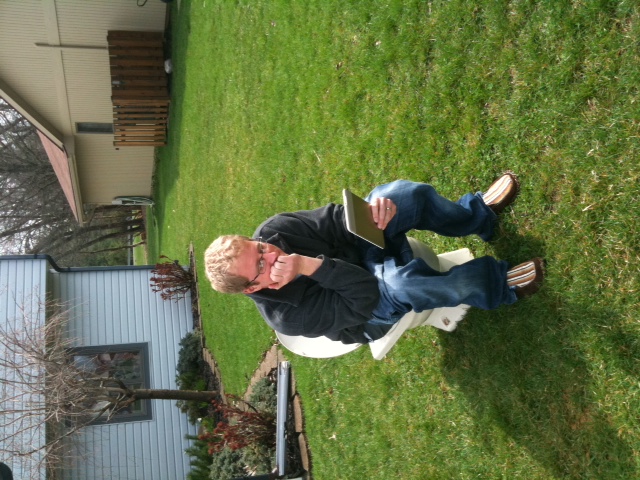
I hope this picture of me sitting on a toilet in my front yard reading my Kindle makes Anthony Weiner feel better
Breaking: It was Weiner's weiner.
It turns out that Congressman Anthony Weiner has a habit of online-only (yeah right) affairs, and the photo tweeted from his Twitter account of the bulging member in briefs was, in fact, the member of Congress's member.
Anyhow, in order to make Weiner feel better and take some of the media heat off of him, I'm releasing this photo of me on a toilet in my front yard reading my Kindle.
I know what you are thinking… "Kelsey, what are you reading on your Kindle?"
Unfortunately, I'm not at liberty to answer that at the moment, but I've hired a team of investigators who are looking into it.
Could you live in poverty?

I could live in poverty. Sort of.
The poverty threshold for a family of four is just over $22,000. I sat down with my budget (on Mint.com- highly recommend Mint) to see how far $22K would get my family.
On $22,000/year, which is $1,833/month or $423/week, we could pay our mortgage, buy groceries, and keep our lights on and water running. That's about it.
I'm not sure how we would even earn $22,000 because we couldn't afford transportation to work. There's just no money left for anything else. Not for health insurance, not for birthday gifts, not for any of the host of minor emergencies my family has faced in the last six months, including, but unfortunately not limited to, child birth (not really an emergency but feels like one on the budget), a flooded house, replacing water heater, replacing garbage disposal, and a flat tire.
Oh, and I just realized something…my kids would be running around naked.
"Sorry, Harper and Griffin, I forgot to include clothes in the budget. Would you rather have lights on and be naked or be clothed in the dark?"
In poverty I couldn't watch the Daily Show, buy books, buy music, buy a gallon of bubbles for the kids, take my wife out for a meal, afford the hosting expense of this website, afford Internet at all, and afford any bump in the road whatsoever.
I work with an amazing group of people in Muncie who have pulled together to fight local poverty, and they often talk about the Tyranny of the Moment – not being able to see beyond the current crisis to make good long term decisions or even have the option of making a good long term decision. With an income of $22,000/year, we would be slave to the Tyranny of the Moment.
In poverty, we could survive until something, anything, went wrong or broke. And things always go wrong and get broke. People too.
How long could you live in poverty?
There are a couple of things I should point out.
1) I realize that my family would be eligible for assistance with housing, utilities, food, etc, if we were living in poverty. However with all of the political talk about cuts to these programs, I would be really nervous that we could lose that assistance. Then what?
2) I live in Indiana. Life in Indiana is way cheaper than a lot of places across the country. I point this out because I could make $22,000 go a lot farther in Muncie, Indiana, than someone could in a big city somewhere.
June 5, 2011
The whole world…
…in my hands. Introducing Griffin Noah Timmerman.

Born May 26th, weighing a whopping 8 lbs 13 oz. A big thanks to Shawna Pierson of Shawna Renee Photography for snapping this great shot of G-money, Big Griff, Fin, Finn, or whatever we decide to call this little man.
June 3, 2011
Glocal Challenge #2: Not in my backyard
 14.3% of Americans live in poverty. How many of them are your neighbors?
(This is the 2nd Glocal Challenge. Let's Go Glocal together.)
Mom and dad's dog got out.
I stomped across the frosty fields of snow. The remains of the fall harvest were under foot, making each step a search for balance.
"Zoey! Zoey!" I hollered into woods and across the empty fields.
Until now there had been no reason to knock on the doors of the neighbors. I had lived in the neighborhood for nearly a decade and zipped past the properties at 55 miles/hour. There aren't even that many neighbors to know – maybe thee to four houses every mile.
The first door I knocked on was metal – white, rusty metal. The white metal siding on the house was rusting, so was the beater Chevy blazer in the drive. The house, the barn, the Blazer, could be painted with two colors – snow white and rust the shade of old blood on snow.
With each knock, the door reverberated like thunder – or at least the in-studio thunder made for old-time radio dramas.
A woman answered. She was bundled against the cold. At first I though I was catching her on her way out. When she asked me to step in, I realized the house had no heat.
No heat. In winter. In Ohio.
I handed the woman a Missing Dog flyer with Zoey's sweet mug and flappy ears. Those ears bounded without a care as she chased squirrels around my parents' woods. And at night those ears lay on the floor of her heated doghouse.
A heated house. For a dog.
Mom and dad's house sits back a quarter-mile lane in an 11-acre woods. They have a heated doghouse and a heated pool, a full basketball court complete with adjustable rims for dunking, a generator that can power the whole house if the power goes out, in addition to everything else a person could want.
The woman hadn't seen Zoey. That was fair, because I had never seen the woman and the poverty that she lived in until now.
I eventually found Zoey (although that's a heartbreaking tale for another time). In searching for her I found a new perspective on where I had grown up. I had never realized how much poverty surrounded my childhood oasis in rural Ohio.
Glocal Challenge #2: Not in My Backyard –
Do you know the poverty statistics in your own community? They might surprise you, and likely not in a good way.
Visit the U.S. Census's Poverty Estimates and find out how many are living poverty in your county or school district.
Next week I'll be sharing my own findings and discussing how easy it is to be blind to the poverty in our own backyards.
Sign up for the Go Glocal newsletter…
join our mailing list
* indicates required
Email Address *
Email Format
html
text
mobile
var mce_preload_checks = 0;
function mce_preload_check(){
if (mce_preload_checks>40) return;
mce_preload_checks++;
try {
var jqueryLoaded=jQuery;
} catch(err) {
setTimeout('mce_preload_check();', 250);
return;
}
try {
var validatorLoaded=jQuery("#fake-form").validate({});
} catch(err) {
setTimeout('mce_preload_check();', 250);
return;
}
mce_init_form();
}
function mce_init_form(){
jQuery(document).ready( function($) {
var options = { errorClass: 'mce_inline_error', errorElement: 'div', onkeyup: function(){}, onfocusout:function(){}, onblur:function(){} };
var mce_validator = $("#mc-embedded-subscribe-form").validate(options);
$("#mc-embedded-subscribe-form").unbind('submit');//remove the validator so we can get into beforeSubmit on the ajaxform, which then calls the validator
options = { url: 'http://kelseytimmerman.us2.list-manag...?', type: 'GET', dataType: 'json', contentType: "application/json; charset=utf-8",
beforeSubmit: function(){
$('#mce_tmp_error_msg').remove();
$('.datefield','#mc_embed_signup').each(
function(){
var txt = 'filled';
var fields = new Array();
var i = 0;
$(':text', this).each(
function(){
fields[i] = this;
i++;
});
$(':hidden', this).each(
function(){
if (fields.length == 2) fields[2] = {'value':1970};//trick birthdays into having years
if ( fields[0].value=='MM' && fields[1].value=='DD' && fields[2].value=='YYYY' ){
this.value = '';
} else if ( fields[0].value=='' && fields[1].value=='' && fields[2].value=='' ){
this.value = '';
} else {
this.value = fields[0].value+'/'+fields[1].value+'/'+fields[2].value;
}
});
});
return mce_validator.form();
},
success: mce_success_cb
};
$('#mc-embedded-subscribe-form').ajaxForm(options);
});
}
function mce_success_cb(resp){
$('#mce-success-response').hide();
$('#mce-error-response').hide();
if (resp.result=="success"){
$('#mce-'+resp.result+'-response').show();
$('#mce-'+resp.result+'-response').html(resp.msg);
$('#mc-embedded-subscribe-form').each(function(){
this.reset();
});
} else {
var index = -1;
var msg;
try {
var parts = resp.msg.split(' - ',2);
if (parts[1]==undefined){
msg = resp.msg;
} else {
i = parseInt(parts[0]);
if (i.toString() == parts[0]){
index = parts[0];
msg = parts[1];
} else {
index = -1;
msg = resp.msg;
}
}
} catch(e){
index = -1;
msg = resp.msg;
}
try{
if (index== -1){
$('#mce-'+resp.result+'-response').show();
$('#mce-'+resp.result+'-response').html(msg);
} else {
err_id = 'mce_tmp_error_msg';
html = '
'+msg+'
';
var input_id = '#mc_embed_signup';
var f = $(input_id);
if (ftypes[index]=='address'){
input_id = '#mce-'+fnames[index]+'-addr1';
f = $(input_id).parent().parent().get(0);
} else if (ftypes[index]=='date'){
input_id = '#mce-'+fnames[index]+'-month';
f = $(input_id).parent().parent().get(0);
} else {
input_id = '#mce-'+fnames[index];
f = $().parent(input_id).get(0);
}
if (f){
$(f).append(html);
$(input_id).focus();
} else {
$('#mce-'+resp.result+'-response').show();
$('#mce-'+resp.result+'-response').html(msg);
}
}
} catch(e){
$('#mce-'+resp.result+'-response').show();
$('#mce-'+resp.result+'-response').html(msg);
}
}
}
// ]]>
June 2, 2011
Tom Hanks on Faith & Fear
Tom Hanks gave the commencement speech at Yale this year. He shared some interesting thoughts on Faith & Fear.
Since Saving Private Ryan he's become a bit of a history buff, and I appreciate the fact he takes a longer view on current events. We're in a rough patch and, unless you are graduate from Yale, you might've noticed it's not easy finding a job these days.
The talking heads on TV spout the latest fears at us (America is done, move to China, the earth is toast, buy gold because when the economy collapses and no one has anything to eat or drink it will be worth a lot!!!!) or they are spouting off, red-faced about Weiner-Gate. (By the way I'm totally against the use of -gate to describe a scandal. If Weiner-gate doesn't kill the usage, nothing will.)
Every generation has their tough time or six. My parents hid under their desks in school, practicing in the event their was a nuclear attack. My grandparents were too young to know they were poor, but late in life they heard their parents talk about the tough times of the depression.
As Tom Hanks says history is a "Yin and Yang thang!" That's important to remember. So why is it that we act as if there are more of us that have faith that the world as we know it is ending than those of us who have faith in tomorrow.
(Start at 9:30)
June 1, 2011
What is voice?
[image error]
"I've noticed that there is a…conversational feel [in your work], something that says each text was written by Kelsey Timmerman. Perhaps that is voice…What do you think voice means?" My buddy and fellow author/writer Chris Humphries asked this in an email the other day.
He explores voice further in a new post More than words on a page.
Here's what I had to say to Chris about voice:
"When my editor sent my manuscript to the copyeditor, he sent instructions to "keep the voice." There were several very specific instructions, but the one I remember the most was to keep the spelling of "fella." Is that voice?
I've always adhered to the advice: "Write like you speak. If a word wouldn't come of your mouth, don't put it down on paper." That being my goal, I take it as a compliment when someone hears me speak in person and tells me that I "sounded" just like I do on the page. That said, people also tell me I sound either like Joe Dirt of Matthew McConaughey. I don't imagine either one of those fellas is a very good writer.
My favorite Esquire writer is Tom Chiarella. For a long time I never knew he was my favorite because I wasn't reading the bylines. But eventually I discovered that all of my favorite pieces were written by him. I liked his voice.
When I think about voice vs. style vs. tone my head hurts. So that's all I have to say. I try to think about writing as little as possible, especially when I'm doing it."
May 31, 2011
Vonnegut on the 3 basic shapes of stories
What's the shape of your story?
I'd like to see Vonnegut draw a few of his own. I think he'd need a bigger blackboard.
Poo-tee-weet!
May 27, 2011
Team, Red, White, and Blue on the Today Show
Team, Red, White, and Blue was featured on the Today Show! It was great to see many of my teammates from the American Odyssey relay race highlighted.
There's a divide between civilian life and life in the military. It's not easy for civilians to appreciate the level of commitment and honor our troops have, and, in turn, it's not easy for injured veterans to transition to life as a civilian. Team, Red, White, and Blue tackles both of these issues.
Learn how to become an athlete, donor, and/or advocate with Team RWB.
Visit msnbc.com for breaking news, world news, and news about the economy