Kelsey Timmerman's Blog, page 39
August 30, 2012
I’m in China
I’ve been a bit quite.
Call me crazy, but when the hotel you’re staying at each night has to walk your passport down to the police to check in, I prefer not to blog about China.
That and the Great Firewall of China prevents me from using Facebook, Twitter, YouTube, and Flickr.
So I’m good. How about you?


August 27, 2012
A note from a 20-year-old cocoa farmer to his parents
One of the most soul-shaking experiences I’ve ever had started with the note below. It was given to me by a 20-year-old Ghanaian cocoa worker working in Ivory Coast.
My mother and Father,
>I am sorry for not telling you before leaving. I am not missing. I will be back again. You don’t worry about me. This is Solomon. I am in Core d’ Ivoire.
August 19, 2012
Open letter to people of the Tropics: Wear Shorts!
Dear People of the Tropics,
Why don’t you wear shorts?
You have nice legs. Maybe you don’t. Who cares? If you live in a county that hits 40-degrees Celsius, you should be wearing shorts. Not slacks. Not blue jeans. Not anything that covers your knees unless that’s a kilt or a dress and you’re going commando.
Got it?
For the past two weeks as I traveled through Ivory Coast and Burkina Faso, I’ve bent to your predilection for pants (although I wasn’t able to bend all that far because my pants stuck to my sweaty legs). How do you stand it?
Men in the tropics often roll up the bottom of their shirts to air out their beer bellies, but God forbid you bare your knees.
Dan Savage of MTV’s Savage U doesn’t think you should wear shorts unless you are boy. He must have chicken legs. Because even GQ’s Style Guy gives shorts a thumbs up in certain circumstances. Quoted from this NY Times story on the appropriateness of shorts.
“I avoid them,” said Glenn O’Brien, the fashion editor and writer of GQ magazine’s “Style Guy.” “If it’s like 100 degrees, or if I’m just going to Whole Foods, I will break down and wear shorts, but I try to avoid them for business.”
People of the Tropics, Today, I say enough! I’m leading a revolution of bringing shorts to the tropics. Think how much water we’ll save through decreasing leg sweat! How much petroleum we’ll save from less chafing. This has environmental and health ramifications.
At 3PM yesterday after riding around Ouagadougou all day on a motorbike in the scorching sun, I shed my pants for shorts. I grabbed my baseball cap. I applied another layer of sunscreen. I put on my Oakley’s and I embraced my legs. I embraced my inne Touron and my outer grande gringo and I got a little sun on my legs. I hopped back on the scooter, and you know what? There was a nice breeze in regions that could use a little cooling down.
Down with Pants! Up with shorts! Do it for yourself. Do it for the future of your children.
The revolution has begun.
Sincerely,
Kelsey
August 17, 2012
How are you a glocal?
It has been a good week, but the last few days have been tough. I needed a pick-me-up and a reminder of why it is I do what I do. That pick-me-up came in an email from Dr. Cristian Lienick from Texas State University. Texas State is using WHERE AM I WEARING? as a common reader this fall. Here’s what he wrote:
Am I glocal? Yes, no – wait, maybe. I don’t know. I think so, partially. I am well-traveled within the continental United States, yet have only been to another country (Mexico) once, and that was on my honeymoon, which probably doesn’t count. I do not speak another language other than English, even after taking French in high school and Spanish in college. If it were up to me, before reading your book, I would easily say that I am a true LOCAL.
Yet after reading Where am I Wearing, it is now much more apparent to me that for one to be glocal, he/she does not have to be well-traveled to foreign countries, speak several languages, and purposely attempt to infuse a daily lifestyle with international and multicultural characteristics. While these activities may further enhance one’s ability to be global, the true essence of glocalism is the simple understanding and true awareness of the intersection between globalism and localism. To be glocal, one can just step outside.
I am glocal because I am now much more aware of how privileged we are to be citizens of the United States and how the things we take for granted are highly coveted, often future goals or even dreams of citizens in other countries. For example – I recently paid to go on a fishing/camping vacation this summer to escape the city lights, television, and other daily distractions only to quickly yearn for a hot shower, air conditioning, and a queen size bed upon my return. If I need something, I go buy it. If something needs to be repaired, I google a service company. If I’m hungry, I only have to search just past my arm’s reach to find something to eat.
Am I glocal? Let’s leave it at this – my 2012 Texas State University Common Experience t-shirt was handed to me out of a large cardboard box during my check-in at a recent US 1100 faculty meeting here on campus. “Cool, free t-shirt!” I thought in the back of my mind. But then something happened – I checked the tag: “made in Honduras.”
I hope that Genesis and Betsabe back in Honduras are ok and are lucky enough to find jobs with credible working conditions, and that Amilcar continues to support his family, regardless of what the note from Jolanis said. I’m taken back for a minute. Free for me, not for them.
Hopefully, we will all endure such a glocal, Common Experience as I did, simply by being handed a t-shirt at a faculty meeting.
Thanks for your time,
Cristian Lieneck, PhD, FACMPE, FACHE, FAHM
Assistant Professor of Health Administration and US 1100 faculty
Texas State University
How are you a glocal?
August 16, 2012
Layover in Tatooine (Casablanca, Morocco)
So I’m a nerd.
I had a 12 hours layover in Casablanca, Morocco, and all I could think of the entire time was…
“I’m on Tatooine!” That’s the home of Luke Skywalker. If you don’t know who Luke Skywalker is you are totally hopeless.
I’m guessing there were less dead cows lying around on Tatooine. They probably got eaten up by sand worms or something. I counted four dead cows from the train between the airport and the city. None are featured in this video, but you’ll get the idea of the landscape.
If you ever have a long layover in Casablanca, here’s what I recommend. Get a room at the airport hotel. Leave your luggage. Grab the train into town. Get off at the Casa Voyageurs. Hire a cabdriver. Have him give you the three-hour tour for about $25-$30 (that’s about what a cab ride costs from the airport, hence taking the train). Take the tour of the huge mosque, see the beach, be whisked away to a carpet store, and eat some awesome food.
August 15, 2012
Method to the Madness: How I Interview People
I thought I would start sharing a little bit about how I work. I’ve been collecting and sharing stories now for a decade from all over the world and have learned a few things along the way. I’m not saying that my methods are perfect, but they work for me.
The most important thing I do is not interview anyone.
Here’s the tools I use to do that – Moleskine, Bic pen, iPhone, Asus netbook, dropbox
My stories are usually people focused so I typically conduct multiple interviews with the characters lasting 15-90 minutes long. Quotes are really important to me. I’ve been misquoted many times and I hate it. Turns out that there’s these amazing things that actually capture word-for-word what people say called recorders. I use my iPhone and the FiRe app (5.99 on iTunes). Fire is supposed to allow you to send files to DropBox (cloud storage) but that has yet to work for me. Instead I download them using the http linking feature.
I turn on FiRe and tuck it under my Moleskine. Soon the interviewee forgets about it or at least that’s the hope. I write some quotes in my notebook, but mainly to keep track of my place in the conversation. Instead I write descriptions of the scene and of the person. What’s happening in the background that might be relevant to the story. For instance the other day I visited a family’s farm. How the person interacted with the environment was every bit as important as what they said. Since what they said was being captured by the audio, pen and paper is the only way to get it.
I write fast. This is important. I’ve been interviewed and people stopped me to write. The goal with any interview is to have a conversation and there’s no better way to have a conversation fall back into an interview if you stop the person to scribble something. My moleskine is filled with one word notes: “helicopter” to denote a helicopter flew over, or “yells at dog. “ The notes aren’t worth much in a few days so it’s important that I sit down with my moleskine at least every day or two to write out the notes and the scene while I remember what happened. I write out the notes on my Asus netbook and save them in Dropbox.
I also take photos of the setting. My eye doesn’t always catch everything so a few quick photos often helps me describe the scene and the interviewee in more detail. I save these to drop box as well, along with my notes and audio files.
An interview will only give you part of the story. It’s important to see your subject move through their world or put them in a situation — like playing a sport or visiting a market or walking in a field — that allows their character to shine through.
Interviews are important, but they aren’t everything. The best material always seems to happen when the notebook is away and the recorder is off. When I’m in these situations I try to hang on to a few telling quotes and remember the events until I find my notebook to scribble them down.
A notebook and a recorder can get in the way between you and the heart of the person you are writing about. Relax and carry on a conversation.
Don’t interview. Talk
I typically go in with 5-7 questions that I really want to touch on written in my notebook. I rarely look at them. I let my curiosity and the organic evolution of the conversation guide the interview and check the questions at the end to see if I touched on them.
Also warming up your subject with a little Aerobie never hurts either!

August 14, 2012
Sex & Chocolate
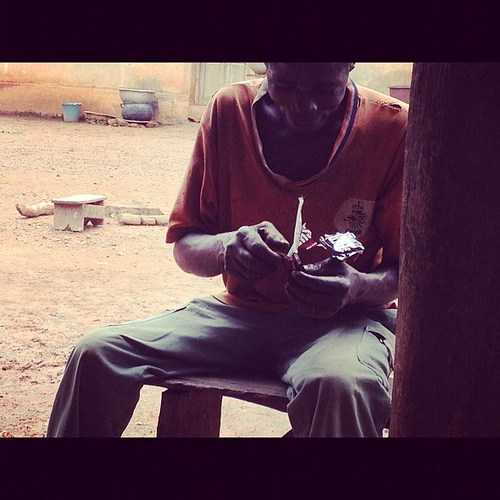
We ate chocolate and talked about AIDS.
I was surrounded by a group of young men who all work on the surrounding cocoa farms. I try to answer as many questions as I ask and they were asking me what diseases we had in the United States.
“Heart disease and diabetes and…” I named one eating related disease after the other. Diseases that chocolate plays a part in.
On the other hand all of the diseases they named involved a mosquito, “Malaria, yellow fever, dengue fever…”
There was one disease that our nations share…AIDS.
“How do you get AIDS?” I asked, curious to know how educated they were on the subject.
“From sexual contact…” one of the men answered, “…and from hair clippers.”
Huh?
They explained that cutters can knick your head and that can lead to AIDS.
That sounds like something a husband made up to his wife.
August 13, 2012
The Things We Put in Our Mouths
One is faced with the biggest language challenge of all when one is handed something to eat. All or part of that something may or may not be edible. Whether that something is a bat…

(One would think you wouldn’t eat bat tongue, but don’t tell that to Tom Neuhaus of Project Hope and Fairness.)
Or the insides of a cocoa pod…
What’s the weirdest thing you’ve eaten while traveling?
August 1, 2012
You Can Travel With ME, Thanks to the Village Experience
For years folks have been asking me if they can go with me on my adventures. Well, now you can. And since no one wants me to plan their trip (trust me) I’ve teamed up with The Village Experience, which has organized and led such trips around the world. If you’re interested in arranging a trip. Please contact Kelly Campbell at info@experiencethevillage.com. For more information keep reading…
Read the book? Inspired by the author? Excited to travel the world?
Take your common reading experience to another world by joining Kelsey Timmerman and The Village Experience on the adventure of a lifetime to one of four destinations featured in the book “Where am I Wearing – A Global Tour to the Countries, Factories, and People that Make Our Clothes.”
Cambodia – visit the cities of Phnom Penh, Siem Reap, and Angkor. Explore the Russian market, artisan cooperatives, rural communities, and historical sights. Learn about fair trade, silk production, and eco-tourism. Visit the UNESCO World Heritage Site of Angkor Wat. Meet with representatives from the Mines Advisory Group and spend time volunteering with the Cambodian Children’s Fund.
China – visit the cities of Guangzhou, Beijing, and Shanghai. Journey through the bustling pearl, silk, fabric, electronic, and antique markets to understand China’s current rise to economic power. Talk with communities involved in garment production. Stroll along the Great Wall, sample international foods, and explore the artisan villages of Foshan and Shiwan. Special visit to Dunn Global to learn about green initiatives in manufacturing.
Bangladesh – visit the cities of Dhaka, Chittagong, and Assam. Explore the Chowk Bazaar, visit the Bangladesh Tea Institute, meet with representatives from Grameen Bank, volunteer with OBAT Helpers, and trek into the hills in search of tribal woven fabrics and eco-tourism initiatives. Special meeting with fashion designer, Bibi Russell.
Honduras – visit the cities of Tegucigalpa, Comayagua, San Pedro Sula, and Tela. Learn about fair labor practices, explore local markets, talk with rural villagers, watch the coffee cultivation process, and explore the agricultural sector. Visit Garifuna Villages and the ancient Mayan ruins at Copan.
Next Steps:
1. Pick the destination
2. Choose your dates (8-12 days preferable)
3. Determine the number of passengers
4. Submit this information to TVE
5. You will get a confirmation, itinerary, and pricing within a few weeks
6. Once all details are finalized, a contract will be signed and TVE will handle all logistics of the trip
Contact the Village Experience for more information: 6055 N College Ave * Indianapolis, IN 46220 * 317-602-3696 * info@experiencethevillage.com* www.experiencethevillage.com

Kelsey with students in Honduras Spring of 2012
*Tours are arranged on a first come, first serve basis and in conjunction with Mr. Timmerman’s schedule.
*All itineraries are flexible and customizable
July 31, 2012
I was an Eagle Scout
So today is the day I’m mailing off my Eagle Scout awards to the Miami Valley Council of Boy Scout of America and the National Office. For the past few days I’ve been reminiscing about my Scout experience. I even found my Eagle application. The first paragraph includes this:
What I will major in is unknown to me at this time. I feel that I am about to reach a major crossroads in my life, and the fact that I do not know what my field of study will be is weighing on me. I enjoy writing. Science intrigues me. Business is always a possibility. I know I will find that place where I belong, my niche in life.
“I enjoy writing.” I was closer than I knew to finding my way.
One of the people mentioned having helped with my Eagle Scout service project was my cousin Brice. If you listen to the Talk of the Nation interview, I talk about Brice. He’s marrying Billy, a gay Eagle Scout. Brice and Billy, two amazing people who I’m lucky to know, are the reason I’m turning in my awards. If they aren’t good enough for Boy Scouts, neither am I.
There were also letters from my piano teacher, athletic director at my school, principal at my school, my high school English teacher Mrs. Marshall, President Clinton, Vice President Gore, and more. I have more than 50 cards from family and friends. The box bursts with badges and news clippings, pins, sashes, plaques, and even my very first Scout Book.
All of this reminded me just how big of a deal attaining Eagle was and how much fun I had along the way. The trip down memory lane didn’t make me second guess my decision, but only reaffirmed it.
Here are a few pictures from my journey…

At Philmont Scout Ranch
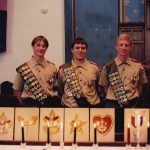

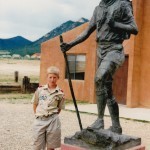
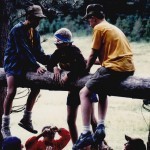
Note: Annie, my wife, looked at these pictures and said, “What did I ever see in you?” Fortunately, I got better looking.