Kelsey Timmerman's Blog, page 36
January 4, 2013
GIVING BACK IN 2012
The greatest thing you can give is your time to another.
Unfortunately I didn’t have loads of time this year to give. Between traveling for three months researching EATING, and speaking across the country, which had me away for more than 30 days, I was booked. When I did have free time, I spent it with Annie and the kids.
I simply didn’t have the time to give as much as I would’ve liked. Therefore I feel like I wasn’t the Big Brother (through Big Brothers & Big Sisters) nor the ally through Teamwork for Quality Living) that I should’ve been.
These are definitely two of my biggest regrets from 2012.
GIVING PASSION
On a much more positive note, I found a vehicle in which to give my time much more efficiently: The Facing Project. I teamed up with service-learning guru, J.R. Jamison, to lay the groundwork for a project that is really taking off. The Facing Project brings together a community’s creative resources and not-for-profits to face important issues together around a common project. The pilot project took place in Muncie (Facing Poverty). Muncie’s Facing Poverty, with the support of Teamwork for Quality Living, brought together hundreds of Muncians to face poverty from all angles through stories and monologues.
Now we’re helping other communities:
Ft. Wayne’s Facing Homelessness
A group of three college’s in Rome, Georgia
Atlanta’s Facing Human Trafficking
There are several other communities who are on the path to face an issue through the Facing Project, but a little too early in the process to announce.
J.R. and I are doing another Facing Project in Muncie in 2013.
If you are interested in starting a Facing Project in your community, email me hi@kelseytimmerman.com and like the project’s Facebook page.
Every community has a story. What’s yours?
GIVING MONEY
Here’s another fail for 2012.
Our family goal is to donate a percent of our income each quarter to local and a global causes that are important to us as a family. Unfortunately we began 2012 paying 15 months of taxes; it was our first quarter to file quarterly. This coupled with traveling to eight countries from March to August of 2012 meant that we had a healthy load of expenses the first half of the year.
Don’t worry about us. We’re doing fine.
2012 marked our first year as a stay-at-home family, and the first we’ve totally relied off my writing and speaking income. Actually this was our highest-earning year since we’ve been married. But our income is so irregular and our future income is so hard to predict that we like to maintain a larger safety net than before. So between poor tax planning, the expense of researching EATING, and building up a larger safety net, we didn’t feel comfortable giving like we had hoped.
In order to give, you have to manage your money well. We’re learning to do that better.
Scheduling monthly giving through Network for Good was something that helped us give better in 2012.
With less travel, expenses, and our safety net in place, we should have much more time, passion, and funds to give in 2013.
How did you give in 2012?


January 3, 2013
SPEAKING of 2013
[image error]I’ve been writing since 2001. I knew that I enjoyed sharing stories from the page. When WEARING came out, I started to receive requests to speak across the country.
Who likes to speak in front of a large group of people? I’ve read that some fear the stage more than death. Eek! But in 2009 I discovered that I love sharing stories from the stage almost as much as sharing them from the page.
In 2012 I got to speak a lot. I spent more than a month on the road in 2012 traveling to speak in front of some of the biggest audiences to which I’ve ever spoken. I talked to auditoriums and stadiums full of people who where there just to listen to me for an hour.
This was humbling and amazing.
I remember one event in 2009 at a local library in Indiana where three people showed up. Here’s the most surprising thing: whether three people or three thousand, I haven’t lost the sense of responsibility, joy, and passion for sharing the stories of the people I’ve met on my adventures. If you told me that I would still enjoy sharing some of these same stories, which I’ve shared hundreds of times, three years later, I would have laughed at you. But I do.
I love it and will be doing more of it in 2013. Now I have WEARING and EATING stories to share.
Invite me to speak to your group. Email me at hi@kelseytimmerman.com
Note: I’m putting a priority on being home in 2013, since I was gone so much in 2012. So I’ll be limiting the number of engagements I’ll be doing this year. This is to say that if you want me to speak to your group, the sooner you contact me the better.
January 2, 2013
A year in travel: There and back again

(An unexpected leg of a bus trip in Burkina Faso)
The first time I stepped into a developing country was in 2001 in Thailand. I was wide-eyed. My senses were overloaded. Everything was new, everything was different.
The more you travel, the less you see.
You get used to being the odd man out, and seeing odd things. I don’t think I’ve ever become jaded by travel, but I think it takes a bit more to make me awestruck, to register on my sense of wonder meter. So I was thrilled and honored to travel with students from West Texas A&M to Honduras. Seeing them seeing the world for the first time was definitely one of my 2012 highlights.
It was a great way to kick off a year of traveling that would also take me to Costa Rica, Peru, Colombia, Ivory Coast, Ghana, Burkina Faso, Morocco, and China. They reminded me why I love to travel and helped to rekindle my fascination with the world and its people.
I enjoyed the experience so much I partnered with The Village Experience — a socially responsible tour company – to offer other such trips to groups. In May I’m traveling with students from Winthrop University to Guatemala. I can’t wait!
Learn more about going on a WHERE AM I WEARING or EATING themed trip.
So far Guatemala is my only planned trip abroad, which is good because I want to be gone less in 2013.
But…
The world is big and there are a lot of stories that need telling. I aim to tell as many as possible.
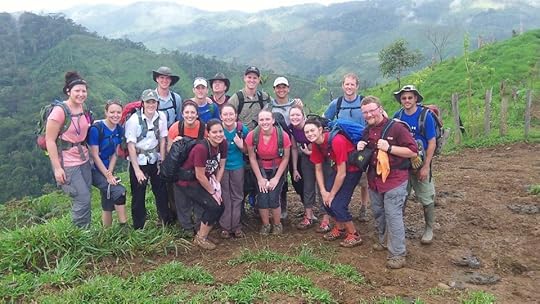
(With students in Honduras)
Writing: The year that was, the year that will be
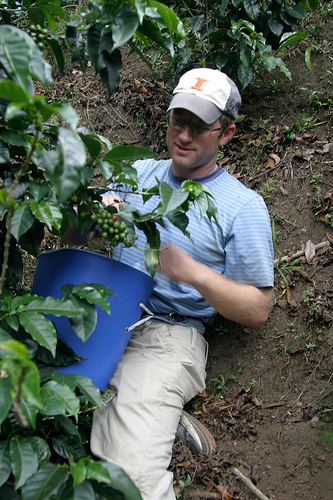
(picking coffee in Colombia)
I lived to write in 2012.
WHERE AM I EATING? AN ADVENTURE THROUGH THE GLOBAL FOOD ECONOMY
I came across some amazing stories in 2012, but to do that I had to be away too much from my amazing family. Don’t tell my editor, but I wasn’t sure if it was possible to travel to eight countries (Costa Rica, Honduras, Colombia, Peru, Ivory Coast, Ghana, Burkina Faso, China) for research for three months and write an 85,000 word book in a single year. It is. Barely.
EATING comes out April 22nd. If you want to know where I’ve been this year and where your food actually comes from, reading EATING will do both. WHERE AM I EATING was an easy book to write, but a tough one to live.
Living is the most important part of the writing process.
And by living I mean meeting interesting people, doing interesting things, and not dying in the process.
There were too many moments in living EATING that I thought I was going to die. Annie is reading about my adventures through the global food economy now. The other day she put the book down and said, “I thought you told me you were going to be safe.” However, my risks pale in comparison to the daily risks of many of the people who work to feed us.
You can preorder WHERE AM I EATING on AMAZON / BN.com / Indiebound.org
WHERE AM I WEARING?
The paperback edition of WEARING came out in April of 2012 and, in terms of sales, completely owned the first edition in a matter of months. As I’ve mentioned before, I had a lot of unfinished business that I was thrilled to have the chance to finish in the 2nd edition.
WEARING basically has been a giant F-U to the idea of the “publishing window” – books only have a finite window in which to sell upon their initial release. It took a lot of effort on my part to do everything I could to keep sharing the stories of the people I met. I also had a lot of great support from my publisher John Wiley & Sons.
I hope I get to keep sharing these stories. They have impacted the way I live my life so much.
If you haven’t read WEARING yet, you can get it at all of these places.
December 17, 2012
I’m alive…
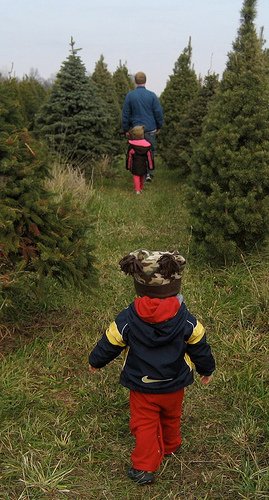
Looking for the perfect tree with the Timmerkids.
…just writing like editors are chasing me. So,no blogging for me. I’ll be back at it soon because I’m almost done with WHERE AM I EATING?
I’ll leave you with a question: Did you ask for a socially-conscious gift for Christmas or are you giving one? If so, what?
November 29, 2012
Walmart, 112 Dead Bangaldeshis, And You
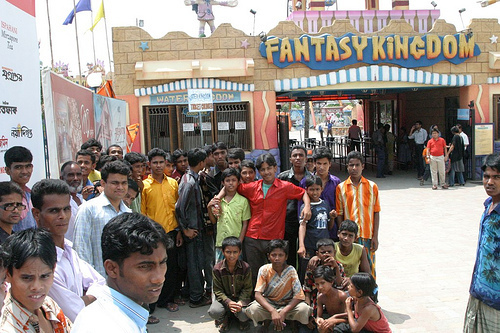
(My friends at the Fantasy Kingdom amusement park located near the site of the factory that burned on Sunday in Ashulia, Bangladesh, killing 112 workers.)
They stood at the windows of the building, 100-feet above the ground, skin boiling. Fire behind and nothing ahead.
There was no choice.
Was it more courageous to stay and burn or to jump? It takes about two-and-a-half seconds for a person to fall 100 feet. That’s two-and-a-half seconds of air cooling enflamed skin, two-and-a-half-seconds of relief before the end.
One of the advantages — and there are few — of jumping was that your family could identify your body. Eight workers jumped. Workers on the ground thought they were bails of clothing being thrown out the windows, as if that made sense, as if clothes need saving, as if they are worth more than lives.
This isn’t the Triangle Shirtwaist factory fire of 1911 that outraged the American public and helped propel labor rights forward in the United States. This isn’t then. This is now. This is 100 years after that fire. These aren’t Americans. These are Bangladeshis making products for Americans.
Twenty-nine Bangladeshi garment workers burned alive, were asphyxiated by smoke, or jumped to their deaths during the garment factory fire in Ashulia, Bangladesh, on December 14th, 2010. I wrote about the tragedy in my book Where Am I Wearing?
I visited Ashulia in 2007, and I took 19 kids and an old farmer to the Fantasy Kingdom amusement park there for the price of one ticket to Disney World ($67). Most garment workers could never afford the $3 admission on their own. I rode a roller coaster with three young garment workers, Russell, Zumon, and Habir. Habir was 18 and a five year veteran of a local garment factory. Russell went to school for six years and spoke a little English. All three were doing their darndest to grow mustaches and had a blast on the roller coaster. The day was one of the most memorable of my life.
When I learned of the 2010 factory fire, I was horrified. Were they in the fire? Did they jump?
I hoped that I would never have to ask the question again, but on Sunday it happened once more. Just like Triangle in 1911, just like 2010 — exits were locked, fire extinguishers didn’t work, and workers lost their lives in the fire or jumped to their deaths.
Many of us will wag our fingers at the brands the factory was filling orders for, including Walmart’s Faded Glory line, Sean Comb’s Enyce, and Dickies. We’ll criticize the companies for chasing lower wages (the minimum wage in Bangladesh is now $37; it was $24 when I was there in 2007). But they are just giving us what we want: cheaper prices.
The timing of the event is striking, since Friday was Black Friday, a day in which leftover-fueled Americans chased bottom dollar deals. Sales were up! This is good! A record Black Friday!
The Sunday of the fire was even blacker in Bangladesh.
I have an online friend who works for Walmart. I emailed him before Black Friday asking him what he thought of the Walmart workers threatening to strike in the United States.
Here’s what he told me:
I don’t like working 12 hours so people can trample each other to buy $4 bath towels for $1.88 or a $60 DVD player for $25.
But here’s the thing: I don’t like everything about the job, but I knew the nature of this beast when I applied for the job. And in the present economy, I feel blessed to have a job. There are changes that ought to be made. Others that need to be made, but you won’t find me on a picket line. I need a job too badly to complain.
His statement sounds an awfully lot like how we justify workers in Bangladesh earning a monthly income of $37 and having to spend almost half of that income just to feed their families rice: they need the opportunity.
In the name of lack of opportunity and poverty, we are exploiting American workers and Bangladeshi workers.
How long will we justify injustice?
We are paying a high cost for chasing low prices. As many as 80 percent of Walmart employees at some stores are on food stamps. In total Walmart employees receive $2.66 billion in government subsidies. Since 2006, 700 Bangladeshis have died in garment fires. When we demand everyday low prices, we get everyday low wages and bad working conditions. We are saving money, but are we living better?
Walmart doesn’t like unions; that’s not a secret, but the Bangladeshi business community really doesn’t like unions. Labor leaders have been killed. Worker protests for higher wages in the face of rising food prices have met violent opposition.
Here’s the thing though: If Walmart and other companies that source from countries like Bangladesh don’t want their charred labels showing up on the scenes of tragic factory fires, they need to support unions.
No amount of audits and unannounced audits or reports will improve working conditions more than an empowered workforce. Walmart has forever altered retail. Imagine what they could do for Bangladesh, for global poverty, and for American poverty if they stood with workers? Imagine if we, the American consumers, fought for justice as much as we fought for the last “doorbuster” flatscreen?
Were my friends Russell, Zumon, and Habir among the ashes? Did they jump? I’ll never know. But as long as we continue to chase lower prices at all costs, these types of tragedies will continue to happen, and I’ll have to ask these same questions again.
—-
What can you do?
Learn how to be a more engaged consumer
See how transparent your favorite brand’s supply chain is by checking out Free2Work’s report (spoiler alert: Walmart gets a D!) The Story Behind the Barcode
—-
UPDATE:
- The Institute for Global Labour and Human Rights has a first hand accounts of the fire from workers at the factory. Exits weren’t merely locked to begin with, but locked in front of the workers who were told to go back to work after smelling smoke and trying to escape. The local paper said “[The Tazreen factory] did not look like a workplace –rather, set up for confinement.” All of the The workers interviewed believe the number of those killed to be more like 200, not 112.
- Walmart has distanced themselves, saying that the factory was no longer approved as a supplier as of 2011. It is WAY common for larger factories to subcontract their work to other factories. This is a common practice that I know goes on and that Walmart knows goes on. If the practice didn’t take place, then Walmart would probably have to pay higher prices for their clothes. It’s just business in Bangladesh. I would love to see Walmart step up and take some responsibility for not having a handle on their supply chain. GAP stepped up in 2010, and now it’s Walmarts turn, along with the other companies.
- Overall, it’s in a company’s best interest to not have a firm grasp of their supply chain so they can plead ignorance. From a Reuters:
“I won’t believe Walmart entirely if they say they did not know of this at all. That is because even if I am subcontracted for a Walmart deal, those subcontracted factories still need to be certified by Walmart,” Annisul Huq, former president of the Bangladesh Garment Manufacturers and Exporters Association, told Reuters following a meeting of association members.
“You can skirt rules for one or two odd times if it is for a very small quantity, but no decent quantity of work can be done without the client’s knowledge and permission,” he said.
- As the Bangladeshi industry tries to find someone to blame, three supervisors at the factory may face arson charges. Video shows them trying to start a fire in another factory. (Not sure what setting fire in another factory has to do with the Tazreen factory.) Even if cameras caught some dude lighting the place up with a flamethrower, that is no excuse for workers being locked into a burning building.
November 27, 2012
Time is the most important gift
It’s giving Tuesday! You know ever day after Thanksgiving has to have a theme, don’t you? Tomorrow is…Wednesday?! Did we run out of themes?
Anyhow, this is the day when everyone is supposed to give to their favorite cause. Really this is something that you should do throughout the year and be very intentional about, and not wait for a post-Thanksgiving theme day or a cashier asking you if you’d like to give $1 to X cause.
Do you give when the cashier asks?
I don’t. Yes, I’m the guy in front of you at PetSmart who hates orphan puppies. I like to have more of a connection with a cause than a knee jerk reaction. I put more thought into my giving decisions than I do into what kind of gum to purchase.
Here are two tools that I use to give more intentionally and efficiently:
Charity Navigator’s Holiday Giving Guide
Give You
But the most important gift of all is giving your time to another. Volunteer! Here’s my Glocal Volunteer Guide.
How much of an impact can a volunteer have? I recently had the pleasure of working with Phictional Stoodios to tell the story of the impact one Big Brother (the LeadershipBoard.org ‘s BJ McKay) can have on the life of another.
This Giving Tuesday, give you!
November 21, 2012
Wear a shirt that changes lives
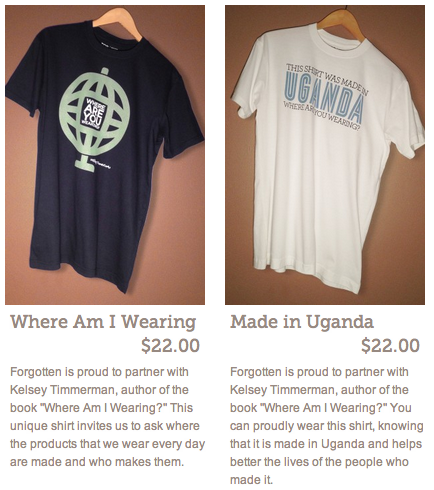
ORDER ONE OF THESE COOL SHIRTS NOW
The good folks at Forgotten Shirts have designed two “Where Am I Wearing?” inspired T-shirts. I’m a huge fan of Forgotten shirts. The shirts are sewn from Fair Trade cotton in Uganda where they provide opportunities to people who could use some. And then they are shipped to Minneapolis where 50 teenagers from poor neighborhoods work part-time to screen print the shirts and participate in a tutoring program.
From Uganda to Minnesota, Forgotten Shirts give opportunities to folks facing poverty. You can’t get more glocal than that. During a time when so many of us have forgotten about the lives of the people who make our stuff, Forgotten helps us remember. That’s a pretty cool story.
Black Friday contest: Leave a comment between now 11/21 and Black Friday 11/23 and you’ll be entered to win one of these Forgotten Shirts!
November 19, 2012
That moment when you realize that an agent wants your book
You write and you write and you write. You have so many insecurities and questions.
“Is anyone else ever going to read this?”
“Will I allow anyone else to read this?”
Deep down you think that just maybe this book that you’ve slaved away at might be something. You go to the Midwest Writers Conference. You learn to pitch an agent. You pitch one agent and then another agent, and before it’s all said and done EVERY agent at the conference is interested in your book!
Right when this sinks in, I stick a camera in your face.
Your name is Summer Heacock (aka @fizzygrrl) ,go…
After Summer’s soliloquy of squee, Jama, the workshop’s directors, says, “This is why I do this.”
Like Jama, and hopefully like Summer, the conference played an important role on my path to being a published author — I met my agent there. I’m thrilled to be on the committee of the workshop. The summer 2013 conference is July 25-27, and marks the 40th anniversary of the conference that has helped so many writers.
Pencil in that date. Follow the Midwest Writers Facebook page for announcements regarding 2013 faculty. But most of all keep writing and writing and writing…
November 17, 2012
Green Festival LA Today
As reported in the LA Times (!!!!), I’ll be speaking at the Green Festival today alongside Chris Yurba of Sustain U. So, if you are in the area, stop in. You can come for free. Just tell them at the entrance that you are one of the speaker’s guests and then tell them you are my guest at the registration table.
Find me and I’ll buy you an organic beer or Fair Trade coffee.
Free entrance, free beer. How’s that for brightening a rainy Saturday in LA?