Kelsey Timmerman's Blog, page 42
May 7, 2012
Creative writing major ignores profs, publishes
Each year I try to work with a college student who has an interest in writing. They help me manage some of my workload, research, and proof my work. C.M. (Chris) Humphries helped me last year, and this year he has a book out — Excluded. Congrats Chris! I asked Chris to write a post addressed to college creative writing students and share what he learned on his path to publishing his first book.
All These Stories & No One to Tell Them To
While I was still an undergraduate student, I never knew what to do with my writing. I cannot even guess at how many writing courses I took, whether under my telecommunications major or my creative writing minor. No matter which style of writing I was assigned to, it seemed like I was crafting a new story every day.
It was great to have so much material piling up, and sometimes the workshops were enlightening (although in most cases, my peers hadn’t bothered reading any of the material), but there was nothing to do with it. Although I always thought my writing could be better, there was definitely prose I wanted to publish.
But where to start?
I figured the best thing to do was inquire from those who’d already published their works—professors. Interestingly enough, most of them said not to. They wanted me to attend a MFA program before I ever considered writing.
What a pipe-bomb! At first, I thought maybe I just sucked. Maybe they read my material and thought, Man, this guy is awful. Soon enough, though, I came to realize they were telling all of my peers the very same thing.
Doing What They Said Not To Do
Now I definitely had no intention on dismissing my professors’ advice, but publishing was the very thing I wanted to do.
I’d been writing novels since high school. In my room, I had about three novels I spent years on, redrafted, but never sent out. Maybe down the road I’d rework one, but even before all of the creative courses, I knew what bad literature looked like.
But I did have some stories I thought people would enjoy. Excluded wasn’t the first novel I wrote—I think it was the third—but it definitely had something to it. I pulled Excluded out of the pile and wrote about three more drafts of it. I had my dorm-mate at the time review it (he was the biggest cynic I knew), and he sampled the story. “I don’t think this will work for a class, but it’s damn creepy.”
Once I had a clean draft, I brought it to a few professors and asked them what they thought, while reminding them it was horror (genre fiction is often shunned in literary circles). All they really told me was, “Why horror? It’s well-written, but it’s genre fiction.”
At this point, I knew I had to draw my own conclusions. I was urged not to publish because a) I wrote mainstream fiction and b) I had not attended MFA workshops. That’s when I started gathering criticism from people I knew personally and trusted to rip me a new one if my stories sucked. Overall, Excluded was definitely giving people nightmares.
I was certain I wanted to publish Excluded, but I was new to publishing world. I didn’t want to jump in and query agents and New York publishers until I procured a bit of publishing insight. I started looking at the works my professors published.
Now there were definitely some professors with pretty big publishers. A lot of them, though, were with independent presses. I wondered if I could see that level of success without a MFA.
Before long, I landed a contract for Excluded. Since then, it’s been a fun ride. I’ve learned a lot more about the publishing industry than I ever thought I would. I never realized how much leg work is expected from an author, but it’s all enjoyable.
From time to time, though, I receive some curious brows and dismissing stares. Some people just won’t accept a work of fiction as valid unless your name has a MFA tagged to it. The thing is, you don’t really need to go through all the workshops to find success in writing. The rules are quite simple: read and write. Write every day. Challenge yourself. Use prompts when you have to (there’s no such thing as writer’s block).
To be honest, a MFA program may still be in my future. I like the idea of being a professor, and I loved the ones I had. To be fair, some of them were really behind the Excluded deal and gave me the go-ahead. With writing, there’s no one way to do it. I mean, if you’re writing for the first time, definitely learn the craft. If you suck, you suck—but you can get better! If you don’t write often, you should probably write and rewrite extensively and ask for feedback before you send anything out.
Most importantly, remember your aspirations when you face rejection. Rejection letters are by far the best starting point for a writer. You’ve read a lot. You’ve written a lot. But why did they say no? All you have to do is focus on what they accepted. Research a bit if you need to. Read a lot more. You’ll instinctively notice the difference between your writing and the next guy.
If you believe in your writing, travel where it takes you. A MFA next to your name will demonstrate you’re quite good at what you do, but so will a great story.
Like what you read? Read more from C.M. Humphries at his blog.
And don’t forget to check out Excluded on Kindle…


May 4, 2012
People aren’t proprietary information
I’m at it again. Calling brands, working the corporate phone chain, sending emails, filling out contact forms, and in general not getting anywhere fast.
I’m working on a new book project – WHERE AM I EATING – out in the spring of 2013. In March I was in Costa Rica working as a banana worker and soon I’ll be on a coffee farm in Colombia.
Whole Foods and EARTH University worked with me to arrange my banana farm visit and I’m so grateful. There you have two major institutions kind enough to help me. Awesome! But that’s not always the case.
The other day I received an email from a food brand that you are definitely familiar with. Most of you probably have one of their products sitting next to your computer as you read this. The email was a response to a note I had sent asking for them to point me to the farms/farmers that produce the main ingredient for their products. Their email stated that names and locations of farms are “proprietary information.”
That’s the standby excuse. It has been for decades. “If we tell you, then our competitors will know and we could lose our competitive advantage.” NIKE used this excuse, but today NIKE reveals the names and addresses of all of their factories. How have they survived? [Check out the NIKE link. They source from 48 countries, 903 factories, and their products are made by more than 1.1 million people.]
If we’re allowed to know where our shoes come from, shouldn’t we be allowed to know where our food comes from?
One of the best examples of a transparent supply chain just keeps getting better; Patagonia’s Footprint Chronicles, which I mention in the new edition of WHERE AM I WEARING?
, has just been expanded and updated. You can see all of Patagonia’s suppliers and virtually visit them.
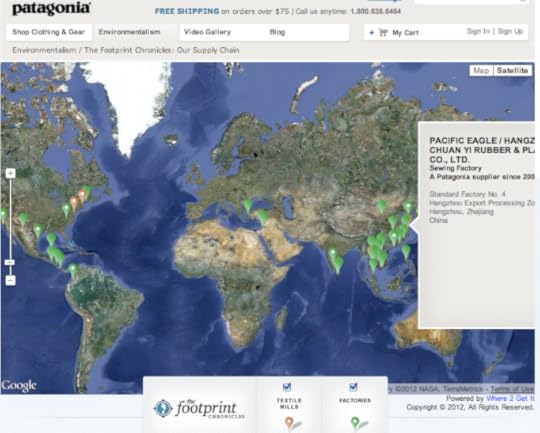
This is the future of producer–brand–consumer relations. The veil is being lifted. I have Facebook friends that work at factories in the developing world. The arc of the future bends toward transparency. Any company that refers to their farmers or suppliers as “proprietary information” is going to fall behind.
May 3, 2012
How To Do Colombia Like A Secret Service Agent
I’m heading to Colombia soon to hangout with coffee farmers, so I’ve been searching for a guidebook. Moon, my guidebooks of choice, doesn’t have one for Colombia, and Lonely Planet’s guide was last updated in 2009, which means the info probably came from 2008 at the latest.
I really had to search Amazon before I found Colombia Handbook, 4th (Footprint – Handbooks)
, which I ultimately purchased. In the process I found a couple of guides the Secret Service agents must’ve used or written:
Men’s Guide to Colombia 2010

Bang Colombia

In the Introduction (it was in the “look inside” section on Amazon; I didn’t buy it!) the author mentions that Colombia is leaving its FARC, hostage, drug problems in the past and is now starting to see an influx of tourists. It argues that this is exactly why you need to get there soon and start banging Colombian women.
…the last thing you want is to meet a girl who is already experienced with banging and playing gringos. To get the best of Colombia women you want to be one of her first gringos so the relationship will be fresh and novel.
Can you believe this crap exists and that it has 17 review?!? Thanks self-publishing!
On behalf of all traveling Americans, if you buy one of these books, please stay home. And on behalf of all Americans my apologies for the behavior of our Secret Service agents.
If you’re shopping for a guide for an upcoming trip, here’s an old travel column I wrote:
Misguided: The search for a guidebook
By Kelsey Timmerman
“The Kauai International Hostel has a laidback atmosphere, a friendly staff, and a quaint setting.” So says my guidebook.
After a one-night stay, allow me to translate this guidebook-ese bologna. A “laid back” atmosphere means that guests are passed out in the lawn, playing pool in the common area, sipping on 40-ouncers while listening to the Grateful Dead.
The “friendly staff” consists of live-in, 30-something, social outcasts who exit out of a room choking on, and wafting, a haze straight out of a Cheech and Chong movie to greet new arrivals. They are friendly enough, but unable to make change – and by this I mean they have the money, but are unable to count.
College keggers are quainter.
This hostel is the only place in all of my travels where I have had something stolen. It wasn’t money or my camera. It was my socks! What kind of person steals a fella’s socks? What possibly could a bunch of barefoot, drunk, high, hippies want my stained, stretched, newly-washed-but-still-smelly, socks for?
It wasn’t the first time or the last that I would be misguided by a guidebook.
When shopping for a guidebook the first thing you should look at is the copyright date. Make sure that the guidebook was published within the last few years. Keep in mind, even if the book is a brand new edition most of the information is at least a year old already.
Something that I take in consideration with every item that makes its way into my luggage is weight. I have a guidebook that covers the entire continent of Europe. That’s about 40 countries worth of info from where to stay to what to eat. It’s more of a brick than a book. Sure, it provides me with some unique uses (bicep curls), but all things considered it may not be worth its weight in underwear. The book equals about 15 pairs. Which would you rather have, more than three pairs of skivvies or info on the best time of day to visit The Baked Bean Museum of Excellence: The Home of Captain Beany in Wales?
Regardless of how objective and definitive guidebooks present themselves, they are written by overworked authors with likes and dislikes that are probably much different than your own. Check out the author bios at the beginning or end of the book. Does the author have similar interests as you? Personally, if the bio mentions anything about the author’s fondness for clubbing or massages at day spas, I may want to look elsewhere since my sole dance move is the coffee-grinder and I am terribly ticklish. Guidebooks written by people who enjoy the outdoors are a better fit for me.
There are two types of guidebook authors: those with an abundance of local knowledge and those who travel to a location solely for the purpose of researching and writing the book. Let’s say that you are visiting Bosnia and you want to go for a hike. Much of the Bosnian countryside is littered with landmines from the war in the 1990’s. Which type of author do you want to trust?
Me, I’ll go with guidebook authors like Tim Clancy, author of the Bradt Travel Guide to Bosnia. I met Tim in a restaurant in Sarajevo. He came to the Balkans in 1992 to assist with the relief efforts during the war and never left. He operates Greenvisions, an eco-tourism company. He was in the process of writing his guidebook when I met him and he recommended an itinerary for my stay in Bosnia. He drew excellent maps on restaurant napkins of some first-rate local hiking trails. Tim had hiked every trail he recommended and knew for a fact they were safe. I was blown away by the scenery of the trails, not the land mines, thanks to Tim’s local knowledge.
For the most part, guidebook accuracy is not a question of life or death, but they can heavily influence decisions that will make or break your trip. I find it best to supplement guidebooks with first-hand accounts and recommendations from other travelers. On-line you can find up-to-date, destination-specific, open-forums on Lonely Planet’s Thorn Tree (http://thorntree.lonelyplanet.com) and the BootsnAll Boards Virtual Tourist (www.virtualtoruist.com) is also worth visiting to read destination guides written by its members, over 650,000 strong.
Don’t forget that in guidebook-ese sometimes “laidback” means pot parties, a bad guidebook may cause you to have your socks stolen or lead to your stepping on a landmine. But most of all, remember that often the most memorable travel experiences are not found in the pages of any guidebook. Of course, an exception to this is The Baked Bean Museum of Excellence: The Home of Captain Beany.
April 26, 2012
Kelsey’s Closet: Alta Gracia
To celebrate the release of the new updated and revised edition of Where Am I Wearing? I’m celebrating apparel companies that are making a difference by conducting two weeks of giveaways. Each day I’ll highlight a company and then giveaway an item of theirs at 9PM (ish). To enter, leave a comment in that day’s blog post or on Facebook. Winner will be randomly selected. Wanna see more clothing companies changing the world? Visit Kelsey’s Closet.
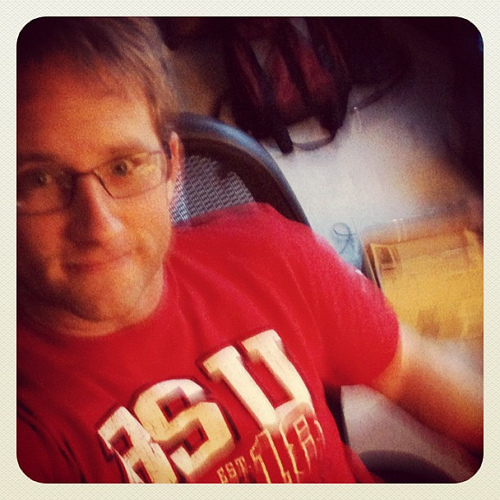
Rocking my Ball State Alta Gracia shirt
Leave a comment in this post for a chance to win a shirt from Alta Gracia
One of the best stories to develop in the garment industry since the 1st edition of Where Am I Wearing was released is the rise and success of Alta Gracia. I was thrilled to talk about the good work they are doing by connecting garment workers in the Dominican Republic to students in the United States in the new edition. To make their induction into Kelsey’s Closet, here’s an excerpt from the new edition.
From the closing chapter of the new edition of Where Am I Wearing?
The apparel industry has a lot of issues, including child labor and sweatshops, but these are all just symptoms of the real problem: poverty.
There’s a reason a single mom of three children in Bangladesh will work for $24 per month. There’s a reason a young woman in Cambodia will pay a month’s wages as a bribe to land a job. There’s a reason a worker in China will clock out and go back to work for free instead of telling his boss to shove it. They all have an extreme lack of options—because they all live in poverty.
New York Times columnist Nicholas Kristof agrees, and wrote in a January 14th 2009 column: “. . . sweatshops are only a symptom of poverty, not a cause, and banning them closes off one route out of poverty.” But I’m not so sure about his assessment that working in a sweatshop is a route out of poverty. It might be for some, but working in a garment factory wasn’t a route out of poverty for Nari or Ai or Arifa or any worker I’ve ever met (most of whom are no longer garment workers five years after I met them). Their situations haven’t improved. Amilcar looked at his family’s needs, assessed his career as a garment worker, and decided to take his chances traveling north into an unknown future. A job at a “sweatshop” might be the best of a host of not-great opportunities, but it rarely does more than keep people just on the edge of extreme poverty.
Kristof claims that developing countries need more sweatshops. But I disagree. Developing countries need more jobs like those at soleRebels and Alta Gracia, jobs that allow parents to send their kids to school. The garment industry has huge—relatively untapped—potential to fight poverty.
Bethlehem projects that soleRebels (here’s link to my radio report on soleRebels) will have 300 full-time employees by 2015. Let’s say that every worker at soleRebels has six kids (based on Ethiopia’s fertility rate). This means that over 1,800 kids will be supported by jobs at the company by 2015. The workers, with the help of the company, are able to send all six kids to school. And since these kids have an education, they don’t grow up to be shoemakers. They do something that pays better, and they send their six kids to school. By the third generation, the 300 jobs at soleRebels will have impacted 64,800 people. Within six generations, the jobs will have impacted over two million.
I realize that this calculation might be a bit oversimplified, but my point is that a job, a good job, has an exponential impact.
Another brand that is changing lives is Alta Gracia, a brand manufactured in the Dominican Republic that makes T-shirts and sweatshirts for university bookstores across the country. They pay their workers a living wage, which happens to be three times the average wage at other such factories in the country. They are open to the workers unionizing, and allowing me to work alongside their employees on the factory floor. Actually, when I made my request, the brand’s parent company, Knights Apparel, wasn’t the only group that decided it would be okay. The workers liked the idea, too. I’m hoping to take them up on the job offer someday.

The fact that they are this open is simply amazing—as is the fact that I’m not the only one they’ve invited to their factory. Alta Gracia’s union regularly receives visitors at the factory and has Skype calls with American students. The Worker Rights Consortium also regularly visits the factory and checks the pay-records at least once per week.
The New York Times reported on Alta Gracia from the Dominican Republic on July 17th, 2010:
Sitting in her tiny living room here, Santa Castillo beams about the new house that she and her husband are building directly behind the wooden shack where they now live.
The new home will be four times bigger, with two bedrooms and an indoor bathroom; the couple and their three children now share a windowless bedroom and rely on an outhouse two doors away.
Ms. Castillo had long dreamed of a bigger, sturdier house, but three months ago something happened that finally made it possible: she landed a job at one of the world’s most unusual garment factories. Industry experts say it is a pioneer in the developing world because it pays a “living wage”—in this case, three times the average pay of the country’s apparel workers— and allows workers to join a union without a fight.
“We never had the opportunity to make wages like this before,” says Ms. Castillo, a soft-spoken woman who earns $500 a month. “I feel blessed.”
“It’s a noble effort, but it is an experiment,” Andrew Jassin, co-founder of Jassin Consulting, an apparel industry consultant, quoted in the same story. “There are consumers who really care and will buy this apparel at a premium price, and then there are those who say they care, but then just want value.”
You’re a consumer. Do you care?
(end of the excerpt, now this is me today)
Today, Alta Gracia is more than an experiment. Notre Dame just unveiled their official shirt, made by Alta Gracia, for the 2012-2013 football season and their book store announced they hope to carry $500,000 of Alta Gracia apparel in the near future.
Alta Gracia is succeeding, and with each T-shirt sold, they are proving that consumers do care.
Leave a comment in this post for a chance to win a shirt from Alta Gracia
Channel One’s report on Alta Gracia:
April 24, 2012
Kelsey’s Closet: {R}evolution Apparel
To celebrate the release of the new updated and revised edition of Where Am I Wearing? I’m celebrating apparel companies that are making a difference by conducting two weeks of giveaways. Each day I’ll highlight a company and then giveaway an item of theirs at 9PM (ish). To enter, leave a comment in that day’s blog post or on Facebook. Winner will be randomly selected. Wanna see more clothing companies changing the world? Visit Kelsey’s Closet.

Leave a comment in this post for a chance to win a Versalette from {R}evolution Apparel
An email from Shannon Whitehead of {R}evolution Apparel from 10/27/10:
Hi Kelsey,
This is Shannon from @RevApparel (via Twitter). I started reading “Where Am I Wearing?” yesterday and have to tell you, I’ve flown through it. I’ve found it so interesting and very pertinent to what I’m currently pursuing.
My business partner, Kristin and I are currently in Antigua, Guatemala, learning Spanish and putting the finishing touches on our business plan. We’re going down to Nicaragua in two weeks to start a fair trade apparel line with one of the cooperatives down there. All the cotton with be locally grown, the employees paid a fair and sustainable wage, as well as healthy working conditions.
Shannon continued on to ask me if I had any advice for her and her business partner Kristin Glenn about how to visit a typical garment factory. I told her that I doubted that they could get into the factory, but they could wait outside and meet workers. I even sent her a photo of Amilcar and asked if she would be interested in trying to find him. She was, but it didn’t work out in their schedule. (It turns out he was in California, so I’m glad they didn’t try!)
Anyhow, I get quite a few emails like this: An individual or a few individuals are starting X apparel company and they want to pick my brain about socially responsible sourcing.
I always try to follow up and offer my two cents. They send me a few follow up questions and then the conversation ends and no one ever hears from the budding company again. I supposed most of them don’t make it. It can be tough starting up a business, let alone one that involves sourcing in a developing nation. Most don’t have a lot of money and it’s hard to win the attention of a factory to work with. That’s probably one of a thousand reasons that the company doesn’t work.
(You might remember Shannon and Kristin from their guest post last year – 6 Clothing Companies Every Engaged Consumer Should Know About“
On November 17, 2011 Revolution Apparel introduced their signature piece to the world. The Versalette can be worn 15 different ways (scarf, shirt, skirt, dress, head wrap, etc), and would be made in the United States of 100% recycled material (they never did find a factory to work with in Central America). They didn’t have the funds to go into production so they turned to Kickstarter. They launched a Kickstarter campaign to raise $20,000. If they reached their Kickstarter goal, they would be able to go into production. If they didn’t reach it, well, they’d probably find some other way.
By December 22nd, they raised $64,246 from 796 backers! Today Shannon and Kristin and their company Revolution Apparel are about to ship their first order of Versalettes and will be launching a collection of 10 other versatile pieces later this year.
They’ve documented their journey on their blog. It hasn’t been easy, but they never gave up. They started with the right questions and lofty goals :
We were determined to do it right – we wanted to create a business that preserved the environment, cut down on pesticide and chemical use, and said “no” to the exploitative labor that keeps our clothing cheap in the Western world.
We wanted to create a business that was beneficial for every single person involved.
At the time, we didn’t realize that attempting to do “good business” in the fashion industry is one of the tallest orders you can ask for.
I don’t think the Versalette is versatile enough for me, a dude named Kelsey who lives in Indiana, to wear. Still, I love their mission, the way they’ve done things, and have enjoyed following their journey every step of the way. I can’t wait to see what they do next.
Leave a comment in this post for a chance to win a Versalette from Revolution Apparel
April 23, 2012
Kelsey’s Closet: Ethix Merch
To celebrate the release of the new updated and revised edition of Where Am I Wearing? I’m celebrating apparel companies that are making a difference by conducting two weeks of giveaways. Each day I’ll highlight a company and then giveaway an item of theirs at 9PM (ish). To enter, leave a comment in that day’s blog post or on Facebook. Winner will be randomly selected. Wanna see more clothing companies changing the world? Visit Kelsey’s Closet.
Leave a comment for a chance to win an Ethix Merch “Sweatfree Baby!” onesie (organic, made in USA, Union Made) see it here
I walk off the stage. People are clapping. A professor takes the mic and has me stop.
“Kelsey, you are amazingly handsome, pleasingly humorous, and highly interesting.” (Okay, so this is a somewhat fictionalized composite. The litany of praise isn’t normally so long or adverbial, but this next part has happened a lot.) “And as a token of our gratitude, we got you a little something.”
She hands me a gift bag. Inside there is a coffee mug, some pens, and a shirt that she wants me to hold up.
I just spent the past 45 minutes talking about the connection that has been lost between producer and consumer and that we all need to start thinking more about how our purchasing decisions impact the lives of others. We all need to be more engaged consumer.
We pose for a picture with the shirt, and that’s when it dawns on her, “Uhh…. I’m not sure where it was made.” She laughs nervously, afraid that I might check the tag and know something awful about the brand or the shirt’s country of origin.
I don’t. I say thanks.
Many universities and businesses are focusing on their environmental and social impact these days, yet when it comes to buying the cheap schwag they giveto students, clients, and guest speakers, not much thought goes into who, where, or under what conditions the schwag was made.
More and more consumers are looking how to incorporate their values and ethics into their purchasing decisions. We buy some fair trade coffee here, an organic cotton shirt there. But the organizations we belong to buy thousands of this, thousands of that. If we could get them to be more conscious consumers, they could really make an impact.
That’s where EthixMerch comes in. From their site:
Balancing ecological issues, fair trade and international solidarity in a fully globalized world is a complex task. Our intention is to provide you with the tools to make conscious choices, choices that make it possible for you to use your buying power to support workers and protect the environment.
All of their products have at least one of the following labels: Union Made, Locally Made USA, Fair Trade, Eco-friendly. And they have loads of products, everything from Made in USA temporary tattoos to golf gear. Pretty much everything you’ve ever had dumped into your schwag bag or been given to you with an organizations logo on it, EthixMerch.com has found a supplier that meets at least one of their four labels.
They even have onesies for babies! As the parent of two kids, one of who is still rocking the onesies, you can never have too many onesies.
I don’t mind when the “Ah crap, I’m handing a shirt from God knows where to the Where Am I Wearing guy” moments happen. But what’s really cool is when someone hands me some schwag and they tell me the story of it: Where it was made, the research they did, and all of the thought that went into the purchase.
Recently, I met with Melinda Messineo the director of Ball State University’s Freshmen Connections program. Ball State is using the new edition of Where Am I Wearing as their freshman common reader book this fall. She handed me a Ball State traveling coffee mug that all incoming freshmen will be given alongside my book. She told me about all of the thought and effort that went into deciding what to give the freshmen. They finally decided on this biodegradable mug made in Indiana. How cool is that?!
All of my stuff doesn’t have to be made in Indiana or the USA for that matter, or biodegradable, but I was so excited to see the effort that Melinda and her committee put into this decision.
When it comes to schwag, it’s not just about what’s given. It’s the thought that counts.
If your boss gives you the task of buying some cheap pins or T-shirts, contact the Merchant Adventurers (I love that job title!) at EthixMerch to help your organization practice what it preaches.
Leave a comment for a chance to win an Ethix Merch “Sweatfree Baby!” onesie (organic, made in USA, Union Made) see it here
April 20, 2012
Kelsey’s Closet Giveaway: Cotton of the Carolinas
To celebrate the release of the new updated and revised edition of Where Am I Wearing? I’m celebrating apparel companies that are making a difference by conducting two weeks of giveaways. Each day I’ll highlight a company and then giveaway an item of theirs at 9PM (ish). To enter, leave a comment in that day’s blog post or on Facebook. Winner will be randomly selected. Wanna see more clothing companies changing the world? Visit Kelsey’s Closet.
Enter a Comment below to win a shirt
They’re bringing cotton back
Farm, gin, spin, knit, finish, cut, sew, print, and dye. That’s what it takes to make a T-shirt. And Cotton of the Carolinas is happy to introduce you to everyone on each of these steps. Cotton of the Carolinas is the most transparent apparel company I’ve ever seen.
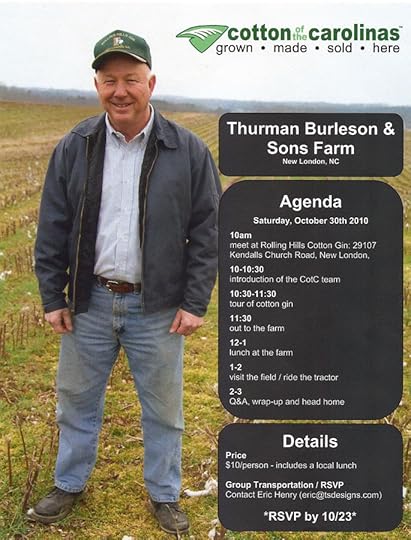 Want to talk to the farmer who grew the cotton for your T-shirt? Well, his name is Ronnie Burleson and Cotton of the Carolinas has his phone number and email address on their site. AMAZING! Ronnie lives outside Richfield and is a 3rd generation farmer and one of the first to bring cotton back to the area in 1991. Today he farms alongside his brother Dennis, son Andrew, and nephew Aaron.
Ronnie’s nephew Wes Morgan (New London, NC) does the ginning . Mark Leonard (Thomasville, NC) at Hill Spinning does the spinning. Mortex Apparel a family business run by Brian Morrell (Spring Hope, NC) and Started by his father in 1984 cuts, knits, and sews the shirts. Kenny Hoyle (Statesville, NC) over at MoCaro Dyeing and Finishing oversees the dyeing and finishing. And my buddy Eric Henry and Tom Sineath at TS Designs (Burlington, NC) print the shirts.
You can meet them all on the Harvest ’10 interactive map.
All of these efforts equal the most comfortable organic T-shirt I’ve ever worn. They are amazing! I should email all of the folks involved producing my shirts thank you notes. But as great as the shirts are, I get more excited about the transparency involved in their creation. Also, everyone is from North Carolina, which holds a special place in my heart, since Annie and I lived there for a few years.
The most local T-shirt in the world
A typical T-shirt might travel 17,000 miles on the global supply chain. A Carolina Cotton shirt travels from dirt to shirt in under 750 miles and employees over 700 people. It just might be the most local T-shirt in the world.
Every Fall I get an invitation from Eric Henry at TS Designs to attend their harvest celebration. One of these days I’m going to take him up on the offer. Watch the video below and tell me you don’t want to sit on a front porch with Eric and Ronnie Burleson and throw back a couple of cold ones (beer or iced tea), and talk about farming and cotton and T-shirts with maybe a little blue grass playing in the background!
North Carolina has a long history with the textile industry and it’s great to see folks keeping the tradition alive.
They have a couple of great designs available for purchase. And any group that works with environmental issues or is looking to lessen their carbon footprint can request a quote.
Enter a Comment below to win a shirt
April 19, 2012
Kelsey’s Closet Giveaway: Forgotten Shirts
To celebrate the release of the new updated and revised edition of Where Am I Wearing? I’m celebrating apparel companies that are making a difference by conducting two weeks of giveaways. Each day I’ll highlight a company and then giveaway an item of theirs at 9PM (ish) EST. To enter, leave a comment in that day’s blog post or on Facebook. Winner will be randomly selected.
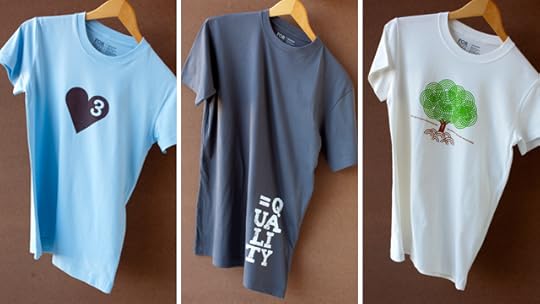
Enter a Comment below to win a Forgotten Shirt
A Glocal Shirt
“I received my Kony Kit yesterday and I noticed that the tshirts are made in Mexico. I’d just like to know your opinion on it! Thanks!”
That’s a note I received from a student the other day. The “Kony Kit” she mentions refers to the $30 kit, including a bracelet, T-shirt, action guide, stickers, and poster that Invisible Children was selling (it’s sold out) as part of their Kony 2012 campaign. The campaign’s goal is to raise awareness about Joseph Kony. Kony is the head of the Ugandan guerrilla group, the Lord’s Resistance Army, and infamous for his use of child soldiers. You’ve probably heard of the Kony 2012 campaign. The video that launched it is considered the most viral video ever. It was kinda big news and stirred up quite a debate.
My response:
“Wouldn’t it have been great if the shirts were made in Uganda? I know a tshirt company there.”
Forgotten shirts doesn’t own the factory in Uganda, but they support it. Know who else has supported the factory in the past? Bono, that’s who. Bono’s clothing company Edun placed an order that launched the Phenix garment factory in 2007. It was Bono’s goal to support jobs in Africa and the garment industry is typically one of the first industries to emerge. (Note: Edun has since moved some manufacturing to China. Hmm.)
My point to my Facebook buddy is that Invisible Children is all about helping Uganda recover from years of violence and war and there are few things that combat both of these better than jobs; good ones that allow parents to send their kids to school. Here’s the really odd part, Invisible Children along with Edun established the Conservation Cotton Initiative in 2008 to help cotton farmers. Tell me again why they didn’t buy shirts made from the cotton grown by the farmers they support?
T-shirts are used to spread our messages and our causes. Race for the cure and get a T-shirt. Give blood and get a T-shirt. Do good things and get a T-shirt, but how often do the stories of these shirts line up with the message of the organization using them?
I talk a lot these days about thinking and acting globally and locally, about going glocal. That the local goes global and the global goes local. Our actions here impact the lives of people around the world and their actions impact our lives. Few items of clothing capture the essence of glocal than a Forgotten Shirt.
The Global
As I mentioned before my Bono/Invisible Children tangent, Forgotten Shirts are made from Ugandan Fair Trade cotton and sewn at the Phenix factory in Kampala Uganda. In a place where exports are low and unemployment can push 90%, an order for something, anything from somewhere else is a big deal. A job has a bigger impact than a sticker.
A Forgotten Shirt supports Ugandan farmers and garment workers.
The Local
The shirt is shipped to Minneapolis where 50 teenagers from poor neighborhoods work part-time to screen print the shirts and participates in a tutoring program. College becomes a possibility.
From Uganda to Minnesota, Forgotten Shirts give opportunities to folks facing poverty. You can’t get more glocal than that. During a time when so many of us have forgotten about the lives of the people who make our stuff, Forgotten helps us remember. That’s a pretty cool story. Check ‘em out.
April 18, 2012
Kelsey’s Closet Giveaway: SustainU
To celebrate the release of the new updated and revised edition of Where Am I Wearing? I’m celebrating apparel companies that are making a difference by conducting two weeks of giveaways. Each day I’ll highlight a company and then giveaway an item of theirs at 7PM (ish). To enter, leave a comment in that day’s blog post or on Facebook. Winner will be randomly selected.
Enter a Comment below to win a SustainU Shirt
You’re T-shirt is dirty.
It’s covered in water. According to SustainU, today’s induction into Kelsey’s Closet, it takes over 40,000 liters of water to make one shirt. By 2025 two-thirds of people in our planet will live under water-stressed conditions.
It’s dirtier than steel. Between manufacturing and transportation, the average shirt contributes air pollutants that weigh 12 times more than the shirt. Manufacturing a shirt releases 6 times more air pollutants than manufacturing an equal amount of steal.
It’s covered in gas. One XL polyester shirt uses 2 gallons of gas.
It’s cancerous. The inks in most shirts have a known carcinogen.
And guess how many pounds of clothes the average American throws away each year. Seriously, guess. Here’s an ellipsis for you think of a number…
Here’s another one …
Got it? The average American throws away 68 lbs of clothing each year! So take all of the crazy numbers above and multiply them by 68 (that’s if each shirt weighs 1 lb; they weigh less). You’re throwing away 2.72 million gallons of water and 136 gallons of gas.
Now I’m pro-environment as the next guy, but I’m more anti-me-being-naked. I’m not going to stop wearing clothes. So what can we do?
Recycle.
SustainU is doing just that. They are turning yesterday’s discarded cotton and plastic bottles into today’s T-shirt and sweatshirts. Now their garments still make an impact on our world, just less of one. They reduce the gallons of gas per shirt by half a gallon, release 12 kilograms less of carbon-dioxide per shirt, and save half-a-pound of clothing from a landfill.
One of SustainU’s slogans is “Change your shirt, change the world.” I have to admit that I thought that was a bit over the top when I first heard it. I believe that we aren’t going to shop our way to a better world. But after learning more about how many resources one shirt uses and how much pollution it creates, I see what they’re talking about.
Part of Sustain U’s magic is that their products are made in North Carolina, Tennessee, and South Carolina. These states were once strongholds of the American textile industry, but now that only 3% of clothes are made in America, and countless textile factories sit empty. They are employing American textile workers and sewers.
I’m not one to say that you should only buy Made in America products, but I like having a choice. Sustain U sent me a shirt. It reads: Rebuilt in America. I once saw a shirt at the Detroit airport that read: “Imported From Detroit.” It was Made in Egypt! Where that shirt missed the mark my Rebuilt shirt hit it.
Sustain U is the real deal. Shirt-by-shirt they are rebuilding our clothes. And while the garment industry is largely gone, they are providing very real jobs to American workers.
Our T-shirts change the world more than I ever imagined.
Enter a Comment below to win a SustainU Shirt
April 17, 2012
Kelsey’s Closet giveaway #1: Rain Tees

Leave a comment to be entered to win a Rain Tee
If you hate rain forests and kids’ drawings, stop reading. Otherwise you’ll love Rain Tees.
Rain Tees donates school supplies to children living in endangered rainforests and asks them to document what they see. They draw things like the one below. 
As described on the Rain Tees site…
Sadly, as shown in “Tree of Life” (right), drawn by 11-year-old
Mariela of Peru, we see a tree crying leaves and fish laying
dead in a stream due to oil drilling and agricultural pollution.
People in Amazon villages like Mariella’s often die of disease
as their food supplies become polluted and the endangered
wildlife around them slowly die off.
Other children in countries such as Ecuador, Brazil, and
Costa Rica show us similar scenarios in their drawings.
No, Debbie Downer, I don’t think you can get that picture on a T-shirt to wear to your nephew’s birthday party.
“Happy Birthday Stevie!”
“Aunt Debbie, what’s on your shirt?”
“Oh just the tree of life weeping leaves at all of the animals that will die because your mother isn’t recycling the paper birthday plates.”
But seriously, images like this are what Rain Tees seeks to eliminate. How depressing is that given a blank piece of paper Mariella in Peru drew that?
[image error]Typically a child draws a picture of something like a toucan. Rain Tees takes that picture and puts it on an organic T-shirt using environmentally friendly inks. A family that lives just outside a rainforest in Peru makes the shirts. (correction: Rain Tees were originally made in Peru but are now made in USA.) The child’s name and where they are from are also printed on the Made in USA shirt. For every shirt sold, Rain Tees plants a new tree in the rainforest.
How’s that for a shirt with a story? Pretty awesome!
Beth Doane, the founder of Rain Tees, has been mobilizing kids to fight for rainforests since grade school. When she was eight, she convinced her classmates to donate their lunch money to save the Amazon rainforest. That got her sent to the principal’s office. Now she travels the world giving, educating, and connecting.
Her stories from the front lines of the Ecuador/Chevron lawsuit are heartbreaking and inspiring. I’ve known Beth for a few years and she constantly inspires me. Watch her recent TEDx talk below and be inspired too.
Leave a comment to be entered to win a Rain Tee