Kelsey Timmerman's Blog, page 44
February 14, 2012
Knowing a lot of writers doesn't make you a writer (and other thoughts on community)
 I was the first author I ever knew. I'm also the first person I've met who got sprayed by a skunk, shot himself in the leg with his BB gun, and put a sweater defuzzer to his tongue (ouch!).
I did not grow up in a community of writers or artists. I grew up in a community of farmers, and then non-writer college students, and then SCUBA divers. I have never talked craft over a cup of caffeinated anything.
Because of all of this, or perhaps in spite of all of this, I am the writer I am today. I'm not saying I'm a fantabulous writer, but I tell stories that allow me to do what I love and earn a living. What I lack in writing tools, I try to make up for by doing interesting stuff. I live by Dave Barry's writing advice: "Do things, not think things."
I'm a doer every bit as much as I'm a writer.
Knowing a lot of writers doesn't make you a writer
This weekend I had the pleasure of addressing students at the Wabash Entrepreneur Summit. Afterwards a student who wants to be a writer came up to me and said something like, "I want to be a writer, but I'm stuck in Crawfordsville, Indiana, where there isn't a community of writers to inspire me."
Crawfordsville, Indiana, is the perfect place to be a writer. You don't have other writers or a city full of activities to disturb you from the thing that actually makes you a writer: WRITING!
(Also, rent is a heck of a lot cheaper in Indiana! A major bonus for living and working as a writer in the Midwest.)
Let's cut the crap. You can surround yourself with a community of Pulitzer Prize winning authors and you aren't going to catch their genius like you catch a cold. I don't mean to discount the benefit of inserting yourself into your local or the virtual writing community, but too many writers overemphasize community and underemphasize alone time writing.
Community is important, but don't let it or the lack of it hold you back. I'm a committee member of the Midwest Writers Workshop. This is a fantastic conference nearly 40-years-old that I owe a lot. Because of the Midwest Writers Workshop I found the agent who sold my first book, and I landed one of my first big ($3,000) magazine assignments. I searched for a community of writers and found a good one.
The Midwest Writers Workshop and other conferences have played a crucial part in my writing career. I would be living someone else's dream right now instead of my own, if it weren't for writing conferences.
So, again, community is important. But knowing a lot of writers doesn't make you a writer, writing does.
Stop talking about writing and write.
Stop being a tortured artist and create.
Stop daydreaming about your first book signing (overrated) and lose yourself in the story bouncing around in that melon of yours.
You have all of the tools it takes to be a writer; now let go of the excuses holding you back.
Don't think. Do.
–
I'd love to introduce you to my community of writers. Join the Midwest Writer on March 17th for a one-day intensive session with bestselling author Shirley Jump and picture book author Peter J. Welling.
Registration for the summer conference will begin soon. Check here for details.


February 10, 2012
I'm just the writer
The New York Times recently did a profile/review of author Katherine Boo and her new book Behind the Beautiful Forevers: Life, death, and hope in a Mumbai undercity
Since 2005 Boo has visited a slum near Mumbai and documents life there in the book. The Times review ends with this passage:
Another thing that makes her uncomfortable is policy wonkery, and by design "Beautiful Forevers," a book as depressing as it is memorable, has no summing-up chapter full of recommendations. "I respect the division of labor," she said. "My job is to lay it out clearly, not to give my policy prescriptions." She added: "Very little journalism is world changing. But if change is to happen, it will be because people with power have a better sense of what's happening to people who have none."
I was Skyping with a group of students the other day and one of them asked me, "What do you do and what has your work done to help the people you write about?" I've been asked this question many times. It hits me hard each time.
I usually say something like Boo said, "I'm just the storyteller. It's not my job to do, but to show."
Am I copping out?
Typically I'll confess that the lives of the garment workers I met, who are now suffering a cruel global economy, have gotten harder since I met them, and that I haven't changed their world, but I hope to have changed those who have read my work. Maybe my readers have the skills and focus to do something that can change the world and my writing inspired or encouraged them to do so.
I'm just the writer.
That said, I do end with a prescriptive last chapter in Where Am I Wearing? (The new edition out in April has even more of this) because I'm also a person who has changed and wants to make a difference.
What's a journalist's or a writer's job?
February 7, 2012
33
 Yesterday I got a nice note from a publisher in Germany wishing me a happy 33rd birthday. He called 33 a repdigit. He told me that the translation of "repdigit" in Germany is hilarious. I'll have to take his word for it.
Anyhow, he got me thinking about repdigits.
11
I was carefree. I spent my days pounding the pavement of our basketball court, driving a Go-Kart around the dirt track in our field, and playing TECMO Bowl (the first awesome football video game.)
22
Oh my God! Oh my God! I'm almost an adult! Or am I an adult? I think 22 has to be the scariest age in which you aren't worried about dying. In a sense, your childhood has started to fade a way and responsibilities come into focus. Of course, I was still able to push off many of those responsibilities for another 6 years or so, but that didn't mean that they still didn't scare the shit out of me.
33
I have created life! Twice! And these little creatures that call me "Dada" are needy. They need comforted at all hours of the night. They need food and shelter. And someday they'll be 11 and need basketballs and video games. And someday they'll be 22 and I'll see their eyes quivering with excitement, fear, and growing pains of expectation and regret.
At 11 I couldn't imagine being 22. At 22 I couldn't imagine being 33. And now I look at those who are 44 and can't imagine what life will be like. My heart hurts thinking about releasing my kids into a world with name calling bullies, and test scores and game scores and other such judgments. I'm ready for them to sleep through the night, but I'm not ready for them to grow up to a size that I can't hold them, and to a self-awareness in which they won't run into my arms with hugs and kisses when I walk in the door.
I'm not ready for 44. Heck, I'm not ready for 34. But I can assure you that I will be. 33 is where I'm supposed to be. 33 is excitement about a growing career. It's moments of contentment between stretches of exhaustion. It's 2 kids and 6 trips up the stairs to comfort them. It's being in the trenches of early parenthood with my wife who knew me and has grown with me since I was 11 and 22.
What does 33 look like to you?
February 2, 2012
Africa Does Not Need More Orphanages
Abide Promo Video from Abide Family Center on Vimeo.
Kelsey Nielsen, a 22 year old social work major at Temple University, pointed me to a post she had written about orphanages in Uganda. It kind of blew my mind in that it made me look at orphanages in developing nations in a new way. Kelsey spent 12 months in Uganda and started the Abide Family Center (feel free to donate!) alongside Megan Parker. I asked her to expand her post and write a guest post.
Patrick, a twenty year old, first time father, sits with his wife's head in his lap. Their beautiful four month old baby boy lay sleeping next to them. Patrick sits silently listening to every breath his wife takes as she grips his hand tight to keep from screaming out in pain. This night spent on the cool dirt floor of their small one room home in the slums of Kampala, Uganda would strip Patrick of the two people he loved most. That night his wife died of an undetermined illness. Patrick worked in the quarry making just enough to pay rent and feed his family. He had little if any extra money all. He was unable to pay for transport to the closest hospital, let alone provide medical care.
The days after her passing, Patrick was not only faced with the loss of his wife, but with the uncertainty of how he would take care of his son. Christopher had been growing big and strong with his Mother's love and breast milk packed with nutrients. To keep his son he would need money for formula and for the salary of a house girl who would watch Christopher while he worked during the day. He tried everything, but was left with few options. Hearing of Patrick's situation, a neighbor directed him to an American working in a slum area nearby. The woman gladly admitted Christopher to her program. Patrick walked away from his son that day not knowing if or when he would ever get to bring him back home again.
If Patrick, a loving father who desired so deeply to raise his own son, had been living somewhere in the developed world, there would have been an entirely different outcome. If Patrick lived in a country with a progressive social welfare system in which the State worked to care for its most vulnerable citizens, he would have had access to programs that helped alleviate the increased economic strain that came with the death of his wife. Patrick would have potentially had access to government programs that subsidized food and housing costs, making it easier to provide for his son. These are not options for single-parents living in Uganda. Often times caregivers in their most vulnerable state seek assistance for their children and more often than not assistance comes in the form of institutional care models. Probation officers recommend OVC (orphans and other vulnerable children) to local babies' homes and orphanages. After placement in an institution, there is little if any work being done to reunify the child with their immediate or extended family. Most commonly, when a child enters an orphanage they are forfeiting their right to grow up in their natural family. Family preservation models in the care of OVC are seldom implemented in the developing world, leaving at-risk families with extremely limited options.
The Dilemma: 4 out of 5 orphans have 1 or both parents living
Save the Children reports, "Lack of support to families and communities also results in large numbers of children ending up in potentially harmful institutions. 4 out of 5 of the estimated 8 million children currently living in care institutions, have one or both parents alive. With some support these parents would be able to continue to care for their child in their own home" (Family Strengthening and Support, 2010). In this policy brief, Save the Children acknowledges that not all families are able to care for and protect their children from harm. There are some families that even with the necessary assistance, would still fail to meet the critical developmental needs of their children. Therefore the unethical gap in care provided to OVC in the developing world I will be addressing are the services offered to at-risk caregivers by which the dominant and fundamental need is monetary.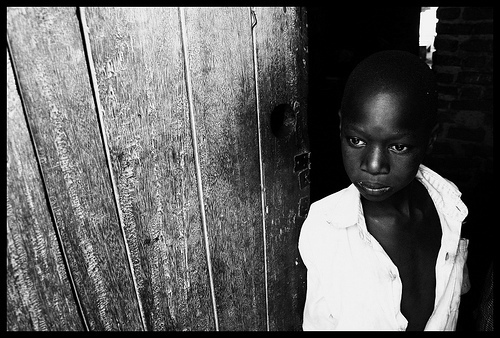
The clear and upsetting gap between services for at-risk children and youth in the U.S. and the services offered to the developing world is one that must be acknowledged and critically analyzed in order to begin providing families overseas the same level of care offered to families here. In this paper I will question most directly why individuals from the developed world- individuals from countries with progressive social welfare systems, why we have decided it is okay to move backward and continue offering solutions that have been found ineffective and actually damaging in our own countries. There has been a clear movement away from institutional care in the United States, with a movement toward family preservation. However, we insist on offering the developed world this sub-par level of care that countless studies have proven damaging not only to children and families, but to entire communities and cultures.
In Philadelphia, families who DHS feels it necessary to separate are scheduled to be seen in court on multiple occasions. Individuals present at said hearings would most likely include: a judge, a child advocate, the child(ren), parents, other family members, a case worker, and a lawyer defending the parents. These court hearings are held to make sure all parties are doing their job. The judge wants to see evidence that there is a movement toward permanency for the child. If at all possible, it is in the form of reunification with the natural family. For a child to be released back into the care of the home they were removed from, the caregiver must take the necessary steps to make their home a safe place for that child.
Anyone at DHS would tell you that as often as they are referred to as "baby snatchers", that is not what they are about. Not at all. The social workers, supervisors, and department heads all want to see children out of foster care and reunited with their biological family. They want to see caregivers making the necessary changes to help bring their children home. And it is in fact the case workers' job to do everything in his or her power to make this possible. Whether it is providing transportation to NA meetings, helping the caregiver look for employment, or finding necessary mental health treatment- the caseworker serves as a broker and advocate for the caregiver.
Family preservation is at the center of the services DHS provides to their clients. Individuals and institutions working to address the needs of at-risk children in the U.S. have studied the effects of institutional care on children. They have understood that it is a child's right to grow up with their natural family. They have realized that it is unethical to automatically write a caregiver off as unfit regardless of how a caseworker may feel about the situation initially. They have understood that it is entirely necessary to provide a caregiver with the tools to bring their children back home. Does it always work? Absolutely not. There are many parents who don't take advantage of the services provided to them. They do not do their part in completing the steps to make reunification possible, and in this case the caregiver's rights would be terminated. The point is, they are to be given every opportunity to make it possible for their children to return home. It is up to the caregiver to choose whether or not they will take responsibility and work with the case worker and the courts to meet the requirements for regaining custody of their children.
In Uganda at-risk families aren't even presented with this choice. Just imagine how the number of children living in institutional care would decrease if instead of simply placing children in orphanages, we came alongside the parents and gave them a choice. What if we focused on empowering and helping link them up with the necessary resources to keep their children? We could prevent family separation in the first place.
In some cases there is a definite need to remove a child from the home; however there is a major difference between the care provided when this occurs. One of the major differences between orphanages and foster care as temporary solutions- when children are placed in foster care in the U.S. a social worker is working with their parents to help them regain custody. In Uganda when a child enters an orphanage, the orphanage is not working with the caregiver to help improve their situation- thus the orphanage becomes more of a long-term solution for these families.
When we measure services offered to at-risk families in the U.S. against what we fund and promote in Uganda there is a disparaging gap that should upset all of us. I don't believe in satisfactory care. I believe in researching and educating ourselves before starting NGO's in cultures SO vastly different from our own. I believe in offering the best care possible, whether it is in North Philadelphia or East Africa. Performing needs based assessments, studying evidence based/best practice models, and determining the cultural appropriateness of potential services and aid programs is critical. Because if you are not doing this, you are committing a serious disservice to the population you are serving. And you just might be doing more harm than good
–
Please consider supporting the work of the Abide Family Center
photo by Ryo
January 24, 2012
Dr. Seuss, inspiration and rejection
 The inspiration of Dr. Seuss
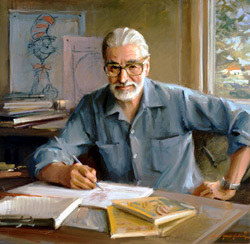
Before he was Dr. Seuss, Theodor Geisel was stuck on a ship returning to the States from Europe listening to the thump thump thump of the engine. Inspired by the rhythm, he wrote his first children's book: And to Think I Saw it on Mulberry Street.
The rejection of Dr. Seuss
He pitched the book and was rejected 27 times before a chance encounter with a friend who had just landed an editing job. Geisel told his friend about his book, about the rejection, and told him he was fed up and about to destroy the book. The friend read it and Dr. Seuss was born.
#28
You never know where inspiration is going to come from. It could be from a T-shirt or an engine.
Knowing when to listen to and when to reject the opinion of others is key. Imagine a room full of all of the people who have rejected your ideas and work. Geisel's room had 27 people in it. Now imagine going around that room and telling each of them your idea and each of them gives you a big thumbs down. Do you walk out of the room and go find #28?
Unless you do, you'll never know the places you'll go.
(Another blog post brought to you courtesy of NPR's Morning Edition)
January 23, 2012
How to travel the world with your iPhone and not pay $11K in charges
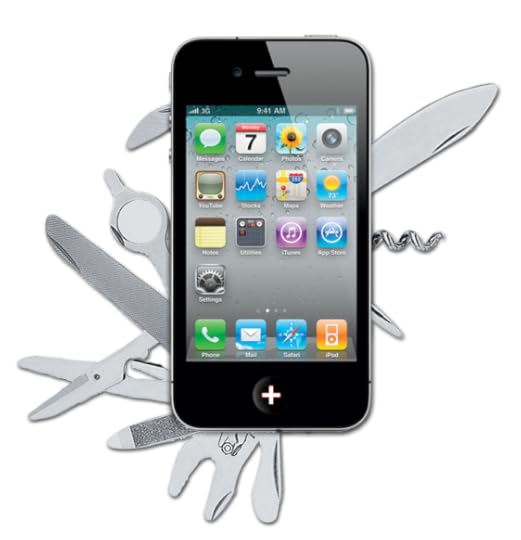 Yes, that is an iPhone in my pocket, but I'm also glad to see you.
No matter where I go in the world these days, my iPhone goes with me. My iPhone is my alarm, recorder, video camera, camera, calendar, notes, currency converter, translator, texting device, map, and, yes, sometimes even my phone.
I've recorded audio with it that has aired on NPR and taken photos that have appeared in shiny magazines. I know it's not the optimal tool for any one of these things, but it's the Swiss Army knife of my storytelling/traveling gadgets.
(This is why when a friend asked me if I would buy another iPhone after the recent Foxconn revelations, I told them YES.)
But if you step off the plane in Timbuktu and don't prep your iPhone ahead of time and it starts downloading all of your emails, voicemails, and facebook notifications, your data roaming charges could equal hundreds if not thousands of dollars. Heck, Adam Savage, the guy with the goatee on MythBusters, simply traveled to the faraway nation of Canada for a few hours and got hit with $11,000 of charges!
Here's what you need to do to prepare your iPhone to travel the world:
1) Turn off data roaming: select Settings > General > Network > toggle "Data Roaming" to Off
You can still make and receive phone calls, but you'll want to check with your carrier about the cost of answering the phone when grandma calls. Sorry, grandma, I'm ignoring your call, it's like $4/minute in Kenya!
Note: If you have an iPhone 4s on Verizon or Sprint you may be able to buy a local SIM card wherever you are and not have the expense of international roaming. Since I have AT&T my phone isn't unlocked so I travel with a cheap unlocked phone that I buy local SIM cards for wherever I go.
2) Turn off your email: select Settings > Mail, Contacts, Calendars > toggle off "Fetch New Data"
3) Turn on International roaming: Initially an AT&T iPhone is locked from all international roaming. In order turn it on call 1-800-331-0500 if in the United States and +1-916-843-4685 if outside the United States
4) Check for international text packages: With AT&T I pay $10 for 100 international texts/month. If I'm only going to be in a country for a few days, I don't buy a SIM for my cheap unlocked phone, instead I just text my local contacts.
For more information about rates and traveling with your iPhone visit:
Traveling with iPhone4s on Verizon / / Verizon International Service:
Next up: How to hack the iPhone map while traveling the world
January 18, 2012
Let's email Apple encouraging them to do better
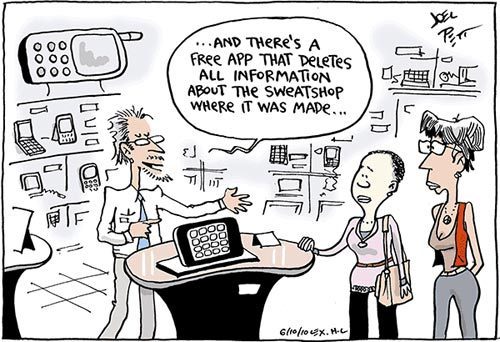
Mike Daisey's visit to the Foxconn factory in Shenzhen, China where iPhones and Macs are made has sparked a national debate.
Are our precious Mac toys and tools made by child labor, by unhappy people who are paid poorly and treated even worse? Should you, should I toss iTunes to the wind and shout at the computer Gods, "I'll never buy another Mac again."?
My next phone will be…
As much as I'd like to take a stand, my next phone will be an iPhone and my next computer will be a Mac. What are the alternatives? All of our electronics are made under these conditions.
That said, what are the conditions? No one knows. Short of going to China and talking with workers, which Mike Daisey did and which I did, we only know what China wants us to know.
Unannounced 3rd party inspectors with teeth and companies and customers that actually care are the only way any of this will change.
There was a great piece in Washington Monthly by T.A. Frank titled, "Confessions of a Sweatshop Inspector." Frank a former factor inspector writes:
Now, anyone in the business knows that when inspections uncover safety violations or wage underpayment more than once or twice—let alone five times—it's a sign that bigger problems are lurking beneath. Companies rarely get bamboozled about this sort of thing unless they want to.
Sometimes consumers prefer to be bamboozled too.
To really see what's up with your iPhone check out its GoodGuide ranking. Scored on its environmental and social impact, the iPhone4 is ranked 69 of 498 phones. It scored a 5.2 of 10 in social impact. The highest ranked phone a Palm Pixl scored a 7 of 10 in social impact and that score was mostly earned by Palm's avoidance of using conflict minerals in the phone. When it came to workers, Palm scored no higher than the iPhone.
I'm glad the debate is happening, but will it change anything.
What you can do today
Join me in emailing Apple at supplierresponsibility@apple.com. You can even copy and past my note below:
I'm a loyal Apple customer. I have an iPhone and a MacBook. I've been very disturbed by the recent reports of poor working conditions at the Foxconn factory in China where Apple products. As a forward thinking company, that always seems to know what its customers want before they know they want it, I encourage you to lead the way in ensuring that the workers who make your products are treated and paid fairly. This is something I want even more than a MacBook Air.
Thanks,
Kelsey
January 16, 2012
Are you making a career of Humanity?

As we celebrate the life of one of the greatest Americans, everyone seems to be asking this question: What would Martin Luther King Jr. fight for today?
New York Times Columnist Paul Krugman argues that income inequality and lack of upward mobility is the greatest injustice of today in the United States:
Yet if King could see America now, I believe that he would be disappointed, and feel that his work was nowhere near done. He dreamed of a nation in which his children "will not be judged by the color of their skin but by the content of their character." But what we actually became is a nation that judges people not by the color of their skin — or at least not as much as in the past — but by the size of their paychecks. And in America, more than in most other wealthy nations, the size of your paycheck is strongly correlated with the size of your father's paycheck.
Goodbye Jim Crow, hello class system.
I think instead of asking what Dr. King would be doing in 2012, we should be asking what we can do in 2012. What cause do you believe in, what injustice will you fight, what dream do you have in 2012?
Krugman's career is as an economist. It's natural that he would see economic inequality in the United States as the biggest threat to justice. And many would agree with him.
We all pick our fights and causes based on our life experiences, educations, and careers.
In 1958 Dr. King addressed 26,000 high school students at en event in Washington D.C.:
Whatever career you may choose for yourself — doctor, lawyer, teacher — let me propose an avocation to be pursued along with it. Become a dedicated fighter for _______[fill in your cause here. He said civil rights], Make it a central part of your life.
It will make you a better doctor, a better lawyer, a better teacher. It will enrich your spirit as nothing else possibly can. It will give you the rare sense of nobility that can only spring from love and selflessly helping your fellow man. Make a career of humanity. Commit yourself to the noble struggle for equal rights. You will make a greater person of yourself, a greater nation of your country, and a finer world to live in.
Make a career of humanity.
I love that.
No matter what your talents are, they can be used in some fashion to make the world a better place and help others. My mother-in-law is a hairdresser and a cancer survivor. In her small town she's like a one-woman cancer support clinic. She does so much more than cut hair.
Diane Stevens owns a salon in Connecticut where she first heard about the violence and struggles in Sierra Leone. One of the stories that resonated with her was a hair stylist in the country who lost a leg, but still managed to stand all day and work. Diane was moved to do something. She went to Sierra Leone, gave makeovers and more importantly taught women how to style hair. She gave them a trade. She founded the Cinderella Foundation that seeks to "make dreams a reality for young ladies in our community, our nation, and around the world."
Today isn't about Dr. King; it's about how he changed us and challenged us to make a difference no matter where we are and what we do.
Are you making a career of humanity?
January 12, 2012
Deckers responds
If you've read my book, you know I had a less than magnificent experience working with Deckers (company that owns Teva, Simple, Uggs) in China. In the Spring of 2011 I stopped by their office near Santa Barbara, California, and dropped off a copy of Where Am I Wearing?
That started a dialog and I eventually asked them if they would like to make a statement to include in the new edition. I wasn't able to include the entire statement, so I'm placing the it here:
Deckers Statement for Kelsey Timmerman's book
We apologize for any difficulties that you encountered while researching your book. As you said, having a customer travel to a factory to see where their shoes are made is an unusual request that we hadn't gotten before and didn't respond as well as we could have.
Our Corporate Responsibility (CR) Program has come a long way since the first edition of Where Am I Wearing. Since 2007, we have created a CR department and hired a director to help manage our efforts towards minimizing our social and environmental impact. We've also increased our transparency by making our list of factories public, and creating a CR website where you can find information about various Deckers programs.
As for the focus of our program, we have organized our CR efforts into three main areas: fair and safe factories, environmental sustainability, and community engagement.
Fair and Safe Factories: We recognize our responsibility to ensure that working conditions in the factories are fair and safe for workers. In 2008, we launched our Ethical Supply Chain (ESC) program. This includes the Deckers Supplier Code of Conduct, which communicates our expectations for working conditions in the factories we partner with and also involves monitoring all of our key suppliers and factories at least once per year. The results of these audits are tracked through our supplier scorecard, and we use a corrective action plan with suppliers to address any issues that demand attention.
Environmental Sustainability: We are committed to reducing the environmental impact of our operations and products, so we have launched a project to measure our environmental footprint in our offices, retail stores, distribution centers, transportation and logistics. We are also collaborating with the Outdoor Industry Association and have joined its Eco Working Group. This is a group of companies working together to develop a common tool for suppliers to address social and environmental issues around product design and manufacture.
Community Engagement: Our company is committed to supporting our communities, and we encourage our employees to do the same, which is why we created two company initiatives, Deckers Goods and Deckers Gives. Through Deckers Goods, we encourage our employees to volunteer in the community and donate to local charities through incentive and matching programs. And through Deckers Gives, we have donated over $2.4 million and over 220,000 pairs of shoes to charitable organizations since 2006.
Learn more about Deckers social responsibility & sustainability progams
January 11, 2012
Where was your iPhone made? Probably here…
60% of the world's population has a mobile phone. All of the best phones — iPhones, Blackberries, probably the one you have — are made in at the Foxconn factory in China. Storyteller Mike Daisey visited Foxconn and talked with the workers. He shares his experience in the amazing essay above that was featured on This American Life.
Foxconn is the largest private employer in all of China. The company employs more than one million people. Half of them work at the Shenzhen factory. Foxconn and Apple received a lot of negative press after a rash of worker suicides – 17 total – in 2010 at the Shenzhen plant. Suicides became such a problem that the company put up nets to catch workers who were so depressed they'd rather jump to their death than go back to work.
The Chinese newspaper Southern Weekend sent reporter Liu Zhiyi undercover for 28 days into the factory in 2010. He wrote, "[The workers] actually envied those who could take a leave due to work injury."