
Cathy Day's Blog, page 4
February 12, 2015
Want to take a class with me?
This summer, I’ll be teaching a one-day intensive fiction workshop at the Midwest Writers Workshop here in Muncie. Here’s the scoop:
Short Story Fellows Workshop
Those accepted into this intensive will have the opportunity to have their 5-10 page short story critiqued by me and by the whole group.
Specifically, you’ll be working to improve your facility with scenecraft (when to dramatize, when to summarize), point of view, setting, suspense, and readability.
All work will be discussed anonymously and read aloud.
To apply, send a 5-10 page writing sample in manuscript form (as an attachment) to Cathy Day at cathy@cathyday dot com. Applications will be taken from the day MWW registration begins (February 12) to midnight on March 27.
You will be notified of your acceptance by April 15 so that you can sign up for another intensive if you’re not selected.
Why you should apply
Because Midwest Writers is a great conference. Here’s a previous post extolling its many virtues.
Because normally, I don’t read work by people I don’t know. I devote my energy to my current and former students–and that’s considerable. All writers get a lot of requests like this from people they don’t know. But I almost always say no. I just don’t have time, unfortunately. But this summer, I will say yes to six people.
Because the best thing a writing conference can give you is writing instruction. Not “how to market yourself.” Not a lecture on “how to write better.” But someone spending time with your words specifically.
Because your work will be read aloud. There’s nothing quite so illuminating as being physically present when a group of strangers experiences your work for the first time. You see them fidget when they get bored. You hear them laugh and sigh. You watch them lean forward in their chairs. (Ever since The Circus in Winter started its journey as a musical, I’ve realized how important and instructive “live reading” can be.)
Because your work will presented anonymously. Nobody will know whose is whose. This might make you more inclined to write about something embarrassing or difficult–which is probably your best material, actually. And you’ll get more honest feedback, too; people tend to pull punches in their critique when the writer is right in front of them.
Come to Muncie!
Registration for the conference opened up today. I hope you’ll consider applying!
The post Want to take a class with me? appeared first on Cathy Day.


February 1, 2015
30 Easy Pieces for English Majors
This morning I woke up early, made myself some coffee, and got back into bed with my husband and my dog.
I needed to do a brain dump, a blog post, but I was too lazy to walk into another room and get my laptop.
So I grabbed my phone and started tweeting as @bsuenglish, the Twitter account for my department. And an hour and a half later, I’d tweeted 30 pieces of advice.
I hope these words help others–not just the students in my department.
The post 30 Easy Pieces for English Majors appeared first on Cathy Day.
January 2, 2015
2014: My Year in Review
In 2013, I posted to this blog once a week and enjoyed some pretty great stats. 47,000 unique page views. Up from 20,000 the year before.
But at the beginning of 2014, I declared (a little facetiously) that this blog was a waste of my time. Instead of posting once a week, I posted sporadically. About 17 times total.
And a funny thing happened: I still got about 43,000 page views.
How did this happen?
Well, I think I got Googled a lot because of the musical.
A lot of my old posts about Statements of Purpose and LORs, etc. still get read a lot.
Truthfully, a lot of my blogging energy went into this blog, maintained by my department at Ball State. If you read the post I’ve linked to, you’ll see the stats, etc.
Lately, my blog posts have been about administrating in higher education and my personal life rather than teaching and writing. I guess that’s what happens as time passes–the things that occupy space in your brain change.
I’ll be happy if you continue reading, despite these changes. Thank you.
My year in review
My husband published an essay at the Rumpus on the occasion of the death of chef Charlie Trotter.
The Indy Star did a nice story about me.
Spoke about Literary Citizenship at the Antioch Writer’s Workshop “Paths to Publishing” event. Reunited with Erin Flanagan and met Kirby Gann and Steve Saus.
The night I came back from Yellow Springs, my dog was hit by a car. He lived. We rejoiced.

Seattle
Went to Seattle with my husband for AWP 2014. Loved Seattle. For some reason, I felt compelled to blog about my marriage while we were there. I put them on Tumblr rather than here. I don’t know why. “Traveling as a Couple,” “AWP Spouses.” And this one, too.
I wrote about my fear of and desire to be looked at on my Tumblr blog. (I wasn’t sure if these personal stories were appropriate for the Big Thing. I guess I felt safer posting them in this little corner of the internet where you might not see it.)
Took part in a roundtable discussion on Money and Creative Writing Programs with some amazing writers (Dinty Moore, Robert Hass, Elizabeth McCracken, and Yiyun Li. ) for Scratch Magazine.

My mom celebrating her first blog post.
Helped my mom start a caregiving blog.
Redesigned this blog. Click around. It’s kind of pretty.
Started a new job as Assistant Chair of the English Department.
Gave a talk at Hanover College because my book was the “common read” there. What an honor.
Published a two-part essay in Inside Higher Education about starting over in academe. Part 1. Part 2. (This essay started as a blog post, which I sent to IHE instead of posting to my blog.)
Published an essay about the value of a degree in English at The Millions. (This too started as a blog post that I sent out rather than posting here.)
Taught with Dinty Moore at the Grailville Retreat Center for the Antioch Writer’s Workshop.
Found out I’m going to be an aunt again. To a girl this time.
Read with Ben Clark at the R.J. Julia Bookstore and at the Mark Twain House and Museum. What an honor.

West Baden
Went to French Lick for a book signing that went bust, but got to stay at West Baden.
Did a webinar for AWP’s Career Services on Requesting Letters of Recommendation.
Saw two of my former graduate students publish books: Karin Lin Greenberg and Katie Coyle.
Saw a new production of The Circus in Winter.
Launched my department’s first e-newsletter.
Lost two members of my extended family to cancer.
Reunited with an old high school friend and started trading work. Thanks to a new set of eyes, I got excited about my novel again. Worked on it a lot over Christmas Break and have applied for a sabbatical so that I can get that baby out the door.
In Conclusion
I started writing this post feeling like “Man, I don’t feel like I accomplished much this year,” but now I see that I was as busy as ever in 2014.
Thanks, as always, for reading. Have a great year!
The post 2014: My Year in Review appeared first on Cathy Day.
November 16, 2014
This is what I’ve become, part 2
A few weeks ago, I started thinking out loud about my new job. Here’s part two of my thoughts on the subject.
Don’t all 46 year old professionals wonder if they’ve made the right life choices?
Becoming a bureaucrat
For the last few years, I’ve been able to translate my teaching and writing into interesting blog posts for you, faithful readers.
But I don’t know if you’re that interested in what I did on Friday:
Inputted the schedule requests from four different academic areas in my department into a grid.
Approved some course equivalencies for a young woman studying abroad.
Met with an advisee who doesn’t know what to do with his life.
Met with an prospective student who knew exactly what to do with her life.
Proofread upcoming blog posts.
Tried to find people to teach unassigned classes or cancel them. Why are they unassigned? I can’t talk about it.
Answered 50 emails about lots of different things I can’t talk about.
Basically, I’m a bureaucrat.
My mad, bureaucratic, communication skillz:
I am pretty good at seeing things that need to be done and finding ways to do them.
I’m good at delegating. I can keep interns busy. Just ask Daniel, Becca, Lauren, and Taylor.
I’m a macro person. I see systems. How do systems work? Where are they getting jammed up? How can they be unjammed?
I’m pretty good at thinking outside the box. I’ve worked at four different universities. I’ve seen a lot of boxes.
I’m pretty good at communicating a message clearly and effectively to a large number of people. I think this comes from my other job as a writer, someone who has had to learn how to be my own publicist/media consultant.
I’m pretty blunt, I guess. I hadn’t realized this. I’m sort of a bull in a china shop, which sucks when you have no authority, but is great when you do have a little. I’m not always politic about it, but I try.
I’m good at meeting with prospective students and their parents. I guess time will tell if they apply and are accepted and major in English, but I feel like I’m good at “selling” what we offer: a solidly excellent humanities foundation plus lots of professionalization opportunities. I like to bring the students in first and talk to them alone, find out what they dig, and then I bring the parents in and reassure them that English is a practical degree. Amazingly practical! because the world desperately needs people who can write well. I like the students I meet because they’re from Indiana, from the same socio-economic background as me. In fact, the other day, I met a prospective who lives a few miles from my parents. It’s easy to sell something when you believe in what you’re selling with every fiber of your being, and you’re talking to people you already know, even though they’re strangers.
Skillz I need to work on:
The little things. I’m not much of a micro person. I’m not the best proofreader. I send emails with typos all the time. This is embarrassing.
The little things. I love the communications part of my job, the challenge of coming up with a social media campaign, a departmental calendar, etc., but find it harder to answer emails about does this course count as this? And can this student get credit for this? And can I change so-and-so’s schedule for this reason or that? And have we spent our library money? It’s not that those issues are unimportant. In fact, they are vital—to the students’ happiness and the faculty’s. But the challenge is different. I like to do the harder things about my job, which I find easier (because they are more interesting), and I don’t like to do the easier things about my job because I find them harder (because they are less interesting).
Fashion. On Friday, I put a paperclip in my hair to keep my bangs out of my eyes. And forgot that I’d done it. I walked around like this for hours. Nobody said anything.
Getting out of my silo. I get so wrapped up in the job that I forget to come out of the office except to go teach my class and go to the bathroom. I never see people.
Keep it simple, stupid. I’m very very bad about making things harder than they need to be. It is my lifelong struggle.
Conservation: When I’m being Admin Cathy, I sometimes fail to conserve my energy and brain function so there’s a little something left for Writer Cathy.
I’m sure that if you asked people in my department, they’d tell you PLENTY of other things I need to work on!
What Would Richard Do?
I know this person who knows this person who teaches at University X. Over her desk, she keeps this sign that says “W.W.R.D.”
It means “What would Richard do?
Who is Richard?
Richard is that senior faculty member who came of age as a professional with lots of support staff. A wife. A secretary. Graduate students. Interns.
Richard delegates as much as humanly possible. He is never reticent to ask the office staff to type up the notes from his Moleskine.
He never, ever offers to make coffee.
If he shows up to a meeting and there aren’t enough chairs, he doesn’t solve the problem by pulling a few from a neighboring room; he calls somebody to fix the problem.
Richard doesn’t initiate new programs or events or classes unless there are resources for said work, and if there’s not, Richard simply says, “No.”
Richard has perfected the befuddled shrug that is part truth, part lie that excuses him from learning new things and that results in someone else (usually a woman) doing it for him.
Richard innately looks out for number one.
When I heard about that W.W.R.D. sign, I got angry for awhile, but then I recognized I’d grown up in a world full of working-class Richards. Without thinking, I often bent over backwards to help the nearest Richard–just like I’d been brought up to do. I decided that I needed to channel him a little bit if I was going to survive as a writer and as an academic.
I’ve written of this before re: protecting my writing space the way my dad protects “The Swamp.”
Moving up the ladder
Somewhere along the way, I got this message about being a writer in academia: do your job–no more, no less. Serve when asked. But volunteer nothing. Protect your writing time. Don’t get involved. Conserve as much time as possible for your writing.
Most of the creative writers you know who have academic positions (let’s say George Saunders and Lorrie Moore) don’t let themselves get invested in moving up the university ladder. The ladder they want to move up is the New York Times bestseller list or the short list for the Pulitzer prize in poetry.
The thinking is: once you start moving up the university ladder, it’s hard to maintain your professional or scholarly identity.
Is this true?
I’ve worked at four universities and only one, The College of New Jersey, had a president who was an English professor.
Only about 13% of university presidents or chancellors come from the fine arts/humanities–period.
Thus far, no writer has become a college president.
I once visited Vanderbilt university and met with Kate Daniels the poet in her office. The Dean’s office. I remember thinking, wow, that’s rare. A poet! A dean!
A few weeks ago, I asked my friends in the Facebook group Creative Writing Pedagogy if they could think of any creative writers who had served their institution beyond directing a CW program or serving as department chair for a time. I got a long list of suggestions. Here are a few:
Chad Davidson
Crystal Williams
Billy Reynolds
Daniel Tobin
Terry Wright
Matthew Shenoda
Gabe Welch
Brian Gilmore
Tom Williams
Amy Weldon
Joel Brouwer
Davis Schneiderman
Gary Myers
Rosemary Royston
Jill Baumgaertner
Brad Korbesmeyer
A few things I noticed:
Most of the writers who’d taken a university position (who responded to me personally) did so for the same reason I did: they were asked plus they thought that having a more 9-5 job would help their writing, but most said that that was NOT the result.
Most of the writers who’d moved up the university food chain were poets.
I don’t mean to offend the poets reading this, but I think that the amount of time and head space that poets needs vs. what fiction writers and memoirists or long-form nonfiction writers need are quite different. Prose writers need bigger chunks of time, and administration takes that away.
Administrators don’t blog about being administrators. They don’t write about this work. They don’t talk about it on social media. They’re usually too busy doing it.
My “mission”
I’ve never known a creative writer who took on an administrative job and ended up happier for it. Except for maybe Richard Robbins.
Actually, I don’t know too many academics who didn’t end up bitter in the end anyway—no matter whether they chose to serve their research/writing first nor their institution/students first.
I just don’t know too many people my age and a little older who aren’t seriously jaded.
But strangely, I’m not. At least not right now.
One thing that makes me different, I think, is that I didn’t just end up at Ball State. I chose it. I wanted to serve my state somehow. When I’m meeting with a young person trying to figure out how to pursue their dream, that’s fulfilling of course. But it’s even MORE fulfilling to me because they are from the same place I am. It’s the closest I’ll come to have kids, this work I do. When I’m playing whack-a-mole, whittling down my inbox or signing a form, there’s a greater purpose to the bureaucratic stuff I do. Everything fits into and is part of a larger something. That’s meaningful.
I feel like I’m helping my state be a slightly smarter place every day, and that’s a good feeling.
My writer game
To be honest, a big reason why I started blogging back in 2010 was that I wanted to stay in “the game.” The writer game.
I taught for five years in New Jersey and went to New York and Princeton for readings a lot.
Then I taught for five years at Pitt and came into contact with lots and lots of contemporary writers.
I was scared that moving back home to Indiana meant I’d fall off the face of the earth and feel the same literary loneliness and isolation I felt growing up here.
This blog connected me to literary scene in all kinds of wonderful ways that could not be achieved IRL.
But now I guess I feel connected to something else, something more local. The needs of my department, my college, my institution. I feel a sense of purpose I have never felt—ever–in my 20 year career. It’s a great feeling.
But I also feel like I’m falling off the face of the Earth. Going off the grid. Not popping on people’s radar. And I’m sort of ashamed that this bothers me.
I’ve seen this happen over the years to many writers who either a.) became parents or b.) took on an administrative position or c.) both a. and b. They fall off the face of the earth for awhile. Their attention is focused on much more immediate concerns.
I want to prove to myself (and to you, I guess) that writers can be administrators and maintain their writerly identities.
I also want to encourage writers to step up in their departments and institutions when possible. Maybe we’ll never be able to convince deans to open up enough tenure-track creative writing lines to meet the considerable demand from students.
A thought: Maybe we’ll just have to become those deans ourselves.
A thought: Maybe that’s the worst suggestion ever. Maybe we should exit the academy entirely (we’ve only been putting one foot in anyway) and get jobs that make more money.
Remember:
I have changed jobs about every five years for my entire professional life.
This is my fifth year at Ball State.
This is the first time, however, that I’ve had a blog whilst going through this phase.
The post This is what I’ve become, part 2 appeared first on Cathy Day.

November 2, 2014
This is what I’ve become.
It’s been four months since I started my new job, and the things I most feared have happened.
I’ve stopped blogging here.
I haven’t been working on my novel as much as I’d like.
I care about stuff that I never cared about before–like bulletin boards and registration time tickets and how class rooms are assigned and posters and scheduling grids.
I’m not surprised. Administrating changes you. Entire realms which have been hidden from view suddenly appear, and all you can really say is, “Holy shit.”
This quote from an Inside Higher Education essay by Chuck Ryback is on the money. Read the whole thing here.
Looking back to when I was first hired on the tenure track, I really didn’t know anything about how the systems I was working in were structured. Literally, it has taken me 10 years to even achieve a competent grasp. Why? If a maze built by Daedalus is complicated, imagine a maze built by an army of Daedaluses. Campus and system governance in public universities is deeply complicated and entangled, and this is largely because it’s supposed to be difficult to understand (but that’s a whole different post).
My job as Whack-a-Mole
When people ask me what I do all day as Assistant Chair of Operations, I tell them it’s like this:
You walk in the door and the moles start popping up—in my office door and in my inbox—and I take my mallet and whack whack whack as fast as I can.
Perhaps this makes it sound bad. Like I’m mad. Like I resent the moles from popping up. Like I’m trying to hurt them.
Au contraire.
The “whacking” isn’t hurting, it’s helping, solving, progressing.
For twenty years, I’ve written words that took months if not years to be published, taught students that I (mostly) never heard from again. So there’s something deeply rewarding about walking out of the office at the end of the day knowing that I actually finished something. Even if it was answering/archiving/deleting 50 emails and signing five forms.
My job at the candy conveyer belt
I like coming home and having dinner with my husband and maybe writing a little in the evening or reading or watching a movie, like a normal fucking human being who is almost 50 years old, not a graduate student. Like my doctor. Like my lawyer. Like pretty much every professional person I know.
Except for teachers.
We don’t expect our doctors to help us and answer our questions when they aren’t in their office. Why do we expect college professors and teachers to do this? I don’t know. But it drives me crazy.
I never worked this hard when I was in my 20’s and 30’s. This is a new development. It’s Lucy Ricardo’s candy conveyer belt and the chocolate is coming faster and faster and faster. Because there are real chocolates and virtual chocolates coming in via email.
One reason why I took this new job, I think, is that I’m no longer Lucy at the conveyor belt anymore. I’m her supervisor. I don’t know if that’s a good thing or a bad thing, but for me, it was a necessary thing.
My job as a state bureaucrat.
Last night I went to a play with my cousin, who is a freshman at Ball State. She introduced me to a friend and I said I was the Assistant Chair of the English Department, let me know if you need anything, etc.
Later, I saw a dean walk down the aisle and pointed him out. “That’s the dean of your college,” I said to my cousin. She looked at me, and I thought, Oh my God, if I was 18 years old and a freshman, I would have no freaking idea what that meant nor why it mattered in the slightest.
So I said, “Okay, so pretend Ball State is a country. President Ferguson is the President. The deans of all the different colleges are like the governors of the states.”
She nodded. “So you’re like a senator, right?
“No, a department chair is like a senator. I’m like his chief of staff.”
“Oh.” She sighed. “I’m sorry. I just think politics is kind of boring.”
“Yeah, I know. Or think of it this way. The department chair is like the mayor of a city. And the English department is a big city in the country’s largest and most populous state.”
“So you’re like the mayor of Los Angeles?”
“No, more like Sacramento. I’m like the deputy mayor of Sacramento.”
I remembered then that her friend had wanted to meet me because I’m a writer, but lately, I’ve started thinking of myself as the deputy mayor of Sacramento because I really like the job.
And that’s what scares me. Can you help run a city and write books at the same time?
That is the question, isn’t it?
Here are some more:
How does your identity change when you take on an administrative position?
How do you maintain your identity as a writer when your daily work is so specific to the institution to the place where you work?
Since so many of us have day jobs–lots of different kinds–how can we balance our job (paycheck) and our work (art)?
How do we keep our work from becoming a hobby?
How do we keep our job from defining us?
When do we say to ourselves that we’re better at the job than the work? Or can we do both?
How do you keep doing your job for years and years and years without becoming overwhelmed by despair?
Here’s a great essay that’s helped me think through these things.
(more later, i’ve been thinking about this a lot)
The post This is what I’ve become. appeared first on Cathy Day.

October 22, 2014
Everything I know about Letters of Recommendation
Note: This is about LORs for the academic job market, not for applying to MFA programs. That post is here.
True Story
 A few years ago, a writer I knew (I’ll call her Chris) sent me an email asking me for some information. A graduate creative writing program had asked her to speak with their MFA students about “going on the market.” How to do a CV. How to write a good letter of application. How to read job ads. How to ask for LORs. That sort of thing.
The problem was that Chris was not on the faculty of that (very prestigious) MFA program. She was visiting and had only been on the job market in a limited way. So when Chris asked me if I would share my job search materials with her to share with MFA students in this program, here’s what I said:
You know, no. And I’ll tell you why.
First, I think that it’s the responsibility of the faculty of that very fine school to mentor their students. Not mine. And really, not even yours. THEY need to make their CVs and job letters and wisdom available to people who worked really hard to get into that school. That is why one works hard to get into that school–for access to that sort of thing.
Second, my materials are for my students and for my friends. If YOU want to see my letter, my CV, really ANYTHING, I would give it to you in a heartbeat. But not to them.
Chris said she understood, and that the faculty who’d asked her to speak understood, too, but this represented their good faith effort.
Because professionalizing MFA students for the job market just had never been a part of their program culture or the department’s infrastructure.
Because–let’s be serious now–how ethical is it to professionalize thousands and thousands of MFA students for roughly 100 tenure-track jobs that open up each year?
Most graduate MFA programs will tell you that their mission, their culture is built on mentoring writers via a focus on craft, not on professionalizing academics.
Infrastructure
Should you build academic professionalization into an MFA program?
Let’s pretend that you think the answer is Yes.
So, how do you build academic professionalization into an MFA program?
Here’s what happens at some graduate programs
Ideal:
Graduate faculty are assigned to mentor the students in their area (CW, Lit, Rhet Comp, etc.) who are going on the job market.
Discipline-specific meetings held to discuss how to read job ads, how to assemble your application, how to give a “job talk,” feedback on materials, mock interviews, nuances of the job market in that particular discpline, etc.
This work is either part of the faculty member’s load (a course they teach) or is part of their service/committee assignment.
Okay, but not ideal:
A graduate faculty committee (of one or many) is assigned to mentor students in ALL areas who are going on the job market.
Non-discipline specific meetings held to discuss the academic job market in general. Mostly pitched to PhD students, but MFA students attend and translate the advice for their own purposes. (This is the kind of experience I had as a grad student.)
This work is done on a volunteer basis by faculty (never a good idea).
I’ll be blunt
Look, I’ve worked in two MFA programs. I know how hard it is to professionalize MFA students. Where does that work go? And how do we do it ethically?
I believe that we shouldn’t be “academifying” MFA students. We should be giving them a lot of stars to steer by. The problem is that most of us followed one, maybe two stars. How are we supposed to help MFA students figure out how to become something very different from what we ourselves are–as writers and as professionals?
This is the question I ask myself: if we put more MFAs on the job market with good materials, good applications, good credentials, are we making the adjunct crisis worse, or could we make it better?
This is the question I ask myself: what’s it going to take for the faculty distribution/balance in English Studies to look something more like its student distribution/balance? Because I’ve worked a lot of places, and the numbers of CW faculty are always low while the numbers of CW students are high.
This is the question I ask myself: are we doing right by our MFA graduates?
This is the question I ask myself: when AWP asked me to create a webinar sharing my secrets and hard-won wisdom about professionalization, did I do the right thing? Isn’t it just like Chris’s request? Why should I help strangers? Why should AWP professionalize MFA students? Shouldn’t the programs themselves be telling students the things I put in this 40-minute webinar?
Those are a lot of questions, I know.
I’ve written elsewhere on this topic, and I’ll keep thinking and writing about it. I know I will.
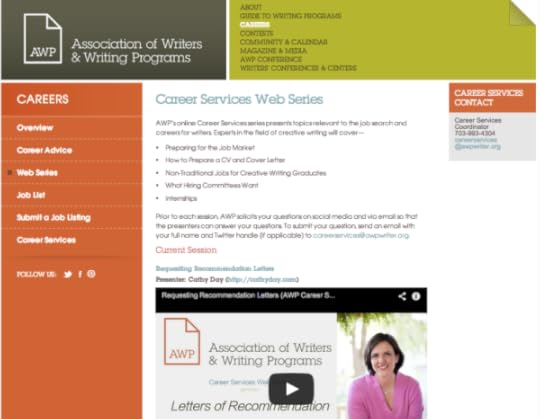
For now, here is everything I know (pretty much) about Letters of Recommendation. If you teach in an MFA program, send this to your students. If you’re on the job market or you’re thinking about it, watch it.
I hope it helps you. I hope it helps us all.
I really really want to know what you think about this. Please tell me. Please tell AWP Career Services.
The post Everything I know about Letters of Recommendation appeared first on Cathy Day.

August 12, 2014
11 Days: My Caregiving Story
I don’t usually tell personal stories here, but helping my mom get her caregiving project going has inspired me to tell my own caregiving story. This a cross-post between my blog and my mom’s. Wow, now that’s something I thought I’d never say.
Day 1
On Sunday Dec. 4, 2011 my mom called me and said Grandma had had a stroke and could I go to Peru. An hour and a half from Muncie. I went.
Mom had just had back surgery and hadn’t been cleared to travel. I cancelled a few classes. My students certainly didn’t complain. I only brought a day’s worth of clothes with me because I didn’t think I’d be there long. She’d had so many little strokes and always bounced back.
I got to the hospital and D. was there with her. She directed the activities at my grandma’s facility, drove everyone around on the bus, held their hands. Grandma was still in the emergency room, waiting for a room to open up. She recognized me and was happy to see me. She couldn’t enunciate really well, but she could communicate. She was a little confused and scared, but she calmed down when I got there. They got her settled into a room.That night I went back to her apartment to sleep. I was told that her doctor did his rounds really early, so I wanted to get some sleep so I could be back by 6 am.
Day 2
A woman came by and fussed over my grandma, and boy, did she love that kind of attention. I loved my grandma a lot, but I never gave her that kind of clucking, fakey, baby-time attention. I just couldn’t, although as I stood there watching, I had a thought: is she acting more like a granddaughter than I am?
The only thing I regret about the next few days is that I didn’t treat the situation like “Oh no! Grandma’s dying.” And now, I sort of wish I had. I would have stayed in her room at night. She was still alert, responsive, somewhat communicative during that time, and I feel like I missed a chance to have more time with her. But I felt like I needed to take care of myself, too.
It’s amazing how exhausting it is to sit next to someone’s hospital bed.
Day 3
I arrived to find her soaking wet and agitated. She’d pulled the IV out and the glucose drip was everywhere. I flagged down a nurse and said, “What is happening here? When was the last time someone checked on my grandmother?” I got a vague answer and was told that she’d been combative in the night when the aide came in to take her blood pressure.
“So what?” I said. “She’s had a stroke. She’s not herself. You’re supposed to take care of people. Even the the ones who aren’t nice.”
She said, “I understand.”
It’s true. She was combative. They ran a lot of tests those first few days, a lot of poking and prodding, and she was confused. But if I was there, she’d calm down. I held her hand while she was in the tube getting an MRI—a very interesting (and loud) experience. I held her hand when they put in the catheter—that was really rough. For the first few days, I was able to get her to eat little bits of things like ice cream, take sips of water. And every morning, the doctor would say, “We just have to wait and see if she’s going to turn the corner or not.”
The clucking woman came again, but my grandma couldn’t cluck back. The woman looked at Grandma sadly and turned to leave the room. I wanted to scream at her. Hello! I’m here, too! You could talk to me or ask me how I am or spell me for a half hour so I can get something to eat. But I didn’t say anything, because if you have to say that to someone, do you really want to leave them in charge?
Day 4
The doctor came in and she wasn’t really responding much, and that’s when he said “You have to start preparing yourselves.” That’s when I called my mom and she said, “I’ll be there in a few hours.”
My mom and dad came, my sister, my brother and his wife. Grandma was so happy to see Mom. They cried together for awhile.
Day 5
I was swabbing her mouth with that little sponge on a stick. She didn’t respond by sucking on the sponge like she had every other day. I burst into tears, because that’s when I knew she wasn’t really there anymore.
One of her favorite ministers came and we all prayed by her bed and she stirred around quite a bit while he was speaking. Afterward, a family friend offered to stay with her for awhile so we could get something to eat. We had just ordered lunch when she called and said to come back, that Grandma seemed to be slipping away. So we rushed back. Her breaths per minute were way down. We all waited.
Day 6
I decided it was time for me to leave. My siblings left that day, too. I felt like I’d said my goodbyes to Grandma and that she’d pass very soon.
Days 7-9
But Grandma hung on. All weekend long. And into the next week. The hospital had to transfer her back to the nursing home side of her facility because, well, technically, they weren’t caring for her anymore. I talked to Mom every day, and I could tell she was just so tired.
I told her I’d come back to Peru and give her and Dad a break. So, back I went.
Day 10
I stayed in the room with her that night. They’d placed her on this mattress that automatically inflated and deflated to keep her from getting bed sores. It was kind of a comforting sound. The aides came in every few hours to turn her, keep her mouth moist, make sure she was comfortable. I played some Christmas music for her. I tried to keep the room quiet. At the hospital, people had a tendency to drop by to see her or see Mom and Dad and they’d stay and “visit,” talking really loud. I don’t know, I thought it was rude. So at the nursing home, I put a sign on the door that said, “Quiet please.” That night, she woke up a few times and called for Mom, so I went over and held her hand, let her know someone was there and she calmed down.
The hard thing about that long stretch—from when she ALMOST died to when she did ACTUALLY die—was that there was nothing we could do. We just wanted to keep her comfortable, and so we were hyper vigilant about making sure the staff at both the hospital and the nursing home were doing everything they were supposed to do. I kept track in a notebook next to her bed of when she got her pain meds, when she got turned, etc. We probably drove the staff crazy. But that’s what you do, I guess, when something like that is happening. You console yourself with the things that ARE in your control.
The hospice nurse came to see her. She explained to me what would happen at the end, what signs to look for. I worked up my nerve and asked her something that I realized had been on my mind for a long time. See, I was there when my maternal grandpa died. He woke up right at the end. Grandpa woke up and I think he was a little scared that it was happening. Grandma went right up to him and looked him in the eye and said really something lovely and touching and consoling. He saw her, heard her, and relaxed instantly. And then he was gone.
I asked the hospice nurse if Grandma would wake up like that, when it was time. I didn’t want that to happen and for no one to be there. The hospice nurse said no, that Grandma probably wouldn’t be able to do that. She said I could stay in the room if I wanted at night, but I’d be doing it more for me than for her.
I was so glad I asked that question.
Day 11
I tried to leave her and went to her apartment. But I set my alarm for just a few hours so I’d wake up and go back. It must have been about 3 or 4 in the morning when I got there. My sister and my mom were scheduled to come back at 6 am. I didn’t go back to sleep. I just sat with her and held her hand. At this point, she was taking in big breaths every so often, but they started to come more slowly.
I sent a text to my mom. “Hurry.”
I watched her breaths slow, and then they stopped.
I’ve never had children, never been in the room when someone came into the world, but I’ve bore witness as two people left it. What made me happy was that I knew for certain that she hadn’t been frightened because I’d been there. I knew her passing was peaceful, and that fact was something I could give to others—Mom, my aunt, everyone.
Honestly, I sort of feel like I was supposed to be there.
She was admitted to the hospital on December 4 and died 11 days later on December 15th. I wish it hadn’t taken that long, but it is what it is.
What’s 11 days, really?
The only flowers at her funeral were poinsettias, and the only people there were us, her immediate family, and the people from town who’d taken care of her. How could we have managed all those years, my family so far away, without those kind people? Some were paid caregivers. Some were neighbors and friends. My mom thanked each one by giving them a poinsettia when they left.
They deserved more than that.
I’m glad I got to take her to a doctor’s appointment or two and hold her hand at the end, but seriously, that’s nothing. A small army of people took care of my grandma during the last 20 years of her life, but I was not her caregiver until the last 11 days.
My story is nothing, really, compared to the stories the real caregivers in this country could tell us.
What is yours? I hope you tell it. I know that these moments feel so keenly private. It’s hard to share them. But believe me, there are a lot of people out there who need and want to hear your story.
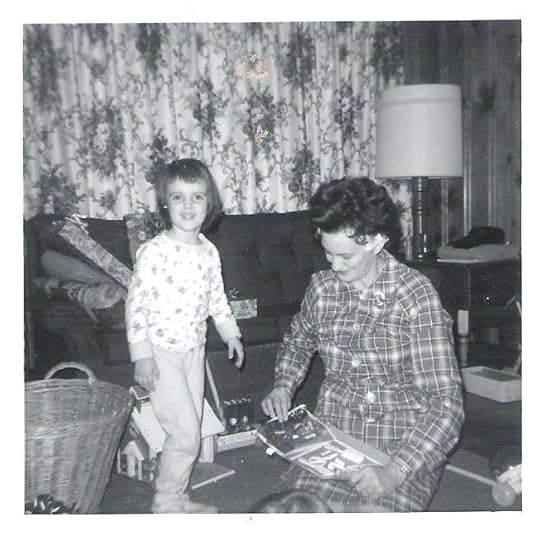
Me and my grandma in 1970 or so.
The post 11 Days: My Caregiving Story appeared first on Cathy Day.

August 6, 2014
Come upstairs and see my route book?
Route books are a gold mine of circus history. They’re a yearly archive of a show’s acts and travels, meticulously recorded for posterity, then printed and given to circus personnel as a keepsake.
I have one that belonged to my great great uncle Henry Hoffman, superintendent of the menagerie for the Great Wallace Show.
When I started doing readings for The Circus in Winter, I took lots of pictures and put them in scrapbooks. I wanted to remember as many of those wonderful moments as possible.
But I noticed that many of the pictures from those years featured me standing behind a podium or sitting at a table.
That isn’t how I remember readings and events. I remember looking out at a sea of faces.
So for the last few years, I try to take a picture of the audience at all my readings.
Check out the new Route Book page
When I was creating my Route Book page for this website, I decided to do more than caption the photos. Where. When. I decided to share my memories of those events, and what I realized is that I’ve met and re-met so many people by going on the road.
Readings are hard on me. I have a bad back. I have anxiety issues. I’m an introvert. But I also love the experience of being in the room when people are experiencing my work or reacting to my ideas.
So feel free to follow the link and thumb through the pages of my route book. Maybe you’re in one of the pictures?
Check out the new Events page
I’ll be adding lots of pictures to the Route Book page soon; I’m going to be on the road a lot this fall. For more information, check out the Events page.
And may all your days be circus days.
The post Come upstairs and see my route book? appeared first on Cathy Day.

July 5, 2014
Circus in Winter is 10 Years Old

 It’s July 5th, P.T. Barnum’s birthday, the 10-year anniversary of the publication of my first book, The Circus in Winter.
I. Circus back then
In 2004, I was teaching at The College of New Jersey. I was 35 years old.
That was the summer my sister got married. The first time I saw the book on a bookstore shelf was on June 17. We were on our way to her wedding rehearsal, which was near a Borders. I asked my dad to stop so I could go inside and see if the book was on the shelf yet. It was! I took a picture.
I wondered why my pub date was July 5th if the book was available in a bookstore on June 17?
My agent called me on July 5 to say congratulations and asked “What are you doing right now?” and the answer was that I was shucking corn.

Me and my sister, 2004
That was a fantastic summer, full of happiness and starred book reviews and wedding receptions and a book tour.
I didn’t realize at the time how special that summer was, that sometimes a book pops and sometimes it doesn’t. It’s been hard to write my third book with this knowledge in the back of my mind. Here’s something I said to Bryan Furness when he asked me how a writer gets past moments like that.
In late July 2004, during my town’s annual circus festival, I did a signing in my hometown historical museum and many, many people came. Ex-boyfriends. Former teachers. Former circus people. Former babysitters. Childhood friends. It was completely overwhelming in a good way. I sat next to the skull of the elephant that killed my great-great uncle, the artifact that started my writing journey.
 The next morning, I got to ride in a convertible in my hometown’s annual circus parade and wave at people. My brother and sister walked alongside the car and threw candy at the crowds lining the streets. The sign on the side of the car said: Guest “Author” Cathy Day.
Ah, the unnecessary quotation marks of the Midwest!
In my life thus far, these are the four greatest moments (in chronological order):
Returning to my hometown as a published author and riding in the parade
The morning a few months later when I was solving the New York Times Magazine acrostic and realized that the answer was a quotation from Circus.
The day I got married.
 The day in 2010 when I returned to Peru with a group of students from Ball State who had adapted Circus into a musical. They performed in a circus tent on the same ground where the real circus had performed a hundred years earlier. I wrote about that day here.
II. Circus today
I’m incredibly fortunate that people are still reading The Circus in Winter. It was selected as the 2014 Common Reader at Hanover College. The other day, I got an email from a young woman who had just finished it.
I am attending Hanover College in the fall and I was required to read The Circus In Winter. I just finished reading it. While I was reading I didn’t know how I felt about the book. I kind of liked it and I kind of didn’t until the very end when Jenny talks about hometowns and how no matter what you can always go back. Just those very last paragraphs really got to me and it helped me appreciate the book so much more. Besides that I love the little bits of the book that actually happened. I understand some details were changed and so were names but it’s amazing for me to think something exciting has happened in Indiana.
Back in 2004, I sent a postcard to every county library in the state of Indiana asking them to add Circus to their collection. Someone asked me why I’d done that. Why focus on getting the word out about the book in Indiana rather than New York or Los Angeles? The answer is contained in that email.
III. Circus tomorrow
I’m visiting Hanover College on Aug 25 and 26th.
In September, I’ll be in Connecticut for two events with Ben Clark, who wrote the music for Circus. We’ve actually never done an event together where we trace the evolution of a story into song. I’ll let you know more about those events as details are finalized, but one of them will be at the Mark Twain House and Museum. Very excited about that!
And then from October 23-November 16, Goodspeed Musicals is mounting a full production of Circus. I’ll be there, although I’m not yet sure which date.
Will you do me a favor today? Will you like the Facebook page for The Circus in Winter? If things go well with the musical, I hope that Houghton Mifflin Harcourt will reprint Circus, and those likes might help me make my case.
I’m writing this on the porch of my house in Muncie, Indiana. If you’d told me 10 years ago that I’d be back home in Indiana or that I’d be blogging or that there’d be something called “Facebook” or that there would no longer be a thing called “Borders” or that my book would be a musical, I wouldn’t have believed you.
Thank you very much. Today I’m filled with so much gratitude for the blessings this book has brought me.

July 1, 2014
I have a new job
 A few weeks ago I went to the high school graduation party of my second cousin, Erin. She’s going to be a freshman at Ball State this fall. I asked her if she was taking ENG 103 with “Staff,” and she said, “How do you know?”
“Because starting July 1st, I’m the person who makes sure there is a class for you to take and someone to teach it.”
So, today I officially started my new job as Assistant Chair of Operations of the English Department at Ball State University.
What does this mean?
Well, I work in a very large department. We have a chair and two assistant chairs. Basically, I’ll be in charge of:
Scheduling classes. This is pretty complicated when you consider 100+ sections of first-year writing, the needs of 60+ faculty members, and the desires of hundreds of students who want to graduate on time.
Advising. I’m the primary advisor, which means I’m the person who figures out when you can graduate, whether that class should count for the major, etc.
Library budget. One thing I’ve learned about academia over the last 20 years is the value of a good university library. I’m the person who reminds everyone to turn in book and journal acquisition requests.
Personnel. I will hire and help to review the yearly performance of our full-time contract faculty.
Communications. With the help of three interns, I oversee our social media accounts, department blog, and yearly newsletter.
Other things I’ve probably forgotten.

New office.
A few of my thoughts today
Right now, I feel least confident about the advising aspect of this job. I know the creative writing curriculum very well, but now I’ll need to understand the needs of all the majors, notably the teaching majors.
I feel most confident about the communications aspect. It’s a challenge I look forward to. How the hell do you communicate effectively with such a large number of people? I’ve been thinking about this a lot with regard to my job as a writer (communicating with readers) and as a teacher (communicating with students), and now I’ll apply what I’ve learned to my job as an administrator (communicating within and without the department to faculty, students, alumni, donors, deans, etc.)
Because my job will involve hiring contract faculty, my new position will give me a front-row seat to the adjunct crisis. This issue has been on my mind a lot for the last few months. If you follow me on Twitter or Facebook, you know I’ve been sharing many articles like this one. Unfortunately, I will not be in a position to fix the problem (determine budgets and create teaching lines, etc.), only to manage the problem. But I am determined to use whatever privilege I’ve been afforded to do right by everyone.
Most writers who work in academia eventually take their turn in administrative roles. Writers have a reputation for flightiness in these matters, but I have many friends and acquaintances who are/have been excellent administrators. Most of my grad school cohort have all been directors or assistant chairs or chairs by now.
Conventional wisdom for writers in academia is that you should practice a healthy kind of selfishness: keep your head down, do what needs to be done at the institution that employs you, but volunteer for nothing that will distract from the limited amount of time you have to write. I know many writers who have directed writing programs, but very few who have chaired an entire department or who would want to. Creative writers aren’t typically very good at being bureaucrats. And that’s what I have agreed to become, really, a slightly bigger cog in a large bureaucracy called an American university.

My lovely view of a parking lot, a dorm, and incoming weather patterns.
My problem is that I have always liked being in charge of something. This goes all the way back to my junior year of high school when I was elected class president and spent one class period a day working behind the scenes to put on The Prom. I’ve never been so happy. All those moving parts. The lists. Creating a structure, a system, a kind of machine. If you build it right, things go smoothly. I love trying to figure out how a system works.
This blog was created in an effort to figure out how my classroom works, and I shared that thinking with you. However, I cannot do the same thing re: my new position. Much of what I do will concern confidential matters. There are many blogs about being a writer, some about being a teacher, but none (that I’ve ever seen) about being an administrator. Why? I imagine it’s because you’re too freaking busy, because it’s not interesting to most people, and because there’s a lot you can’t really talk about anyway.
However, I think that this silence re: the professional lives of academics is one of the reasons that we’re in the mess we’re in. The public doesn’t understand what we do. Some of my most popular posts here at the Big Thing are on “unspoken” topics, such as how to ask for a letter of recommendation for grad school or how to write a Statement of Purpose. I’ll try to find a way to share what I’m learning with all of you in a way that’s helpful but also professional.
(Many thanks to Nicole Walker for pointing me to this blog, Confessions of a Community College Dean. The blogroll will be of much interest to anyone interested in higher ed issues.)
Will this job make it easier or harder to finish my novel? That’s a good question. The position comes with release time. I’ll go down to one course a semester. I’ll need to be in the office more often, but I can work something more akin to “banker’s hours.” I’m looking forward to more compartmentalization in my daily and weekly routine, and that, I hope, will be good for my writing habit. I do better with a little structure to my days. I recognize, however, that protecting my writing time and the head space for it is largely up to me.
This past weekend, I became very nervous about taking this job. I went into my closet and realized that most of my teaching clothes are for fall and winter. In the summer, I mostly wear t-shirts every day. So I went to Goodwill and TJ Maxx and bought myself a shit-ton of classier summer attire. I rationalized these purchases by remembering this quotation from the fashion designer Mainbocher:
“How you look influences how you feel, and how you feel influences how you act, and how you act influences how many other people act.”
I’ve never really been in a position of authority before, but I’m grateful that the newly elected department chair, Dr. Adam Beach, thought I could do the job. I anticipate that the focus of this blog might change a bit–in fact, I have no idea what category to call this post!–and I hope you’re willing to go along for the ride.


