Jesse Sublett's Blog, page 7
October 18, 2014
SEE YOU, HEAR ME, AT TEXAS BOOK FESTIVAL


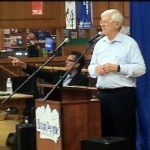
The Texas Book Festival is October 25-26. Come see our panel, TELLING THE TEXAS STORY: TRUTH & FICTION IN LONE STAR HISTORY, at 4:15 PM Saturday, but first, at 3 PM, stop by the Music Tent and see Jesse Sublett & The Big 3 Trio! It’ll be a quick set, because right after the last rocking tune, they’ll hoist me up by helicopter over to the Capitol extension for the book panel. The panel features my “Broke, Not Broken” [read more here] co-author Broadus A. Spivey, Carmen Boullosa, and Cynthia Leal Massey. “Broke, Not Broken” is published by 
Much more news is happening but lately I ain’t got time to blog!
Cheers, till later,
Jesse
[contact-form]


September 28, 2014
Not Without A Fight
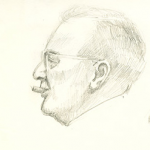
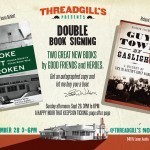
Our new book, “Broke, Not Broken: Homer Maxey’s Texas Bank War,” is the subject of a swell review in Thursday’a Austin Chronicle, titled “Not Without a Fight,” reviewed by Joe O’Connell. Come say hello today–Sunday, Sept. 28, 3-6PM at Threadgill’s North, for book signing, hanging out, beer & food. “We” being myself plus co-author Broadus A. Spivey and also Richard Zelade, of “Guy Town by Gas Light,” and our host, Eddie Wilson.
Broke, Not Broken: Homer Maxey’s Texas Bank War
by Broadus Spivey and Jesse Sublett
Texas Tech University Press, 338pp., $29.95
Imagine the classic film It’s a Wonderful Life if Mr. Potter were the good guy and the dapper George Bailey may have been up to no good. Welcome to Broke, Not Broken: Homer Maxey’s Texas Bank War, a true story about good old boy West Texas commerce gone wrong.
Here’s the basic plot: Curmudgeonly Lubbock builder/entrepreneur Homer Maxey gets talked into transferring his assets to a new bank by a smiling youngster with jet-black hair and plastic-framed glasses to match. The bank, whose attorneys also work for Maxey, forecloses on Maxey’s loans and immediately sells his assets for next to nothing. Maxey’s reputation and wealth are destroyed. He sues, and the case stretches across decades.
But it goes deeper than that. This is the story of post-World War II commerce and shadow kingmakers who met not-so-secretly in back rooms to dream and do. Maxey was the kid who worked hard labor during high school to amass $950 that he’d invest in a small grocery to fund his Texas Tech University education. From there, it was on to wartime military service and the creation of wealth through a series of businesses for which he’d provide the money and vision while his pals did the day-to-day work.
Soon he was building postwar Lubbock: shiny midcentury modern subdivisions, newfangled shopping malls, and the sleek downtown Plainsman Hotel. He was a soft-spoken visionary, whom his daughter, the sculptor Glenna Goodacre, described as interested in family, church, making money, and Texas Tech – but not necessarily in that order. But, the book admits, Maxey was also a bald-headed, red-faced demon who could “chew your ear off in language that would peel the paint from a battleship’s hull.”
The book itself has an interesting pedigree: Austin attorney Broadus Spivey, former State Bar of Texas president, was assistant county attorney in Lubbock during the first trial in the early Sixties and knew the players. To complete his long-term obsession, Spivey turned to Jesse Sublett, an Austin mystery writer and musician. The result plays to both their strengths. Spivey clearly revels in the minutiae of the two main trials – both of which Maxey won. Sublett brings in the mystery of an imperfect man obsessed with those who did him wrong. Maxey settled out of court in 1980, but then concentrated on writing his story. After his death, his wife burned those pages. Spivey and Sublett’s book rises from the ashes as a complex tale of a complex man.
The review in the Austin American Statesman can be found here.
September 25, 2014
Author Party Sunday at Threadgill’s

Guy Town meets Hub City at Threadgill’s on Sunday.
Eddie Wilson is throwing a party for us at Threadgill’s North Lamar location Sunday afternoon, 3-6 PM. By “us” I mean Jesse Sublett, Broadus A. Spivey, and Richard Zelade. Between us we have two new books, “Broke, Not Broken: Homer Maxey’s Texas Bank War” and “Guy Town by Gas Light.” Eddie is a fan and wants to celebrate and help spread the word. There will be free food and libations. Come by for a minute or three hours, whatever suits you. Sign up on Facebook, but it’s not necessary.
“Guy Town” is about Austin’s infamous red light district which thrived from the late 1800s-1913, a wide-open “reservation” of saloons, bordellos, gambling halls, and such. “Broke, Not Broken” is a true courtroom drama history-biography of Homer Maxey and Lubbock, with a background story that encompasses the settlement of the region, just after the Comanche wars, up through the 1980s. Homer’s daughter is Glenna Goodacre, the world-renowned sculptor whose works are in public spaces in almost every state in the US, including the National Mall in DC and Zilker Park (The Three Philosophers: Dobie, Bedichek & Webb).
Sex, legal thrillers, skullduggery, vice, corruption, post-war go-go, West Texas weirdness, gunfights, Victorian hypocrisy… all these and more can be enjoyed (vicariously) in these books.
Books provide for sale by BookPeople. Need more info? Check out the reviews of “Guy Town” and “Broke, Not Broken.”
Hope you can join us.
September 22, 2014
THINGS I LIKE LATELY
Books I’ve liked a lot include Townie, by Andre Dubus III, which I bought years ago and finally read. Dubus is a venerated so called literary writer, an ex-bare knuckles fighter, and he lived in Austin for a while in the early seventies and was affected by the experience, which is saying a lot, since this book is largely about the mixed legacy of his father and growing up on the mean streets in a very different corner of the country.
I’ve been reading a lot of things by Jean Cocteau lately, mostly play scripts, movie scripts, and the first volume of his diaries. The diaries are swell and I love them for the tone, attitude, names, context, and even his quirky non-grammatical writing, which means, oftentimes, bursts of images or ideas or pronouncements that don’t bother with conventional structure, and such structure is not missed.

Jean Cocteau, 1889 – 1963, artist of many stripes.
Here’s something I recommend on Youtube: Jean Cocteau speaking to the year 2,000 (I know, that was 14 years ago) from the year 1962, the year before his death.
I also like this a lot. Portions of Cocteau’s silent “Blood of a Poet” as a music video with Massive Attack.
I’m still reading The Good Rat, by Jimmy Breslin. What a great book. My kind of book, which is great writing about bad people who do terrible things but they’re interesting. You’d think that with my crime aficionado status I would have read this one and all of Jimmy’s previous titles, but this is my first one and next I’m going to read all the others, possible starting with “The Gang Who Couldn’t Shoot Straight.”
We are still a little shaken by Sunday night’s episode of Ray Donovan. We expect darkness, suspense, density, perversion, cynicism, etc. from this really intelligent and hip Showtime series starring Liev Schreiber and a bunch of other fine actors, including that right wing reprobate misanthrope, Jon Voight, but still, this one left us a little weirded out. Not because it wasn’t well-done in just about every way (OK, we really think the Boston reporter is lame)… Next Sunday, here goes nothing… (Did you know that Liev Schreiber’s Twitter (cited above) introduces him as “Hirsute actor type best known for his slavic fat pads and shockingly attractive children…”?

Jim Tully (1886 – 1947) writer, vagabond, pugilist, and not in that order.
Last two books before this, I devoured two by Jim Tully (June 3, 1886 – June 22, 1947) in a row: “Beggars Abroad” and “Shanty Irish.” Like many of Tully’s novels, both are at least semi-autobiographical, and Tully’s life and career(s) were about 100x more varied, exciting and crazy than yours and mine. I’m not posting a link here because I’m not crazy about the ones I’ve found, but you can check his Wiki bio, which introduces him as “vagabond, pugilist, and American writer. His critical and commercial success in the 1920s and 30s may qualify him as the greatest long shot in American literature.” He’s definitely one of my favorites, living and dead. If in doubt, start with “The Bruiser” or “Circus Parade” and if you don’t like both of those, you can lose my number.
SELF SERVING ANNOUNCEMENT #1: Broke, Not Broken: Homer Maxey’s Texas Bank War, by Broadus A. Spivey & Jesse Sublett, published by Texas Tech Press, going into second printing. Come see us at the
August 30, 2014
Cats

Most of the time if your cat disappears, you look in the closet, under the tables, etc. Chavez was more of a challenge.
Rest in Peace, Moe Chavez, 1997-2014.
My first cat was a black one named Maxwell. Fat and long-haired, he napped flat on his back, sunning his wide tummy. After that I remember a huge litter of orange tabbies, an army of kittens. In college there was a gray and white tabby who would wake me up in the morning with a kiss on the nose and a petite black manx named Bunny. After moving to Austin from San Marcos in 1974 there was a silver manx named Roxy and a tabby/manx named Bogey, and I think I’m skipping a few. A black and white kitten named Kiki got me through some hard times as a grief-stricken musician in a glam blues band called Jelly Roll, after which I met Lois, my future wife, and she acquired a grey kitten named Greyson. The Skunks fired off 1978 with Lois and I and we adopted Marlowe, the stout grey tabby, who took me in as an apprentice hardboiled detective writer. When Kiki and Marlowe drove us to LA in 1987, we stopped off in Fredericksburg to see my dying grandmother, Katy Duecker, and because of concerns over Kiki’s nerves we dosed her with tranquilizers which had the unforeseen effect of inspiring her to pace in circles over our laps and the seats all the way to El Paso, smearing the windows with a thin coating of mucous, like a wandering drunk. Arriving on the outskirts of LA the cats became exceedingly curious at the scenery, their faces glued to the windows, noses working overtime. We had lied to the landlords, saying we “only have one little bitty kitten,” because the apartments strictly forbade pets.

Moe aka Chavez, Not Crazy About His New Portrait
When we went out to LA the month previous (I was rehearsing with Kathy Valentine’s new band while Lois shopped for apartments) Lois had caught the landlord painting and drinking wine and in a liberal state of mind and he relented to just one pet. However after moving in, both cats insisted on going out on the balcony overlooking the pool, and Marlowe was always inching around the corner to the unit next door, home of a former Ziegfield Follies dancer, one of the white-haired forgotten divas you find only in LA. And always when we went down to the swimming pool, our new kitten, Willie, would climb up the screen of the balcony door and expose himself, spread-eagled and mewing, which was not very discreet at a place with a big “NO PETS ALLOWED” sign facing out on Kling Street, there in Valley Village, right off Laurel Canyon.
LA was paradise for living and dreaming and writing, but family and other matters called us back to Texas in 1994. I had just had the first of several neck surgeries, doctors having missed the cancer cells that were forming a colony on my right tonsil, unseen, and the Northridge earthquake, 6.7 on the Richter scale, rocked us out of bed at 4 AM. Neighbors streamed downstairs where the swimming pool was roiling with tidal waves like a fat man in the tub, and after helping Donya the diva down the stairs she exclaimed “What about Fluffy???” I ran upstairs to get her obese, hugely furry white cat. Donya also had a white ’65 Mustang she let us drive for a year or so. Whenever she went in the hospital, Donya gave me one of those rambling, ten page long instructions of how to feed and care for Fluffy.

Kiki #2
Back in Austin we acquired Kiki #2, a fluffy orange tabby. She was Dashiell’s cat and he was four years old and he insisted that Kiki #2 was a girl, which became confusing during visits to the vet on account of Kiki’s male genitalia. Eventually we became convinced that Dashiell was correct. Sam the tabby came along and became Lois’s best friend, although best friends don’t usually follow you wherever you go, sleep at your side, wait at the door crying a full hour before your car pulls into the garage.
Moe is another story entirely. One day in 2004 we came home and noticed a black cat sitting on the rock wall in back, watching us. He kept appearing on the wall and by the end of summer was around quite a bit. He had a collar with a light blue bow on the back that was quite fetching. Around October I was petting him a lot. He would stand there and talk to me and rub my leg. One hell of a purr, too. He had a runny nose. We put out inquiries and learned that his keepers were David and Julia Lundstedt, who lived up the hill a block away. They were up in Ohio helping register voters in hopes that John Kerry would help save the country from the neo-cons and their puppet from Midland, George W. Bush. Valiant effort, tragic story. The Lundstedts also rescued cats and dogs. As it turned out, Moe, who was then going by an alias of Mose (a folk artist whose last name has slipped my mind), had come to the Lundstedt house in Travis Heights after his running mate died. The family Moe was living with previously told the Lundstedts that he had come to them after leaving another family. So the Lundstedts, who were technically at least the third parents of Moe, told us that if he seemed to prefer us, it was OK with them if we adopted him.

Sam the Tabby
Moe had some sort of chronic allergy that caused sneezing and a runny nose. Our vet, Deborah Besch, tried many things but in the end, nothing was a cure. Some drugs seemed to help a little, but he kept sneezing for another ten years. Despite this burden Moe was a trooper. The first night we let him in the house he came to bed and rested his cheek on my neck and stayed there. Every night after that he would climb on my chest, his purr penetrating my rib cage.
Even during his last days he has not lost his purr. He was born in 1999 and he made it to age 17, which is pretty remarkable. During his outside days, he was the tough cat of the neighborhood, making the rounds via the rock walk and the back trails, going next door to the old Taylor Gaines house and bossing around the half Siamese cats there, going up the hill and driving the Lundstedts’ giant dogs crazy. Once inside he became a lap cat and Kiki #2′s sleeping pal. They stuck together like a couple of fur balls. He stopped eating over a week ago. To say we’re going to miss him, just as we, Lois and I and Sam, miss all the above cats, is a monumental understatement. This weekend we’re saying good-by, but like all good spirits, we know he’ll always be with us. This is painful but as long as you can feel pain and love you know your heart is still beating and you are in the world. I’m grateful that my world has always had cats in it.

Me & Moe aka Chavez
August 2, 2014
BROKE, NOT BROKEN: NEW BOOK: NONFICTION TEXAS COURTROOM DRAMA

Broke, Not Broken: Homer Maxey’s Texas Bank War, by Broadus A. Spivey & Jesse Sublett, “a tale of Giant-like proportions.”
BookPeople, Monday, August 4th, 7 PM, our Austin debut.
Barnes & Noble Lubbock, Friday August 15th, 7 PM (I don’t see the event posted on their page yet but it should be updated soon), one of many Lubbock-area events that weekend.
Like us on FaceBook and keep up with upcoming events and news.
Texas Tech Press catalog, for more info, or ordering straight from the press.
For more info, contact Jada Rankin at TTU Press or John Higgs in Austin (512.474.6061, email john+at+spivey-law+dot+com)
When a rich man strips a poor man of his money and leaves him in ruin, isn’t that a terrible injustice? If a rich, powerful man is stripped of his fortune and reputation by a nest of greedy corporations and a cadre of richer, more powerful men, isn’t that also a terrible injustice? This is one of the questions posed in the new book, BROKE, NOT BROKEN: HOMER MAXEY’S TEXAS BANK WAR, written by Broadus A. Spivey and myself, Jesse Sublett.
Join us at BookPeople in Austin Monday August 4th 7 PM to hear more about the book that W.K. “Kip” Stratton (author of Chasing the Rodeo and Floyd Patterson: The Fighting Life of Boxing’s Invisible Champion) says:
Broadus Spivey and Jesse Sublett have delivered us a tale of Giant-like proportions. The greed and the virtue and the gray areas in between seem larger than life. But they aren’t. This is the real West Texas of the not-so-distant past populated by formidable oil men, avaricious connivers, and tough-as-bullets lawyers. And by one less than perfect hero, Homer Maxey, who refused to stand down once he’d been done wrong. Broke, Not Broken is a hell of a page-turner of a real-life legal thriller.
Come to our party and meet the remarkable Broadus A. Spivey, an Austin attorney and son of West Texas, former president of the State Bar of Texas, to name just one of dozens of positions of prestige in the trial law field; he’s an advocate for justice and equality under the law without parallel, and one of the most interesting people I’ve ever met. I met Broadus in 2009 after hiring an attorney for a copyright infringement case.

A musical play I had written was being performed as “an original work” by artists who were not me. I hired a lawyer who said, after our second conference, “The lawyer upstairs, the one who owns this building, wants to meet you.” That was Broadus, who told me about the book he’d been attempting to complete during his very busy schedule, the story of Homer Maxey v. Citizens National Bank, a bank that had seized Homer’s huge ranches, hotels and other properties totaling tens of millions of dollars and sold them to friends and shell corporations owned by the bank at a secret sale for pennies on the dollar.
The story of a rich man’s rise and fall is not that unusual, but when set in ultra conservative, pro-business Lubbock, and the man is Homer Maxey, you’ve got an exceptional chronicle of the American Dream gone bad. Maxey’s relentless fight against the bank and the elite powers of West Texas who destroyed his wealth is a gripping read about power, greed, business culture, institutions, values, corruption and ultimately, vindication. ―Joe Nick Patoski, author of Willie Nelson: An Epic Life
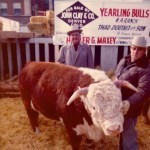
In a single day in 1966, Homer Maxey, a rich, powerful, prestigious Lubbock native who had literally helped build Texas Tech University from an open field, was penniless and ruined. At the time, 1966, Homer’s younger daughter, Glenna Goodacre, was a rising visual artist in Lubbock and busy mother of two, just then transitioning to the field of three dimensional sculpture. During the 15 long years of courtroom fireworks that Homer, assisted by young, firebrand attorneys who believed in his cause, Glenna rose to become a world-renowned sculptor.

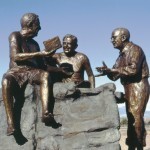
Glenna’s works include the Vietnam Women’s Memorial on the National Mall in Washington, DC; the gigantic Irish Memorial in Philadelphia; Philosophers Rock at Zilker Park in Austin; the Sacagawea dollar coin… and countless others. She’s a national treasure, and as she assisted us in the writing of this book, Glenna said numerous times: “I’m an exact replica of Homer… He was always there, urging me, ‘Keep going forward…’” When Glenna was just 16, Homer arranged the family trip to Europe on the QE2 so that Glenna could examine the works of the great masters in France, Italy and elsewhere.
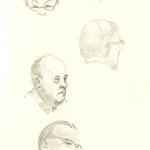
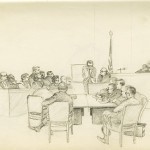
In the final stages of production of the book, just as we were going to press, I received an email from Glenna’s studio manager, Dan Anthony (also a fine artist), with great news: her photographer, Matt Suhre (also a fine artist) had accidentally found the sketch pad Glenna took to court during the first two weeks of the trial in 1969, making courtroom sketches of the good, the bad and the very ugly — her father, the plaintiff; the jurors; the lawyers on both sides; the cigar-chewing banker’s lawyer; Charlie Jones, the lawyer who had once represented Homer and the bank at the same time, urging Homer to sign papers that “tied his finances up into one big knot so that if one enterprise fell, his whole fortune fell…” in a classic case of conflict of interest, one of many. Charlie was known as “the most confident man in West Texas,” a talented corporate defense lawyer and supposed genius who stumbled into acts of hubris that would shock a crackhead neocon.
Despite Broadus’ sympathies for Homer Maxey (he’s also a longtime friend of Glenna Goodacre and her husband, Dallas attorney Mike Schmidt), he was torn by the contradictions and ambiguities in the saga, because he also liked and admired many of the individuals on the other side of the case, including Charlie Jones.
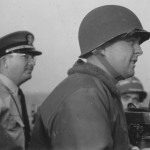
Working together on this story, Broadus and I invested hundreds of hours in getting at the truth of the case; also trying to articulate the background of social and cultural factors that were involved, going back to the very origins of Lubbock and Lubbock County, the complex community relationships there in that town of many churches, the legendary “Empire Builders” or “King Makers” who ran things behind the scenes, the wheeling and dealing, the heroism of men like Homer, who commanded amphibious ships during the most brutal combat scenarios in the Pacific theater of World War II, then returned home and put their suit and hat on and went out to make deals and build up modern West Texas.
If you know me, you might be surprised that an old punk rocker, blues singer and crime novelist would be attracted to a story out in the South Plains, in the second most conservative town in the USA, but I’m also a history buff and I’ve got a thing for stories about injustice, and this one really hooked me. Lubbock may not be the hippest or most beautiful town I’ve ever been to, but almost everyone I met there was kind and helpful to an incredible degree and they brought pleasure to the often difficult and labor-intensive tasks of research. Above all, I think, the attorneys and the historians were the ones who impressed me the most with their intelligence, their passion for the law, justice, the everyday chores involved in their profession, and on top of all that, their passion for stories. They’ve heard them all. They love to tell them.
Even when they’re not the hero of the story. 
Please join us at a book event near you.
July 9, 2014
BIG FEET, BIG HEART, RED STAR?
Like this blog? OK, why not subscribe anyway? Contact form below.

Big Foot Chester benefit for Davy Jones
Come out Friday night for a great cause: As most of you probably know, Davy Jones is that cool cat who’s played guitar in like 100 bands since the founding of Raul’s. The Hickoids and Big Foot Chester are just two of them. Right now, Davy is having an adventure with lung cancer and his friends have been getting together to help him out since he has helped so many of us over the years. Coincident with the anniversary of Hole in the Wall (40 years) and Big Foot Chester (10 years) there’s a big benefit show at the Hole this Friday. Big show, small price: $10. Come out, drop by and pay the cover if you’re on your way to some lame show that you can’t get out of or a hot date or whatever, pull some more dough out and drop it in the hat and help a brother out. Talking about My Terrible Self singing a Howlin Wolf song, plus my bros Walter Daniels, Bill Anderson, Big Joe Doerr, Ted Roddy, Texacala Jones, and quite a number of sensational individuals.
See my art gallery by clicking this link. A couple of new images below, just for fun.
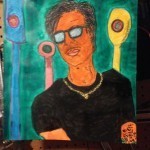
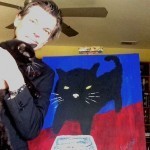
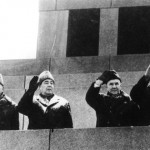
And then, finally, I guess you heard, they are remodeling the city council chambers here in Austin and, because some of our more conservative Texas cities have sometimes derisively referred to the Liberal Oasis of this Red State as The People’s Republic of Austin, I just wondered if those folks might be wondering about what the brand new city council dais might look like?

[contact-form]
June 23, 2014
THEY KNOW THINGS THAT WE DON’T

THEY KNOW THINGS THAT WE DON’T, 36 x 24, acrylic on canvas, by Jesse Sublett, $595, from Jesse Sublett’s Little Black Book
A new piece added to the ART page, above: “THEY KNOW THINGS THAT WE DON’T.” Yes, another one with grackles. AND another chapter in the Grackle Chronicles.
But first, this message from the New York Times, one of the best bits in the Sunday’s edition, about the fabulously successful author Neil Gaiman, which I filed in the “I can relate” department:
[Neil Gaiman's] first published book — “written solely for the money,” he says — was “Duran Duran: The First Four Years of the Fab Five” (1984). “I got a phone call from a lady,” Gaiman explains in an interview cited in the book, “and she said would you like to write a rock ’n’ roll book for us? A rock ’n’ roll biography? And I thought, ‘Oh God, yes! I’m in!’ ” Gaiman suggested a handful of subjects, including the Velvet Underground, David Bowie and Elvis Costello, before the editor interrupted: “Do you want to write the Duran Duran book, the Barry Manilow book or the Def Leppard book?” Pragmatism led him to choose the relative newcomers Duran Duran. “With Barry Manilow,” he said, “I figured I was going to have to listen to, you know, 40 Barry Manilow albums.”
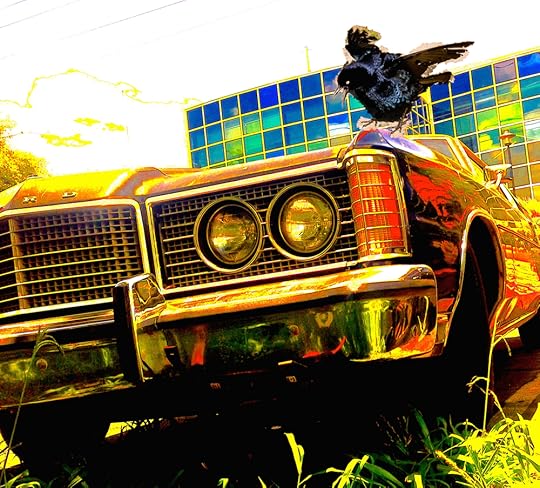

GRACKLE PROFILING
Grackle
rolling down South Congress Avenue
in a ‘74 Ford LTD
talking to himself
as he floats past Enoteca
a mockingbird
says
to a blue jay
“Never mind the grackle, Jake, it’s SoCo.”

Grackle
turns left on Annie, rolling east
proud of that machine
not all that much rust
or Bondo
vinyl top patched with duct tape
on the left side
plywood in the opera window
of that Detroit beast
Grackle
running on about this & that
pea brain working overtime
midnight black, raven shape
split second later
matador with a black cape
Grackle
talking squawks & rattles
loudmouth beak
trash truck of beer cans
backward whistles
airplane cabin with a compression leak
LTD
riding low, white wall retreads
brass balls striking sparks on a speed bump
muffler killing your ear drums dead
radiator leak, bad head gasket
burning oil tail feathers
big as the Hindenburg
what the hell is he saying?
now & then a human word
dumbass Suburban driver
woodpecker cell phone texting
comatose as the light changes
grackle perches on the horn
hollers out
“Hey shit bird!”
FINALLY: Don’t forget these dates for for “Broke, Not Broken: Homer Maxey’s Texas Bank War,” by Broadus A. Spivey and Jesse Sublett August 5, 7 PM, BookPeople: The Austin premier book party. August 15, 7 PM, Barnes & Noble Lubbock: The West Texas book party, with Broadus A. Spivey, Jesse Sublett AND special guest, Glenna Goodacre. Texas Tech Catalogue page for Broke, Not Broken: Homer Maxey’s Texas Bank War. Like us on FaceBook to keep up with upcoming events, reviews & news about the book and the authors.
Broke, Not Broken: Homer Maxey’s Texas Bank War, by Broadus A. Spivey & Jesse Sublett
June 15, 2014
Darla Pours a Double
New art added to the Art page this weekend. “Darla Pours a Double” is a small 8 x 11 acrylic & oil pastel on paper in a black matte temporary frame. “Grackle World” is 20 x 16 acrylic on canvas. It’s a Grackle World, we’re just living in it. Happy Fathers Day.
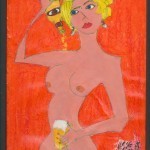
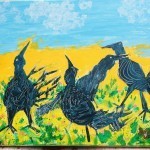
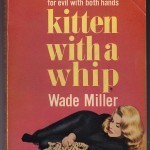
A few bonus images below from my pulp fiction collection. For you fans of TOUCH OF EVIL (1958), one of the best and darkest and weirdest of all films noir, here’s the source material for the movie script, along with a book about the film and the adaptation process.
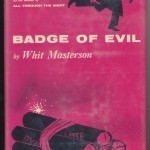
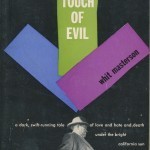
At one time I had every book published under the various names and pseudonyms of author team Bob Wade and Bill Miller. That includes not only the monumental classic, Badge of Evil / Touch of Evil, but also the super strange Kiss Her Good-By and Kitten with a Whip.



June 12, 2014
RED DIRT #6

“This wild man who crashed into your room, was he a minotaur?” “Huh? A Ford Taurus?” “No, man, this cat drove a Buick.” (from Grave Digger Blues , Art by Picasso)
RED DIRT #6
The latest chapter in RED DIRT CHRONICLES. For previous chapters, see Red Dirt #1, Red Dirt #2, Red Dirt #3, Red Dirt #4 and Red Dirt #5.
This one even has a little soundtrack, a modest little demo track of mine.
Love You Like a House on Fire – 3:27:14, 8.00 AM
Love You Like a House on Fire, a GarageBand demo by Jesse Sublett
"Love You Like a House on Fire - 3:27:14, 8.00 AM".
"Love You Like a House on Fire – 3:27:14, 8.00 AM"
IT WAS GETTING LATE
I watched them like a scorpion
waiting, I said:
Time, I got it right here
all the time in the world
EVEN LATER
She was dancing by herself
I would have gone looking for her
when she left
but I was nailed
to this chair by a daydream.
NEXT MORNING AT THE END OF THE ROAD
so they came, an army of pickup trucks
sledge hammers and hoists
busted out the old foundation
jacked and shimmed
the underpinnings of our life
crumbled once again
they paused at noon
exfoliating the foil from flour tacos
hechos de manos de sus esposas quieridas.
the aroma being something
primal, like sex, birth, death
all in one bite
then it was off to the graveyard
where defunct dreams
return to the elements
concrete dust and rebar
rotten timbers
rusting tin
there she stands now
another abandoned cicada skin
CODA
Strange man in the cemetery after midnight
waist deep in a hole, slinging his spade
you say, “Are you the grave digger?”
“No,” he says,
“just filling in for the other guy.”
THE END.