Jesse Sublett's Blog, page 2
October 13, 2018
Latest in my Austin Series of Bird Paintings
Here’s my latest painting. Look for it at Yard Dog when our show opens December 1st, featuring new works by me, Jon Dee Graham, and Larry Seaman.
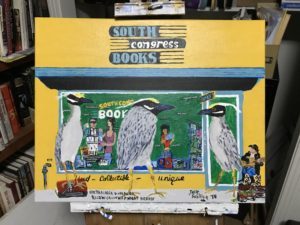
Disillusioned Author: Yellow Crowned Herons at South Congress Books, acrylic on canvas, 24 x 16.


October 9, 2018
JESSE’S PAINTING BIRDS
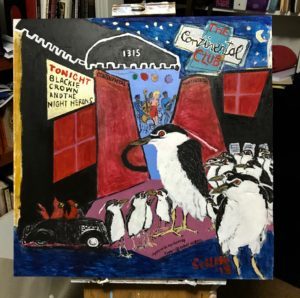
Blackie Crown & the Night Herons @ The Continental Club [SOLD]
[contact-form]
IN BETWEEN WRITING PROJECTS, I’ve been painting again. Mostly birds. I love birds. Herons are my favorites. We’re doing a show at Yard Dog on South Congress December 1st, featuring new works by me, Jon Dee Graham, and Larry Seaman. Some 40 years ago, we three musicians were all playing a new / old kind of rock ‘n’ roll they called punk/new wave down at a little Tejano bar called Raul’s. Jon Dee and I were in the Skunks. Larry was with Standing Waves and the other guitar player was Randy Franklin, who happens to own Yard Dog and who is beside himself with happiness about presenting this very special show. More details to follow, but we are thinking of calling it BIRDS, BEARS, & BONES. (Larry does the bones, assemblages of industrial and household objects, Jon Dee does BEARS (yes, all caps), and I do the birds.
I’ll be posting more images from all three artists soon, but here’s a few of my birds. To see them all, go to my Instagram at @jessesublett.visualart . You can arrange to purchase art there also.
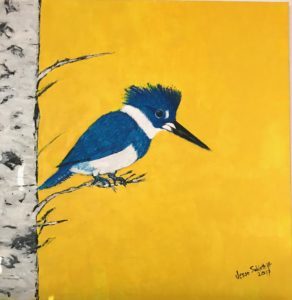
Belted Kingfisher, 36 x 36 acrylic on canvas, by Jesse Sublett
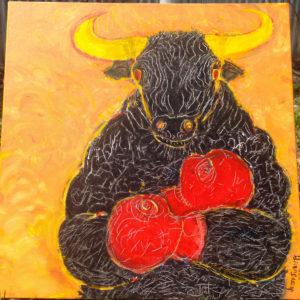
Minotaur, Undefeated, 24 x 24 on canvas, [SOLD]
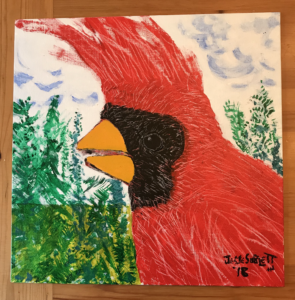
Claudio Cardinal, 12 x 12 acrylic, by Jesse Sublett
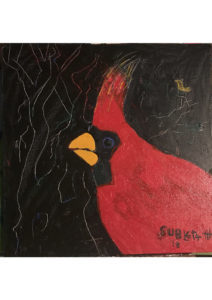
Claudio Cardinal’s Evil Twin, 12 x 12 acrylic by Jesse Sublett
Esther’s Follies: Cabaret, Magic, Political Satire
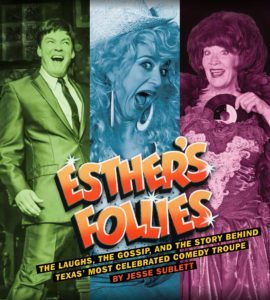
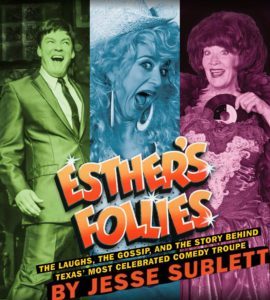
Almost a year ago, we celebrated the release of my book Esther’s Follies: The Laughs, the Gossip, & the Story Behind Texas’ Most Celebrated Comedy Troupe, a book that I’m really proud of. It’s 200 pages long, large format, lushly illustrated and designed, and it documents the strange and exciting and unlikely 40-plus-year history of Austin’s own cabaret, vaudeville, political satire and magic show on East Sixth Street. Co-founder Shannon Sedwick and superstar magician Ray Anderson are at the heart of the story, along with a case of literally thousands. Esther’s Follies has been knocking people out three shows a week for over 40 years. They’ve had their ups and downs: The Big Split of Christmas 1978 (half the cast walked out), death, a TV pilot, economic collapse, banned by UT in the Sixties (because of a little spontaneous nudity), success on Broadway and Europe, crazy regime changes, fire… and as always, the pressure to maintain their level of excellence and relevance.
They built up and survived the Ritz–including the hard-core punks vs. frat years on Sixth Street, Halloween Pumpkin Stomp, and they’ve even managed to thrive during the first two years of Donald Trump–thanks to the excellent Trumpster act of Ted Meredith. As for myself, I spent a year researching, interviewing, and writing it, while others, particularly Esther’s publicist Stephanie Donahue, worked tirelessly collecting and clearing photos, graphics, and original artwork. The book weaves my narrative history with interviews and way over 200 photos and images. It’s like a firehose of backstage history, personal stories, and the satirical side of politics and culture–and just like the saying that I stole from Robert Faires, “Esther’s is Austin, Austin is Esther’s,” and you can’t know one without the other.
I am very, very proud of this book. I think you will dig it, too.
November 1, 2017
September 21, 2017
And ANOTHER Cool Review of ARMADILLO WORLD HEADQUARTERS: A MEMOIR
Thank you, Allan Buller, for your review, I know you’re an authority, you put in lots of “research” in the subject back in the day.
BULLER’S BACK PORCH: HOME TO THE ARMADILLO, ONCE AGAIN
Posted on September 20, 2017by bullersbackporch
I feel like I’ve just returned from an extended journey through the past: I just finished reading Armadillo World Headquarters: A Memoir, by Eddie Wilson with Jesse Sublett. Replete with scads of the incredible artwork by the Armadillo Art Squad and fantastic photos by Burton Wilson from backstage and beyond, this is treasure trove of memories, some of them old, some renewed — some brand new!
 For those of us who lived in Austin during the days of the Armadillo (1970-1980), the whole flavor of the volume rings true. If you went to any shows there, you might find Eddie’s reminiscences of the particulars of that show or that performer included here. For me, it was fun to confirm specific dates for specific shows I saw. Even more fun, though, were some of the behind-the-scenes stories.
Like the time Dandy Don Meredith, veteran Dallas Cowboy and at-the-time, announcer on the new Monday Night Football show, saved the ‘Dillo from the Texas Alcoholic Beverages Commission (TABC) and imminent shut-down for liquor violations early on by glad-handing the agents, talking ’em up, signing autographs and slow-walking them back outside.
Or how the legendary Thanksgiving Jam of 1972 with Jerry Garcia and Phil Lesh of the Grateful Dead joining old buddy Doug Sahm and Leon Russell came together for an unannounced gig the day after the Dead’s show across the street at the Municipal Auditorium.
One fun detail for me was the tale of Frank Zappa’s first show there on March 10, 1973. Hearing some of the backstage tales filled in some color details on a night with several memorable moments. The opening act was Blind George McClain, a nearly blind-nearly-deaf keyboard player who rocked from side to side and banged his forearm on the keys for rhythm. At first, I figured him for one of Frank’s traveling band of freaks, but no, George, was a local favorite known for his rowdy rock-a-billy. Eddie tells of getting Frank to meet George, and George’s critique of the Mothers’ (shortened) sound check: “You were way too fucking loud!”
But the highlight that evening, for me at least, involved an inspired pairing for a most unlikely song to be performed by the Mothers of Invention. Touring with the Mothers at the time was jazz violinist extraordinaire, Jean-Luc Ponty, supercharging Zappa’s tunes with the rest of the top-notch band. Late in the show, Zappa stepped up to the microphone and said, “We don’t usually play with local folks, but this girl’s name is Mary and she plays the fiddle.”
Sweet Mary Egan of Greezy Wheels joined the band on stage and they tore into the bluegrass standard, “The Orange Blossom Special.,” and Mary and Jean-Luc truly tore into into it, ripping that thing wide open as they fiddled with each other, at each other, and around each other’s necks at one point. Never before nor since have I ever seen such ferocious fiddling!
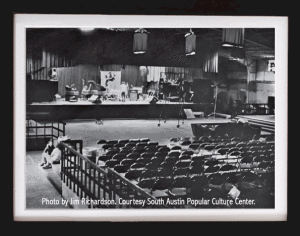 Another Armadillo moment I recall that did not make it into the book but seared itself into the memory of nearly anyone there was when my friend Nancy blew up Keith Godchaux’s piano during a Jerry Garcia Band set.
Okay, she didn’t “nearly blow it up” but here’s what happened. This configuration of Garcia’s side band included Keith and his wife Donna, both also in the Grateful Dead. Now, Nancy & Larry, friends who helped run Nothing Strikes Back, the world’s only black-light ice cream parlor, loved the Dead and especially adored Donna singing in the band. So Nancy had brought a small bouquet of roses to toss onstage for Donna.
Larry describes it best. “She’s got, like, 25 yards of stage she can toss them onto and she hits the open bay of the piano.” Where there was a web of microphone cables strung to capture the grand piano sound — which immediately started shooting giant sparks and making loud crackling and popping noises as the water at the bottom of the packaged bouquet hit the wiring.
The band wrapped up the tune quickly and lights dimmed as someone ran over to assess and fix the damage. In the dimmed light, I could see Keith nervously trying to light a cigarette — but his hands were shaking so bad it took him several tries before it lit.
Truthfully, though, I did not get to that many shows at the Dillo. Between schooling, being broke, and working evenings, sometimes up to 7 nights a week, I caught a few shows but nowhere as many as a lot of lucky folks. Flipping through the limited set of great show posters at the end of the book, though, I found 5 from shows I know I saw: Jerry Garcia-Merl Saunders, Jimmy Cliff, David Bromberg, Zappa, and Bob Weir.
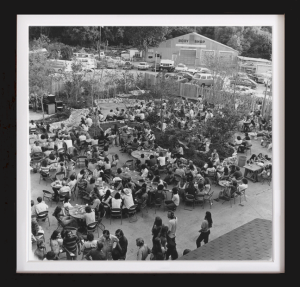 I did spend a lot of time through the years at the Armadillo Beer Garden. I recall a carpenter friend saying we could find him down there anytime in the summer in the evening — and that turned out to be true. Later, when I first worked at the Brown Schools, our Lariat dorm staff would hold one weekly team meeting a month off-campus at the Dillo beer garden. It always loosened us up and let us speak more candidly to solve tough team problems.
But my favorite visit to the beer garden had to be with my old friend, Billy the Kid, who had worked awhile in the Dillo kitchen, We were sitting outside, lamenting not being able to get in to see the Kinks that night due to our being broke. Then Billy looked over at the back door where staff walked in and out taking and delivering orders. “That door goes into the kitchen,” he said, “And it’s a straight shot to behind the beer counter on the floor at the back.” He swigged his beer. “I betcha we could just walk straight through and no one would say anything.” He thought a moment. “If they do notice you, just smile and keep going.” Finishing his beer, he announced, “I’m gonna try it — if I’m not back in a minute, give it a shot. Good luck.”
Well, he walked straight through the door there and disappeared. And did not reappear. Gulping the dregs of my beer and mustering up some courage, I headed over there. As I walked through, only one person looked up from a counter surface and we exchanged smiles. The folks at the beer counter seemed a bit surprised, but I slipped around them while they were busy selling beer.
I headed up around the crowd to the front where you could still boogie your way in closer to the stage. Ray Davies and the boys launched into “Demon Rum,” as he strutted the front of the stage, sloshing beer out of his cup onto the crowd. I jumped forward to get some soaking, drinking it all in.
Good times, good memories — and a great book to help bring them back alive!
New Austin Armadillo Memoir “A Perfect Evocation of a Crucial Time and Place in History”
ARMADILLO WORLD HEADQUARTERS: A MEMOIR
by Eddie Wilson & Jesse Sublett
Distributed by UT Press, Available in all fine stores, online, and brick & mortar
A featured book at the 2017 Texas Book Festival, November 4-5.
“A perfect evocation of a crucial time and place in Texas cultural history, this book isn’t as good as being there, but it’s close.”
The Rambling Boy
Lonn Taylor,
September 21, 2017
Wilson also describes some seamier business situations, including … the tangled relationship between the Armadillo and the television program Austin City Limits. The takeaway is that the music business is a business like any other except that more throats are cut and the egos involved are bigger.
Eddie Wilson says that if he had a larger bladder the history of Texas music might be different. As Wilson tells the story, one night in July 1970 he was at a South Austin music spot called the Cactus Club listening to the Hub City Movers when he felt the call of nature. There was a long line at the club’s rest room, so Wilson stepped outside and found a convenient wall across the alley. The wall was part of an enormous building that had once been a National Guard Armory, and after Wilson zipped up his pants he explored it in the dark and realized that its cavernous spaces would make a perfect music venue.. He rounded up some business partners and turned it into Armadillo World Headquarters, an institution that dominated the Texas musical scene for a decade.
Wilson records a couple of stabbings and one fatal shooting, which I guess is not a bad record for a Texas beer joint over a ten-year period.
Wilson himself has become an Austin institution that has lasted much longer than the Armadillo, and as the proprietor of Threadgill’s, a South Austin restaurant with occasional live music, he has been regaling friends and patrons with Armadillo stories for the past 40 years. Now he has finally got them down on paper in a beautiful, self-published book, designed by Lindsay Starr, printed on heavy paper, and illustrated with at least a hundred and fifty black-and-white photographs by the late Burton Wilson and at least as many color reproductions of the famous and eccentric Armadillo World Headquarters posters. The book, Armadillo World Headquarters: A Memoir, distributed by the University of Texas Press, is a perfect evocation of a crucial time and place in Texas cultural history. It is also very much Eddie Wilson’s own book, with a certain amount of edginess and score-settling in the text and an absolute openness about the illegal substances that fueled the Armadillo’s staff and performers and sometimes paid the bills.
There is a disquieting scent of violence underlying Wilson’s narrative, which may have as much to do with Wilson’s self-admitted explosive temper as it does with the fact that at bottom the Armadillo was a Texas beer joint.
The Armadillo World Headquarters opened on August 7, 1970 at 525 ½ Barton Springs Road and closed on December 31, 1980. Over those ten years it became far more than a concert hall. In Wilson’s words, it was “a hippie boot camp, a trade school, a music hall, an art pad, home.” It also incorporated a beer garden, a restaurant, a recording studio, a bakery, an ice cream parlor, a jewelry shop, an art gallery, an advertising agency, and a nursery for employee’s children. At its peak the Armadillo had 140 full- and part-time employees and countless volunteers and hangers-on.
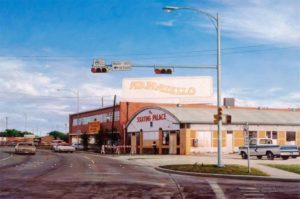 The Armadillo is best remembered as the place where the fusion between county music and psychedelic rock and roll took place, where Willie Nelson and Waylon Jennings produced what Wilson calls “the cosmic cowboy and progressive country thing,” but Wilson is quick to point out that the music presented at the Armadillo was far more diverse than country rock. Over a ten-year period Nelson played there only seven times and Jennings five. Nelson left in 1974 after a dispute with one of Wilson’s partners, Bobby Helderman, over the fact that too many of Nelson’s entourage carried guns. Emphasizing the diversity of the Armadillo’s presentations over the years,Wilson writes, “We had everyone from Shawn Phillips to Slade, and in between we had Frank Zappa, Martin Mull, Bette Midler, Leo Kotke, John McLaughlin and the Mahakrishna Orchestra, and Sonny Terry and Brownie McGhee. . . . Roxy Music….We also had ballet every month.”
There is plenty in the book for the fans of the bands of the 1970s, but in my opinion Wilson is most interesting when he is describing the intricate business arrangements that kept the Armadillo afloat. The advertising agency, TYNA/TACI (which was pronounced “teena tacky” and was an acronym for Thought You’d Never Ask/The Austin Consultants, Inc.) was a scheme dreamed up by another partner, entertainment lawyer Mike Tolleson, to get around a state regulation prohibiting beer companies from making contributions to beer retailers. Lone Star Beer paid TYNA/TACI $5,000 a month to promote Lone Star longnecks, and Armadillo artists produced tee shirts, bumper stickers, and posters, including the famous Jim Franklin poster showing a covered wagon inside a Lone Star bottle.
The campaign was run by a radio genius named Woody Roberts, who compiled a list of two hundred words that he thought would elicit positive reactions from potential Lone Star customers, had them market-tested by a psychographic research lab in Richardson, Texas, and then commissioned songwriters Tom Livingston and Gary P. Nunn of the Lost Gonzo Band to incorporate as many of the high-scoring words as possible into a song about Lone Star Beer. What emerged was “The Nights Never Get Lonely,” recorded by Sonny and the Sunliners, Freddie King, and the Pointer Sisters. And you thought country songs got written by an inspired songwriter just plucking a guitar.
Wilson also describes some seamier business situations, including arguments in the box office over the night’s receipts between performers’ agents and Armadillo staff members and the tangled relationship between the Armadillo and the television program Austin City Limits. The takeaway is that the music business is a business like any other except that more throats are cut and the egos involved are bigger.
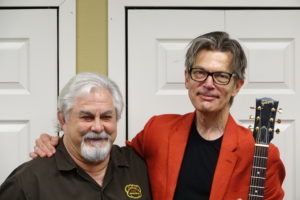
Eddie Wilson & Jesse Sublett
There is a disquieting scent of violence underlying Wilson’s narrative, which may have as much to do with Wilson’s self-admitted explosive temper as it does with the fact that at bottom the Armadillo was a Texas beer joint. For what it’s worth, the Armadillo’s security staff took instruction in Zen meditation, and followed the precept of “hug, don’t hit,” preferring to envelop bad actors in bear hugs and walk them to the door rather than laying them out with punches or black jacks. Wilson records a couple of stabbings and one fatal shooting, which I guess is not a bad record for a Texas beer joint over a ten-year period.
Wilson left the enterprise in November 1976 after a dispute with his partners over how best to reduce and pay off the business’s increasing debt. The Dillo’s management was taken over by Hank Alrich, a long-time friend of the house with a private income. Alrich restructured the business’s finances and actually had it showing a profit when the landlord, Austin real estate developer M.K. Hage, announced his intention to demolish the building and sell the property. He gave the Armadillo a year’s notice, time to organize one hell of a goodbye party on New Year’s Eve, 1980. Thirty-seven years later, Eddie Wilson has recaptured the essence of the place in this fine book. Reading it is not quite the same as being there, but it is close as you are going to get.
Lonn Taylor is a historian and writer who lives in Fort Davis. He can be reached at taylorw@fortdavis.net.
July 20, 2017
My New EP, At Last
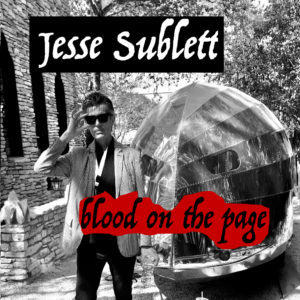
Jesse Sublett’s new EP, “Blood on the Page,” with seven new songs, big sound.
Seven new songs! A long summer. I’m writing my 1,000 words a day, sometimes more, 1,250 ideally, and sometimes 1,500. That’s 4 pages, 5 pages, 6 pages, etc. Word count never changes, it’s the only yardstick for success this summer for me. Working like a mule!
Ahhh, but it’s good. My new Converse shoes & Ted Baker pants arrived yesterday, and Lexus had my dashboard in stock for replacement, and they actually have drinkable espresso in their waiting room.
And for a quick weekend reward next month, when I reach my milestone of 300 pages on the current book, Lois and I are flying to LA to see Bryan Ferry at the Hollywood Bowl.
What a ramble! Here’s my new CD. You can buy it immediately at CD Baby. Soon to be in Waterloo Records and on iTunes. Kim Simpson and William Mansell played with me, made it possible, along with Cris Burns, brilliant engineer studio maestro at Ameripolitan Studio, courtesy Dale Watson. Jon Dee Graham guest stars on one track, “Mockingbird Town,” and it’s a pretty one. See ya soon. … Like at the Texas Book Festival November 4-5, where I will be presenting TWO books, Armadillo World Headquarters: A Memoir, by Eddie Wilson and Jesse Sublett; and Esther’s Follies: Funny Business, by Jesse Sublett, period.
March 29, 2017
WRITING ON THE AIR
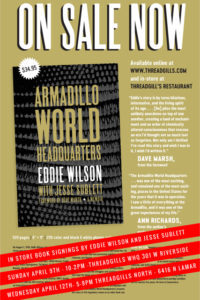
 See you tonight at 6 PM with Martha Louise Hunter on 91.7 FM KOOP. The show is called Writing On the Air, and it’s all about books, what goes in them, who writes them, who reads them. The books are pulling into port and will be at Threadill’s Friday evening, for sure, for sure! Long-awaited, much anticipated, pre-order or make a point to get the first printing ASAP. You can preorder here.
We’re having fun so far promoting it and I don’t see any reason not to keep doing it. Eddie Wilson is a brilliant writer. You already knew that. It was my privilege to help my pal bring it all together.
Eddie Wilson & Jesse Sublett
[contact-form]
February 23, 2017
New Book: ARMADILLO WORLD HEADQUARTERS: A MEMOIR
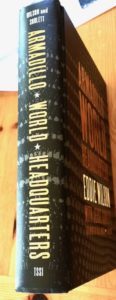
The Book.
Well, I’ve been letting the blog slip by in favor of other work and media but now I’ve got to tell you about the long-awaited book by Eddie Wilson and me, Armadillo World Headquarters: A Memoir, by Eddie Wilson and Jesse Sublett. Some advance copies trickled in from the printer this week, with the first official edition arriving at the end of March 2017.
You’ve probably heard about it, you will definitely be hearing more about it in the near future. This is a landmark in the documentation of Austin music history. Yes, I’m prejudiced in favor of the book–I’m privileged first to be a good friend of Eddie’s and second, to have helped in bring this book into fruition.

The man. No one can tell the story of Austin music like Eddie Wilson.
PREORDER THE BOOK FROM THREADGILL’S. DO it here. And you’ll be hearing more about stuff soon right here on this blog, including my book on the history of Esther’s Follies, which also happens to have deep roots in 1960s Austin. It looks like an interesting year ahead.



May 12, 2016
It’s a long way from the Pink Pussy Cat
During the buffalo trade, Mobeetie was the mother city of the Panhandle. They called it Hidetown, because everyone lived in little condos of buffalo hide. Then it was known as Sweetwater, for a nearby river. It grew fast, with more permanent structures sprouting like weeds, especially saloons and dance halls. Places like the Pink Pussy Cat Paradise, Buffalo Chip Mint and the Ring Tail, which catered to black men only, mostly the buffalo soldiers from nearby Fort Ellison.
It was rude and crude, a magnet for outlaws and con men. Only one woman could honestly claim she wasn’t a prostitute, and she ran a dance hall. The owner of the main dance hall was Billy Thompson, the trouble-prone, alcohol-soaked brother of Ben Thompson, Austin’s noted gambler, gunfighter and city marshal. But fortune’s smile on Mobeetie turned to a frown as nearby Fort Eliot was abandoned, the railroads bypassed it, a cyclone devastated it and in 1907, the town of Wheeler became the county seat.
And so… what’s this all about? Click on this MysteryPeople link to find out, or read below.
Continuing our series of Texas crime fiction writers on their home state, we next have a piece from Noir At The Bar cohort Jesse Sublett. In his piece Jesse looks at how Texas legend, history and violence shapes our state’s art and culture.
Jesse will be at tonight’s Noir at the Bar – this Thursday, May 12th, at our new home at Threadgills downtown. Jesse is joined by Con Lehane, Jordan Harper, and Les Edgerton. Each author’s latest title will be available for sale at the event. Readings begin at 7 PM. Booze, books, and bars – what’s not to love?
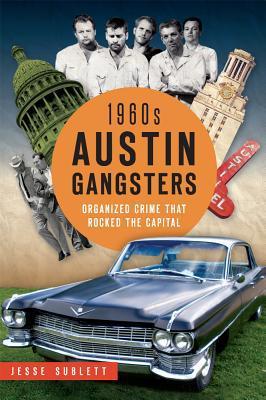
When I was researching 1960s Austin Gangsters, I visited many Texas landmarks that had been devastated by greed and avarice over the past several centuries. Gun-toting thugs, pimps, petty thieves, and wisecracking roughnecks were not the ones who devastated these places. The culprits were corporations, land barons, bankers, and other would-be empire builders.
Take the upper Panhandle town of Mobeetie, for example. Texian settlers came through in the early 1800s and began killing off the nomadic Plains tribes. By the last quarter of the nineteenth century, it proved more efficient to kill off the buffalo herds on which the Plains Indians were so dependent for their lifestyle and culture. During that time, also known as the Buffalo Wars, the town of Mobeetie became a thriving city, an economic crossroads. After the bison herds had been slaughtered, the land barons moved into the Panhandle and West Texas and ran cattle for a couple of decades. After beef industry took a steep dive in the late 1800s, the landowners subdivided and town-promoted. After Spindletop, there were oil boom towns. They erupted across the state like festering blisters, places as crazy, cash-drenched, and vice-ridden as any Wild West movie you can imagine. Most of those boom towns are gone now.
“After Spindletop, there were oil boom towns. They erupted across the state like festering blisters, places as crazy, cash-drenched, and vice-ridden as any Wild West movie you can imagine.”Today Mobeetie (which is more or less the same as New Mobeetie, just around the bend… long story…) is a stark, lonely little outpost of 200 or so people. Not much to look at and far less to do there. The population is unchanged since the Overton Gang came through in the spring of 1966 on a bank-burglary spree. Around one a.m. on the night of March 17, gunfire interrupted (the deputy shot out the tires of their getaway Cadillac parked on the road to the dump) the work of quintet of characters at the First State Bank and they scattered across the snow-dusted plains in all four directions. The ensuing fugitive manhunt for them encompassed thousands of square of miles of the shockingly empty landscape. Hundreds pitched in: deputies, rangers, G-men, and volunteers. They spread out on foot, in cars, on horseback, in airplanes, in helicopters, trailing bloodhounds. By the end of the week, all five were in jail.
It’s an empty landed crowded with myth: Billy the Kid, Bat Masterson, Wyatt Earp, Quanah Parker, Pat Garrett… all had been through here, rocking and rolling. There’s something about such a place like that makes a crime writer turn philosophical. As I stood in the middle of main street New Mobeetie in the middle of the day, looking out on the knife-edge horizon, no cars or any humans anywhere in sight, my first thought was this a simple one: Out there is a whole lot of nowhere to run.
The story of Timmy Overton, football hero, Golden Gloves boxer, and Austin gang leader hooked my attention back in 2001 when I was researching something entirely different. It wasn’t just the Timmy Overton Gang and the 1960s subculture of vice and crime but his personal story that fascinated me. He was born into a rough family with four other brothers and grew up in the rough and tumble working class neighborhood called the Seventh Ward, or East First (now a hipster haven of trendy espresso bars, clubs, cafes and yoga gyms). He was smart, athletic and driven, and when he graduated in 1958, he was given a football scholarship by the University of Texas saint of the pigskin, Darrell Royal.
“As I stood in the middle of main street New Mobeetie in the middle of the day, looking out on the knife-edge horizon, no cars or any humans anywhere in sight, my first thought was this a simple one: Out there is a whole lot of nowhere to run.”Things didn’t work out between Overton and Royal, however, and the same year the Longhorns played the Cotton Bowl, Timmy was twice convicted in burglary and forgery schemes and would finish his higher education at Huntsville. Within two years, Timmy was a noted underworld character, gambling and pimping and cruising the interstates with a platoon of other Cadillac driving bros, burglarizing small-town banks late at night and running a small empire of vice and crime based in Austin.
I found it amusing. Football players are programmed to be rough and brutal, to run over anything between them and a score. Once they step over some narrow line or run afoul of one of their appointed handlers, it’s back to the ghetto. Between high school and college, some fatal quirk was triggered in Timmy’s inner world. I gathered plenty of evidence to have opinions about the nature of that quirk, but along the way I also learned humility and empathy.
“But often the law and the justice system was almost as crooked as the criminals they sought to control, and if not for corrupt officials and willing civilians, the nexus of vice and crime would never have existed at all.”I felt empathy despite the many terrible deeds committed by Timmy and his pals. They hurt many people. They were part of a network of bootleggers, casino owners, thieves, murderers, crooked lawmen, and others throughout the South and Southwest that came to be known as the Dixie Mafia. But often the law and the justice system was almost as crooked as the criminals they sought to control, and if not for corrupt officials and willing civilians, the nexus of vice and crime would never have existed at all.
I talked to lawmen, ex-cons, ex-pimps and gamblers, and dozens of former classmates of Timmy Overton. Looking back on their youth and in particular, their high school days, members of the class of ’58 had a fascinating perspective. With tough guys like Timmy and his childhood friends on the line and the backfield, the Maroons football team had come within an inch of winning the state championship. There was a real sense of pride, respect, and humility as they considered those years. When they met for their ten year class reunion in 1968, Timmy was famously absent, as twenty members of the Overton Gang were on trial in El Paso on a massive federal conspiracy indictment.
When they told me about Timmy and other classmates who had ended up in prison or murdered, they spoke not with judgment and a tragic sense of loss, but fondness and respect. They were all friends and cohorts in the grand adventure of life.
This impressed me a lot.
“I’m sure there are fans of film noir and crime fiction who look at the world as a place of right or wrong, black and white. No shades of gray. No moral ambiguity. No dead end alleys where every choice leads to disaster. I suppose that simple, streamlined map of the moral universe is a comfort to them. But it sounds really boring to me.”I’m sure there are fans of film noir and crime fiction who look at the world as a place of right or wrong, black and white. No shades of gray. No moral ambiguity. No dead end alleys where every choice leads to disaster. I suppose that simple, streamlined map of the moral universe is a comfort to them. But it sounds really boring to me. When those other people watch a film noir or follow the footsteps of Sam Spade, Phillip Marlowe, or Harry Bosch, maybe they came for the biggie sized buckets of popcorn and corn syrup drinks, but myself, I like a little moral ambiguity and mystery.
Come by Threadgill’s off Riverside tonight, Thursday, May 12th, starting at 7 PM for readings from your favorite authors accompanied by your favorite drinks. You can find copies of Jesse’s latest, 1960s Austin Gangsters, on our shelves, at Noir at the Bar, or via bookpeople.com. You can additionally find Jesse’s latest album on our shelves.
Share this:
Hope to see you tonight.
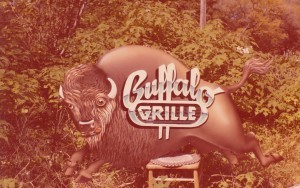
Gary Martin sign for Buffalo Grille, back in 1979? Just for the heck of it.