
Jesse Sublett's Blog, page 4
August 1, 2015
Jon Dee & Friend Show featuring Jesse Sublett

Jon Dee Graham & Jesse Sublett at at the Gallery
Sunday August 2, 8 PM, a rare treat: Jon Dee Graham & Friend Show with Jesse Sublett. That’s the official billing, but those of you who’ve been around for a while will note the irony. That is, Jon Dee Graham & I have been friends and musical co-conspirators since 1979 when Jon Dee replaced Eddie Munoz in the Skunks. A lot of time has passed since then. Jon Dee has played with a lot of famous people, toured a zillion miles, written about 100 songs that are among the best songs around. I’ve played with a few famous people, published at least eight books, played music and presented literary-musical-artistic works in various formats. But one of the coolest, most important things I do anymore is hang out, whenever possible, with my great friend Jon Dee Graham. As some of you know, when you sit down with Jon Dee and pick up some musical instruments, you never know what’s going to happen next. In some ways, it’s frightening, but fear stimulates adrenaline and, with luck, the creative machinery. So I’ll come to the gig with a few songs written on a list in my pocket, just as reminders, but we never follow any set list. I’ll practice a bit on my own, just to try and sharpen my chops. I do want to do a couple of Casey Bill Weldon songs. In fact, I’m putting that out there so I’ll be committed to doing them instead of chickening out at the last minute. It means bringing my resonator guitar. (By the way, here’s a video clip of me singing CBW’s “My Stove Won’t Work” in the jungle patio.) Anyway, I’ll be bringing my upright, my B-50, and the resonator, and that list… and I’m really looking forward to it. Oh yeah, I’ll bring along a few copies of “1960s Austin Gangsters” so if you haven’t bought one yet, here’s your chance to pick one up and get it deface by de author. Cheers!


July 5, 2015
#ThugBackThursday with “1960s Austin Gangsters”
Update: See a brand new review of “1960s Austin Gangsters” on LoneStarLiterary.com.
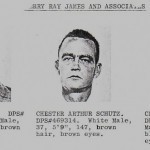
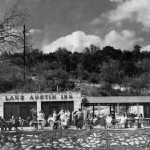
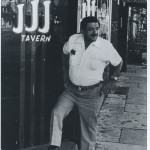
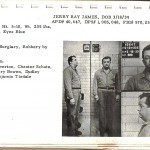
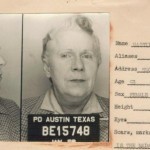
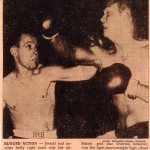
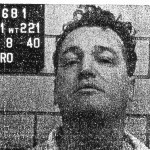
Come see us at Barnes & Noble Sunset Valley Thursday July 9th, 5 PM, for their #ThrowBackThursday #GetPopCultured book signing for “1960s Austin Gangsters: Organized Crime that Rocked the Capital.” This is my eighth book and it’s been a huge hit in the Austin area. As it well should be. Austin was still a laid back capital and college town in the late sixties when the white thug culture was exploding in the rough parts of town. The class of ’58 in particular remembers Timmy Overton and his brothers Darrell and Charles, Don Jester, Dudley Pounds, “Little Larry” Culbreath, Dickie Goldstein, Sonny Stanley, and all the other toughs who strutted around Austin fist-fighting, shaving dice, safecracking, pimping, and all around thuggery, profiling in their Cadillacs and Thunderbirds and even, in the case of Travis Erwin, driving a green Edsel. Remember Le Lollypop, Austin’s first go-go club? Or the Golden Gloves tournament with its gala banquet and Miss Golden Gloves pageant? Remember when Don Jester punched out Elvis or when Timmy Overton and Jerry Ray James got revenge on Darrell Roy and UT by punching the safe at the UT Co-op during the Texas/A&M game, robbing all the money from the ticket sales–the biggest safe burglary in Austin history? Lots of history in this book, lots of lurid, weird noir tales, all true, all carefully authenticated. I’m really pleased when local stores — even Walgreen’s — tells me that the book has been “flying off the shelves.” Also really pleased to hear from former classmates of these bad boy s who remember them when they were just, more or less, regular guys. Thanks for your support, come out and get your copy signed. Happy Fourth of July, whatever country you hail from.

June 14, 2015
KING OF NOIR (UPDATED)
Hello: You may have accessed this post from November 30, 2012 via another host, a ghost host, and if so you won’t see the illustrations and you’ll basically be lost. Please use this link to access this post. It’s been lovingly updated, with all the graphics from the original post re-inserted here.
November 30, 2012 | Filed under: Books & other writing by Jesse Sublett, NOIR & TRUE CRIME and tagged with: book collectors, crime novels, fawcett gold medal, film noir, grave digger blues, jim thompson, michael connelly, noir, paperback book collectors, pulp fiction, texas monthly, vintage paperback

I’ve been thinking about pulp fiction.
In the 12 days since my new novel Grave Digger Blues went on sale, I’ve been thinking more about pulp fiction.
Sometimes wherever I am this genre seems to reach out and grab me, like some random demons in waiting. Certainly I’ve some experiences of my own that were right out of a pulp fiction nightmare.
I’ve written about them, and will probably write about them again. At other times, writing from the noir state of mind just helps me put things in perspective, in the same way that writing a blues song helps me communicate.
A band called the Tin Can 44s contacted me and asked me if I could share some more scans of my vintage paperback novels to help them in their development of artwork for an upcoming release. and I’ve been doing some research that required digging through my book collection and files (but nothing new about that), so I fired up the scanner and flipped through some files and found this piece I wrote about Jim Thompson published by Texas Monthly in November 1999. The idea for the story came to me all at once. Novelist Jim Thompson, widely acknowledged as the “King of Noir,” lived in Texas for many years, and many of the rough and tumble experiences, including his stint as a teenage bell hop in Fort Worth during the Roaring Twenties and his work and fucking off in the oil fields of West Texas, became fodder for many of his classic pulp fiction novels. And here’s Texas, a state that’s always bragging about the great, famous people who are from here, yet this fact was rarely acknowledged and even more rarely–as in never–celebrated.


So here’s that story, in its entirety, as published in Texas Monthly, with my own scans of my copies of the novels which I loaned the magazine for their illustrations back in 1999. (Oddly enough, there did not seem to be any hardboiled crime collectors in the offices of Texas Monthly at the time.)


From the Kindle edition of “Grave Digger Blues” by Jesse Sublett
Commercial Announcement: If you haven’t done so yet, do yourself a favor and download a sample of Grave Digger Blues right now. The Blues Deluxe Edition for the iPad (with an hour of audio, including original blues music and audio chapters, over 100 photos and graphics, plus a video intro) is available on iTunes for $6.99, and the Kindle version (100+ photos and graphics and the same wild story) is available in the Amazon Kindle Store for $4.99. Much more info on the Grave Digger Blues page, with updates here and here.
WILD TOWN: JIM THOMPSON’S FORT WORTH YEARS
Many of Jim Thompson’s noir novels drew on his days as a bellhop at the old Hotel Texas, when Fort Worth was rowdy and the twenties were roaring.
by Jesse Sublett
When Jim Thompson died in Los Angeles in 1977, his career was almost as dead as he was. Not one of his more than two dozen books was in print. His last important screen credit had been for Stanley Kubrick’s Paths of Glory, twenty years earlier. But during the past decade and a half, Thompson has blazed a comeback trail from oblivion to mainstream popularity and recognition as a unique voice in American literature. Almost all of his novels are back in print, including the ultimate noir novel, The Killer Inside Me, one of the scariest ever written. Even Stephen King thinks so.


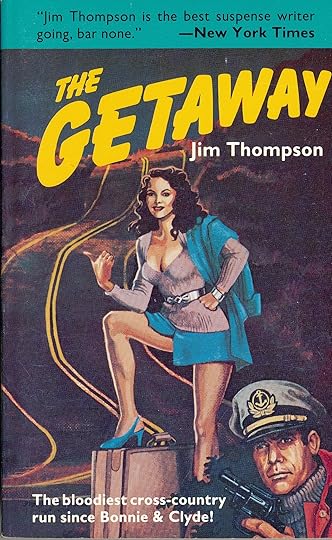
Generations of filmmakers, from Orson Welles to Quentin Tarantino, have admired his work. Among his eight books that have been made into movies, the best known are probably The Getaway, filmed in 1972, and The Grifters, which was nominated for four Academy awards, including best adapted screenplay, in 1990. Too bad Jim Thompson isn’t around today to enjoy his amazing comeback. In a perfect world he’d be the star attraction at this month’s Texas Book Festival. At least half of Thompson’s books are set in Texas, and all of them are informed by his experiences here during his teens and twenties, between 1919 and 1935—times that were quite likely the worst of his life.  He was born James Myers Thompson in 1906 in Anadarko, Oklahoma, where his father, James Sherman Thompson, was the county sheriff. The following year, his father fled to Mexico and parts unknown for two and a half years after being implicated in a murky scandal involving financial improprieties. The family moved around Oklahoma and Nebraska for years before relocating to Fort Worth in 1919. For the next four years the senior Thompson dabbled in numerous schemes and ventures, including drilling wildcat oil wells in West Texas, but by 1923 the family was destitute. His son chronicled this chapter of his life in his first book, Now and on Earth: “Pop went broke and his was the irremediable brokeness of a man past fifty who has never worked for other people.”


Things were booming in Texas, however, and sixteen-year-old Jim Thompson was able to get a job working nights as a bellhop at Fort Worth’s Hotel Texas, at 815 Main Street. Rubbing up against and running errands for gamblers, gangsters, con artists, rich oilmen, and lonely females in a big-city hotel gave Thompson plenty of material for his future novels. One example is the swindle known as “the twenties” that figures in The Grifters; Roy Dillon (played by John Cusack in the film) uses sleight of hand to get $20 of change for a $1 bill. Thompson learned that trick and a slew of others at the Hotel Texas, a thinly disguised version of which is featured in numerous Thompson novels and is the focal point of all action in his hotel novels, like Wild Town and A Swell-Looking Babe.
Thompson also befriended notorious bank robber and gangster Airplane Red Brown, who made a big impression on him. Brown would serve as the inspiration for the protagonist or a major character in many of Thompson’s novels, including Airplane Red Cosgrove in Recoil, Allie Ivers in Bad Boy andRoughneck, and professional thief Doc McCoy in The Getaway.


During the wild and woolly oil boom and Prohibition years, bellhops at places like the Hotel Texas didn’t just carry luggage for the guests; they also procured bootleg booze (Thompson used to carry a couple of extra half-pints in his socks), hookers, and drugs. A bellboy who was killed while scoring drugs for a guest is at the center of the short story “The Car in the Mexican Quarter,” one of Thompson’s few private-eye stories: “The Lansing is one of the biggest hotels in town, but I knew that it stood for a lot of dirty work from its employees. One suicide a year is plenty for a big hotel and the Lansing had one almost every month.”
Things have changed in Fort Worth since Thompson lived there. The Hotel Texas is now the Radisson Plaza, and the wildest thing that went on while I stayed there recently was a convention of Seventh Day Adventists. The fifteen-story luxury hotel was completed in 1922, and despite having been extensively remodeled inside, it still exudes a sense of grandeur and history. President John F. Kennedy spent his last night there, in room 850.

To be fair, the Hotel Texas never had a lock on decadent behavior in downtown Fort Worth. It was located in a part of town known as Hell’s Half Acre—a concentration of brothels, saloons, gambling halls, and like enterprises that had catered to cowboys and cattlemen back when Fort Worth was a major stopover on the Chisholm Trail.
Thompson’s father used to regale him with stories about the infamous lawmen and outlaws he’d known, many of whom spent time sampling the delights of places like Two Minnies, where customers in the downstairs bar could view the naked prostitutes prancing about upstairs through the glass ceiling. Two Minnies was long gone, but there were still plenty of holdovers from the days of Hell’s Half Acre when Jim Thompson walked these redbrick streets. In his autobiographical novel Bad Boy, Thompson recounts a day he spent with his Grandfather Myers in downtown pool halls, arcades, and burlesque houses:
. . . following lunch we went to a penny arcade.
Pa had brought the bottle with him, and he became quite rambunctious when ‘A Night With a Paris Cutie’ did not come up to his expectations. He caned the machine.
Great story material, but working seven nights a week while attending Polytechnic High School devastated Thompson’s health. Whiskey, cocaine, and three packs of cigarettes a day kept him going. After two years of this hellish routine, he suffered a total physical and mental breakdown at the age of eighteen.
In more than a few Thompson novels the protagonist’s spiral of doom and dissolution is propelled by an Oedipal streak a mile wide. It doesn’t take a degree in psychology to guess that Thompson wrote to get back at his father for his various failings, not to mention the torturous routine he himself had to endure to support his family. He created numerous wicked caricatures of his father. Both The Killer Inside Me and Pop. 1280 are narrated by a slow-talking, joke-spinning West Texas deputy sheriff who is actually a serial murderer.
A bleak, menacing backdrop is a staple of noir fiction, but Thompson’s portrayals of Texas and Texans are so bleak and bitter that they veer into the category of surreal cartoons. As he explains in Bad Boy:
. . . Texans were distasteful—or so I soon convinced myself. I studied their mannerisms and mores, and in my twisted outlook they became Mongoloid monsters. I saw all their bad and no offsetting good.
Texans made boast of their insularism; they bragged about such things as never having been outside the state or the fact that the only book in their house was the Bible.
Interestingly, as Thompson’s narratives move westward, his tone mellows considerably. In Texas by the Tail, written in the mid-sixties, his con man narrator berates Houston for, among other things, its weather and its racial politics. He definitely favors Fort Worth over Dallas:
Neighboring Dallas started an evil rumor about its rival. Fort Worth was so rustic, the libel ran, that panthers prowled the streets at high noon. Fort Worth promptly dubbed itself the Panther City, and declared the lie was gospel truth.
Certainly, there were panthers in the streets. Kiddies had to have somethin’ to play with, didn’t they? Aside from that, the cats performed a highly necessary service. Every morning they were herded down to the east-flowing Trinity River, there to drain their bladders into the stream which provided Dallas’ water supply.
Thompson’s own sympathies ran along similar geographic lines. In 1926, after recuperating from his first stint as a bellhop, he hitchhiked to West Texas on a strange pilgrimage that took him to the very same oil fields and towns where his father had gambled away his family’s future. He spent the next two years laboring at backbreaking, dangerous jobs in the oil fields, working in gambling joints, briefly running a diner, and hoboing.
In Bad Boy, Thompson says that becoming a writer was foremost in his mind when he lit out for West Texas. “Oil Field Vignettes,” the first of several pieces he wrote while in the oil fields, was published in Fort Worth—based Texas Monthly magazine (no relation) in 1929. Ironically, the oil business—which had broken his father—provided the means for Thompson to reinvent himself.
It had already transformed Cowtown into Fort Worth, a major hub of the Texas oil business. The black gold that bubbled beneath their ranchland made West Texas cattlemen like Burk Burnett and W. T. Waggoner—who weren’t exactly poor before—into wealthy oil barons who funneled a great deal of their prosperity through the city that had always been good to them. Jim Thompson undoubtedly encountered many of these men while working as a bellhop, and certainly breathed construction dust as monuments to their success shot skyward: the W. T. Waggoner Building (810 Houston), oilman R. O. Dulaney’s cool art deco Sinclair Building (106 West Fifth), the Petroleum Building (also built by Dulaney, 611 Throckmorton), and others, all built between the teens and the early thirties.
While train travel isn’t a frequent fixture in Thompson’s novels, most of the grifters, gamblers, and other fun-seekers he hopped bells for came into Fort Worth via the old train stations that are just a short walk from downtown: the Santa Fe Depot (1601 Jones) and the Texas and Pacific Terminal (West Lancaster Street between Houston and Throckmorton). The former, built in 1899, evokes old Cowtown more than it does the Roaring Twenties, while the latter is a magnificent 1930 art deco structure that conjures up fedoras and big-city film noir. (To take a guided walking tour called “Hell’s Half Acre to Sundance Square,” contact Bill Campbell at 817-253-5909 or dwcjr@swbell.net. A “Downtown Fort Worth Walking Tour” brochure is available from the Fort Worth Convention and Visitors Bureau, 817-336-8791.)
In 1931 Thompson married Alberta Hesse, and before long he had found a job at the Worth Hotel (at Seventh and Taylor, where the expanded Fort Worth Club stands today). Thompson was working at the Worth when Will Rogers gave him a $50 tip for retrieving his car. Despite occasional nights like that and the fact that he was working 84 hours a week with no days off, he still wasn’t making enough to get by. Things only got worse as the Thompson household expanded to include three children born between 1932 and 1938.
In a bold stroke that, in hindsight, seems to have been preordained, Thompson turned from writing for oil trade journals to writing for true-crime magazines. A gentle, well-mannered soul who loathed violence and bloodshed, he churned out lurid stories for publications like True Detective, Daring Detective, and Startling Detective, managing to eke out a living and at the same time developing many of the stylistic techniques he would employ in his later novels. In 1935, lured by a lucrative offer from a true-crime magazine, Thompson moved to Oklahoma, ending the strange, bittersweet, and often brutal saga of his Texas years.
Once Thompson got to Oklahoma, his crime-magazine job suddenly fizzled out. In 1936 he obtained a position with the Oklahoma Federal Writers’ Project and not long thereafter was appointed its director. Also actively involved in left-wing politics, he gained many influential colleagues and admirers, including Woody Guthrie, who essentially agented Thompson’s book deal for Now and on Earth, published by Modern Age in 1942. A sort of semi-autobiographical protest novel—cum—psychological study, it met with mostly great reviews but lackluster sales. His first crime novel, however, Nothing More Than Murder (1949), struck a nerve with critics and the reading public alike.
As chronicled in Robert Polito’s excellent 1995 biography, Savage Art, Thompson’s writing career is the stuff of hard-boiled literary legends: He wrote like a demon between 1952 and 1954, turning out twelve explosive novels for Lion Books. Although he never really fit into the neat category of mystery or crime fiction, the trajectory of his life from 1942 until his death in 1977 was eerily similar to that of noir giants like Dashiell Hammett and Raymond Chandler, who also emerged from the ghetto of pulp fiction into mainstream American culture. Such men often wrote for two main reasons: because they needed the money and because if they didn’t write, their head would explode. They also tended to live hard and drink hard, and when they were hot, they were on fire.
One night during a recent stay at the Radisson Plaza, I lay in my bed sleepless, thinking about young Jim Thompson toiling up and down these halls where the Roaring Twenties howled with a uniquely Texan decadence, leaving a young man with a hangover that would last a lifetime. If these walls could talk, I wondered, what would they say? Maybe they would say some of the things that are said in the pages of Jim Thompson’s books. In Bad Boy he wrote:
It was a weird, wild and wonderful world that I had walked into, the luxury hotel life of the Roaring Twenties. . . . a world whose one rule was that you did nothing you could not get away with.
There was no pity in that world. . . .
At the end of Thompson’s life his declining health made it all but impossible to write—and no one seemed interested in his style of writing anyway, since all his books were out of print. Shortly before he died he told his wife, “Just you wait. I’ll be famous after I’m dead about ten years.” Wherever he is now, Jim Thompson must be enjoying a hell of a last laugh.[The End]
June 6, 2015
The Splash Four covers “Earthquake Shake”

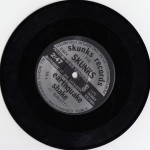

Although I’ve known about this record for several years, I only recently scored a copy of “Do the Earthquake Shake” by The Splash Four, a punk band from Paris. Their version of the Skunks‘ original “Earthquake Shake” is pretty damn solid. They changed a few chords between choruses, which is fine, because in our version, there was just a one-chord bridge, which I thought was pretty brilliant in a totally minimalist way, but I like their addition a lot. It almost sounds like a vinyl record skipping. The CD was released in 1995 and is distributed by Get Hip of Pittsburgh, PA, a label run by Gregg Kostelich of the band the Cynics.
Enough talk, here’s the rock. By the way, the rest of the CD is pretty damn good, too. One of my other favorites is “Girl with No Brain.”
Earthquake Shake
Originally composed by Jesse Sublett in 1973, Big Striped Cat Publishing, BMI.
"Earthquake Shake" from Do The Earthquake Shake! by Splash Four. Track 16. Genre: パンク.
"Earthquake Shake"
May 29, 2015
Half Price Books Gig, Tertulia
Saturday, May 30, 1 PM – 3 PM, Austin Gangsters Take Over Half Price Books North Lamar. A few murder ballads plus Q&A. I’ll be signing “1960s Austin Gangsters: Organized Crime That Rocked the Capital.” But actually, I’ll sign anything. Come by. Eddie Wilson has promised to buy you a beer at Threadgill’s (N. Lamar) after the signing if you buy a copy of “1960s Austin Gangsters,” the chronicle of Austin’s dark underbelly of vice and crime in the peace and love decade. Read past posts about the book here and here.

Sunday night, May 31, I’ll be doing a song at the Tertulia event at the Continental Club Gallery. If you haven’t been to one of these, you don’t know what you’re missing. The contributors each do a song, poem, or some other performance piece in response to a theme determined by the curators. This time it’s “Maybe.” What does “Maybe” mean to you? Come find out what it means to this talented roster of artists (see poster below).

May 21, 2015
#TBT Three Chords Never Die
 Some songs never die. There are terrible songs that make you want to shove an ice pick through your ear drums every time and some that have the power to make your day of any year. For me the latter would include most anything by Howlin’ Wolf, Al Green, Otis Rush… with dozens of selections by Roxy Music, Jimmie Reed, Mingus, etc… Ice pick songs tend to be by Grateful Dead, Beatles, Oasis, etc… I’m almost always up for the Velvet Underground — “Sweet Jane,” “Waiting for My Man,” “All Tomorrow’s Parties” — and then there are songs like “Sister Ray” that raise the bar, then smash it into powder and smoke it.
There are songs with so much history and angst behind them that people have written books about them — “Louie Louie” (investigated by the FBI for sexual and anti-American content), “Lili Marlene” (favored by both Allied and Axies soldiers during WW2 and Marlene Dietrich’s theme song). And there are songs that are as simple and well designed as a claw hammer, so good and simple that even a trio of guitar banging bone heads can’t screw them up — “96 Tears,” “Sweet Jane,” “Gloria,” “Louie, Louie,” maybe even “It’s My Party” –songs that have been recorded hundreds of times and played by a million garage bands that may never die.

I’m not suggesting that my own song “Earthquake Shake” falls into any of those categories, but I’ll say that having at least three other cover versions out there pleases me a lot.

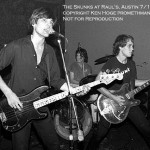
“Earthquake Shake” is the second song I wrote (going back to about 1975), and it joined the Skunks’ live set list in late 1977 as we threw our band together as an opening act for The Violators at our first gig at Raul’s in January 27, 1978.
There were no other punk bands in Austin at the time, except maybe the Bodysnatchers, who might have considered themselves a rock band.
Anyway, the Skunks had a working song list of about 20 – 30 songs, as the original guitarist, Eddie Munoz, and I had been playing together in a glam-blues-rock band called Jelly Roll and other bands for almost two years and we could fake our way through dozens of blues and rock and rockabilly covers, playing in bars that required three to four hours of live music from a band.

A not-pristine copy of “Earthquake Shake” on eBay for $150. Copies in Very Good or better condition have fetched $250 and higher.
Playing all night in Texas joints and parties could be a tough way to earn a dollar, but, as I like to say, it sure beats working. The Skunks of 1978 also played “Thigh High,” which was my actual first original song (also about 1974). The 1978 Skunks (with drummer Billy Blackmon) recorded a demo of “Earthquake Shake” in January or February 1978, along with a few others no one would remember today (except, I reckon, the band), such as the not-so-classic “Virgin Mary” and “Adolph Hitler Was a Closet Queen.”

Jesse Sublett and his 1950s Fender Precision bass guitar.
If I remember correctly, we also recorded “Earthquake Shake” with Joe Gracey producing in his studio in the basement of KOKE-FM (a k a Electric Graceland), but it didn’t make the cut of the Skunks “Black/Bootleg” LP on Gracey’s Rude Records. Long story, but that record took so long for Gracey to release (1980) that the new version of the Skunks, with Jon Dee Graham on guitar, recorded “Earthquake Shake” and “Can’t Get Loose” on a Friday night in July 1979, using two 2-track tape machines and sent it off to be pressed and released it in late July 1979 on our own Skunks Records label. The single was a hit on KLBJ-FM and sold out quickly in Austin (despite what some music historians have stated elsewhere, KLBJ-FM was hugely supportive of our band; not only were our official releases part of their playlist but they also played demo cassettes in heavy rotation as early as the summer of 1978).
In 1980 we released a second pressing of 1,000 copies with a different sleeve. The original sleeve was printed for free by a fan at Ginny’s copying services in Dobie Mall. We got a lot of free (pilfered) stuff in those days. In 2000 The Skunks released a live CD called “Earthquake Shake: Live” (including the original 45 version and live sets from Max’s Kansas City and the Back Room in Austin; available on iTunes) and then, later that year, the Italian label Rave UP released a compilation of Skunks material on a vinyl LP called “Earthquake Shake.” In 2010 Last Laugh Records, based in Brooklyn, released a facsimile edition of the original 45. Last Laugh is owned by one Harry Howes, a busy guy, as you can see below:


At least a couple of Austin bands were playing “Earthquake Shake” at Raul’s in the late 1970s; but the first band I heard about releasing their own version was The Long Gones, from Cincinnati, Ohio (1998, on the Shake It label). There’s also the French band the Splash Four, who in 1995 titled their record “Do the Earthquake Shake,” released on a Japanese label. I heard about it years later, found the band, contacted them, and was told, Sorry, we no longer have any copies.
Get Hip from Pittsburgh distributes the record, which I recently acquired through eBay. I’m happy to say that our French fans turned in a damn good version of the song. In fact, the style of “Earthquake Shake” seems to permeate the whole record. The guy behind Get Hip is apparently Gregg Kostelich, who plays guitar in a long-running old-school punk band called The Cynics. Ironically, Lois and Dashiell and I were in Pittsburgh for a family reunion when the Splash Four CD arrived in the mail here in Austin. Had we known, we could’ve looked up Greg in person to save on postage. 
My friend Mal Thursday has also recorded “Earthquake Shake” and plans to release it soon, maybe this summer, on a release by his great garage band, The Malarians. I look forward to that.
Oops, I almost forgot that Soul Jazz Records from the UK included “Earthquake Shake” on the excellent compilation of garage punk 45s released a couple of years ago called “Kill the Hippies! Kill Yourself!: Underground Punk in the United States of America, Vol. 1″ This is an excellent package, highly recommended.

I think the second-most-covered song by the Skunks is “Gimme Some.” The Skunks have released several versions, including one on the Joe Gracey produced LP, plus the Republic “Purple” Skunks LP of 1982, our double-EP from 1980, the Rave Up LP, the Earthquake Shake: Live CD, and probably several others. The Sons of Hercules recorded what some consider to be the definitive version (I admit, it’s really, really great); the all-girl band The Platforms recorded a smoking version as well. And Tim “Napalm” Stegall’s band The Hormones do an incendiary version as well.
I’m always gratified to hear from fans. My friend Robb Burley, the auctioneer, says that his two girls, age 4 and 6, count “Gimme Some” among their personal Top Five songs of All Time.
Update: I’ve added some mp3s to play on the music player, including the Splash Four version of “Earthquake Shake” as well as the Skunks original single and a live version. Unfortunately, the interface with the music player is hard to figure out and it’s a 50-50 chance whether it will work or not. Crossing my fingers that it does.
Cheers,
Jesse
Earthquake Shake
"Earthquake Shake" from Do The Earthquake Shake! by Splash Four. Track 16. Genre: パンク.
"Earthquake Shake"
Earthquake Shake (live 2007)
"07 earthquake shake".
"Earthquake Shake (live 2007)"
Earthquake Shake
"20 Earthquake Shake".
"Earthquake Shake"
Earthquake Shake (live 2007)
Earthquake Shake
Earthquake Shake
April 23, 2015
#TBT 2.23.14
Books I love lately: Redeployment, by Phil Klay, and Barefoot Dogs, by Antonio Ruiz-Camacho. Send Antonio a tweet at @aruizcamacho. Phil Klay is at @PhilKlay.
 Loved this NPR story on ribeye steak by John Burnett. Great first line of audio: “The first week of March is ultrasound week at the R.A. Brown Ranch in Throckmorton, Texas…”
Speaking of radio, I’ll see you on KOOP-FM, 91.7 FM, Friday at 2:00 PM, when I’ll be Thorne Dreyer’s guest on his Rag Radio show. You can stream the program here.
We’ll be talking a lot about my new book, “1960s Austin Gangsters.” In case you had not heard, the book was published on March 9 by History Press and the first printing sold out about a week ago. With luck, copies of the second printing should be reaching stores some time early next week. The Statesman reported that “Austin Gangsters” was the top-selling book in Austin the week of April 5th.

April 12, 2015
That’s MISTER Gangster to you, bro

From the April 2, 2015 issue of Country World, a rural paper published in Sulfur Springs, TX.
It’s been a busy week here in South Austin. Normally, if we spend the evening in the living room, our neighborhood semi-feral cat, Carl “CJ” Johnson, comes to visit and eat. Between his visits, we usually see either possum or raccoon, possibly a gang of the latter. In recent months foxes have joined our neighborhood, and last week, we had a healthy looking coyote come up the sidewalk to the front door, as if he was soliciting or something.
We’ve enjoyed the incredible response to the new book, “1960s Austin Gangsters.” Just about everywhere in Austin it’s currently sold out while the publisher gets the second printing into the pipeline. Next Saturday, I’ll be signing books at Barnes & Noble Arboretum, and the store had to scrounge for copies and put them in back so that we’d have some for the event. There will be a limited number of copies available, so if you intend to come see me and buy one, show up early!
The event runs from 2-3 PM. That’s Saturday, April 18, Barnes & Noble Arboretum.
The next Austin event is at Half Price Books North Lamar on May 30th, 1-3 PM. We’ll have some live music to kick it off, Q&A, a reading, all that good stuff. NEW BOOKS WILL BE AVAILABLE!
Check out this cool new review from Country World. I never thought I’d get to have my book reviewed on a page with an ad for chicken litter and an Ace Reid “Cowpokes” cartoon, and it’s an extremely insightful, well-written article. I’m honored.

April 6, 2015
We’re Number One! THANKS!

Austin Gangsters is/are Number One.
Hey, if you missed John Kelso’s column on the book, see my previous blog.

Published March 9, 2015





March 30, 2015
Busting Out

Busting out all over, blooming like redbuds and dogwood and mountain laurel. This time of year, Texas almost seems habitable.
My new book, “1960s Austin Gangsters: Organized Crime that Rocked the Capital,” has been getting good press. We just returned from the Wildcatter Exchange Festival in Fort Worth, where our presentation went over well and we sold books. Also met the great talent Josh Alan Friedman, who mad a dynamite presentation of his supercool book, “Tell the Truth Until they Bleed.” We missed our friends’s gigs, though – Tom Zigal, John Burnett and Turk Pipkin. We were waiting for Tammy True who, sadly, was a no-sho.
Lots and lots going on this season. Gigs – musical and literary- and new projects.
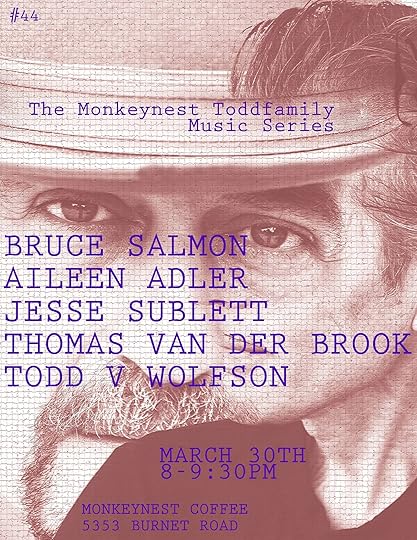
Monday, March 31, 8-9:30 I’m joining my pals at the Monkeynest on Burnet Rd. for a show curated by the unthinkably cool photographer groove-master Todd V. Wolfson. See the poster for all the info. You can get great coffee or beer or wine there and it’s free. I’ll be performing “The Headless Supermodel,” “I’ll Be Glad When You’re Dead (You Rascal You,” and “St. James Infirmary Blues,” for sure, plus others. Info here.
Tuesday I’m looking forward to Michael Ondaatje at the HRC. I almost didn’t write that sentence because I don’t want to hype his appearance so much that a mob appears and fills the room and Lois and I get locked out in the cold outside. A number of my favorite books — in fact, a number of my favorite paragraphs and sentences and poems — were produced by Michael Ondaatje. Running in the Family, In the Skin of Lion, and Coming Through Slaughter are among the best novels ever published. His The Collected Works of Billy the Kid and Handwriting are among the best poetry books ever published. Don’t even try to argue with me about it.
Wednesday, 6-7 PM I’ll be talking with Francois on his program Writing On the Air, broadcast on KOOP-FM about “1960s Austin Gangsters.”
Saturday, April 18, 2-3 PM, I’ll be presenting “1960s Austin Gangsters” at Barnes & Noble Aboretum. Info here.
Saturday, April 25, 1-3 PM, I’ll play some songs & read from “1960s Austin Gangsters” at Half Price Books North Lamar. Details to come.
More events in April and May TBA. Keep rocking, keep reading, be cool, and support social justice and equality for all.
Thanks to BookPeople and South Congress Books for great kick-off events. We love you. Buy the book there, or if you want a signed /inscribed copy direct from the author, see this info.
Hope you caught the solid review from Scott Montgomery on MysteryPeople blog and the great column by the eternal John Kelso on Sunday in the Statesman, which is reprised below. Cool!

By John Kelso
We think of Austin as a hearts and flowers kind of place.
We’re an artsy offshoot of the flower child generation, right? We’d rather love than mix it up. A major tiff around here? How about two geeks arguing over who has the snappier phone.
Hattie Valdes, a friend and business associate of the Overton Gang, ran a well-known brothel on South Congress Avenue at a roadside motel called M&M Courts. Tim Overton’s favorite gal was the place’s star attraction.
But we weren’t always this civilized, which you’ll discover when you read Jesse Sublett’s new book: “1960s Austin Gangsters: Organized Crime That Rocked the Capital.”
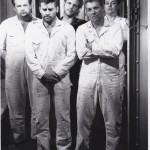
Sublett tells us the harrowing story of the Overton Gang, a ragtag band of poor misfits who robbed small town banks, ran prostitution rings, hired crooked lawyers, were in cahoots with disreputable used car dealers, would knock your lights out and were tough to catch.
They led the Austin Police Department on a merry chase.
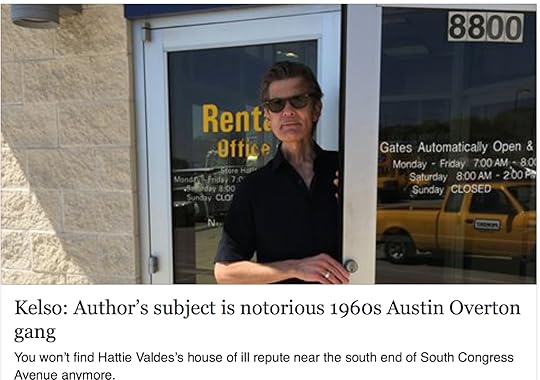
You won’t find Hattie Valdes’s house of ill repute near the south end of South Congress Avenue anymore. It’s been replaced by Penske Truck Rental. That’s author Jesse Sublett hanging out by the front door.
“A few of them were knuckleheads, but some of them were really smart,” Sublett said. He thinks these hooligans enjoyed their work so much that they would have preferred stealing to a real job, even if the real job paid better.
The Overton Gang hit banks in small towns that weren’t county seats, knowing those towns wouldn’t have cops. Tim Overton, the gang’s namesake, bought a used cannonball vault, a type used by banks back in the 1960s that was tough to break into. So Overton had one of them set up in his father’s transmission shop on the East Side so the boys could figure it out. And just in case the guys got busted, they’d bring their prostitutes with them on road trips so the hookers could do some street work and raise the bail money.
The bank heists were a traveling act. Interstate 35 was their route of choice. In 1965 alone, they knocked off 13 small-town banks in Texas, Kansas and Missouri.
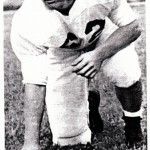
Tim Overton grew up in East Austin, roughly where East Cesar Chavez is today, a part of town where poor whites and Hispanics lived. Overton started out well enough. He was a football star for Austin High School, and Coach Darrell Royal gave him a shot with the University of Texas Longhorns. Although he didn’t play, Tim was on the team that went to the Cotton Bowl game against Syracuse in 1960.
When football didn’t work out, he decided to rob the jewelry out of your grandmother’s safe deposit box instead.
“About the Overton gang?” said Eddie Wilson, the Armadillo World Headquarters founder who grew up in Hyde Park, which had its rough elements back then. “I knew when not to go out after dark, and that was when they were anywhere in the neighborhood. Timmy was a bad dude. … I thought for sure Darrell Royal was going to save his life, but he didn’t get along very well over there either.”
Yet, Tim Overton was said to be good at math, and funny, too. A photo in the book shows him laughing and joking, while being escorted out of a federal courthouse by Texas Rangers. Who gets a chuckle while being led out of the courthouse by a couple of cops?
“I don’t know if he was ever on the straight and narrow,” said Sublett, who spent 10 years putting the book together. “He was a fistfighter and kind of a ruffian, but he was also smart, charismatic, very popular in school. I talked to his classmates. They liked him a lot. He was kind of a hero to them.”
Sublett mentions a blurb that appeared in the Jan. 17, 1964, edition of Time, an issue devoted to the Texas mystique. Remember that this was just a couple of months after President Kennedy was assassinated, a time when many on the East Coast were pretty sure Texas served as a perfect stand-in for the pits of hell.
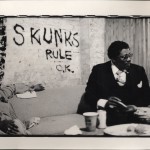
In a one-paragraph description of Austin, Time mentioned our moonlight towers, our broad, clean streets — and a well-known South Austin brothel where “the star attraction has a skunk tattooed on each buttock.”
The whorehouse in question was M&M Courts, a motel near the south end of South Congress Avenue, run by notorious madam Hattie Valdes, a generous woman who left large amounts of money to charities when she died in 1976.
The skunk art was to be found decorating the hind end of Judy Cathey, one of Valdes’ workers and Tim Overton’s favorites.
You wonder how the writer from Time discovered the skunk tattoos in the first place. Was the expense account item filed under “entertainment”?
Sublett, a talented Austin musician as well as a gifted writer, decided to take on the Overton Gang project in 2002 while he was researching the serial killer who had murdered his girlfriend, Dianne Roberts, in 1976. Sublett seems emotionally over the tragedy, although he says that every couple of years he goes before the parole board to convince the board to keep the killer locked up.
Sublett found an article in the American-Statesman under the headline “Austin Underworld of the ’60s. Overton Gang Capers recalled.’’ He writes that the discovery “made me feel that I had stumbled onto the secret history of Austin.”
Collectively, the gang members ended up doing enough time to have a geological era named after them. Among other stints in the lockup, Overton spent five years and four months at Leavenworth, the federal pen in Kansas.
So you want to find out how Overton’s life turned out? As the saying goes, what goes around comes around. But if you want the details, check out the book.
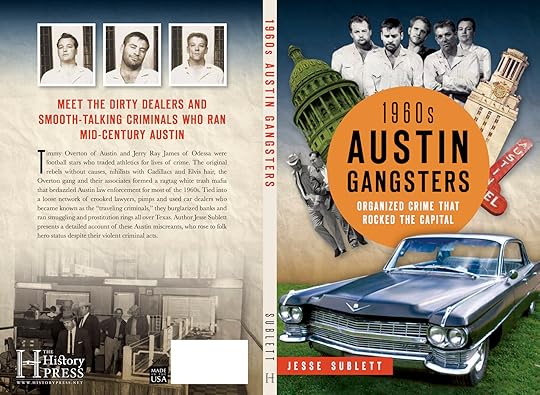
Published by History Press March 9, 2015.


