
Noah Filipiak's Blog, page 12
June 26, 2020
Ep. 31: Interview with Patrick Filipiak on why he thinks you should get rid of Facebook
Listen below or subscribe on iTunes or Google Play
In Episode 31, Noah interviews his oldest brother Patrick on why he (Patrick) thinks you should get rid of Facebook. Whether you agree or disagree with Patrick, you’re bound to look at your social media behavior differently after this interview.
We also jump into the mailbag for a BIG question about if God is in control of everything that happens or not.
Noah’s rant is back and epic as always.
You can email the show at podcast@beyondthebattle.net
Show notes:
Join Noah’s Book Launch Team for new Zondervan book
Article on Theological Determinisim
The post Ep. 31: Interview with Patrick Filipiak on why he thinks you should get rid of Facebook appeared first on by Noah Filipiak.


June 20, 2020
Noah’s New Book from Zondervan, coming in July 2021


BIG NEWS: I signed a contract with Zondervan to publish a new, updated book for men on how our identity in Christ brings us freedom from the pressure of the oversexualized world that we all live in.
The book will be available in July 2021. Book pre-sales will begin in November 2020.
Thank you to so many of you who have supported my writing efforts over the years, I am deeply grateful. If you’d like to receive an email on key points in the publishing process that you can support and/or help spread the news, please sign up below and be sure to click the checkbox at the bottom. (If you are already subscribed to my blog post emails, go ahead and fill out the form below. You’ll then see a “Click Here to Update your Profile” option. Click that and Mailchimp will send you an email link to add yourself to the Book Launch Team)
I will be very selective in what I send to this email list and will not clutter your inbox.
#mc_embed_signup{background:#fff; clear:left; font:14px Helvetica,Arial,sans-serif; }
/* Add your own Mailchimp form style overrides in your site stylesheet or in this style block.
We recommend moving this block and the preceding CSS link to the HEAD of your HTML file. */
Subscribe
* indicates required
Email Address *
First Name
Last Name
Additional Name
Join Noah’s 7/2021 Zondervan Launch Team?
Yes! Add me to Noah’s Book Launch Team
Subscribe to Noah’s Blog Posts:
Yes! I want to receive Noah’s blog posts in my email inbox
The post Noah’s New Book from Zondervan, coming in July 2021 appeared first on by Noah Filipiak.
June 13, 2020
The Babylon Bee Gets Defunded by Christians Who Love Black Lives #DefundTheBee
MINNEAPOLIS, MN – Defunding is all the rage these days. After consistently mocking the concern for black lives, Christians finally rallied their efforts to defund The Babylon Bee, a popular satire website ran by politically conservative white guys who use a lot of words from the Bible.
The Bee made its name years ago with genuinely funny articles poking fun at the quirks of being Calvinist or Baptist, repetitious Chris Tomlin choruses, and smoke machines used in worship sets. As previously reported by the Pulitzer-Prize winning Filipiak Flea, somewhere along the way The Bee transitioned into mocking oppressed and minority groups like women, people of color, and the LGBTQ community and drinking the dangerous cocktail of Christianity and politics as one in the same. Some thought this award-winning exposé by The Flea would be enough to turn those who follow Jesus away from supporting The Bee‘s resentment of the people Jesus would be spending most of his time with today. But a recent visit to The Babylon Bee’s articles that mock the plight of black lives shows otherwise.
You’ll still find the random funny article that doesn’t mock oppressed people sprinkled in to the list of options, as if to say, “Look we’re still the good old Babylon Bee you started following in 2016…(And hey, making fun of black people is no different than making fun of Calvinism, right!?)”
But some Christians began noticing the change and became confused that The Bee calls themselves a “Christian” news website. Will Bird, a random white guy from Minneapolis who loves Jesus and black lives, started questioning why he followed The Babylon Bee on social media. “I love Jesus. I love black lives. Jesus clearly loves black lives. I wonder why The Babylon Bee doesn’t,” Bird said. And that simple logic is what began Bird’s #DefundTheBee campaign.
Knowing that online companies receive their ad revenue based on web traffic and their amount of social media followers, Bird unfollowed The Babylon Bee on all of his social media accounts, stopped visiting their website, and thinks other followers of the Jesus in the Bible will want to do the same. “It was really difficult at first,” Bird confessed, “and I backslid quite a bit. I at first said I just wouldn’t read The Bee‘s racist articles, but I’d read the other ones. Their articles that make fun of the rapture are so funny, I just wasn’t ready to ‘surrender all,’ you know? But then I realized this was lukewarm faith and that even my clicks on their non-racist articles still supported their existence as a racist website, so I had to give it up altogether.”
Bird now uses Covenant Eyes to help him avoid visiting The Bee in moments of weakness.
The #DefundTheBee campaign is a serious campaign meant to communicate to The Babylon Bee and the watching world that Jesus-followers are for black lives and against racism and will not support websites that mock the plight of black people in Jesus name, no matter how funny said website might be. To participate in Bird’s campaign, do the following:
Unfollow The Babylon Bee on all of your social media accounts.
Stop sharing their articles on social media.
Make a commitment to never go to their website (or podcast, etc.) again.
Share THIS ARTICLE on social media with the hashtag #DefundTheBee along with a note to your friends why you are no longer reading The Babylon Bee and why they should consider doing the same.
The post The Babylon Bee Gets Defunded by Christians Who Love Black Lives #DefundTheBee appeared first on by Noah Filipiak.
June 5, 2020
Racism 101 – First Steps – Defining Racism
You’ve made your social media posts about George Floyd.
You may have even attended a rally or protest.
What will you do now?
Many won’t do anything. Time will go on, the protests and riots will stop, the momentum will fade. George Floyd will no longer dominate the headlines. White people will move on with their lives until the next hashtag comes along and the cycle will continue. Don’t let that be you.
Others are ready to solve racism now. Let me first say, I love this zeal. I am not mocking your ideals as I hear some do. I love this and want to fan this flame. But I also want to give a word of caution, and this is where this blog post comes in:
Don’t try to do surgery when you’ve never gone to med school.
The first step to “solving racism” is to become educated about what racism even is. I hope to provide some really basic concepts for that here. And we can’t “solve” racism, but we can work on dismantling it. You can be on the side of the dismantlers rather than the perpetuators. But I’m already getting ahead of myself. This is going to be a very basic first step to understanding racism.
Most white people would define racism as a negative or derogatory feeling an individual feels towards a person based on their skin color. A lot of this is semantics and is why it’s so hard to make progress or get on the same page, but let’s stop using “racism” as the word for this. Let’s call this “prejudice.” You might be prejudiced toward people with long hair, punk rock pink hair, heavy people, thin people, people who live in the country, people who live in the city, and Ohio State fans, to name a few examples. Or people with black skin or white skin. Prejudice is not good and we should be against it!
But prejudice is different from what I will refer to as systemic racism. It might be helpful to call prejudice individualized racism, differentiating it from systemic racism. It can be very frustrating to both sides if two people are using the word “racism” and one is using the definition of individualized and the other is using systemic.
It’s the difference between being nice to a slave and abolishing slavery. Both are good, but they are two very different things.
Individualized racism or prejudice is when a white person calls a black person the “N” word. It’s the KKK. It’s being mean to someone based on their color. Most people in white society would say they are not racist, based on this definition. When we see former Minneapolis police officer Derek Chauvin kneeling with his knee on George Floyd’s neck, suffocating him to death, we say “He is racist! Racism is wrong!” In part we are right. But what we really mean is “That is individualized racism! That is prejudice at its worst! That is wrong!” It’s what allows us to call Derek Chauvin and cops like him “bad apples” and in doing so never have to talk about the larger issue of police brutality, which is a systemic issue. This blog article is not about police brutality. I know that’s a trigger word for some and I want you to hang in there with me. There are a lot of good police officers out there and I’m not villianizing them. I also have empathy for how hard and complex their job is. I’m just using police brutality & the individual example of Derek Chauvin as my first teaching illustration to help us understand the difference in definitions of how we use the word “racism.”
When you hear organizations or individuals calling out racism and lamenting the death of George Floyd, but not calling out police brutality, you are seeing individualized racism be spoken out against, but not systemic racism. So in this individualized mindset, the white person or organization thinks that black people are protesting and rioting for two reasons: George Floyd’s death and the racism of Derek Chauvin.
But they’re not.
As tragic as George Floyd’s death is and as heinous as Derek Chauvin’s racism is, these are not the primary reasons for the protest.
The protesting is about a national justice system that has a long track record of not applying judicial consequences when police officers kill unarmed black people. Historically this has given officers a sense of freedom to do what they want toward blacks, without fear of criminal consequences.
(I write about that history here)
Do you see the difference?
An illustration that is removed from the George Floyd case will probably help. Watch this 6-minute video, which helps explain why most of the nice, affluent parts of town are filled with white people and why most of the poor, struggling parts of town are filled with black people:
Do you remember what the white salesman told the black gentleman who was interested in buying a home? “It’s not me, ” the salesman said, “but the owners of this development have not decided to sell these homes to Negroes.” In other words, “Look my black friend, I’m not racist. I like you. I’d go out to lunch with you. I don’t have any mean feelings toward you. But this neighborhood development, and in fact the laws of the United States of America at the time, will not let me offer you this mortgage to purchase this home.”
That man was not individually racist or prejudiced, but he certainly was complicit within a racist system. Complicit in perpetuating it, as well as certainly benefiting from it.
Redlining is only one of many examples of systemic racism. Police brutality is another. But for now I just want to you to ask yourself if you’ve ever thought about racism as systemic. As something, like redlining laws, that is built into the fabric of our country that has created the inequalities (based on skin color) that we see in our country today.
The last piece to defining racism is that it must involve power. Congregations Organizing for Racial Reconciliation defines racism as:
Race Prejudice + the Misuse of Power = Racism
So in the redlining example from the video, white people were personally prejudiced toward black people, so they didn’t want to live near them. White people also had the societal power to actually do something about this. They misused their power to created a systemically racist and unjust housing system. Black people could have felt an equally strong amount of racial prejudice toward white people, but did not have the power to do anything detrimental to white people’s housing and economic situation. Blacks were in fact powerless to do anything about the housing situation and how it crippled them from amassing wealth equity.
Court systems that let police officers (or retired police officers) go free after killing an unarmed black person who was not posing a lethal threat are systemically racist because they have the power to decide what and when the law gets applied. They have the power to condition police officers that there won’t be repercussions or accountability to their actions when they kill a black person in this context. The police officer has power over the black person to be the judge, jury, and executioner, while the black person is powerless to do anything about it.
Power is what turns prejudice (individualized racism) into (systemic) racism.
In conclusion, when we only define racism as individualized racism, we make systemic racism worse. We allow racist systems to go on unchecked because we think we’ve done our duty by treating black people nicely and by calling Derek Chauvin a racist. We allow for more racism when we only focus on individualized racism.
What we have to do is stand up against and dismantle systemic racism, which is much harder because we (whites like myself) benefit from it every day and are complicit in its perpetuation in our society. How do we do this dismantling? We’re not quite ready to dive into that yet after Racism 101 
June 1, 2020
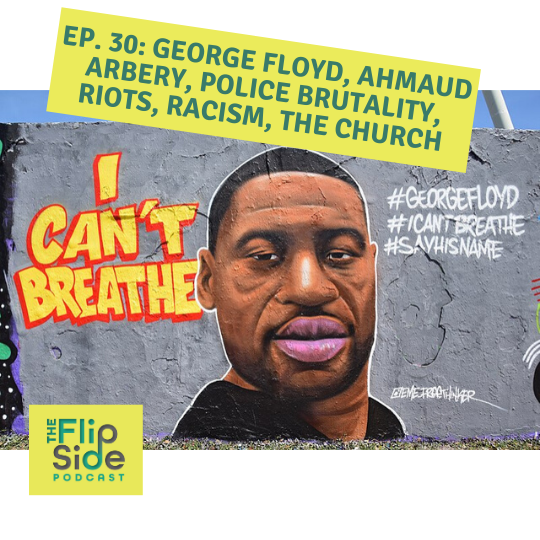
Ep. 30: George Floyd, Ahmaud Arbery, Police Brutality, Riots, Racism, the Church
Listen below or subscribe on iTunes or Google Play
In episode 30, we dive head first into the recent riots over George Floyd’s death and the national stories of Breonna Taylor and Ahmuad Arbery’s deaths. This episode covers these events, police brutality, racism, and the Church.
Show notes:
Black Parents Explain How to Deal with Police: https://youtu.be/coryt8IZ-DE
Why there is unique outrage when an unarmed black man is shot and killed #AhmaudArbery
The Past of Racism Polluting Our Present: How White Suburbs Were Made
Divided by Faith: Evangelical Religion and the Problem of Race in America by Michael Emerson and Christian Smith
Race: The Power of an Illusion PBS documentary
In Some Cities, Police Officers Joined Protestors Marching Against Brutality
You can email the show at podcast@beyondthebattle.net
You can support the podcast at www.patreon.com/noahfilipiak
The post Ep. 30: George Floyd, Ahmaud Arbery, Police Brutality, Riots, Racism, the Church appeared first on by Noah Filipiak.
May 22, 2020
Why Jesus & John the Baptist got to call people names and you don’t (especially your government officials)

I recently posted this on my Facebook page as I’ve seen more and more Christians calling our government officials insulting names in light of their COVID-19 efforts:
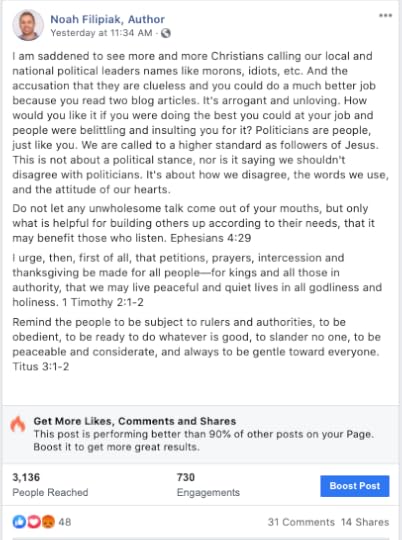
Most people have been in agreement and very supportive. A few were distracted by my analogy of “How would you like it if you were doing the best you could at your job and people were belittling and insulting you for it?”… saying that our government officials are not doing the best they can (therefore we can insult them). I wasn’t expecting that distraction to be there, as it’s obviously not the point of the post, but decided to keep it in after people started commenting. But what really got me thinking was the few commenters who referred to Jesus and John the Baptist calling 1st century religious leaders a “brood of vipers.” Saying that since Jesus and John set this example, then we by all means can do that to our government officials today.
Let me briefly explain why Jesus and John the Baptist got to call their (religious) leaders names, but you don’t get to call your governing officials names.
Jesus is God-in-the-flesh. He knows all. He is the God who will judge every soul on Judgment Day. He was/is holy, righteous, and perfect. He is the only one who has the authority to cast judgment.
You do not know all. You do not have that type of perfection or authority, therefore you do not get to call people broods of vipers the way he did. This would be the pot calling the kettle black, as they say. This is also why Jesus got to turn over the tables of the money changers in the temple and chase them out with a whip, but you and I in our fallen, broken, sinful state, do not get to act in such authoritatively judgmental ways.
John the Baptist was a divine prophet, coming from a long line of prophets who spoke the very God-inspired, authoritative words of the Bible. He was God’s mouthpiece. You do not speak the God-inspired, authoritative words of the Bible and you are not God’s mouthpiece.
(As a related aside: Jesus and John were criticizing religious officials, which in their context would have been very different than the government likes of Caesar, Pilate, and Herod, which we don’t see any name calling of, yet who were heinously corrupt and even savage. Jesus and John’s concern was how God’s people, specifically their leaders, were not living in accordance with the Scriptures. I don’t want to distract from my main point here, only to point out the irony of those trying to make their point that Jesus and John’s criticisms and name calling allows us to insult our government officials today. This is apples and oranges.)
So we have covered what you and I don’t get to do based on the model of Jesus and John the Baptist. Let’s now look at what the Bible unabashedly commands us to do, which will be a repeat if you read the Scriptures in my Facebook post:
Do not let any unwholesome talk come out of your mouths, but only what is helpful for building others up according to their needs, that it may benefit those who listen. Ephesians 4:29
I urge, then, first of all, that petitions, prayers, intercession and thanksgiving be made for all people—for kings and all those in authority, that we may live peaceful and quiet lives in all godliness and holiness. 1 Timothy 2:1-2
Remind the people to be subject to rulers and authorities, to be obedient, to be ready to do whatever is good, to slander no one, to be peaceable and considerate, and always to be gentle toward everyone. Titus 3:1-2
There’s no wiggle room here. There’s no grey area. There’s no “yeah but Jesus did this… or John the Baptist did that…” Those phrases remind me of my 6 and 8-year-old when they get angry because Mommy and Daddy get to stay up past 9:30pm, but they don’t. That’s because we are Mommy and Daddy and they are our children, and we gave them a specific command of what they are to do within that authoritative relationship. Jesus is God, we are not. He commands us on what we are to do, and we are to do it. He has clearly laid out his commands here to us.
It’s also worth adding that Jesus commands us to love our enemies and pray for those who persecute us. (Matthew 5:44)
Our political system is corrupt and broken, no doubt about it. Some politicians create this corruption, while others are trying to reform it. You can (and often should!) disagree with your politicians. You can protest your disagreement. You can protest injustice. But you are commanded by God to do it in a wholesome, helpful, building up of others, beneficial to others, prayerful, thankful, peaceful, quiet, godly, holy, subject, obedient, good, not slandering, peaceful, considerate, gentle, and loving way.
The post appeared first on by Noah Filipiak.
May 8, 2020
Why there is unique outrage when an unarmed black man is shot and killed #AhmaudArbery
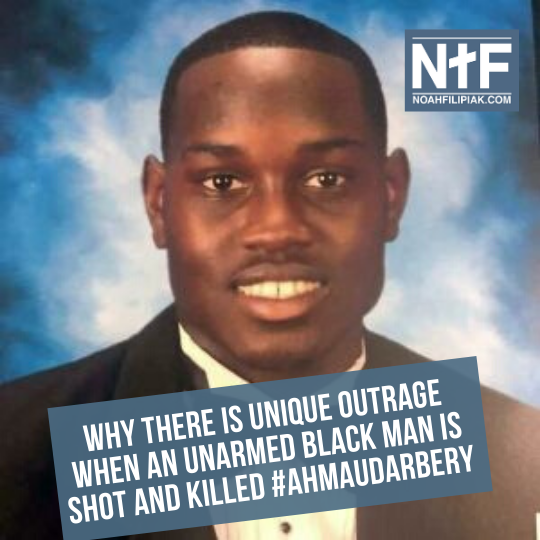
A personal friend recently asked an honest question on social media in response to the shooting of Ahmaud Arbery: I hate these meaningless killings…(but) why does it seem like when black men kill white men it’s not as big of a deal?
I’m thankful for my friend who asked this question. It’s so important to be humble and seek constructive conversation, with a heart to learn, when approaching such polarizing subjects as racism, which I appreciate about my friend. I felt like it was a good question whose answer would help bring clarity to people out there who might not understand why stories like Ahmaud’s go viral. So I hope this blog article is helpful in giving some context. I hope it’s done in a non-judgmental way and in a way that people of all skin colors and cultures will find approachable and helpful. I hope it can bring some transformation to individuals and to our country.
There are two answers to my friend’s question, and they are related. The primary answer is that the outrage about a death like Ahmaud’s is not necessary about his death itself (though certainly tragic, and worthy of outrage), it is that the shooters were not going to face criminal charges. (They are now, likely due to the protests and petitions) In many of the trending cases of unarmed black men being shot and killed over the past few years, the shooter either wasn’t going to face charges at all, or they were acquitted of all charges once they got to court. Without getting into the details of each of these unique and complex cases, I hope it’s helpful to you as a reader to see this difference. The reason there isn’t outrage when a white man is killed by black men is that those black men are typically prosecuted and convicted.
It would be terrifying to live in a country where a white person could randomly kill a black person and have no legal repercussions for it. I’m not saying that’s always the state of our country today, I’m saying I think we all would agree that would be a terrifying country to live in if you were black.
That ties into the second answer to my friend’s question, and that is our recent history as a country. During the Civil Rights Movement, that was the state of our nation, particularly in the South (note that Ahmaud was killed in Georgia). Throughout the 50’s and 60’s, when the Beatles and Elvis Presley were in their heyday, it was commonplace in the South for blacks to be killed at random by whites and then for the whites to not face any criminal charges. Police officers, judges, and even pastors often participated in these killings and lynchings, let alone the members of a jury, so a black person was unlikely to find much help from those sources. I’m not saying every judge, police officer, or pastor was this way, but you can imagine this environment where so many were that it would make it impossible to trust any of them with you or your children’s lives. The Southern Poverty Law Center lists out some of the Civil Rights martyrs here. Take some time and read through them and see if you can track how many of their killers were found innocent or where the case never went to trial at all. A famous example of such a pattern was the murder of 14-year-old Emmett Till:
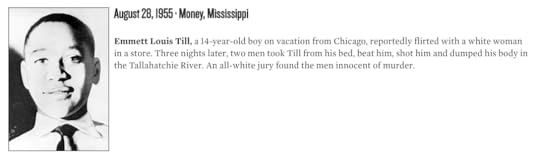
Till’s family courageously decided to have an open casket for Emmett’s funeral where his disfigured face was seen by all, exposing the brutality of injustice and white hate in the South. Viewer discretion is strongly cautioned but if you want a taste of this reality, you can view the photo here.
The National Memorial for Peace and Justice, informally known as the National Lynching Memorial, opened in 2018 in Montgomery, Alabama. It reports that more than 4400 African American men, women, and children were hanged, burned alive, shot, drowned, and beaten to death by white mobs between 1877 and 1950. None of these deaths would have been prosecuted.
So the reason there is unique outrage when an unarmed black man like Ahmaud Arbery is shot in cold blood, and the death is not treated as a homicide, is because we’ve seen this so many times before.
I saw another helpful line on a social media thread around Arbery’s death, particularly in this age of sensationalized news and lack of civil discourse between polarized political sides: My motto these days is curiosity before conclusions.
I agree with this, and we need to learn from these past few years. Both sides need to do their due diligence to try to find out what actually happened before retweeting or posting the new hashtag on social media. I’ll show my cards and say I was rattled by the conflicting accounts of what happened in Michael Brown’s 2014 death in Ferguson, MO, after getting caught up in the initial “Hands up, don’t shoot” account. It’s easy to read those eyewitness accounts and “vote” for the ones you think are true, which doesn’t help with whatever actually happened. All we can tell from all of those accounts is that whatever happened wasn’t as clear cut as either side tried making it out to be. I bring up this tender topic in an effort to bring a rare attempt at objectivity within these discussions. I bring it up to say, whichever side you’re on, we need to come toward one another if we want to move forward in community.
So with Ahmaud Arbery’s death, I wanted to do my research (curiosity, per the above motto) before I drew my conclusions. In Michael Brown’s death, there was no video, so we are left with conflicting eyewitness accounts. In Ahmaud Arbery’s death, I was shocked and disturbed to find there is a video. It looks like the car that was following the shooters began to pick up what was happening and started filming while trailing behind the situation. I strongly caution you to consider if you want to watch this video or not. It is a man getting shot in real time, bleeding out, and dropping to the ground. It is not an image that will not leave your mind quickly, but it is here for those who feel led to watch it.
After watching this sickening video, it is hard to see any scenario where this sort of shooting would be justified or legal. (And yes, the point needs to be made there shouldn’t need to be a video in order for an unarmed black man’s death at the hands of armed white men to be brought to trial)
Even if these men thought they saw Arbery commit a burglary, as they claim, no one should think this would allow you to chase that unarmed person down and shoot them.
In this petition from Change.org, it explains that the shooters are a retired police officer and his son and infers that this was the reason that Arbery’s death was not being addressed as a homicide or taken as seriously as it should be. This is the reason for the outrage. And it’s important to note, much like Martin Luther King’s efforts in an era before us, that the outrage brought about these two men being arrested and taken into custody, where they will now stand trial for what they did.
It’s not only important so that Arbery and his family can see justice, it’s important for our entire country. This might be a difficult statement for some readers to digest, but our country is a scary place to live for black people. I’ll just give you two examples from personal friends of mine that happened within the last few weeks.
One is a black pastor friend of mine who lives in Detroit. As he reflected on Arbery’s death on Facebook, he wrote this within his post: I was reminded where I stand when I was pulled over by a white police officer a month ago. He attempted to open my car door with his hand on his weapon during a routine traffic stop, while assuring me that this was “routine procedure.”
Another friend is a black man who was a part of the church I pastored in Lansing for 13 years. He recently posted a video on Facebook Live after feeling like his life was in danger by some white men who were intimidating him at a gas station. He had stopped for some food after Uber driving. They pulled up behind him, staring at him, then circled around him, then parked next to him, staring at him further.
These are terrifying situations where my black friends literally don’t know if they will end up as the next hashtag. This is a daily experience of trauma for black Americans, always wondering if they will be next. It’s not that they are scared of all white people or all police officers, it’s that they know the harassers and killers are out there, walking among us. And they are unsure if they live in a country that cares or a judicial system that will act, giving their potential attackers little reason for pause. When the news of Ahmaud Arbery’s death hits their newsfeed, they instantly know that could have been them, or one of their kids. This is very real for them.
For white Christians and the white Church, if we at all desire to be diverse in our makeup or to obey the Bible’s mandates for justice and for standing up for the oppressed (Micah 6:6-8, Isaiah 1:11-17, Amos 5:21-24, Luke 4:18-19, Matthew 12:18-21, Matthew 23:23), we have to (at minimum) acknowledge and honor the daily traumatic experiences of our black brothers and sisters. Expressing outrage at Ahmaud Arbery’s death and the lack of criminal charges on the shooters is one small way of doing that. It’s one small way of telling our friends of color that we support them and are not okay with the injustices they endure, and that they can come to us in Christian community, and we can be the Body of Christ together, supporting one another like the family we are.
The post Why there is unique outrage when an unarmed black man is shot and killed #AhmaudArbery appeared first on by Noah Filipiak.
May 7, 2020
I Treated Sex Like a Vending Machine: Pastor Noah’s Story (Part 2)

This is Part 2 of a 3-part series I’m writing. Check out Part 1 if you missed it.
When I got married on June 19, 2004, I thought my sexual purity problems were in the rearview mirror for good.
I had been porn-free for over two years, was leading sexual purity small groups, and had regular accountability. I was also reading Christian sexual purity books that told me if I starved my eyes from lustful looks and images, there would be a “sexual payoff” in my marriage. My wife and I were both virgins when we got married, and I was ready for this payoff.
This promise fit in with what I was taught about sex throughout my teenage years in youth group: save it for marriage, and you’ll have the best sex in the world.
Please don’t misunderstand me—I’m not downgrading purity teaching or the sound biblical mandate to save sex until marriage. What I am discouraging is the idolatrous carrot at the end of the stick that’s put out as the motivating lure for a lot of this teaching. A selfish carrot based around getting my desires met, which pollutes and warps my concept of love and my concept of who and what a woman is.
Read the rest of this article written by Noah Filipiak on the Covenant Eyes blog, here.
The post I Treated Sex Like a Vending Machine: Pastor Noah’s Story (Part 2) appeared first on by Noah Filipiak.
April 28, 2020
Good Kids Get Hooked on Porn Too: Pastor Noah’s Story (Part 1)
I’m 37. This is relevant because you can tell a lot about someone’s sexual purity story by how old they were in the mid-’90s, also known as when the internet became as common in households as the telephone or television.
For me, this was 7th grade.
I’m a bit biased because of my own story and experience, but I can’t think of a worse combination than the onset of puberty and first-time access to the vast unknown of the World Wide Web.
Puberty for me was the typical unknown. Unknown who I could talk to about my new sexual development and desires. Unknown if it was okay to talk to anybody about it. Unknown what was a sin and what was just a natural process of my body.
Click here to read the rest of this article written by Noah Filipiak on the Covenant Eyes blog…
The post Good Kids Get Hooked on Porn Too: Pastor Noah’s Story (Part 1) appeared first on by Noah Filipiak.
April 27, 2020
Ep. 29: Why do bad things happen to good people?
Listen below or subscribe on iTunes or Google Play
In Episode 29, we tackle the age old question, “Why do bad things happen to good people?”
And of course there’s a Noah’s Rant to lift your quarantined spirits!
Email the show at podcast@beyondthebattle.net
The post Ep. 29: Why do bad things happen to good people? appeared first on by Noah Filipiak.


