
Noah Filipiak's Blog, page 23
March 8, 2018
Episode 40 – Hip hop artist James Gardin on insecurity, overcoming rejection, and using parables
You can listen to Noah Filipiak’s “Behind the Curtain” Podcast interview with James Gardin on the Podbean Player below or you can subscribe to all “Behind the Curtain” Ministry Podcast episodes on iTunes. (Podcast listening tip: use the podcasts app on your smartphone and listen while driving, doing chores, or working out)
Noah Filipiak interviews James Gardin’s about overcoming rejection and persevering in the music industry. About what it’s like to get a song on ESPN and how to handle the insecurities. James explains what his message is as a Christian artist, and last but not least freestyles about Noah’s hometown of Oconomowoc!
Connect with James on social media:
Illect Recording artist James Gardin has used his multifaceted skill set of empowering rhymes, fun melodies, energetic stage presence, and deft fashion sense to become the most successful emcee in his hometown of Lansing, Michigan. He has performed hundreds of shows around the world, amassed thousands of plays and downloads with coverage on top web sites and publications (2DopeBoyz, HipHopDX, Rapzilla , DJ Booth etc). He has also had songs featured on ESPN, GaryVee TV, and Black&SexyTV. He has also shared the booth and the stage with artists such as Grieves, Macklemore, Dessa, Murs, Talib Kweli, Astronautalis, KING, and many more. James aims to use his art and message to inspire all those around him to live their life fully, and encounter their purpose daily.
E-mail Address:
Unsubscribe me
Categories
All categories
Behind the Curtain Podcast
Depression and Insecurity
Subscribe me
Unsubscribe
The post Episode 40 – Hip hop artist James Gardin on insecurity, overcoming rejection, and using parables appeared first on At A Crossroads | Noah Filipiak.


February 22, 2018
110,000 Condoms, Porn, & Tinder Highlight the Pyeongchang Olympic Village Activities
Last week Shaun White won a snowboarding gold medal, only to have the spotlight shift toward a 2016 lawsuit against White by a female drummer in his band. She was suing White for sexual harassment, which included forcing her to watch porn of two people have sex on a bear, and several other unsavory allegations.
This made me look at White a lot differently. It made me not want to cheer for him.
So today I’m listening to the Jim Rome sports radio show to learn that 110,000 condoms were distributed in the Pyeongchang Olympic Village. That’s 37 condoms per Olympian.
450,000 condoms were given out in the 2016 Rio Olympic Village. 41 per athlete.
Tinder, a dating app where people hookup for sex, has had its usage increase by 348 percent since the start of the games in the Pyeongchang Olympic Village.
Decorated US swimmer Ryan Lochte told ESPN he estimated 70-75% of the Olympians are sexually active with one another during the games. Random hookups with people from around the world.
Athletes talk about those who would have sex out in the open on the Olympic Village lawn.
At the 2004 Athens Olympics, US javelin thrower Breaux Greer, tells ESPN how he had 3 women visit his room every day for sex, hours apart.
Of course having a roommate and getting free condoms out of a public vending machine can put a damper on such an “intimate” act. At the 2000 Sydney Olympics, US target shooter Josh Lakatos talks about how his no-roomate house (because they’d all went home already) turned into an all hours sex romping ground. It had a duffle bag overflowing with condoms in it. Lakatos told ESPN, “I’m running a friggin’ brothel in the Olympic Village! I’ve never witnessed so much debauchery in my entire life.”
This sounds more like Sodom and Gomorrah than a hotbed for role models and culturally-adored celebrities.
There is also an 85% spike of use on Pornhub in the Olympic Village in Pyeongchang, with “threesome” being the most searched for word by Olympians.
One anonymous male Pyeongchang Olympic athlete told USA Today’s Martin Rogers, “Before competing, it is online stuff. Afterwards is when it’s time for the real thing.”
I’m speechless.
I’m speechless that our culture celebrates and accepts sex so far from God’s design of a man and a woman within marriage. Speechless that human sex is meant to be more than animal sex. That we aren’t meant to turn one another into objects to be consumed and discarded. That we’ve taken the most intimate act and shed it of all of its intimacy. And all this is normal.
Yet we are shocked and appalled when Shaun White makes a woman watch porn?
Or that men continue to sexually harass women over and over again?
His actions certainly aren’t justifiable, but what the heck do we think is going to happen in a culture like ours? Why do we consistently think that we can have unlimited sex with unlimited numbers of people and watch unlimited porn and somehow think we’ll be able to just switch it off when we need to? That someone hooked on porn and obsessed with hooking up on Tinder will know when someone isn’t interested in what they’re dishing out? Or that a marriage has any chance of lasting in this world when people have been spoon-fed this type of sexual debauchery their whole lives. That our sexual selfishness is the top priority over the idea of a child actually growing up with a mom and a dad who love one another and are faithful to one another.
We live in a terrifying world.
A terrifying world I’ve brought three daughters into. Praise God for his commands, praise God for his design for sex, and praise God for the Church, for those in the Church who are obedient to God’s design for sex. Who treat humans as humans, not as objects. Who are safe to be around without fear of being taken advantage of. Who are a light to a dark world.
Someone needs to be the light, because the Olympics certainly aren’t.
E-mail Address:
Unsubscribe me
Categories
All categories
Sex and Pornography
Marriage and Singleness
Subscribe me
Unsubscribe
The post 110,000 Condoms, Porn, & Tinder Highlight the Pyeongchang Olympic Village Activities appeared first on At A Crossroads | Noah Filipiak.
February 15, 2018
Ep. 39: Tyler St. Clair (the sequel) on real life church planting in Detroit + the Contend Conference
You can listen to Noah Filipiak’s “Behind the Curtain” Podcast interview with Tyler St. Clair on the Podbean Player below or you can subscribe to all “Behind the Curtain” Ministry Podcast episodes on iTunes. (Podcast listening tip: use the podcasts app on your smartphone and listen while driving, doing chores, or working out)
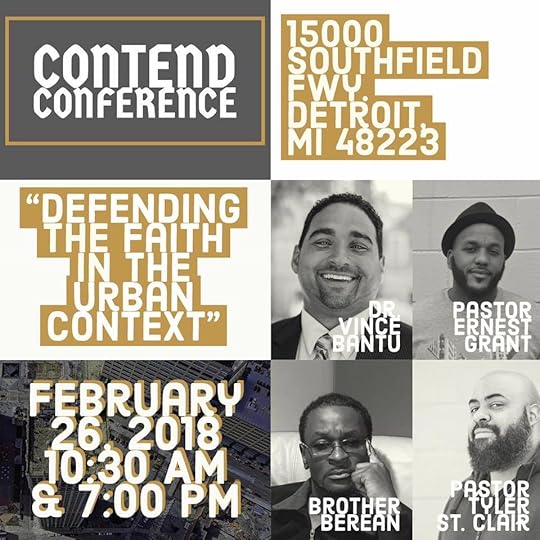
Two years ago, Pastor Tyler St. Clair was interviewed in Episode 17 of the Behind the Curtain Ministry Podcast, discussing what it was like to gear up for his urban church plant in Detroit and what it was like to do fundraising as a black pastor. Today, Noah Filipiak catches back up with Pastor Tyler to see what actually planting and pastoring has been like after all the hype has died down. The two church planters talk about life in the trenches of pastoral / church planting ministry and about how important it is to keep realistic and biblical expectations as a pastor. Tyler also discusses the Contend Conference, coming up in Detroit on February 28th.
E-mail Address:
Unsubscribe me
Categories
All categories
Behind the Curtain Podcast
Church
Pastors
Subscribe me
Unsubscribe
The post Ep. 39: Tyler St. Clair (the sequel) on real life church planting in Detroit + the Contend Conference appeared first on At A Crossroads | Noah Filipiak.
February 14, 2018
Looking at porn? Mad about your marriage or singleness? Read the intro to Beyond the Battle here.
The Lord of the Rings story comes to a climax in the final battle at Mordor as the forces of good square off against the seemingly insurmountable forces of evil. The king Aragorn, the dwarf Gimli, the elf Legolas and the wizard Gandalf represent the best and strongest warriors for good in Middle Earth. These heroes cluster with their followers in the middle of a plain, while countless foes of darkness close in around them. For every one hero, there seem to be a million enemies.
This is the type of scene that comes to mind for Christian men seeking to fight off the temptations of living in an oversexualized world. Most men are taught simply to be better warriors—better Gandalfs, Aragorns, Legolases, and Gimlis. Well-meaning advisors and “experts” teach men how to try harder, think better, manage behavior through mental tricks, and even physically beat themselves into submission. The problem is, no matter how strong the hero in the middle, the enemy continues its barrage with no end in sight.
What Aragorn and his company knew was that, no matter how strong they were as fighters, they were destined to lose simply because of the overwhelming number of evil forces they faced. It is the same with men fighting against sin. When we adopt a symptom-based or behavior-management approach to sin, we will eventually wear down and lose. The key to victory in The Lord of the Rings story is not found in the mighty warriors’ skill and tactics, but in a small and meek hobbit named Frodo. Frodo isn’t a mighty warrior, but holds a different type of power. He has a subversive inner power, and he knows the way to defeat the enemy is not to attack the symptoms, but to go to the source. While Aragorn and his mighty company distract the enemy’s eye, Frodo sneaks silently to the enemy’s heart, the core of Mount Doom. This unanticipated move will destroy the enemy once and for all—not with a sword, but with a surrender of power.
The point to this metaphor is to show that while the short-term tactics of learning to be a better warrior play a necessary role in the war against sin and should not be dismissed, they must be followed up with a cure that goes to the core of the disease. If this never happens, defeat is inevitable.
Beyond the Battle sets out to win not the battle, but the war. More accurately, readers will discover that the war has already been won in Jesus, and will be guided through the process of learning to rely on and rest in his victory.
Order Beyond the Battle: A Man’s Guide to his Identity in Christ in an Oversexualized World here.
Watch the free small group videos here.
E-mail Address:
Unsubscribe me
Categories
All categories
Sex and Pornography
Marriage and Singleness
Subscribe me
Unsubscribe
The post Looking at porn? Mad about your marriage or singleness? Read the intro to Beyond the Battle here. appeared first on At A Crossroads | Noah Filipiak.
February 6, 2018
What Jesus’s Atoning Sacrifice Means to Me
I read Hebrews 2:14-18 yesterday. Read it slowly, out loud, a few times:
Since the children have flesh and blood, he too shared in their humanity so that by his death he might break the power of him who holds the power of death—that is, the devil— and free those who all their lives were held in slavery by their fear of death. For surely it is not angels he helps, but Abraham’s descendants. For this reason he had to be made like them, fully human in every way, in order that he might become a merciful and faithful high priest in service to God, and that he might make atonement for the sins of the people. Because he himself suffered when he was tempted, he is able to help those who are being tempted.
I am a person who struggles mightily with depression and anxiety. It comes and goes and is subject to a diverse array of stimulus. I also have a lot of good ways of coping with it, which are sometimes enough to feel better and sometimes aren’t.
Usually when we think of Jesus’s atonement, we think of him as the substitute for our sins. We deserve a penalty for our sins, hell, and Jesus took that hell upon himself on the cross so we wouldn’t have to take it on ourselves for all eternity. Then when the Judge looks at us, we are declared innocent (righteous). Not because of what we’ve done, but because of what Jesus did on our behalf.
All of this is true, praise be to God! But something even deeper hit me yesterday.
Substitutionary atonement (what I just described) has always felt like Jesus is my pinch hitter, using a baseball analogy. I know this pitcher will strike me out, so Jesus goes to bat in my place. He hits a home run and we win. That’s what I think of when I think of a substitute. But what do you observe about this scenario?
I observe myself sitting alone on the bench, and Jesus quite far away from me.
That, my friends, is not the picture of Jesus’s atoning sacrifice. To me, that’s a picture of depression and anxiety. Jesus has punched my ticket into heaven, but I’m sort of left fending for myself here on this earth.
Something clicked yesterday (praise be to God) as I was reading Hebrews 2. Yes, Jesus is my substitute. But he’s my substitute for everything. All the ways I feel inadequate. The ways I don’t measure up. The ways I don’t feel valuable. The things I’ve messed up. The things I fear. He says, “I’ve got you, and I’ve got this.” His substituting for me wasn’t a one-time act. It is a covering over me, in me, and through me, that never leaves me or forsakes me.
Analogies fall short here, but the best I can come up with is Jesus driving the car while I sit in the passenger seat, or him flying the airplane while I rest in his power and control. Wherever I go, he goes. Wherever he goes, I go. I’m reminded of Jesus’s promise from Matthew 11:28-30, a promise that often feels untrue to me:
Come to me, all you who are weary and burdened, and I will give you rest. Take my yoke upon you and learn from me, for I am gentle and humble in heart, and you will find rest for your souls. For my yoke is easy and my burden is light.

Yoked oxen
What I began experiencing yesterday is the two-necked truth of the yoke analogy. A yoke was put on two oxen, not one. Jesus uses this analogy to tell us that he’ll be on one side of the yolk, and we’ll be in the other. Where he goes, we go; where we go, he goes.
He is my atoning sacrifice. My substitute. He covers for me each and every time I don’t measure up. Each and every time I fail. Each and every time I feel like I don’t have value. Each and every time things feel out of control. He has measured up for me. He’s my atoning sacrifice. He is my substitute. He is always there, always interceding for me, always giving me true worth when it feels like I have none.
This truth has felt like Alka Seltzer to my anxiety and to my ups and downs of depression. Not that I’ll never have these feelings again. No, I’ve already had to go back to this mantra over and over again just in the last day. But every time I do, I feel the yoke on my neck. I feel the warmth of Jesus next to me. His power and strength guiding me, loving me, leading me.
Jesus is my substitute.
And he’s yours too.
E-mail Address:
Unsubscribe me
Categories
All categories
Depression and Insecurity
Jesus
Subscribe me
Unsubscribe
The post What Jesus’s Atoning Sacrifice Means to Me appeared first on At A Crossroads | Noah Filipiak.
February 3, 2018
4 Reasons NOT to Read “Beyond the Battle” by Noah Filipiak
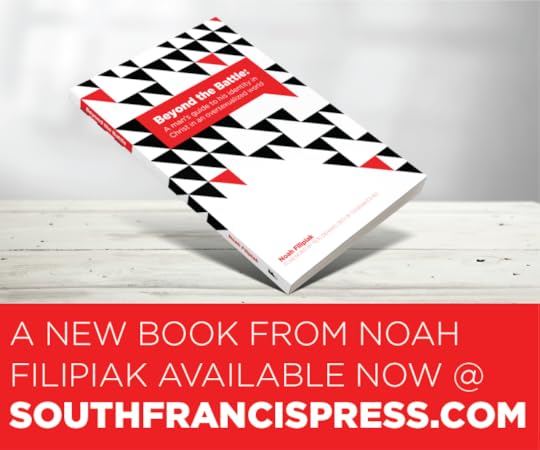
Men, here are 4 reasons you should NOT read Beyond the Battle: A Man’s Guide to His Identity in Christ in an Oversexualized World by Noah Filipiak:
1. You don’t struggle with lust at all. You never check out attractive women when they walk by. You don’t have any desire to look at internet porn or nudity in TV shows and movies.
2. You do lust, look at porn, watch Game of Thrones, etc. but you don’t think it’s a sin and you don’t have a problem with it.
3A. You are completely content in your marriage. Your wife is the definition of perfection in every way. You never wish she would change anything or act differently.
3B. You are completely content in your singleness. You never struggle with God about why you aren’t married.
4. Because Noah Filipiak is not a celebrity, and you know that only celebrities have good or helpful things to say.
If any of these apply to you, make sure you do NOT click on the following link: Beyond the Battle: A Man’s Guide to His Identity in Christ in an Oversexualized World by Noah Filipiak
E-mail Address:
Unsubscribe me
Categories
All categories
Sex and Pornography
Marriage and Singleness
Subscribe me
Unsubscribe
The post 4 Reasons NOT to Read “Beyond the Battle” by Noah Filipiak appeared first on At A Crossroads | Noah Filipiak.
January 25, 2018
Episode 38 – Kent Carlson discusses shifting the church he founded from a seeker-driven megachurch to a church of spiritual formation
You can listen to Noah Filipiak’s “Behind the Curtain” Podcast interview with Kent Carlson on the Podbean Player below or you can subscribe to all “Behind the Curtain” Ministry Podcast episodes on iTunes. (Podcast listening tip: use the podcasts app on your smartphone and listen while driving, doing chores, or working out)
Noah Filipiak interviews Kent Carlson on what led him and his team to shift the seeker-driven megachurch he founded into a church of spiritual formation. A shift that led to around 1500 people leaving the church. Kent is the co-author of Renovation of the Church, a book that chronicles the journey of Oak Hills Church and its leadership. He was mentored by Dallas Willard and currently serves as Vice President of Leadership Formation for the North American Baptist denomination.
E-mail Address:
Unsubscribe me
Categories
All categories
Spiritual Formation
Behind the Curtain Podcast
Church
Subscribe me
Unsubscribe
The post Episode 38 – Kent Carlson discusses shifting the church he founded from a seeker-driven megachurch to a church of spiritual formation appeared first on At A Crossroads | Noah Filipiak.
BONUS Podcast Episode – Noah Filipiak breaks down his new book “Beyond the Battle”
You can listen to Noah Filipiak’s BONUS “Behind the Curtain” Podcast episode on the Podbean Player below or you can subscribe to all “Behind the Curtain” Ministry Podcast episodes on iTunes. (Podcast listening tip: use the podcasts app on your smartphone and listen while driving, doing chores, or working out)
In this bonus episode of the “Behind the Curtain” Ministry Podcast, host Noah Filipiak takes time to break down the content of his new book Beyond the Battle. In the first half of the episode, Noah talks about his personal testimony of overcoming a pornography addiction, how he was tempted to get a divorce, and how going beyond symptom-based solutions to sexual sin transformed him as a man. In the second half of the episode, Noah talks about the toll his book publishing journey did on his soul, and why he chose to publish independently.
Purchase copies of Beyond the Battle here, including discounts on group orders.
Check out the free 6-week men’s small group video curriculum here.
Sign up for Noah’s Author Newsletter to stay up to date on future book projects:
Subscribe to the Noah Filipiak Author Newsletter:
* indicates required
Email Address *
First Name
Last Name
Powered by MailChimp
The post BONUS Podcast Episode – Noah Filipiak breaks down his new book “Beyond the Battle” appeared first on At A Crossroads | Noah Filipiak.
January 13, 2018
Can a good person say evil things?
In speaking to hypocritical religious leaders who were accusing Jesus of doing his miracles by the power of Satan, Jesus says:
“Either make the tree good and its fruit good, or make the tree bad and its fruit bad, for the tree is known by its fruit. You brood of vipers! How can you speak good, when you are evil? For out of the abundance of the heart the mouth speaks. The good person out of his good treasure brings forth good, and the evil person out of his evil treasure brings forth evil. I tell you, on the day of judgment people will give account for every careless word they speak, for by your words you will be justified, and by your words you will be condemned.” Matthew 12:33-37 (emphasis added)
A person can’t be divided from what they say and what they do. In Jesus’s case, his actions were good, and they were coming from a good heart. He was consistent. The religious leaders on the other hand were branded a “brood of vipers” due to their ability to say “good things” while being evil people. With the opposite also being true, saying evil things, while claiming to be good.
This is a very relevant message for today. No one wants to be called “evil,” but does that mean evil people don’t exist? When a person says evil things (over and over again), what is the logical conclusion? These evil things are coming from an evil heart. We are in a day and age when people think they can say and do evil things, but step aside from those words and actions and say, “I’m a good person.” Or if it’s not them saying this about themselves, it’s their fans and followers.
I’m not talking about when a decent person makes a mistake, owns up to it, and seeks reconciliation. I’m talking about people who use their power to abuse, mistreat, and step on others, then they (and their fans) are in denial about their evil hearts.
It’s been refreshing to see people losing their jobs and even going to prison for sexually abusing women and children. It’s only through this type of accountability that socially acceptable evil behavior will change.
What if one of these sex abusers gives a lot of money to charity? Are they a good person now? Or they are really nice to babies? Should they get to keep their job and be seen as a good citizen? Should they not be held accountable for their abuse? That’s sadly what happens all too often. Yes, they did or said that, but that’s not who they are.
So what happens next? Well obviously they continue their destruction, harming more and more people. No one willing to hold them accountable because of the good things they do, or good ideas they have, or economic help they bring. It’s amazing how money can blind society from morality.
I heard a great quote recently: There is no difference between what I believe, what I say, and what I do.
This is certainly true for regular people. And it’s true in the courtroom, or at least it’s supposed to be. You can’t give someone’s words or actions a prison sentence, you have to give the person who said the words or did the action the prison sentence.
But this rule typically doesn’t ring true for society’s elite. Only recently have movie stars’ sexual abuse habits started catching up to them. We’ve sadly lived in a country where if you’re rich and powerful, you can live above the law. Both the actual law, and the moral law. As if no matter how hateful the things you say or do are, you’ll still have throngs of adoring fans who somehow separate your hateful words and actions from what they would consider your good ideas or good actions. The latter always trumping the former.
Is the tongue really no big deal? Are words harmless? Can a person say whatever they want about other people and still be a good person or a good leader, and not held accountable for what they say? Should we still follow this person, convincing ourselves we aren’t following someone who is evil at their core? James chapter 3 has some answers to these questions:
When we put bits into the mouths of horses to make them obey us, we can turn the whole animal. Or take ships as an example. Although they are so large and are driven by strong winds, they are steered by a very small rudder wherever the pilot wants to go. Likewise, the tongue is a small part of the body, but it makes great boasts. Consider what a great forest is set on fire by a small spark. The tongue also is a fire, a world of evil among the parts of the body. It corrupts the whole body, sets the whole course of one’s life on fire, and is itself set on fire by hell.
All kinds of animals, birds, reptiles and sea creatures are being tamed and have been tamed by mankind, but no human being can tame the tongue. It is a restless evil, full of deadly poison.
With the tongue we praise our Lord and Father, and with it we curse human beings, who have been made in God’s likeness. Out of the same mouth come praise and cursing. My brothers and sisters, this should not be. Can both fresh water and salt water flow from the same spring? My brothers and sisters, can a fig tree bear olives, or a grapevine bear figs? Neither can a salt spring produce fresh water.
James 3:3-12 (emphasis added)
Two questions remain:
What kind of person will you be?
What kind of person will you follow, support, root for, and defend?
The post Can a good person say evil things? appeared first on At A Crossroads | Noah Filipiak.
January 8, 2018
A reminder of our only guarantee: Life is short, eternity is long.
One of my uncles died last week. He was 67. My dad is also 67.
I turned 35 today. If you cut my years on this earth in half and went back in time, it would be the summer between my junior and senior year of high school.
Blink.
Now I’m 35.
If you double the years I’ve already spent on this earth, I’ll be 70.
Blink blink.
It’s been a reflective couple of weeks for me. It’s a reflective time when I start realizing my parents and their siblings are the generation of people who are dying. Like when I was in 3rd grade and my grandpa died. I was sad, but also gained a pragmatic understanding: that’s what old people do, they die. You’d think everyone aged 65 and over would be repenting of their sins and running to the forgiving arms of Jesus at a frenetic pace, but they aren’t. It seems like nobody is. Sure, individuals are, but certainly not multitudes.
Why is this?
Why is it we live our lives on this earth like we’ll never die, when death is the only guarantee.
It’s trendy and in vogue to believe that eternity, heaven, and hell are naive concepts thought up by primitive cultures. Science rules the world today, and science says we’ll all become worm food. But I think we’re all bigger believers than we let on when filling out our science exam.
I think it’s one thing for you to believe we all become worm food and that’s it, but do you really believe that about your parents? About your children? If you had a child die at a young age, I doubt your belief.
Your belief in the worm-food-theory I mean. That takes faith and belief too and I think you know that your dead child was (and still is) more than a big pile of cells and atoms.
I do believe in heaven and hell, and I don’t think I’m alone there. I can’t quite get my mind around our culture on this subject though. Our culture lives as if God is dead and pleasure and the moment is all there is, but what do you hear at almost every single funeral or death announcement?
They are in a better place.
How do you know that?
Did you create that better place?
If you created it and really wish for it, does that make it true?
I don’t say this in theory. I mean, you are staking your entire eternal destination (and the destination of your loved ones that you are influencing) on something you wish and hope to be true, while living in a way that completely contradicts this hope you are pinning your eternal future on.
I honestly don’t know why so many people go for that bet.
If you believe in heaven and hell, I would advise you to think about how to get heaven and the options that have been presented. There are essentially two options: one is that we can make it there ourselves. We rescue ourselves. You hear this a lot, “Well I’m a good person so I’ll be fine.” Who gets to define what “good” is? Do you? Or is there a higher authority who is actually the gatekeeper of heaven who gets to determine that? If you are the gatekeeper, then you’re all set.
But you’re not the gatekeeper. So you may want to try an alternate option.
The second option is that the one in authority, the one who created all this, God, rescues us. That a holy (perfect) God has mercy on his sinful, imperfect people–people who chose to leave and rebel against God–and comes and dies on a cross to pay the penalty for these sins, absorbing and experiencing our legal punishment so that the crime doesn’t exist anymore. The crime that brought the divide between God and man. So that man and God are now one again. If man accepts this gift of mercy.
I sincerely recommended the latter. At the very least, if you’re going to reject the latter, please stop acting like every person you know who dies is “in a better place.” I’m either wrong and they are worm food, or I’m right and they are in hell. Neither of those is a better place. People sound nonsensical when they live and believe one way but then say other things after a person dies. It doesn’t make logical sense, and it’s the most ironic and sad thing on the planet because this is the most serious matter we each have to decide about.
Even broader than the matter of eternity is the matter of how we live our lives now: in freedom or in bondage. There’s a life-changing talk by pastor, priest, and professor Henri Nouwen that I’ll link to below. He gave it in 1991 when he was 59 years old and in good health. He died 5 years later at the age of 64. In it he says:
When you’re dead, you’re dead. When you’re dead, it’s gone. It’s over. You don’t have anything and nobody talks about you anymore. When you’re dead, you’re dead. It’s amazing you know, how people can be so busy and so anxious and so nervous one day and the other day they’re gone. End, over, out, gone, forgotten. Think about how anxious you can be, how worried you are about how busy you are, how urgent everything is, how important it is to do these things, and suddenly it all stops and it’s all gone and you’re gone and nobody is interested in you anymore. That’s what living in the darkness is all about. You’re not really living, you’re surviving. And the tragedy is, is finally you failed. Finally you and I failed. When it’s all said and done, you’ve failed at surviving. You’re going to die. It’s simple. It’s very basic. It’s very real.
You can listen to his entire talk here. (You’ll be ask to create a free Hoopla account. Hoopla is a library service where you can check out free audio items like this talk. I recommend downloading their mobile app.)
It’s one of the best, most life-changing, talks I have ever heard.
Nouwen goes on to talk about how that timeline, the timeline of being anxious about impressing people and then dying, is a lie. About how we were a part of God’s eternal timeline before time even began. How we have always been beloved in his sight, and how Jesus’s death on the cross not only saves us for eternity, but allows us to live as God’s beloved children here and now, in the freedom and joy that only Jesus can bring.
I have experienced this freedom and joy and it is sweet.
It is sad to think about my parents dying. But who is to say that I won’t die first? Or one of my three incredible children?
Death will always win in this timeline.
Praise God that Jesus always wins and defeats death!
If you’re reading this, it means it’s not too late for you.
When it’s your turn to die, give your loved ones the peace of being able to say, “He/She is in a better place,” knowing they have the revelation of Jesus walking on this earth, dying on a splintered wooden cross, and raising from the dead as the guarantor behind this emphatic statement.
The post A reminder of our only guarantee: Life is short, eternity is long. appeared first on At A Crossroads | Noah Filipiak.


