
Noah Filipiak's Blog, page 22
May 4, 2018
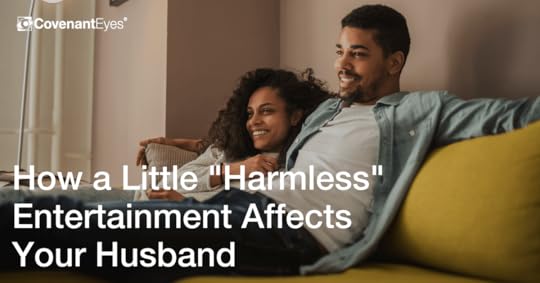
How a Little “Harmless Entertainment” Can Affect Your Husband
My latest blog article is up at Covenant Eyes, entitled How a Little “Harmless Entertainment” Can Affect Your Husband. Check it out!
E-mail Address:
Unsubscribe me
Categories
All categories
Sex and Pornography
Marriage and Singleness
Subscribe me
Unsubscribe
The post How a Little “Harmless Entertainment” Can Affect Your Husband appeared first on At A Crossroads | Noah Filipiak.


May 2, 2018
Black & White Theology: Total Depravity & the Philadelphia Starbucks Arrests
Click below to listen on podcasts.com. You can also subscribe on iTunes and Google Play.
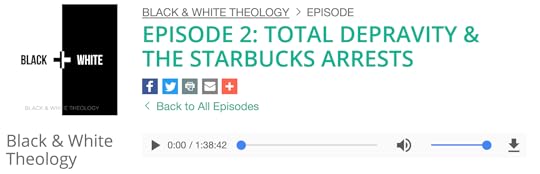
Pastors Tyler St. Clair and Noah Filipiak dive into the mailbag to discuss Joyce Meyer and why we are analyzing well-known people’s theologies at all. The theological topic for this episode is the “T” in Reformed Theology’s “TULIP”, Total Depravity. The race relations topic for this episode is the two black men who were arrested at a Philadelphia Starbucks.
Please send us your questions or comments to bwtheology@gmail.com or connect with us on Twitter @bwtheology and we’ll read and interact with them on the air.
E-mail Address:
Unsubscribe me
Categories
All categories
10 Things
Abortion
Adoption and Foster Care
Anger
Behind the Curtain Podcast
Beyond the Battle Blog
Beyond the Battle Podcast
Black and White Theology Podcast
Book Reviews
Choppin It Up Podcast
Christian Singles Survey
Church
Church Planting
Confusing Parts of the Bible
Depression and Insecurity
Did Jonah and the fish actually happen?
Faith
God
Haiti
Hebrews
Hell
Homosexuality
Human Trafficking
Humor
Islam
Jehovah's Witness
Jesus
Joel Osteen
Marriage
Marriage and Singleness
Misc.
Money
Mormonism
Other Religions
Pastors
Pastors / Church Planting / Church
Podcasts
Politics
Racial Reconciliation
Refugees and Immigrants
Rob Bell
Sex and Pornography
Should we read Genesis literally?
Singleness
Social Justice
Social Justice Misc.
Speaking
Spiritual Formation
Strange Parts of the Bible, misc.
the brutal violence in the Old Testament
The Church
Topics
Uncategorized
Universalism
Video
Weekly Bible Reading Devotionals
weird verses in Old Testament
What does the Bible say about...
Subscribe me
Unsubscribe
The post Black & White Theology: Total Depravity & the Philadelphia Starbucks Arrests appeared first on At A Crossroads | Noah Filipiak.
April 26, 2018
The Beyond the Battle Podcast: Entitlement is Your Worst Enemy
Listen below at podcasts.com or listen/subscribe on iTunes or Google Play (available soon).

In the inaugural episode, Noah breaks down the first video of the Beyond the Battle free small group curriculum, “Entitlement is Your Worst Enemy,” giving an expanded explanation of the video. He looks at Exodus 19, Romans 2:5, and Matthew 18:21-35 to look at how holy God is and how when we grasp this in balance with his grace, it brings tangible freedom to our struggles with sexual and relational sin.
Send in your questions and comments to beyondthebattlepodcast@gmail.com or @battle_podcast on Twitter for next episode’s mailbag section.
E-mail Address:
Unsubscribe me
Categories
All categories
Sex and Pornography
Marriage and Singleness
Beyond the Battle Podcast
Subscribe me
Unsubscribe
The post The Beyond the Battle Podcast: Entitlement is Your Worst Enemy appeared first on At A Crossroads | Noah Filipiak.
April 20, 2018
Black & White Theology Podcast, Ep. 1: Theology Preview & Rochester Hills
Click below to listen on podcasts.com. You can also subscribe on iTunes and Google Play.

Interact with us on Twitter @bwtheology or bwtheology@gmail.com and we’ll reply back on the air.
This is the inaugural Black and White Theology episode. Here’s a description of the new show:
A black pastor and a white pastor, Tyler St. Clair and Noah Filipiak, discuss a theological topic and a race relations topic.
Our podcast name has a dual meaning:
Some theological topics are black and white. They are either correct or incorrect based on what the Bible says. There are other theological topics that are grey areas. In fact, the Bible tells us that some things will be grey areas. The importance is in using Scripture appropriately to tell the black and white from the grey.
Most theological conversations happen in ethnically homogeneous groups. The Church misses out on a great opportunity to be a part of the solution to race relations in America when it does this. When theology is only done homogenously, you also end up with a warped, one-sided perspective.
We feel interaction is what will make this podcast special. Please send us your questions or comments to bwtheology@gmail.com or connect with us on Twitter @bwtheology and we’ll read and interact with them on the air.
E-mail Address:
Unsubscribe me
Categories
All categories
Racial Reconciliation
Black and White Theology Podcast
Subscribe me
Unsubscribe
The post Black & White Theology Podcast, Ep. 1: Theology Preview & Rochester Hills appeared first on At A Crossroads | Noah Filipiak.
April 18, 2018
Final Q&A: Why has the church stepped back from being on the forefront of race relations?
I was on a panel last week at an event entitled Uprooting Racism from the Church, sponsored by the Michigan State University student group MSU Project 1:17. In addition to the live panel, they took anonymous questions from the audience for the speakers to answer online. I’ve realized recently that I haven’t posted about racism / racial reconciliation in a while. Somewhat because I’ve been busy with posts about sexual purity, lust, porn, marriage, etc. that go along with my recent book release. But to my discredit, it’s also because some white Christians who would be interested in buying my book about sexual purity would also be upset about what I write about race. So in my fear of man, I have backed down from speaking the truth (the same temptation I face as a pastor with the topic of race, Lord help me). How quickly and easy it is to fall into this trap! I had also become fatigued with debates and fatigued with people being upset with me, so had taken the easy road. I apologize for that to anyone reading this, especially my friends of color.
I thought posting a blog with my answers to these Q&A questions would be helpful because I’ve already written them, and because I’ve previously articles on these subjects, which you can find at the bottom of each post. There will be 3 of these, with the questions having been anonymously submitted from the crowd at the event earlier this week. The original format for these was on a Facebook event page, which I’ve just copied and pasted here. I’ll post one each day over the next three days, this is day #3 of 3:
The Question:
Why has the church stepped back from being on the forefront of race relations? Do you think if we stepped in and did it God’s way, we could end it?
My Answer:
For the white church, it has typically avoided race relations historically. In the Civil Rights Movement, it didn’t want to offend / lose its white members or jeopardize being able to “preach the gospel” to white lost people who also would not have been on board with the Civil Rights message. I put “preach the gospel” in quotes because we did such a disservice to Jesus when we divorced his teachings from how to get to heaven, what we often now call “the gospel.” Yes, the gospel is how we get to heaven, but it’s also entering into Jesus’s Kingdom, where he and his teachings are on the throne. We can’t divorce the two. I think the black church is still heavily engaged in race relations, but our society is much more secular than in the 60’s, so the voice of the Church isn’t as heard in the public forum. Though there are definitely still prominent black Church leaders on the forefront of race relations today. I think it would idealistic to say we could end it if we stepped in and did it God’s way, though that should be our prayer and God can do anything. I say idealistic because Dr. King and the powerful movement of the black Church in the 60’s wasn’t able to end it, and sadly so much of the white Church today is in denial that there is even a problem. And I mean deep denial where there’s a lot of anger if it’s even brought up. It’s hard to picture those folks jumping in to the forefront, or at all. Though I am encouraged to see movement! While there are still a lot of naysayers in the white Church, there is also some movement which is very encouraging to see.
E-mail Address:
Unsubscribe me
Categories
All categories
Racial Reconciliation
Social Justice
Subscribe me
Unsubscribe
The post Final Q&A: Why has the church stepped back from being on the forefront of race relations? appeared first on At A Crossroads | Noah Filipiak.
April 14, 2018
What would you say to someone experiencing “white guilt”?
I was on a panel this week at an event entitled Uprooting Racism from the Church, sponsored by the Michigan State University student group MSU Project 1:17. In addition to the live panel, they took anonymous questions from the audience for the speakers to answer online. I’ve realized recently that I haven’t posted about racism / racial reconciliation in a while. Somewhat because I’ve been busy with posts about sexual purity, lust, porn, marriage, etc. that go along with my recent book release. But to my discredit, it’s also because some white Christians who would be interested in buying my book about sexual purity would also be upset about what I write about race. So in my fear of man, I have backed down from speaking the truth (the same temptation I face as a pastor with the topic of race, Lord help me). How quickly and easy it is to fall into this trap! I had also become fatigued with debates and fatigued with people being upset with me, so had taken the easy road. I apologize for that to anyone reading this, especially my friends of color.
I thought posting a blog with my answers to these Q&A questions would be helpful because I’ve already written them, and because I’ve previously articles on these subjects, which you can find at the bottom of each post. There will be 3 of these, with the questions having been anonymously submitted from the crowd at the event earlier this week. The original format for these was on a Facebook event page, which I’ve just copied and pasted here. I’ll post one each day over the next three days, this is day #2 of 3:
The Question:
What would you say to someone experiencing “white guilt”?
My Answer:
This is a great question. Honestly, I wish I had kept this in mind last night more when I was giving my answers. I forget that I’ve been in these conversations for 10 years and I’m often not sensitive to white folks who want to learn but are just being exposed to these truths. I want to present answers in a way that helps white people change, learn, and grow. When I get too fired up, I sometimes forget to do that and I apologize for when I did that last night.
White guilt often paralyzes us white folks. We need to pray against that. It can also turn to anger and defensiveness, which we also need to pray against. The best thing you can do with your white guilt is use it as motivation and fuel to be an agent of change. I think it’s the first step in waking up to reality. Use it to become even more educated and aware. And with all this, know that it’s okay to be white. That’s how God made you. You can’t control where you’re born or the blindness that your upbringing bestowed upon you. I think we need to be honest and real about how white society created the oppression that people of color are still affected by, and just own that. And own that it still exists. So now what are you going to do about it? My advice is to not become apathetic. Don’t go into your white cultural cocoon where you’re only under white leadership, only around white people, etc. because that is only going to perpetuate the problem. I’m always going to be a privileged, white male. My friends of color know I can’t change that, and they’re not asking me to. But I have to be able to admit that and admit that it isn’t right. Not that it’s wrong to have privileges, but it’s wrong that everyone else doesn’t have equal access to that privilege. Everyone should have the same privileges I have. (If you’re not familiar with white privilege, a list made in 1988 by Dr. Peggy McIntosh gives a good description: http://www.mdcbowen.org/p2/rm/mcintosh.html )
E-mail Address:
Unsubscribe me
Categories
All categories
Racial Reconciliation
Social Justice
Subscribe me
Unsubscribe
The post What would you say to someone experiencing “white guilt”? appeared first on At A Crossroads | Noah Filipiak.
April 12, 2018
If life is so bad for people of color in the United States, then why do those who complain continue to live in the US? Why do they not move to another country?
I was on a panel this week at an event entitled Uprooting Racism from the Church, sponsored by the Michigan State University student group MSU Project 1:17. In addition to the live panel, they took anonymous questions from the audience for the speakers to answer online. I’ve realized recently that I haven’t posted about racism / racial reconciliation in a while. Somewhat because I’ve been busy with posts about sexual purity, lust, porn, marriage, etc. that go along with my recent book release. But to my discredit, it’s also because some white Christians who would be interested in buying my book about sexual purity would also be upset about what I write about race. So in my fear of man, I have backed down from speaking the truth (the same temptation I face as a pastor with the topic of race, Lord help me). How quickly and easy it is to fall into this trap! I had also become fatigued with debates and fatigued with people being upset with me, so had taken the easy road. I apologize for that to anyone reading this, especially my friends of color.
I thought posting a blog with my answers to these Q&A questions would be helpful because I’ve already written them, and because I’ve previously articles on these subjects, which you can find at the bottom of each post. There will be 3 of these, with the questions having been anonymously submitted from the crowd at the event earlier this week. The original format for these was on a Facebook event page, which I’ve just copied and pasted here. I’ll post one each day over the next three days. I thought I’d start off with the most provocative of the 3!
The Question:
If life is so bad for people of color in the United States, then why do those who complain continue to live in the US? Why do they not move to another country?
My Answer:
Lord help me to answer this in love and in a way that truly helps the person who asked it. Help me to believe that they are asking it from an honest place and that they want to learn and grow.
First and foremost, where would they go? African-Americans do not have a home country. African slaves were brought here and separated from their families. Husbands and wives were separated, parents and children were separated. They were mixed up on the boats to remove all personal identity, so their only identity would be as laborers, as property. Then they were raped by slave owners. An African-American does not know what country they are from originally. And even if they did, could they go back to a country they’ve been away from for hundreds of years? This is their home! White people forcibly brought them here and deprived them of everything. To say that moving to a different country is the solution would only be to admit how awful of a country the United States really is — I’m not saying we are that awful of a country, I’m saying that if your solution is people of color should move away if they don’t like being oppressed, then you are saying we are that awful of a country. Hypothetically if Canada was presented as a good option to move to for an American person of color, that would only be admitting that America is racist and bigoted and only cares about whites, but Canada isn’t. I hope that no American really believes that or wants that. The solution isn’t to throw people out of our country who “complain,” it’s to fix what they are “complaining” about. This is especially true for those of us who are Christians. Jesus tells us the 2nd greatest commandment in all of Scripture is to love our neighbor as ourselves. If our neighbor of color is being oppressed, we are to love them and help fix the situation, not throw them out because they don’t like being oppressed. In addition to this, the Bible is full of scriptures about God’s heart for justice and for the oppressed (Isaiah 1:11-17; Amos 5:21-24; Micah 6:6-8). To ignore the cry of the oppressed in our own country, and to be a part of the oppression, puts us directly under God’s judgment. I think the main thing missing from this question is the understanding that people of color are under oppression in our country, they aren’t just complaining about it. We have to believe people of color, otherwise we can never be in Christian community together. To not believe people of color is what creates and sustains the racial division in our country. I typically find that the mindset behind this question comes from a person who is looking at the world through the lens of their political party rather than Scripture, through political jargon of political radio and TV, and someone who is not in community with people of color, someone who has spent most of their life in white spaces and that that’s the only experience they have. The key step is: are you willing to learn and grow? Do you assume that your experience is the same as people of color’s? Are you willing to listen? Are you willing to see how big the world is? To the person who wrote this question, I would highly recommend reading the book Divided by Faith: Evangelical Religion and the Problem of Race in America by Emerson and Smith if you have a humble heart to be learn and grow in this area.
E-mail Address:
Unsubscribe me
Categories
All categories
Racial Reconciliation
Social Justice
Subscribe me
Unsubscribe
The post If life is so bad for people of color in the United States, then why do those who complain continue to live in the US? Why do they not move to another country? appeared first on At A Crossroads | Noah Filipiak.
March 25, 2018
God-Honoring Sex
God didn’t randomly create sex and then add a bunch of rules
to make it as difficult as possible for us to enjoy. He created it
with great intentionality. And the part of that intentionality we so
often overlook is that sex is about much more than what happens
between the sheets. God-honoring sex produces strong, incredible
families, which produce incredible societies and incredible legacies.
God-honoring sex upholds all humans with dignity and love,
rather than relegating humans to be objects that are consumed
and discarded. God-honoring sex shapes our hearts to love the
way Christ loves us. God-honoring sex teaches us what real love
is. God-honoring sex models to our children how they are to view
people. God-honoring sex produces lives of substance, character,
and integrity. God-honoring sex produces better people and a better
world, period! It produces a life free from the emptiness and destruction
of betrayal, as Proverbs 5 speaks so passionately against.
This is an excerpt from Beyond the Battle: A Man’s Guide to his Identity in Christ in an Oversexualized World by Noah Filipiak (page 119)
E-mail Address:
Unsubscribe me
Categories
All categories
Sex and Pornography
Marriage and Singleness
Subscribe me
Unsubscribe
The post God-Honoring Sex appeared first on At A Crossroads | Noah Filipiak.
March 21, 2018
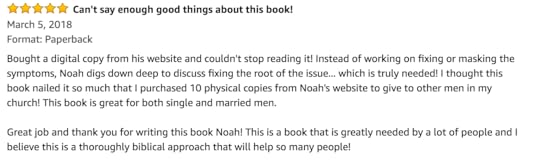
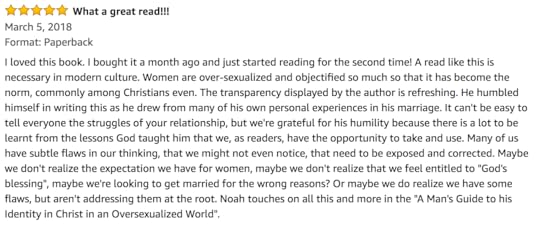
Read Reviews of Beyond the Battle by Noah Filipiak
You can preview and order Beyond the Battle here.
You can leave your own Amazon review here.
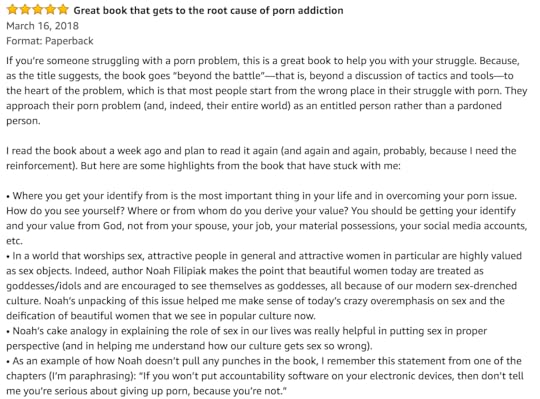
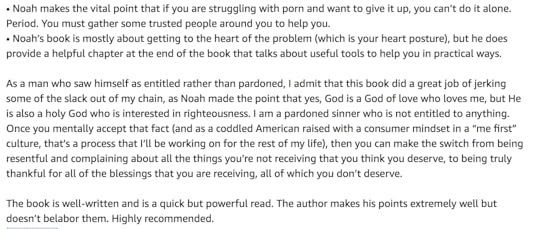
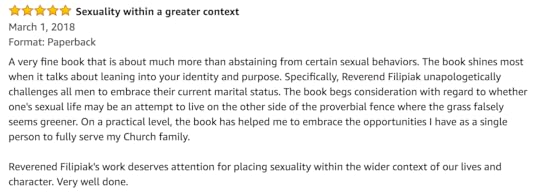
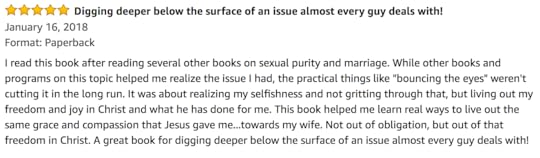
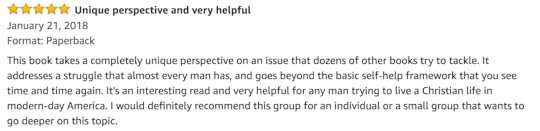

You can preview and order Beyond the Battle here.
You can leave your own Amazon review here.
E-mail Address:
Unsubscribe me
Categories
All categories
Sex and Pornography
Marriage and Singleness
Subscribe me
Unsubscribe
The post Read Reviews of Beyond the Battle by Noah Filipiak appeared first on At A Crossroads | Noah Filipiak.
March 14, 2018
How To Find What You’re Looking For In A Pornography Search
I just did a guest post for the Dadding Depressed blog:
How To Find What You’re Looking For In A Pornography Search.

E-mail Address:
Unsubscribe me
Categories
All categories
Sex and Pornography
Marriage and Singleness
Depression and Insecurity
Subscribe me
Unsubscribe
The post How To Find What You’re Looking For In A Pornography Search appeared first on At A Crossroads | Noah Filipiak.


