Michael Roberts's Blog, page 22
May 2, 2023
First Republic – the case for public ownership
The collapse of First Republic Bank is the latest chapter in the rolling banking crisis in the US. This was the second largest banking collapse in US financial history. It demonstrates yet further the case for public ownership of the banking system.
First Republic is the third bank to fail after the Silicon Valley Bank (SVB) and Signature. In total, $47bn in bank assets have disappeared into smoke, the losses being taken in part by the shareholders and holders of the bonds in these banks. But there has also been a cost to public funds. The Federal Deposit Insurance Corporation (FDIC) is a public body financed by contributions from all the banks. The cost of arranging and financing the cost of these bankruptcies and takeovers is estimated at $20bn (for SVB), $13bn (for First Republic) and $2.5bn (Signature). So around three-quarters of the total losses are being taken by the FDIC. The FDIC will ask for new levies from the banks, so the burden will eventually be shared, but at the expense of reducing bank lending for households and business and at higher interest costs.
One bank that is not going to lose is JP Morgan. The takeover of First Republic looks like a great deal for JPM. JPM is paying the FDIC $10.6bn, for which it is getting $185bn in interest-bearing loans and securities. In turn, JPM is taking on the deposits of First Republic and First Republic’s outstanding borrowing from the Fed. But the FDIC is providing a $50bn credit line to JPM over five years so that any further fall in deposits or defaults on First Republic loans are covered. In other words, JPM will not have to get expensive borrowing from the Fed as it has a special FDIC loan on easier terms. Small banks may wonder why the largest bank in the US gets a special cheap loan facility.
JPM will now own First Republic assets for $10.6bn. JPM’s chief Dimon says it will make about $500m a year from these assets, which it deserves for taking on the risk of First Republic’s debts. But that is clearly an underestimate – it’s more likely to be a profit of $1bn a year at current loan rates to businesses and especially the low rate that the FDIC has arranged for JPM to borrow. That’s what First Republic earned in its last quarter. So that will add 2% to annual profits from JPM. Moreover, the FDIC has agreed to take 80% of any losses on loan defaults! JPM’s stock price went up by $11bn in one day on the news. So even JPM’s payment to the FDIC has been covered immediately.
These banking collapses offer yet another powerful argument for public ownership of banking. If the three banks had been nationalised, the $35bn being spent by the FDIC to hand over the assets of these banks to larger ones could instead have been used to restructure them into public banks that would have delivered over time sufficient income to make profits for the government (FDIC), not for the likes of JPM.
The other lesson of this crisis is the failure of regulation as the alternative to public ownership. In a special report commissioned by the Fed on the SVB debacle, the blame was laid on the reduction in regulation of smaller banks under the Trump administration. The Democrat administration likes that conclusion, but the report provided no evidence that the Trump changes made any difference to preventing the collapse of any of these banks. The history of regulation, whether applied to large or small banks, has shown to be a total failure.
So now we have had three banking busts, leaving JP Morgan in an even more dominant position in the banking sector, now with 12% of all customer deposits in the US. In the 2008 financial crash, the cry was there were many large banks that were ‘too big to fail’. Fifteen years later and the big banks are even bigger – but not too big to fail as the collapse and takeover of Swiss bank Credit Suisse last month proved. Indeed it is ludicrous that the now huge Swiss UBS bank remains in private ownership, subsidised by the state, instead being publicly owned.
And as long as the Federal Reserve and other central banks keep raising their ‘policy’ interest rates, driving up the cost of borrowing and tightening credit, there remains the increasing danger of further bank collapses down the road.
The case for public ownership is overwhelming, not only of middle-sized banks like First Republic that get into trouble, but also of the big mega banks like JP Morgan, increasingly becoming powerful monopolies. Public ownership, democratically run would end banking as a wasteful, corrupt and unstable money-making machine paying grotesque salries, bonuses and capital gains for a small clique of super-rich speculators (speculating with our deposits) and instead turn it into a public service for its customers, households and businesses, with any profits going to the country as a whole.


April 27, 2023
Inflation: causes and solutions
Last week, the Bank of England’s chief economist, Huw Pill, doubled-down on the argument that the current inflationary spiral affecting the major economies was the result of excessive wage demands. He said that workers should just accept that price rises will hit their living standards. “Somehow in the UK, someone needs to accept that they’re worse off and stop trying to maintain their real spending power by bidding up prices, whether through higher wages or passing energy costs on to customers etc.” Workers asking for more wages just made inflation worse. Pill echoed the previous comments of his boss, the Bank of England governor, Andrew Bailey, who said a year ago that: “I’m not saying nobody gets a pay rise, don’t get me wrong. But what I am saying is, we do need to see restraint in pay bargaining, otherwise it will get out of control”.”
At least this time, Pill vaguely mentioned that firms hiking prices to sustain (or even increase) profitability might also be contributing to inflation. But it remains the orthodox mainstream theory that accelerating inflation is being caused by ‘excessive’ money supply growth over output growth (the monetarist theory) and/or by ‘excessive’ wage demands forcing prices up (the Keynesian theory).
In a similar message, Ben Broadbent, BoE deputy governor, said there was “no getting round the impact on real incomes of . . . jumps in import prices”, which he said had “led to second-round effects on domestic wages and prices”. But how does hiking interest rates stop import price inflation from increased energy and food prices introduced by the multi-nationals that control these necessaries?
I and others have spent much ink in showing that both these theories do not explain inflation in prices, either now or in the past. And it’s not just leftists. For example, economists at the Bank for International Settlements (BIS), hardly a leftist body, found that: “by some measures, the current environment does not look conducive to such a spiral. After all, the correlation between wage growth and inflation has declined over recent decades and is currently near historical lows.”

But central bankers and mainstream economists ignore the evidence and continue to promote monetarist or wage-push inflation theories. Why is this? Gavyn Davies, former chief economist at Goldman Sachs, once explained why the theory that inflation is caused by wage rises persists even though it has been discredited theoretically and empirically. Davies: “without the Phillips Curve, the whole complicated paraphernalia that underpins central bank policy suddenly looks very shaky. For this reason, the Phillips Curve will not be abandoned lightly by policy makers”. (Davies 2017). Another reason not mentioned, of course, is that the monetary authorities and mainstream economics resolutely refuse to recognize the role of profits in capitalist economies. Profits apparently play no role in investment or in firms hiking prices in order to sustain profitability. And above all, profits must be sustained.
Pill reiterated the policy solution of central banks to get inflation rates down: “Interest rate rises in the US and UK over the past year were designed to cool spending power and the ability of companies and people to pass on the pain of inflation to others”. Exactly who was taking on pain, he did not say; but it is clear that the pain is on workers’ real incomes, not on corporate profits (so far).
In a penetrating paper by Matías Vernengo and Esteban Ramon Perez Caldentey, entitled Price and Prejudice: A Note on the Return of Inflation and Ideology, the authors pose the issues at debate: “there is an ideological divide between those that blame inflation in an incompetent government and central bank reaction to the pandemic versus those that suggest that the real culprits are greedy corporations raising their mark up above their costs.” But “this has deviated the debate from the more important question, which is related to the question of whether the inflationary acceleration originated in temporary supply side disruptions caused by the pandemic or resulted from excess demand in an economy close to full employment.”
The authors go on to say that the dominant view in the profession, and among policy makers is that inflation is caused by excess demand. The main argument against this view is that corporations have taken advantage of supply-side problems during the pandemic to obtain unjustifiable extra gains in an already unequal society.
It’s true that over the past forty years of neoliberal ascendancy, deregulation has allowed corporations to amass pricing power. And it is also the case that that profit margins have increased during the recent inflationary acceleration. And the financial sector has made significant profits during and after the pandemic. But Vernengo and Ramon counter that “it would be wrong to claim as some do on the left that current inflation is ‘greedflation’ ie caused by price-gouging; or that it is the result of monopolistic pricing.”
The empirical evidence shows that it was the sharp rise in the prices of non-labor inputs that were “the likely culprits for the acceleration in inflation”. They rose because of the shutdown of key suppliers during COVID in China and other developing countries and from the loss of electronic components supply that went into the production of consumers goods and because the supply chain system was broken with the collapse of the just in time inventory methods over the last four decades.
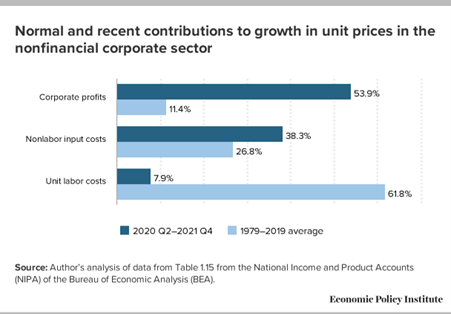
Sure, prices in oligopolistic markets are likely to be higher than in more competitive markets “but it is not the case that this can explain the continuous rise in prices; that would require a change in the competitive conditions, something that is not clearly taken place in the last two years.” Higher inflation can occur both with fairly competitive or oligopolistic market structures. In the late 19th century, the so-called Gilded Age Era was characterized by the rise of cartels, but with deflation in prices; and the 1990s, often seen as a second Gilded Age with increasing market concentration, experienced a so-called Great Moderation in price inflation ie disinflation. Indeed, in the last big inflationary spiral of the 1970s, profits actually fell. According to Sylos-Labini, wiring then: “the decline of the share of profits in several capitalist countries can be attributed primarily to the persistent increase of direct costs in labor, raw materials, and energy”. This contradicts views according to which: “Companies with enough market power can also unilaterally raise prices in a quest for greater and greater profits” as MMT economist, Stephanie Kelton has argued.
In a recently widely acclaimed paper, Isabella Weber and Evan Wasner, Sellers’ inflation, profits and conflict: why can large firms hike prices in an emergency? argue that “To link market power to the sudden increases in profits, it is necessary to examine why large firms have raised prices in the context of the pandemic but kept prices stable in the preceding decades. This implies that market power is not constant but can change dynamically in a changing supply environment.” They point out that that, before the pandemic, there was a long period of relative macroeconomic price stability, with low inflation and generally shared growth in nominal value added between wages and profits.
It was only in the post-pandemic period of the last two years that profits have usurped a greater share of the value in price increases per unit of output. But as their table shows, in the first part of 2020, it was wages that gained most from price rises as profits dived in the pandemic slump. Through 2021 those relative shares were gradually reversed and profits reaped the lion’s share. But in 2022, the wage-profit share in the value of price rises was pretty even. Indeed, in Q3 2022, labor’s share in price rises was greater.
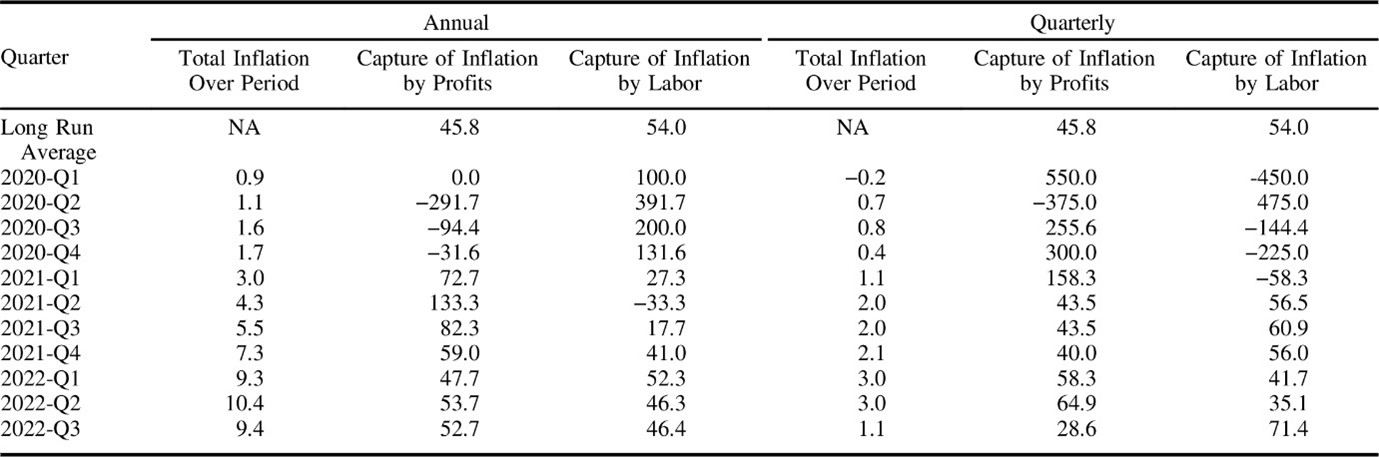
So it all depends on the point in the cycle of expansion and contraction that a capitalist economy is undergoing, not on the ability of monopolies to ‘price gouge’ as such. The data suggest that, in the period of supply chain blockages and sharply rising basic commodity prices (food, energy), firms with pricing power hiked prices to sustain and even increase profits (2020-21). But as supply blockages subsided and production picked up in 2021-22, competition increased and further profit mark-ups could not be sustained.
As Vernengo and Ramon conclude: “The persistence of contractionary demand, mostly monetary, policy as the main tool to contain inflation seems to respond more to the prevailing prejudices and the ideological biases of the profession, than to the analysis of the real causes of inflation.” On the other hand,“It is not helpful that the main challenge to this consensus has been to blame corporations for increasing their profit margins, since this view also provides an incorrect explanation for the recent acceleration of inflation. The main culprit for the inflationary acceleration in the U.S. and most advanced economies is related to the supply side snags, and the shock to energy and food prices resulting from the pandemic and the war in the Ukraine.”
Central bankers and the mainstream ignore all this debate and continue with their claims that it is excessive money, or excessive aggregate demand and wage rises that is causing the inflationary spiral. Their policy answer is to raise interest rates and reduce money supply to restrict demand and, as unemployment rises, weaken wage bargaining power.

What should be the policy against accelerating inflation? Weber and other leftists have argued for the introduction of price controls as the alternative to central bank policies. I have argued against price controls as an effective policy to control generalized inflation, especially as current inflation,is being driven by international energy and food prices. Controlling energy prices at the domestic consumer end would not solve price rises at the producer end, but simply drive private energy supplies into bankruptcy. That would force governments to reverse controls or take over companies. Indeed, that poses the best policy answer: public ownership of the international energy and food companies that operate throughout the global supply chain.
In the meantime, price controls or not, the reality is that, as economies go into 2023, headline inflation rates are falling, as energy and food prices fall back. And so are profit margins as the major economies slip into a slump.

Sure, so-called ‘core inflation’ (excluding food and energy) remains ‘sticky’, so that even in a slump, inflation rates are likely to stay above the average rates prior to the pandemic slump. But it’s the slump that will end high inflation (as it did in the early 1980s), not interest-rate hikes or price controls.
April 22, 2023
A multipolar world and the dollar
Christine Lagarde, the head of the European Central bank (ECB), made an important ‘keynote’ speech last week to the US Council of Foreign Relations in New York.
It was important because she analysed recent developments in global trade and investment and assessed the implications of the apparent move away from the hegemonic dominance of the US economy and the dollar in the world economy and the move towards a ‘fragmented’, ‘multipolar’ world economy – where no one economic power or even the current imperialist bloc of the G7-plus will dominate global trade, investment and currencies.
Lagarde explained: “The global economy has been undergoing a period of transformative change. Following the pandemic, Russia’s unjustified war against Ukraine, the weaponisation of energy, the sudden acceleration of inflation, as well as a growing rivalry between the United States and China, the tectonic plates of geopolitics are shifting faster.”
You may not agree with the causes that Lagarde offers, but she concluded that “We are witnessing a fragmentation of the global economy into competing blocs, with each bloc trying to pull as much of the rest of the world closer to its respective strategic interests and shared values. And this fragmentation may well coalesce around two blocs led respectively by the two largest economies in the world.”
So it’s fragmentation and a coalescence into a battle between a US-led bloc and a China-led bloc. This is the worry for Lagarde and the US-led imperialist bloc – a loss of global control and a fragmentation of global economic power not seen since the inter-war period of the 1920s and 1930s.
Lagarde talked nostalgically of the post-1990 period after the collapse of the Soviet Union, supposedly heralding a period of global dominance by the US and its ‘alliance of the willing’. “In the time after the Cold War, the world benefited from a remarkably favourable geopolitical environment. Under the hegemonic leadership of the United States, rules-based international institutions flourished and global trade expanded. This led to a deepening of global value chains and, as China joined the world economy, a massive increase in the global labour supply.”
Yes, these were the days of the globalization wave of rising trade and capital flows; the domination of Bretton Woods institutions like the IMF and the World Bank dictating the terms of credit; and above all, the expectation that China would be brought under the imperialist bloc after it joined the World Trade Organisation (WTO) in 2001.
However, it did not work out as expected. The globalization wave came to an abrupt end after the Great Recession and China did not play ball in opening up its economy to the West’s multi-nationals. That forced the US to switch its policy on China from ‘engagement’ to ‘containment’ – and with increasing intensity in the last few years. And then came the Russian invasion of Ukraine and the renewed determination of the US and its European satellites to expand its control eastwards and so ensure that Russia fails in its attempt to exert control over its border countries and permanently weaken Russia as an opposition force to the imperialist bloc.
Lagarde comments on the economic implications of this: “But that period of relative stability may now be giving way to one of lasting instability resulting in lower growth, higher costs and more uncertain trade partnerships. Instead of more elastic global supply, we could face the risk of repeated supply shocks.” In other words, globalization and the easy movement of supply, trade and capital flows that benefited the imperialist bloc so much (see our paper The economics of modern imperialism) had come to an end.
The response has been an intensification of protectionist measures (rising tariffs etc); control of trade, particularly in technology and attempts to reverse globalization into ‘reshoring’ or ‘friendshoring’ capital that previously went to all parts of the globe.

As Lagarde put it: “governments are legislating to increase supply security, notably through the Inflation Reduction Act in the United States and the strategic autonomy agenda in Europe. But that could, in turn, accelerate fragmentation as firms also adjust in anticipation. Indeed, in the wake of the Russian invasion of Ukraine, the share of global firms planning to regionalise their supply chain almost doubled – to around 45% – compared with a year earlier.”
Do these developments mean that the imperialist bloc is losing control of the extraction of surplus value from the working people of the world? In particular, is the US dollar’s role as the emperor of currencies under threat from other currencies in trade and investment? Lagarde commented: “Anecdotal evidence, including official statements, suggests that some countries intend to increase their use of alternatives to major traditional currencies for invoicing international trade, such as the Chinese renminbi or the Indian rupee. We are also seeing increased accumulation of gold as an alternative reserve asset, possibly driven by countries with closer geopolitical ties to China and Russia.”
It’s undoubtedly true that the imposition of economic sanctions on Russia employed by the imperialist governments – banning of energy imports; seizing FX reserves; closing international banking settlement systems – has accelerated the move away from holding the dollar and euro. However, Lagarde added the caveat that this trend is still way short of dramatically changing the global financial order. “These developments do not point to any imminent loss of dominance for the US dollar or the euro. So far, the data do not show substantial changes in the use of international currencies. But they do suggest that international currency status should no longer be taken for granted.”
Lagarde is right. As I have shown in previous posts, that although the US and the EU have lost ground in the share of world production, trade and even currency transactions and reserves, there is still a long way to go before declaring a ‘fragmented’ world economy in that sense.

The US dollar (and to a lesser extent the euro) remains dominant in international payments. The US dollar is not being gradually replaced by the euro, or the yen, or even the Chinese renminbi, but by a batch of minor currencies.
According to the IMF, the share of reserves held in US dollars by central banks has dropped by 12 percentage points since the turn of the century, from 71 percent in 1999 to 59 percent in 2021. But this fall has been matched by a rise in the share of what the IMF calls ‘non-traditional reserve currencies’, defined as currencies other than the ‘big four’ of the US dollar, euro, Japanese yen and British pound sterling, namely such as the Australian dollar, Canadian dollar, Chinese renminbi, Korean won, Singapore dollar, and Swedish krona. All this suggests is that the shift in international currency strength after the Ukraine war will not be into some West-East bloc, as most argue, but instead towards a fragmentation of currency reserves.
This fragmentation worries Lagarde, as a key representative of the US-EU global hegemony. She proposed: “insofar as geopolitics leads to a fragmentation of the global economy into competing blocs, this calls for greater policy cohesion. Not compromising independence, but recognizing interdependence between policies, and how each can best achieve their objective if aligned behind a strategic goal.” What does she mean? She means that the major powers must work together with similar fiscal and monetary measures to ensure that ‘fragmentation’ fails and the existing order is sustained. But that is going to be very difficult in a world economy that is slowing in real GDP and investment growth, and above all, where the profitability of capital remains around all-time lows.

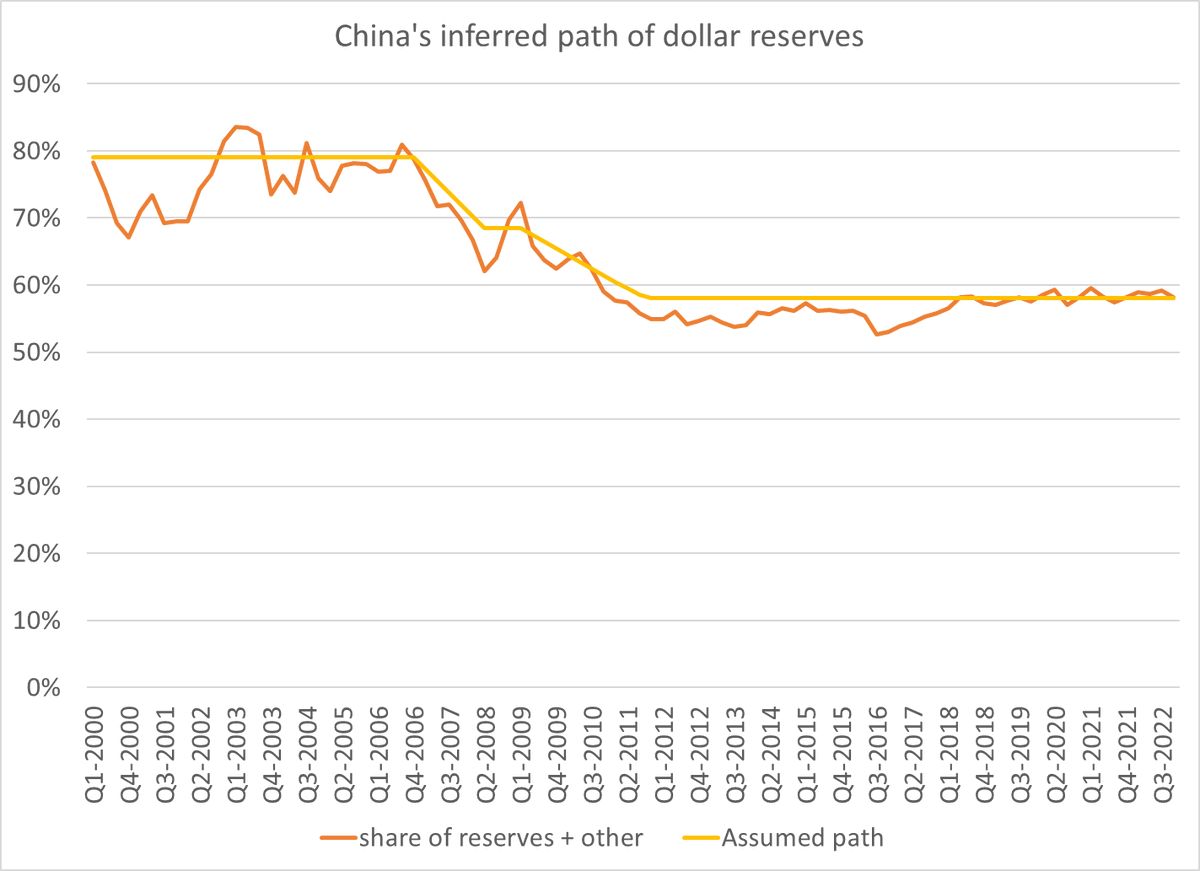
The US dollar and its hegemony is not under threat yet because “50-60% of foreign-held US short-term assets are in the hands of governments with strong ties to the United States – meaning they are unlikely to be divested for geopolitical reasons.” (Lagarde). And it’s even the case that ‘anti-US’ China remains heavily committed in its FX reserves to the US dollar. China publicly reported that it reduced the dollar share of its reserves from 79% to 58% between 2005 and 2014. But China doesn’t appear to have changed the dollar share of its reserves in the last ten years.

Moreover, multilateral institutions that could be an alternative to the existing IMF and World Bank (controlled by the imperialist economies) are still tiny and weak. For example, there is the New Development Bank set up in 2015 by the so-called BRICS (Brazil, Russia, India, China and South Africa). The NDB has now appointed Brazil’s former leftist President Dilma Roussef as head, based in Shanghai.

There is much noise that the NDB can provide an opposite pole of credit to the imperialist institutions of the IMF and World Bank. But there is a long way to go in doing that. One ex-official of South African Reserve bank (SARB) commented: “the idea that Brics initiatives, of which the most prominent thus far has been the NDB, will supplant Western-dominated multilateral financial institutions is a pipe dream.” For a start, the BRICS are very diverse in population, GDP per head, geographically and in trade composition. And the ruling elites in these countries are often at loggerheads (China v India; Brazil v Russia).
As Patrick Bond put it recently: “The “talk left, walk right” of BRICS’ role in global finance is seen not only in its vigorous financial support for the International Monetary Fund during the 2010s, but more recently in the decision by the BRICS New Development Bank – supposedly an alternative to the World Bank – to declare a freeze on its Russian portfolio in early March, since otherwise it would not have retained its Western credit rating of AA+. ” And Russia is a 20% equity holder in NDB.
But back to Lagarde: “the single most important factor influencing international currency usage is the “strength of fundamentals.” In other words, on the one hand, the trend of weakening economies in the imperialist bloc facing very slow growth and slumps during the rest of his decade; and on the other, continued expansion of China and even India. This means that the heavy military and financial dominance of the US and its allies stands on the chicken legs of relatively poor productivity, investment and profitability. That’s a recipe for global fragmentation and conflict.
April 14, 2023
Well founded pessimism
Only last February, I posted that there had been a burst of optimism about the state of the world economy in 2023. The consensus view then was that the G7 economies (with the sorry exception of the UK) would avoid a slump this year. Sure, there will be a slowdown compared to 2022, but the major economies were going to achieve a ‘soft landing’ or even no landing at all, but just motor on, if at a low rate of growth. The international agencies like the World Bank, the OECD and the IMF upgraded their forecasts for global growth.
However, all that optimism has proven “unfounded” as I suggested then. Even in the best performing G7 economy, the US, a recession (ie ‘technically’ two consecutive quarters of contraction in real GDP) now seems probable. Even the US Federal Reserve accepts that a recession is unavoidable. At its last meeting, its economists agreed that there would be a ‘mild recession’ in US economic activity this year.
And according to economists at the Bank of America, there are plenty of signals that suggest a recession in the US has not been avoided and they provide several charts to back that up. First, there was the significant decline in manufacturing activity. “March ISM was 46.3, lowest since May 2020. In past 70 years whenever manufacturing ISM dropped below 45, recession occurred on 11 out of 12 occasions (exception was 1967),” BofA said. Indeed, globally there appears to be a manufacturing recession.
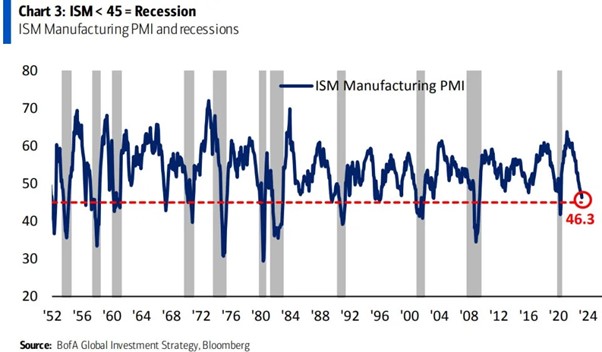
Second, the current ‘buoyant’ jobs market won’t last because it often follows manufacturing activity downwards – it’s a lagging indicator.
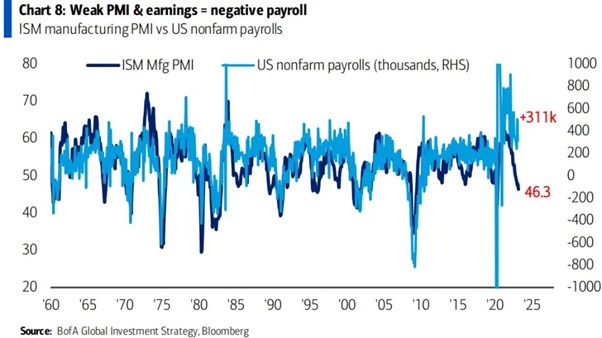
“Weak ISM manufacturing PMI suggests US labor market will weaken next few months,” BofA said, adding that it viewed the February and March jobs report as “the last strong payroll reports of 2023.”
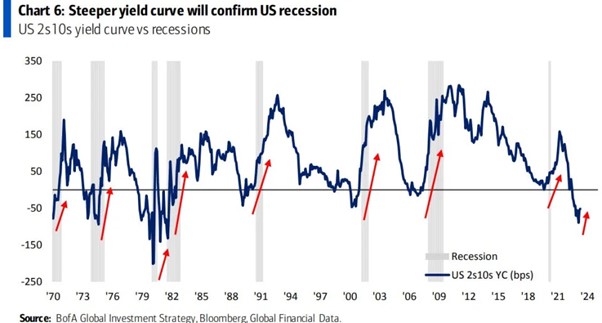
Then there is the inverted bond yield curve that always presages a recession.
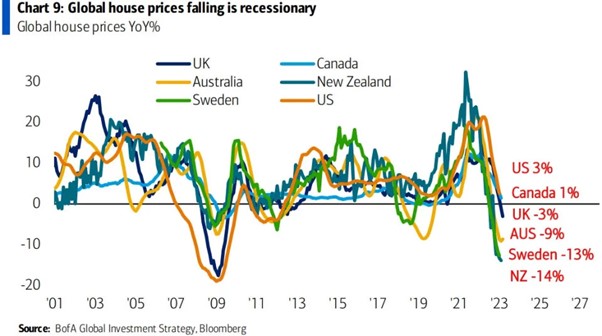
Also, global house prices are falling, creating a slump in construction and real estate development.
Another reliable indicator is the Leading Economic Index (LEI) published by the Conference Board. The LEI for the US fell for the 11th straight month in February, which is the longest slump since the collapse of Lehman Brothers in 2008. “While the rate of month-over-month declines in the LEI have moderated in recent months, the leading economic index still points to risk of recession in the US economy,” said Justyna Zabinska-La Monica, senior manager at the Conference Board.
These are some indicators of a forthcoming recession, but they are not the causes. I have argued that there are two principal drivers of a slump: falling profits and profitability; and rising interest costs. These are the two closing scissors that cut off the accumulation of capital and force companies to stop investing, reduce employment and, among the weaker brethren, go bust.
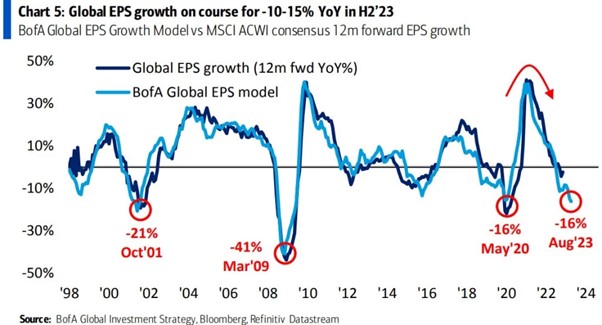
The BoA economists also recognise these factors. They note that a decline in manufacturing often coincides with lower earnings.
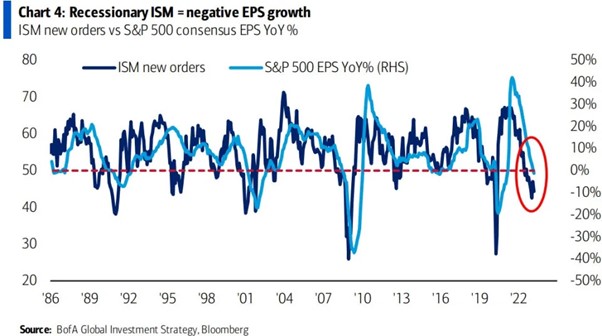
And their global earnings model also suggests imminent decline in corporate earnings.
Much has been made on the left about the huge rise in corporate profit margins after the end of the pandemic. And this is undoubtedly the main contributor to the inflationary spiral experienced in all the major economies in the last 18 months – not any wage-cost push as the Keynesians argue; or too much money supply as the monetarists argue. A January study from the Federal Reserve Bank of Kansas City found that “markup growth”—the increase in the ratio between the price a firm charges and its cost of production—was a far more important factor in driving inflation in 2021 than it had been throughout economic history.
University of Massachusetts Amherst economists Isabella Weber and Evan Wasner published a paper that has been widely taken up entitled, “Sellers’ Inflation, Profits and Conflict: Why Can Large Firms Hike Prices in an Emergency?”. It found that corporations engaged in “price gouging” during the pandemic. The authors went on to argue that price controls may be the only way to prevent the “inflationary spirals” that could come as a result of this gouging.
Albert Edwards, a global strategist at the 159-year-old bank Société Générale, has now followed up on this thesis that has come to be called ‘Greedflation’. Corporations, particularly in developed economies like the US and UK, have used rising raw material costs amid the pandemic and the war in Ukraine as an “excuse” to raise prices and expand profit margins to new heights, Edwards said.
There is no doubt that corporate margins have been at record highs. Both in the US and in Europe. But I have thrown some doubt on the explanation that current high inflation has been caused mainly by ‘price-gouging’ from monopolistic corporations.
And the Kansas Fed paper cited above agrees. The authors reckon that “although our estimate suggests that markup growth was a major contributor to annual inflation in 2021, it does not tell us why markups grew so rapidly. We present evidence that the timing and cross-industry patterns of markup growth are more consistent with firms raising prices in anticipation of future cost increases, rather than an increase in monopoly power or higher demand. First, the timing of markup growth in 2021, as well as earlier in the pandemic, does not line up neatly with the spike in inflation during the second half of 2021. Instead, the largest growth in markups occurred in 2020 and the first quarter of 2021; in the second half of 2021, markups actually declined. Therefore, inflation cannot be explained by a persistent increase in market power after the pandemic. Second, if monopolists raising prices in the face of higher demand were driving markup growth, we would expect firms with larger increases in current demand to have accordingly larger markups. Instead, markup growth was similar across industries that experienced very different levels of demand (and inflation) in 2021.“
The authors cast doubt on the simple explanation of “greedflation,” understood as either an increase in monopoly power or firms using existing power to take advantage of high demand. So the post-Keynesian mark-up theory of inflation and the policy conclusion of price controls looks faulty.
I wrote a post last September that, anyway, profit margins were beginning to fall. The average profit margin for the top 500 US companies 2022 is estimated at 12.0%, down from 12.6% in 2021, if still well above the ten-year average margin of 10.3%. And as overall economic growth in the US slows – corporate sales revenue growth is slowing too.
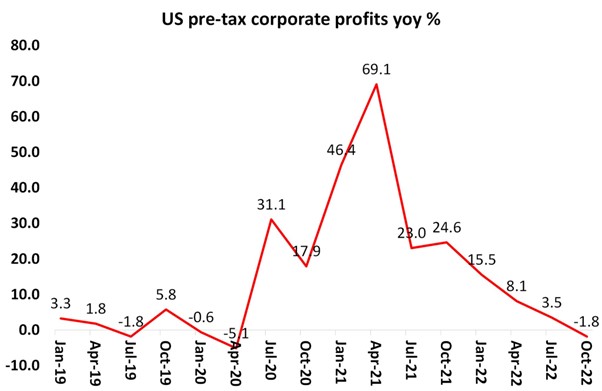
Indeed, I found that the final data on US pre-tax corporate profits in Q4 2022, show a 5-6% fall in each of the last two quarters of 2022, or a 12% fall from the peak in mid-2022. Profits fell year-on-year for the first time since the pandemic slump. The post-pandemic corporate profits boom is over.
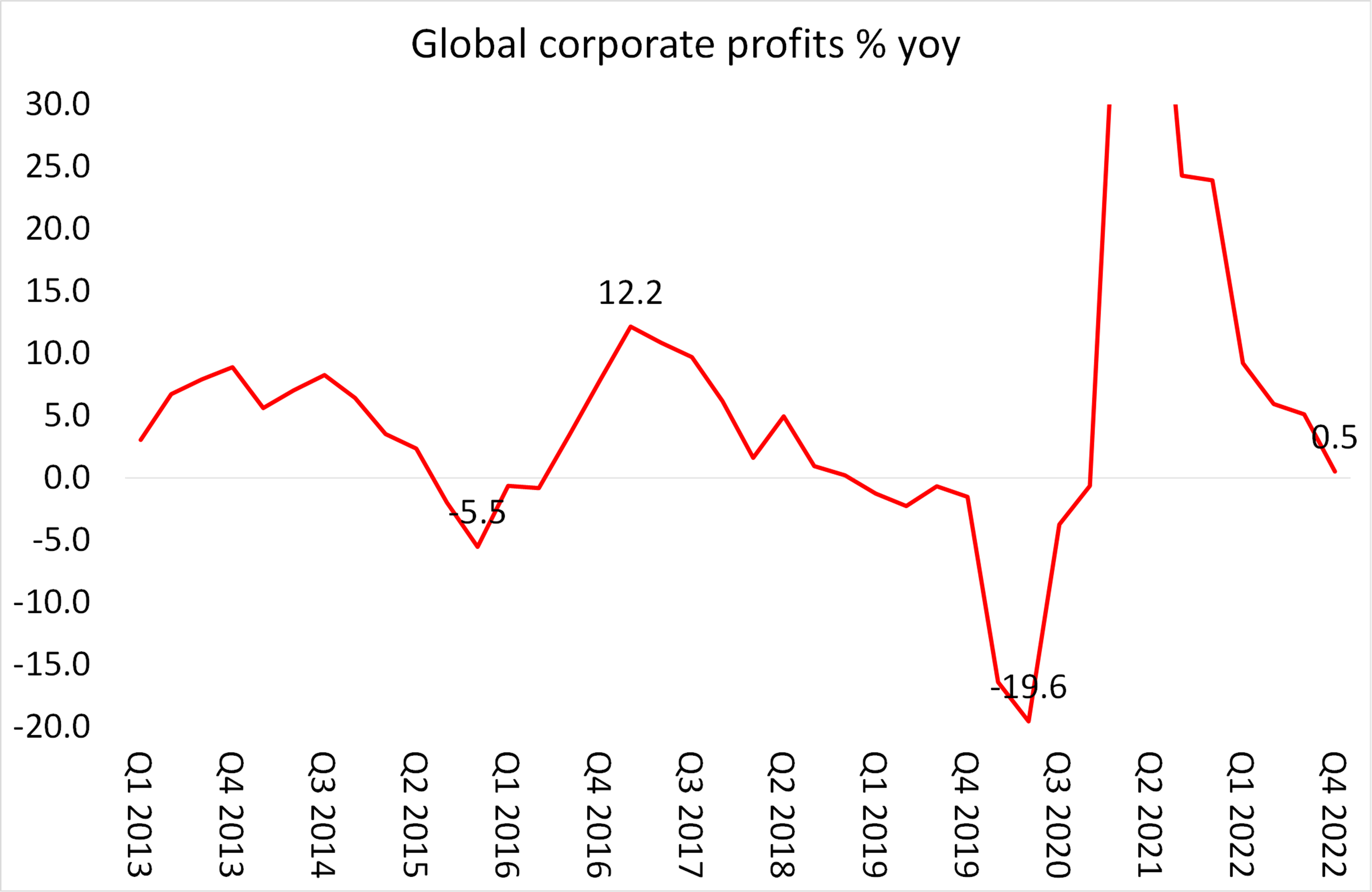
The slowdown in US corporate profits is replicated in all the major economies. Here is my latest estimate of global corporate profits based on five key economies. The pandemic slump recorded a 20% fall in global corporate profits in 2020, followed by a 50% recovery in 2021, but now profits growth has slowed to just 0.5% in Q4 2022. And note, as I have done before, that profits had stopped rising through 2019 even before the pandemic, suggesting that the major economies were heading for a slump before COVID emerged.
Then there is the credit squeeze from rising interest rates and monetary tightening (ie a fall in money supply growth). This is happening because the major central banks are still determined to try and ‘control inflation’ with high interest rates (even though this has been shown to misunderstand the causes of current inflation).
In its minutes, the Fed put it this way: “With inflation remaining unacceptably high, participants expected that a period of below-trend growth in real GDP would be needed to bring aggregate demand into better balance with aggregate supply and thereby reduce inflationary pressures.” So even a recession will be needed to bring inflation down. In that, the Fed is right – indeed inflation rates will stay well above pre-pandemic elevls unless there is a slump.
After the pandemic, central banks tried to return to the easy money policy adopted during the long depression of the 2010s in order to boost economic recovery. A tremendous credit boom took place in 2022, which led to a surge in US bank lending of $1.5trn.
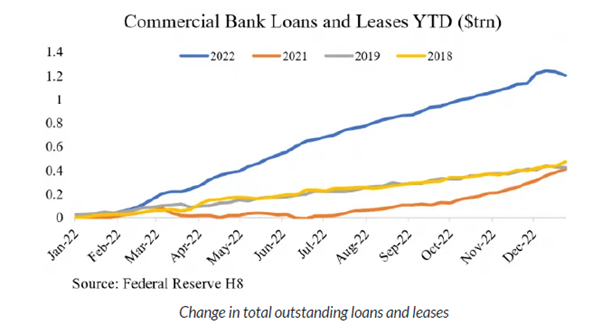
Alongside bank loans there was an explosion in what is called low-quality lending that brought debt loads in corporate America to record highs. The total US stock of “subprime” corporate debt (junk bonds, leveraged loans, direct lending) has reached $5tn. Total non-financial corporate debt (bonds and loans) stands at $12.7tn, making low-quality debt as much 40% of the total.
This debt financed very speculative or highly indebted companies either in the form of a loan (“leveraged loans”) or non-investment grade bonds (“junk bonds”) and includes corporate loans sold into securitizations called Collateralized Loan Obligations (CLOs) as well as loans extended privately by non-banks that are completely unregulated. Years of growth, evolution, and financial engineering have spawned a complex, highly fragmented, and under-regulated bond market.
And this was replicated globally. The annual report from the Global Financial Stability Board on the so-called Non-Bank Financial Institutions (NBFI) found that the “NBFI sector grew by 8.9% in 2021, higher than its five-year average growth of 6.6%, reaching $239.3 trillion. […] The total NBFI sector increased its relative share of total global financial assets from 48.6% to 49.2% in 2021.”
Central banks have no idea of what is causing inflation and how to control it, but they go on hiking rates even if it causes bank failures, corporate bankruptcies and a slump. Fed governor Kocherlakota noted that “central bankers have expressed concerns that above-target inflation could lead “inflation to become unmoored” (Bernanke 2011) or “inflation to become entrenched” (Powell 2022).” That could give rise to the follow-up need to bring down “inflation expectations” through a severe recession. As Bernanke (2011) saids, “the cost of that in terms of employment loss in the future, as we had to respond to that, would be quite significant… To the best of my knowledge, there are no macroeconomic models in the academic world that integrate possibilities of this kind. “ So not a clue.
The recent US banking crisis was a result of the growing credit squeeze on banks, mainly smaller ones, and on companies. And it is not over – either in the US or Europe. As interest rates rise, depositors are switching their money from weak banks into better yielding accounts such as money market funds, fleeing those banks that put their customer deposits into loss-making assets like government bonds. This has led to a sharp decline in bank lending to companies across the US.
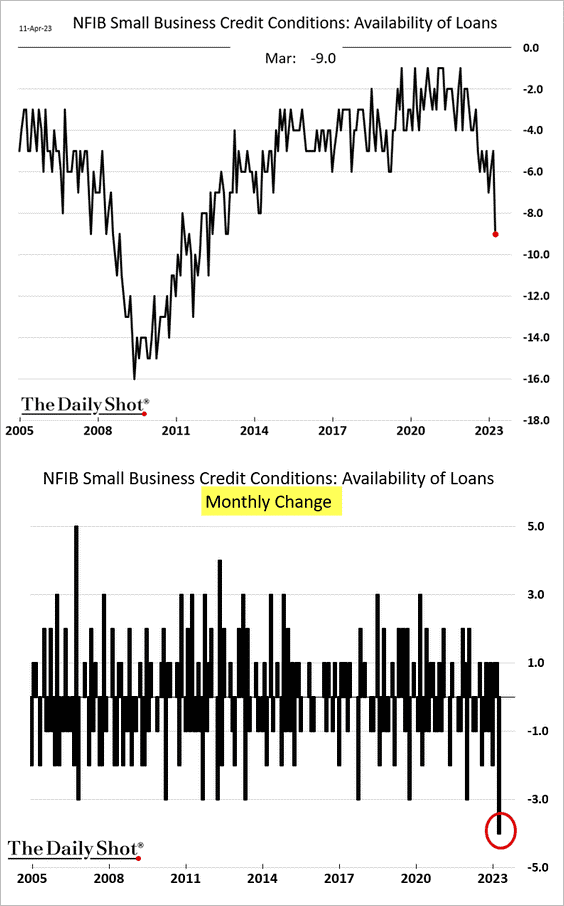
and in Europe.
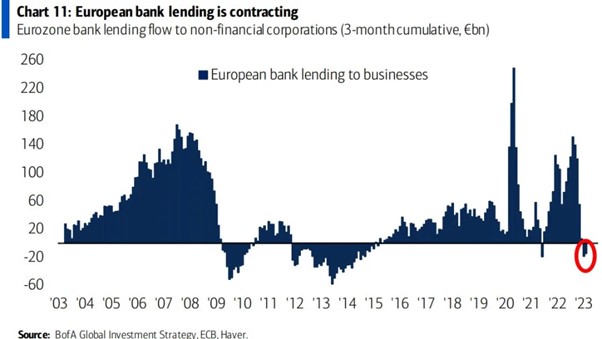
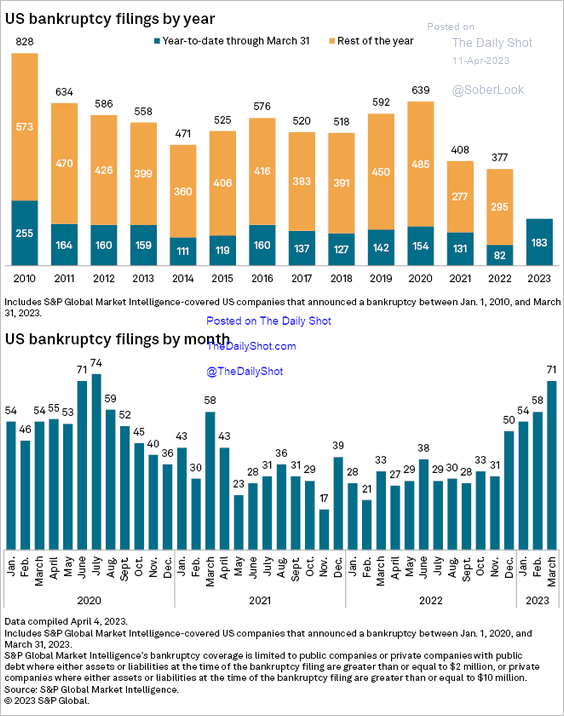
So there are less funds for investment and survival and at higher interest rates. Up to now, because corporate profits had risen so much, even though corporate debt to GDP had risen to all-time highs, most US firms have been able to cover the debt servicing costs comfortably. But that is over. The infamous zombie companies (up to 20% of all firms in the US and Europe) are facing bankruptcy.
Bankruptcy filings have spiked across major industries. In March, 42,368 new bankruptcies were filed, up 17% from a year back. It was also the third straight month of bankruptcy increases. Meanwhile, venture capital funding for start-ups declined by 55% in the first quarter of 2023 compared to the same period a year ago. This is the lowest level in over five years.
And here is how John Plender of the FT put it: “the most draconian tightening in four decades in the advanced economies with the notable exception of Japan, will wipe out much of the zombie population, thereby restricting supply and adding to inflationary impetus. Note that the total number of company insolvencies registered in the UK in 2022 was the highest since 2009 and 57 per cent higher than 2021.”
In its latest economic report, the IMF says the world economy is experiencing “a rocky recovery”. It forecasts that global growth (which remember, includes China, India and other large ‘developing’ economies) will slow this year to 2.8%. And that’s the base forecast. If credit tightens further and interest rates stay high, global growth could drop to just 1%. The G7 economies will grow little more than 1% this year and, after accounting for population growth, hardly at all. The UK and Germany will contract.
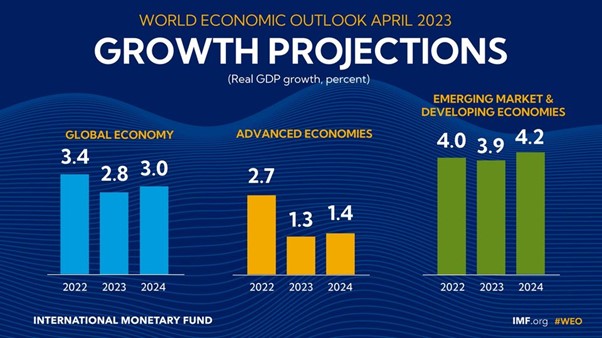
UNCTAD follows the IMF with an even more pessimistic forecast for global growth this year – just 2.1%. It concludes that “This could set the world onto a recessionary track…. With the era of cheap credit coming to an end at a time of “polycrisis” and growing geopolitical tensions, the risk of systemic calamities cannot be ruled out. The damage to developing countries from unforeseen shocks, particularly where indebtedness is already a source of distress, will be heavy and lasting.”
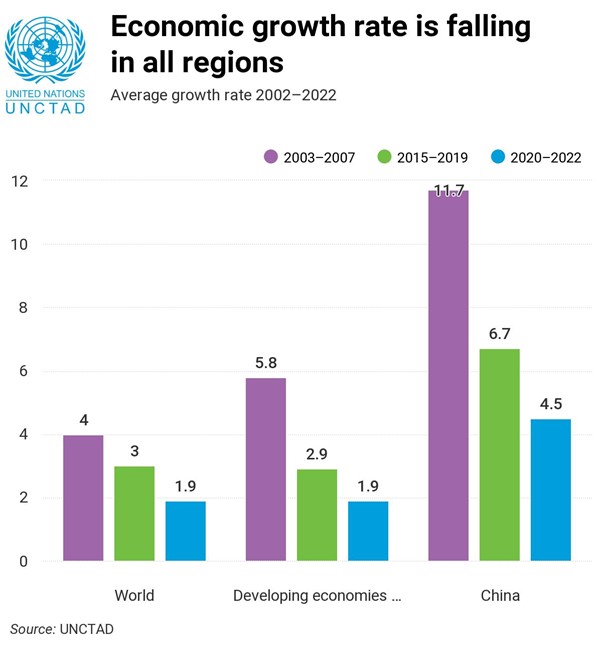
UNCTAD points out that debt servicing costs have consistently increased relative to public expenditure on essential services. The number of countries spending more on external public debt service than healthcare increased from 34 to 62 during this period.
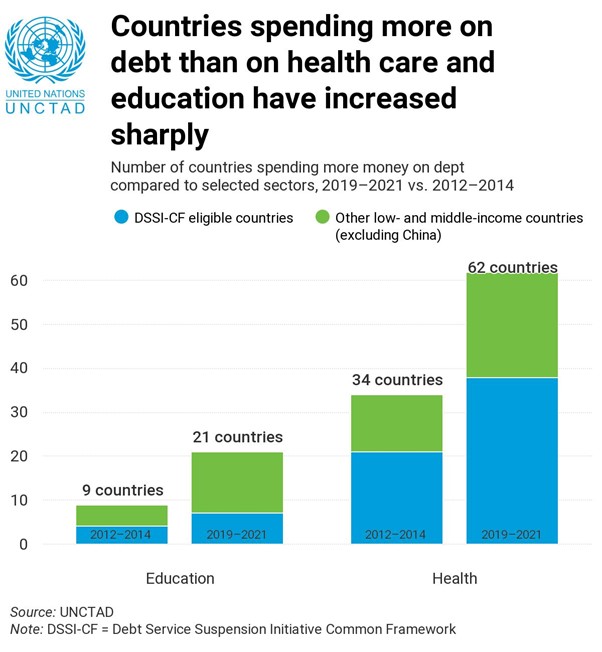
Vítor Gaspar, head of fiscal policy at the IMF, said that by 2028, the world’s public debt burden was on course to match the value of goods and services produced in the world. “By the end of our projection horizon — 2028, public debt in the world is expected to reach almost 100 per cent of GDP back to the record levels set in the year of the pandemic”.
His answer was a new bout of ‘austerity’ (ie cutting public spending and raising taxes). “Fiscal tightening can help by moderating the growth of aggregate demand and therefore contributing to more moderate increases in policy rates,” he said, adding that this in turn would “ease the pressures on the financial system” triggered by the surge in borrowing costs over the course of 2022.
According to Fitch Rating, national debt defaults are at a record high. There have been 14 separate default events since 2020, across nine different sovereigns, a marked increase compared with 19 defaults across 13 different countries between 2000 and 2019.
The long depression of the 2010s is continuing into the 2020s. The World Bank’s latest economic report makes dismal reading for the world economy. “The global economy’s “speed limit”—the maximum long-term rate at which it can grow without sparking inflation—is set to slump to a three-decade low by 2030.” Between 2022 and 2030 average global potential GDP growth is expected to decline by roughly a third from the rate that prevailed in the first decade of this century—to 2.2% a year. For developing economies, the decline will be equally steep: from 6% a year between 2000 and 2010 to 4% a year over the remainder of this decade. These declines would be much steeper in the event of a global financial crisis or a recession.
“A lost decade could be in the making for the global economy,” said Indermit Gill, the World Bank’s Chief Economist. Unless, of course, Generalised Artificial Intelligence with ChatGPT saves the day for capitalism.
April 8, 2023
AI-GPT: a game changer?
ChatGPT is being heralded as a revolution in ‘artificial intelligence’ (AI) and has been taking the media and tech world by storm since launching in late 2022.
According to OpenAI, ChatGPT is “an artificial intelligence trained to assist with a variety of tasks.” More specifically, it is a large language model (LLM) designed to produce human-like text and converse with people, hence the “Chat” in ChatGPT.
GPT stands for Generative Pre-trained Transformer. The GPT models are pre-trained by human developers and then are left to learn for themselves and generate ever increasing amounts of knowledge, delivering that knowledge in an acceptable way to humans (chat).
Practically, this means you present the model with a query or request by entering it into a text box. The AI then processes this request and responds based on the information that it has available. It can do many tasks, from holding a conversation to writing an entire exam paper; from making a brand logo to composing music and more. So much more than a simple Google-type search engine or Wikipedia, it is claimed.
Human developers are working to raise the ‘intelligence’ of GPTs. The current version of GPT is 3.5 with 4.0 coming out by the end of this year. And it is rumoured that ChatGPT-5 could achieve ‘artificial general intelligence’ (AGI). This means it could pass the Turing test, which is a test that determines if a computer can communicate in a manner that is indistinguishable from a human.
Will LLMs be a game changer for capitalism in this decade? Will these self-learning machines be able to increase the productivity of labour at an unprecedented rate and so take the major economies out of their current ‘long depression’ of low real GDP, investment and income growth; and then enable the world to take new strides out of poverty? This is the claim by some of the ‘techno-optimists’ that occupy the media.
Let’s consider the answers to those questions.
First, just how good and accurate are the current versions of ChatGPT? Well, not very, just yet. There are plenty of “facts” about the world which humans disagree on. Regular search lets you compare those versions and consider their sources. A language model might instead attempt to calculate some kind of average of every opinion it’s been trained on—which is sometimes what you want, but often is not. ChatGPT sometimes writes plausible-sounding but incorrect or nonsensical answers. Let me give you some examples.
I asked ChatGPT 3.5: who is Michael Roberts, Marxist economist? This was the reply.

This is mostly right but it is also wrong in parts (I won’t say which).
Then I asked it to review my book, The Long Depression. This is what it said:
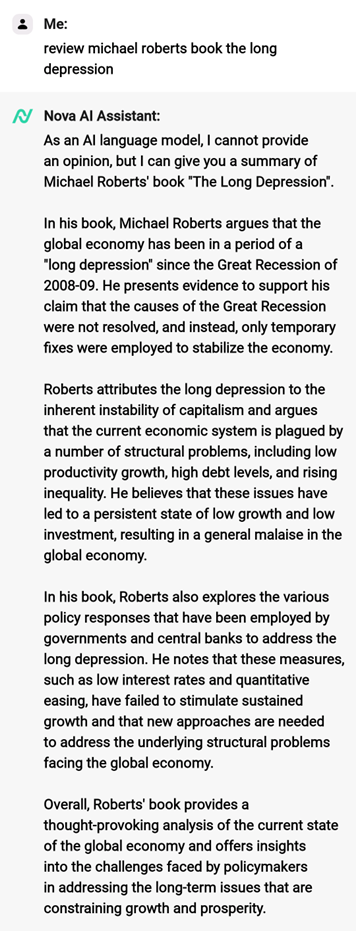
This gives a very ‘general’ review or synopsis of my book, but leaves out the kernel of the book’s thesis: the role of profitability in crises under capitalism. Why, I don’t know.
So I asked this question about Marx’s law of profitability:
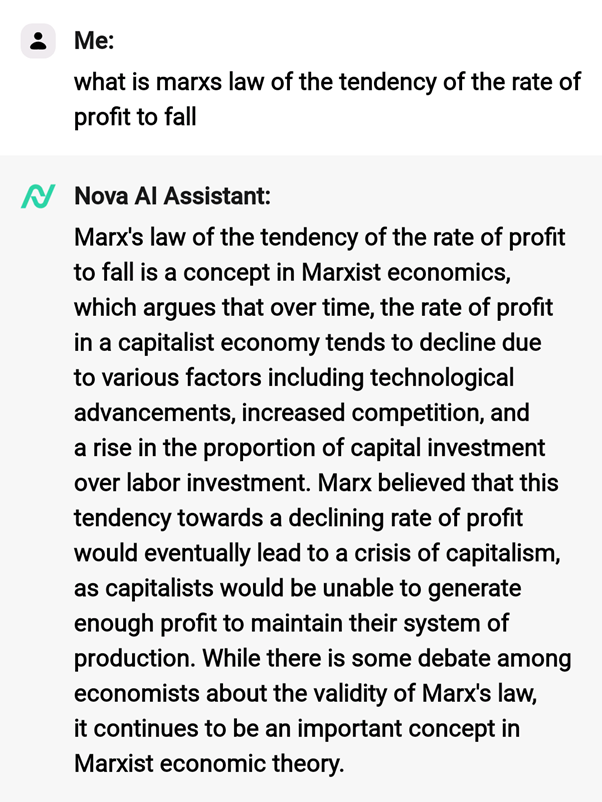
Again, this is broadly right – but just broadly. The answer does not really take you very far in understanding the law. Indeed, it is no better than Wikipedia. Of course, you can dig (prompt) further to get more detailed answers. But there seems to be some way to go in replacing human research and analysis.
Then there is the question of the productivity of labour and jobs. Goldman Sachs economists reckon that if the technology lived up to its promise, it would bring “significant disruption” to the labour market, exposing the equivalent of 300m full-time workers across the major economies to automation of their jobs. Lawyers and administrative staff would be among those at greatest risk of becoming redundant (and probably economists). They calculate that roughly two-thirds of jobs in the US and Europe are exposed to some degree of AI automation, based on data on the tasks typically performed in thousands of occupations.
Most people would see less than half of their workload automated and would probably continue in their jobs, with some of their time freed up for more productive activities. In the US, this would apply to 63% of the workforce, they calculated. A further 30% working in physical or outdoor jobs would be unaffected, although their work might be susceptible to other forms of automation.
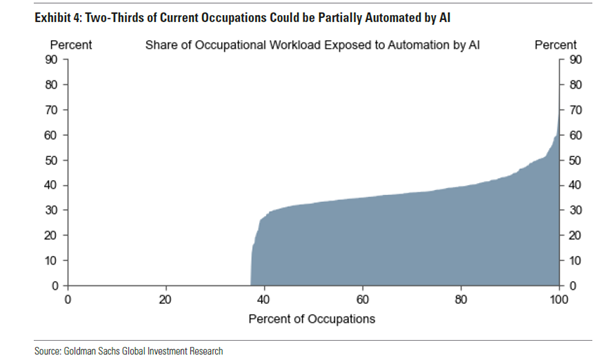
The GS economists concluded: “Our findings reveal that around 80% of the US workforce could have at least 10% of their work tasks affected by the introduction of LLMs, while approximately 19% of workers may see at least 50% of their tasks impacted.”
With access to an LLM, about 15% of all worker tasks in the US could be completed significantly faster at the same level of quality. When incorporating software and tooling built on top of LLMs, this share increases to 47-56% of all tasks. About 7% of US workers are in jobs where at least half of their tasks could be done by generative AI and are vulnerable to replacement. At a global level, since manual jobs are a bigger share of employment in the developing world, GS estimates about a fifth of work could be done by AI — or about 300m full-time jobs across big economies.
These job loss forecasts are nothing new. In previous posts, I have outlined several forecasts on the number of jobs that will be lost to robots and AI over the next decade or more. It appears to be huge; and not just in manual work in factories but also in so-called white-collar work.
It is in the essence of capitalist accumulation that the workers will continually face the loss of their work from capitalist investment in machines. The replacement of human labour by machines started at the beginning of the British Industrial Revolution in the textile industry, and automation played a major role in American industrialization during the 19th century. The rapid mechanization of agriculture starting in the middle of the 19th century is another example of automation.
As Engels explained, whereas mechanisation not only shed jobs, often it also created new jobs in new sectors, as Engels noted in his book, The condition of the working class in England (1844) – see my book on Engels’ economics pp54-57. But as Marx identified this in the 1850s: “The real facts, which are travestied by the optimism of the economists, are these: the workers, when driven out of the workshop by the machinery, are thrown onto the labour-market. Their presence in the labour-market increases the number of labour-powers which are at the disposal of capitalist exploitation…the effect of machinery, which has been represented as a compensation for the working class, is, on the contrary, a most frightful scourge. …. As soon as machinery has set free a part of the workers employed in a given branch of industry, the reserve men are also diverted into new channels of employment and become absorbed in other branches; meanwhile the original victims, during the period of transition, for the most part starve and perish.” Grundrisse. The implication here is that automation means increased precarious jobs and rising inequality.
Up to now, mechanisation has still required human labour to start and maintain it. But are we now moving towards the takeover of all tasks, and especially those requiring complexity and ideas with LLMs? And will this mean a dramatic rise in the productivity of labour so that capitalism will have a new lease of life?
If LLMs can replace human labour and thus raise the rate of surplus value dramatically, but without a sharp rise in investment costs of physical machinery (what Marx called a rising organic composition of capital), then perhaps the average profitability of capital will jump back from its current lows.
Goldman Sachs claims that these “generative” AI systems such as ChatGPT could spark a productivity boom that would eventually raise annual global GDP by 7% over a decade. If corporate investment in AI continued to grow at a similar pace to software investment in the 1990s, US AI investment alone could approach 1% of US GDP by 2030.
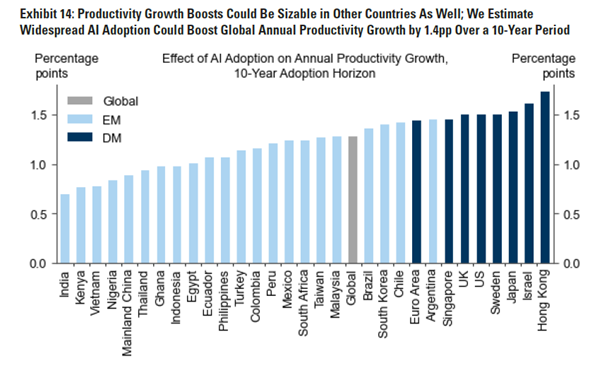
I won’t go into how GS calculates these outcomes, because the results are conjectures. But even if we accept the results, are they such an exponential leap? According to the latest forecasts by the World Bank, global growth is set to decline by roughly a third from the rate that prevailed in the first decade of this century—to just 2.2% a year. And the IMF puts the average growth rate at 3% a year for the rest of this decade.
If we add in the GS forecast of the impact of LLMs, we get about 3.0-3.5% a year for global real GDP growth, maybe – and this does not account for population growth. In other words, the likely impact would be no better than the average seen since the 1990s. That reminds us of what Economist Robert Solow famously said in 1987 that the “computer age was everywhere except for the productivity statistics.”
US economist Daren Acemoglu adds that not all automation technologies actually raise the productivity of labour. That’s because companies mainly introduce automation in areas that may boost profitability, like marketing, accounting or fossil fuel technology, but not raise productivity for the economy as a whole or meet social needs. Big Tech has a particular approach to business and technology that is centered on the use of algorithms for replacing humans. It is no coincidence that companies such as Google are employing less than one tenth of the number of workers that large businesses, such as General Motors, used to do in the past. This is a consequence of Big Tech’s business model, which is based not on creating jobs but automating them.
That’s the business model for AI under capitalism. But under cooperative commonly owned automated means of production, there are many applications of AI that instead could augment human capabilities and create new tasks in education, health care, and even in manufacturing. Acemoglu suggested that “rather than using AI for automated grading, homework help, and increasingly for substitution of algorithms for teachers, we can invest in using AI for developing more individualized, student-centric teaching methods that are calibrated to the specific strengths and weaknesses of different groups of pupils. Such technologies would lead to the employment of more teachers, as well as increasing the demand for new teacher skills — thus exactly going in the direction of creating new jobs centered on new tasks.” And rather than reduce jobs and the livelihoods of humans, AI under common ownership and planning could reduce the hours of human labour for all.
And then there is the issue of the profitability boost provided by AI technology. Even if LLM investment requires less physical means of production and lowers costs of such capital, the loss of human labour power could be even greater. So Marx’s law of profitability would still apply. It’s the great contradiction of capitalism that increasing the productivity of labour through more machines (AI) reduces the profitability of capital. That leads to regular and recurring crises of production, investment and employment – of increasing intensity and duration.
Finally, there is the question of intelligence. Microsoft argues that intelligence is a “very general mental capability that, among other things, involves the ability to reason, plan, solve problems, think abstractly, comprehend complex ideas, learn quickly and learn from experience.” Microsoft hints that LLMs could soon obtain this ‘generalised intelligence’ and surpass all human ability to think.
But even here, there is scepticism. “The ChatGPT model is huge, but it’s not huge enough to retain every exact fact it’s encountered in its training set. It can produce a convincing answer to anything, but that doesn’t mean it’s reflecting actual facts in its answers. You always have to stay sceptical and fact check what it tells you. Language models are also famous for “hallucinating”—for inventing new facts that fit the sentence structure despite having no basis in the underlying data.” That’s not very encouraging.
But Guglielmo Carchedi has a more fundamental reason to deny that AI can replace human ‘intelligence’. Carchedi and Roberts: “machines behave according only to the rules of formal logic. Contrary to humans, machines are structurally unable to behave according to the rules of dialectical thinking. Only humans do that.” (Capitalism in the 21st century, p167). Here is the ChatGPT answer to the dialectical question: “Can A be equal to A and at the same time be different from A?” “No, it is not possible for A to be equal to A and at the same time be different from A. This would be a contradiction in terms, as the statement “A is equal to A” is a tautology and always true, while the statement “A is different from A” is a contradiction and always false. Therefore, these two statements cannot both be true at the same time.”
Machines cannot think of potential and qualitative changes. New knowledge comes from such transformations (human), not from the extension of existing knowledge (machines). Only human intelligence is social and can see the potential for change, in particular social change, that leads to a better life for humanity and nature.
March 31, 2023
What’s the problem with pensions?
The recent massive demonstrations against the Macron administration in France forcing through so-called pension reforms reveals the determined attempts of pro-capitalist governments in all the major economies to cut real wages when we are old and can no longer work.

The Macron government has forced by decree a ‘reform’ that raises the pension age to 64 years from 62 years. In Spain, where the retirement age has been fixed at 65 years for decades, the government is opting for an alternative solution to the so-called pensions problem. It is going to increase contributions from the incomes of younger higher earners to pay for older retirees.
Pensions are really deferred wages, deductions from income from work to pay for a decent income when people retire. After decades of work (and exploitation), workers, male and female, should be entitled to stop and enjoy the last decade or so of life without toil without being poverty. Literally, they will have earned it. But capitalism in the 21st century cannot ‘afford’ to pay decent living incomes as state pensions when workers retire. Why? Well, the mainstream arguments are several-fold.
First, the demographic trends, particularly in the advanced capitalist economies, mean more people are reaching retirement age and fewer people are at working age. So the argument goes, higher ‘age dependency rates’ mean that those at work have to pay more in taxes for those who are not working. For example, in Spain there are three people of working age for every single pensioner; by 2050 that dependency ratio will be just 1.7 to one.
The second argument is that life expectancy has risen so much and people are much healthier, that the ‘gap years’ between stopping work and dying have risen far too much. For example, Spain’s life expectancy is 83 — one of the world’s highest. So people should work longer to reduce that gap to where it was before.
The cruel irony is that the pensions cuts that the French and Spanish governments seek to impose for reasons of demography are taking place when life expectancy in the major economies has started to fall. In the first decade of this century, life expectancy increased by nearly three years every decade. But now life expectancy at retirement is two years less than previously expected.
World average life expectancy (years at birth)
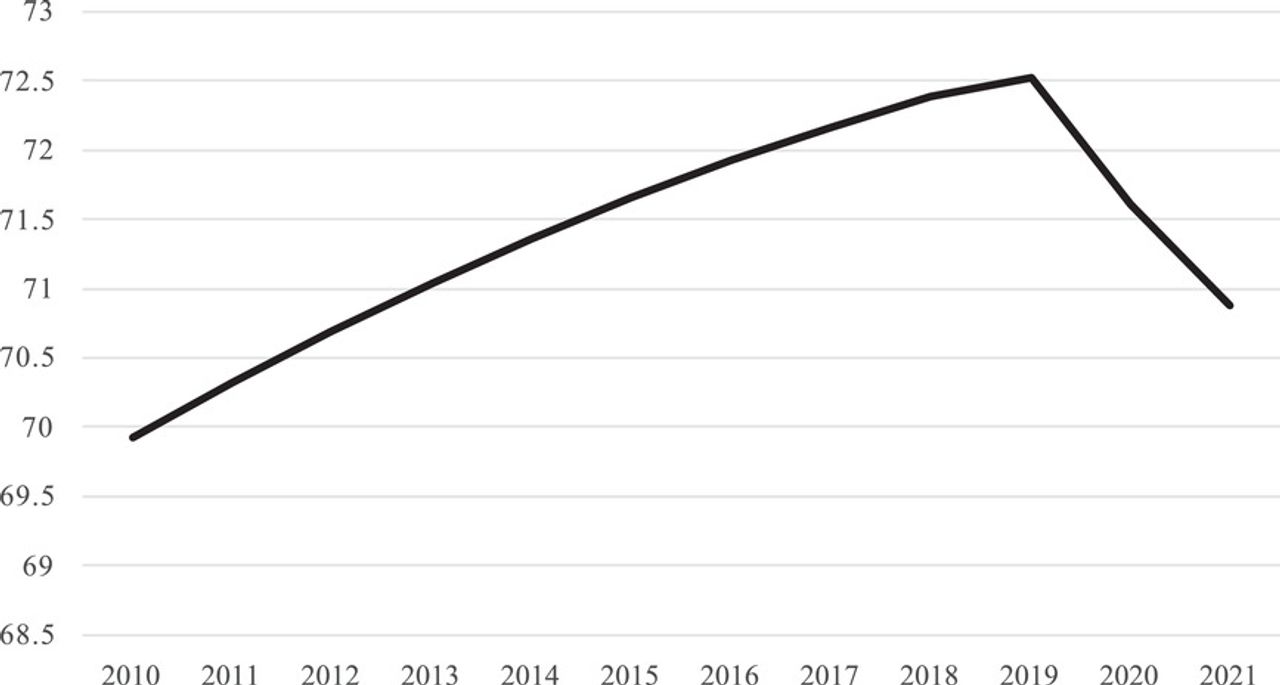
https://onlinelibrary.wiley.com/doi/10.1111/padr.12477
And what is ignored is the huge disparity in life expectancy between lower income people retiring and very dependent on state pensions and better-off people with additional company pensions. For example, almost eight years separates the life expectancy of retirees living in exclusive parts of London like Kensington and Chelsea to those living in Glasgow. A 60-year old man in the Scottish city might live a further 19 years. For his London contemporary that rises to 27 years. In both places women live almost three years longer than men. Indeed, the fall in life expectancy in the UK has forced the government to delay until 2026 raising the retirement age (already at 67 years) to 68 years.
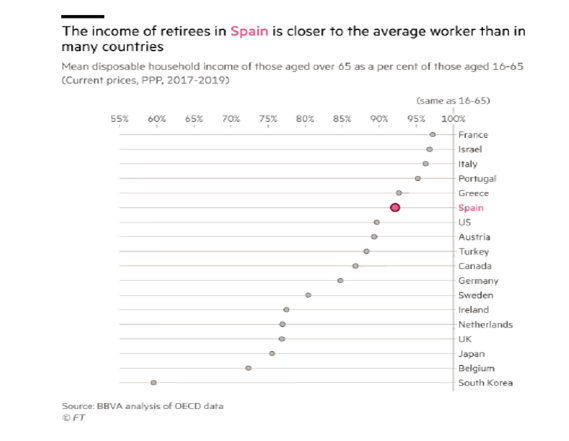
And the third argument is the cost to the public purse. The argument is that too much public money goes to pensioners, thus reducing available funds for other important public services and benefits. Governments are forced into running budget deficits that increase public debt and so raise interest costs that eat into public spending. It’s true that pensions in France are higher than most other EU countries. And Spain’s net pre-retirement income average at 80% is actually ahead of France’s 74 per cent and an average of 62 per cent in the OECD.
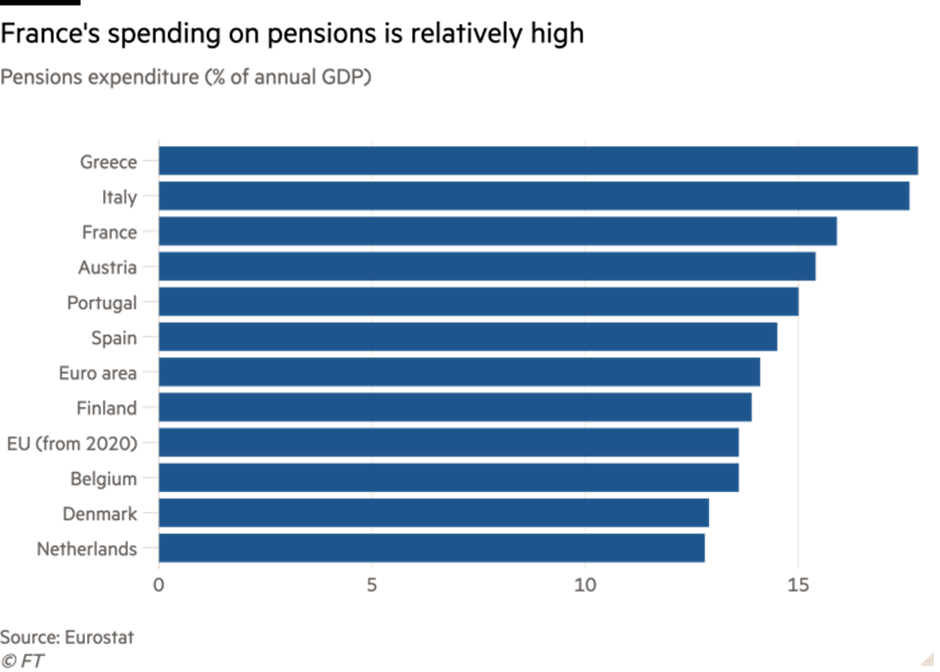
But does that mean the aim should be to ‘level down’ pensions to those of the UK, for example, which has one of the lowest state pensions relative to average earnings in the OECD? Surely, the aim should be to ‘level up’ to the best?
And the pensions deficit in France is tiny compared with the cost of measures introduced in response to the pandemic (€165bn) and the energy shock (around €100bn), as well as President Macron’s commitments to invest more in nuclear power (€50bn) and defence (€100bn by 2030).
Nevertheless, mainstream economists continue to see the ‘problem of pensions’ as causing excessive government spending and deficits. Here is what one such analysis put it in vigorously supporting Macrons’ attack on French state pensions. “France’s pension reform, centred on prolonging the age of retirement to 64 from 62, should ensure the progressive rebalancing of the pension system by 2030, given unfavourable demographic trends and a widening deficit. The reform sends a strong signal to European partners and international institutions of France’s intent to preserve medium-term fiscal sustainability and introduce supply-side reforms.” So it’s to encourage the others to level down.
Similarly, that paper for capitalist strategy, the UK’s Financial Times, called Macron’s move ‘indispensable’. “Plugging a hole in the pension system is a gauge of credibility for Brussels and for financial markets which are again penalising ill discipline.” The FT went on: “If unchanged, the (French) pension system will run annual deficits of between 0.4 per cent and 0.8 per cent of gross domestic product over the next quarter-century; (there are more benign scenarios of break-even, but these suppose a productivity miracle). It is not a catastrophic hole: the minimum contribution for a full pension is already quite exacting at 41.5 years — and it is climbing to 43 — even if a pension age of 62 looks generous. Yet it is a hole that needs to be filled.”
Two things here. So this (not so large) deficit hole has to be filled? Even if we accept that it does, why does it have to be filled by forcing people to work longer or make higher contributions from their wages now to pay for pensions later? And also, note that “there are more benign scenarios, but they suppose a productivity miracle’. And this is the crux of the ‘pensions problem’. Without recognizing it, the FT exposes the mainstream arguments as bogus.
Ten years ago, I called the ‘pensions crisis’ (yes, it was doing the rounds then) a myth. Then I put it this way: “There are enough resources if they are properly organised and fully used. It’s both a political choice and question of economic organisation. Does a country want to use its resources so that people can stop work at the age of 60 or 65 and have enough income to live on in reasonable comfort, or not? It can be done.”
It depends on two things: first, that an economy creates enough resources and expands sufficiently to cater for its elderly population that may also be getting larger as a share of the population. And second, given finite resources, decent pensions can be provided by cutting out other calls on government revenues i.e. such as bailing out the banks; increased arms spending; more subsidies for private corporations to invest in fossil fuels; and lower taxes for top earners and corporations etc.
It is not a choice between good pensions or a good health service or education system. Ten years ago, I showed that just a 1% pt sustained rise in average real GDP per capita in the major economies could deliver enough extra revenue to governments to easily maintain current pension levels and terms with something to spare. And that would be without changing the allocation of public money to defence (now set to increase in all EU economies to at least 2% of GDP each year) or chasing down the tax havens and avoidance schemes by which companies and rich individuals lose revenues for governments by up to 10% a year.
And I emphasise the word a ‘sustained’ increase in real GDP growth. Every 8-10 years, capitalist economies have slumps in output and investment which significantly hit government revenues and often lead to substantial bailouts of banks and multi-nationals, further reducing revenues to pay for public services and pensions. A planned economy, where production is not based on profitability and not subject to regular and recurring crises, could soon ‘afford’ decent pensions.
Instead, in the 21st century, capitalist economies are experiencing slowing economic growth and already three slumps, with the prospect of another right now. The World Bank has just published a truly shocking report on the prospects for the world economy for the rest of this decade. The Bank reckons that the world’s maximum long-term growth rate is set to slump to a three-decade low by 2030. Between 2022 and 2030 average global potential GDP growth is expected to decline by roughly a third from the rate that prevailed in the first decade of this century—to 2.2% a year. For countries like France, the growth rate will be well below 2% – indeed just 1.2% a year.
Given that the working age population in France, like many other advanced economies in the Global North, is set to fall further in the rest of this decade, growth depends higher productivity from a shrinking labour force (unless governments force people to stay in work longer or work longer hours). But productivity growth is slowing to almost a trickle as investment in value-creating sectors of economies stagnates. So increased productivity is unlikely to compensate for a declining labour force.
And there is no answer to be found in privatising pensions. Already, corporate pension schemes are failing to meet workers needs. First, private pension managers take a sizeable cut in fees for managing pension funds.
Second, these investment managers cannot deliver sufficient returns on investing in stocks and bonds, so that private pension funds often go into deficit. And pension fund managers resort to risky investments to try and boost returns. That can lead to crises and losses – for example, the meltdown in UK pension funds in so-called “liability driven investment” schemes (LDI) last year when bond yields rocketed, forcing the Bank of England to provide emergency credit of £65bn.
And third, most private schemes are no longer ‘final salary’ ie pensions based on your wage when you retire, but on the amount of contributions you make from your wages as you go, and so relying on pension fund managers to invest wisely. Private pension schemes are a con – and anyway, most workers do not have one.
The French option for state pensions is to raise the retirement age so that people have to work longer. And that includes those who do tough, physically or mentally, stressful work that cannot be continued for more than a few decades, if that. Some might say that even 64 years is ok because in many countries the retirement age is way higher (at 67 years in the UK now). But the majority of French people do not agree. For them, the pension age was a hard fought right, along with better social services that people do not want to lose.
As one French sociologist put it: “For 40 years, successive governments have been asking the French people to accept ‘reforms’ reducing social rights. These have degraded public services in health, education, transport and so on, while eroding purchasing power and worsening working conditions … The French are fed up.”
March 27, 2023
Banking crisis: is it all over?
Bank stock prices have stabilized at the start of this week. And all the key officials at the Federal Reserve, the US Treasury and the European Central Bank are reassuring investors that the crisis is over. Last week, Fed Chair Jerome Powell called the U.S. banking system “strong and resilient” and there was no risk of a banking meltdown as in 2008-9. US treasury secretary Janet Yellen said that the US banking sector was “stabilizing”. The US banking system was strong. Over the pond, ECB president Lagarde has repeatedly told investors and analysts that there was “no trade-off” between fighting inflation by raising interest rates and preserving financial stability.
So all is well, or at least soon will be, given the massive liquidity support that the Fed and other US government lending bodies are offering. Also the stronger banks have stepped in to buy up the collapsing banks (SVB or Credit Suisse) or plough cash into failing ones (First Republic).
So is it all over? Well, it ain’t over til it’s over. The latest Fed data from show that US banks lost $100bn in deposits in one week. Since the crisis started three weeks ago, while the large US banks have added $67bn, the small banks have lost $120bn and foreign-owned banks $45bn.
To cover these outflows and to prepare for more, US banks have borrowed $475bn from the Fed; split evenly between large and small banks, although relative to their size, small banks borrowed twice as much as the large ones.
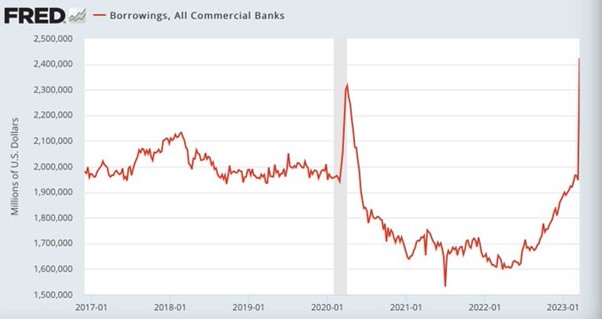
The weakest banks in the US have been losing deposits for over two years to the stronger banks, but $500 billion has been withdrawn since the collapse of SVB on 10 March and $600bn since the Fed started raising interest rates. That’s a record.

Where are all these deposits going? Half of the $500bn in the last three weeks has gone into the bigger, stronger banks and half into money market funds. What is happening is that depositors (mainly rich individuals and small companies) are panicking that their bank might go bust like SVB and so are switching to ‘safer’ big banks. And also depositors see that, with rising interest rates across the board driven by central banks raising rates to ‘fight inflation’, there are better savings rates to be found in money market funds.
What are money market funds? These are not banks but financial institutions that offer a better rate than banks. How do they do this? They offer no banking services at all; MMFs are just investment vehicles that pay higher rates on cash. They can do this by in turn buying very short-term bonds like Treasury bills that offer just a slightly higher rate of return. Thus, the MMFs make a small interest gain but with huge amounts. More than $286bn has flooded into money market funds so far in March, making it the biggest month of inflows since the depths of the Covid-19 crisis. While that is not a massive shift relative to the size of the US banking system (it is less than 2% of the $17.5tn of bank deposits) it shows that nerves remain on edge.

And let’s remind ourselves how this all started. It started out with Silicon Valley Bank (SVB) closing its doors. Then the cryptocurrency Signature Bank. Then another bank First Republic had to be bailed out by a batch of large banks. Then over in Europe, Credit Suisse bank collapsed in less than 48 hours.
The immediate cause of these recent bank failures, as always, was a loss of liquidity. What do we mean by that? Depositors at the SVB, First Republic and Signature started to withdraw their cash big time, and these banks did not have the liquid cash to meet depositor demands.
Why was that? Two key reasons. First, much of the cash that had been deposited at these banks had been reinvested in assets by the bank boards that have hugely lost value in the last year or so. Second, many of the depositors at these banks, mainly small companies, had found that they were no longer making profits or getting extra funding from investors, but they still needed to pay their bills and staff. So, they started withdrawing cash rather than building it up.
Why did the assets of the banks lose value? It comes down to the rise in interest rates across the board in the financial sector, driven up by the actions of the Federal Reserve to raise its basic policy rate sharply and quickly supposedly to control inflation. How does that work?
Well, to make money, say banks offer depositors 2% a year interest on their deposits. They must cover that interest, either by making loans at a higher rate to customers, or by investing the depositors’ cash in other assets that earn a higher rate of interest. Banks can get that higher rate if they purchase financial assets that pay more interest or that they could sell at a profit (but might be riskier), like corporate, mortgage bonds, or stocks.
Banks can buy bonds, which are safer because banks get their money back in full at the end of maturity of the bond – say five years. And each year the bank receives a higher fixed rate of interest than the 2% its depositors are getting. It gets a higher rate because it cannot have its money back instantly but must wait, even for years.
The safest bonds to buy are government bonds because Uncle Sam is (probably) not going to default on redeeming the bond after five years. So SVB managers thought they were being very prudent by purchasing government bonds. But here is the problem.
If you buy a government bond for $1000 that “matures” in five years (i.e., you get your investment back in full in five years), which pays interest at, say, 4% a year, then if your deposit customers get only 2% a year, you are making money. But if the Federal Reserve hikes its policy rate by 1%, the banks must also raise their deposit rates accordingly or lose customers. The bank’s profit is reduced. But worse, the price of your existing £1000 bond in the secondary bond market (which is like a second-hand car market) falls. Why? Because, although your government bond still pays 4% every year, the differential between your bond interest and the going interest for cash or other short-term assets has narrowed.
Now if you need to sell your bond in the secondary market to get cash, any potential purchaser of your bond will not be willing to pay $1000 for it but say only $900. That’s because the purchaser, by paying only $900 and still getting the 4%, can now get an interest yield of 4/900 or 4.4%, making it more worthwhile to buy. SVB had a load of bonds that it bought “at par” ($1000) but worth less in the secondary market ($900). So it had “unrealized losses” on its books.
But why does that matter if it does not have to sell them? SVB could wait until the bonds mature, and then it gets all its investment money back plus interest over five years. But here is the second part of the problem for SVB. With the Fed hiking rates and the economy slowing down towards recession, particularly in the start-up tech sector in which SVB specialized, its customers were losing profits and so were forced to burn more cash and run down their deposits at SVB.
Eventually, SVB did not have enough liquid cash to meet withdrawals; instead, it had a lot of bonds that had not matured. When this became obvious to depositors, those that were not covered by state deposit insurance (anything over $250,000) panicked and there was a run on the bank. This became obvious when SVB announced that it would have to sell much of its bond holdings at a loss to cover withdrawals. The losses appeared to be so great that nobody would put new money into the bank and SVB declared bankruptcy.
So a lack of liquidity turned into insolvency – as it always does. How many small businesses find that if only they had got a little more from their bank or an investor, they could have ridden out a shortage of liquidity to stay in business? Instead, if they get no further help, they must fold. That is basically what happened at these banks.
But the argument goes that these are one-offs and the monetary authorities have acted quickly to stabilize the situation and stop depositor panic. There are two things that the government, the Fed, and the large banks have done. First, they have offered funds in order to meet depositors demand for their cash. Although in the US, any cash deposits over $250,000 are not covered by the government, the government has waived that threshold and said that it will cover all deposits (for these banks only) as an emergency measure.
Second, the Fed has set up a special lending instrument called the Bank Term Funding Program where banks can obtain loans for one year, using the bonds as collateral at par to get cash to meet depositor withdrawals. So, they don’t have to sell their bonds below par. These measures are aimed at stopping the “panic” run on banks.
But here is the rub. Some argue that SVB and the other banks are small fry and rather specialist. So they do not reflect wider systemic problems. But that is to be doubted. First, SVB was not a small bank, even it specialized in the tech sector – it was the 16th largest in the US and its downfall was the second biggest in US financial history. Moreover, a recent Federal Deposit Insurance Corporation report shows that SVB is not alone in have huge “unrealized losses” on its books. The total for all banks is currently $620 billion, or 2.7% of US GDP. That’s the potential hit to the banks or the economy if these losses are realized.

Indeed, 10% of banks have larger unrecognized losses than those at SVB. Nor was SVB the worst capitalized bank, with 10% of banks having lower capitalization than SVB. A recent study found that the banking system’s market value of assets is $2 trillion lower than suggested by their book value of assets (accounting for loan portfolios held to maturity). Marked-to-market bank assets have declined by an average of 10% across all the banks, with the bottom 5th percentile experiencing a decline of 20%. Worse, if the Fed continues to raise interest rates, bond prices will fall further, and the unrealized losses will increase, and more banks will face a lack of liquidity.
So, the current emergency measures may well not be enough. The current claim is that extra liquidity can be financed by larger and stronger banks taking over the weak and restoring financial stability with no hit to working people. This is the market solution where the big vultures cannibalize the dead carrion – for example, the UK’s SVB arm has been bought by HSBC for £1. In the case of Credit Suisse, the Swiss authorities forced a takeover by the larger UBS bank for a price one-fifth of CS’s current market value.
And that is not the end of the coming problems. US banks are heavily into commercial real estate (CRE) assets ie offices, plants, supermarket malls etc. When interest rates were very low or even near zero before the pandemic, small banks loaded up on real estate development lending and CRE bonds issued by developers. Borrowing as a share of bank reserves accelerated from 25% a year to 95% a year in early 2023 in small banks and 35% for big banks.
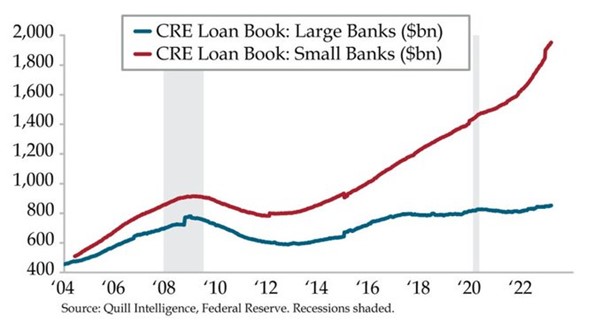
But commercial premises prices have been diving since the end of the pandemic, with many standing empty earning no rents. And now with commercial mortgage rates rising from the Fed and ECB hikes, many banks face the possibility of more defaults on their loans. Already in the last two weeks $3bn of loans have defaulted as developers collapse. In February, the largest office owner in Los Angeles, Brookfield, defaulted on $784m; in March Pacific Investment Co. defaulted on $1.7bn of mortgage notes and Blackstone defaulted on $562m bonds. And there are $270bn more of these CRE loans due for repayment. Moreover, these CRE loans are highly concentrated. Small banks hold 80% of total CRE loans worth $2.3trn.

The CRE loan risk is yet to hit. But it will hit the regional banks, already reeling, the hardest. And it’s a vicious spiral. CRE defaults hurt regional banks as falling office occupancy and rising interest rates depress property valuations, creating losses. In turn, regional banks hurt the real estate developers as they impose stricter lending standards post-SVB. This deprives commercial property borrowers of reasonably priced credit, crimping their profit margins and pushing up defaults.
And the other risk not yet resolved is international. The liquidation of the 167-year old Swiss international bank, Credit Suisse, and its forced takeover by its rival UBS was only made possible by writing off the $18bn value of all the CS secondary bonds held by hedge funds, private investors and other banks globally. Writing off bonds (debt) and saving the CS shareholders instead is unprecedented in financial law. That has raised the risk of holding such bank bonds, despite the assurances of the ECB that this would not happen in the Eurozone. As a result, investors have started to worry about other banks. In particular, their eyes have focused on the travails of Germany’s largest bank, Deutsche Bank, which after the events of Credit Suisse, is no longer too big to fail.

What that shows is that ECB president Lagarde’s repeated claim is nonsense that there is no ‘trade-off’ between fighting inflation with interest rate hikes and financial stability, as banks struggle to keep depositors and avoid defaults on loans. Indeed, a new paper by leading financial academics including the former governor of the Reserve Bank of India, finds that “the evidence suggests that the expansion and shrinkage of central bank balance sheets involves tradeoffs between monetary policy and financial stability.”
The dismissal of the dangers past and ahead by the monetary authorities should be no surprise to readers of this blog. Mainstream economist, Jason Furman, has noted that after the global financial crash of 2008-9, the Fed started doing regular Financial Stability Reports. But as Furman remarks: “The Fed completely missed what happened–not a hint of concern. One interpretation: incompetence. Another interpretation: this stuff is hard even if obvious in retrospect.” For example, the last November 2022, the FSR “generally presented a comforting picture of the financial sector. And it was especially serene about banks–both their capital and proneness to runs”.
The Fed’s FSR never stress-tested high interest rates. And yet when interest rates started to rise it should have been clear that banks had mark-to-market losses they were not accounting for in their hold to maturity portfolios. This risk was dismissed in in a footnote because the Fed thought that higher interest rates would mean gains for banks in net interest income. It was the same story with the Swiss National Bank and its confident assessment of Credit Suisse’s future just a few months ago.
As for regulation, I have beat the drum on the total failure of bank regulation to avoid crises on every occasion. As one bank legal expert put it: “In the wake of the 2008 crisis, Congress erected an enormous legal edifice to govern financial institutions–the Dodd-Frank Act. And we saw in the course of a weekend that it was all an expensive and wasteful Potemkin village. What good does it do to have a massive set of regulations…if they aren’t enforced? To have deposit insurance limits…if they are disregarded? Dodd-Frank is still on the books, but its prudential provisions are as good as dead. Why should anyone follow its requirements now, given that they’ll be disregarded as soon as they’re inconvenient? And why should the public have any confidence that they are protected if the rules aren’t followed? Indeed, did anyone even look at SVB’s resolution plan or was it all a show?”
“I really don’t know how one can teach prudential banking regulation after SVB. How can you teach the students the formal rules—supervision, exposure and concentration limits, prompt corrective action, deposit insurance caps—when you know that the rules aren’t followed?”
“The rules always get tossed out the window in financial crises and then there’s a lot of finger wagging and new rules that are followed until the next crisis, when they aren’t.”
And the head of the world’s top financial regulator, Pablo Hernández de Cos, chair of the Basel Committee on Banking Supervision, said last week “The only way to entirely prevent a bank run would be to require them to keep all of their deposits in highly liquid assets, but then you wouldn’t have banks any more”. What he means is that you would not have any banks that aim to make profits and speculate; but you could still have non-profit banks providing a public service. But, of course, that’s not on the agenda.
It now seems that the bust Silicon Valley Bank paid out huge bonuses to its senior executives based on the profitability of the bank – as a result, the executives invested in riskier long-term assets to boost profitability and so gain larger bonuses. And that’s not all. Just before the bank went bust, it made huge loans at favourable rates to senior officers, management and shareholders to the tune of $219m. Nice if you can get it – as an ‘insider’.

What went wrong at SVB? Fed chair Jay Powell put it this way: “At a basic level, Silicon Valley Bank management failed badly. They grew the bank very quickly. They exposed the bank to significant liquidity risk and interest rate risk. Didn’t hedge that risk.” But “we now know that supervisors saw these risks and intervened.” Really? If so, they were a bit late! “We know that SVB experienced an unprecedentedly rapid and massive bank run. This is a very large group of connected depositors, concentrated group of connected depositors in a very, very fast run. Faster than historical record would suggest.” So the Fed was caught out.
But don’t worry it won’t happen again. “For our part, we’re doing a review of supervision and regulation. My only interest is that we identify what went wrong here. How did this happen is the question. What went wrong. Try to find that. We will find that. And then make an assessment of what are the right policies to put in place so it doesn’t happen again. Then implement those policies.”
But this is a superficial explanation. Every time, there will be some fault-line in banking. As Marx explained, capitalism is a money or monetary economy. Production is not for direct consumption at the point of use. Production of commodities is for sale on a market to be exchanged for money. And money is necessary to purchase commodities.
Money and commodities are not the same thing, so the circulation of money and commodities is inherently subject to breakdown. At any time, the holders of cash may not decide to purchase commodities at going prices and instead hoard it. Then those selling commodities must cut prices or even go bust. Many things can trigger this breakdown in the exchange of money and commodities, or in money for financial assets like bonds or stocks – fictitious capital, Marx called it. And it can happen suddenly.
But the main underlying cause will be the overaccumulation of capital in the productive sectors of the economy or, in other words, falling profitability of investment and production. The tech companies’ customers at SVB had begun to lose profits and were suffering a loss of funding from so-called venture capitalists (investors in start-ups) because the investors could see profits falling. So that’s why the techs had to run down their cash deposits. This destroyed SVB’s liquidity and forced it to announce a fire sale of its bond assets. Alongside that interest rates rose increasing the cost of borrowing. This ‘liquidity’ crisis is now brewing in the real estate sector and in banks with large bond debts.
So the banking crisis is not over yet. Indeed, some argue that there could a rolling crisis that lasts for years — echoing what happened during the US [1980-90s savings and loan] crisis.
What is certain is that credit terms are tightening, bank lending will drop and companies in the productive sectors will find it increasingly difficult to raise funds to invest and households to buy big ticket items. That is going to accelerate economies into a slump this year. The bold optimism expressed before March that recession will be avoided will prove to be unfounded. Only last week, the Federal Reserve’s own forecasts for US economic growth this year were lowered to just 0.4%, which if met would mean at least two quarters of contraction in the middle of this year.

And if the current banking crisis becomes systemic, as it did in 2008, there will have to be ‘socialization’ of the losses suffered by the banking elite through government bailouts, driving up public sector debts (already at record highs); all to be serviced at the expense of the rest of us through increased taxation and yet more austerity in public welfare spending and services.
March 21, 2023
Bank busts and regulation
Stock markets are jumping back up today. It seems that financial investors think the monetary authorities and banking supervisors have got the banking crisis under control. That could be wishful thinking.
The banking crisis of 2023 is not over yet. The Californian ‘tech’ bank Silicon Valley (SVB) that went bust last week has been taken over by the US banking authorities; and so has the cryptocurrency bank Signature. First Republic Bank, used by local companies and rich New Yorkers, has got liquidity funding from a batch of big banks, but it is still tottering on the brink, as depositors flee.
And over in Europe, one of the largest and oldest banks Credit Suisse has been eliminated after 167 years. In a shotgun marriage, its rival Swiss bank UBS has taken over CS for just $3.2bn, a fraction of its book value. The Swiss authorities forced this through to ensure that CS shareholders would keep most of their equity investment, but bond holders of CS have been wiped out to the tune of $17bn – an unprecedented step. The Swiss National Bank is also providing $100bn in liquidity funding to cover deposit withdrawals as a sweetener to UBS, while thousands of low-grade banking workers are to lose their jobs. The government insisted this was the only solution – otherwise CS would have to be nationalized and we can’t have that! Thus, the strong (UBS) has swallowed up the weak (CS).
Some say that all this has been done without a bailout that would use public money and credit. But that is baloney. The liquidity funding by the Swiss authorities is huge and the US Fed has set up a Bank Term Funding Program which enables banks facing depositor withdrawals to borrow for one year using as collateral their government or mortgage bonds that they hold, at ‘par’ (namely the price they paid for them), not what they are worth in the bond market today. So the government is taking on the risk of default. Also the US authorities have guaranteed all the deposits in banks, not just up to the previous threshold of $250,000. So the better-off will not lose their money as the government will cover any bank collapse using public money.
Already this is a large crisis, fast being comparable to the 2008 meltdown and it’s taking place not in the speculative ‘investment’ banks as in 2008 but in standard depositor banks.

There are many other US banks out there facing the same problems of ‘liquidity’ i.e. not able to meet depositor withdrawals if there is a run on their bank. A recent Federal Deposit Insurance Corporation report shows that SVB is not alone in having huge ‘unrealised losses’ on its books (the difference between the price of the bond bought and the price in the market now). Indeed, 10% of banks have larger unrecognised losses than those at SVB. Nor was SVB the worst capitalised bank (equity), with 10% of banks having lower capitalisation than SVB. The total unrealised losses sitting on the books of all banks is currently $620bn, or 2.7% of US GDP. That’s a huge potential hit to the banks and the economy if these losses are realised.
A recent study found that the banking system’s market value of assets is $2 trillion lower than suggested by their book value of assets when accounting for loan portfolios held to maturity. That’s because ‘marked-to-market’ bank asset prices have declined by an average of 10% across all the banks, with the bottom 5th percentile experiencing a decline of 20%. Worse, if the Fed continues to raise interest rates, bond prices will fall further and the unrealised losses will increase and more banks will face a ‘lack of liquidity’. No wonder US banks are sucking up funding from the Fed through its so-called ‘discount window’ and from the Federal Home Loans Bank provision.
It’s the smaller and weaker regional banks that are vulnerable from depositor withdrawals. The regional bank stock index has collapsed.

And the problem of unrealised losses isn’t limited to US regional banks either. For example, the mark-to-market value of Bank of America’s held-to-maturity bond portfolio declined 16% in 2022. That’s the same size as the unrealised loss at Silicon Valley Bank and not much less than First Republic’s 22%, according to JP Morgan.
All this is bad news for the US economy because regional banks have done a larger share of US lending to ‘Main Street’ in recent decades. Banks with less than $250bn in assets make about 80% commercial real estate loans, according to economists at Goldman Sachs, along with 60% of residential real estate loans and half of commercial and industrial loans. If they come under stress, they won’t lend so much and the US economy will grow more slowly than previously thought.
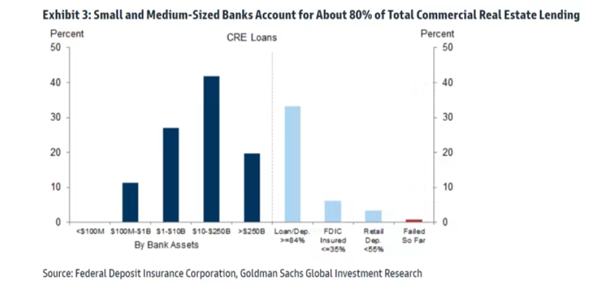
Economists at Goldman Sachs reckon that the crisis has already reduced real GDP growth estimates by 0.3pp to 1.2% for this year. Torsten Slok, chief economist at Apollo Global Management, estimates that banks holding roughly 40% of all financial assets across the sector could retrench, which would lead to a sharp recession this year. Slok estimates that the combination of tighter financial conditions and lending standards following the recent bank failures has in effect raised the federal funds rate — the rate at which banks lend to each other — by 1.5 percentage points from its current target range of between 4.50-4.75%. The banking crisis and the bond market is doing the Fed’s work for it in driving the economy into a slump.
What can be done? There are various solutions offered to stop the ‘contagion’ of bank crashes spreading and to mitigate them in future. Martin Wolf in the FT makes the point that bank crashes are inevitable and cannot be avoided. “Banks are designed to fail. Governments want them to be both safe places for the public to keep their money and profit-seeking takers of risk. They are at one and the same time regulated utilities and risk-taking enterprises. The incentives for management incline them towards risk-taking, just as the incentives for states incline them towards saving the utility when risk-taking blows it up. The result is costly instability.”
That’s nice to know! Marx explained it better. Capitalism is a money or monetary economy. Under capitalism, production is not for direct consumption at the point of use. Production of commodities is for sale on a market to be exchanged for money. And money is necessary to purchase commodities. But money and commodities are not the same thing, so the circulation of money and commodities is inherently subject to breakdown. It is a fallacy (contrary to Say’s law) that the production of commodities guarantees equal demand for their purchase. At any time, the holders of cash may decide not to purchase commodities at going prices and instead ‘hoard’ the cash. Then those selling commodities must cut prices or even go bust: “with the commodity splitting into commodity and money, and the value of a commodity becoming independent in the form of money, the direct exchange of products divides into the processes of sale and purchase, which are internally mutually dependent and externally mutually independent. And here is posited, at the same time, the most general and most abstract possibility of crisis.” Many things can trigger this breakdown in the exchange of money and commodities, or money for financial assets like bonds or stocks (‘fictitious capital’, Marx called it). And it can happen suddenly.
So what to do? The first solution offered is to let the market prevail. Banks that get into trouble and can’t pay their depositors and creditors must be allowed to fail, to be liquidated. That solution gets little support from governments which fear the political backlash and from economists who fear that liquidation would lead to outright slump and depression as in the 1930s.
So the fall-back solution is more and stricter ‘regulation’. Regulation could take many forms. The usual one is making banks hold more equity capital relative to their lending and investments; another is to reduce the amount of borrowing they do to invest speculatively. So there is a great paraphernalia of banking rules, the latest of which is the Basel 3, brought in after the global financial crash of 2008.
Three things here: first, regulation does not work because crashes continue even in banks keeping to the rules (eg Credit Suisse); second, many banks fudge the rules and try to mislead the regulators; and third, capitalist governments are continually under pressure to relax the rules that make it difficult to invest or lend and reduce profitability, not only in the financial sector, but also for the borrowers in the productive sectors.
When the profitability of capital in the major economies plunged during the 1970s, one of the policies of neo-liberal governments of the 1980s was to make a ‘bonfire’ of regulations, not only in finance but also in the environment, in product markets and in labour rights. In the three decades leading up to the Global Financial Crash in 2007-8, regulations were swept away: including barriers between commercial and investment banking; and allowing banks to borrow hugely and issue all sorts of ‘financial instruments of mass destruction’ (Warren Buffet).
Indeed, after Margaret Thatcher’s ‘big bang’ of the 1980s which created a free-for-all in banking, it was social democratic governments that presided over ‘deregulation’ – Clinton in the US and Blair in the UK. In 2004, Chancellor Gordon Brown opened Lehman Bros’ new Canary Wharf office, saying “Lehman brothers is a great company that can look backwards with pride and look forwards with hope”(!) The City minister of the time was Ed Balls who adopted enthusiastically what he called ‘light touch regulation’ of banking activities in the City of London, because the banks and financial institutions were the heroes, vital to Britain’s prosperity. Instead, the eventual UK financial sector crash cost the economy something like 7% of GDP, huge rise in pubic sector debt and permanently low growth since.
Deregulation turned the modern banking system into a series of giant ‘hedge fund’ managers speculating on financial assets or acting as conduits for tax avoidance havens for the top 1% and the multi-nationals. It may be true that international banks are better capitalised and less leveraged with bad debts after the gradual implementation of the Basel III capital and liquidity accords and the widespread adoption of ‘stress testing’, but even that can be disputed. As IMF admits: “in many countries, systemic risks associated with new forms of shadow banking and market-based finance outside the prudential regulatory perimeter, such as asset managers, may be accumulating and could lead to renewed spillover effects on banks”.
Generally, the left seems unable to come up with any solution except more regulation. Take liberal economist, Joseph Stiglitz. At the time of the Global Financial Crash, he proposed that future meltdowns could be prevented by empowering ‘incorruptible regulators’, who are smart enough to do the right thing.“[E]ffective regulation requires regulators who believe in it,” he wrote. “They should be chosen from among those who might be hurt by a failure of regulation, not from those who benefit from it.” Where can these impartial advisors be found? His answer: “Unions, nongovernmental organizations (NGOs), and universities.”
But all the regulatory agencies that failed in 2008 and are failing now were well staffed with economists boasting credentials of just this sort, yet they still manage to get things wrong. In a 2011 book, Engineering the Financial Crisis: Systemic Risk and the Failure of Regulation, Jeffrey Friedman and Wladimir Kraus contested Stiglitz’s claim that regulations could have prevented the disaster, if implemented by the right people. Friedman and Kraus observe: “Virtually all decision-making personnel at the Federal Reserve, the FDIC, and so on, are . . . university-trained economists.” The authors argue that Stiglitz’s mistake is “consistently to downplay the possibility of human error—that is, to deny that human beings (or at least uncorrupt human beings such as himself) are fallible.”
David Kane at the New Institute for Economic Thinking points out that banks have managed to avoid most attempts to regulate them since the global crash as “the instruments assigned to this task are too weak to work for long. With the connivance of regulators, US megabanks are already re-establishing their ability to use dividends and stock buybacks to rebuild their leverage back to dangerous levels.” Kane notes that “top regulators seem to believe that an important part of their job is to convince taxpayers that the next crash can be contained within the financial sector and won’t be allowed to hurt ordinary citizens in the ways that previous crises have.” But “these rosy claims are bullsh*t.”
Even the IMF quietly admits this: “As the financial system continues to evolve and new threats to financial stability emerge, regulators and supervisors should remain attentive to risks… no regulatory framework can reduce the probability of a crisis to zero, so regulators need to remain humble. Recent developments documented in the chapter show that risks can migrate to new areas, and regulators and supervisors must remain vigilant to this evolution.”
One other solution offered is the so-called Chicago Plan, which is promoted by Martin Wolf and some leftist post-Keynesians. Originally this was an idea of a group of economists at the University of Chicago in the 1930s who responded to the Depression by arguing for severing the link of the commercial banks between the supply of credit to the private sector and creation of money. Private banks would lose the power to create deposits by making loans, as all deposits would have to be backed by public sector debt or by bank profits. In effect, lending would be controlled directly by government. “The control of credit growth would become much more straightforward because banks would no longer be able, as they are today, to generate their own funding, deposits, in the act of lending, an extraordinary privilege that is not enjoyed by any other type of business,” says an IMF paper on the plan. “Rather, banks would become what many erroneously believe them to be today, pure intermediaries that depend on obtaining outside funding before being able to lend.” And that outside funding would be the government. The banks would still be privately owned, but could not lend. Ironically, to exist they would have to turn into outright speculative investment operations like hedge funds to make a profit. That could create even more instability in the banking system than before. The Chicago Plan would only work if the banks were brought into public ownership and made part of an overall funding and investment plan. But if that happened, there would be no need for a Chicago Plan.
What is never put forward is to turn modern banking into a public service just like health, education, transport etc. If banks were a public service, they could hold the deposits of households and companies and then lend them out for investment in industry and services or even to the government. It would be like a national credit club. We could then make a state-owned banking system democratic and accountable to the public. That means directly elected boards, salary caps for top managers, and also local participation. Way back in 2012, I presented such an idea to the Institute of Labour Studies in Slovenia, as structured below.

Don’t hold your breath for anything like this being proffered by any leftist party, let alone governments.
This week the Federal Reserve and the Bank of England meet to decide on whether to continue to raise interest rates to ‘fight inflation’. As we now know, this policy is causing instability and bank crashes, as well as lowering growth. Meanwhile, inflation (core) remains ‘sticky’ at over 5-6% a year in the major economies. The European Central Bank at its latest meeting did hike its rate further, arguing that there is “no trade-off” between fighting inflation by raising interest rates and financial instability . Yet that has already proved demonstrably untrue.
The ECB claims that European banks are ‘resilient’ and in better shape than even US banks – tell that to CS bond holders. Bank lending in the Eurozone is contracting fast – down €61bn between January and February, the biggest monthly decline since 2013. And the ECB admitted in its quarterly survey of lenders that banks have tightened their lending criteria on business loans by the most since the region’s sovereign debt crisis in 2011. Demand for mortgages fell at the fastest pace on record.
Will the Fed, the ECB and the BoE go on tightening until even more banks break down and economies dive into recession? Or will they pause or reverse policy to avoid a financial meltdown? Many financial institutions are screaming for a pause and the markets are rising on the prospect. But as one Fed member observed in supporting a further quarter-point rate rise, it is necessary to “preserve the credibility that Powell at the Fed had gone to great lengths to restore over the past year,” she said. “I wouldn’t think he would want to let that go at this point.” This Fed is not for turning – or is it?
March 15, 2023
Moral hazard or creative destruction?
As I write, US regional banks stock and bond prices are diving. And a major international Swiss bank, Credit Suisse, is close to bankruptcy. A financial crisis not seen since the global financial crash of 2008 appears to be unfolding. What will be the response of the monetary and financial authorities?
Back in 1928, the then US treasury secretary and banker Andrew Mellon pushed for higher interest rates in order to control inflation and credit fuelled stock market speculation. At his bequest, the Federal Reserve Board began raising interest rates and in August 1929 the Fed banged up the rate to a new high. Just two months later in October 1929, the New York Stock Exchange suffered the worst crash in its history in what was called “Black Tuesday“. History repeats.
In 1929 Mellon was undeterred. He advised the then president Hoover to “liquidate labor, liquidate stocks, liquidate farmers, liquidate real estate… it will purge the rottenness out of the system. High costs of living and high living will come down. People will work harder, live a more moral life. Values will be adjusted, and enterprising people will pick up from less competent people.” Additionally, he advocated the weeding out of “weak” banks as a harsh but necessary prerequisite to the recovery of the banking system. This “weeding out” would be accomplished through refusing to lend cash to banks (taking loans and other investments as collateral) and by refusing to put more cash in circulation. The Great Depression of the 1930s followed a major banking crash.
In 2008, when the global financial crash unfolded, at first the authorities aimed at something similar. They allowed investment bank Bear Stearns to go under. But then came another, Lehman Bros. The Federal Reserve dithered and finally decided not to save it with a bailout of credit. What followed was an almighty crash in stocks and other financial assets and a deep recession, the Great Recession. Fed chair Ben Bernanke at the time was supposedly a scholar of the Great Depression of the 1930s and yet he agreed for the bank to fail. Subsequently, he recognized that as ‘lender of last resort, the job of the Fed was to avoid such collapses, particularly for those banks that are ‘too big to fail’ which would only spread the busts across the whole financial system.
It’s clear that now governments and monetary authorities want to avoid ‘liquidate, liquidate’ and the Lehmans crash, even if such a policy would clear away the ‘dead wood’ and “rotteness of the system” for a new day. Politically, it would be disastrous for governments presiding over yet another banking collapse; and economically, it would probably trigger a new and deep slump. So it’s better to ‘print more money’ to bail out the banks’ depositors and bond holders and avert financial contagion – the banking system being so interconnected.
That’s what the authorities eventually did in 2008-9 and that it what they will do this time too. Officials were initially unsure about rescuing Silicon Valley Bank. They quickly changed their minds after signs of nascent bank runs across the US. Interviews with officials involved or close to the discussions paint a picture of a frenzied 72 hours. Credit Suisse too is likely to get similar financial support.
There are supporters of Mellon’s approach today and they still have a point. Ken Griffin, founder of a large hedge fund Citadel, told the Financial Times that the US government should not have intervened to protect all SVB depositors. He went on: “The US is supposed to be a capitalist economy, and that’s breaking down before our eyes…There’s been a loss of financial discipline with the government bailing out depositors in full.” Griffin added. We can’t have “moral hazard,” he said. “Losses to depositors would have been immaterial, and it would have driven home the point that risk management is essential.”
Moral hazard is a term used to describe when banks and companies reckon that they can always get money or credit from somewhere including the government. So if they make reckless speculations that go wrong, it does not matter. They will get bailed out. As Mellon might have put it: it’s immoral.
The other side of the argument is that banks that get into trouble should not mean that those who deposit their cash with them should not lose it through no fault of their own. So governments must intervene to save the depositors. And they too have a point. As another hedge fund billionaire, Bill Ackman, put it when the SVB collapse emerged, the Federal Deposit Insurance Corporation must “explicitly guarantee all deposits now” because “our economy will not function nor our community and regional banking system”. Mark Cuban expressed frustration with the FDIC insurance cap that guarantees up to $250,000 in a bank account as being “too low”; he also insisted the Federal Reserve buy up all of SVB’s assets and liabilities. Rep. Eric Swalwell, a California Democrat, joined the chorus, tweeting that “We must make sure all deposits exceeding the FDIC $250k limit are honored.”
The irony here is that those demanding bailouts now are the very venture capitalists who usually stand firmly for the ‘free market and no government intervention’. Another bailout supporter is one Sacks, a longtime associate of investor Peter Thiel, who fervently believes in ‘free markets’ and in ‘capitalism’. But it was Thiel’s Founders Fund that helped kick off the bank run that sank SVB in the first place.
FT columnist Martin Wolf explained the dilemma. “Banks fail. When they do, those who stand to lose scream for a state rescue.” The dilemma is that “if the threatened costs are big enough, they will succeed. This is how, crisis by crisis, we have created a banking sector that is in theory private, but in practice a ward of the state. The latter in turn attempts to curb the desire of shareholders and management to exploit the safety nets they enjoy. The result is a system that is essential to the functioning of the market economy but does not operate in accordance with its rules.” So it’s moral hazard because the alternative is Armageddon. As Wolf concludes: “it’s a mess.”
So what’s the solution offered to avoid these continual banking messes? Liberal economist Joseph Stiglitz tells us that “SVB represents more than the failure of a single bank. It is emblematic of deep failures in the conduct of both regulatory and monetary policy. Like the 2008 crisis, it was predictable and predicted.” But having told us that regulation was not working, Stiglitz argues that what we need is more and stricter regulation! “We need stricter regulation, to ensure that all banks are safe.” Well, how’s that worked up to now?
Nobody has anything to say for public ownership of the banks; nothing about making banking a public service and not a vast sector of reckless speculation for profit. SVB collapsed because its owners bet on rising government bond prices and low interest rates to boost their profits. But it went pear-shaped and now other bank customers will pay for this in increased fees and losses for the Federal Reserve – and there will lees funding of productive investment to pay for yet another banking mess.
This is what I said 13 years ago: “The answer to avoiding another financial collapse is not just more regulation (even if it was not watered down as the Basel III rules have been). Bankers will find new ways of losing our money by gambling with it to make profits for their capitalist owners. In the financial crisis of 2008-9, it was the purchase of ‘subprime mortgages’ wrapped up into weird financial packages called mortgage backed securities and collateralised debt obligations, hidden off the balance sheets of the banks, which nobody, including the banks, understood. Next time it will be something else. In the desperate search for profit and greed, there are no Promethean bounds on financial trickery.”
Let us return to the dilemma of choosing between ‘moral hazard’ and ‘liquidation’. As Mellon said, by liquidating the failures, even if it means a slump, that is a necessary process for capitalism. It’s a process of ‘creative destruction,’ as 1930s economist Joseph Schumpeter described it. Liquidation and the destruction of capital values (along with mass unemployment) can lay the basis for a ‘leaner and fitter’ capitalism able to renew itself for more exploitation and accumulation based on higher profitability for those that survive the destruction.
But times have changed. It has become increasingly difficult for the strategists of capital: the monetary authorities and governments to consider liquidation. Instead ‘moral hazard’ is only option to avoid a major slump and political disaster for incumbent governments. But bailouts and a new wound of liquidity injections would not only completely reverse the vain attempts of the monetary authorities to control still high inflation rates. It also means the continuation of low profitability, low investment and productivity growth in economies unable to escape from their zombie state. Just more long depression.
March 13, 2023
Monetary tightening, inflation and bank failures
Last week, US Fed Chair Jay Powell gave testimony to the US Congress on inflation and Fed monetary policy. He spooked financial markets when he appeared to say that the latest data on the economy would probably require further interest-rate hikes and at a faster pace. Powell argued that although the headline inflation rate had fallen back, the ‘core’ inflation rate, which excludes energy and food prices, remained ‘sticky’. Also, the US labour market still seemed exceptionally strong, justifying the need to control the impact of any wage rises. He again suggested that it would be necessary to hike further the Fed’s policy rate (which sets the floor for all other borrowing rates) until wage costs came under control.
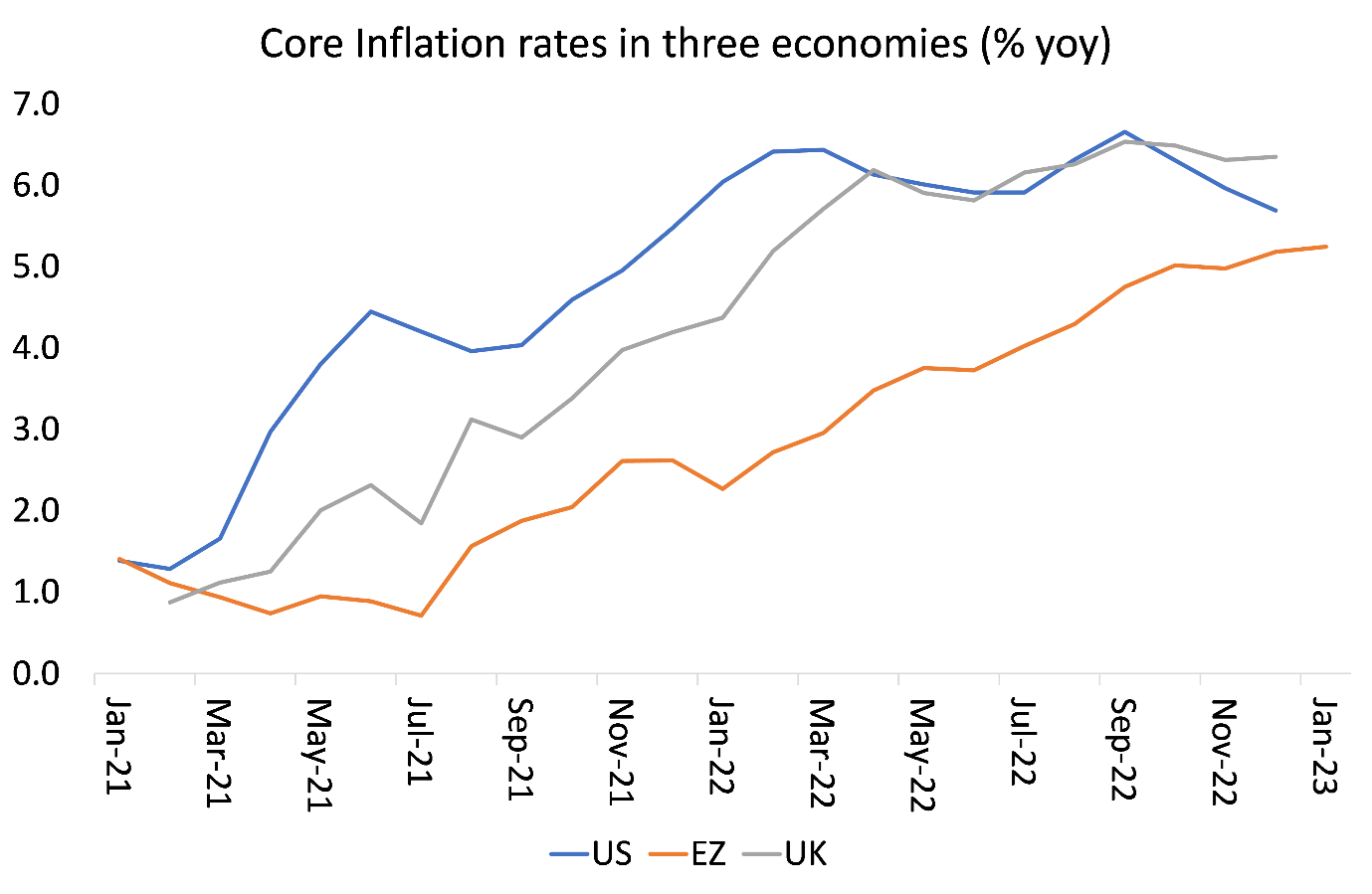
Once again, Powell, like other central bank governors, claimed that inflation was being driven by ‘excessive demand’ and also by the risk of rising wages causing a ‘wage-price’ spiral. But there is plenty of evidence that it is not excessive demand or wage-push that has caused the acceleration of inflation. I have offered such evidence in several previous posts. And in a recent post, I recounted a long study by Joseph Stiglitz that offered comprehensive data showing that inflation was caused by supply-side shortages not ‘excessive demand’.
Since then, more evidence has appeared backing up the supply story. One recent paper found that when the economy came out of the COVID pandemic lockdowns and slump there was a shift into buying more goods. However, producers were unable to deal with this surge. “Our main finding is that the shift in consumption demand from services towards goods can explain a large proportion of the rise in U.S. inflation between 2019:Q4 and 2021:Q4. This demand reallocation shock is inflationary due to the costs of increasing production in goods-producing sectors and because such sectors tend to have more flexible prices than those producing services.”
And there is further evidence that the inflationary spike was driven mostly by non-labour costs (raw materials, components and transport) and by sharp rises in profit mark-ups. Wage rises made the least contribution.
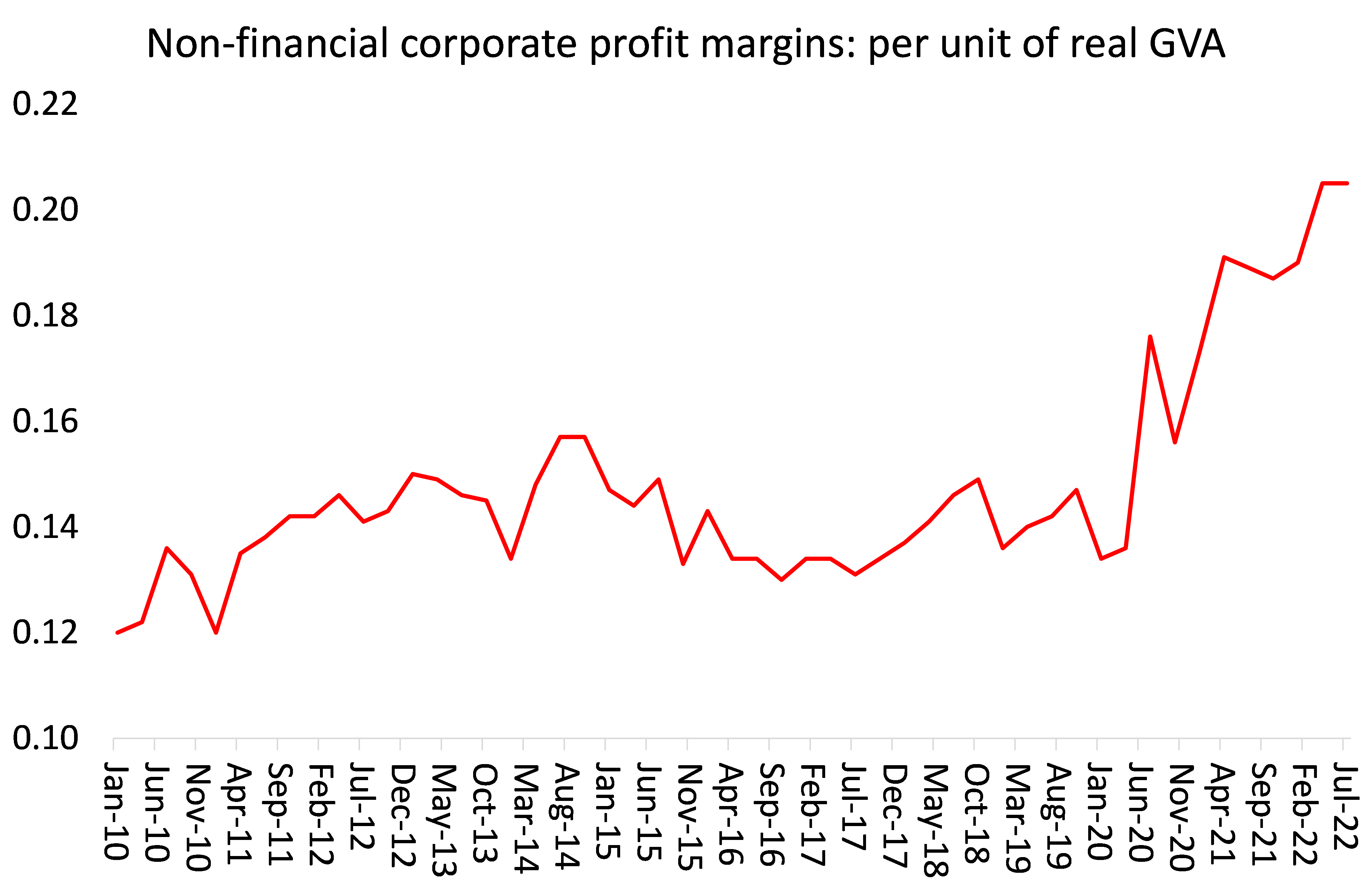
The latest US data on wage increases confirm that there is no ‘wage-push’ inflation.
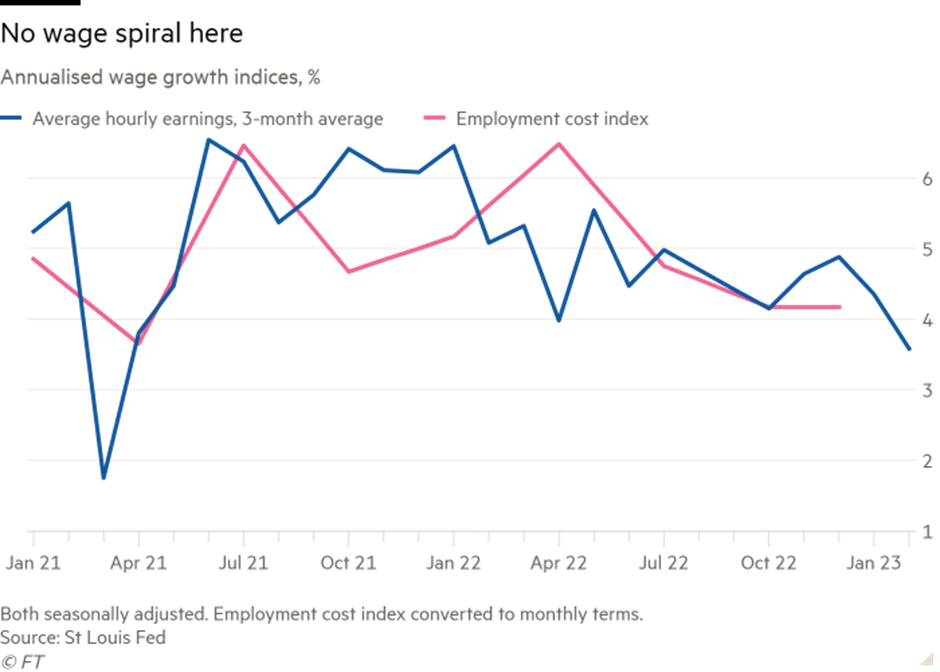
And this is not just in the US. In the Eurozone, it is even more the case that non-labour costs and profits drove inflation rates. The ECB recently published an estimate of the contributions from profits, taxes and labour costs to EZ inflation.

Well, even so, can it be argued that tighter monetary policy ie raising interest rates to increase the cost of borrowing and reducing money supply by selling central banks’ stock of bonds can still get inflation down? Well, not according to the ECB’s own analysis. In a study, the ECB found that an interest-rate hike by 1 percentage point only reduces inflation by about 0.1 to 0.2 percentage points. The ECB also estimates that the largest negative year-on-year effect of rate hikes on GDP will materialise only after nine quarters!

It’s the supply-side that is key to inflation. In particular, over the long term, it is the rate of productivity growth in any economy. If the growth in production per employee slows or even falls, costs per unit of production will rise and that will force companies to try and raise prices. Another recent paper argued that “sector-wide cost shocks and supply bottlenecks” create the conditions for companies with some pricing power to raise prices to protect profit margins. It becomes ‘sellers inflation’.
Productivity growth is key to inflation. Indeed, there is a strong inverse correlation (0.45) between productivity growth and inflation rates over the last two decades.
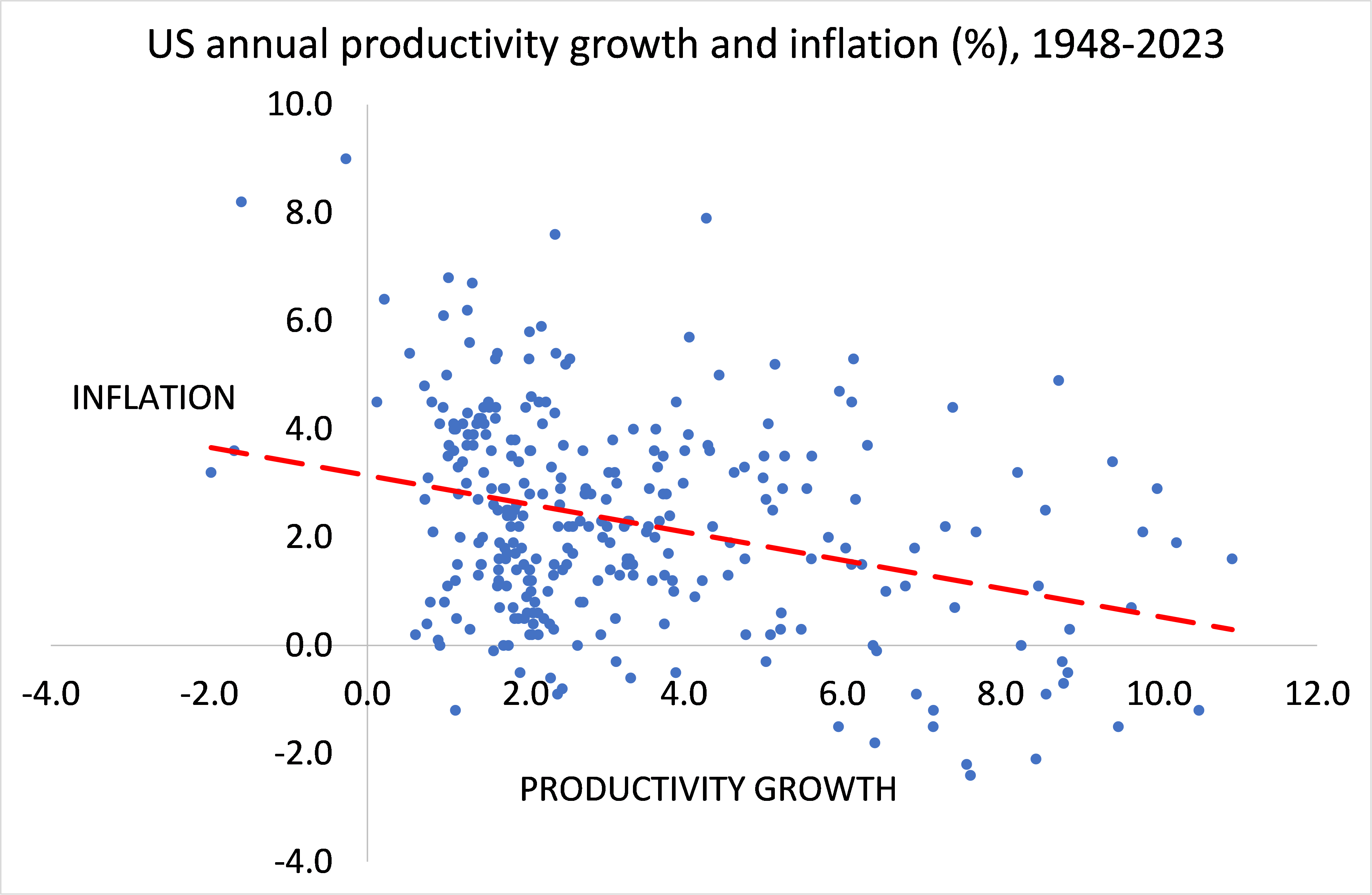
Powell is now talking of going higher and faster with rates. But the impact of previous hikes have hardly affected inflation. And controlling the money supply does not seem to have much effect on inflation, contrary to the view of the monetarists. The Bank for International Settlement (BIS) is the international association of central banks globally. Its economists are firm monetarists and Austrian school supporters of free markets. In a recent study, the BIS found “a statistically and economically significant correlation across a range of countries between excess money growth in 2020 and average inflation in 2021 and 2020.” John Plender of the Financial Times, another Austrian school pundit, concluded that “you do not have to be an out and out devotee of the quantity theory of money to see that the buoyancy of US house prices and equities last year was substantially about too much money chasing too few assets.”
Note two things here. First, there is causality. As the BIS admits “The debate about the direction of causality in the link between money and inflation has not been fully settled. The observation that money growth today helps to predict inflation tomorrow does not, in and of itself, imply causality.” It could be that “it is income, not money, that causes spending to increase, with the evolution of money balances acting as a signal.” But then the BIS goes onto argue that “causality is neither necessary nor sufficient for money to have useful information content for inflation – which is our focus here.” Really? Surely it matters whether it is economic activity, production and spending growth that drives overall money supply, or vice versa?
Second, Plender notes that increased money supply is associated with rising house prices and stock prices – no mention of the prices of goods and services. And that is the point. Strong money supply growth and low interest rates up to the point of the pandemic did not lead to rising prices and accelerating inflation in the shops. Instead, money supply fuelled a credit boom expressed in a boom in real estate and financial assets.
What is missing from the monetarist argument is that changes in money supply can also mean changes in the velocity of money ie the turnover rate of the existing stock of money. If the velocity of money falls, it means that holders of cash are not spending it on goods and services but hoarding it in deposits or investing in property and financial assets. So as money supply growth accelerated in the first two decades of this century, the velocity of money fell as the cash was used in financial and property speculation.

But note the change since the pandemic. The Fed has been tightening money supply to control inflation. After exploding up in 2020 during the pandemic slump, money supply is now contracting.
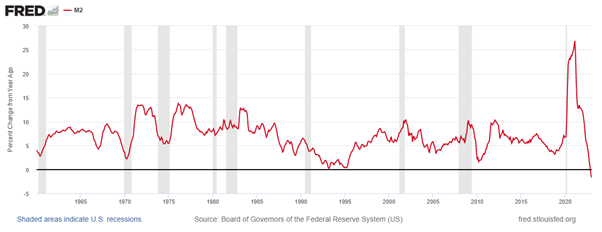
But in contrast, the velocity of that money stock is turning up, counteracting the impact of tighter monetary policy. That makes any tight monetary policy ineffective on inflation, but not necessarily on economic growth and employment. Fed policy will not work except to accelerate any slippage into economic recession. Cleveland Fed researchers analyzed the FOMC’s most recent economic projections. Their model projects the FOMC’s current unemployment forecast would bring core PCE inflation down to 2.75% but only by 2025 And a “deep recession would be necessary to achieve” the 2.1% inflation projection that the Fed is aiming for.
And now we have the collapse of SVB as a result of Fed interest-rate hikes. See my post. Indeed, this may force the Fed to pause on its plan to raise interest rates higher and faster. The Fed is being caught in a dilemma: more rate hikes could mean more bank failures and recession; but stopping hikes means that the Fed is toothless in dealing with inflation.
The worst is to come for the so-called global south. If the Fed continues to hike, then the US dollar will regain strength after the recent brief pause (graph below).

Total global debt is now over $300trn, or 345% of their combined GDP, up from $255trn, or 320% of GDP, before the covid-19 pandemic. The more indebted the world becomes, the more sensitive it is to rate rises. To assess the combined effect of borrowing and higher rates, The Economist , estimated the interest bill for firms, households and governments across 58 countries. Together these economies account for more than 90% of global GDP. In 2021 their interest bill stood at a $10.4trn, or 12% of combined GDP. By 2022 it had reached a whopping $13trn, or 14.5%. As much of the debt owed by economies in the Global South is in dollars, an appreciating dollar relative to their own currencies is an extra burden. Developing economies now spend more on external debt service than on the health of their citizens!
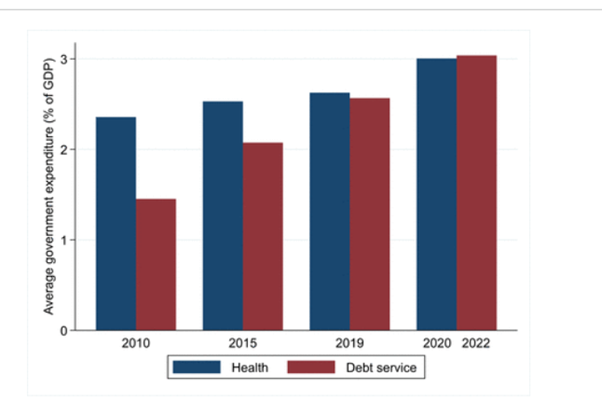
So not only is recession on the agenda in the G7 economies, but debt default and slump is already beginning in ‘developing’ economies (e.g. Sri Lanka, Zambia, Pakistan, Egypt).
Michael Roberts's Blog

- Michael Roberts's profile
- 35 followers