S.D. Falchetti's Blog, page 8
February 18, 2019
PilotEdge Flight - Chiriaco Summit to Bermuda Dunes
Continuing on my with PilotEdge tour, I did a VFR flight from L77 Chiriaco Summit to KUDD Bermuda Dunes. I’ve been working on L77 using Laminar’s free World Editor, which allows users to create their own airports. It’s a fun little airport next to Interstate 10 in California, and you can visually follow the interstate northwest to several airports. It’s fun to fly in X-Plane the way an actual VFR pilot would fly - using my eyeballs to visually navigate, instead of just plotting a direct course in a GPS. For a change,

I flew the Cessna 172 Skyhawk, which I customized with Hayden-Pratt colors.

All went well until a series of small mistakes at my destination lead to some flustering. It’s interesting when flying on PilotEdge because you’re not supposed to pause the simulator, so when things happen you quickly find yourself frazzled that you’re trying to maintain control of the plane while sorting things out. When flying solo on X-Plane, it’s easy and tempting to pause things while you fix settings on your navigation, for example, but in PilotEdge you have to work it out on the go. Just like real life.
Here’s the shortened version of my flight, with my narration. Enjoy!


February 15, 2019
Freebooksy Results - 1 Month Later
Just shy of a month ago I ran a Freebooksy promo for Hayden’s World: Volume 1. I chose Freebooksy based on positive feedback from other authors. At $70 for a one-day science-fiction newsletter promo, Freebooksy was on the pricier side (compared to my usual $15 - $40 promos), but on par with sites like Books Butterfly. Their website was very easy to book - a calendar displayed which days were available, you selected your data, filled in your book blurb, and paid. Freebooksy does state that they check your book to ensure it meets their editorial standards. I didn’t have any problems and received a confirmation within one day.
My promo went live Jan 20th, 2019. It was everything I’d anticipated. The first day, 1558 copies of Hayden’s World were downloaded. I set it free for the full five days allowed in KDP, and over the course of those days saw 2007 downloads. This easily hit number one in multiple categories on the Kindle store.

The nice thing about giving away a book for free which is enrolled in Kindle Unlimited is that page reads count towards KENP, so I got paid for them. In the month of the promo, I saw a big increase in KENP, with 4,523 pages read. That’s around $22.
I picked up three Amazon reviews and one Goodreads rating.
So, all-in-all a very good result. The ad didn’t pay for itself, but in terms of downloads per cents it performed much better than my usual promos. This weekend I am using Freebooksy again for Janus 2. Curious to see what results I get.
February 11, 2019
Thoughts on Divinity 2
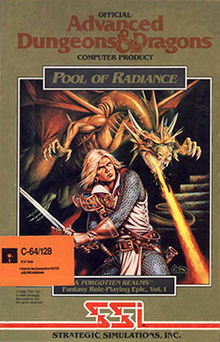
In 1988 I strapped on my black velcro Reeboks and wandered over to the neighbor’s house. There, a Commodore 64 rested upon a small stand in front of his television. He slipped a five-and-a-quarter-inch floppy disk into the drive, typed the load command, and the tv screen illuminated with the Pool of Radiance logo. It was a bit of magic. Off to the right, a stack of Dungeons and Dragons books remained from our weekend play sessions. But here, on the screen, was a computer dungeon master, taking us through an adventure. Pool of Radiance was the first of SSI’s Gold Box Dungeons and Dragons adventures, and for years the company would churn out newer and better games using the same formula. It was all 2D graphics and barely animated sprites, but it was nonetheless fun.
In the late nineties, Baldur’s Gate rekindled the old-school roleplaying niche and in the two-thousands Dragon Age continued it. More recently, Pillars of Eternity resurrected the Baldur’s Gate engine. On the most part, though, adventure games become first-person affairs, and the old isometric scheme was mostly abandoned.
The first Divinity: Original Sin was a breath of fresh air. It had the structure of Baldur’s Gate but the “do anything” approach of pen and paper roleplaying. “Do anything” was particularly focused on elemental mayhem. Rain water down upon enemies, cast a lightning bolt into the puddles they stand in, then freeze them solid. Shoot a flaming arrow into an oil barrel and watch it chain react in glorious fiery chaos.
Last week, Divinity 2 was released for Mac. I quickly scoffed it up while it was on sale and have been playing it since. It has all of the fun things I enjoyed in the first game with some new twists (both good and bad). Overall, I like it.
The biggest noticeable change is that you have more of a World of Warcraft array of races to choose from, instead of just male or female humans. Your party is weird, but in a good way that reflects the weird parties players rolled up with pen and paper games. My group consists of a lost royalty lizard called The Red Prince, a skeleton with a magic mask which makes him look human, a dwarf called The Beast, and a female bard named Lohse. Each has a detailed back story and personal quests. A truly delightful moment occurs early on, for example, when Lohse bumps into an acquaintance from her tavern days and they two decide to sing a duet for old time’s sake. The resulting performance sounds great and they laugh about it. It’s details like that which are brilliant.
The environments are even lusher and more detailed than the previous game. Every place you visit you’ll enjoy seeing. Although isometric, it is fully 3D modeled and you can rotate the camera any way you like for a better view.
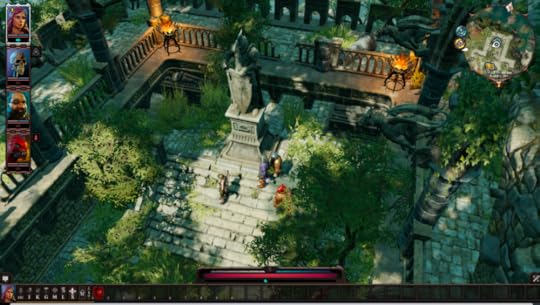
The inventory system is much improved. All four characters’ inventory is displayed side-by-side, making it easy to drag items between players. The other significant change is that armor now has physical and magical hit point values, and attacks do physical or magical damage. This basically works like Star Trek shields. When your shields are down, you start taking damage. You can regenerate your shields through various means. This analogy is quite literal: one of the skills is named “Shields Up” and regenerates part of your physical and magical shields. While you still have magic armor hit points, magical effects are blocked (not just damage, but spells like Sleep). I don’t really like it. It becomes quite the numbers game when a foe is bristling with magic armor but has no physical, so you just smash him with physical attacks as if he were wearing pajamas.
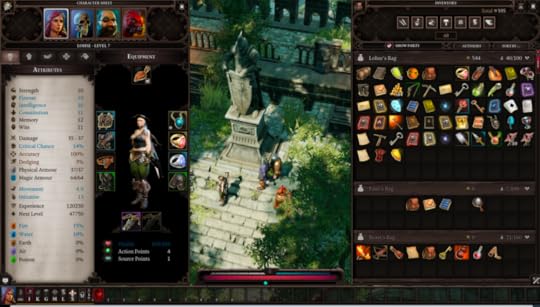
One of the other nice changes is the inclusion of a narrator. In many ways, the narrator is like the Dungeon Master, giving you bits of verbal information like, “You find a wry old man lounging against the wall, a guitar slung across his back. He gives you a smile and a wink when you glance at him.” Including the narrator, voice acting is present for all of the NPC interactions, and is excellent. A gruff ice dragon’s voice sounds exactly as you’d expect.
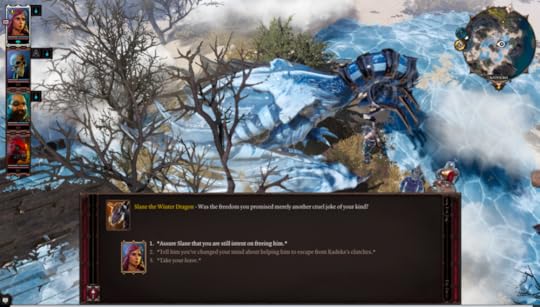
Other welcome changes include the use of bedrolls which instantly heal the entire party when used outside of combat. These are a nice upgrade versus the previous game’s approach of casting Restoration on every character one at a time until health is replenished.
Divinity 2 still uses a skill (as opposed to class) system, so you can make a Battlemage/Scoundrel/Huntsman or any other crazy custom combination of abilities. One nice update is that party members ask you what you’d like them to be upon joining, so if you don’t need another mage but want Fane to join your party because, well, he’s a skeleton who wears people’s faces as masks, you can just ask him to be a Ranger, for example, and the game will create him with the appropriate skills.
If you liked the elemental mayhem of the original game, Divinity 2 dials it up to eleven. There are many more abilities which create surfaces. The Red Prince breathes fire in a cone, for example. Nearly every combat is a screen full of inferno and electrical maelstrom.
eGPUs are becoming more popular for Macs, and I was happy to see that Divinity 2 includes eGPU integration. With my eGPU plugged in, I could simply select it from Divinity’s graphics option menu and run everything smoothly at full Retina resolution with Ultra settings. Without my eGPU, I ran it at 1440 x 900 with Medium settings on a 2016 MacBook Pro.
Divinity 2 still suffers from the same problem as Divinity 1, which is that a one level difference between you and an attacker is huge and can quickly make battles impossible. As a result, although you are mostly free to wander around the map, in reality you must explore it in precisely the way it is intended or you will leave the “level one” corner and enter the “level four” corner. Many of its situations have multiple endings - you can help someone or double cross them - but often you will find yourself using the internet a bit too much to figure out how to proceed. It’s not that puzzles are too hard, it’s that they often require a Groundhog Day type of foreknowledge to complete. Sometimes it’s things like “be sure to talk the statue that’s hidden behind the rock before exiting the cave or you won’t be able to proceed with the plot,” which can be maddening. There’s also a general lack of direction, in particular at the beginning in Fort Joy, where you are required to talk to everyone and every animal to find something to do. Once the plot kicks in, this improves, and you find events daisy-chaining together to lead you along.
Aside from some of the quirks, it’s a great game, and evokes much of the nostalgia and wonder of those old SSI gold box titles.
February 9, 2019
PilotEdge Flight - Sun Valley to Havasu City
After my free two-week trial completed, I purchased a subscription to the ZLA area of PilotEdge. If you’re not familiar with PilotEdge, it’s a service which links ATC controllers with flight simulators, providing a multi-player environment to fly your virtual plane. The paid controllers are trained in actual procedures and ATC communication and will hold you to the correct standards. Other virtual pilots broadcast on comms even when visiting non-towered airports, just like real life. Hearing all of the human comm chatter over the radio is a game-changer for immersion. More importantly, I feel like I’m learning something.
I’ve been working my way up through their training system, starting simple with non-towered to non-towered flights. Even without direct ATC interaction, there’s still plenty of radio work announcing my positions to other pilots, and I’m conscious not to violate airspaces because ATC will engage me.
It raises the bar for X-Plane flight planning. I need to work out all of my frequencies in advance, know exactly where I’m going, and plan to properly enter the flight pattern and determine the active runway based on local traffic or weather conditions. It’s not the solo X-Plane experience of “hop in the fully running plane on the runway and fly in a straight line for a straight-in landing at my destination”. In addition to human pilots, PilotEdge has hundreds of NPC aircraft flying around. More than once I had to wait until a runway was clear or do a go-around due to traffic.
Here’s a clip of my flight from A20 Sun Valley to KHII Havasu City. Both are non-towered airports in Class E airspace. In the middle of the flight you can hear ATC getting progressively frustrated with someone, resulting in a lecture. It’s common to hear ATC give you corrections or advice, such as “you don’t have to call base once I’ve given you clearance to land”. Most of the time it’s just professional chatter of jet and GA craft flying around California.
Next up is moving through the CAT ratings in PilotEdge. This weekend I’d do the CAT-2, landing at a Class Delta airport with ATC communications.
January 22, 2019
First Flight on PilotEdge
A few months ago I stumbled upon the YouTube channel On the Glidescope. Its host, a real-life pilot, has constructed a full-size Cessna cockpit for use with X-Plane. His forward view is digital projection and his side windows are mounted monitors. All of the controls are real. This itself is remarkable, but what caught my eye in his videos is that he appears to be talking to air-traffic controllers and listening to other pilots respond.
The service he’s using is called PilotEdge. It offers professional ATC coverage for the western United States and turns X-Plane into a multiplayer simulation. It’s populated by many actual pilots using it to build their radio and procedural skills. It even offers virtual training for correctly executing real-world procedures.
Aside from learning how to use the radio, what really appeals to me about PilotEdge is that it turns X Plane into a living, breathing environment with active flights taking off manned by real people getting guidance from actual ATC. When you want to taxi across an active runway at an untowered airport, you actually do need to stop and look both ways and announce it on the radio because another human being may be landing on it. When you bust Bravo airspace without clearance, you get an ATC scolding (fortunately without the follow-up FAA report).
Tonight I did my first flight on PilotEdge via X-Plane, flying my Piper Arrow III. I was feeling ambitious and decided to go directly for their first Communications and Airspace Training (CAT) certification. CAT-1 is easy - fly from one non-towered airport (L52 Oceano) to another (L88 New Cuyama) making proper radio calls. I have to say, I was actually nervous, which I found amusing, since this is all virtual. It also made my flight require much more preparation than my usual X-Plane flights, and it made my time inside the plane more hectic.
A few of the bigger differences versus playing X-Plane solo:
I had to set up the COMM1 frequencies in advance by looking up the CTAFs (Common Traffic Advisory Frequency) for L52 (122.70) and L88 (122.90). I also set COM2 to Guard (121.50).
Just because the airport is non-towered doesn’t mean you make any less radio calls. I needed to make calls when starting to taxi, crossing the runway, entering the runway for departure, departing the pattern, ten miles from destination, when entering the downwind of destination, when entering the base leg of destination, when entering the final leg of destination, after landing and clearing the runway.
As mentioned above, I actually had to stop and look whenever crossing runways, and needed to look for traffic throughout the flight. While taxiing, I watched another plane land on the active runway.
It was easy to miss the details because I was doing many things. For example, I forgot to take my transponder out of standby and didn’t catch it until I was leaving the pattern (technically I don’t need a transponder in Class E airspace, but still).
Although I try to do this in solo X-Plane, I found that I really focused on entering the pattern correctly at my destination airport. It’s easy when playing solo X-Plane to just do straight-in approaches, where in real-life you’d enter the downwind at a 45, probably after overflying the airport to see who is in the pattern.
I felt very pilotish wearing a headset with a mic. The particular one I wore was ginormous - I’d asked for it as a Christmas gift and, I admit, it looked much smaller in the picture. I could’t hear myself talk over the engine noise, which seemed realistic.
So, after saying things like “New Cuyama Traffic, Arrow One Eight Niner Hotel Romeo ten miles west at three-thousand five hundred entering left downwind runway two eight, full stop, New Cuyama,” I passed the CAT-1 certification. Aside from the radio lingo, I found it much harder to fly and land my plane. You never knew who was in the area watching your sloppy pattern work or crooked landing. It was a self-conscious feeling, but an oddly satisfying one.
Next up is CAT-2, which involves flying to a towered airport in Class D airspace, talking with ATC, and following instructions. I’m looking forward to it.
Lastly, although it’s not required for PilotEdge (and other players can’t see your custom liveries or in some cases your correct aircraft type), I had to modify my Arrow livery to match my PilotEdge call sign (you get to choose your own call sign, but it must be a valid FAA designation). Mine is 189HR:

January 12, 2019
Thoughts on Amazon's Electric Dreams
Amazon and Netflix are engaged in a bit of a content war, which, for the longest time, Netflix was winning with series like House of Cards and Stranger Things. Recent Prime entries like The Man in High Castle and the Marvelous Mrs. Maisel are evening the playing field. Amazon’s Philip K. Dick’s Electric Dreams is the countermove to Netflix’s successful Black Mirror.
You might recognize the title as a reference to Dick’s novel, “Do Androids Dream of Electric Sheep?”, which is what the movie Bladerunner is based upon. Phillip K. Dick’s influence is ubiquitous, and it’s surprising just how many well-known movies are based on his stories. These include:
Blade Runner
Total Recall
Screamers
Minority Report
A Scanner Darkly
Next
The Adjustment Bureau
Each of Amazon’s ten episodes is loosely based upon a Phillip K. Dick story. Because many of his shorts appeared in pulpy sci-fi magazines like Galaxy Science Fiction in the 1950s, the works all have an Amazing Stories feel to them.
Intrigued, I binged the series. It started off badly.
The opening credits look like they were done with mid 90s computer animation and video effects. It’s not exactly the same quality as the credits to say, The Man in High Castle:
It somewhat reminds me of the 90s The Outer Limits opening, both visually and in weirdness:
Initially, I watched the first episode and half of the second episode before bailing. Fortunately, I googled the episode reviews and found the better episodes were later in the series. I decided to give it another chance. The three episodes I liked the best were:
The Commuter - a man discovers passengers on his train buying tickets to a stop which doesn’t exist. When he goes there, he finds something amazing. This is the hands-down best episode of the series because it is the most human. It feels at home in an Amazing Stories episode, and has themes from the Adjustment Bureau. Its central question is: what if you could wish all of your problems away, but some of those problems are your loved ones? This very much reminds me of the Adjustment Bureau’s plan to give Matt Damon’s character a better life at the expense of never meeting his true love.

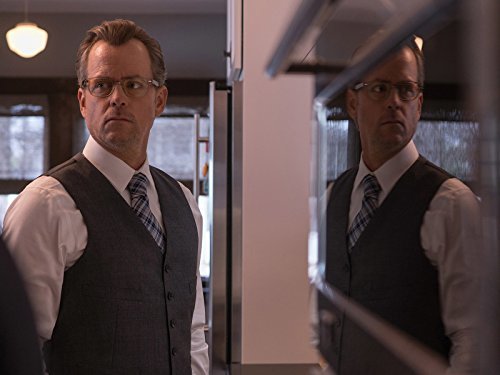
The Father Thing - a boy believes his father has been replaced by an alien. Quite a good episode, with Greg Kinnear playing the dad, the boys channeling a Stranger Things vibe as they have basement meetings and go up against evil forces.
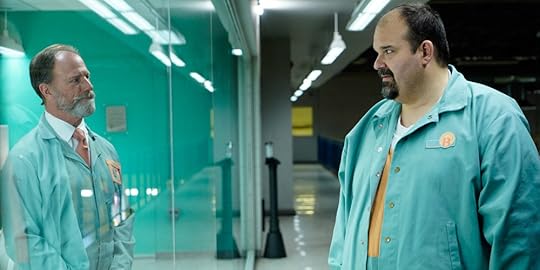
Crazy Diamond - a man helps a replicant steal an AI to rejuvenate her. Crazy sets and brilliant cinematography separate this episode from the others. Its director clearly knew what he was doing both in tone and story. For example, when Steve Buscemi unwittingly climbs onto a boat containing the two women he’s double-crossed, we don’t see the ensuing struggle. The camera simply cuts to an underwater view looking up at the boat, suddenly disturbed by Steve being tossed into the water. The plot itself is bonkers, but the unearthy music and Wes Anderson-ish visuals are worth the price of admission..

Kill All Others - a man becomes increasingly unsettled when everyone treats an inflammatory politician’s violent directives as normal. Well-directed, but, similar to Black Mirror, unsure of how to end. The hyper-advertised world with people buying products just to get the sexy hologram advertisement is brilliant. “You need to buy some cheese,” one of the co-workers nods and winks to the main character.
The remainder of the episodes are:
Human Is - a woman believes her unkind war-hero husband has been replaced by a kinder alien, and she prefers the alien. The briefly-viewed infantry battle is very Forever War-ish, with soldiers in space suits shooting at weird aliens which look like electrical will-o-wisps. The story itself, which devolves into a trial episode, is dry and boring, despite Bryan Cranston’s best efforts.
Real Life - a detective (True Blood’s Anna Paquin) with a troubled past tries to put her worries aside in virtual reality, but she becomes increasingly unsure which of the realities is the virtual one. Disjointed, confusing, and violent, this was one of my least favorite episodes. The ending, where she must choose (and stay in) one reality, does redeem the episode a bit because people in both realities make compelling arguments about how the other reality is unrealistic.
Impossible Planet - two star hustlers try get a big payday by fulfilling an aging woman’s dream of visiting a long-gone Earth. This felt very much like Titanic, with the elderly Rose recounting her story. Her robot sidekick has a nearly steampunk aesthetic which is interesting. Its weird ending doesn’t make much sense unless it’s all in the woman’s mind (which I think it is - the Jack and Rose go up the Titanic staircase ending).

The Hood Maker - a telepath works with police, but a man invents a hood capable of blocking her powers. Quite obviously channeling Minority Report, but too dark and somber to be enjoyable. Points, though, when the telepath realizes that when she wears the hood, she can have silence. Also, I liked her telepathic interrogation of a witness who tries to block her by reciting “The quick brown fox jumped over the log” only to have her recite the inverse phrase, “The slow black dog bows before the regal fox,” eventually overpowering his block and syncing his speech with hers. This reminded me of the odd replicant tests in Bladerunner.
Safe and Sound - an activist mother and daughter move from the unsecured west coast to the security-obsessed east coast. When the daughter tries to fit in, she befriends a tech support voice, who manipulates her into being an anti-terror propaganda tool. Heavy-handed and preachy, one of the least enjoyable episodes in the series.
Autofac - after a nuclear warrior, survivors try to stop an automated factory from polluting their environment by abducting a customer-service android and convincing it to shut down the factory. Autofac starts somewhat badly, with text exposition, but does congeal and pull off an unexpected twist near the end. It’s one of the few series episodes which sticks the landing.
As a whole, it’s a bit of an Outer Limits collection of shorts, some good, some not. I don’t think it’s competition for Black Mirror, simply because Black Mirror episodes like USS Callister are in a different league than Electric Dreams. But, with tighter writing, shorter episodes, and more Crazy Diamond/Commuter and less Safe and Sound, Season 2 could be Black Mirror competition Still, worth a watch if you’re a sci-fi fan.
Using Shadow Tech for X Plane
Some time before Christmas I was in a rut. It went like this: install Windows via Bootcamp, install X-Plane in Windows, install eGPU drivers, try various experiments, then throw up my hands and delete the entire Windows partition out of frustration.
For reference, I have a 2016 13” MacBook Pro laptop (2 GHz i5, 8 GB memory, Intel Iris Pro 540 integrated graphics with 1536 MB). Separately, I have a Gigabyte Gaming Box eGPU with a RX580 graphics card. Surprisingly, the stock configuration (without the eGPU) enables me to run X-Plane moderately well, getting 19 FPS - 35 FPS depending on where I am. I can even do max world objects and high texture quality as long as I’m not in a huge city, only knocking that number down by a few frames.

The eGPU unfortunately is useless with X-Plane, because the Mac version of X-Plane does not support eGPUs currently (Laminar, please fix this!). Plugging it in actually lowers the FPS.
These numbers are at 1440 x 900 resolution with no antialiasing, shadows, or reflections. It would be nice to run at my Retina monitor’s full resolution of 2560 x 1600 and get over 40 fps.
On Christmas day, I decided to try Shadow Tech, which advertises itself as “high-performance gaming for all”. Shadow Tech, in essence, is a virtual Rent-a-Center, allowing you to subscribe to your own personal fully-configured Windows gaming computer. Your virtual computer has an Intel Xeon core with 12GB memory 256GB storage and a NVIDIA GTX 1080 GPU. The way you access your computer is through a streaming app which works on your laptop, desktop, phone, or tablet.
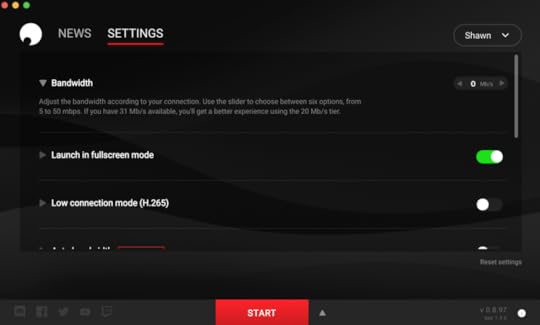
The Shadow App, waiting for me to click Start. It will then launch in either full-screen or windowed mode, transforming your Mac display into a Windows desktop.
Currently the subscription is $34.95 USD per month, although when I signed up there was a holiday deal of $24.95. For twenty-five dollars, I thought I’d give it a whirl.
After signing up on their website, I received a notification that it may take up to ten days to activate my account. I signed up 12/25 and it was ready 1/1. When I first launched, it was mindlessly easy: open the app and click the big red start button. Poof! You’re in Windows. For some reason, Windows launched in 1024 x 768 resolution the first time, which looked alarmingly blurry. After tinkering with the display settings I was able to put it at my monitor’s full resolution and it looked great.
I have to say, I was impressed by the seamlessness and lack of latency. If there was any lag between me moving the cursor and seeing it happen on my streaming desktop, I could not tell with my eye. For me, this was via a wifi connection using Comcast’s basic internet tier, so, you know — nothing special — what an average human being would have.
Make no mistake, this is a new Windows install. Just as if you did a new Windows install on your own computer, you will need to go and install the software you want, run Windows updates, and generally tinker with your system until it is the way you like.
So how does one get software on his hosted computer? You can direct download from a website or install Steam. I did both, installing X-Plane and the Steam version of XCOM 2. What about my gigabytes of orthophotos, planes, and sceneries saved on my hard drive for X-Plane? Here I encountered my first limitation. As far as I can tell, there is no file transfer capability with the Shadow app. Moving files from your real-life computer to your Shadow computer involves uploading them to a third-party service like Dropbox, then downloading them. This was disappointing. Given the choice between uploading and redownloading 50 gigs of orthophotos, it was faster just to make them all from scratch on the Shadow side by installing Ortho4XP. It would be nice if the Shadow app had an FTP client, even if it were only usable when the app was not streaming.
Once X-Plane was installed on the Shadow PC, I eagerly launched it, maxing out settings and envisioning 60 fps. What I got was low teens. Frowning, I set X-Plane up with the same levels as my Mac, and, to my surprise, only got mid twenties for FPS. In fairness, the Windows Shadow X-Plane ran at a higher resolution (2560 x 1600) versus the Mac’s 1440 x 900, but still, this seemed low. After much tinkering, I came with the compromise of High World detail, no shadows, minimum reflections and antialiasing, and HDR (instead of HDR+SSAO). This gave me 40 - 50 fps.
I also tried XCOM 2. On my Mac, no eGPU, XCOM runs on medium settings well. With eGPU, it runs on high settings. On Shadow, it ran at max settings smoothly. No complaints.
So, after trying Shadow for about two weeks, here’s the pros and cons:
PROS:
No noticeable latency. I flew my X-Plane aircraft the same as if it were on my own system. I can’t stress enough how impressed I am with the responsiveness of the streaming. It was the thing I had my biggest initial doubts, and was pleasantly surprised.
Not once did the Shadow interface pixelate or lower resolution due to streaming issues. It really felt like I was interacting with a natively-installed copy of Windows.
I could run X-Plane at full resolution, and it really does look much better there.
I could get 20 - 50 fps on X-Plane, as long as I turned off some settings (shadows, reflections, etc).
Although I could run similar graphics settings for XCOM on my local Mac using my eGPU, the Shadow version, not surprisingly, was much faster. XCOM load screens were much quicker with the Shadow.
CONS:
Cumbersome to move files from my Mac to the Shadow. If you play X-Plane, you probably have a large library of custom scenery and payware aircraft to move. Uploading gigabytes to Dropbox is just too slow (hours too slow). Initially there was some Windows setting blocking Dropbox downloads, but after installing Windows updates Dropbox worked fine, but I abandoned it in favor of just making new ortho tiles from scratch.
X-Plane UDP functions which require X-Plane to be on the same local network do not work. This is just the reality of remote access. This means things like head tracking using SImhat or external moving maps on an iPad will not function.
USB connections are a bit wonky. Shadow does recognize some USB devices you plug into your local computer, but my experience with X-Plane was that my HOTAS joystick was recognized (by X-Plane) as an X-box controller, and I could not convince it otherwise. With my local PC, X-Plane recognizes my joystick as its exact model and configures it correctly. I could not get Shadow to recognize an external USB hard drive. The Shadow app for Windows seems to have a workaround with USB over IP, but as far as I can tell the Shadow app for Mac does not.
There were a few technical glitches, but they were the exception, not the rule. Sometimes the Shadow interface would lock up when toggling between full screen and windowed mode. Once or twice I couldn’t boot up my Shadow - it would either just hang or launch in low resolution with the cursor not matching up with the click location. It seemed to be stuck like this for about thirty minutes once, resetting itself eventually (I didn’t bother to contact tech support).
XCOM 2 would occasionally get confused as you scrolled the game cursor offscreen, trying to pan the map. It would work as designed for a while, then seem to think you were trying to launch the Shadow app menu bar, forcing you to use the arrow keys in game to move the screen instead of the mouse. Not a big deal - just quirky.
Maybe I’m spoiled by my Mac’s very fast SSD, but simple file moves in Windows (for example, moving the Ortho tiles from the Ortho4XP folder to the Customer Scenery folder) were slow, sometimes taking minutes for large files. Yes, yes, where you’re used to dragging your newly created orthos into the Scenery folder and being ready to play five seconds later, waiting two minutes feels like a long time.
The 200 GB of storage I was allotted seemed to fill up faster than expected. X-Plane plus eight ZL16 orthotiles used up the majority of it, and I needed to delete XCOM2 to free up space. Note you can purchase additional storage through Shadow.
So, what’s the verdict? I think that will depend on how you want to use Shadow Tech. If you have a Mac, it’s certainly compelling to have a full Windows PC accessible through your Mac without taking up any hard drive space. This probably will be most beneficial if there are Windows games you want to play which either aren’t available or unplayable on your Mac. There are countless Windows games which fall into this category. For me, both X-Plane and XCOM2 play well already on my Mac, so it becomes a cost/benefit analysis of things like “play X-Plane at full resolution” versus “lose Simhat head tracking”. Also, I find that I change out my orthotiles often, shuttling them to an external hard drive. The difficulties of moving files to the Shadow PC is definitely a negative here. So, net, I’ll poke around for the remaining two weeks of my trial, but I probably won’t renew. There’s nothing wrong with Shadow - it does exactly what it advertises, and does it well - but it’s just not for me.
December 30, 2018
Thoughts on Netflix's Bandersnatch
As a Black Mirror binge watcher, I was pleasantly surprised with Netflix’s secretive release of Bandersnatch. My curiosity peaked, however, when I realized it was a choose-your-own-adventure episode. Throughout the show, viewers are presented with choices, and the narrative advances based on their selections. With enthusiasm, I opened the Netflix app on my Apple TV only to receive a “device not supported” error. No problem - I opened the Netflix app on my smart TV. Same result. Okay, I opened the Netflix webpage from my laptop. It worked…until I attempted to stream my laptop display to my TV, at which point it informed me I wasn’t allowed to do this. Sigh. So, with laptop on lap, I clicked my way through about an hour’s worth of storyline.
SPOILERS AHEAD
The interface was quite slick. I think I was expecting the CD-ROM games of the 90s where the scene pauses while I click on a choice, then stutters while loading the new scene. In reality, it was seamless. The scene plays as a timer ticks down for your choice and continues without breaking stride.
There’s a certain charm to the initial choices, which do not affect the plot at all. Given a choice of which cassette to listen to on the bus, I chose Thompson Twins and enjoyed that it became the musical montage soundtrack for the ride.
If you haven’t seen Bandersnatch (please do so before reading on), it’s the story of a computer programmer, Stefan, who is creating a choose-your-own-adventure video game called Bandersnatch. Stefan has a goal: work for the software company Tuckersoft and release the game in time for Christmas. Stefan has a dark past - his mother died in a train derailment when he was five - and takes medication presumably for depression. The show is set in 1984.
The first choice capable of ending the story comes quickly. When the head of Tuckersoft offers Stefan his dream job working alongside his hero Colin with his own dedicated support team, Stefan must choose to either accept or counter-offer to go it alone and work-from-home. This being a Shining-style writer-descent-into-madness story, you can guess which option is the correct narrative choice. When you choose incorrectly, you’re given a quick fast-forward of the ho-hum way this plays out, then, like Groundhog-day, are returned to your alarm clock waking you up at the story’s launch. Try again.
Now, here was where my first glimmer of hope appeared. As the characters replayed the scene leading up to the accept/decline choice, it was subtly different. Both Stefan and Colin seemed to have some knowledge of their first go around. When Colin asks Stefan how he knew something he shouldn’t, he responds, “I don’t know. I just did.” It made me think of the Star Trek the Next Generation Episode “Cause and Effect” where the crew relives the same day over and over again, each time retaining some knowledge of their previous iteration. In the end, they use that knowledge to break the loop - discovering they’re not the only ones trapped in it.
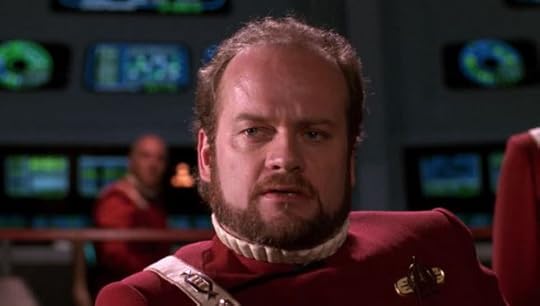
Unfortunately Bandersnatch just as quickly abandons this concept. What it does retain, however, is an increasing awareness from Stefan that his decisions are not his own. Given a choice to bite his nails or pull his earlobe, you can see Stefan wants to bite his nails but visibly fights his hand when you select pull your earlobe. Depending on your choices, this can play out in an over-the-top Truman Show style scene where Stefan becomes aware you’re controlling him and you divulge that it’s a Netflix interactive show from the future. When his therapist tries to logically convince him they’re not on a TV show, the fourth wall falls and they abandon their characters to provide a scene more typical of a TV show. Some reviewers didn’t like this meta-scene, but I thought it was snarky and fun.
I’d say the first half of Bandersnatch actually felt like a Black Mirror episode. I found myself making choices based on what I thought would be more interesting narratively. A key choice, for example, is whether Stefan should go with his father to the doctor or bail and follow Collin. The sensible thing to do is get Stefan some medical help, but the plot is more interesting if he follows Collin. The resulting scene feels right for the narrative, and is dark, with elements of Inception in it. I think right up to the end of this scene I felt like I was watching and participating in a story.
Afterwards, the story quickly devolves into endless loops. Every time you chose a dead end the story repeats the scenes up to the ill-fated choice and you try again. After a dozen of these it becomes tedious, and you quickly realize that there is no satisfying ending to be had. Collin’s character put it perfectly, describing how Poc Man tries to escape his maze only to re-emerge on the other side, still trapped.
One of my criticisms of Black Mirror is that often the writers don’t know how to end an episode. This is certainly true of Bandersnatch. It doesn’t need to be a happy ending, but it does need to be a fulfilling ending. If you search on the web, you can find flowcharts of all the possibilities. To some effect, I felt like the ending scene should be from the ending of 1983’s War Games.
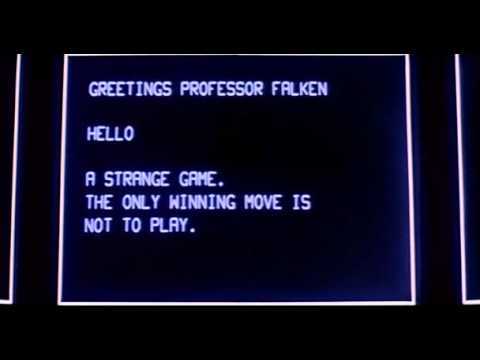
A few observations:
Forbes has a good write-up on what the best ending is in Bandersnatch. I’d call it the Butterfly Effect ending. They also comment on the theory that we, the viewer, are really in the White Bear episode of Black Mirror, where we are punishing Stefan for his crime. The decision-tree symbol which keeps reappearing in Bandersnatch is the same used in White Bear.
Tuckersoft’s rainbow logo is channeling Activision’s 80s logo. I like it.
The show did succeed in making me feel uneasy about choosing for Stefan, especially as he became more aware that he was being manipulated.
I’d like to see more interactive shows like this. It’s a bit gimmicky, but with the right story I think it could be compelling.
December 27, 2018
Thoughts on The Man in High Castle
The past two weeks I’ve been bingeing Amazon Prime’s The Man in High Castle, a series based on Phillip K. Dick’s 1962 book by the same name (which won a Hugo award in 1963). The brilliant opening credits tell you everything you need to know about the setting:
Setting, perhaps, is one of the strongest points of the series, with a designed-in conflict of an America divided between Japan and Germany buffered by a lawless neutral-zone. The premise is compelling: filmstrips exist depicting an alternate reality where the United States won WWII. Many think they are fake propaganda designed to inspire hope in the rebellion, but some think they are true. We, of course, have seen these films countless times — a sailor kissing a woman in Times Square as ticker tape rains down over a parade — but for the inhabitants of this alternate reality they are powerful images.
SPOILERS AHEAD
The series has a Game-of-Thrones-sized cast, but the three characters it focuses on are Juliana Crain (Alexa Devalous), John Smith (Rufus Sewell) and Nobusuke Tagomi (Cary-Hiroyuki Tagawa). Juliana is intended to be the protagonist, coming into possession of one of the film reels in the first episode and catapulting her into a life on the run which puts her into the hands of the Resistance, the Japanese, and the Reich. Unfortunately the show’s writers have made her the least interesting of the primary characters. Her role is mainly to run from location to location, get shot at, and be scared. John Smith, on the other hand, is an American soldier who changed sides after WWII, now a rising star in the Reich. He lives in New York (complete with swastikas covering Times Square) with his family. You can see the gears turning in Rufus Sewell’s head as he plays John Smith, and John Smith’s struggle to accept Reich idealogies versus the consequences to his family are potent. Lastly, Trade Minister Tagomi is, well, the Trade Minister for Japan, living in San Francisco. He is a kind and peaceful man who wants to prevent World War III. He also is able to travel to the alternate reality depicted in the films.
Notable secondary characters include: Joe Blake (Luke Kleintank), son of a prominent Reich leader and flip-flopper; Frank Frink (Rupert Evans), Juliana’s ex-boyfriend and the Banksy of the Resistance; Inspector Kido (Joel de la Fuente), the Bad Guy playing the show’s Javert role; Robert Childan (Brennan Brown), a seller of Americana artifacts to some of Japan’s more culture-obsessed buyers; Nicole Becker (Bella Heathcote), the Nazi version of Mad Men’s Don Draper.
There are many more secondary characters. These are just the ones with the biggest story arcs. Phew.
Now that we’ve got the foundation, here’s a few thoughts. The first two seasons were a bit like a bowling ball rolling down an alley with the bumpers raised, veering in random directions, deflecting, always moving forward, but unfocused. Somewhere in season three clear themes began to emerge and the episodes were much better when they had a purpose. I think season one reminded me a bit of the sci-fi series Colony, which has a similar setup (America is taken over by an alien power and many Americans try to adapt by working for them as soldiers or bureaucrats. A Resistance forms.).

The problem with Colony was that its endless shootouts mowed down Redhats (stormtroopers) in mind-numbing numbers while human bureaucrats promised all questions would be answered. It quickly became apparent that the writers themselves were winging it and didn’t have those answers. Similarly, when the Man in High Castle series does actually get Juliana to meet the Man in High Castle, it’s nearly incidental. She just moves on to her next location.
What High Castle does excel at, however, is exploring ideas (which is what all great sci-fi stories should do). The show is at its best with:
Visuals - a fleet of Japanese battleships slipping under the Golden Gate Bridge; Times Square with building-sized posters of the Fuhrer; a New York hotel room lamp with a bronze swastika base; the look of the 1960s-era Reich uniforms. In conjunction with this is the ease and comfort that the actors accept their surroundings. People lounge in their uniforms as if they were blue jeans and treat swastika-laden hotel rooms the same as the generic art we encounter at a Holiday Inn.
John Smith - as someone who switched sides to enjoy the comforts and security of the Reich, he now must accept the consequences of their government. When he discovers his son has a genetic disease which would require him to be euthanized under the Reich’s genetic purity laws, he will do anything to prevent it. The aftermath of this extends through all of season 3, and is one of the best elements of the show. There are no simple answers here.

Robert Childan, Americana dealer to the Japanese - in contrast to our reality, where Americans have kanji tattoos or katanas hung on their walls, here is a reality where the Japanese are interested in collecting bits and pieces of American history as a status symbol, like having a rare art piece on one’s wall. Robert Childan as a culturally-savvy shop owner who buys sometimes-illicit items to satisfy his clients is terrific.
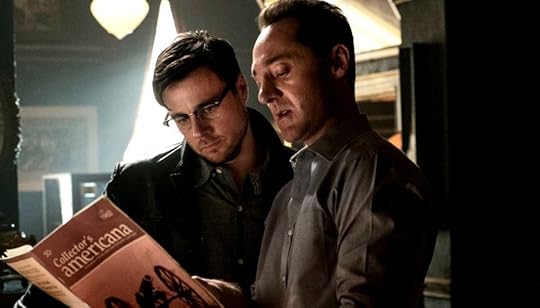
Minorities - It’s expected that John Smith should have some doubts about Reich ideology. What’s unexpected, and welcome, is that characters like Nicole Becker, a German national, engage in same-sex relationships despite the potential consequences. Other characters establish colonies in the Neutral Zone where they can practice Judaism. It hints that people are people, regardless of their society’s views.
Complexity in opposing sides - It would have been easy for the writers to turn the story into Red Dawn. Instead, we get terrific characters like John Smith - a Breaking Bad type of arc - where compromises are made to ensure his family’s security. John does some terrible things, but you know why he does them. Trade Minister Tagomi has the weight of the world on his shoulders, a kind, weary man who wants to spare everyone the horrors of atomic war. They seem like real people trying to make the best of their situation.

Lastly, as I hinted at earlier, I think the writers chose the wrong protagonist. Juliana is missing the complexity of her adversaries. The show mistakingly relies on plot to try and make her interesting (she appears in nearly all of the alternate-reality films, indicating that whoever made them knows her). Yet I find myself waiting for any scene with Rufus Sewell. More so than any other, his character is a keystone, where the plot elements converge, and he often is the decision-maker for what happens next. Those decisions often are conflicted and we sympathize with those conflicts. He would be the perfect lens to watch this world unfold.
December 17, 2018
Getting the Most Out of X-Plane
I’m sitting in the living room with my laptop on my knees, my green Daytona Beach cap slumped on my head. It’s the hat I never wear, the one I bought not because I wanted a Daytona Beach cap but because my scalp was sunburned and I wanted to comb my hair without it hurting. My wife walks in and does a double-take. I look up. “What?”
“Uh, why is your iPhone strapped to your head?”
She’s right. Two rubber bands affix my iPhone to my cap’s bill.
“It’s so I can do this.”
When I turn my head to the left, the Piper’s cockpit view on my laptop screen rotates left. I turn my head to the right and the view follows. “Cool, huh?”
She blinks.
These are the weird things you end up doing when you have an X-Plane addiction
Now that I’ve logged a jillion hours or so flying my Pixel Plane, I can share a few things to make your X-Plane experience even more awesome, and possibly encourage your loved ones to think you’re even weirder than they previously thought:
Download Ortho4XP and create your own photorealistic scenery. One of the amazing things about X-Plane is that it models the entire world. You may as well go all in and put the right textures on that model. When using Ortho4XP for U.S. areas, I use Bing, Arc, or USA_2 photo sources. Tip: You can edit the config file for Ortho4XP to automatically create higher-resolution tiles immediately around airports - it’s an easy way to have Zoom Level 16 tiles for general travel but Zoom Level 18 at airports.

Orthophotos - You’re welcome
There are many, many weather plugins for X-Plane, but I like simply replacing the default clouds with better ones. I like the clouds in Environment+ (just the clouds - I don’t use the lua script, which kills my FPS). You just place them into your Resources/bitmaps/world/clouds folder.
X-Plane’s sky is nice, but I find their sunsets a bit cartoonish. Fortunately, you can swap in any sky colors you want. I prefer Eddie’s Skypack. You just place them into your Resources/bitmaps/skycolors folder.
Speaking of clouds, X-Plane is a little reluctant to give you those big puffy cumulous clouds you’re used to seeing in summer skies. There are plenty of lua scripts to fix this, but I prefer Vivid Sky (which requires the free Fly with Lua plugin). The script fixes many things with cloud appearance and ground shadows, improves the sky colors, and is FPS-friendly.
Simhat - yes, yes…you will look completely silly with your iPhone strapped to your baseball cap’s bill, but for $10 you will have head tracking that works remarkably well. Adding head tracking is right up there with Ortho photos as being one of the most impactful things you can do for immersion.
XPRealisticPro is a great script to add some realism, especially if you don’t have head tracking.
A few other tips:
The default X-Plane aircraft are quite good, but can be a bit boring for their paint options. You can download endless liveries from the X-Plane forums to customize them (changing both the exterior and interior appearance). The default Cessna 172 has plenty of great internet options.

No need to settle for ‘default’ when you could have this design.
You will likely spend plenty of time tinkering in your Custom Scenery folder, but I find less is more. I try to avoid custom airports which have a dozen different library dependencies. It just bogs down your load times. If you’re flying general aviation craft, the smaller airports will probably be of more interest than the giant ones. The free L52 Oceano is excellent, especially when paired with orthophotos, and is also the first airport you’ll visit if you fly on Pilot’s Edge.
MisterX6’s Airport Environment HD runways are so much better than the default. Just get them (they’re free!).
I purchased seven payware aircraft, but really only fly two. Both are by JustFight.
Option-R will put X-Plane into playback mode, allowing you to rewind and watch your flight from any camera angles, including the tower view. If you press control-space, it will record to an avi file, but slow down the frame rate so the recorded video is at the perfect FPS. It’s also handy for taking screenshots, since you’re not trying to fly the plane at the same time.
Enjoy your X-Plane adventures. Hope this helped!