S.D. Falchetti's Blog, page 10
November 24, 2018
Indie Publishing - The Good, the Bad, and the Pointless
This weekend I updated my social media headers to include all my latest releases. I felt a bit of pride seeing all the covers side-by-side:
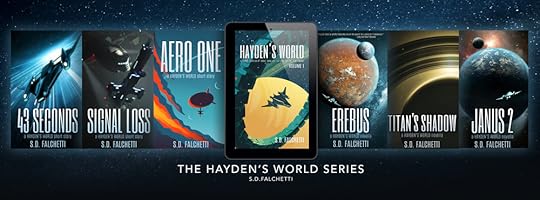
It’s been two-year journey to get here and I keep learning new things as I go along. Here’s a short post about what’s worked best and worst during that time:
BEST
Reading Self-Editing for Fiction Writers before I began. I was spared many of the one-star reviews new indie publishers typically receive due to grammar issues because I was given a very clear template of what not-to-do from this book.
Buying Scrivener and Vellum. Vellum, in particular, makes my books look professionally typeset and produced.
Getting an Adobe Photoshop license for $10 per month. All of my covers and social media graphics are created in Photoshop.
Getting Blender for free. Blender is open-source 3D-modeling software. I’ve used it to create most of the photo-realistic graphics in my cover artwork.
Creating this webpage and blog on Squarespace. The blog is a forum for me to write but also drives more traffic to my site than just having my static book pages.
Creating an author Twitter page and connecting with other authors. I really enjoy participating in weekly hashtag games like #scififri and seeing what other authors are writing. You get a real sense of belonging to an author community.
Setting the first book in my series permafree on Amazon.
Creating an Amazon series page for my stories. Sometimes people read 43 Seconds, go to the series page, and buy the entire series at once.
Submitting my books to unpaid review sites such as Long and Short Reviews, which netted reviews on Amazon, Goodreads, and their webpage, and gave me blurbs for my Amazon editorial review section.
Having a first reader. I’ll get a good work-in-process read about what plot elements are working and failing, and make course corrections or rewrites as necessary. My first reader has spared everyone else from countless bad chapters and cheesy ideas.
Creating a physical paperback. Even if you sell no copies, there’s something pride-inducing about buying one for yourself and seeing your works in print.
Just having fun. The blog post series Pixel Plane Adventures was about my personal journey learning about aviation. There was no agenda for it — I wasn’t trying to sell copies of my books, and I didn’t even think many people would read it. Still, it’s one of my favorite things on my blog.
WORST
Doing a Goodreads Giveaway. The winners simply sold their free copies on Amazon and eBay. The single Goodreads review was negative.
Creating a book trailer using Adobe Spark. In hindsight, I’ve never bought a book based on a book trailer.
Using Twitter for self-promotion. The occasional “my book is free this weekend” post is okay, but, in general, you will not get any sales from self-promo links on Twitter, and will likely lose followers if you use your author page mainly for this reason.
Sinking a bunch of money into multiple layers of ads for free book giveaways. Maybe you’ll pick up one or two reviews, but it’s not worth the cost. My stats show that for every two-hundred copies I move, I get a review. You really need to move thousands of copies with a promo to pick up more than one or two reviews. When giving out your book for free, keep in mind people will scoff up freebies simply because they’re free. The quality of the review differs from people who intentionally buy your book because they are fans of the specific genre.
I think the last bit of advice I have is that it helps to accept that not everyone is going to like your stories, and it doesn’t necessarily have anything to do with how you write. The genre of sci-fi is very wide. Some people want space opera and others want hard sci-fi. Finding your core audience, and, more importantly, helping them to find your work, is the real trick (one I’m still working on). Your audience is out there, though, so keep looking.


November 20, 2018
Janus 2 - Story Extras
WARNING: Major Janus 2 spoilers follow! Be sure you’ve read it before proceeding.
Janus 2 is the longest of the Hayden’s World stories, racking up just over thirty-thousand words spread across seventeen chapters. It’s also the most complex, sporting a moderately large cast, and is the first major story in the series to use multiple point-of-view characters. If you’re counting, you’ll get point-of-view segments from the following characters:
James
Ananke
Ava
Hitoshi
Isaac
When I wrote Erebus, I needed to choose between maintaining a single POV (Sarah’s) or doing multiple POVs. I kept with single. It was Sarah’s story, and much of the plot revolved around finding James. This sacrificed all of James’s off-screen action, such as crashing Bernard’s, but I think it was the right choice for that story.
I have to admit that it’s hard for me to imagine Janus 2 told from a single POV. Imagine sticking with Hitoshi and just getting a data dump of James and Ava’s visit to the alien ship, or sticking with James and missing out on Hitoshi’s character arc to step up and take command of Bernard’s. It’s something I may get dinged on — some readers don’t like multiple POV characters in shorter fiction — but I think it’s the right choice for this story.
When I set out to write Janus 2, I knew my beginning, end, and major plot events, but I had some flexibility about how to get there. I have an entire folder in Scrivener titled “Scrubbed” which houses my deleted scenes. Sometimes I’ll write a segment and realize it’s best condensed with another existing scene. Other times my first reader will give me a puzzled look after reading a chapter, and I know I’m in trouble. One of my favorite chapters to write was Penitente, which starts at the crystal crater and ends with a blast. In the first draft, the crystal crater was simply the crater next to the cryovolcano where Bernard’s had crashed. There, the crew discovers a mysterious tunnel which they send drones to explore. Here’s a snippet:
James motions to the tunnel. “We good to send the drone in?”
“Alright,” Beckman says. He moves over to his console and taps a few commands. His drone zips over to the tunnel entrance and flicks on a flashlight. The rock gleams with reflections as the drone descends. As the tunnel wreathes about it, they notice a spiral pattern etched in the stone, as if a mechanical bore cut the passage. The signal pixelates, fades back in, pixelates again, and goes black.
“Too much rock to transmit through,” Beckman says. He stares at the three-dimensional map. “Give it ninety-seconds to do a loop and come back.”
Everyone waits, arms folded. The chronometer spins. Sixty seconds. Ninety seconds. One-twenty. No drone.
Beckman stares at the screen. “Hmm. Well, we have two more.”
James nods and Beckman sends in the second drone. Its signal pixelates and it disappears into the depths. Three minutes goes by. Nothing returns. Beckman scratches his head.
“Alright then,” Hitoshi says. “Gave it the old college try. No harm, no foul.”
“What do you think?” James says to Beckman.
He raises his eyebrow. “Could be something screwing up their sensors. Might be stuck down there.”
“Or maybe something ate them,” Hitoshi adds.
“What do you think of us suiting up and taking a look?” James asks.
Beckman and Hitoshi both say simultaneously, “I think that’s a bad idea.” Beckman arches an eyebrow at Hitoshi.
Hitoshi holds out his palm. “Seriously, have you guys never seen a sci-fi flick?”
It was fun, and gave the characters an excuse to explore on foot. Ultimately, however, the panspermia plot worked better with the separate locations, and the way the characters investigated each location gave the whole cast a chance to shine.
One of the more significant choices was whether to allow Ananke to establish communication with the alien probe after it abducts her. Another way of saying this, from a plot perspective is: does Ananke rescue herself, or do James and Ava rescue Ananke?
Here’s a snippet from the scrubbed chapter “Qubits”:
Ananke’s built a very basic vocabulary of one to two hundred concepts. She’s been most successful with stellar objects such as star, planet, moon, or items related to these, such as orbit or crater. Items located on Janus have also netted recognition, such as the life forms at the crystal crater, the biological life at the cyrovolcano, and Gossamer Goose. Verbs have been maddening. The entity doesn’t seem to grasp her examples of something doing an action to something else. Each concept she presents is done pictorially through her input/output matrix. Anything abstract, such as letters or numbers, is nearly impossible to present and nets no results. The one consistent thing about their conversation is that the entity will only answer queries as true or false, and does not initiate any of its own queries.
Query, Ananke projects. Origin - Janus?
The entity shifts its qubits. FALSE.
Ananke conjures an image of the one-hundred-and-fifty stars within twenty light-years of the Sun. Query: Origin - local?
FALSE.
She expands the star selection to include the three-hundred light year span of the Local Bubble in the Orion Arm of the Milky Way. Query: Origin - Local Bubble?
The entity illuminates. TRUE.
Unfortunately, as interesting as her conversation would have been, the trade-off is the sacrifice of the dramatic rescue scene with James and Ava aboard the alien ship. My first reader also felt the alien probe, as introduced in the Penitente chapter, was very scary (which was a good thing) and maintaining the lack of communication kept it scary. The true/false dialogue served to dilute its impact, not enhance it.
One other choice was a bit less dramatic. Originally, after Penitente, I followed Hitoshi’s investigation before eventually returning to James. The benefit was that the reader didn’t know if James was alive, and needed to discover it along with Hitoshi. But, I figured the reader wouldn’t seriously wonder if I’d just killed off the series title character, so I cut right to the chase by hitting the rewind button and watching the cockpit events from James’s POV.
On the science front, I found this story unusually difficult. Most of my stories have some planetary science, which I feel is in my comfort zone. Janus 2, with a main character who is an astro biologist, put me in a pickle writing about biology, which is not at all in my comfort zone.
A few bits of science which took some research for the story:
The Cayman Rise is already being studied, full of unusual deep sea hydrothermal vent life forms. When people talk about possible life on Enceladus, they reference the deep sea vents of the Cayman Rise.
The bit about vibrio fischeri is true. It’s a bioluminescent bacteria which lives in the Hawaiian bobtail squid, and forms a type of invisibility cloak for the squid by reproducing lighting conditions which are above the squid.
The International Academy of Astronautics does currently have first contact protocols, but they’re more along the lines of what you see in the move Contact (swinging telescopes off axis, verifying signals, then figuring out what to do). In general, however, we don’t really have much of a plan for what to do if aliens say hi. When you read about some of the things we’ve haphazardly done — like beaming a bunch of Twitter messages to nearly star systems — you will probably be dismayed.
Ava discussed looking for molecular hydrogen and methanogenesis when investigating the cryovolcano for life. The real-life Cassini probe found evidence of both in Enceladus’s cryovolcano plumes, intensifying speculation that life may be present in its icy saltwater oceans. She also mentions looking for vinyl cyanide and azotosomes. Both are hypothetical non-carbon based life structures which could survive in Titan’s methane lakes.
Julian’s quote, “We are all made of stardust,” is popular and accurate. All heavier elements and metals in our bodies were produced from supernovas, which is kind of a cool thought.
Kate’s ATP synthase deficiency is a real-life mitochondrial disease. When I considered what type of disease Kate had, I realized it couldn’t be something which was presumably curable in the future. Instead, I thought her disease would be a consequence of future technology — in this case, an unforeseen consequence of genetic manipulation.
As Julian says, polyoxometalate is an inorganic metal-ion which has some medical properties as an anti-viral and anti-bacterial. It’s also nearly impossible to spell, based on my numerous proof readings.
If you’ve read my previous stories, you’ll notice a few shout outs:
The “keep dreaming big'“ business card which James gave to Julian is the same one he gives Kyan Anders at the end of Last Stand.
Titan’s Ligeia Mare station, where Julian worked previously, is the same staton which sends an autonomous rescue vehicle to pick up Jia and Ping in Titan’s Shadow
Ananke reveals that she is an Intentional Consciousness, but that she’s always thought it would be romantic to be Emergent. In the story, Last Stand, Rios is classified as an Emergent Consciousness after developing sentience while aboard the Aristarchus
The U.N. Hermes played a part in Last Stand, Aero One, and Titan’s Shadow. Despite it hassling Bernard’s upon arrival at Janus’s conclusion, it’s one of the good guys, keeping Cassini Station safe.
Thanks for reading! Hope you found the tidbits interesting.
November 16, 2018
Janus 2 Launch - Erebus is free
Janus 2 is live in the Kindle store today. If you haven’t read the prequel to Janus 2, Erebus, you can get it FREE over the weekend (11/16 - 11/20).
November 11, 2018
Janus 2 (First Chapter, 1500 words)
Late-day sun drenches asphalt as the motorcycle winds along the coastal highway. James banks right and the sky leans left. Kate’s arms encircle his waist, her chest rising and falling with each breath. To their left, the Pacific is a tapestry of shining diamonds with a single sailboat silhouetted against a goldenrod horizon. They watch the boat bob against the waves for a moment before James rotates the throttle, the motorcycle’s engine whining, veering them off the highway onto a dust-soaked road.
“Going somewhere?” Kate asks over her helmet mic.
James glances back over his shoulder. “I want to show you something.”
The landscape flattens as the bike clears the crest. Two buildings stand to the right, the first a long-abandoned convenience store with sand-blasted lettering. Dirty windows show hints of counters and chairs inside. The second is a twenty-meter rectangle with a girder roof and two huge sliding white doors. Parallel one-kilometer roads run in front of the buildings, the closest overgrown with dirt and grass, and the furthest paved and clear with white dashed lines and huge block numbers reading 30. James pulls the bike beside the sliding white doors.
Kate removes her helmet and runs her fingers through her blonde hair. A silver ring dangles on a chain from her neck. She’s eighteen, same age as James. “Why do I get the feeling we’re trespassing?”
James grins and waves a hand. “No worries. I got permission from the owner.”
She arches an eyebrow. “You asked permission for something?”
He motions to the door and walks over towards the handle. “Don’t you want to see what’s inside?”
Her eyes dart to the structure. “Okay, now I’m curious.”
James anchors himself and tugs with both hands. As the sunlight spills into the hangar, the white wings and black propeller appear. Gold glares from chrome accents on the nose and the livery is marine blue with brick-red stripes stenciled with N147CP.
“Woah,” Kate says. “Will you look at that?” She walks over and runs her hand along the airplane’s cowl. “It’s a classic. Did you…did you buy it?”
James nods. “Found it in a salvage yard. Bought what was left, pieced it back together. Purrs like a kitten.”
“What’s it run on?”
“Good old gasoline. Nineteen-ninety-two Piper Arrow Three. They only built six that year.” He moves to the passenger-side. A foot-step juts out from the fuselage and the wing has a black non-slip surface next to the door. James leans over, opens the door, and steps up. He extends his hand and Kate accepts. They slip into the cockpit and settle into their seats. “What do you think?” James says.
She sets her hands on the yoke and turns it slightly. He points over her shoulder at the right wing and she watches the aileron move up and down. “Oh, this is awesome. I love it.”
James flicks the red battery switch on. Indicator lights illuminate. “Would you latch that door?”
She pauses a moment, a smile creeping across her face, and pulls the door closed. Without saying a word she slides the seatbelt across herself. “Where are we going?”
He hands her a headset and motions towards the plane’s nose. Rich blue sky awaits. “You know, that-a-way, just higher,” he says over his mic. When he flips the beacon switch, red light spins in the hangar. Leaning towards the window, he says, “Clear prop!”
The propeller sputters to life when he turns the starter. He adjusts the throttle and turns on the avionics and navigation lights.
Kate taps the Garmin in front of her. The individual pixels of the airplane stick figure are visible. “Oh, wow, look at this navcon. That’s….is that even a computer?”
James taps the power button off. “We don’t need it. Guys flew for half-a-century with nothing but eyeballs and radios.”
“You sure this is safe?”
“Safe as anything else in life. Wanna go?”
She eyes the crystal sky and glances back. “Yeah. A little different than your dad’s planes, huh?”
James snorts. “You’re just along for the ride in those. This…” He turns the yoke. “…this is real.” He clicks the thumb button. “Fairway Cove Traffic, Piper one four seven charlie papa at east hangar taxiing to runway three zero.”
Kate quirks her head. “Who are you talking to?”
“Whoever’s out there. Maybe there’s another James and Kate puttering around in a seventy-year old plane. Gotta do it right.”
She sets her hand on his. “I think the universe can only handle one James Hayden.”
He winks at her and edges the throttle forward. “Well, I’m lucky this one found his Kate.”
* * *
James at forty-one doesn’t look much different than he did at eighteen, one of the fortunate blessed with a baby face and sandy hair hiding any hint of gray. He taps the Sandpiper’s controls and watches Earth’s blue marble spin away. As the star field pans, Hayden-Pratt’s MEO2 shipyard swings into view, a brightly-lit lattice cradling a sixty-two meter wedge. Gold interior light glows from the wedge’s cockpit and spotlights illuminate patches of the fuselage. Black registry letters read HP-G01 Gossamer Goose. In the ship’s aft, robotic arms spin hull plates into place.
Ananke is beside James, her slate affixed to the dash. Blue ripples spill across her screen. “I remember the first time I saw Gossamer. I was so proud to be a part of fulfilling Bernard’s dream. With her ivory white paint, she reminds me of a spinnaker, catching starlight.”
James smiles. “I think that’s the perfect description of Goose.” As the shipyard grows, filling the cockpit windows, he stretches forward and examines the aft construction. “Looking good. On track for end of week.”
“Any word on launch authorization?”
A quirk of his head. “Larson wants to meet one-on-one.”
Ananke’s screen splashes orange. “Well, that should be interesting.”
“Yeah, curious what he’ll say when it’s off-the-cuff. I kind of like it. Two guys sorting it out, no audience.”
Green ripples slide across Ananke’s face. After a pause, she says, “If I could offer an observation.”
James arches an eyebrow. “Shoot.”
“Two guys sorting it out is often more brawn than brain, so to speak.”
He chuckles. “You think I’m going to deck him?”
“No. But ego might overtake intellect.”
A shrug. “I think I can handle it. Anyway, it’s a negotiation. He wants something. If it was just him digging in his heels there’d be no need to meet.”
“Agreed.”
James taps the comm. “MEO Control, Sandpiper four four three, ready to dock.”
A synthetic voice replies, “Cleared to dock Sandpiper four four three.”
A tap on the arm panel and the ship spins ninety-degrees. Thrusters hiss with corrections as the Sandpiper settles into the umbilical with a clank and a jolt. James picks up Ananke and tethers her to his flight suit belt loop, then pushes out of his chair and sails to the belly hatch. When it opens, he ascends through the umbilical to Gossamer’s starboard entry, emerging into the passenger cabin and a din of conversation. Hitoshi is here, peering through augmented glasses. Six other techs have bits and pieces of the cabin disassembled.
“Hey, boss,” Hitoshi says. “Don’t mind the mess. So, what’d you think on approach?”
“Cargo area looks good. Saw the new ventral heat shielding. Black, kind of like an old NASA shuttle.”
“Yeah, I thought you’d like that. Got confirmation that the last Bernard’s repair parts are fabbed and loaded.” He motions around the room. “You now have a level two starship. Plus five hit points, plus three dexterity.” A pause as he waits for a response. “And you’ve never played a video game in your life, have you?”
James holds up his hands. “Sorry.”
“You know, between you and Sarah, it’s like you two were separated at birth. She’s been very helpful, by the way, doing telepresence uplinks for questions. I know she’s supposed to be on leave, but she knows all of Gossamer’s quirks.”
James raises his eyebrows slightly. “Goose will always be her ship.”
Hitoshi extends his slate. “I’ve got something for you, Ananke.”
Ananke’s screen pulses orange. “Ah, beautiful! The new Boseman interference patterns, like peaks and valleys beating in a symphony. Ready for the low-power test?”
“With your approval, Friday.”
“Yes. It’s perfect.”
“Alright, you got it.” He shows the slate to James. “This started as a permanent fix for the strangelet event from the last mission, but Ananke ran with it. Some adjustments to the wave generator placements and parameter tweaks will give us a big efficiency boost. We’ll hit ninety-nine point nine six percent light-speed. Had to carve out more fuel space for the reactor. Best part is that it’s reapplicable to Bernard’s.”
“That’s fantastic,” James says.
“Told you. Plus three dexterity.”
* * * *
November 10, 2018
Janus 2: Now Available for pre-order
The new sequel to Erebus, Janus 2, is now available for pre-order on Amazon for 99 cents. Release date is Friday, November 16th.
Janus 2 is a 30,000 word novella featuring your favorite Gossamer Goose crew members on a return mission to repair Bernard’s Beauty and discover what the silver probe was doing on Janus. It’s another interstellar adventure with plenty of discovery, danger, and fun - this time with James in command - so be sure to grab your copy.
October 7, 2018
Plug-and-Maybe-Play
Long ago, my house had a spare bedroom. It was tiny by bedroom standards - one of those closet-sized spaces which realtors class as a bedroom to enable houses to meet the magical three-bedroom descriptor which so many buyers crave. I’d built my little computer empire there. I remember when I ditched my CRT monitor in favor of a flat-screen LCD snatched from an open-box sale at Best Buy. The other big purchase I recall was a graphics card. At the time I’d been playing World of Warcraft, and after booting up the game post-card installation, I wondered what have I been playing all this time? It was a similar experience to switching from an SD TV to an HD.
Fast-forward a decade later and my computer room has dissolved and relocated to a desk on the first floor. Another few years and it’s a laptop in the living room. Modern laptops are quite powerful, with their lightning-fast SSD drives and, depending on the model, discrete GPUs. But, what they grant in portability they trade-off in upgradability. You simply cannot plug a new graphics card into your laptop.
With Apple’s recent OS update to Mojave, however, you can connect an external GPU enclosure via the laptop’s Thunderbolt port. If you’ve ever upgraded a graphics card in a desktop PC, you know it involves sliding the card into a slot and potentially upgrading the laptop’s power source. An eGPU enclosure is similar. It has its own power source as well as a slot for your card. It just exists outside of the laptop. It’s not that eGPUs couldn’t be used prior to Movaje with Apple computers; it’s just that Mojave provides official software support.
Sort of.
For those who followed my Pixel Plane project, you know I’m an X-Plane enthusiast. X-Plane is a bit demanding on system resources, and I have a desire to play it at more than 20 fps. So, this past week I purchased the Gigabyte eGPU with an RX580 graphics card.
Unlike most enclosures, the Gigabyte Game Box is slightly smaller than a lunch box. The box has four USB ports, one Thunderbolt port, three display ports, and one HDMI port. It’s capable of charging your laptop while connected via the Thunderbolt port. From an Apple Mojave OS perspective, it’s plug-and-play. No drivers to install. It just turns itself on when you open your laptop. A little icon in the system tray allows you to eject it, similar to a USB drive.
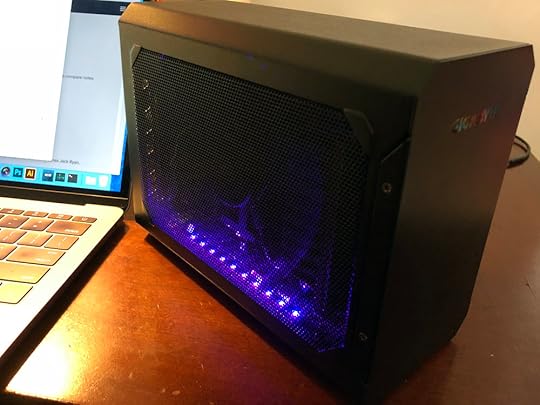

One of the things I waffled about prior to purchase was that eGPUs are designed to be an intermediate between the laptop and an external monitor. Meaning, the eGPU intercepts and accelerates the graphics on their way to the external monitor, but does nothing for the graphics on your laptop display. Since I don’t intend to use an external monitor, this was a bit of a deal-breaker.
Prior to Mojave, there were some work-arounds for this, including a shell script which redrew the eGPU’s output back to the internal display. With Mojave, it’s now a checkbox on the application. When you View Properties for any app, a checkbox titled “Prefer eGPU” is available if you have an eGPU present. This will, in theory, force your eGPU to accelerate the graphics and display them on the laptop’s internal display.

When the eGPU arrived on Friday, I remember unboxing it and saying to my wife, “I know how this is going to go. It’s supposed to be plug-and-play, but I’m going to end up spending all weekend troubleshooting it.”
My experience:
The unit itself was plug-and-play in terms of Mojave recognizing it immediately. There’s a row of color-changing LEDS visible through the eGPU grill which illuminate when it’s connected. The fan, which is about as noisy as my laptop’s internal fan, runs whenever the lights are on.
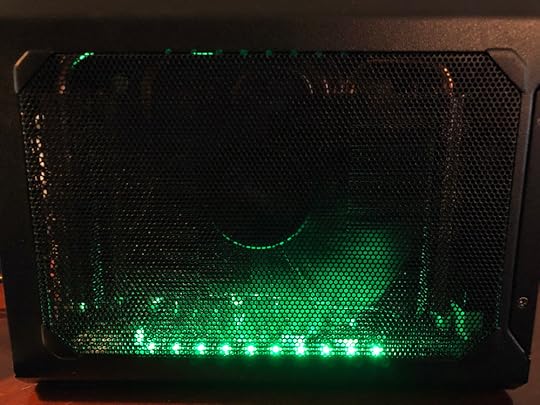
Whether the eGPU accelerated graphics and which display it was capable of accelerating was entirely dependent on the specific application.
Eve Online: all I needed to do was check ‘Prefer eGPU’ and it was accelerated right on my native laptop display.
Divinity Original Sin: could only be accelerated on an external monitor. The laptop display always reverted back to the integrated display chip.
X-Plane: could not be accelerated at all, either via internal or external displays. I also tried running X Plane in Windows via Bootcamp (which was its own technical saga to get the eGPU working in Bootcamp), with similar results. The weird thing about X-Plane is that it engages the eGPU, switching off the internal chip (you can verify this via Activity Monitor), but it doesn’t seem to actually use the graphics acceleration of the eGPU, giving you much, much worse performance (single digit FPS) than using the laptop’s integrated chip. I suppose this performance hit makes sense because it’s neither using the external nor the internal GPU for acceleration. If you visit the X-Plane forums, you’ll see a statement from the software developer that eGPUs are not supported at this time.
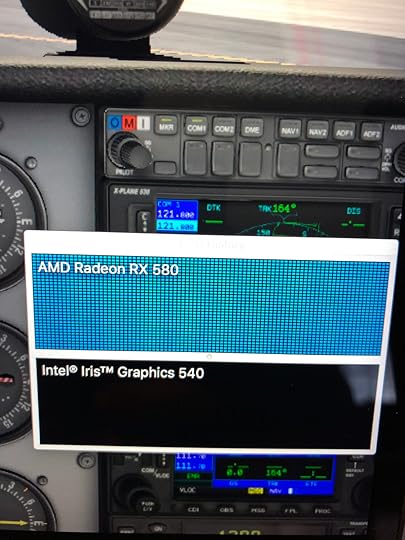
So, there you have it. It’s application dependent. For X-Plane, I’ll need to wait until Laminar adds eGPU support, or someone clever develops a work-around. For other games, I’ve ordered a headless ghost emulator ($10), which plugs into the back of the eGPU, tricking it into thinking it’s using an external display. I suspect this will get Divinity to render on the internal display. I’ll keep you posted.
September 29, 2018
Reality Check
When I first purchased X-Plane, like many, I loaded up my home airports. The main regional airport is on the east side of the river and the small county airport is on the west. I’ve practiced virtual pattern work at the county airport, as well as doing countless short hops from the regional to the county.
This past week I had a business trip flying out of the regional airport. As a passenger aboard a CRJ900, I found the departure especially exciting. I’d been on the virtual versions of all of the airport’s runways and taxiways and knew them well. I knew how to read the assorted signs and taxiway markings. I could see the hold short lines approaching ahead, and expected the airplane to stop and await clearance. As it did, I eyed the block numbers on the runway. 22. I visualized the two-hundred and twenty degree heading out of the airport, pointing southwest, and produced a mental image of the VFR landmarks I’d spot after take off. And here I was very curious - would I be able to pick out the small county airport from the air, and how would it compare to my virtual experience?
The jet rolled down runway twenty-two and rotated, smoothly ascending. I watched the main airport drop away, eyeing the general aviation area and trying to pick out the models of the assorted aircraft parked there. Green grass spun by, then the white roof tops of an industrial complex. To the right, the blue-gray of a winding river appeared.
When I practiced my virtual pattern work, I used two islands in the river as reference points. They were easy to spot in real life from my window seat. And here is where my jaw dropped. They were so close. Walking distance close, and huge. The small county airport also wasn’t so small, its surrounding grass swathe impossible to miss (although the runway itself was difficult to make out, blending in with the landscape).
My brain stumbled trying to readjust its reality. It’s like thinking a house is a mile away when in fact its right across the street. Was X-Plane wrong in its depiction? Had I been experiencing the thirty-seven Pixel Plane airports through binoculars held backwards? I loaded up the same flight in X-Plane, now with a Cessna 172, and checked it out.
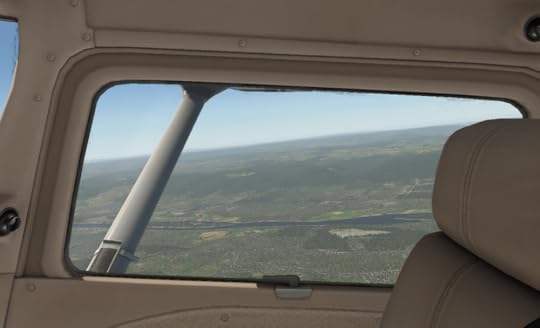
The island is on the right near the bottom of the head rest. The airport field is on the right 3/4 of the way down the wing strut.
There it is, above. A bit hard to see unless you know what you’re looking for. It’s a little easier with an exterior view of the plane:

Field on left, island on right.
I checked the Cessna’s Garmin. 2272 feet to the county airport from my position in the sky. It actually was walking-distance close.
This perhaps is one of the best arguments for VR. It’s a matter of scale and depth. On my 13” laptop screen the field is just under 2” wide, which looks tiny and distant. Now, indulge me in this mental exercise. Take a moment and look up. Mentally place markers at the furthest left and right point in your field-of-view. Divide that view into six equal pieces. One of those pieces would would be the airport. Big, isn’t it! Something which takes up 1/6 of your visual field when viewed from a three-thousand foot altitude must be large and close. Now, add depth perception to that mental image. That’s a very different experience than a 2” collection of pixels on a computer screen.
I admit I’m still not 100% sold on VR, mainly because of my play style (I gave up a desktop long ago in favor of a laptop’s portability), but I’d be curious to experience how different flying would look at full scale with depth perception. It’d be like turning the binoculars around and looking through them the correct way.
The last comment I’ll make from my real-life flight is that it was a partly-sunny day with brilliant white clouds scattered in drifting pockets. For all of X-Plane’s amazing photo-realism, it can’t come close to the beauty and complexity of a real sky. Hopefully future versions will bridge the beauty gap, because the views are half the fun of flying.
September 3, 2018
Thoughts on Amazon's Jack Ryan
I admit, as a movie-goer growing up I didn't make the immediate connection that Harrison Ford in Patriot Games was the same character as Alec Baldwin in the Hunt for Red October.
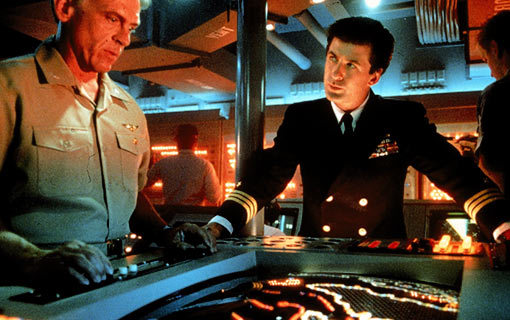
One was a bit on an intellectual desk-jockey and the other was Indiana Jones. Many years later, Ben Affleck, Chris Pine, and eventually John Krasinski would play Tom Clancy's CIA analyst, Jack Ryan. Each tried to put their own spin on the character.
The first Tom Clancy novel that I read was Rainbow Six, which doesn't feature Jack Ryan at all. Although parts of it were silly - the elite anti-terrorist squad happens to be on a flight which is hijacked, resulting in them quietly separating and picking off the bad guys one-by-one, Liam Neeson style - the rest was fascinating. Tom Clancy has a knack for making you feel like you're training with the elite squad and that you understand what it takes to plan and free the hostages. His stories feel like a series of chess moves, each side taking their turn, and you wonder how he'll topple the enemy's king. President Reagan famously said that "The Hunt for Red October" was his "kind of yarn” - pethaps the ultimate endorsement of the story’s 80s sensibilities - and is chided with propelling Clancy to his bestseller rank.
So, what to make of a 2018 Jack Ryan, when Russia's threats come not in the nuclear form but as cyberattacks and election-influencing? Rebranding Ryan as a fighter of modern terrorism simultaneously feels like a no-brainer while coming a decade too late. The reason shows like 24 were such a success is that they were post 9/11 during a time when Americans wanted to see jet fighters incinerate terrorist bases and smart guys keep us all safe. After nearly twenty war-on-terror-weary years, though, it just feels a bit tired. Shows like Homeland freshen it up a bit by taking Clancy's hardware knowledge and applying it to Homeland Security’s inner workings.

Half the fun of Homeland comes from its political maneuvering to get things done - spies being spies and politicians having agendas. In that show's first season, the actual attack is not the show's thrust. The viewer instead is lost in the gray area of whether the lead is a good guy or bad guy, and when we find out, it's not so much we want to see the attack stopped as we don't want see the fallout for his family. It's character drama over plot, and the scene where Brody is on the phone with his daughter trying to decide what happens next is truly intense.
Amazon Prime's Jack Ryan starts with simple chrome block lettering which reads "Tom Clancy's Jack Ryan". It looks like iMovie's stock trailer footage, which is perplexing for a big-budget production, but seems the perfect metaphor for the show’s straightforward world view. Krasinski is a likable Ryan, spinning the character more towards analyst than brawler. His boss, played by the Wire's Wendell Pierce, brings the same intensity you'd expect, and makes the best of the script’s limitations.

The two are on the trail of the "next Bin Laden", globe trotting and always landing where the next shoot-out occurs. The actual plot is very 24-ish, where they thwart an attack, but it's just a stepping-stone to the next attack. There are cliches - higher ups don't listen to the main character's dire warnings, Jack's love interest ends up at exactly the same place as the bad guys - but perhaps most disappointing is that the elite military assault teams fumble through ops with the same precision as Star Wars stormtroopers. If you're going to wear the Tom Clancy badge, do a little research. Authenticity was his thing, after all.
The show has mixed results when it treads into moral ambiguity. The antagonist’s flashbacks of facing subtle discrimination as a Muslim in France are surprisingly restrained, and one of the better parts of the writing. One can imagine a very good Breaking Bad-type series detailing how he spiraled from earnest intellectual to terrorist. His brother’s loyalty is similarly well-written. When his brother is on the run and must choose between murdering an old friend’s family or jeopardizing his mission, the viewer honestly worries what he will do. However, a sublot on the American side with a guilt-riden drone pilot ventures into “what the hell?” territory when we find ourselves in a Vegas hotel room while a perverted husband beats the pilot after a voyeuristic tryst with his wife. This sets up the psychological motivation for the drone pilot to stop an overseas sexual assault with a hellfire missle. Even worse, the bad guy hit by the missile reappears later, Terminator-style, to continue his arc. In Clancy’s books professionals are professional and miltary weaponry is not set to stun.
Despite my grievences, Amazon’s Jack Ryan wasn’t a bad diversion. It’s been renewed for season two and I will watch it. Some very good series - Breaking Bad for example - meandered their first season but later hit their stride. I see Michael Bay listed as a producer - so I’m not optimistic that it won’t all be explosions and gunfights - but I’ll give it a second chance and see where it goes.
August 30, 2018
Cutting the Cord - 3 Months Later
Three months ago I unplugged my Comcast cable box, packaged it up, and shipped it back. After a flurry of app setups on my new Apple TV 4K, I'd gone fully digital, streaming cable channels via the DirectTVNow app and watching network shows via their assorted apps. Now that I've had the summer to experience the ups and downs of cutting the cord, I thought I'd provide an update for all of those dreaming of losing the cable box.
Short answer: I'm happy I did it, and so is my wallet.
My setup: DirectTvNow ($35/month) + HBO ($5/month) + Comcast Internet ($80/month) = $120/month, versus my previous Comcast Xfinity Bundle which topped $300/month.
I also received a free Apple TV 4K with my DirectTVNow trial.
I admit I wanted to go fully Comcast-free, but their internet speeds and pricing were considerably better than anything offered in my area.
Result:
Streaming quality: No issues with buffering or stutters. The only change versus regular cable is that when you first open apps like DirectTV, there is a two second progress bar as the channel loads. Channel surfing: You surf channels on DirectTVNow the same way as normal, with the usual channel guide. DirectTVNow also has a built-in cloud DVR at no extra charge. The channel guide is designed to use Apple TV's swipe up/down/left/right remote. Unfortunately it's executed in a logical but non-intuitive manner. To get to a menu directly left of where your cursor is, you would naturally want to swipe left, but instead you may find yourself swiping up to the top menu, left across the top menu, then down to the side menu. Not a big deal, but a bit quirky.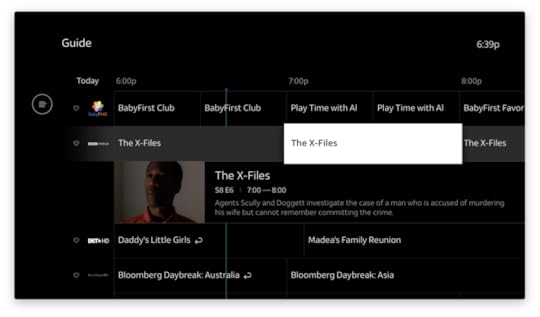
Finding content: Similar to Comcast voice commands, the Siri remote will let you search for programs by voice. In this case, it searches all apps (not just DirectTVNow), so it may respond with something like "Watch on AMC", seamlessly opening the AMC app and streaming the show. Often I just go directly to the network app. For example, I'll just open the HBO app and click on the John Oliver Show to watch the latest episode. Because nearly every tv show can be streamed from its network app, I rarely open the DirectTVNow app (because I'm usually not watching episodes live).

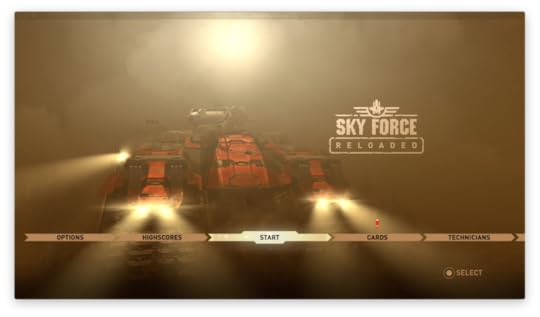
Interface: The network apps in particular are very polished. The Disney Kids app has animated full-screen characters interacting with you as you browse episodes for their shows. It's much more engaging than just reading text on a channel guide.Local channels: At first, DirectTVNow only had Fox available for my local channels, which was an issue because there was some local content I wanted to watch on NBC. I bought a cable antenna and watched it live. Since then, DirectTVNow has added NBC to my local lineup, allowing me to record it using DirectTV's free cloud DVR. I still have the cable antenna - it's nice to know that if there's an internet outage I can still watch over-the-air tv.Games: I bought two Nimbus game controllers. Apple TV has similar games as your iPad, so you can play Minecraft, Asphalt 8, Lego Batman, etc. I have fun playing these with my daughter. Games like Asphalt 8 or Skyforce really feel like console games on a large TV.
Negatives:
It took a good two hours to initially set up all the apps. Every single one needs to be activated by going to a webpage and typing in a code, and everyone needs to be connected to your DirectTVNow account.Infrequently an app will log itself out of DirectTVNow, prompting you to enter your email/password to watch content. It's quick - AppleTV remembers your logins - but a bit of a nuisance.The Apple TV remote is a bit too modern. When surfing, you swipe up/down on its touchpad, which gets old quickly, and you end up fighting with it as it overshoots channels. Call me old-fashioned, but touch surfaces are not always an improvement over physical buttons. Although the remote does turn your tv on/off and control the volume, it oddly has no mute button. I use the pause button when I have to mute the TV.Apple TV lets you do text searches, but does so in the most maddening way possible - by arranging the letters alphabetically in a straight line and making you swipe left and right one letter at a time. It's worse than trying to text on your cell phone from 1998. Fortunately you can use voice commands to either spell things or simply say their names.Not really a negative, but a bit of a surprise that the Apple TV app store is somewhat sparse compared to its iPad counterpart. I'd like to see more apps ported.
But, all-in-all, I'm very happy with my cord-cutting choice. Picture quality is excellent and I like how well integrated everything is. I'm continuing along my cordless journey, and enjoying the extra money each month.
August 19, 2018
Pixel Plane Technical - X Plane Setups
For the X Plane fans out there, I thought I'd share a bit of my setup for my recent coast-to-coast Pixel Plane project. A few basics:
My computer is a 2016 13" MacBook Pro with 240 GB SSD hard drive, 2 Ghz i5, 8 GB memory, and integrated Intel Iris 540 graphics with 1536 MB. Surprisingly, this runs X Plane moderately well, as you can tell from the screenshots. My graphics settings are: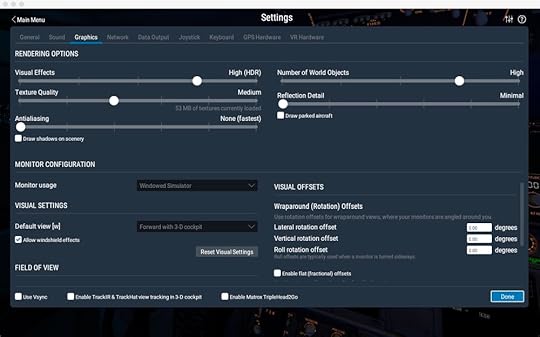
Texture Quality = High was fine for default aircraft, but many of the payware aircraft come with 4 k textures, which would overload my graphic chip's measly memory. The difference between High and Medium was normal and single digit frame rates.
On the most part, I ran vanilla X Plane. Here's the small list of tweaks:
I downloaded satellite photos from Bing using Ortho4XP. By far, the biggest improvement you can do for X Plane is to use ortho photos. These use up a lot fo disk space, though, so in my case I'd download a set for the next three airports and delete the previous set. With a little editing of the config file you can set Ortho4XP to download higher resolution photos in the vicinity of each airport.
MisterX's free KSFO and KLAX airports, available from the X Plane forumsMisterX's Airport Environment HD, HD Forests, and SierraPappaYankee's 4K Moon texturesTrixsta's Better Lights.txt modification - changes the colors of city lighting to a mix of white and orange, which looks much more realisticSimheaven's VFR Landmarks - adds wind turbines and other structures.My airplane was JustFlight's Warrior II. I modified the livery to have custom tail numbers (for those following my stories, they're Lucky Cricket's numbers from Titan's Shadow. I used X Plane's Plane Maker tool to change the tail number for the model, so X Plane ATC would call me by it.WorldTraffic3, which I ended up with mixed feelings about. It did add thousands of flights in the air, which you could see on its radar display. In game, usually you would only encounter those flights immediately over airports. Since most flights were commercial jets, even if you were at the same place and time as one, often they were twenty-thousand feet above you and non-visible. On the ground at airports, however, it was fun seeing the steady line of jets taxi and take off.
For flight planning, I used SkyVector.
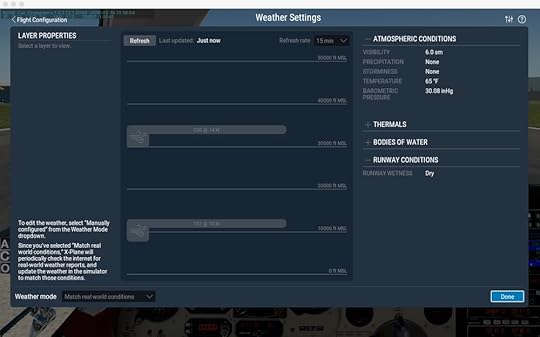
I enabled X Plane's real-world weather, which downloaded the weather every fifteen-minutes for wherever I was flying. I liked this - clouds would roll in, fog would develop, and winds would change over the course of a flight. You could see storms and fly around them. Its only downside is that it could be abrupt. You'd hit the fifteen-minute mark, get a data download, and suddenly clouds would appear around you with wind gusts. In reality you would have seen those clouds and not entered them in the first place. It did make me cut some flights short and find local airports to set down in until weather improved, which I liked.
The few times I used X Plane's built-in ATC were disappointing, because it tried to murder me. It's oblivious to terrain and other aircraft, steering you in mountains. On approach to Albuquerque it kept telling me to descend two-thousand feet below surface level, causing me finally to turn it off. I did like that it was easy to use, though, and had real voices, including other aircraft's comm chatter. It's main function is more of a talking GPS, though. Using it for an IFR flight where ground visibility is limited would be disasterous.
I'm looking forward to trying real ATC via human networks (most likely Pilot's Edge). Flying into LAX with no ATC just felt weird.
One piece of equipment I didn't use (because I'm too cheap to buy it) is TrackIR, which gives your cockpit a VR-like experience by tracking your head and moving the cockpit view to suit. But, as I try to do pattern work and learn more about flying, I find I really need to move my head and look around. Pressing function keys to look ninety-degrees left is clunky. I'll probably get a TrackIR unit at some point.
That's it - hope this helps if you're considering your own virtual adventure.