S.D. Falchetti's Blog, page 2
May 15, 2022
Thoughts on Star Trek: Strange New Worlds
Star Trek peaked in the early nineties. Trek fans could feast on their pick of golden-age shows: Star Trek: The Next Generation. Star Trek: Deep Space Nine. Star Trek: Voyager. After a bit of a lull, Star Trek: Enterprise attempted to revitalize the franchise in the early two-thousands. Enterprise was perhaps the first flat-footed attempt in what would become a series of misfires to ride the Star Trek coat tails. I liked Enterprise, but it was off, in the way that watching fan fiction is often off. The problem is that the heart of Star Trek is not warp nacelles, phasers and transporters. If there’s one thing I wish I could convince the writers of 2022, it’s just that. It’s not about the gadgets. If you think back to the Next Generation, you’ll instantly envision Captain Picard giving a principle-based speech to either his crew or aliens at a critical decision. If you think of Voyager, you’ll see Janeway wrestling with doing the right thing while trying to get her crew home. In each case, the crews are good, professional people trying their best to help others. Star Trek, for all of its high tech gadgetry, is fundamentally about its characters and the trials they face in their quest to do good.
The J.J.Abrams reboots somewhat exasperated the flat-footed problem by falling into the sugar-rush hyper activeness of the CGI special effects trap, a trend that would continue to modern day. His plots often used hand-waves to ignore non-sensical elements, scooting the viewer along with the next glitzy explosion to keep him from thinking too much. The first movie was, admittedly, enjoyable, however, because it tapped into a bit of the goofy sense of adventure that permeated the original series. Sure, the characters were in life-and-death situations, but they were having fun, and their fun extended to the viewer.
In the past few years, Star Trek has returned with Star Trek: Discovery and Star Trek: Picard. I made it through about three episodes of each. These illustrate my point that gluing warp nacelles onto your ship is not enough to make it Star Trek. Fortunately, you can imagine that the executives at Paramount read the tea leaves and said, “You know, there’s probably a whole segment out there that we can market to that just wants plain old Star Trek.” And so, Star Trek: Strange New Worlds was born.
I’m two episodes into Strange New Worlds and I like it. It’s not perfect, and it is, indeed, plain old Star Trek (perhaps to a fault). The opening credits encapsulate the show nicely. It’s a mix of classic elements and glitzy CGI. It’s not a nineties Star Trek series, but it’s not a Star Trek: Discovery series either. It’s somewhere in between:
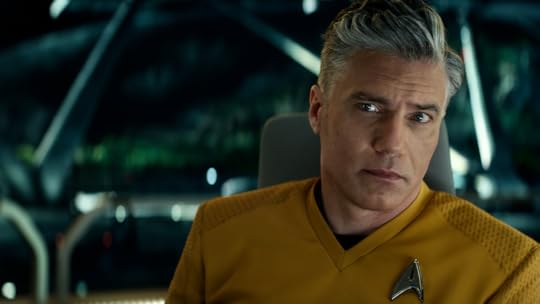
The original 1960s Star Trek pilot had the Enterprise commanded by Christopher Pike, with Spock as his science officer and Majel Barrett as Number One. Star Trek: Strange New Worlds returns to this Pike-captained Enterprise. Spock is here, and the show takes some liberties by introducing Uhura as a cadet. Pike, played by Anson Mount, is charismatic and kind. He’s instantly likable and seems like the type of captain you’d like to work for. He has some crazy graying hair (sometimes upstaging him) which Anson jokes about as being “the best hair in sci-fi”.
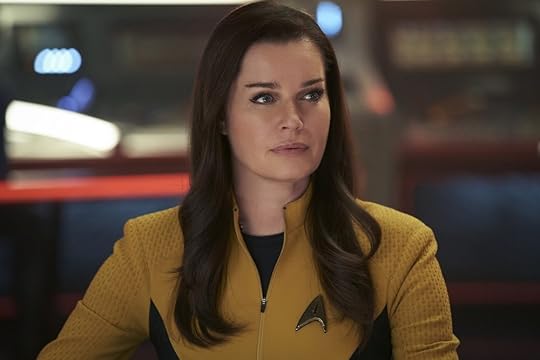
Rebecca Romijn plays Number One. She’s serious and professional, in much the same way that Majel Barrett was in the pilot.
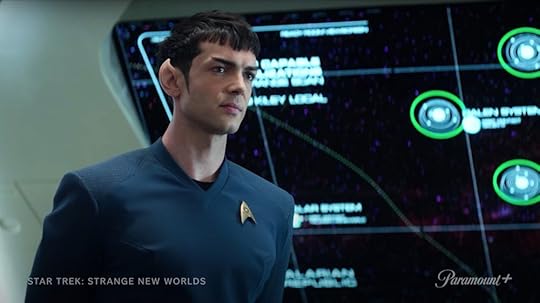
Spock is played by Ethan Peck. The writers have tried, once again for some reason, to coolify Spock. To all of the current and future Star Trek writers: please stop. Spock does not need to be made cooler. Strange New Worlds Spock is certainly likable, but the viewer being introduced to a shirtless Spock about to have a love scene, talking with Pike on a viewer while his scantily-clad partner reclines on the bed just seems very J.J. Abrams. Spock is not James Bond. Spock is Spock. That being said, the actor, like the entire cast, is excellent and brings a warmth to his character.
Other notable officers include:
Melissa Navia as Erica Ortegas. Warm and interesting, like the other characters, but I kept expecting her to speak Belter and to hail to Rocinante. Christian Chong as the security officer La’an Noonien Singh. Yes…same last name as Khan Noonien Singh. That Khan. I’m not sure where the writers are going with that, but I ask them: wherever it is, is it necessary? Can’t we just have a bridge crew that are their own interesting people without each person needing to have some monumental dark past? I mean, do you remember Scotty’s dark past? Chekov’s? No you don’t. Were they interesting and fun characters nonetheless? Yes they were. For the record, if we end up with a scene where Pike yells “La’an!” into a communicator, I will be quite disappointed.

In sick bay we go a little off the rails with Nurse Chapel, played by Jess Bush. For some reason the writers have given Nurse Chapel a borderline personality disorder where she likes to surprise-inject people with painful hyposprays because it’s “more fun that way”. I imagine they were shooting for quirky but ended up with someone you’d probably get a restraining order against. By they way, none of these comments are critiques on the actors. I think they are all superb. It’s critiques on the writing.

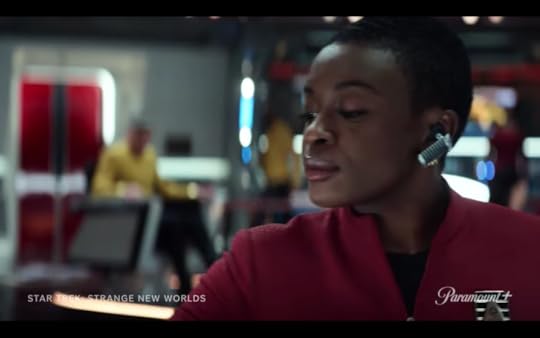
Uhura appears as a cadet who is not sure she wants to be in Starfleet, played by Celia Rose Gooding. Although she doesn’t seem like the cool professional portrayed in 1960s Trek, she does a great job of fulfilling the role of a fresh-out-of-school talented cadet with a bright future. One could imagine how she would mature into the Uhura on Kirk’s Enterprise.
I had to think a bit about how to describe the sets, and the best description is that the series has its own look. I think, overall, I like it. There are elements of the original 1960s concepts extrapolated to the hyper-modern look of more recent Star Trek series. The result is something that’s neither over-the-top nor overly retro. It works.
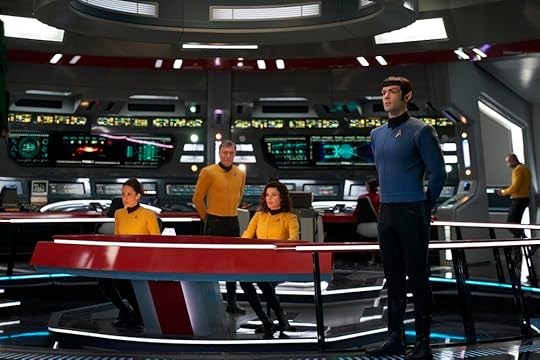

And now, the plots. I was pleasantly surprised to see straight-forward plots that even took breathers for character development. Case in point: Episode Two starts with Uhura nervously attending a dinner with the Captain and other officers. A good five minutes of nothing but dialogue exchanges occurs over dinner, and we learn something about both Uhura and Pike. A lesser series would get about one minute into the scene before there was an attempted mutiny or surprise attack, but Strange New Worlds lets the characters breathe. The dinner ends not with a “Shields Up! Red Alert!”, but with Spock walking Uhura back while chatting with her about her Starfleet uncertainty.
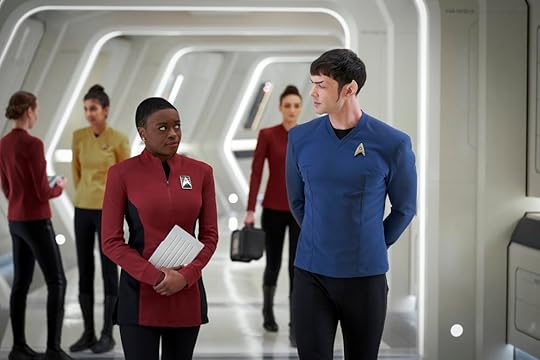
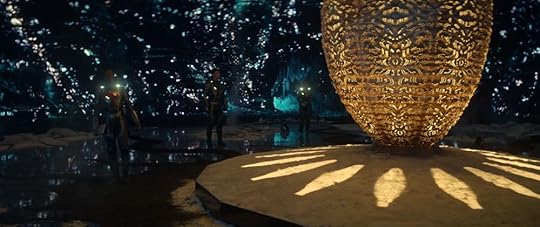
The first episode is a Prime Directive/First Contact plot where a pre-warp civilization (think Earth 21st century) has somehow created a warp signature. Contact was lost with the Starfleet ship sent there to investigate. When Pike and crew arrive, they must beam down to the plant disguised as locals to find the missing crew members and determine what’s happened. The resolution involves a classic captain’s soliloquy to the alien leaders. It feels like Star Trek. This could easily be a Captain Picard speech, and you feel like you’ve seen this setup before. In fact, it’s a basic plot from classic episodes that has one element spun (how they created the warp signature and what it will be used for).
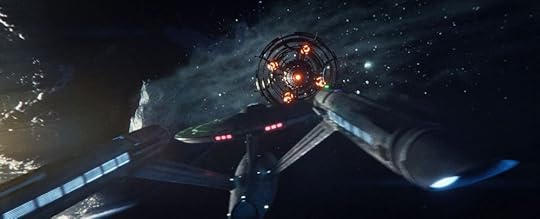
Episode two has a comet on a collision course for a planet that houses a primitive civilization. When Enterprise attempts to nudge the comet away from the planet, they discover it is actually a technological device. If this plot sounds familiar, it is, essentially, a spin on the 1960s episode, “For the World is Hollow and I Have Touched the Sky”. In that episode, Enterprise is sent to divert an asteroid on a collision course with an inhabited planet. The asteroid is technological, and contains an entire world within it. The world’s inhabitants are oblivious to the fact that they live in an asteroid, and they are kept that way by a central computer. Similar to Strange New World’s episode one, episode two is a mash-up of classic episodes with one element flipped. Pike and the Enterprise crew resolve the situation not with force but by being clever, which, once again, is a good thing.
So, what to make of it? I like it. It feels like its own show, which actually says a lot considering it is using several pre-established characters and events. The environments are a bit magical, in the same way that the Lost in Space Netflix series does an excellent job of evoking a sense of adventure and wonder with its strange locations, and I hope there are many actual strange new worlds ahead of us in the series.
The crew is very likable and every now and then the shows pauses to let them be people - which is something that’s been lacking in so many recent Star Trek attempts - and they do have the classic Star Trek vibe of good people trying to do good things. The plots feel a little lazy so far, dusting off classic episodes and swapping out one thing for another to call it something new, but the execution of the episodes is done well and both have been enjoyable. I’m cautiously optimistic about where the journey is heading, and looking forward to the next episodes to find out.


March 24, 2022
Getting Real
From my view in the pilot’s seat, the runway streaked underneath me as the airspeed indicator crept up, the rumble of the full-throttle engine muffled by my headset. As I pulled back on the yoke, the Cessna’s nose lifted and the yoke pulled back, as if I were holding the plane up with my own strength. The jolting vibration of the wheels jostling upon runway subsided as my weight shifted back and down into the seat. Now, nothing but air supported the plane. Blue sky crept down, displacing the ground in my vision, and the C172 climbed into the sky.
This could be a scene from one of my books with James at the controls, but it was real, and I was actually flying that Cessna. I’d been thinking about flying lessons for a while now, and the first step in that journey was a discovery flight to see if real flying was for me. I’d been an enthusiastic fan of simulated flying - I have a YouTube channel where I post Microsoft Flight Simulator and X-Plane flights. Would those countless hours of simulated flight help me at all when I got behind the controls of a real airplane?
I planned on writing a long blog post about it, but the day after my flight I made a YouTube video where I described the experience. I don’t think any words that I write on a blog can capture the emotion in my voice, so I’ll just direct you to it. Check it out here:
December 22, 2021
Thoughts on the Matrix Resurrections
In 1999, I recall sitting on a couch watching television when a movie ad appeared. “What is the Matrix?” asked a sunglass-clad actor. Keanu Reeves stood on a rooftop as the actor jumped impossibly high and landed on the next skyscraper, Keanu uttering, “Woah.” It looked vaguely sci-fi, or perhaps superhero-ish, and I was mildly interested. When it released to movie theaters, I went to see it, and…my mind was blown. Here was Bill & Ted’s Keanu opening up a serious can of whoop-ass, dodging bullets in bullet-time, with a sidekick who could run up walls, wrapped up in a mind-bending plot about escaping from reality. There are very few movies that I’ve seen in the theaters more than once, but I returned with some of my karate school friends (and we mimicked the movie’s moves for quite some time), and a few months later when I was on a business trip and the local IMAX theatre had it, I went to see it by myself in IMAX. I bought the soundtrack, and listened to it on my daily work commute.
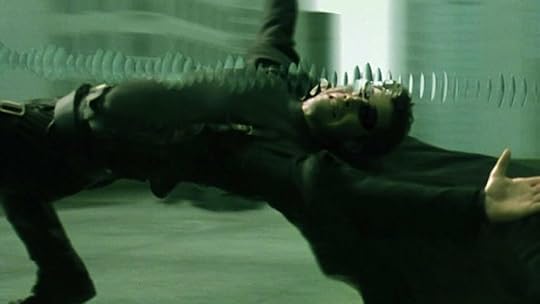
In 2003, I recall flipping through an entertainment magazine that had an article about the upcoming sequel, the Matrix Reloaded. It featured a clip from the first big fight scene, the Chateau battle:
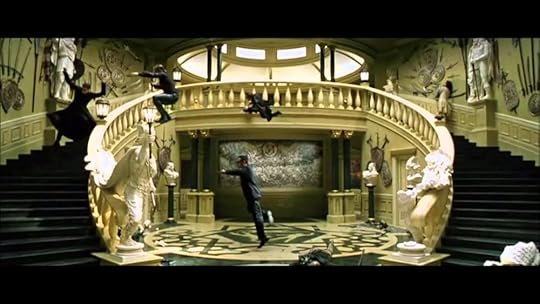
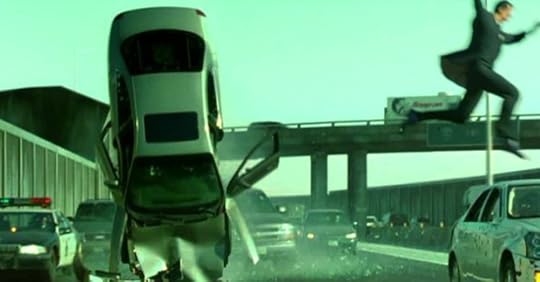
I wondered, after the ending of the first movie, what could possibly be a challenge for Neo? After all, he ended the movie essentially as a god able to completely reshape the Matrix to whatever he wanted. When I went to see Reloaded, there were parts of it I really liked - the freeway battle in particular - but there was something a bit numb already filtering into the series. During the Chateau battle, for example, you could almost see Keanu going through his memorized movies like a karate student executing a kata. The whole battle was spectacular and precise, but its outcome seemed inevitable, and even Neo seemed like he would have preferred to hit the fast forward button to the spot where all of the bodies were sprawled on the ground and he was the last man standing. Still, for a series that introduced bullet-time, the freeway chase managed to show us once again something we hadn’t seen before, in a way that was exciting and unpredictable.
When the Matrix Revolutions was released later in the same year, the series took its nosedive. All of the glitzy costumes and superhuman powers of the Matrix were traded for normal humans in drab tattered sacks plotting war in an underground city. When Neo and Smith finally clash in their concluding battle, they are both so omnipotent and indestructible that it’s a bore.
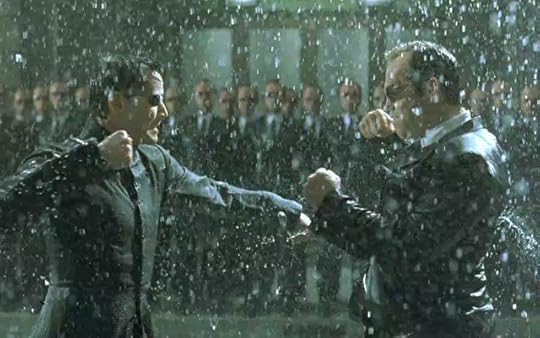
Let’s face it: the Matrix should have ended after the first movie. Don’t get me wrong - the second movie had plenty of Matrix fun (although not nearly as much as the first) - but the first movie was a complete story with the Matrix defeated and our hero able to remake it however he wanted (or not at all). The subsequent movies, which tried to explain where the Matrix and Neo came from, were entirely unnecessary. It would be like making a prequel to the Planet of the Apes to show exactly how the Statue of Liberty got buried. While you could spell it all out in a ninety-minute flick, people were like, “Oh yeah. We blew it all up. Got it.”
The Matrix’s reality-is-not-real concept wasn’t new. Dark City had a similar plot with a person trapped in a false reality (and Dark City is a brilliant movie to watch all on its own. Its final reveal is equally mind-bending), but the Matrix turned anime comics into amazing live action. We’ve all seen endless martial arts flicks, but somehow the martial arts in the Matrix were like nothing we’ve seen before.
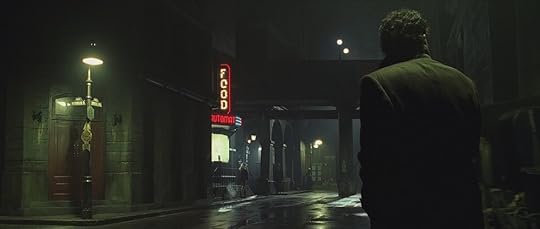
1998’s Dark City - What if your entire city and everyone in it changed every night, and you were the only one who remained the same?
There were several video games and spinoffs, such as the Animatrix, between now and then, but fast-forward to December 2021 for the release of the fourth movie in the series, the Matrix Resurrections. I watched it today, streaming on HBO Max.
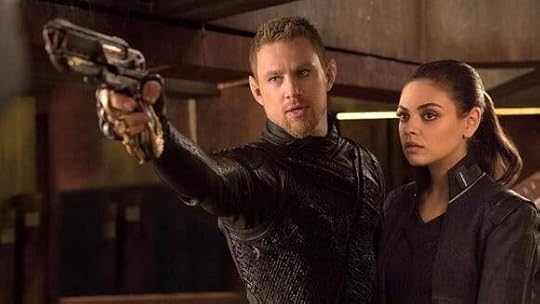
There was a point in the movie’s two-and-a-half-hour runtime where my brain had enough and started distracting itself with memories of better movies, and I know exactly where that point was. It’s when two of the characters ride flying manta ray/dolphin mechs, straddling them like World of Warcraft mounts, soaring semi-seriously through the red goo pods of the human harvester fields. Right about here was where I’d realized I was in Jupiter Ascending territory. In case you rightfully forgot Jupiter Ascending, it was also a Wachowski film, featuring a hover-skating Chanum Tatum elf pew-pewing it with evil aliens.
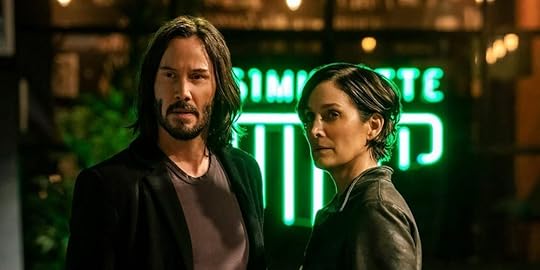
Without getting too spoilery, the plot of the Matrix Resurrections is that Neo and Trinity must get together, for…reasons. Yes, yes…they died at the end of movie three, but like Spock’s noble sacrifice in Wrath of Khan easily being undone by the studio’s desire to have more sequels (and indeed, Spock did live long and prosper after his death, thriving well into the Next Generation), Neo and Trinity are resurrected. Other dead characters, such as Agent Smith, are also resurrected, while some (without naming them to avoid spoilers) are digitally rebranded.
In some ways, the Neo/Trinity portion of the plot reminds me very loosely of 2011’s The Adjustment Bureau. In it, Matt Damon’s character needs to interact with Emily Blunt’s character, but not too much. Forces in the movie are trying to ensure the two walk the fine line between just enough and not too much. Similarly, Neo and Trinity are linked but must be kept apart.
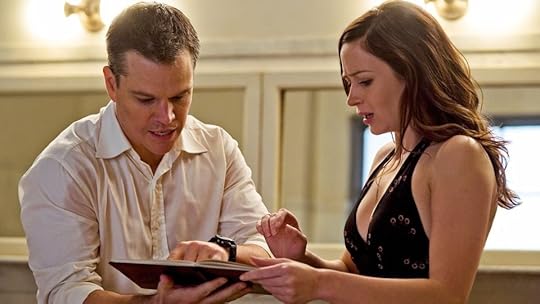
The Adjustment Bureau, based on the Phillip K. Dick story. Phillip K. Dick also wrote A Scanner Darkly, which starred Keanu Reeves.
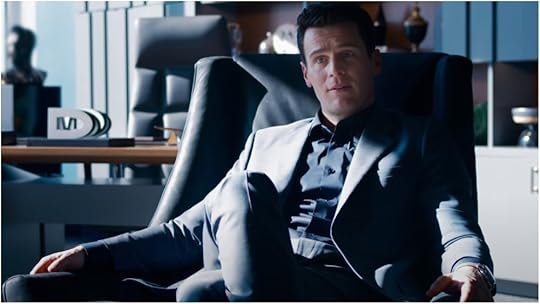
The best thing about Resurrections is the performance of its villains. Jonathan Groff (Mindhunters, Hamilton), is excellent as Agent Smith. I’m sure you’ve seen the trailer with him yelling, “Mister Anderson!”
Neil Patrick Harris plays Neo’s therapist, who works very hard to convince Neo that his delusions of being trapped in an alternate reality are just that - delusions. He’s at his best when the script lets him be manipulative during the first half of the movie.
[image error]Much of the movie is about getting an emotionally-scarred and somewhat-powerless Neo out of the Matrix, and then an Oceans Eleven style caper to break Trinity out. Neo’s sole remaining power is a Witcher-like Aard telekinetic blast. If you’ve played the Witcher games, that’s a minor power that you mash the A button on your controller periodically to buy you a few seconds. Neo uses it mostly the same way here. It does fit in the plot that he’s been in the Matrix for so long that he’s forgotten who he is and how to use his powers, but I was expecting a “he’s starting to believe” moment. There’s a slight escalation of his telekinetic blast to stop bullets, but everything you saw in the trailer is it.
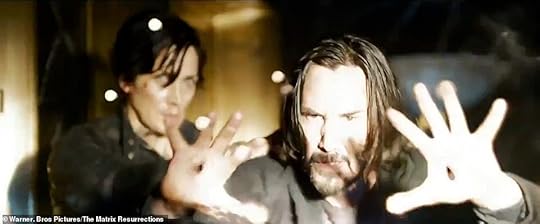
The action sequences are…straight forward. During the fights, at first I thought that everything was slowed down and mushy because the main actors are a bit older - but this style extended to the 20-something actors as well. Unlike the government building battle of the first movie, where Neo and Trinity run between marble pillars as bullets zing and crack into rock, characters in Resurrections simply stand still in the middle of hallways as dozens of soldiers shoot automatic weapons at them, somehow missing as if they were firing blanks
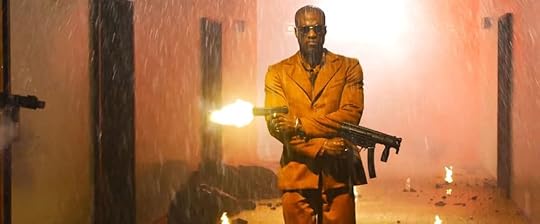
The ending battle morphs into a World War Z zombie hoard and truly feels like a video game, with helicopters shooting missiles and characters dodging explosions. There’s no memorable Matrix Reloaded freeway chase or Neo with the chain gun in a helicopter freeing Morpheus. Well, actually there is the helicopter chain gun scene, complete with the same exact camera shot looking up as the shells rain down. This is certainly meant to pay homage, but so much of the movie either recycles the first movie (in some cases doing a split screen with footage of the first movie beside the current in case you somehow miss it), or does on-the-nose references, like Neil Patrick Harris’s black cat named Deja Vu, complete with a food bowl with giant white Deja Vu letters. The only thing it’s missing is a blinking arrow pointing at the cat. My other complaint about the action scenes is that they simply decide that they are done at some point. During an early battle with Agent Smith, Neo telekinetic blasts him through a wall and then switches gears to calmly chat with his team in the same location, as if Agent Smith won’t just dart back in through the hole and continue the fight. Fortunately for Neo, Smith just gave up, I presume.
So, with all of this negatively, what is it that I liked? I liked the clever self-awareness. Neo is trapped in the Matrix believing he is a computer programmer who created an insanely popular trilogy of computer games called the Matrix that featured all of the characters and plot of the Matrix movies. On his desk, he has a Trinity action figure falling backwards shooting both guns, and a Sentinel figurine. Whenever he believes anything from his previous life was real, his therapist redirects him to acknowledge this is the fantasy world he’s built for himself. Neil Patrick Harris, as his therapist and gatekeeper, is quite a brilliant touch to keep someone in the Matrix. The rebooted Agent Smith has a different personality than the original, but it works. He’s confident, cocky, and in control. The seething disdain of the original Smith is gone.
Overall, however, we didn’t need a fourth movie. I’d place the quality of the fourth movie on par with the third, which is to say…not great. It’s hard to be negative because I really like Keanu Reeves and all of the actors in the movie, but there wasn’t much point to the movie other than to give Neo and Trinity the happy ending they were denied at the end of the third movie. I get the feeling that the Wachowskis are more into the Neo/Trinity love story than the rest of us. Even in the first Matrix movie, Neo and Trinity’s relationship was incidental. When I excitedly recruited my karate school to go see the original movie, it wasn’t, “Hey guys, you have to see this romance!” So, in my mind, I think I’ll just remember Neo flying off at the end of the first movie, with the sky as the limit for what he’ll do next.
December 7, 2021
Thoughts on Squid Game
Continuing on my theme of being the last person in the world to watch something trendy, this week I binged Netflix’s Squid Game. If you, like me, are the last person to see it, I’ll summarize it as a group of contestants play a series of deadly games in pursuit of a giant cash prize. The series follows Seong Gi-hun, a down-and-out gambler pursued by ruthless loan sharks, who seeks to get out of debt and maintain custody of his daughter. One day, he meets a well-dressed man who carries a briefcase full of money. The man invites him to play a simple game, promising the money if Seong wins. When Seong loses and admits he doesn’t have the money to cover his wager, the man suggests Seong can pay with his body, slapping him in the face. Seong catches on and they continue - lose, slap, lose, slap - until finally Seong wins. When the man hands him his small cash prize, he invites Seong to play a different game where there is real money to be won. It turns out that Seong is one of 456 players to accept this invitation, and soon he is ferried (literally) off to an unknown island that houses a Bond-villain type of lair. The 456 players all dorm together and are dressed in identical green tracksuits. The only thing that differentiates them is the player number printed on their tracksuit.
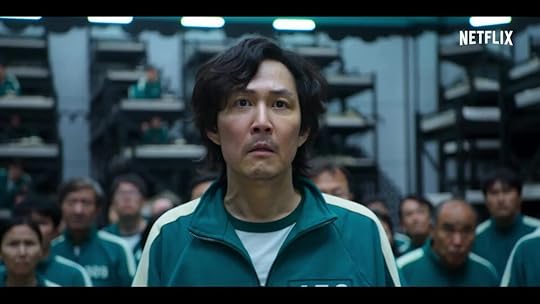
Seong Gi-hun, played by Lee Jung-jam
Perhaps the first hint that something is terribly wrong is the appearance of the facility’s staff, who all wear pink jump suits with black fencing masks obscuring their faces. Each mask has a symbol - a square or circle - that looks like something printed on a Playstation controller.
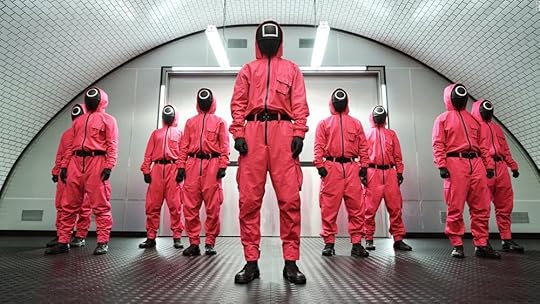
The facility looks like something from a video game, and there’s a playful camaraderie as the 456 players head off to their first content, the children’s game Red Light, Green Light. If the pink faceless jumpsuits didn’t tip them off that something was wrong, then the guns that open fire on all the contestants that fail to freeze for Red Light certainly does. The first game is panicked blood bath, killing off half of the players. There are several more games to come.
What follows is a Breaking Bad-like spiral for the remaining players. People quickly realize that the cash pot increases by a million for each player’s death, and it doesn’t matter if that death occurs in game or in the darkness of their dormitory’s night.
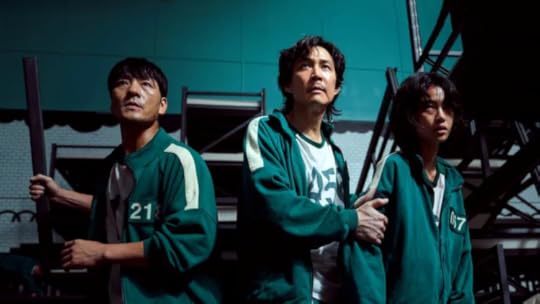
People who are already ruthless continue to be ruthless, but people who were kind find themselves in a dog-eat-dog world where their morals are gradually compromised as they do what it takes to survive. Clans form, Survivor-style, and Seong’s clan is composed mostly of the good guys. To the writer’s credit, the episodes spend time with each of the characters, and when the inventible betrayals occur, the viewer feels them. One of the games near the end is especially brutal when it pits allies against each other, and some of the good guys do awful things to be the one left still breathing.
The facility’s overseer, the Frontman, has an interesting line mid-season where he comments that the game is an equalizer. Every person comes from different disadvantaged backgrounds, he says, but in the game they are identical and for once in their lives have an equal chance at the money. Note his assessment isn't quite true - some of the games rely on physical strength and the physically stronger are at an advantage in these - but it is a theme for the show. The series is about inequality and desperation, and the choices you make when you’re desperate.
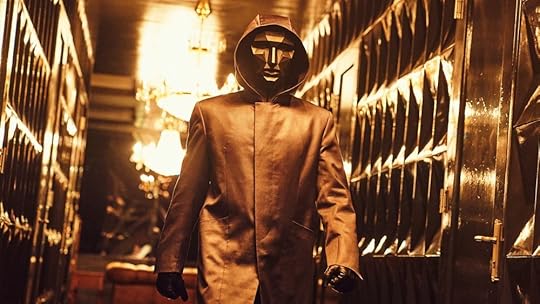
The Frontman. If your host is dressed like this, this also is not a good sign.
If the idea of contestants playing to the death to win a fabulous cash prize sounds familiar, there’s a long history of this in cinema.
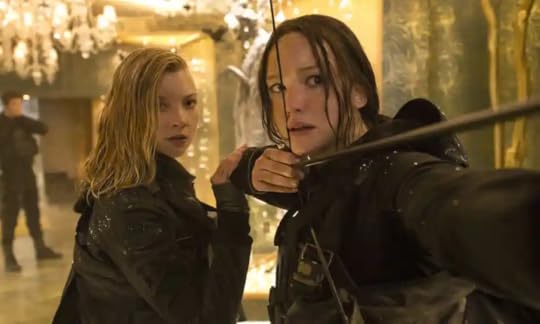
The Hunger Games is the most recent similar story about a contest to the death, although its contestants were picked by lottery.
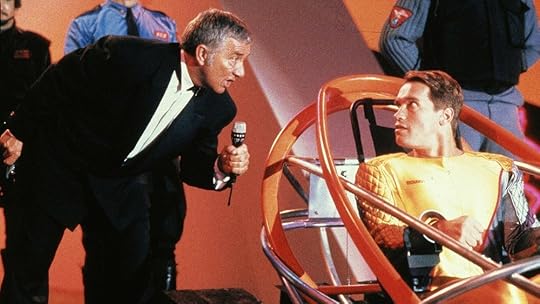
1987’s The Running Man even had a game show host for its lethal contest

1985’s Gymkata had a mountain obstacle course of doom
In a way, the set up reminds me of a murderous version of Willy Wonka and the Chocolate Factory. After each mishap, pink jumpsuit guys come out like Oompa Loompas to clean up the mess, but all of the players continue on nonetheless for the promise of the final prize.
It also reminds me of Most Extreme Elimination Challenge (which itself was a repurposing of the original gameshow Takeshi’s Castle). Granted, people weren’t playing to death in it, but I can imagine that falling face-first into a giant roller would leave a mark.
The other obvious comparison is to 1999’s Eyes Wide Shut (in particular in Squid Game’s third act when wealthy, golden-masked benefactors show up to watch the games).
[image error]Tom Cruise in Eyes Wide Shut.
The Netflix version of Squid Game that I watched was dubbed, but I think there’s also an option to watch in the original language with subtitles. I think I would prefer subtitles, to hear the actors’ performance.
What to make of Squid Game? The fact that I’m writing a blog post means it succeeded in getting me to think about it after it concluded. I enjoyed the later parts of the series more than the earlier, because they became very character-focused. Even the story’s hero didn’t always act very heroic. There was a message that, even if you think you’re the good guy, you may be one dire situation away from tabling your morals and principles.
The story’s wrap up concludes with a final game and a winner, and is both expected and satisfying. The plot that follows, however, flops flat and feels like it missed on an opportunity to show exactly what the money did for the winner. There’s a standard writer’s element for character-building called “the lie that the protagonist believes”, and often it is what the protagonist seeks through much of the plot. The wrap-up flirted with the idea of having the money but not wanting it anymore, but then pivoted for a big character twist right at the end. I won’t spoil it, but it seemed tacked on, and didn’t quite work out as a twist for me.
Do I recommend Squid Game? Yes. Keep in mind it’s very violent - hundreds of people are executed or murdered and there are side plots involving organ harvesting that are gory, so be aware of what you’re signing up for when you watch it. But, the series will leave you thinking a bit about its themes, and the character conflict and macabre curiosity for what the next game is will keep you hooked.
November 24, 2021
Thoughts on Amazon's The Wheel of Time
As a writer, I was a surprisingly late bloomer as a reader. Growing up, I loved movies, and it wasn’t until I ventured into Dungeons and Dragons and other tabletop RPGs that I ventured into my first novels, all D&D adventures by R.A. Salvatore. In the early 90s, physical bookstores reigned, and I remember perusing all of the colorful paperback covers until one caught my eye. In it, a man reached up for a glowing gold sword. The bold blue title text read, “The Dragon Reborn”. I had a habit, then, and still do until this day, of picking a random page from the book’s interior and reading it. If I like the author’s style and handle on prose, I’ll buy it. Such was the case with The Dragon Reborn.
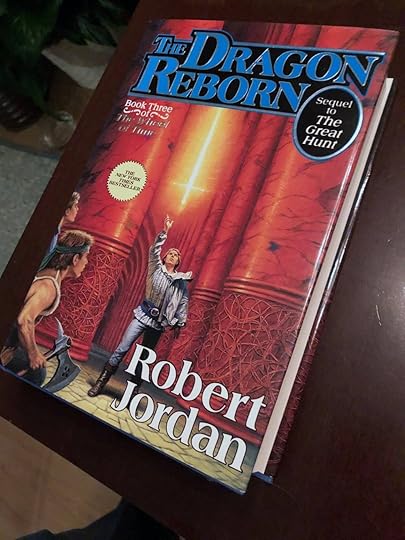
I actually met Robert Jordan in person. One morning, while I was brushing my teeth, one of my friends texted me. Robert Jordan will be signing books at the King of Prussia Mall today. We’re going. You in? King of Prussia was a bit of a road trip from where I lived, and I was supposed to be at work in two hours. Tooth brush hanging out of my mouth, I stared at the message, wheels churning in my head. I had two personal days to use for whatever I wanted this year. This was a good whatever. Hours later, I sat with my friends en route to King of Prussia. The event was a book signing, and, when we arrived, the line was at least a hundred people deep. I patiently waited my turn, handed Robert Jordan my hardcover, and he signed it with a flourish. I, of course, still have it.
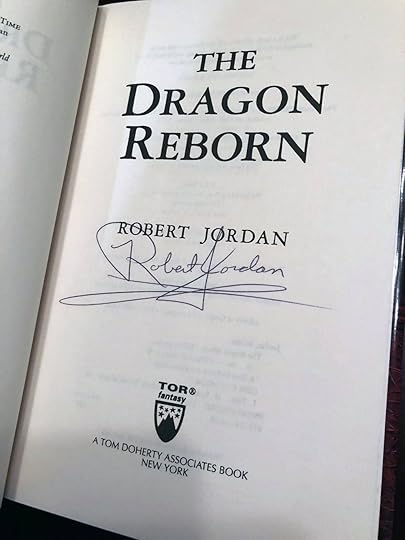
We hung around the mall until closing time, shopping, and when we returned to the book store, there was Robert Jordan and his agent, sitting at the same table, alone except for one chatting fan. My friends looked unbelievingly at each other. Robert Jordan, just chilling out, by himself, looking for someone to talk to. We made a beeline for the table. What resulted was a remarkably casual discussion between us and Robert Jordan. He told us about all of the things that didn’t make it into the books. For example, that the Aes Sedai weren’t sterile, but used an herbal birth control tea that every Wisdom knew how to brew. The chatting fan whipped out a camera and asked if he could take a photo with Robert Jordan. When he agreed, the fan leaned in, smiled next to him, and snapped a group shot. Our mouths dropped open. This was, of course, before everyone had cameras in their phones and taking photos actually required film. All of us flipped around and began search the mall for a store that sold disposable cameras. Simultaneously, an announcement over the mall intercom said, “The mall is closing in ten minutes. Please make your final purchases.”. Robert Jordan reacted to the announcement by closing up his books and starting to tidy his table. We learned a lesson that day. The lone fan got his prized photo because he didn’t assume he couldn’t get one.
What I loved about the Wheel of Time series is that it was mature. Where my previous sword and sorcery books were fun flights of fantasy, the Wheel of Time was an epic, complex series full of politics, factions, character building, and endless detail. To some extent, it rivaled Tolkien for complexity of world building. I encountered it at the perfect age - my early twenties - where I was looking for stories with more.
If you haven’t read the series, it’s about small-town folk from a place called Two Rivers that are whisked away on a grand adventure involving a prophecy in which one of them is the Dragon Reborn, a male spell caster of immense power who can either save or break the world. In the story, women are the only ones who can safely wield magic. The occasional, rare men who can wield it go insane. There is a very Tolkein-esque array of dark forces, ranging from Trollocs to Fades and Forsaken, and the theme of a small-town young man becoming an epic hero is one that works both for Hobbits and Jedis.
The novel series spans fourteen books, some of which approach a thousand pages each. The breadth of the story is massive, and certainly a challenge for any movie or television adaption. After the success of HBO’s Game of Thrones, however, you can see how a network may be up for the challenge. The network, in this case, is Amazon Prime, and the series launched in November 2021. I admit, my first reaction upon seeing the trailer wasn’t great:
Part of my reaction is based upon my love of the Wheel of Time books. It’s a cliche, but it’s always hard for a movie or show to live up to what your imagination has conjured. My other reaction was based on the look. Much like my habit of flipping open a book to a random page to get a flavor of the author’s style, the trailer’s flavor had a certain Dungeons & Dragons costume campiness to it (more on that later), and the swirling white magic looked like the type of mid-tier visualizations that something with more budget than a television episode but less budget than a movie could afford.
The first three episodes are available for viewing now. If you haven’t read the books, the story starts with an Aes Sedai spellcaster, Moraine Damodred, and her magically-bonded Warder, Lan Mandragoran, arriving at the small town of The Two Rivers, in search of the Dragon Reborn (a male spellcaster capable of immense power). They encounter Rand al’Thor, Matt Cauthon, Perrin Albara, and Nynaeve al’Maera. The Dark Lord is also searching for the Dragon Reborn, and the orc-like Trollocs descend upon Two Rivers, forcing Matt and party to flee with Moraine and Lan. This sets up a very Tolkienesque pursuit where everyone, good and bad, wants to get their hands on the Dragon Reborn.
It’s easiest to break my reaction down into categories:
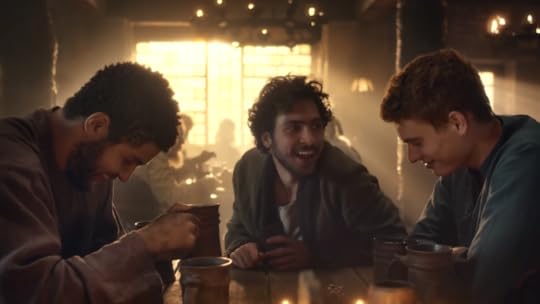
Casting: The casting is excellent. All of the actors look like how I envisioned them and project their character’s personalities well. Rand (Josha Stradowski) looks similar to Hayden Christensen’s Anakin Skywalker, but fortunately channels strength and warmth in his performance.
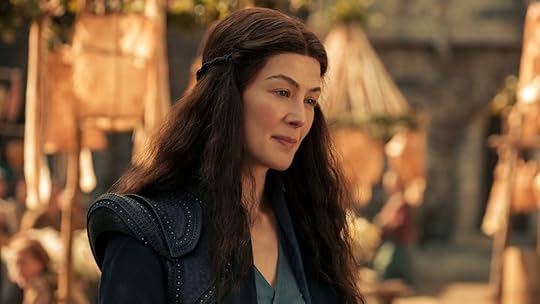
[image error]Moraine (Rosamund Pike) is regal and guarded, and has the ageless look that Aes Sedai are known for.
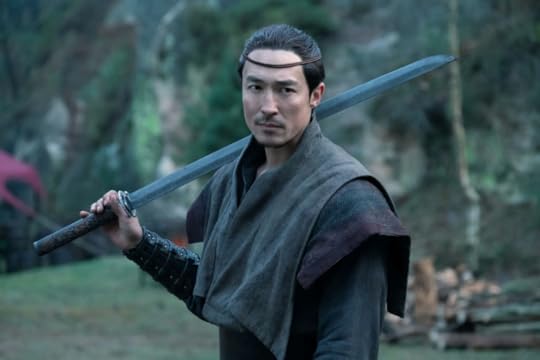
Lan (Daniel Henney) is superb. He’s an actor like The Man in High Castle’s Rufus Sewell who excels at showing the viewer the wheels turning in his head. Lan is a character of few words, yet his silences have their own unspoken dialogue.
Perrin (Marcus Rutherford) isn’t given a lot of material to work with in the first few episodes other than being traumatized by his wife’s death, so we’ll have to see how he develops.
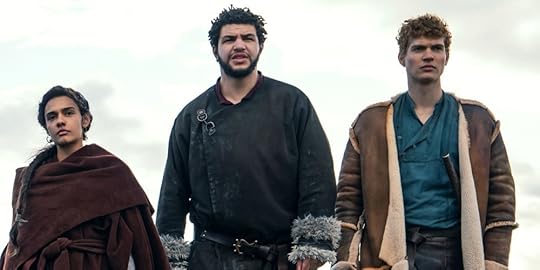
Mat (Barney Harris) is cocky and stubborn, and a good foil for Rand. The third episode, in particular, gives him a chance to both grate on and win over the viewer.
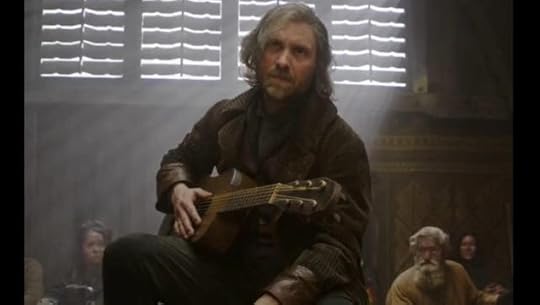
Thom Merrillin (Alexandre Willaume) is all of the rogue you expect him to be, and has real presence.
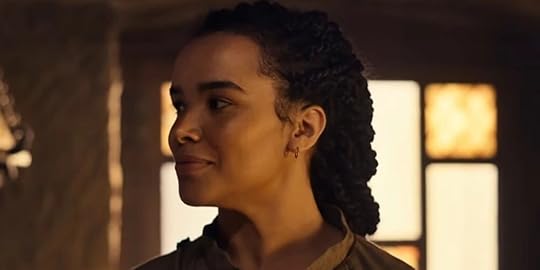
Nynaeve (Zoe Robins) is a spitfire.
So, overall, great job with the casting. My first reaction was that everyone looked young, but, then again, in the books they are. And as I get older, young people tend to look even younger.
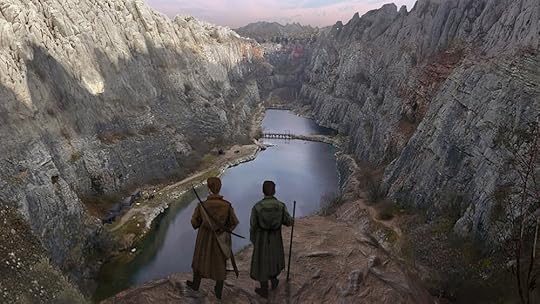
Sets/Landscape: Throughout the first three episodes, the camera will pause to pan across a town set against a fantastic mountain backdrop. These appear to be a mix of on-location and special effects, but they really looked good. Shots have the larger-than-life, epic structures that fantasy book cover art favors. Towns, like the water-wheel powered town in the third episode, look functional and well-thought out. You feel that people could live here and that it’s not just a few set pieces plopped down as a backdrop for the characters. Nicely done.
Costumes: Here is the first stumbling point, for me. I’d describe it as “Wheel of Time by J. Crew”. All of the characters look just too hip, with modern fabrics, trendy patterns, and clothes that look like they are brand-new Christmas presents freshly donned. I found myself unconsciously looking for the size tags that you forget to remove in new clothing. Mat, in particular, looks like he’s one pair of Brooks Brothers glasses and a fall day away from being in a J.Crew catalog.
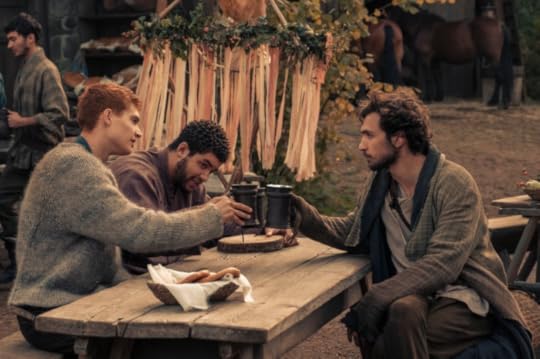
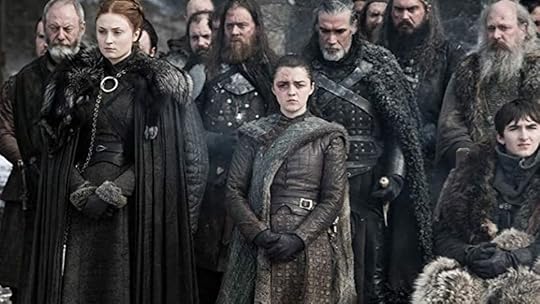
Comparisons to Game of Thrones are unavoidable, but GoT’s costumes looked functional, like the type of things one would need to wear on a winter battlefield.
Not that I want everything to be as dire as Game of Thrones, but armored warriors, like the White Cloaks, look a bit silly to me in the series:
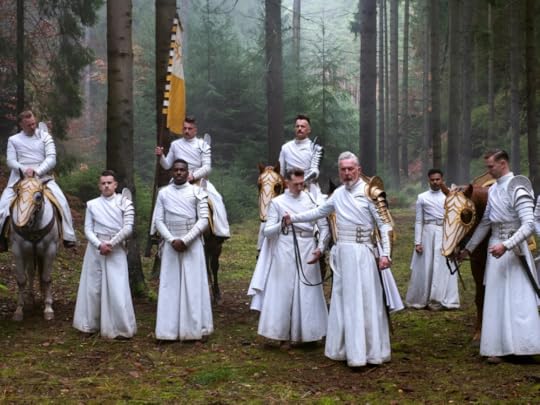
It doesn’t quite delve into Richard Gere/First Knight territory for non-functional armor design, but it is a neighbor at times.
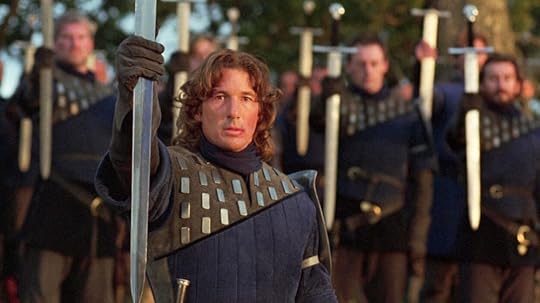
1995’s Arthurian mess, First Knight. I’m sure this turtleneck and random shoulder ingots will keep Arthur safe. Like the White Cloaks, Arthur is also a fan of the tiny shoulder shield.
Note there are some Wheel of Time townspeople shots where I appreciated that their garb reminded me a bit of the book covers. Fantasy book covers also do not usually have functional armor or dress, so emulating them in moderation, I think, is fine.
Special Effects: This one is a mixed bag. There are no bad effects, but the ghostly white tendrils of the spell weaving looks a bit cheesy.
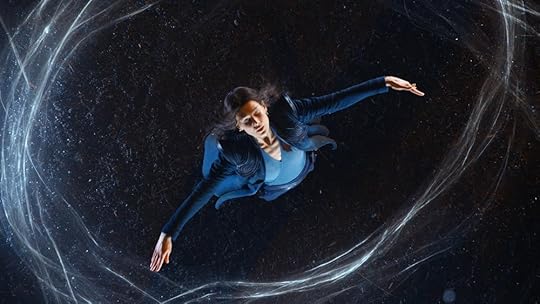
On the other hand, the mix of practical and CGI effects for things like the Trollocs and Fade are superb. The Trolloc battle scenes in the first two episodes are terrifying.
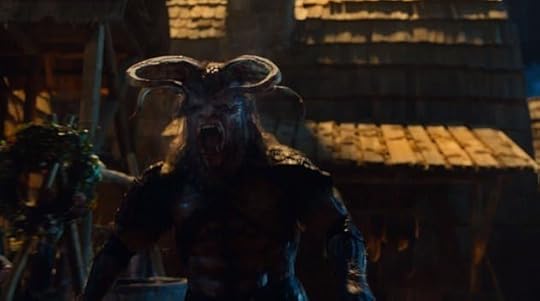
Plot/Pacing: Lastly, although quite a bit happens in the first three episodes, the pacing is a bit slow. This isn’t a complaint. If anything, I’ve grown weary of series that need an explosion every three minutes to keep your attention, so having one that just follows Mat and Rand around as they try to earn a stay at an inn is actually great, because it’s all about character. The show does like to flip from calm to crisis in an instant, so any stretch of mundane-seeming tasks is probably going to end in someone holding someone else at sword point, but it works.
Violence/Gore/Nudity: Because this will inevitably be compared to Game of Thrones, I feel I need to comment on this. GoT dialed nudity to eleven, and episodes were often gruesome. Wheel of Time has no sexual nudity so far. In fact, the only nudity I can recall is Lan’s butt as he gets into a bathtub with Moraine (the water is cloudy and Moraine is obscured). Their bath isn’t sexual - it’s just matter of fact. They’re bonded and have been through life and death together, and being naked in a bathtub is trivial to them. Wheel of Time does have a fair amount of violence and gore. Trollocs get sliced in half by the One Power, spilling intestines, and people take axes to the ribs, vomiting blood. The violence is intended to be jarring. I think the violence in GoT was matter-of-fact: in this world, people are barbaric to each other; deal with it. In Wheel of Time it’s meant to be horrific. Robert Jordan served two tours in Vietnam, and I think his experience of the horrors of battle flipping the switch from serenity to terror come across in his writing, and also in the Amazon series.
So, my verdict? I like it, and it’s growing on me. I wasn’t wowed by the first episode, but I was curious to see where it was going. The more I watch, and the more I see the character building, the more I’m appreciating it. Looking forward to episode four this Friday.
While you’re here, you’ll notice I’m the writer of the Hayden’s World series. If you love exploration and adventure, be sure to grab the first story for free and check out my podcast:
November 14, 2021
MSFS 2020 IFR Warrior II Flight: Syracuse to Teterboro
When I started flight simming, VFR and IFR maps were an incomprehensible jumble of numbers, lines and colors. Still, there was something alluring about them, like a mariner on a ship unrolling an old nautical map and plotting his waypoints across it. Indeed, VFR pilots learn to do much of the same thing, using a ruler and a pencil to plot out courses and estimate distances. IFR maps, on the other hand, are almost like looking at computer code.
Modern avionics like Garmin GTN750s or even Foreflight make it easy to know the position of your aircraft at all times, and plinking away an IFR flight plan on the GTN’s touch sensitive screen coupled with an autopilot that controls all of your plane’s axis is nice. In the sim, you can engage the autopilot and let the GPS handle the flying while you sit back and enjoy the scenery. But, it wasn’t always that way. Pilots used to fly IFR using nothing more than charts, VORs, and math. Vintage aircraft may have only a single navigation radio to work with, making frequency juggling an art. IFR flight was a dance of distances, times, and tuning in radio frequencies.
[image error]In the soup! Flying the Piper Warrior in IMC (Instrument Meteorological Conditions), where you can’t see a thing. Hopefully you’re flying IFR (using Instrument Flight Rules). If you’re flying VFR (using Visual Flight Rules), statistics say you’ll quickly get disoriented, have a fatal loss of control and be dead within 178 seconds.
I love flying the Piper Warrior II in MSFS. It’s a 1970s-era aircraft with a configurable panel that ranges from modern GPSs to simple nav radios. I’ve been flying modern airliners lately in MSFS, creating complex IFR flight plans, and I thought it would be a fun challenge to fly the Warrior IFR using no GPS with only the two navigation radios and a DME. A pilot, a map, and a radio. You know, old school.
MOSTLY UNNECESSARY DISCLAIMER: This tutorial is for flight simulator use only. I’m not an IFR-rated pilot, or even a pilot (although I do hope to change that). As my video says, I’m just some guy playing a video game.
You can watch the flight here on my YouTube channel.
If you want to try it yourself, here are the instructions:
Flight Plan: KSYR Syracuse Hancock to KTEB Teteboro
KSYR TEBOR V483 FILPS V489 HUO KTEB
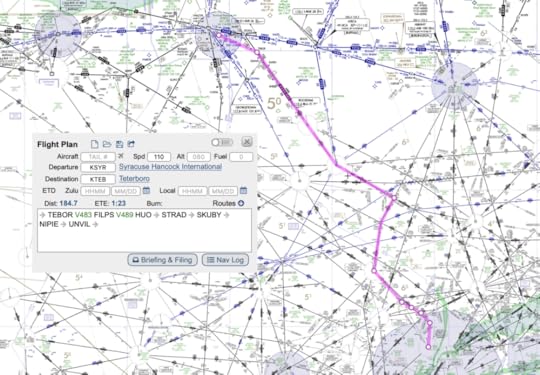
STRAD SKUBY NIPIE UNVIL are part of the ILS RWY 19 approach, and are added to the screenshot so you can see the approach
Flight Duration: 184 NM, 1:44 flight time
Cruise Altitude: 7000 feet
Weather: I recommend the Scattered Clouds preset, since it will give a nice mix of being in clouds and sun. I set my departure time 2.5 hours before sunset.
Airports: In my video, I used payware airports, but they are not necessary. The airports were SierraSim’s KSYR Syracuse Hancock and Flightbeam Studio’s KTEB Teterboro.
Aircraft: JustFlight’s Piper Warrior II. You can use any aircraft that has two course deviation indicators and a DME
To do this flight, you’ll need to already understand the basics of how to dial in headings using a CDI, operate your NAV radios, operate a DME, and operate your autopilot.
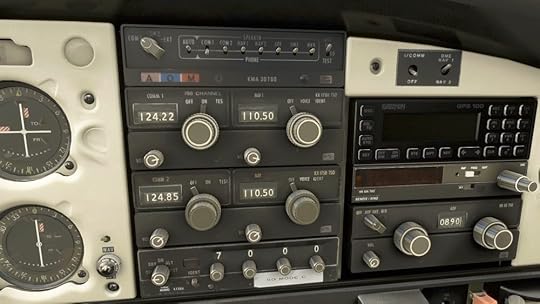
Left: Course Deviation Indicator 1 (CDI1), Course Deviation Indicator 2 (CDI2)
Center: COM1/NAV1, COM2/NAV2
Right, Center: Distance Measuring Equipment (DME)
Right, Top: DME source switch (NAV1 or NAV2)
A short guide to reading IFR charts:
We’ll be using Enroute Low-altitude IFR charts. These are used for IFR flights up to 18,000 feet MSL. The charts show airways, which are much like interstates for cars. In general, pilots get an on airway at a certain point, fly along the airways to their destination, then exit the airway. Airways exist to give pilots safe routes to fly where they won’t hit terrain and are guaranteed navaid radio reception.
There are two types of low-altitude airways:
Victor Airways - drawn in black, these use VOR radio signals to navigate
T-Routes - drawn in blue, use RNAV(GNSS) to navigate
For our flight, our Piper Warrior II does not have any RNAV equipment, so we cannot use any of the T-Routes. We do have two nav radios coupled to course deviation indicators, however, so we can use Victor Airways.
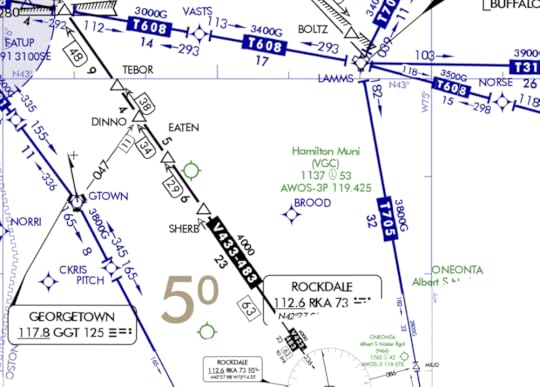
Victor routes in black and T routes in Blue
Airways provide a few key pieces of information:
The minimum safe altitude for a segment
The minimum altitude that guarantees you can receive VOR signals for the entire segment
The length of each segment in nautical miles
Whether the airway is legally flyable (the airway line is bold) or for reference only (the airway line is thin)
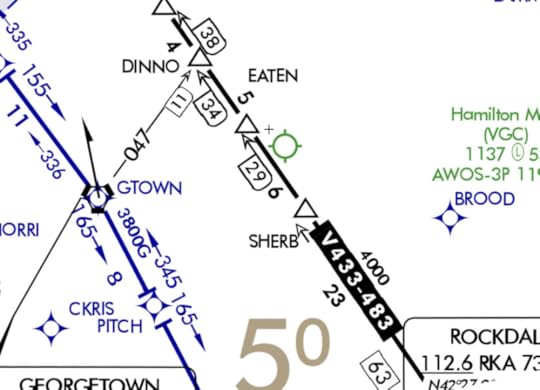
Airway examples, above:
The 4000 over V433-483 means that the Minimum Enroute Altitude (MEA) for this segment is 4000 feet. If you fly at or above 4000 feet, you are guaranteed VOR radio reception. Because this is the only number listed, it is also the Minimum Obstacle Clearance Altitude (MOCA), which is the altitude that guarantees that you will not hit terrain or obstacles such as towers.
The 23 under V433-483 means that the length of this segment is 23 nautical miles.
The 6 to the left of the word SHERB means the length of the segment connecting EATEN and SHERB is 6 nautical miles.
The round-boxed 29 next to the 6 means the cumulative distance from EATEN to Rockdale VOR (lower right of the map) is 29 nautical miles. The airway is broken up into smaller segments defined by waypoints, and each segment has a distance. Round-boxed numbers report the cumulative distance of all the segments up to this point. For example, you can see a 5 under EATEN, which means the EATEN/DINNO segment is 5 nautical miles long, and a round-boxed 34 after that, which means the cumulative distance is 34 (the last rounded boxed number of 29 plus the EATEN/DINNO 5).
The V433-483 airway is bolded black, which means it is legally flyable. The arrow pointing to DINNO with 047 written over it is thin. This line is not flyable. It’s for reference only. It gives you another way to identify DINNO when you are flying on V433-483. In this case, the reference tells you DINNO is on the 047 radial from Georgetown VOR. What would happen if you tried to fly the 047 radial line, anyway? No one knows. That’s the point. There’s no MOCA or MEA written on this reference line. For all you know, there’s a mountain sticking up or no radio reception, which would be bad to discover when you’re deep in clouds. The reason bolded airways exist is that someone has flown them and confirmed that they are safe to fly when you stick by their numbers.
In our simulated flight, there’s a point where I lost VOR reception despite flying by the numbers (because the simulator is not a perfect recreation of reality). I was in a cloud at the time. At that instant, I was flying blind.
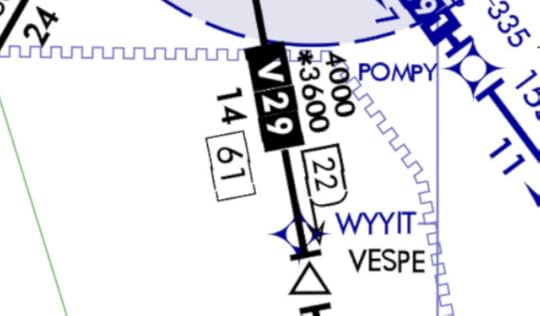
Examples of airway altitudes: The 4000 above V29 is the MEA (Minimum Enroute Altitude) and the *3600 is the MOCA (Minimum Obstacle Clearance Altitude). When picking your altitude for this segment, it should be above 4000 if you want to have VOR reception and not crash into any obstacles.
Steps:
The flight follows the V483, V429 and V489 airways, and uses the following VORS and waypoints:
Syracuse SYR 109.9
Rockdale RKA 112.6
TEBOR, located on V433 at 38 DME from RKA
Delancey DNY 112.1
FILPS, located on V249 at 29 DME from DNY
Albany ALB 115.3
WEARD, located on V489 at 67 DME from ALB. Note you will lose the ALB signal in the simulator before reaching 67 DME (even though the IFR plate shows reception). Fortunately you can just use the next VOR, HUO, to locate it (see below).
Hugenot HUO 116.1
WEARD, located on V489 at 21 DME from HUO.
STRAD, located on the 149 radial from HUO at 18 DME
Teterboro Localizer I-TJL 110.15
UNVIL, located on the TJL localizer (195 radial) at 11.5 DME
TUGGZ, located on the TJL localizer (195 radial) at 15.7 DME
To not get overwhelmed and lost, it’s critical to “stay ahead of the plane”. This means you’ll need to always have the radios and CDIs set up for the next steps. You’ll constantly need to be entering new frequencies and toggling the autopilot and DME between the two radios. I found it to be like playing a game of chess, sliding the pieces into position several moves before they were needed.
On the ground at Syracuse:
Tune NAV1 radio to 112.6 (Rockdale RKA)
Tune NAV2 radio to 112.1 (Delancey DNY)
Set CDI 1 to 156 degrees to Rockdale RKA
Set CDI 2 to 130 degrees from Delancey DNY
Check that the autopilot switch is set up to NAV1
Check that the DME switch is set up to NAV1
Set the heading bug to 126, which is the heading we’ll fly to our initial fix, TEBOR.
Note because you will be using your autopilot to fly VOR radials, it’s very important to get your TO and FROM directions correct when setting up your CDI. Although 180 degrees TO a VOR is the same radial as 360 degrees from the VOR, those are different directions for your autopilot. It’s a bit embarrassing to reach a waypoint and have your plane turn around and go back the way it came because you chose a TO instead of a FROM.
Departing Syracuse:
In the video, I departed from runway 28. The simulator typical puts winds out of 270, for presets, so if you are using preset weather this is the runway you’ll likely depart.
Syracuse does have on Standard Instrument Departure (SID), Syracuse 2, but it is just radar vectors to your assigned fix with instructions “Climb and maintain 4000. Expect filed 10 minutes after departure.” This isn’t very different than what you’d get without a SID, which is just radar vectors to your initial fix and an assigned altitude. Microsoft Flight Simulator’s built-in ATC is not very helpful for radar vectors. ATC will say something like “proceed to your next waypoint”. If you’re using live ATC, like Vatsim, the controller will give you radar vectors (“Fly heading 126”). If you don’t have live ATC, you can self-vector by flying heading 126 (using the autopilot in Heading mode) to your initial fix, TEBOR. You’ll know you’ve reached TEBOR when:
The DME (which is measuring distance to RKA VOR) reads 38 NM. TEBOR is 38 NM from RKA on the V433 airway.
CDI 1 centers (CDI 1 is tracking the V433 airway)
The above tactic of using a distance (via DME) and a bearing (using the CDI) to pinpoint your location is the main way we’ll navigate this flight.
Per the SID, climb and maintain 4000 feet.
Once you reach TEBOR, switch the autopilot from Heading to NAV mode and check that the autopilot source is set to NAV1. This will turn the plane right onto the V433 airway and follow the airway to Rockdale VOR.
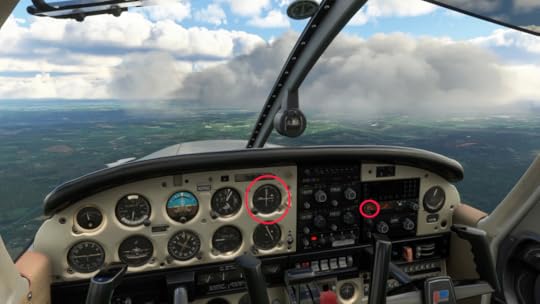
ARRIVED AT TEBOR: CDI 1 is centered and DME reads 38 NM from RKA VOR (NAV1)
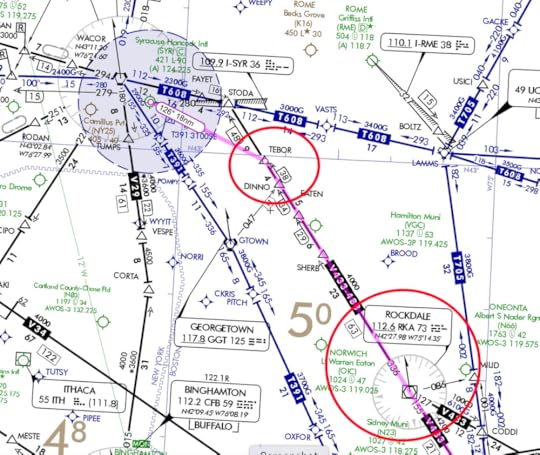
The round-boxed 38 next to TEBOR indicates the waypoint is 38 NM from Rockdale RKA VOR, along the V433-483 radial.
Note the 336 number at the 11 o’clock position coming out of the Rockdale RKA VOR. V433-483 is on the 336 radial FROM Rockdale RKA. If we dialed that into our autopilot (via CDI 1), we’d fly a heading of 336 away from Rockdale. We want to fly TO it, so we subtracted 180 degrees from 336 to get 156, which is what we dialed into CDI 1. This way, our autopilot will fly heading 156 TO Rockdale.
V433 Airway
After TEBOR, start your climb to cruise altitude of 7000 feet (or if you’re using live ATC, whenever they clear you).
As you fly, the DME will decrease from 38 NM (TEBOR) to 0 (RKA VOR). Just before it reaches zero, you will lose the VOR signal as you overfly the VOR, and the DME will briefly go blank before reacquiring the signal. The CDI arrow will flip, going from TO to FROM, because you are now flying away from the VOR. Toggle the autopilot source switch down to NAV2 and also flip the DME source to NAV2. Get used to this. Since we have no standby frequencies in the Piper, we will constantly need to toggle the autopilot between the NAV1 and NAV2 radios. Note you are still on V483. V483 changes direction as you overfly RKA VOR and continues on to DNY VOR. Just like an interstate, where you’d say “get on Interstate 81 and stay on it until you reach Maryland”, you’ll get on an airway and follow it through its twists and turns.
Because we are done with RKA VOR, we can use NAV1 for something else. We’ll “stay ahead of the plane” and enter the next VOR, Albany ALB. Tune NAV1 to 115.3 and set CDI 1 to 222 degrees FROM Albany ALB
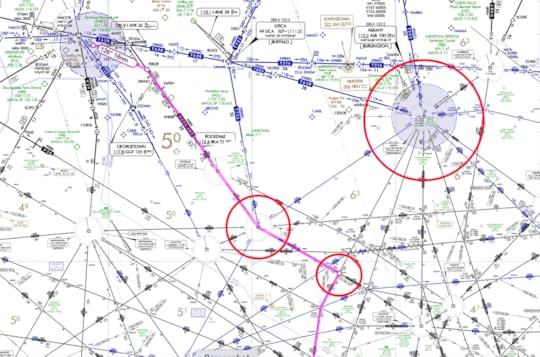
We’re going to need Albany ALB VOR (circled, upper right) and Delancey DNY VOR (circled left) to locate the intersection FILPS (circled, bottom). We’ll use the radials from both and the segment distances to biangulate our position.
V249 Airway
We are currently flying the V433 airway to DNY VOR, and the DME is counting down the remaining distance. When it reaches zero, set CDI 2 to the 130 radial from DNY. Since the autopilot is using CDI 2, this will turn the plane onto the V249 radial.
FILPS intersection is 29 DME from DNY on V249. When you reach 29 DME, toggle the autopilot and DME source to NAV1. NAV1 is currently set to track the Albany ALB VOR, so the plane will turn onto the Albany V489 airway.
Because we’re done with DNY, this frees up NAV2. We can set it up for our next VOR. Tune NAV2 to 116.1 Hugenot HUO VOR. Set CDI2 to 199 degrees to HUO.
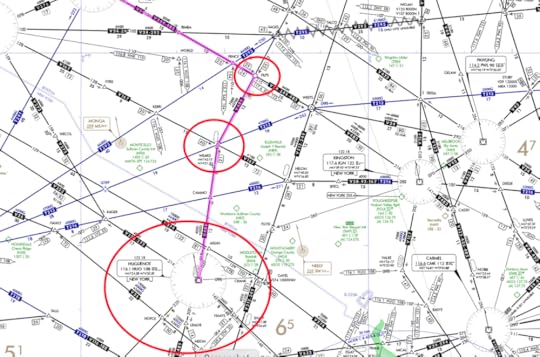
Flying from FILPS (circled, top) to WEARD (circled center) to Hugenot HUO VOR (circled, bottom). WEARD is defined by the intersection of Hugenot HUO and Albany ALB radials.
V489 Airway
The DME is now tracking distance from Albany ALB VOR. At 67 DME, you have reached WEARD intersection on V489. Maintain your cruise altitude of 7000 until WEARD. We chose 7000 because the minimum enroute altitude (MEA) for this segment is 7000 feet.
On IFR plates, if you fly above the MEA you are guaranteed reception. In real life, I should have been able to receive the Albany VOR signal at WEARD. In the simulator, I lost it before reaching 67 DME. To get around this:
I set the heading bug to the Albany radial I was flying (heading 222) and put the autopilot in heading mode.
I flipped the DME source to NAV2, which is HUO. WEARD is located 21 DME from HUO, so I just needed to watch the DME until it ticked down to 21.
At WEARD, flip the autopilot source switch to NAV2 (which is HUO VOR). The plane will turn onto the 199 radial to HUO. Note this is still the V489 airway (which changed direction at WEARD).
Start your descent, descending from 7000 to 5000 as the DME ticks down to zero. The MEA for this segment is 4000. At zero DME, you are directly over the HUO VOR and ready for vectors to your Initial Approach Fix (IAF) of STRAD.
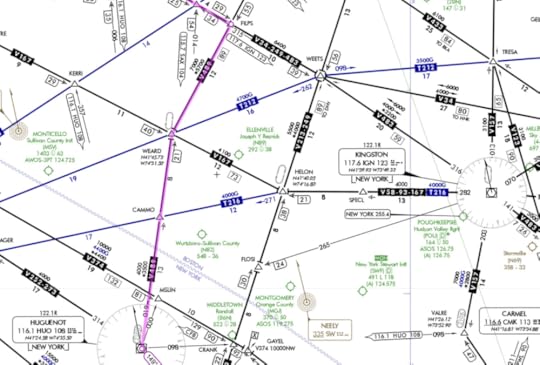
Note the 4000 over the V489 airway, lower left. This allows us to safely descend from our cruise altitude of 7000 to 5000.
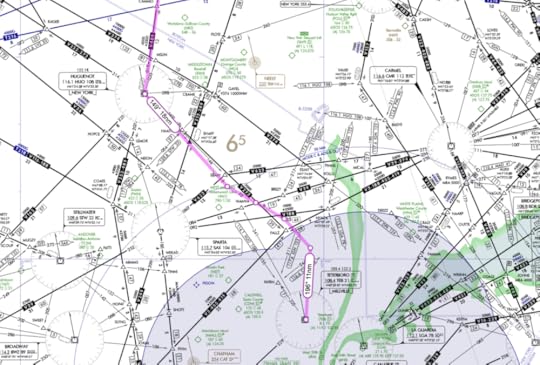
Just like reaching your exit on an interstate, we’ve hit our exit for the airway, at Hugenot HUO VOR. You can see our flight plan now longer follows the bolded black airway line after HUO. At this point, to get safely from HUO to Teteboro, ATC would be giving us step-by-step instructions via radar vectors. Since we are flying a specific approach (ILS runway 19), those vectors will take us to the waypoints on the approach plate.
Vectors to IAF
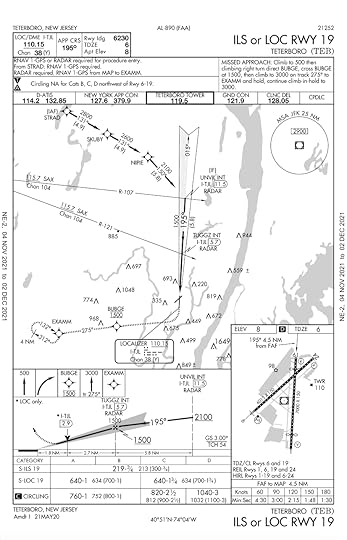
ILS Runway 19 approach plate. After exiting our airway in the previous step, we need to get to the first waypoint in the approach, called the Initial Approach Fix (IAF). In this case, it’s STRAD waypoint, in the upper left. Note there are no VOR distances or references to locate STRAD. The only way to find it is by ATC steering you there (via radar vectors) or through GPS navigation. That’s why the very top of the plate states “RNAV-1 GPS or RADAR required for procedure entry.”
Since we have neither ATC nor GPS for this flight, we’re going to fudge it a little. In real life, you can’t fudge it.
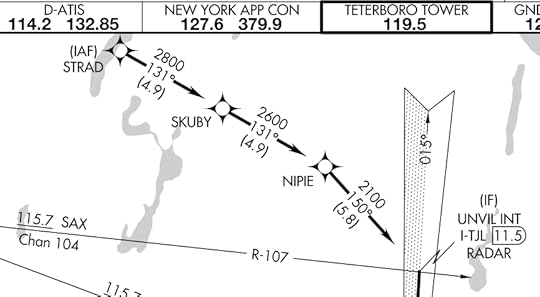
At this point, ATC would give you radar vectors to the ILS RWY 19 Initial Approach Fix (IAF), STRAD. Since we are not talking to live ATC in this video, we will self-vector by doing the following:
Set OBS2 to the 149 radial from HUO. Fly this radial until reaching 18 DME. This will be STRAD. Descend from 5000 to 3000 before arriving at STRAD.
Before reaching STRAD, tune NAV1 to Teterboro’s RWY 19 ILS frequency, 110.15.
Set the heading bug to 131. We will need this for the next waypoint after STRAD.
Once you reach STRAD, set the autopilot to heading mode. Fly heading 131 for 4.9 NM (the DME is still counting distance from HUO, so 22.9 HUO DME is approximately 4.9 files from STRAD). This will bring you to SKUBY. Descend to 2800 before reaching SKUBY.
From SKUBY, continue flying heading 131 for another 4.9 NM (now 26.9 HUO DME) to NIPIE, descending to 2600.
Toggle the DME source to NAV1, which is the RWY 19 ILS.
From NIPIE, fly heading 150 for 5.8 NM to UNVIL, descending to 2100. You will know you have reached UNVIL when CDI1 is centered and you are at 11.5 DME.
Upon reaching UNVIL, flip the autopilot source to NAV1 and put it in Approach (APPR) mode.
Flying the ILS
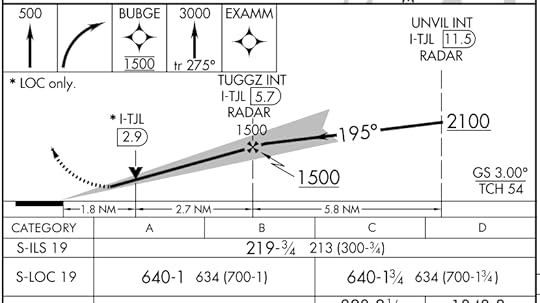
The Piper Warrior’s autopilot can control roll but not pitch. You will need to manage the plane’s altitude yourself using speed and trim. CDI 1 will display whether you are left or right of the localizer and above or below the glide scope. The goal is to keep the crosshairs centered during the descent
The altitudes you need to hit to intercept the glide scope:
2100 feet at UNVIL, which is 11.5 DME from the ILS
1500 feet at TUGGZ, which is 5.7 DME from the ILS. At TUGGZ, you should intercept the glide scope.
At the bottom of the IFR plate for RWY 19 ILS are the minimums, by CATEGORY. We are CATEGORY A, which is aircraft flying 0-90 knots on final. The minimums depend on whether we are flying an ILS (vertical and lateral navigation) or just the localizer (lateral navigation only). We are flying the ILS, so we’re using the S-ILS 19 CATEGORY A numbers, which are 219-3/4. Since this is a precision approach (using an ILS), these numbers are the Decision Height (in this case 219 feet) and the Runway Visual Range (in this case 3/4 of a mile). If we reach an altitude of 219 feet and we do not have the runway in sight, we must go missed and follow the Missed Approach procedure. The Runway Visual Range of 3/4 mile just tells us that at 3/4 of a mile we should be able to clearly see the runway markings and lights in normal visibility. Note if we were flying a non-precision approach (localizer only, or circling approach), instead of Decision Height we would have Minimum Descent Altitude, which is the lowest point you can descend without having the runway in sight. In that case, you’d keep flying level until you reached the Missed Approach Point, which is a specific distance from the field where you must go missed if you can’t see the runway. Anyway, for our weather present of scattered clouds, everything will be clear at 219 feet, so we won’t have to worry about this.
The Warrior is not an Airbus with auto land capability. You will need to turn off the autopilot before reaching 200 feet above ground and hand fly the landing. Remember, the autopilot is always trying to kill you, so don’t put it in charge anywhere near the ground.
Phew! That was a ton of information, but if you followed it you should have a pretty good grasp on how to read low-altitude IFR charts and manage an IFR flight with radios only. Hope you enjoyed it!
When I’m not flying the virtual skies, I’m the sci-fi author of the Hayden’s World series. If you love exploration and adventure, be sure to grab the first story for free and check out my podcast:
The first story, 43 Seconds, is also available as an audiobook narrated by the talented Shamaan Casey. Listen to an excerpt here:
S.D.Falchetti · 43 Seconds - SampleOctober 30, 2021
Thoughts on Chris Hadfield's The Apollo Murders
I first discovered Chris Hadfield, like many, from his out-of-this-world YouTube music video, Space Oddity. In it, a guitar soars down a space station hallway like a CGI special effect. Chris was on the International Space Station, singing, spinning his guitar weightlessly. He followed this up with an equally amazing space duet with the Bare Naked Ladies. I went on to read Chris’s autobiography, An Astronaut's Guide to Life on Earth, and I found him to be inspirational. If you’re read my latest story, Bernard’s Dream, you’ll recognize that Ava gives James a signed copy of An Astronaut’s Guide when he’s in the hospital. It was my small homage to the book.
Every reader brings a certain expectation to what he hopes a book contains. Some see glitzy covers with spaceships and conjure up exciting battles. Others know their author's expertise and want stories filled with technical marvels and accuracy. What to expect from a commander of the International Space Station who writes 70s era NASA fiction? I hoped, as I stared at the cover, that I would get scenes where I was the astronaut reclined in my capsule seat, a massive Saturn V rock underneath me, with the Mission Control countdown ticking in my headset. I wanted to know what it was like to feel the gees and the kick of stage separation, or the clumsy low-gravity bounce of a first moon step. Would the story deliver this implicit promise?
The Apollo Murders delivers exactly that, following a group of astronauts and mission planners on a fictional Apollo 18 Moon voyage (in real life, Apollo 17 was the final mission). The Apollo 18 mission is more of a military adventure, with plenty of U.S./Soviet Union Cold War conflict fueling its plot. Chris Hadfield does an excellent job of crafting a small, focused cast of astronauts, controllers, and Russian agents, placing them in claustrophobic situations where everyone has reason to distrust each other. Are there murders? Indeed, there is quite a body count by the story's end, although most deaths are from combat. And there is, surprisingly, combat. Armed space stations and pistols squirreled away in spacesuits. Spacewalkers trying to fight their way onto each other's ships. Bodies buried on the moon. It's not, say, Moonraker’s level of space mayhem, but there are small struggles peppered throughout the story’s second half.
1979’s James Bond flick, Moonraker, going all-in on the final Bond-villain lair assault. No worries - The Apollo Murders reigns in its battles and keeps them small and plausible
At first, I thought the weapons seemed out of place in a 1970s historical space fiction piece, until I read the afterword about the real-life events that inspired the story. Those events included actual armed space stations and cosmonauts with pistols.
The Apollo Murders has splashes of Apollo 13, First Man, and Space Cowboys written in a style reminiscent of Tom Clancy.
2000’s Space Cowboys. Although the Apollo Murders’ mayhem is lower-key than this, scenes like this will seem familiar
1995’s Apollo 13, with a famous creative problem-solving scene involving duct tape and carbon scrubbers. The vibe of the Apollo Murders is closest to this scene.
2018’s First Man, giving you a taste of the physicality of space flight
When you read a Clancy story, a fighter pilot doesn't just fire a missile; instead, the prose zooms in on the connection of the fire button sending its signal traveling down through wires, igniting the missile's rocket motor, clamps releasing, and radar guidance engaging. Hadfield's prose is like this. When an astronaut flips a switch, we'll know exactly the sequence of events that follows. At times, it's a brilliant enhancement. A harrowing helicopter crash details the fatal consequences of a pilot's simple movement on a flight stick pulling a critical linkage loose. I felt a pit in my stomach as the logical and deadly sequence of events unfolded, the prose following the pilot’s desperate attempts during the subsequent spin and crash. This scene worked so well because the reader knew the pilot was going to die before the pilot did, and watching it unfold was like watching an accident you were powerless to stop. At other times, the omniscient technical view can get in the way of some scenes’ pacing. The plot itself is a push and pull between the U.S. and Soviet Union, both of whom want something on the moon. The conclusion of the book is very action movie-ish and also has a certain Tom Clancy vibe to it.
I listened to the audiobook narrated by Ray Porter. Ray’s narration was fantastic, slipping effortlessly into different character’s voices, accents, and even Russian dialogue as needed. Procedural stories with professionals executing technical tasks can be challenging to write, as character’s personalities may not emerge when uttering “check” and “go”statements, but Ray does an excellent job giving each person his own vocal mannerisms, so you always know who is speaking. The audiobook is fifteen hours, and I enjoyed listening to it on my daily commutes.
The Apollo Murders was a treat. If you loved movies like Apollo 13 or books like Tom Clancy’s The Hunt for Red October, this book is for you. It’s a great mix of insight into what a moon mission is like coupled with dashes of an action/adventure movie. I hope there’s more books like it in the future from Chris Hadfield.
Hardcovers Now Available
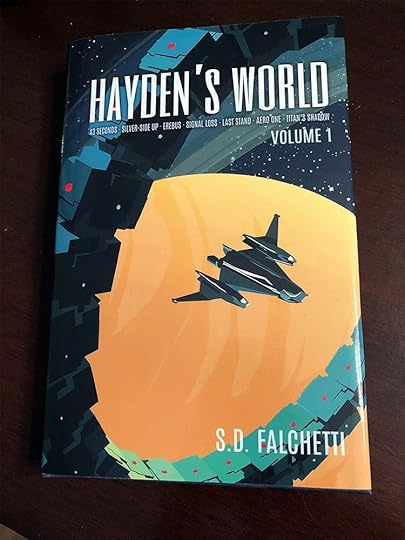
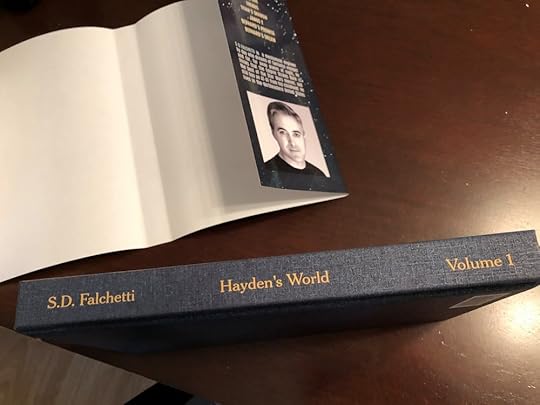
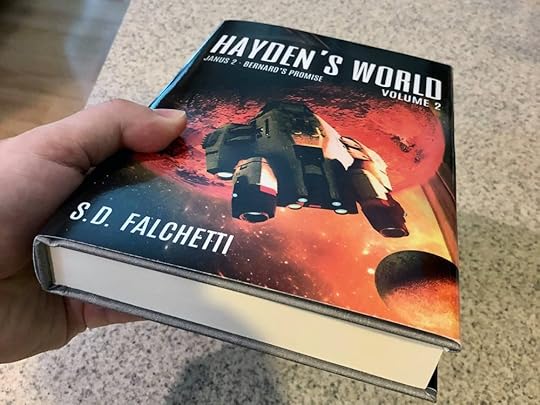
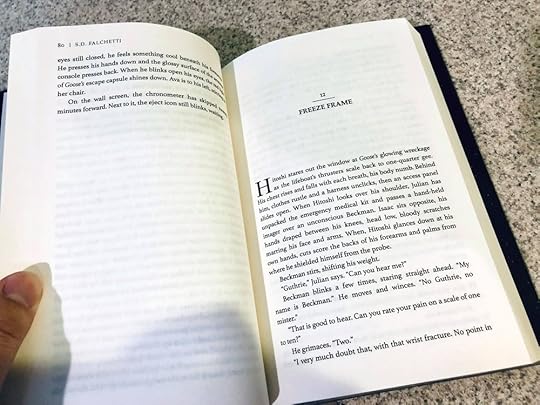
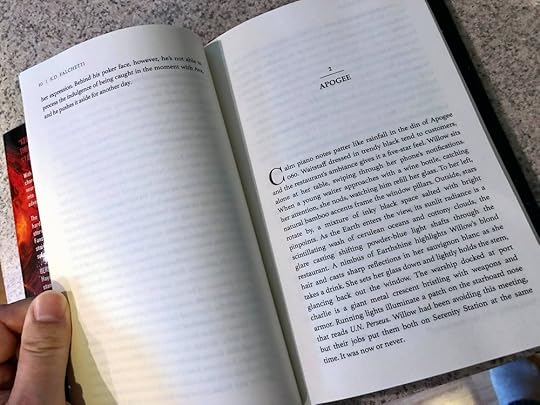
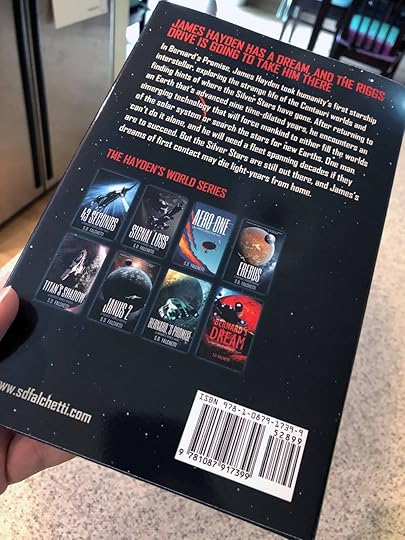
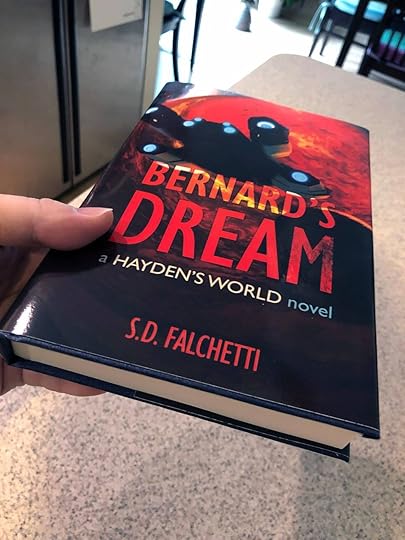
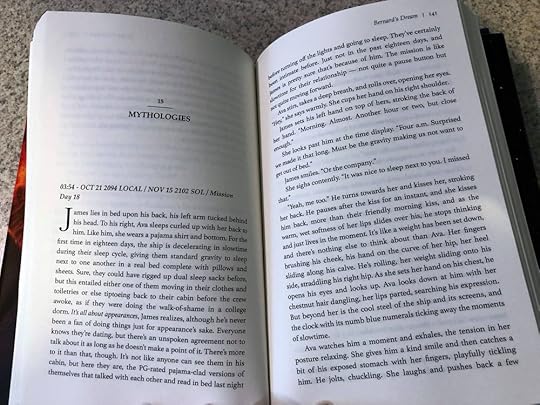
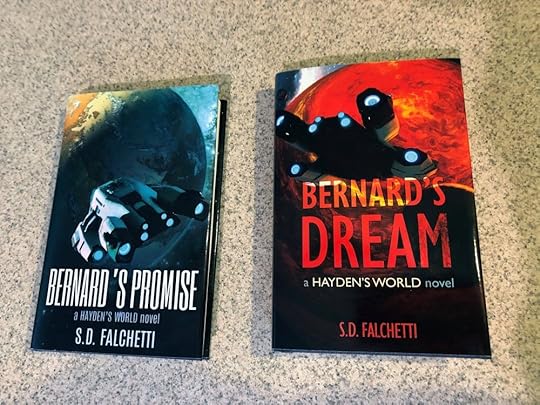
Hardcovers are available for Hayden’s World: Volume 1, Hayden’s World: Volume 2, Bernard’s Promise and Bernard’s Dream. The books are beautifully produced by IngramSpark with full-color dust jackets, gold leaf spine text, and cream 5.5” x 8.5” interiors. You can purchase them through Amazon or any major online retailer.
October 22, 2021
How I Made My Book Covers
As the blinking cursor awaited my instruction, I typed the final sentence of my short story and leaned back to admire it. “Keep dreaming big, James. We have three hundred billion stars waiting for us.” It was a good line, and a fitting kickoff both for the Hayden’s World series and my indie writing career. Career is a bit of an overstatement, perhaps…but it was indeed a launch. After formatting my story and readying to submit it to Kindle Direct Publishing, I realized the next hurdle had materialized: the book cover. How on earth do you make a book cover?
Through a little Googling, I found Canva. My first attempt was a stock image starfield with the words 43 Seconds overlaying it. I scratched my chin. I can do better.
If you’re an indie author like me, you’ve probably endured for-an-indie-author-itis. It goes something like this: This story is well written, for an indie author. That’s a nice cover, for an indie author. I think that sometimes people forget that everyone has his own unique background and one of the appeals of being an indie author is being able to play many parts in the self-publishing process. In my case, I majored in mechanical engineering, which has directly helped with the hard science content in my writing, but I minored in graphic design. After graduating, I spent my days working as a mechanical engineer but my nights and weekends were spent creating artwork. Over the next fifteen years I built my artwork resume with group, juried, and solo shows, and my artwork appeared in magazines such as The Artist’s Magazine and Drawing Magazine and books such as Strokes of Genius: The Best of Drawing. I chose my author name, S.D.Falchetti, with just my abbreviated initials because my full name and website were already in use for my art career (shawnfalchetti.com).
[image error]So, back to me staring at my generic starfield cover. Here’s where I hit a slight snafu. I had almost no digital art training. Everything I’d done up to this point had been traditional artwork. Even my graphic design courses used hand-drawn layouts on drafting tables. So, I taught myself Adobe Illustrator and Adobe Photoshop. My first three book covers were made in Adobe Illustrator and I was shooting for a very stylized, minimalistic look:
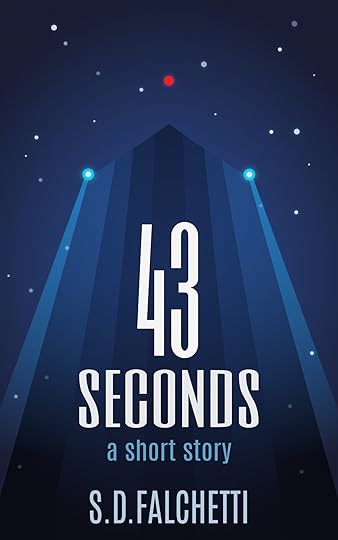


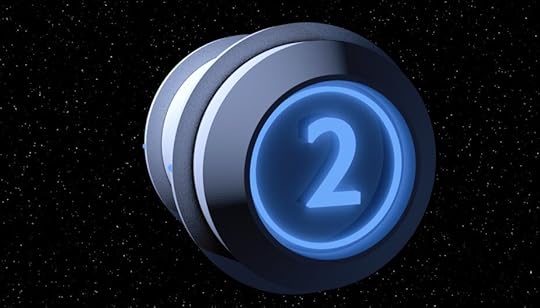
Out of that bunch, Aero One was the standout, and I kept it. For 43 Seconds and Signal Loss, however, I decided I wanted to go a different route. Science fiction book covers should clearly announce they are science fiction through their imagery, and most covers in the genre have a photorealistic look. So…how to create photorealism? Well, as an engineer I spent many hours learning how to three-dimensionally model things in AutoCad, so the leap to 3D modeling software was more of a short hop. I taught myself Blender. One of my first Blender objects was a space module I pieced together as an experiment. When I hit the render button, I’d realized I found a winner.
In no time, I was creating my own space ships and scenes. I felt like I’d discovered a digital version of George Lucas’s model shop. Here’s the rough model of Bernard’s Beauty, before texturing:
[image error]Here’s the Aristarchus and Resolve, which would later grace the new cover of Signal Loss:
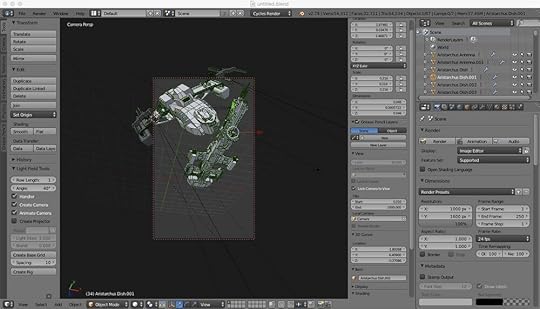
Of course these are just the models. They need to be assembled into a composite plate with a background and the overlaying cover text. For this, I used Photoshop:
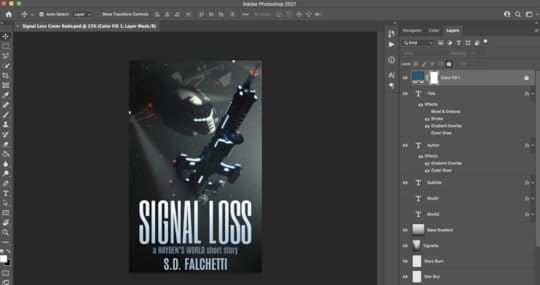
Over time, I learned how to make configurable Blender models for common background objects like planets. Now by tweaking a few parameters and textures, I could have ringed worlds, icy worlds, moons, or rocky planets with oceans.
[image error]The planet Astris, above, appears on the cover of Bernard’s Promise, below:

I also discovered that I could fuse the 3D modeling techniques used for my photorealistic covers with the stylized minimalism of my earlier Illustrator covers. By merging the 3D models of Bernard’s Beauty and the Cassini One Ring with hand-drawn artwork, I created the cover of Hayden’s World: Volume 1. It has a nice, retro, pulpy-art feel to it:
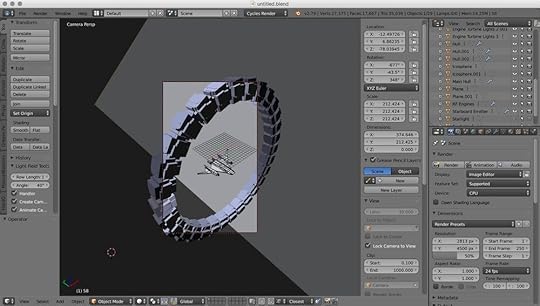
Cassini One and Bernard’s Beauty Blender model

Digitally hand painting using a limited color palette
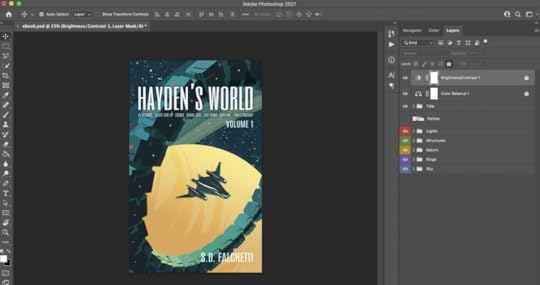
Composite final plate
When it was time to create the hardcover version of my books, complete with a folding dust jacket, I had all of the art assets because I had created them myself, and it was easy to expand the layout to include the spine, back cover, and sleeve layouts. Now, when I say easy, it wasn’t really easy. Graphic design is actually pretty hard, especially for a multipage layout like a dust jacket. But, I loved doing it. I could make covers all day long. The resulting covers have a common design language and clearly are part of the same series:
[image error]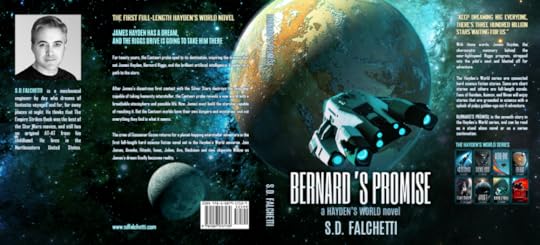
So, that’s it - my book cover journey, and a few secrets of how I do things. I hope you enjoy both the stories and artwork. Thanks for following along.
October 3, 2021
Hayden's World: Volume 1 - Now Available as a Hardcover
Hayden’s World: Volume 1 is now available as a hardcover produced by IngramSpark. The edition features a full-color dust jacket over a blue fabric-bound book with gold leaf lettering. I’m very happy with how it turned out.
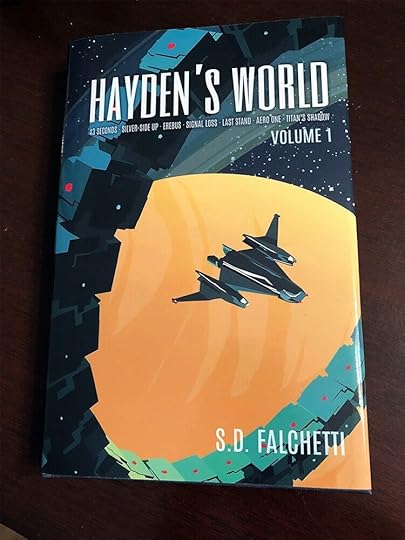
[image error]
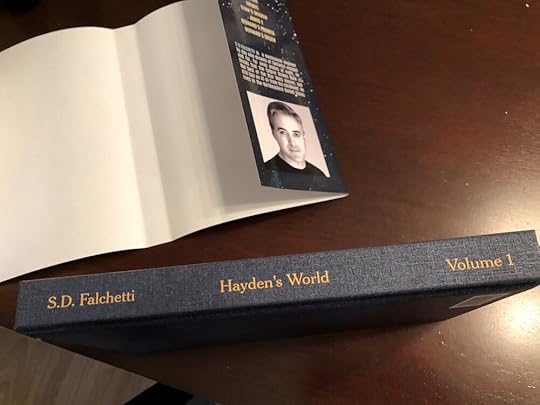
Amazon has recently added a hardcover option to KDP as well, but unlike IngramSpark’s, Amazon’s books are case-laminate only (the cover art is printed directly on the book without a separate dust jacket). Setting up the book for publication was definitely more difficult in IngramSpark’s interface than Amazon’s, but it wasn’t too hard once I understood the requirements. My interior layout was handled by Vellum, same as all of my ebook and print titles, and Vellum formatted everything perfectly on the first try. The cover artwork required significant work to extend it to cover the inside dust jacket flaps, and the technical requirements were a bit involved (although if you’ve created cover art for Amazon’s KDP paperbacks, it’s not that much different). With IngramSpark, I definitely had some confusion regarding the timing of my physical proofs and the book’s go-live dates, which almost resulted in the book going into distribution before I’d seen the proof, but it all worked out in the end. I hope you enjoy it! I have a certain fondness for dust jackets, and it’s very cool seeing my work in this format.