
Exponent II's Blog, page 285
October 13, 2017
Bury Your Weapons: the Mormon Case Against Gun Violence
When I was little my dad used to come home from work with blood on his shoes.
At the time, he was a young medical student completing his ER rotation at a busy hospital in downtown Houston. It was gory work, and when he got home he left his shoes by the door so he wouldn’t track blood in the house.
My dad treated hundreds, maybe thousands of gunshot wounds as he worked his ER shifts. (One night, he says, they treated 27 separate people.) Gunshot victims weren’t his only patients, of course, but they were among the bloodiest, particularly in that part of the US. In fact, the hospital where my dad worked served as a training hospital for military medics before they were shipped overseas to conflict zones.
My dad treated gunshot wounds on all types of patients. Men and women, people of all races, old and young. Some children. One patient he treated was 13 year-old boy. He came in with a gunshot wound to the leg. As my dad stitched the boy up, he asked the family what happened. The boy’s mother replied,
“Never you mind what happened,” she said. “There ain’t no one in this town who ain’t been shot.”
Sometimes, after my dad came home, I glimpsed his bloodstained shoes sitting outside on the steps. I can still picture them, a pair of black and white lace-up sneakers, smeared and spattered with deep, dried-up brown.
[image error]
by albioneurope
My two boys, who are both quite young, are still in the process of learning all the scripture stories. This Monday night for family home evening my husband took my oldest son on his lap and flipped through a large illustrated copy of the Book of Mormon. Each time they came to an unfamiliar illustration, he stopped and told my son the story behind the picture.
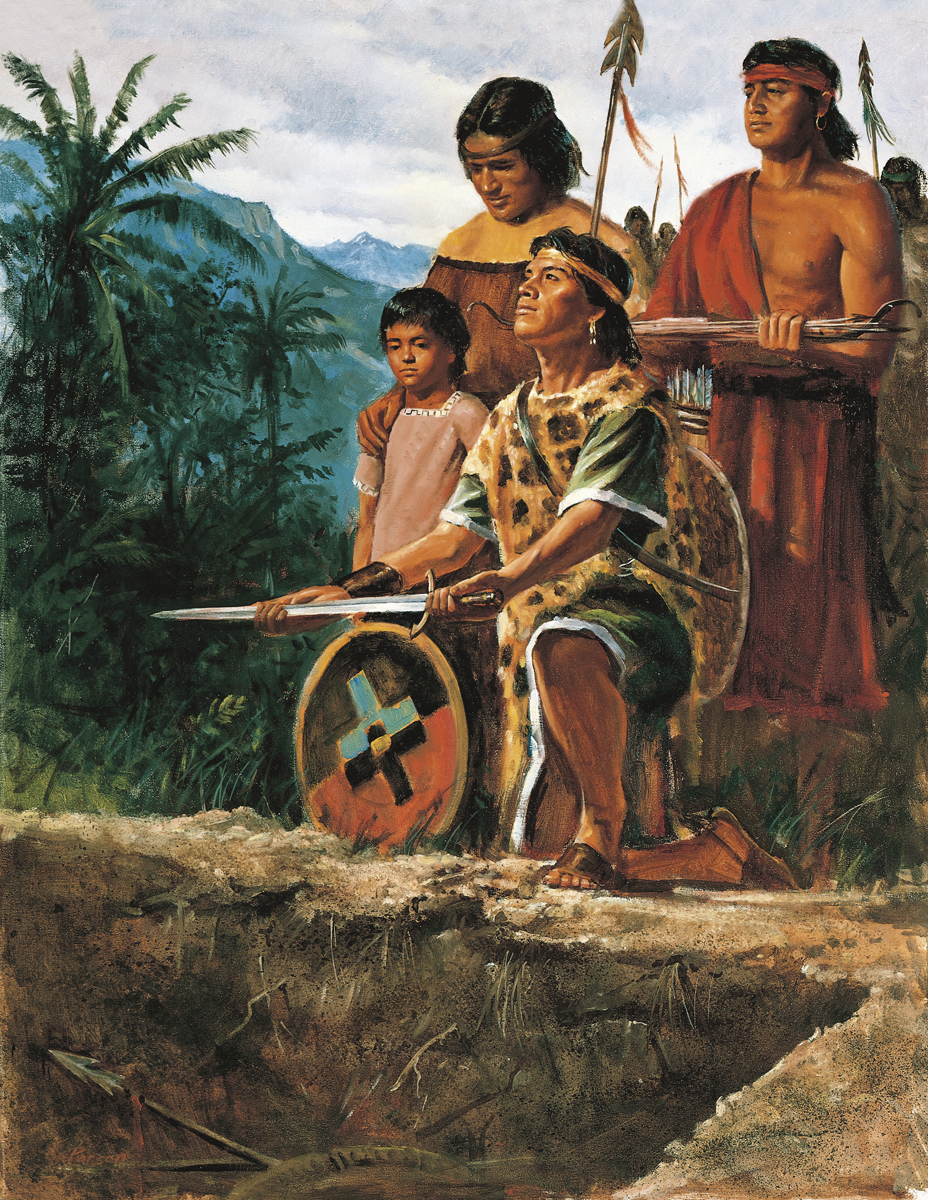
He came to this image of the people of Ammon burying their swords. The corresponding scriptures are found in Alma 24:
“They took their swords, and all the weapons which were used for the shedding of man’s blood, and they did bury them deep in the earth.
And this they did, it being in their view a testimony to God, and also to men, that they never would use weapons again for the shedding of man’s blood.”
My husband told my son the story, and he stared hard at the picture for a few moments.
“They buried their swords so they wouldn’t kill any more people?” he said.
“That’s the idea,” said my husband.
Two days later, as I took my son to school, we drove behind a large pickup truck. This truck had a fat white BYU sticker in the window. We came to a stop light and I noticed that the truck had a custom license plate cover. The plate cover read:
“Fight crime. Shoot back.”
It was then that I noticed the sticker that sat in the opposite corner of the window, this one hanging on the glass like a coat of arms. It was a simple white image: two shotguns laid one over the other like deadly crossbones.
[image error]
by mariaeklind
Like many Americans, I was overcome when I read about the Las Vegas shooting. I was horrified that something so barbaric could happen on such a scale, and not for the first time.
After the initial shock wore off, I wanted desperately to understand how this could have happened. Again. I pawed through scads of data, scrolled through scattered charts, pinned dozens of studies to read and scrutinize in the days that followed.
The more I studied, the more I realized that the problem was not necessarily a lack of information. Numbers on gun violence are had easily enough. As Harvard professor David Hemenway says, “What you find is that where there’s more guns, there’s more death.”
And yet, Americans continue to cultivate a culture of gun worship. As it turns out, statistics matter very little to those who want to own guns. This is because gun owners don’t rely on data while purchasing a firearm. Instead, they’re motivated by strong emotions—emotions like fear.
One image in particular is imminently frightening:
The image of a deranged shooter killing us or those we love.
We easily imagine such a person because we’ve seen him—in the news, in movies, and on television. As disturbing as he is, most of us can easily picture this crazed shooter pointing a gun at ourselves, at our children, at our closest loved ones.
The thought is both terrifying and incredibly persuasive. It’s no wonder a majority of gun owners say they own a gun chiefly for protection, and the NRA continually capitalizes on this fear in their public arguments. (They also make the somewhat last-ditch argument that we need guns to protect ourselves from a violent government takeover, but we lost that arms race decades ago with the invention of tanks, nukes, and battle drones.)
Sadly, those who base their decision to purchase a gun on this frightening image (a mental shortcut which psychologists refer to as the availability heuristic) are actually putting themselves and their loved ones at greater risk. That’s because people who bring guns into their homes are much less likely to imagine suicide than they are to imagine defending themselves from shooters, intruders, and those who would wish them harm.
And yet, when you purchase a gun, you’re 180 times more likely to use it on yourself than to use it to defend your home, your family, even yourself.
The reality is, gun ownership has a devastating effect on suicide rates across the board. In states where gun ownership is high, suicide rates (even by other methods) are higher. And the risk seems to be even more astronomical for suicidal teens. Recent data shows that teens who live in states with higher gun ownership are four times more likely to commit suicide than teens who live in states with low gun ownership. In Utah, a state where teens commit suicide at a rate well above the national average, more than half of those suicides are committed using firearms.
[image error]
by jaredmayfire
It’s time to rewrite the script on gun ownership, and Mormons should be at the forefront of creating anti-gun, anti-violence legislation. Utah has some of the most permissive gun laws in the country. Nearly 1 in 3 Utahns own a gun, and because there’s no statewide gun licensure or registry, the number may actually be much higher. Utah has several loopholes to the universal background check law, and if Utahns want to carry guns around in plain sight, they’re allowed to do so without so much as a permit, so long as the gun is a step or two away from firing. Currently there are also no provisions in place for preventing someone with mental health issues from obtaining a firearm, even if they’ve attempted suicide in the past.
Meanwhile, the number of teen suicides in Utah (and subsequently, gun-related suicides) has tripled since 2009.
As Mormons, we’ve sat at the altar of gun worship for far too long. Our reluctance to bury our weapons of war has cost us so many lives. It’s time to put ourselves on the right side of history and end our reliance on fear and violence. As Christ said to Peter in the Garden of Gethsemane, “Put up again thy sword into his place: for all they that take the sword shall perish with the sword” (Matt. 26:52.) So it is with us.


October 12, 2017
Relief Society Lesson 20: Fellowship with Those Who Are Not of Our Faith
[image error]I’ve been doing Relief Society lessons on this blog for a long time now, and I was delighted to see this new topic. Consider asking a member of another religion to come and speak for 10 minutes about why interfaith relationships are important to them in their spiritual life. You can ask a friend of another faith or consider googling “interfaith council” in your city. These groups often have individuals willing to speak (I googled “interfaith council in Phoenix, Arizona” and found this group).
This lesson is so broad that lends itself to some great discussions. If you are not comfortable asking someone from another faith to come, consider asking the Public Relations representative in your stake to speak about his or her experiences in the broader community or invite a member of your ward who has expressed an interest in those belonging to other faiths.
Another option would be to have a convert talk about how her faith from another tradition helps her as a Mormon or have someone sing a favorite hymn or spiritual from another faith. (I
Creating Relationships with Other Faith Organizations
In the manual, we have a quote from President Hinckley that I love:
“We recognize the need to heal the wounds of society and replace with optimism and faith the pessimism of our times. We must recognize that there is no need for recrimination or criticism against one another. We must use our influence to still the voices of angry and vindictive argument.”
Here are some other quotes from later in the manual that may also help with discussion:
“We must not become disagreeable as we talk of doctrinal differences. There is no place for acrimony. But we can never surrender or compromise that knowledge which has come to us through revelation and the direct bestowal of keys and authority under the hands of those who held them anciently. Let us never forget that this is a restoration of that which was instituted by the Savior of the world. …
We can respect other religions, and must do so. We must recognize the great good they accomplish. We must teach our children to be tolerant and friendly toward those not of our faith.”
“We are not out to injure other churches. We are not out to hurt other churches. We do not argue with other churches. We do not debate with other churches. We simply say to those who may be of other faiths or of no faith, “You bring with you such truth as you have and let us see if we can add to it.”
I would ask the class these possible questions to get the discussion started:
Have you spoken to someone from another religion without the intent to do missionary work? How was it similar to a missionary discussion? How was it different?
Was the discussion difficult? Were there disagreements?
Did you find common ground? How did that make you feel?
The Importance of Diversity
In D&C 1:30, we read about our church as “the only true and living church upon the face of the whole earth.” Sometimes, this is off-putting to those of other faiths.
Why might they feel that way?
What have you done in discussions to bring a spirit of kindness and equality?
I think President Hinckley’s quote in the manual here is helpful to keep in mind and has helped to create relationships based on shared faith and mutual respect without an intent to convert (after all, it is the Holy Ghost, not me who will convert others):
“… Our strength lies in our freedom to choose. There is strength even in our very diversity. But there is greater strength in the God-given mandate to each of us to work for the uplift and blessing of all His sons and daughters, regardless of their ethnic or national origin or other differences. ”
Later in this lesson, President Hinckley speaks again about this concept:
“We must never forget that we live in a world of great diversity. The people of the earth are all our Father’s children and are of many and varied religious persuasions. We must cultivate tolerance and appreciation and respect one another.”
I love the idea of greater strength in our diversity. President Okazaki gave a great talk in April 1996 at General Conference called “Baskets and Bottles” where she talks about how women in Utah and Hawaii store fruit differently.
“The basket and the bottle are different containers, but the content is the same: fruit for a family. Is the bottle right and the basket wrong? No, they are both right. They are containers appropriate to the culture and the needs of the people. And they are both appropriate for the content they carry, which is the fruit.”
She uses the analogy to talk about the differences and strengths we bring as diverse members of the Church. I think this analogy can easily be applied to different religions. The beliefs of different religions speak to the hearts of different people but all work to bring about greater love.
When, in your life, have you benefitted from the another’s religious perspective to increase your own religious understanding or build your own relationship with God?
After I finished college with a degree in Anthropology, I was fascinated with the different religions of the world. I love reading the sacred texts of other religions and finding commonality between my faith and other religious traditions. I continue to do this in my life by:
attending other religious services when I am moved to
searching other texts like the Koran, Talmud and sutras from Hinduism and Buddhism
listening to the music of other religions
looking at the art created by artists inspired by their religious traditions
How else do you experience the things that are lovely or of good report in other religious traditions?
Collective Strength to Drive Away Evil
I believe that one reason why it is so important to have relationships with our sisters and brothers of other faiths is so that we can battle evil together.
In the manual, President Hinckley said, “May the Lord bless us to work unitedly to remove from our hearts and drive from our society all elements of hatred, bigotry, racism, and other divisive words and actions. The snide remark, the racial slur, hateful epithets, malicious gossip, and mean and vicious rumor-mongering should have no place among us.
“May God bless us all with the peace that comes from Him. May He bless us with thankful hearts and with the will to mingle together with respect one for another, uniting our efforts to the blessing of the communities where we are fortunate to live.”
Have you had the opportunity to work with others to battle racism, sexism, homophobia, or other kinds of bigotry with others of different faiths who shared your values? How did that feel? What did you learn?
President Hinckley encouraged us to join with those not of our faith “in good community causes.”
We should live with respect, appreciation, and friendship toward people who are not of our faith.
I thought this section in the manual was so well done.
“We claim the privilege of worshiping Almighty God according to the dictates of our own conscience, and allow all men the same privilege, let them worship how, where, or what they may” (Articles of Faith 1:11).
How very important that is—that while we believe in worshipping God according to our doctrine, we do not become arrogant or self-righteous or prideful but that we extend to others the privilege of worshipping according to their desires. Much of the trouble in the world comes from conflict between religions. I am happy to be able to say that I can sit down with my Catholic friends and talk with them, that I can sit down with my Protestant friends and talk with them. I would stand in their defense, as this Church has done and will continue to do, in defending them in this world.
I plead with our people everywhere to live with respect and appreciation for those not of our faith. There is so great a need for civility and mutual respect among those of differing beliefs and philosophies. We must not be partisans of any doctrine of ethnic superiority. We live in a world of diversity. We can and must be respectful toward those with whose teachings we may not agree. We must be willing to defend the rights of others who may become the victims of bigotry.
President Hinckley exemplified love, tolerance, and acceptance of other religions. Who else have you seen do this well? What did he or she do?
A final quote from the manual followed by some questions to consider in navigating a class discussion:
“We certainly do not need to be boastful about [our religion] or to be arrogant in any way. Such becomes a negation of the Spirit of the Christ whom we ought to try to emulate. That Spirit finds expression in the heart and the soul, in the quiet and unboastful manner of our lives.”
Questions
In our relationships with others, why is it helpful to remember that we are all children of God?
How can we cultivate greater appreciation and respect for others?
How can adults teach children to appreciate and respect others?
Why is it important that Church members work together with other people in good causes?
How can we become a greater influence for good in our community?
How have you seen love and respect overcome feelings of animosity? Why is our behavior toward others “the most persuasive argument for that which we believe”? Consider specific ways you can reach out to others.
What are your favorite resources from other religious traditions?
How will you teach this topic?
Who wants your old boys’ club, anyway?
[image error]I’m sad, y’all.
I was going to write about International Day of the Girl, and the awesome girls in my Activity Days group, and the palpable excitement last month when I asked them, “What don’t you like about Activity Days? What are some things you wish we could do?”
Instead, I have to address yesterday’s announcement that the Boy Scouts of America will soon allow girls to be in its scouting program, Eagle Scout award and all.
If you’re celebrating this, please take a step back and look at what it really means: some dudes whose club is shrinking decided to bring girls in to boost their numbers, and they didn’t bother consulting with their parallel organization that’s already serving girls.
That’s right: Boy Scout leadership made this huge announcement without any input from the people who are most interested in getting girls involved in scouting: the leaders of Girl Scouts of the USA.
It’s mansplaining at its worst: “Hey, we have a program that we really like for boys. Never mind that there’s a very similar program for girls–we’re just going to say that our program is for girls too! You’ll like that, right?”
To make matters worse, they did it in the most tone-deaf way possible, announcing the change on the International Day of the Girl–a day that the Girl Scouts celebrate.
That’s not inclusive; that’s patriarchal. Thanks but no thanks, guys.
October 11, 2017
Thoughts on shame and failure—A mental strategy to stop dwelling on the down
I read a New York Times article about failure. The author asked the readers to do a quick experiment. He said think back on a time when you remember someone failing. It may take a few minutes, he said. Now write down adjectives you would use to think of that person or that failure. Now, he said, think of a time you failed. Write down adjectives you would use to describe yourself and that failure.
Try the exercise yourself. The gist of the results are that people have a hard time remembering other’s failures but when they do, they describe those people as courageous or having grit or plowing through. When they think of their own failures (which easily come to mind) they describe themselves as stupid or unworthy. These results did not surprise me. I couldn’t even remember another person’s failure—not one ridiculous example. But for myself, many memories of failure came to mind.
I tend to think back on negative experiences with extreme negative emotion. Looking back I feel intense shame and embarrassment, often disproportionate amounts of embarrassment or shame, for what were negative but seemingly minor bad memories. To give you an example, I found my mind wandering as I was drifting off to sleep a few weeks ago. I remembered this moment in high school, junior year, where I felt so stupid thanks to a failure.
In my high school everyone interviewed to be part of a prestigious government class called We the People. Everyone who got in was part of We the People senior year and went on to compete in a national high school competition. Everyone who did not get in took a remedial government class. In case it’s not obvious, everyone wanted to be part of We the People. We the People kids were the cool kids.
In my interview for We the People, the teacher asked me detailed questions about my political views. Despite being a bright teenager, I did not have developed, nuanced political views at 16. My views were basically the views of my parents. The We the People teacher asked if I supported abortion. I said no. He asked if I would protest outside an abortion clinic. I said, no, I didn’t think so. When he pressed the issue, I said I might hand out literature or something, I didn’t know. I remember feeling very flustered. Long story short, the teacher was not impressed with me. On the day they handed out acceptances and rejections the last open slot came down to me and one other girl. I did not think this other girl was very bright. But on that day, she got in. I did not.
More than 15 years later as I’m lying in bed remembering this moment, I am feeling intense shame – the shame of failure, the shame of naiveté, maybe the simple, overwhelming shame of adolescence. And while my particular circumstances of shame are unique to me, I know many, many people experience similar shame, embarrassment, and crushing negative feelings when bad thoughts circle back in their minds. And I have recently encountered a strategy that is really, truly helping.
What I learned recently, through a meditation app called Headspace, is an acknowledgement technique called “noting.” Thoughts or feelings tend to come to the surface of our minds, but by noting them for what they are – noting them simply as “thought” or “feeling,”—our minds consider the matter resolved and quickly move on. No dwelling needed. The matter has literally been sorted. Our minds have labeled the unwanted thought or feeling and put it away in its place. This sounds simple, but I have found it to be astonishing. I have always wanted to strong arm my mind into doing what I wanted it to do. It never works. But this simple act of noting is working. My brain is handling unwanted negative thoughts and feelings without me having to dwell in them, feeling crappy about myself and/or reliving any unwanted experiences.
I have found my life (and my head) running a lot more smoothly because I’m noting my thoughts and feelings without judgment—without dwelling.
I wanted to pass this along in case it makes a difference. We all have shame. We all experience failures. But it doesn’t do us any good to sit in that place. We can’t change the past, but we can live in the present. We can work toward who we want to be in the future. Let’s clear that negative mental space so we’re free to fill it with bigger thoughts and better pursuits.
Wishing you all well as we ramp up into fall.
October 10, 2017
Guest Post: Sitting in the Dark
[image error]By ElleK
A woman I know was told years ago by her husband that she wasn’t to open her own doors because he wanted to open them for her as a sign of respect. Throughout the years of their marriage, he has opened her car doors before she enters and exits the vehicle. Once, I drove with this couple somewhere in a large, full SUV. We arrived at our destination and piled out of the car and were halfway across the parking lot when we realized the woman was missing. I ran back to the car and saw her still sitting inside. I opened the door and asked if she was coming, and she said, “My husband gets mad when I open the door myself. He wants to do it for me.” But her husband, distracted by so many other people in the party, had forgotten her. She sat in the hot car by herself, waiting for someone to do a task she was perfectly capable of performing.
Obviously this example is extreme and a bit silly, but it illustrates something I frequently witness at church: women are placed in positions where they have to go through a man for something they could easily do themselves. Sometimes there is good reason for this: any organization must have order and run large items up the chain of command. Schedules must be coordinated and budgets secured in order for things to run efficiently. However, women frequently must ask permission for the smallest of things. Sometimes this is required by her micromanaging priesthood leader, and sometimes it is the woman herself who feels pressured by culture or others to seek approval for minutiae that falls under her stewardship.
We cannot blame this only on a local phenomenon. Several months ago, some meeting notes of the Quorum of the 12 were leaked. One of their agenda items was to approve the opening song for the General Young Women’s Meeting which had been changed by the general young women’s Presidency. These capable women, entrusted with a large stewardship, were not even permitted to choose the hymns for their meeting without oversight and permission.
My stake has rules in place that prevent women from using church buildings without priesthood holders present. I am sure there are reasons for this; however, the logic is flawed (suggesting that an 80-year-old priesthood holder is needed to “protect” 25 adult female volleyball players with access to cell phones is absurd). My stake also has men at Girls’ Camp keeping 24-hour watch (no such policy exists for boys’ camps). Such policies treat women like they are children and in need of governance and supervision, not to mention inconvenience men.
A friend of mine is arranging a camping trip for LDS women in her area. It’s not an official church activity; it’s just friends and acquaintances camping and swimming and having a good time together. But on the bottom of the flyer it says, “Although not a church sponsored camp, two priesthood brethren will be on site for emergencies.” I assume this means that if someone gets hurt or sick, two men will be available to give a blessing. I have no problem with priesthood blessings or with men pitching in to help, but I was confused and, frankly, distressed that the capable and competent women organizers thought that, should an emergency occur, they wouldn’t be able to handle it on their own (let’s not forget that our foremothers gave prophet-sanctioned blessings, including anointings, for a hundred years). This notion that a blessing given by priesthood holders is more effective than a prayer using priesthood power given by women is as toxic as it is widespread. If such a thing were true, then women (or even a lone man, since he can’t bless himself) should conceivably never be further than yelling distance from a priesthood holder.
Despite the new insights we’ve received in recent years regarding women’s relationship with priesthood power and authority, there is still an overarching sense that women need men in every circumstance for approval, for direction, and for access to priesthood power. I’m not bashing on men (or priesthood holders) here–it’s important that we all work together. The problem is when it is assumed (by men or women or the institution or all of the above) that women need babysitting and aren’t capable enough (or allowed) to make decisions without extensive oversight.
The story I related earlier of the woman stuck sitting in the car brings to mind the analogy given by Elder Anderson in a recent General Conference: “A man may open the drapes so the warm sunlight comes into the room, but the man does not own the sun or the light or the warmth it brings. The blessings of the priesthood are infinitely greater than the one who is asked to administer the gift.” While it’s a lovely thought on the surface, my mental picture of this analogy is not one of warm sunlight coming into a room, but of a woman sitting by herself in the dark, perfectly able–but not allowed–to open her own drapes, waiting for a man to come and do it for her.
When possible, we must challenge this culture that insists women need supervision in all things. Until we both confront the sexist and patronizing policies employed by the institution and allow ourselves to seize the drapes and let the sunlight pour in, we’re sitting in the dark.
ElleK listens to NPR in the car, sings in the shower, and crusades from her couch. Women’s issues in the church are not a pebble in her shoe; they are a boulder on her chest.
A second atonement: Mother’s Milk and healing a theological crack in Mormonism’s heart
[image error]
By Elizabeth Pinborough
Rachel Hunt Steenblik has stepped into a great Mormon spiritual-theological gap and filled it with a gentle, yet thunderous, sound. The tiny poems of Mother’s Milk reach into the cosmos to deliver a message about the nature of our spiritual-developmental origins as children of a Heavenly Mother. These poems occupy a distinguished place as a uniquely Mormon book of wisdom literature, and as such they map a path for our spiritual seeking that contains the guiding hope of one day healing the wounds of her absence.
The daughter seeks the Mother through childhood games, just as the child seeks the earthly mother: Peek-a-Boo, Marco Polo. Rachel casts the daughters and sons of Mormonism as the Lost Boys and Girls, wishing to see their Mother again, remembering her, and encountering the grief of her absence. “I woke up again/ without my Mother” (“Every Day,” 22). The wisdom of the Mother’s relationship with her children is more complex, though.
The give and take of these poems reflects the developmental process of the infant. Sometimes the Mother is there, sometimes She is taking a shower. Sometimes She is tired, and then Her strength renews. She uses Her voice with power, and yet Her books are blank so that we, Her children, can learn to write. Yet, although She is obscured by the veil, by mortality, the Mother is there. Rachel senses Her when she is giving birth. The more she looks, the more she sees Her, even if it is only through a dark mortal lens. “I look through/ the glass, darkly,/ and can just barely/ make Her out” (“Darkly“ 122).
She exegetes that in Mormon Christology the Mother must be the cross, just as She is anciently Asherah, the tree representing the mother goddess of Ugarit. Unlike the Father, She is perhaps present during the Atonement and in Gethsemane, strengthening the Son: “When Jesus was on the cross,/ . . . His Mother might have been/ right there,/ branches holding Him—/ a weeping willow,/ the Tree of Life” (“Tree of Life,” 73).
Heavenly Mother’s priceless milk and care are never far away from us. Her spiritual attentions are no less involved than the Father’s are. Yet, “One of the first things/ we must learn on earth/ is how to sleep/ without our Mother” (“Life Lesson,” 55). We learn to be spiritually self-reliant, when we still need connection with Her, just as we need connection with our earthly mothers (“She can sleep/ without her Mother/ but she doesn’t want to” (“The Child,” 12). This need for connection turns us into seekers.
This reveals a keening truth of spiritual development: seeking might need to tear us to produce the growth and answers we are looking for. Working within the tidily coherent theological framework of Mormonism, we sometimes forget the nature of spiritual growth. We are called upon to transform our vision and our hearts, a soul-expanding process. Motherhood perforce brings this kind of self-stretching. And Heavenly Motherhood, we learn, is perhaps no different: “Mother, too, is anxious/ when Her children cry out, a/ veil of forgetting hiding Her/ last words: I will always come/ back for you. It shall be/ a small moment” (“Separation Anxiety, II,” 55).
Now, what of the crack. There are two cracks (perhaps three) in this book. One is that of Rachel’s heart after she gives birth to her daughter, Cora (“Crack,” 84). The second is the Mother’s cracking, which is somewhat ambiguous (“Something cracked open. She is everywhere.” “Crack, II,” 123). We are not given to know what it is. Rachel does not quite know what it is in the moment of the poem. But, the text makes a larger argument for the second atonement, a series of sublunary sacrifices, that Mother makes for Her children in numerous, intimately knowing ways that are part of their spiritual development.
These consist of the sacrifices the Mother makes when she weans a child to earth life so the child can grow in strength: “On Her daughter’s/ first day of Earth,/ they both wept” (“Separation Anxiety,” 12). Rachel teaches us that what may seem like the milk of a thus-far watered down theology of Heavenly Mother is really meat—the opportunity for us to enter the space where we encounter our own woundedness, keening, searching, and questioning, and find an answer, hear a voice, deepen our understanding that we are sons and daughters of Heavenly Parents, that we need a Heavenly Mother, even while on earth. (Søren Kierkegaard offers philosophical undergirding for this idea of a “stronger sustenance” when the child is to be weaned [see note, “What Søren Aabye Taught Me,” 148]).
Rachel’s cracking offers itself as a surrogate for our own spiritual exploration. See me crack open wide so that you can find the crack in yourself that will then reveal other even larger cracks, the crack that created our Mother in Heaven’s abiding concern for us.
Mormonism has the feel of an already-complete theology, one with an entire plan of salvation mapped out from beginning to end. At first glance, there are few perceptible structural cracks. The foundation is certain. Thus, when we uncover a gap in that theology where the current light is not enough (polygamy, race, gender, Heavenly Mother) we often become agitated, unseated, undone. Paradoxically, it is in the crack and in the cracking that we can hope to find healing. These cracks serve as places where a deepened spirituality emerges from the crucible of our searching.
In Mother’s Milk, readers meet a female deity responsive to their hunger for Her. A foundational language of Heavenly Mother had not been fully realized until this book, which is itself a précis to more theological knowledge and more ways of speaking about Heavenly Mother than ever before. Eliza R. Snow revealed the concept of Her, and Rachel has given us flesh and blood, grammar and syntax and emotional-spiritual vocabulary. Heavenly Mother stands before our mind’s eye enfleshed, calling out for a response.
 I have only touched the surface of this text, which has the texture of scripture. It cannot be fully comprehended in one reading, nor should it be. It will be comprehended in reading upon reading of the text wholly and upon reading the numerous little texts that tear our hearts open one strand at a time to make room for the Mother to come into healing relationship with us.
You need this book. Your mother, sister, daughter, brother, father, son, bishop, husband, partner, Relief Society President needs this book. We all need the Mother, and Rachel Hunt Steenblik’s Mother’s Milk is an essential place to find Her.
Elizabeth Pinborough believes in the power of women as creative theologians and writes theological poetry. She graduated from Yale Divinity School and Brigham Young University. Her work has been published in Fire in the Pasture: 21st Century Mormon Poets, Dialogue: A Journal of Mormon Thought, Psaltery & Lyre, and Exponent II.
October 8, 2017
Mourning the loss of a beloved member of our community, Katie Snyder Evans
[image error]We are deeply saddened by the news that Katie Snyder Evans was killed by a drunk driver this weekend while returning home from a visit to her newborn twins at the NICU. We encourage all who are able to contribute to her family’s support fund.
Katie authored several of the Relief Society lesson plans on the Exponent website. She was a dear friend, a talented writer and thoughtful advocate.
Dumb Luck and the Word of Wisdom
“Does anyone know if you can breast feed whilst taking ace inhibitors?”
The question pop up in my facebook newsfeed from a diabetes support group. I’ve been diabetic for decades, and am generally bored with the “latest and greatest” diabetes-related updates which typically mean nothing in the grand scheme of things. I’ve heard most of it before, so tend to avoid diabetes groups—especially on facebook.
But I had recently moved, and the facebook support group was recommended as a way in which to get recommendations for local doctors. Shortly after I joined, I did have a recommendation for a doctor—who was not accepting new patients. But that referral led to another, and I soon had a doctor who I liked well enough. Almost as quickly as I had joined, I forgot about the group and moved on.
[image error]
But then that post popped up in my feed. As a feminist, I feel strongly about women having the choice to breast feed. As a diabetic, I am frightened of the day when I might need an ace inhibitor as it would signify that I was suffering from diabetic neuropathy, also known as kidney damage. So I read on.
“Does anyone know if you can breast feed whist taking ace inhibitors? My doctor said there is limited research on the effect of ace inhibitors on breast milk and I really want to breastfeed my daughter for as long as I am alive. My kidney are failing, so it won’t be long.”
I had no answers, but I sat stunned, tears forming in my eyes.
I spoke to my husband about it that evening. “A doctor I had like twenty years ago said that some people’s bodies manage diabetes pretty well, but other people have real problems. At the time, he was implying that I was one of the lucky people with a body that seemed to handle diabetes.”
It has been a difficult few months for my husband and me, for reasons I won’t discuss in detail here. Thus, I had been concerned about ongoing medical care in-between a number of other uncertainties, including temporary unemployment. One of our first goals when we found our footing was to get the proper medical support for me. Finding it, I began to feel better—mostly due to relief, but also due to a new medication that I didn’t know I needed. To be clear, I wasn’t unwell. But I knew I could do better.
[image error]“It’s not just luck,” my husband said. He is a convert to the church, joining after we married. He joined the church as a result of personal testimony and from reading the Book of Mormon. He also joined knowing of the inequality between Mormon men and women, and has striven to always have me be included. It really was the best of both worlds for me—I don’t generally do well with Mormon men grounded in patriarchal pride, but had a testimony of the Plan of Salvation. In him, I had the best of both of my worlds- Mormon and feminism.
“You’ve never consumed alcohol the way most people do,” he said, reminding me of friend who had non-diabetes related kidney damaged due to excess drink. “You’ve never smoked,” he said reminding me of my own convert father who died from lung cancer long after he had quit smoking. “And you get up and walk every day,” he reminded me, even though I often felt like a brisk walk wasn’t really as much as I could be doing for exercise.
So maybe this post isn’t so much about feminism. Or women. But it is about the word of wisdom and how I am personally blessed by it.
To be clear, I never met a Christmas pudding that couldn’t be improved by my adding Orange Liquor with at least 40% Alc. And I know which wines match meats on a general level for when we dine with non-Mormon friends. I never met a caffeinated beverage I didn’t like (and I a mourning the end of Coke Zero as much as I crave Saccharine-sweetened Tab cola). And lest I be judgmental, I especially don’t know if the diabetic woman who asked about breast feeding ever had a drink in her life, smoked or otherwise. Even if she did, I wept for her and her baby, and prayed that she might be able to raise her child.
Mostly, I was humbled. Because I knew that my body is probably not very able to “handle” diabetes well. But rather, because I am lucky enough to have been raised as a Mormon, I learned to say no to alcohol and cigarettes long before I learned of how hard those things could be on my mortal, diabetic body. In this, I have the best of all of my worlds– diabetes, feminism and Mormonism.
And for that, I am grateful to God.
October 6, 2017
Shoulder to the Wheel Action Announcement
From http://shouldertothewheel.org/
The Mormon anti-racist organization Shoulder to the Wheel is gathering tomorrow morning to participate in the BYU Homecoming Parade. They are meeting at 8:45 AM tomorrow morning (Oct 7) at the Marriott Center Parking Lot inProvo Utah. Their Facebook event page says
BYU Faculty, Students, and Alum (and their friends and family) are invited to participate in the Shoulder to the Wheel Entry in the BYU Homecoming Parade.
In celebration of the upcoming 40th Anniversary of the LDS Church’s Official Declaration 2, ending racial restrictions on temple and priesthood blessings, we pledge to work toward ending racism and white supremacy. We will carry signs that draw attention to the statements of church leaders and scriptures that outline Divine teachings. Some signs invite bystanders to learn more about the Church’s resources on race, while others highlight the lives and voices of Black Pioneers. We will have some extra signs and a banner that students have already made, but feel free to bring your own (nothing political or critical). We will also pass out leaflets that include pledge points and the Shoulder to the Wheel website address so spectators can learn more and take the pledge themselves.
T-shirts with the STW image (courtesy of Ben Crowder) on the front, and “Shoulder to the Wheel” on the back, will also be available ($5 donation requested–cash or Venmo). If you don’t already have a shirt, indicating your requested size will help us with parade-day preparations. We may or may not have a handcart to pull, but we will definitely have handouts for participants to share along the parade route, and lots of spirit!
Please consider participating if you are local. Building Zion is hard work and one way we can contribute to that is to show up for people of color and anti-racism efforts in the church.
Accommodating the Natural Man
“Power” by Ricardo Bernardo, unaltered, used according to the Creative Commons (CC BY-ND 2.0) License. https://creativecommons.org/licenses/...
I recently listened to the interview of Amiee Flynn-Curran on Gina Colvin’s podcast, A Thoughtful Faith. I know Amiee because the ward she studied is my own. I was curious about her takeaways as a non-Mormon, immersed in our “liberal” ward for a year.
My ward, as “liberal” as it is, is still very Mormon and a person passing through on a random Sunday probably doesn’t notice that it’s any different than other wards. We’re still super Mormon. Can’t help that.
So it wasn’t a surprise to hear that a lot of Mormon myths still abound. For example, Amiee mentioned women in the ward believing that men have the priesthood because they need it as motivation to participate in Church and women don’t need this because they tend more towards spiritual things. This is not a surprise to me.
But as I listened to the confirmation that there are, or at least were at the time of this research, women in my ward who feel this way, I felt immensely defeated. I’m one of those people who, at this point in time at least, needs motivation to go to church. Multiple times this summer I snuck up to church just for the second hour to do my primary pianist calling and then came immediately home. I don’t want to be at church right now and having to be there for my calling right now is the only thing keeping me at the moment. It’s hard that my calling is every week and there are no breaks like when I taught YW and had some “off” weeks when I wasn’t teaching to recharge. I mostly go, do my thing, leave. Without this, I’d not bother.
So when I hear that people I know truly believe that men need the priesthood because they need an incentive to go to church I hear two things:
They believe women who need an incentive to be at church are somehow deficient in their womanhood.
They believe God or the Church cares enough about men to extend extra power from on high to keep them in the church and doesn’t extend the same concern to women’s presence.
Regarding the first, it sucks to go to church and know that in Relief Society there are women who, if they knew I’m not in a “naturally spiritual” place at the moment, would think there is something wrong with me and look down on me for needing something more, for being “power hungry”. This past summer I did find myself in Relief Society one Sunday instead of playing Pokemon Go and one of the women made a sweeping comment about how “we’re all here today in Relief Society because…” and I glared at my knitting in my hands wishing people wouldn’t presume why I’m there that day or any day and that I’d rather not be there right now. I’m one of those designing women who is only there because she’s needed for half an hour.
Regarding the second, I feel deserted on a new level. If we take that statement seriously, either God or the people running the Church, or both, feel like men are important enough to the Church that they’ve set up ways to keep them in. The natural man may be an enemy to God, but we’ll accommodate and assist him while ignoring that women have the same needs and desires. It feels like someone has said, “Ok men, we know you need extra help and we value you and want to keep you around, so here it is: you’ll be extended the power and authority of God. And women? Well, they’re fine; no need to give them handouts.”
I’m not saying that I want the priesthood or else I won’t go to church anymore, however, I do need to feel needed. It’s not wrong or status-seeking to want fulfillment. I think everyone has that need on some level. One way to fill that need to is to have positions available to everyone and extending the priesthood to all.
We need to kill this myth of the innately spiritual woman because it is causing women to leave because the Church currently doesn’t have a place for any other kind of woman.


![[image error]](https://i0.wp.com/www.the-exponent.com/wp-content/uploads/2017/10/8004317797_e5a7553792_o.jpg)
![[image error]](https://i0.wp.com/www.the-exponent.com/wp-content/uploads/2017/10/17143763058_660ee0ae20_k.jpg)
![[image error]](https://i1.wp.com/www.the-exponent.com/wp-content/uploads/2017/10/9723708930_e38aeceba0_o.jpg)
![[image error]](https://i0.wp.com/www.the-exponent.com/wp-content/uploads/2017/10/no_thin_mint-2.png)
![[image error]](https://i0.wp.com/www.the-exponent.com/wp-content/uploads/2017/10/Screen-Shot-2017-10-06-at-5.44.29-PM.png)