
Jeffrey Zeldman's Blog, page 79
February 26, 2011
New Sources of Social Awkwardness

MY 6-year-old connected her iPad Smurfs game to my Facebook account, and now she's sending "I Smurf You" cards to my Facebook contacts.


February 23, 2011
A Very Short Story
MY DAUGHTER sat laughing in the dark, her face and hands covered in blood. Just a nosebleed but it aged me 10 years.

February 22, 2011
Sinatra Prototyping, Web App Encryption: A List Apart No. 324
In Issue No. 324 of A List Apart, for people who make websites:
Web Cryptography: Salted Hash and Other Tasty Dishes
by LYLE MULLICAN
One of the most powerful security tools available to web developers is cryptography—essentially a process by which meaningful information is turned into random noise, unreadable except where specifically intended. A web developer working on an underpowered netbook in his basement now has access to cryptosystems that major governments could only have dreamed of a few decades ago. And ignorance of cryptography is not bliss. You may think your web app's profile is too low to worry about hackers, but attacks are frequently automated, not targeted, and a compromise of the weakest password in your system can often give access to the rest. Learn the three broad categories of cryptosystems commonly relate to web applications and begin strategizing how to make your site secure.
Rapid Prototyping with Sinatra
by AL SHAW
If you're a web designer or developer, you're well acquainted with prototyping. From raw wireframing to creating interfaces in Photoshop, designers map out how sites will work before they create them. Over the past few years, the protoyping process has changed significantly. With browser makers generally agreeing on web standards and the rise of tools such as Firebug and WebKit's web inspector, we can sometimes skip Photoshop and go straight to the browser. Plus, JavaScript frameworks like jQuery let us play with browser events with only a few lines of code. But what if we need to do even more? As websites increasingly become web apps, we now need to prototype backend functionality, too. Learn how Sinatra, a so-called "micro" web framework, helps you create real (albeit simple) web apps extremely fast, letting you prototype flows and behavior you may want to integrate into a final product.



February 21, 2011
From Those Wonderful Folks Who Gave You Meow Mix
I'VE TRAINED my cats to think they're in charge, and to think they exact a tribute of two breakfasts from me each morning.
Initially I feed them each half a small can of salmon. The white cat finishes first, and scratches at the cabinets for more. As if in response, I feed them each a half can of whitefish, exactly as I always intended to. They finish with gusto, convinced that they've won.
I am so in client services.
And if you want to know how to succeed in client services, I've just told you.

February 20, 2011
Ignighter, a Dating Site, Finds Love in India – NYTimes.com
"In January 2010, we made the decision that we are an Indian dating site," Mr. Sachs says. And now, with almost two million users — and 7,000 more signing up daily — Ignighter is considered India's fastest-growing dating Web site.
To put it another way, it gets as many users in a week in India as it did in a year in the United States. Next month, Ignighter will open an office in India and hire a dozen local employees. The company has stopped developing its American site, though it remains online.
via Ignighter, a Dating Site, Finds Love in India – NYTimes.com.

Hold off upgrading MobileMe iCal
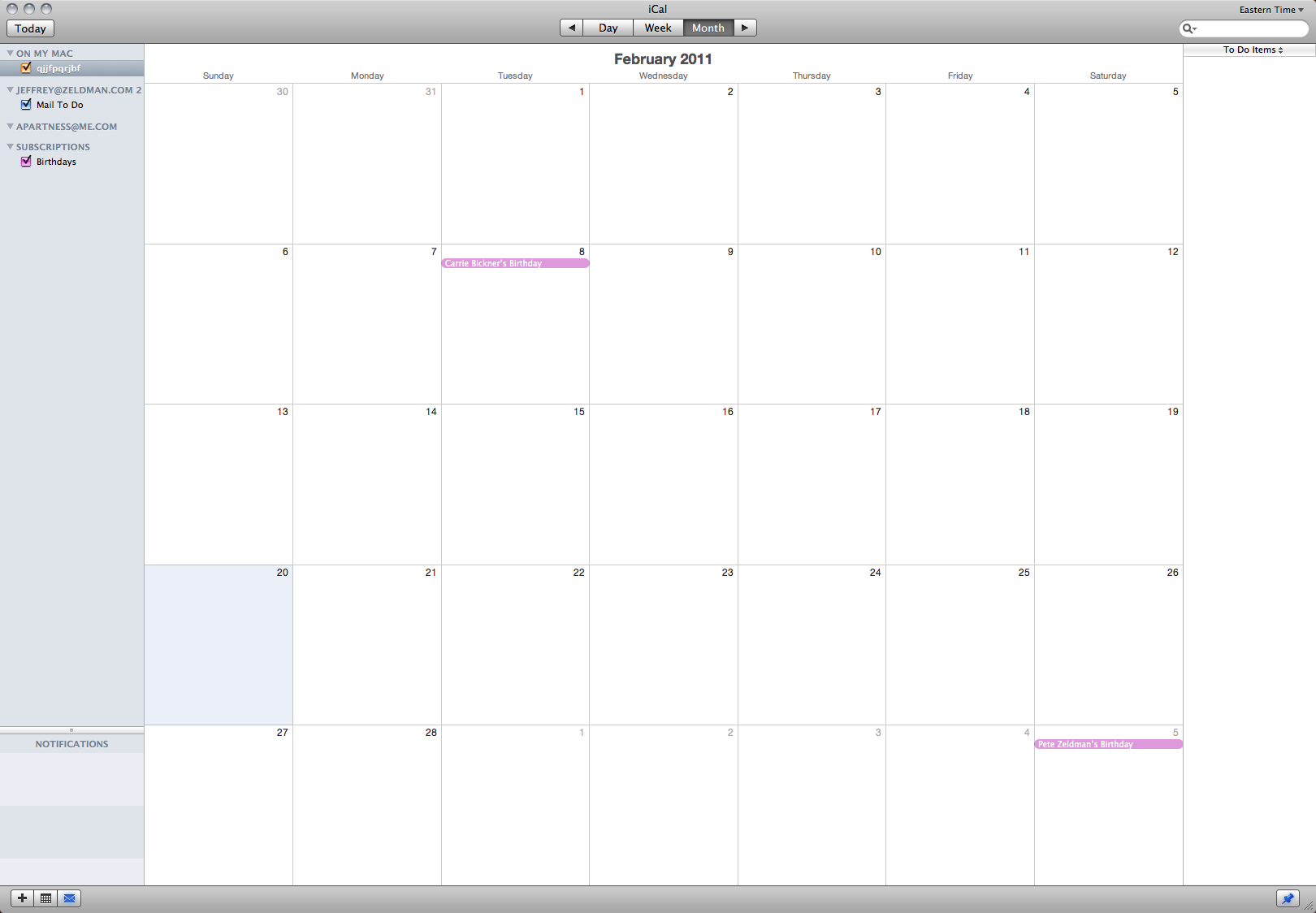
UNLESS YOU ENJOY waking up to a blank calendar, hold off upgrading MobileMe iCal for now. Prior to the latest update, I enjoyed flawless, seamless calendar integration across my desktop and laptop computers, iPhone, and iPad. I could enter an appointment on any device and know that it would show up immediately on all the other devices. And I could share calendar data easily with others, whether or not they were MobileMe users. All that changed last week with Apple's latest calendar update.
The first thing the update does is pointlessly duplicate all your existing calendars, so that you have double listings of all events.
To stop that nuisance, you have to choose which version of each calendar to stop displaying: the new one hosted at MobileMe, or the "old" one that is locally cached on all machines and is in the fact the same thing. With no information from Apple, I guessed that I should stop displaying the "old" sync'd calendar and instead display the new MobileMe copy.
This caused the "old" calendars to disappear from my sidebar entirely. Now when I create a new event, there is much spinning of the beach ball as the cloud and my local computer negotiate every character press.
That's bad enough; losing all calendar data is worse.
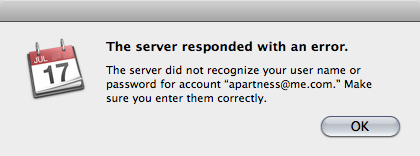
When I rouse my home machine in the morning, it fails to sync with itself due to some asinine unknown problem in Apple's cloud, sends me the pointless error message shown here, and gives me a calendar like the one at the top, which is completely empty except for locally cached birthdays. Restoring the calendar requires me to stop work, quit any open apps, and restart my machine several times.
Additionally, "old" calendars long shared with others don't update. You have to tell the user to stop linking to the "old" calendar and send info about the new one. And the new one won't work if the user isn't on MobileMe.
I'd happily go back to the "old" calendars that were always locally cached, never got hiccups when I typed data into them, and never disappeared like this, but Apple has helpfully removed them from my sidebar, so I can't. I'm stuck with poor performance and disappearing calendars.
Things work better some places than others—for instance, on my iPhone, where I use Calvetica, I haven't suffered the same frustrations I've experienced on my home iMac—and of course your mileage may vary. No doubt Apple tested the update on at least a few user setups, and I'm sure there are people for whom the .0 update is working, but I'm not one of them, and you might not be either. Eventually Apple will fix these bugs. I suggest waiting until they do. There is no benefit to the new calendar for existing MobileMe users, and there are plenty of drawbacks for now. I love Apple but their usability testing sucks.

February 18, 2011
Borders' Bankruptcy Shakes Publishing Industry
"After Borders, the 40-year-old retail chain that helped define the age of the book superstore, filed for bankruptcy protection on Wednesday, the struggling book industry was left wondering what was next — and maybe even who was next."
Borders' Bankruptcy Shakes the Publishing Industry – NYTimes.com

February 16, 2011
Episode 39: Crowd Fusion's Brian Alvey live on The Big Web Show

BRIAN ALVEY (home, Twitter) is our guest on The Big Web Show Episode 39, recording live Thursday, February 16, at 12:00 PM Eastern at 5by5.tv/live.
Brian is CEO of Crowd Fusion, a publishing platform that combines popular applications like blogging, wikis, tagging and workflow management, and a leader in the content management world. He co-founded Weblogs, Inc.—home to Engadget, Autoblog, TUAW and more—and built the Blogsmith platform, both of which were acquired by Aol and are essential to their current strategy. Brian has been putting big brands on the web since 1995 when he designed the first TV Guide website and helped BusinessWeek leap from Aol to the web.
Brian built database-driven web applications and content management systems for many large companies in the 1990′s including Intel, J.D. Edwards, Deloitte & Touche and The McGraw-Hill Companies. His 1999 Tech-Engine site was a "skinnable HotJobs" which powered over 200 online career centers including XML.com, Perl.com, O'Reilly & Associates Network, DevShed, and Computer User magazine.
He has been the art director of three print magazines (I met him in 1995 when he was art director for "Net Surfer" or something like that) and was the Chief Technology Officer of Rising Tide Studios where he developed The Venture Reporter Network, which is now a Dow Jones property.
In 2003, Brian invented and launched Blogstakes, a sweepstakes application for the blogging community. He is a former Happy Cog partner of mine; at Happy Cog, Brian built content management systems for customers including Capgemini, A List Apart, and the Kansas City Chiefs. He was also the creator and host of the Meet The Makers conference, a series of talk show-style events that were so compelling, they helped inspired me to create An Event Apart with Eric Meyer.
And I'll stop there. Ladies and gentlemen, a legend and true creative force in this medium. Please join us at tomorrow on 5by5.tv/live for a lively and wide-ranging discussion.
The Big Web Show ("Everything Web That Matters") records live every Thursday at 12:00 PM Eastern. Edited episodes can be watched afterwards, often within hours of recording, via iTunes (audio feed | video feed) and the web. Subscribe and enjoy!


