
Jeffrey Zeldman's Blog, page 82
January 17, 2011
We Didn't Stop The Fire.

OUR LIBRARY IS BURNING. Copyright extension has banished millions of books to the scrapheap. Digital permanence is a tragically laughable ideal to anyone who remembers the VHS format wars or tries to view Joshua Davis's 1990s masterpieces on a modern computer. Digital archiving is only as permanent as the next budget cycle—as when libraries switched from microfilm to digital subscriptions and then were forced to cancel the subscriptions during the pre-recession recession. And of course, my digital work vanishes the moment I die or lose the ability to keep hosting it. If you really want to protect your family photos, take them off Flickr and your hard drive, get them on paper, and store them in an airtight box.
Though bits are forever, our medium is mortal, as all but the most naive among us know. And we accept that some of what we hold digitally dear will perish before our eyes. But it irks most especially when people or companies with more money than judgement purchase a thriving online community only to trash it when they can't figure out how to squeeze a buck out of it. Corporate black thumb is not new to our medium: MGM watered down the Marx Bros; the Saatchis sucked the creative life and half the billings out of the ad agencies they acquired during the 1980s and beyond. But outside the digital world, some corporate purchases and marriages have worked out (think: Disney/Pixar). And with the possible exception of Flickr (better now than the day Yahoo bought it), I can't think of any online community or publication that has improved as a result of being purchased. Whereas we can all instantly call to mind dozens of wonderful web properties that died or crawled up their own asses as a direct result of new corporate ownership.
My colleague Mandy Brown has written a moving call to arms which, knowingly or unknowingly, invokes the LOCKSS method ("Lots of Copies Keep Stuff Safe") of preserving digital content by making copies of it; she encourages us all to become archivists. Even a disorganized ground-level effort such as Mandy proposes will be beneficial—indeed, the less organized, the better. And this is certainly part of the answer. (It's also what drives my friend Tantek's own your data efforts; my beef with T is mainly aesthetic.) So, yes, we the people can do our part to help undo the harm uncaring companies cause to our e-ecosystem.
But there is another piece of this which no one is discussing and which I now address specifically to my colleagues who create great digital content and communities:
Stop selling your stuff to corporate jerks. It never works. They always wreck what you've spent years making.
Don't go for the quick payoff. You can make money maintaining your content and serving your community. It won't be a fat fistful of cash, but that's okay. You can keep living, keep growing your community, and, over the years, you will earn enough to be safe and comfortable. Besides, most people who get a big payoff blow the money within two years (because it's not real to them, and because there are always professionals ready to help the rich squander their money). By contrast, if you retain ownership of your community and keep plugging away, you'll have financial stability and manageable success, and you'll be able to turn the content over to your juniors when the time comes to retire.
Our library is burning. We didn't start the fire but we sure don't have to help fan the flames. You can't sell out if you don't sell. Owning your content starts with you.


The worst of times
Like prior messengers, Martin Luther King spoke of love. He preached love and lived love when his country boiled with hatred, when the seams of civility were frayed almost beyond mending. When the poor lived in fearful desperation, violence defeated reason on all sides, and you could not hear a prayer for all the shouting. He had a dream, and the dream grew followers, and the followers marched. He would be 82 today if an assassin's bullet had not cut him down on 4 April 1968, as he stood on a balcony of the Lorraine Motel in Memphis, one man in the name of love.
January 13, 2011
Big Web Show Episode 34: Craig Mod on the Form of the Book

CRAIG MOD is our guest today January 13, 2011 in Episode No. 34 of The Big Web Show ("Everything Web That Matters"), co-hosted by Dan Benjamin and recorded at 12:00 PM Eastern (new time!) before a live internet audience.
Mod (craigmod.com, @craigmod) is a writer, designer, publisher, and developer concerned with the future of publishing and storytelling. Based in Tokyo for a decade, he is co-author and designer of Art Space Tokyo, an intimate guide to the Tokyo art world. Since October 2010 Craig has been working in the California Bay Area helping sculpt the future of digital publishing with Flipboard.
Craig speaks frequently on the future of books, publishing, and digital content design. In this week's A List Apart he presents the initial release of Bibliotype, an HTML baseline typography library for tablet reading released under the MIT License.
The Big Web Show records live every Thursday at 12:00 PM Eastern (new time).
Edited episodes can be watched afterwards, often within hours of recording, via iTunes (audio feed | video feed) and the web. Subscribe and enjoy!
January 11, 2011
A List Apart No. 321: Craig Mod on Digital Books, Cassie McDaniel on Design Criticism
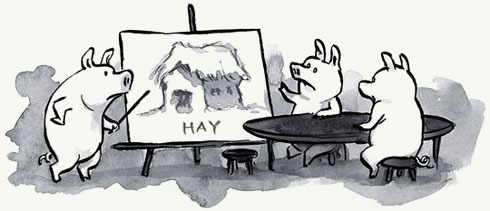
Craig Mod (Flipboard, Art Space Tokyo) comes to grips with the challenges of designing great digital reading experiences and presents the initial release of Bibliotype, an HTML baseline typography library for tablet reading in A Simpler Page. And Cassie McDaniel shows how to let client criticism actually improve your design instead of just watering it down in Design Criticism and the Creative Process. All this, plus Kevin Cornell's illustrations, in Issue No. 321 of A List Apart for people who make websites.
January 10, 2011
Own Your Data
Captured from Twitter, here is Tom Henrich's partial reconstruction of my conversation with Tantek Çelik, Glenda Bautista, Andy Rutledge and others on the merits of self-hosting social content and publishing to various sites rather than aggregating locally from external sources.

January 7, 2011
Reality Check.
HERE'S A REALITY check for those of us who can't believe fax machines are still necessary in 2011. I have just learned, to my astonishment, that half the lawyers in New York create their documents in WordPerfect. That is not a typo.
The version of WordPerfect they use saves in its native format. It can also save as RTF, but it loses formatting when it does so. It can save as a particular version of Word '97 for Windows which is not compatible with other platforms, and which also loses formatting. And it can save as ASCII, because, well.
If the lawyer wishes to preserve the document's formatting while saving a copy for someone (say, a client) who doesn't own WordPerfect and hasn't seen it since DOS ruled, said lawyer and said client are out of luck.
But what of PDF, you ask?
There is no option to save as PDF. Maybe Adobe charged a licensing fee that the makers of WordPerfect weren't able to afford (hampered as they are by the fact that nobody besides New York lawyers buys their product). Or maybe the makers of WordPerfect died before PDF became ubiquitous.
Advanced Windows users can probably finagle a PDF out of WordPerfect, say, by buying Adobe Acrobat Pro and installing a plug-in, but the lawyers in New York do not seem to be advanced Windows users.
Oh, also, IE6 is the cat's pajamas in this world. Twenty-three skidoo!
And you ask why we still use fax machines.

December 31, 2010
2010: The Year in Web Standards
WHAT A YEAR 2010 has been. It was the year HTML5 and CSS3 broke wide; the year the iPad, iPhone, and Android led designers down the contradictory paths of proprietary application design and standards-based mobile web application design—in both cases focused on user needs, simplicity, and new ways of interacting thanks to small screens and touch-sensitive surfaces.
It was the third year in a row that everyone was talking about content strategy and designers refused to "just comp something up" without first conducting research and developing a user experience strategy.
CSS3 media queries plus fluid grids and flexible images gave birth to responsive web design (thanks, Beep!). Internet Explorer 9 (that's right, the browser by Microsoft we've spent years grousing about) kicked ass on web standards, inspiring a 10K Apart contest that celebrated what designers and developers could achieve with just 10K of standards-compliant HTML, CSS, and JavaScript. IE9 also kicked ass on type rendering, stimulating debates as to which platform offers the best reading experience for the first time since Macintosh System 7.
Even outside the newest, best browsers, things were better than ever. Modernizr and eCSStender brought advanced selectors and @font-face to archaic browsers (not to mention HTML5 and SVG, in the case of Modernizr). Tim Murtaugh and Mike Pick's HTML5 Reset and Paul Irish's HTML5 Boilerplate gave us clean starting points for HTML5- and CSS3-powered sites.
Web fonts were everywhere—from the W3C to small personal and large commercial websites—thanks to pioneering syntax constructions by Paul Irish and Richard Fink, fine open-source products like the Font Squirrel @Font-Face Generator, open-source font licensing like FontSpring's, and terrific products/platforms led by Typekit and including Fontdeck, Webtype, Typotheque, and Kernest.
Print continued its move to networked screens. iPhone found a worthy adversary in Android. Webkit was ubiquitous.
Insights into the new spirit of web design, from a wide variety of extremely smart people, can be seen and heard on The Big Web Show, which Dan Benjamin and I started this year (and which won Video Podcast of the Year in the 2010 .net Awards), on Dan's other shows on the 5by5 network, on the Workers of the Web podcast by Alan Houser and Eric Anderson, and of course in A List Apart for people who make websites.
Zeldman.com: The Year in Review
A few things I wrote here at zeldman.com this year (some related to web standards and design, some not) may be worth reviewing:
iPad as the New Flash 17 October 2010
Masturbatory novelty is not a business strategy.
Flash, iPad, and Standards 1 February 2010
Lack of Flash in the iPad (and before that, in the iPhone) is a win for accessible, standards-based design. Not because Flash is bad, but because the increasing popularity of devices that don't support Flash is going to force recalcitrant web developers to build the semantic HTML layer first.
An InDesign for HTML and CSS? 5 July 2010
while our current tools can certainly stand improvement, no company will ever create "the modern day equivalent of Illustrator and PageMaker for CSS, HTML5 and JavaScript." The assumption that a such thing is possible suggests a lack of understanding.
Stop Chasing Followers 21 April 2010
The web is not a game of "eyeballs." Never has been, never will be. Influence matters, numbers don't.
Crowdsourcing Dickens 23 March 2010
Like it says.
My Love/Hate Affair with Typekit 22 March 2010
Like it says.
You Cannot Copyright A Tweet 25 February 2010
Like it says.
Free Advice: Show Up Early 5 February 2010
Love means never having to say you're sorry, but client services means apologizing every five minutes. Give yourself one less thing to be sorry for. Take some free advice. Show up often, and show up early.
Outside Reading
A few things I wrote elsewhere might repay your interest as well:
The Future of Web Standards 26 September, for .net Magazine
Cheap, complex devices such as the iPhone and the Droid have come along at precisely the moment when HTML5, CSS3 and web fonts are ready for action; when standards-based web development is no longer relegated to the fringe; and when web designers, no longer content to merely decorate screens, are crafting provocative, multi-platform experiences. Is this the dawn of a new web?
Style vs. Design written in 1999 and slightly revised in 2005, for Adobe
When Style is a fetish, sites confuse visitors, hurting users and the companies that paid for the sites. When designers don't start by asking who will use the site, and what they will use it for, we get meaningless eye candy that gives beauty a bad name.
Happy New Year, all!

December 29, 2010

December 26, 2010
The Big Web Show: Mandy Brown is up. Dana Chisnell is next.
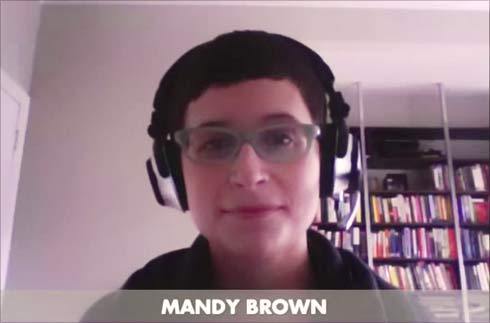
BIG WEB SHOW EPISODE 32 is now online for your listening and viewing pleasure. Mandy Brown (Typekit, A Book Apart) joins Dan Benjamin and me to
discuss the value of customer support, the present and future of type on the web, font choice on reader platforms, what traditional print publishers can learn from the new breed of web-based print publishers, why you've got to write, and why the future belongs to editors.
Dan and I thank all of you for listening, watching, and contributing your questions and comments in the chat room during the live sessions. You've made our little show worthwhile. We promise more thought-provoking questions and more great guests in 2011.

Join us Thursday, 6 January 2011 at 1:00 PM Eastern for the live recording of Episode 33, as Dan and I talk with Dana Chisnell, co-author, Handbook of Usability Testing Second Edition (Wiley, 2008) about her election design usability project for the US Government, plus usable security, researching social interactions mediated by technology, whether UX is a female ghetto, and lots more.

December 23, 2010
Episode 32: Mandy Brown on publishing, Typekit, and more

MANDY BROWN (@aworkinglibrary) is our guest today, Thursday December 23, 2010 in Episode No. 32 of The Big Web Show, co-hosted by Dan Benjamin and recorded at 1:00 PM Eastern before a live internet audience.
Mandy is co-founder and editor for A Book Apart and a contributing editor for A List Apart for people who make websites. A veteran of the publishing industry, she spent a decade at W. W. Norton & Company, an independent and employee-owned publisher, where her work involved everything from book design to web design to writing about design. She serves as Community and Support Manager for Typekit and writes frequently on the Typekit blog.
Named "Video Podcast of the Year" in the 2010 .net Awards, The Big Web Show covers "Everything Web That Matters" and records live every Thursday at 1:00 PM Eastern on live.5by5.tv. Edited episodes can be watched afterwards, often within hours of recording, via iTunes (audio feed | video feed) and the web. Subscribe and enjoy!
P.S. This is the last Big Web Show session of the year. We'll be off next week. (Something about Christmas and New Year's.) Thank you for watching and listening. We love you bunches!


