
Jeffrey Zeldman's Blog, page 81
February 4, 2011


February 3, 2011
Happy Cog Hosting

HOSTING IS HARD. So why exactly are we offering hosting? Why get into a business that requires tremendous patience, extraordinary responsiveness, and technological wizardry? Mr Hoy tells all in the cleverly titled announcement, Happy Cog Hosting.

Bit o' nostalgia for the old folks

LONG BEFORE FLICKR "invented" the banterish copy platform, uncannily optimized for mobile devices a decade before they existed, coming at you from out of the past, it's the 11 February 1998 edition of Jeffrey Zeldman Presents.
Hat tip: Monsieur Charles Roper.
February 1, 2011
An Event Apart presents Hardboiled Web Design with Andy Clarke – uncompromising CSS3 and HTML5 for today's websites
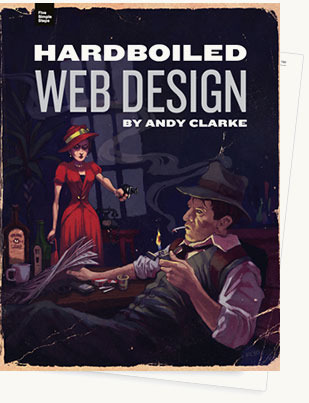
You've read the book, now see the event: An Event Apart presents Hardboiled Web Design with Andy Clarke. This full-day workshop will challenge you, change your approach to web design, and give you the tools you need to make CSS3 and HTML5 a reality for your company and clients.
"Hardboiled Web Design" offers a fresh perspective on designing for the web—never compromising, always pushing boundaries. It strips markup to the bone and uses HTML5 and CSS3 to the maximum, to help make your sites more adaptable to whatever the web might throw at them. Based on the highly acclaimed, best-selling new book, Hardboiled Web Design by Andy Clarke.
EXCLUSIVE U.S. ENGAGEMENT! ONLY 2 SHOWS!
Mr Clarke will make two U.S. appearances in one week, and after that, he and Hardboiled Web Design are gone:
SEATTLE, WA. – AUGUST 26, 2011
Bell Harbor Conference Center
2211 Alaskan Way, Pier 66
Seattle, WA 98121
BOSTON, MA. – AUGUST 29, 2011
Boston Marriott Copley Place
110 Huntington Ave
Boston, MA 02116
Seating is limited, register now.
These are the only two U.S. shows for Hardboiled Web Design in 2011, and tickets will go fast. Register early or learn more at aneventapart.com.
January 31, 2011
Big Web Show, Talk Show Shirts!
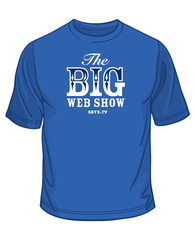
SHOW YOUR LOVE for The Talk Show, The Big Web Show, and the network and Internet pal that bring them to you—by buying fine, authentic, officially sanctioned 5by5wear in the spanking new 5by5 Store. Accepting orders until 11 February 2011, shipping the following week.
January 30, 2011

January 27, 2011
HTML5 vs. HTML

THANKS TO THE WORK of the WHAT WG, the orations of Steve, the acclaim of developers, and a dash of tasteful pamphleteering, the W3C finally has a hit technology on its hands. Indeed, it has a cluster of hot technologies, the latest incarnation of what we've been calling "web standards" since we began fighting for them in 1998, when browser support for HTML, CSS, and JavaScript was inconsistent, incomplete, and incompatible, and the kingmakers of the day couldn't have cared less. Moreover, after 13 years, the W3C has finally learned that it's okay to market to your constituents—okay to actively encourage standards adoption.
Hence the HTML5 logo effort, intended as an identity system for all the hot new standards technologies—and initially bogged down by a controversy in our circle about theW3C muddying the waters. The actual muddying began when Steve Jobs announced Apple's support for HTML5 by pointing to web stuff created with CSS3. In other words, the inaccurate use of "HTML5″ to cover HTML and non-HTML technologies coincided with the surge of interest in those technologies under that inaccurate label. Which is why some thought leaders in our community have reckoned that the business community's confusion about what HTML5 actually means doesn't matter so much, as long as they are clamoring for great sites, accessibly designed with web standards—and as long as developers know the difference between HTML5 and, say, CSS3.
In any case, soon after the standards digerati declared the HTML5 banner launch a communications fiasco, it emerged that the launch was actually merely a communications snafu.
An updated FAQ makes it clear that HTML5 means HTML5, that CSS3 is not part of the HTML5 specification, and so on. The W3C's clarification allows the standards organization to have it both ways in a fashion acceptable to all. In times past, the W3C argued passionately within its own walls during the creation of web standards, only to passively release them as "recommendations" to a world that often ignored them—the development of XHTML 2 in the pure absence of worldly interest was probably the culmination of that phase. But today's W3C has learned better. It has learned to engage its constituents and to seek approval beyond its immediate constituents—i.e. to reach out to the business community, not just to the authors of O'Reilly and Peachpit books. Its "HTML5″ identity effort represents a reasonable and meritorious effort to cash in on, prolong, and extend the world's already keen interest in HTML5 and related technologies and practices. Meantime, the little FAQ page and other minor editorial clarifications allow the W3C to pacify its knowledgeable critics and duck the charge that it is blurring the lines between HTML, CSS, and other technologies.
Now that the story appears to be heading purposefully in a single direction, a kink in the works was inevitable.
That kink is also not surprising and not entirely unanticipated. Just when the W3C figures out that HTML5 is hot, the WHAT Working Group (the splinter group that created the actual HTML5 specification in the first place) has decided that HTML is the new HTML5:
The HTML specification will henceforth just be known as "HTML", with the URL http://whatwg.org/html. (We will also continue to maintain the Web Applications 1.0 specification that contains HTML and a number of related APIs like Web Storage, Web Workers, and Server-Sent Events.)
The WHATWG HTML spec can now be considered a "living standard". It's more mature than any version of the HTML specification to date, so it made no sense for us to keep referring to it as merely a draft. We will no longer be following the "snapshot" model of spec development, with the occasional "call for comments", "call for implementations", and so forth.
Those who are surprised should remember that the HTML5 doctype references "HTML" with no version number. In the thinking of its creators, HTML5 was always just HTML. It looked backward (the first web page ever written would be valid HTML5 with the addition of a doctype) and forward. It would continue to evolve. The WHAT WG gave itself the job of steering and updating HTML, while the W3C took on the task of maintaining milestones (a task it will continue to perform).
In practice, the WHATWG has basically been operating like this for years, and indeed we were going to change the name last year but ended up deciding to wait a bit since people still used the term "HTML5″ a lot. However, the term is now basically being used to mean anything Web-standards-related, so it's time to move on!
To those inside the circle of trust, there is no contradiction here. The W3C will doubtless continue to market HTML5, and, for a time, design technologists will continue to write HTML5 books and teach HTML5 classes, if only to acknowledge HTML's new capabilities and to clearly mark the break from the technologies and practices of the past. Eventually, quite probably, the WHAT WG's view will take hold, and we will view HTML as a living specification.
Meantime, we'll take 5.
Thanks to J. David Eisenberg for the nudge.
Franklin Goes Dutch (Fonts In Use)
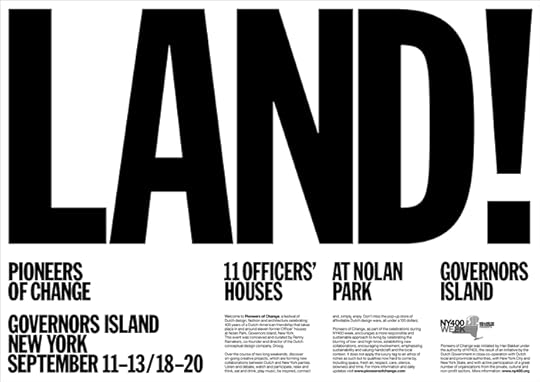
Dutch design studio Experimental Jetset carried out the graphic design for Pioneers of Change—a festival of Dutch design, fashion, and architecture which took place on New York's Governors Island in September 2009. The design system, which included a website, printed programs, and wayfinding elements, made prominent use of Franklin Gothic Extra Condensed
Nick Sherman discusses a smart application of my favorite font, Franklin Gothic, in the virtual pages of what might be my new favorite design website, Fonts in Use.
January 25, 2011
The glory of the doodle, the grandeur of the sketch, in A List Apart No. 322.
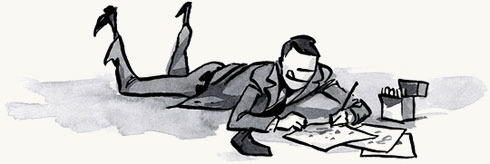
In Issue No. 322 of A List Apart for people who make websites: respect the doodle, honor the sketch—use the power of visual thinking to create and share ideas:
The Miseducation of the Doodle
by Sunni Brown
The teacher who chastised you for "mindless doodling" was wrong on both counts. Far from shutting down the mind, the act of doodling engages the brain in the kind of visual sense-making people have practiced for over 30,000 years. Doodling sharpens concentration, increases retention, and enhances access to the problem solving unconscious. It activates the portions of the visual cortex that allow us to see mental imagery and manipulate concepts, and unifies three major learning modalities—visual, auditory, and kinesthetic. Doodle Revolution leader Sunni Brown introduces strategic doodling and presents the ABCs of our shared visual alphabet.
Sketching: the Visual Thinking Power Tool
by Mike Rohde
You don't have to be a great singer to write a great song—just ask Bob Dylan. Likewise, you needn't be a Leonardo to draw your way to more and better ideas. Sketching helps you generate concepts quickly, exploring alternatives rapidly and at no cost of resources. The looseness of a sketch removes inhibitions, granting clients and colleagues permission to consider and challenge the ideas it represents. Mike Rohde outlines the practice, surveys the tools, and shares ways to become confident with this method of brainstorming, regardless of your level of artistic ability.
♥ Illustration by Kevin Cornell for A List Apart, a publication of Happy Cog.
January 20, 2011
Episode 35: Jen Simmons on Drupal, experience design, and how designing websites has changed since 1996.

JEN SIMMONS is our guest today, January 20, 2011, in Episode No. 35 of The Big Web Show, co-hosted by Dan Benjamin. Tune in to 5by5.tv/live at 12:00 PM Eastern (new time!) to be part of the live recording.
Jen (jensimmons.com, @jensimmons), is a designer who builds stuff too. She designed and created the new default theme for Drupal 7, named Bartik. And she's currently leading a movement to bring HTML5 to Drupal. Jen began using Drupal in early 2007, when it was frighteningly hard to use. She started creating websites in 1996, and used many flavors of technology over the years.
Besides designing for the web, Jen has 20 years experience designing for live performance and for print. She's created seven-channel digital projections for an opera about Nikola Tesla. She's created short films that toured the globe in film festivals. And she's taught media arts to high school kids in San Antonio. Jen has a MFA in Film and Media Arts from Temple University, where she taught as an Adjunct Professor.
The Big Web Show ("Everything Web That Matters") records live every Thursday at 12:00 PM Eastern. Edited episodes can be watched afterwards, often within hours of recording, via iTunes (audio feed | video feed) and the web. Subscribe and enjoy!


