Jeffrey Zeldman's Blog, page 80
February 16, 2011
Blowing HTML up my own ass

I WANT TO export my zeldman.com feed to my Tumblr blog and point to a Readability view of each resulting Tumblr post using a shortened link created with Happy Cog's URL shortener in my Twitter feed, which is automatically imported into my Facebook news stream. Then I want to import my Facebook news stream back into zeldman.com and see if the universe explodes.


February 11, 2011
Video: Rich Ziade & Jeffrey Zeldman discuss Readability at School of Visual Arts
RICH ZIADE AND I discuss the disruptive nature of Readability. Jeffrey Zeldman, "Selling Design," 2/10/2011 from MFA Interaction Design on Vimeo.
Readability 2.0 is disruptive two ways

RELEASED LAST WEEK, Arc90′s Readability 2.0 is a web application/browser extension that removes clutter from any web page, replacing the typical multi-column layout with a simple, elegant, book-style page view—a page view that can be user customized, and that "knows" when it is being viewed on a mobile device and reconfigures itself to create an platform-appropriate reading experience.
In so doing, Readability focuses the user's attention on the content, creating an enhanced—and often much more accessible—reading experience. It also subverts the typical web browsing design paradigm, where each website offers a different visual experience. Instead, to the Readability user, all web content looks the same, once she has clicked a button to engage the Readability view.
If Readability did only this, it would represent a significant directional departure for the web and for site owners, in that, for the first time in the history of designed websites, branded look and feel is subordinated to a user-focused content experience that transcends the individual site.
Of course, this was always supposed to be possible in HTML, and it always was possible for users of some assistive devices and for CSS experts who felt like creating intricate personal style sheets, but those are edge cases, and Readability is for everyone.
Readability 1.0 was released as open source. Apple used its code for the "Reader" view in Safari. The creators of Flipboard used its code too. And the creators of the open-source Treesaver swapped code and rights with the makers of Readability to enhance both products. I've never seen a humble open-source project, created by a not-terribly-well-known shop get so quickly accepted and absorbed by companies like Apple and by the creators of cutting-edge web and hybrid apps.
That was Readability 1.0. What Readability 2.0 adds to the mix is automatic payment for content creators. How it works is simple: I pay a small fee each month to use Readability. Most of that money gets divided between the creators of the web pages I've viewed in Readability. This makes Readability 2.0 disruptive two ways:
As mentioned earlier, for the first time, branded look and feel is secondary to the user's desire to engage with written content in a visually comfortable environment. (That Readability 1.0 premiered around the same time as the iPad is not coincidental.)
For the first time, content monetization is no longer the problem of content creators. Writers can stop being salespeople, and focus on what they do best: creating compelling content. The better the content, the more people who engage with it via Readability, the more money writers will make—with no bookkeeping, no ad sales, and no hassle. This is huge subversion of the ad paradigm.
Many of us who watched Arc90 develop Readability worried that short-sighted publishers and site owners would misunderstand and reject the app, maybe even sic'ing their lawyers on it. But in the hectic two weeks just ending, publishers have had time to absorb what Readability 2.0 does and what it could mean to them—and according to Readability creator and Arc90 founder Rich Ziade, the reaction is positive.
Have publishers suddenly grasped the web? Perhaps not. But it's a rare publisher who'd say no to extra money, risk-free. We are in a wait-and-see, try-it-and-see phase of publishing and the web—past the initial Web 2.0 euphoria and into the hard business of creating great stuff (and finding new ways to keep old great stuff, like great writing and reporting, alive). No one is quite sure what will work. And publishers risk nothing by participating in the Readability program. If the program succeeds, they make additional revenue for their content. If it fails, it's no skin off their budget.
I've interviewed Rich Ziade on The Big Web Show and I'm an advisor on the project but it was only last night, when Rich was addressing my MFA Interaction Design class at School of Visual Arts, that I realized for the first time how profoundly disruptive—and powerful—Readability 2.0 really is.
I urge you to give it a try.
Teaching at School of Visual Arts
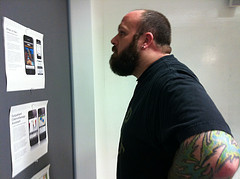
I teach a class called "Selling Design" in the MFA Interaction Design program at School of Visual Arts in New York.
Although the class's name focuses on persuasion, it's really about learning where great ideas come from, recognizing and fostering our best ideas, choosing the right partners to collaborate on those ideas, and finding and growing an audience/market. Persuasion is a key part of all those phases, but we focus on the entire process.
Guest lecturers from various backgrounds contribute their experiences and insights each week.
My students are amazing. They're about to become the first group to graduate (is that the word for it?) from SVA's fledgling program created by Liz Danzico and Steve Heller. Hire them if you can. Watch them make their mark.
Teaching at School of Visual Arts is a small but growing set on Flickr documenting our class—and the nearly two years I spent waiting to teach it. (I'm the last faculty member in the two-year program to actually teach a class, as my class is the last in the sequence.)
February 9, 2011
Episode 38: Macworld's Jason Snell live on The Big Web Show

Macworld editorial director Jason Snell is our guest on The Big Web Show ("Everything Web That Matters") Episode #38, recording live Thursday, February 10, at 12:00 PM Eastern. Jason, co-host Dan Benjamin and I will discuss the future of publishing, Macworld's evolving digital strategy, and of course our favorite computers, phones, apps, and tablets.
Jason Snell is editorial director of Macworld. He's been covering Apple since 1994. He's also the host of The Incomparable Podcast, at theincomparable.com.
The Big Web Show ("Everything Web That Matters") records live every Thursday at 12:00 PM Eastern. Edited episodes can be watched afterwards, often within hours of recording, via iTunes (audio feed | video feed) and the web. Subscribe and enjoy!
February 8, 2011
Nazi Graphic Standards

"Designers and design historians told me over the years that they had heard about the existence of a Nazi graphics standards manual. No one could say they actually saw it, but they knew of someone who had. So it grew into something of a Big Foot or Loch Ness Monster tale, until one day I actually saw it too – and it had been right under my nose the whole time." Steven Heller.
Steve Heller hunts down a Nazi graphics standards manual in Design Observer.
Web Forms for Kids; SVG for Everybody

In Issue No. 323 of A List Apart for people who make websites, learn to love (and make cool stuff with) SVG and design web registration forms for kids.
Cross Platform Scalable Vector Graphics with svgweb
by Jim Ray
Pity Scalable Vector Graphics. It's been an official standard since before IE6 was released yet has never found much of an audience on the web, certainly not the one it deserves. Just as SVG was starting to establish some browser support, along came the canvas tag, stealing the thunder of dynamically generated client-side images. Yet despite all the attention being paid to canvas, there's still a place for SVG, particularly for developers looking to replace plug-ins like Flash for data visualization. Unlike canvas or other script-only approaches, SVG can be easily divided into design and code elements, with just a little code to add interactivity. It even works on devices like the iPad and iPhone. And now, thanks to svgweb and a clever use of Flash, it works on older platforms no one could have ever imagined supporting SVG. Jim Ray shows how.
Designing Web Registration Forms for Kids
by Debra Levin Gelman
Designing websites for kids is a fascinating, challenging, rewarding, and exasperating experience: you're trying to create a digital experience for people who lack the cognitive capacity to understand abstraction; to establish brand loyalty with people who are influenced almost exclusively by their peers; and to communicate subjective value propositions to people who can only see things in black-and-white. Fortunately, it's possible to create a successful registration process for these folks with an understanding of how their brains work. Debra Levin Gelman explores how to design effective registration forms for kids based on their context, technical skills, and cognitive capabilities.
Illustration by Kevin Cornell for A List Apart.
February 7, 2011

February 6, 2011
My Backpack

…AND WHAT'S INSIDE. A work- and workout backpack by Jeffrey Zeldman at Bagcheck.
Bagcheck is a fun and easy way to share the stuff you love with the people you love.