
Jeffrey Zeldman's Blog, page 86
November 28, 2010
Don't forget Blue Beanie Day!

The Fourth Annual International Blue Beanie Day in support of web standards will be celebrated this Tuesday, November 30. That gives you just over 24 hours to …
Take a self-portrait wearing a blue beanie (toque, tuque, cap) and upload it to the Blue Beanie Day 2010 pool on Flickr.
Add a blue beanie to your social network avatar on Twitter, Facebook, Flickr, etc.
Write a web standards haiku and post it on Twitter with the hashtag #bbd4 for your chance to win web design books from Peachpit and A Book Apart in the Blue Beanie Day Haiku Contest.
See you on the internets!


November 27, 2010
UK Judge: Search is Theft

paidContent UK's NLA Ruling Summary: How PRs Break Copyright Law Online offers the highlights of a 148-paragraph ruling by the British High Court "that PRs who subscribe to paid news monitors are breaking UK law by effectively copying a substantial part of online news articles."
The product in question is Meltwater News, an online global media monitoring service that allows subscribers to track "keywords, phrases, and topics in over 130,000 sources from over 190 countries and 100 languages, monitored consistently throughout the day."
The judge argues that in reprinting publications' headlines or summaries of longer than 256 characters, the service is "stealing" the publishers' content, even though Meltwater quite naturally provides links so users who are interested in a given piece of content can click through to the original. Since these summaries and headlines are cached on my computer, as an end-user I am complicit in the theft of content I didn't pay for, says the judge.
If this ruling sticks, and if it ripples out, it will cripple or kill existing and emerging services that help people find content.

November 26, 2010
Big Web Show #28: Finding Your People

In Episode No. 28 of The Big Web Show, Dan Benjamin and I talk about what we're thankful for, awards, visibility, public speaking (and why you should do it), Pub Standards, meetups (and why you should start or join one), and how to make a change in your career and the industry.


Web type news: iPhone and iPad now support TrueType font embedding. This is huge.
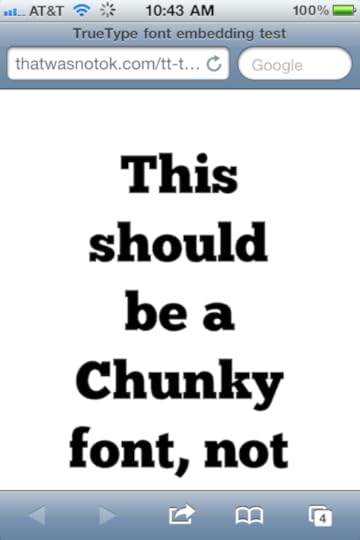
TrueType font embedding has come to iPhone and iPad, Hallelujah, brothers and sisters. That is to say, Mobile Safari now supports CSS embedding of lower-bandwidth, higher-quality, more ubiquitous TrueType fonts. This is huge. Test on your device(s), then read and rejoice:
The Typekit Blog: iOS 4.2 improves support for web fonts
iOS 4.2 is also the first version of Mobile Safari to support native web fonts (in TrueType format) instead of SVG. This is also exciting news, as TrueType fonts are superior to SVG fonts in two very important ways: the files sizes are dramatically smaller (an especially important factor on mobile devices), and the rendering quality is much higher.
Ryan N.: Confirmed: TrueType Font Support on Mobile Safari on iOS 4.2
Thanks to Matt Wiebe for mentioning the rumour that Mobile Safari on iOS 4.2 supports TrueType fonts and providing a handy link to test.
TrueType
TrueType is an outline font standard originally developed by Apple Computer in the late 1980s as a competitor to Adobe's Type 1 fonts used in PostScript. TrueType has become the most common format for fonts on both the Mac OS and Microsoft Windows operating systems.
The primary strength of TrueType was originally that it offered font developers a high degree of control over precisely how their fonts are displayed, right down to particular pixels, at various font sizes. With widely varying rendering technologies in use today, pixel-level control is no longer certain in a TrueType font.
More about webfonts
If you're coming late to the party, the following bits of required reading and listening will get you up to speed on the joys (and occasional frustrations) of "real type" on the web:
Bulletproof @font-face syntax, Paul Irish, 4 September, 2009
Web Fonts at the Crossing, Richard Fink, 8 June 2010, A List Apart
Big Web Show Episode 1, Dan Benjamin and I discuss webtype with Ethan Dunham of Fontspring and Font Squirrel and Jeffrey Veen of Typekit
Big Web Show Episode 18, Dan Benjamin and I discuss webtype, screen resolution, and more with Roger Black
Thanks
My thanks to David Berlow of Font Bureau for waking me from my Thanksgiving stupor and alerting me to this exciting slash overdue development.

November 25, 2010
Finally, cross-browser visual control over forms.
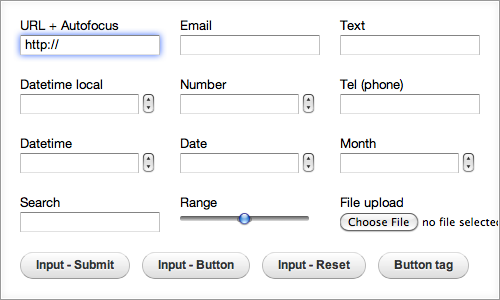
Now we have something else to be thankful for. Nathan Smith of Sonspring has created a library that gives designers and developers "some measure of control over form elements, without changing them so drastically as to appear foreign in a user's operating system." Smith calls his new library Formalize CSS:
I've attempted to bridge the gap between various browsers and OS's, taking the best ideas from each, and implementing what is possible across the board. For the most part, this means most textual form elements have a slight inset, and all buttons look consistent, including the button tag.
For more, including demos, options, screenshots, thanks, and the library itself, read Smith's write-up at SonSpring | Formalize CSS. Hat tip and happy Thanksgiving to my good friend Aaron Gustafson for sharing this gem.

November 24, 2010
Celebrate Thanksgiving with The Big Web Show

JOIN DAN BENJAMIN AND ME Thursday 25 November on live.5by5.tv at 1:00 PM Eastern for a special Thanksgiving episode of The Big Web Show.
The Big Web Show ("Everything Web That Matters") is recorded live in front of an internet audience every Thursday at 1:00 PM ET on live.5by5.tv. Edited episodes can be watched afterwards, often within hours of recording, via iTunes (audio feed | video feed) and the web. Subscribe and enjoy!

November 23, 2010
Gift Ideas: Japanese Beauties

"Representing the Japanese ideal of beauty, the women featured in these colorful illustrations and photographs beam with reassuring smiles and glowing complexions. Though haircuts and clothing styles changed through the years, the women's faces have retained the same familiar features Japanese society has come to know and love."

November 19, 2010
Help deserving web designers find fame.
THE UNDER-KNOWN HAVE EVERYTHING going for them except recognition. Let's do something about that. Name talented web designers who deserve wider attention. Include at least one URL and a Twitter-length comment as to why their work merits wider study. Post to this thread. Thanks.

To my friend who thinks I should not accept awards.
OLIVER REICHENSTEIN—iA to Twitter friends like me—thinks it is wrong for experienced designers to accept design awards. Oliver says:
All awards should go from old uncles (like me or @zeldman or who ever) to young people. They need it.
A fair point. To which I reply:
When Happy Cog wins an award, it is going to young people. It's young designers like Stephen Caver, Yesenia Perez-Cruz, Joey Pfeifer, Mike Pick, Kevin Sharon, Drew Warkentin, Brian Warren, young UX designers like Whitney Hess and Jessica Ivins, young developers like Jenn Lukas, Mark Huot, Ryan Irelan, Matt Clark, Aaron Gustafson, Tim Murtaugh, and Allison Wagner, and young project managers like Rawle Anders, Dave DeRuchie, and Brett Harned whose work is being recognized. (Apologies to young-at-heart Kevin Hoffman, Chris Cashdollar, Russ Unger, and Robert Jolly.)
When I stood up with Happy Cog's co-presidents to accept "design agency of the year," it was on these young folks' behalf that I accepted it. I am a vessel of their talent and of our clients' willingness to support their users instead of making safe, committee-friendly choices. It would be wrong of me to refuse the award on the grounds that I am better known than some members of our staff.
We work for these people called clients. And while Jane HTML may know of Jeffrey Zeldman and Happy Cog, Joe Client does not. Moreover, Joe Client may not know how to evaluate agencies. He may know little about web standards and "user experience." He probably doesn't follow you or me on Twitter, and doesn't participate in our community's passionate debates about everything from the proper semantics for sub-navigation to the value of eye-tracking. He doesn't know from that stuff, but he knows that if an agency has won awards in a respected competition, that agency must know a little something about what it is doing. If our goal as an agency is to do and spread good work, it makes business sense for us to accept an award from a respected forum of our peers.
By the way, we did not enter the .net Awards, we were nominated for them by the community. Accepting the nominations was like accepting a compliment—the gracious thing to do. Not that I'm apologizing.
So much for "design agency of the year." I accepted "video podcast of the year" on behalf of my brilliant partner Dan Benjamin, who creates superior streaming content for people who make websites. It is his work more than mine that was honored. And as for "standards champion," I've already said who I think deserved that nod this year. But I accepted the community's verdict with a blush and thanks.
Winning anything invites enmity; winning three awards is asking for a backlash. But I know that's not where you're coming from.
Are awards bad?
I used to hate awards, too. I've only recently started coming around.
Designers and creative directors I respect and worked for in the past were almost always winning and judging awards shows. Their work was brilliant, and the awards were a tool they used to balance their power against that of tough-minded account executives and clients. When a client said make the logo bigger, a creative director could turn quietly to his or her wall of awards, and the client would back down.
Nevertheless, awards shows are always political to some extent, and those who don't win often find fault with those who do. Like you, I had a distaste for awards shows when I started on my own (plus I didn't think any award show got the web). For over a decade, largely because of my feeling, which other Happy Cog muckety-mucks shared, our agency ignored awards shows.
But we are modifying our views on this, and not merely because we just won a bunch of awards we didn't even seek (as well as a few that we did). Our industry needs real design discussion, peer review, and recognition. I believe in the .net Awards, as their partnership with A List Apart attests. They are the best our industry has.
Personally, I'm inspired to start actually seeking awards, because Joe Business gets them, and I like to see designers working.
I appreciate the purity of your point of view, and I recognize it as a discussion point, not an attack. We are friends, and you're a gent. Maybe I am wrong. But I'm beginning to think we don't need no awards, we need good awards. And when good work wins, it inspires more good work.
Whether you hate awards or love them, the most important thing is to keep wins and losses in perspective, and remember that you're only as good as your last idea.


