P.J. Thorndyke's Blog, page 9
April 15, 2015
Steampunk Wednesdays #9 – Short Fiction Roundup
Novels are fine and dandy. But the short story and novella have often been overlooked in recent years. Fortunately the ebook phenomenon has given a platform to the format and the short story is back in a big way. Sometimes they serve as an introduction to a series of novels. Sometimes they are spin-offs and sometimes they stand alone. Here are just four finds in the Steampunk genre available from Amazon and other ebook retailers. Click on them for links.




April 13, 2015
Inventions and Discoveries of the 19th Century #4 – The Work of Adolph F. Bandelier
 Adolph Francis Alphonse Bandelier, the late 19th century archaeologist and ethnologist was responsible for much of what we know about the prehistoric peoples of the American Southwest. Known as the ‘Pueblo’ peoples after their mud brick villages and cliff dwellings, the tribes of America’s ‘four corners’ (Utah, Arizona, New Mexico and Colorado) comprise several different languages and cultures. Generally they fall into two groupings of matrilineal and patrilineal kinship systems and have a vast collection of beliefs and myths regarding kachinas – spirits representing ancestors, elements or natural phenomena. During the Spanish colonization many missions were set up within the pueblos and although many converted to Catholicism, the pueblo people retained much of their folklore and traditions. The pueblos revolted in 1680 and were able to hold the Spanish at bay for twelve years before being reconquered. Today pueblo culture survives in a handful of tribes like the Hopi and Zuni.

Zuni Pueblo
Born in Switzerland but raised in America, Bandelier met and befriended the famous American anthropologist Lewis Henry Morgan who sparked his interest in the pueblo peoples of the Southwest. In 1880 he received a contract from the Archaeological Institute of America to conduct a field study of the pueblos of Santa Fe. It was the beginning of a career that would make him the leading authority on the previously unexplored culture of the native Southwest. Bandelier’s work is marked by his all-encompassing approach to culture. His interest was not just in archaeology but in the folklore, traditions, mythology and ethnology of the people he was studying.
In 1881 he extended his studies to ancient sites in Mexico like Teotihuacan and Cholula. For the next ten years Bandelier conducted extensive studies of the native peoples and sites of New Mexico, Arizona and Mexico as well as doing much archival work. In 1892 he and his wife moved farther afield by journeying to Lima, Peru. His wife died soon after the move and he married fellow Swiss immigrant Fanny Ritter. Fanny became his research assistant and together they spent ten years researching the ancient sites of Peru and Bolivia.
 Bandelier died in Seville, Spain in 1914 while researching the Archivo de las Indias. Bandelier National Monument in Frijoles Canyon, New Mexico was named after him and includes many pueblo homes, kivas (subterranean ceremonial lodges as pictured) and rock paintings. In 1977 Bandelier’s remains were exhumed and in 1980 he was cremated and his ashes scattered in Frijoles Canyon. Today he is known as much for his research as for his 1890 novel The Delight Makers; a fictional work concerning the prehistoric Pueblo peoples (known to their Navajo neighbors as the ‘Anasazi’ peoples) which I’ll be taking a look at in another post. Its authenticity and care in constructing a civilization known to us only through archaeological remains and the culture of their descendants was a big influence on the writing of my own novel Golden Heart.


April 10, 2015
Vintage Reads #8 – The King’s Fifth
 Aimed at younger readers, this 1966 novel by Scott O’Dell deals with the primary MacGuffin of my own novel, Golden Heart; the fabled land of Cibola.
Set in 1540, the protagonist – a young, Spanish cartographer named Estéban – relates his tale from his prison cell in Vera Cruz, New Spain. Accused of withholding the ‘King’s Fifth’ (one fifth of all treasure found in the New World belonged to the King of Spain), Estéban awaits his trial. His narrative tells of an expedition to find the seven golden cities of Cibola which parallels the real 1540 expedition of Francisco de Coronado. Instead of writing a blog post about the history of the Cibola expeditions, I’ll let Lazarus Longman himself sum up the facts for you in this excerpt from Golden Heart.
Lazarus sighed and began the tale from the beginning. “I know that in fifteen-thirty-six four survivors from a Spanish shipwreck resurfaced in Mexico. With them was a Moorish slave called Estevanico; the first African to set foot in America. They had been wandering for eight years throughout the Southwest and had heard tales of a wealthy land to the north. The Spaniards in Mexico, who had recently amassed vast wealth from plundering the Aztec and Inca empires, became convinced that there must be a third golden empire in the northern continent. The Spanish had their own legend of seven bishops who fled Spain with all their wealth during the Moorish invasion hundreds of years previously. They believed that these bishops had set up seven golden cities in an unchartered land to the west. With the stories told by Estevanico and his companions, it seemed possible that these cities were somewhere in the American Southwest.
“The Viceroy of New Spain sent out an expedition under a Franciscan monk called Marcos de Niza who, with Estevanico as his guide, headed north to find this golden empire. Estevanico was an impetuous fellow by all accounts, who kept running on ahead and sending back promising clues. It seemed that they were drawing near to their goal. In one letter he said that he had found a fabulous city called Cibola, the first of many of its kind. Then, Estevanico drops off the map.”
“De Niza tried to catch up with him,” said Katarina, demonstrating that she too had been filled in on the fairy tale. “But he came across several members of Estevanico’s party who were bloodied and beaten. They told him that the Moor had been killed at Cibola.”
“Correct,” said Lazarus. “De Niza dared not enter the city and only saw it from a distance. When he returned to Mexico City, he told what he had seen but mentioned nothing of gold. This did not perturb the Spaniards, who were more convinced than ever that this Cibola and its sister cities must be the golden empire they sought. Another expedition was organized with de Niza as a guide and the governor of Nueva Galicia—a man called Coronado—as its leader.
“Coronado,” put in Vasquez. “Now there’s a fella I heard tell of.”
“And with good reason,” said Lazarus. “Not just because you share his name. Francisco Vazquez de Coronado was the fellow who exposed the whole thing as a fraud, however inadvertently. When he and de Niza arrived at Cibola, they found only a meager Zuni pueblo called Hawikuh. With Coronado and his men cursing de Niza as a phony, a battle broke out with the Zuni warriors, and the pueblo fell to the Spaniards.”
“So Coronado and his pals hadn’t found Cibola, then?” asked Vasquez.
“That’s a matter of opinion,” said Lazarus. “There is no doubt that they found the city Estevanico had dubbed Cibola, but nobody had ever said anything about it being a city of gold. That was just in the imaginations of the Spaniards. And it was a myth the Zuni and other pueblo peoples were happy to propagate. Soon Coronado was heading out again on instructions given to him by the defeated Zuni, that golden cities lay further north east. He got as far as Kansas before giving up and returning in debt and in disgrace.”
As well as naming his main character after Estevanico the Moor, Scott O’Dell draws other parallels to the real life expeditions such as the character of Captain Blas de Mendoza, an unscrupulous conquistador, who is based on Antonio de Mendoza, a member of Coronado’s expedition. Another character is the young native girl called Zia who joins Esteban and his companions and serves to expose the madness the lust of gold drives men to.
The book also loosely inspired one of my favorite childhood shows; the 1982 cartoon The Mysterious Cities of Gold. While it retained characters like Esteban, Mendoza and Zia, the plot was drastically different. Not only was it set in South America, but a brief stop over in the Galapagos Islands results in another addition to their party; Tao, the sole remaining descendant of the sunken empire of Mu (or Hiva). The plot blends history with science fiction, mixing real life figures such as Pizarro (who conquered the Inca Empire) with a story including aliens, mythology and solar-powered ships and flying machines.


April 8, 2015
Steampunk Wednesdays #8 – Wild Wild West (1999)
 Completing the trio of well-known, big budgeted attempts at putting Steampunk on the big screen (the other two being The League of Extraordinary Gentlemen and Van Helsing), Wild Wild West is loosely based on the 1960s TV series of the same name. Will Smith and Kevin Kline play Jim West and Artemus Gordon respectively; two special agents dispatched by U.S. president Grant to foil the plans of an ex-Confederate mad scientist called Dr. Loveless (Kenneth Branagh).
Restricted to a steam-powered wheelchair, Loveless plots to tear the country apart with his mechanical forces (including a giant steam-powered spider) if President Grant does not disband the Union. Gadding about on a gadget-filled train called The Wanderer, West and Gordon pick up Rita (Salma Hayek), daughter of professor Escobar who has been captured by Loveless.
Wild Wild West’s brand of silly humor wasn’t well received in 1999 and the film remains unembraced by Steampunks and casual movie fans alike. It’s a shame that the genre never really gets the big movie treatment it deserves. As with other attempts, the visual style is there; the effects, gadgets and period feel is Steampunk to a tee, but that’s where the comparison ends. These films are more style over substance. One might say they are all steam and no punk.


April 6, 2015
A Quick Guide to Spaghetti Westerns

There are countless resources online for those interested in the history of the Spaghetti Western (I recommend The Spaghetti Western Database) so this isn’t a comprehensive look at the genre, more of a quick overview of what has been an inspiration during my writing of Golden Heart and On Rails of Gold.
Originally used as a derogatory term for Italian-helmed westerns by Americans who felt that Europeans made cheap, inaccurate movies about a treasured period in their county’s history, the Spaghetti Western ushered in a new take on the genre that has remained ever since. Violent, gritty, lurid and featuring protagonists who had questionable morals, the Spaghetti Western was a refreshing take on the genre that John Wayne had made famous with his clean-cut all-American heroes. This was the western for the counter-culture generation.
 Sergio Leone’s ‘Dollars’ trilogy is on the tip of everyone’s tongue whenever the genre is mentioned and stands as the benchmark of the Spaghetti Western. Beginning in 1964 with A Fistful of Dollars and continuing with For a Few Dollars More in 1965 and resulting in his masterpiece; The Good, the Bad and the Ugly in 1966, the loose trilogy made a household name of TV star Clint Eastwood as ‘the man with no name’ (despite actually having a name in all three films – Joe, Monco and Blondie, respectively). These movies created a blueprint for the genre which most Spaghetti Westerns that followed stuck to. Many were filmed in nearby Spain partly because it was cheap and partly because it made a good double for the American west. Most featured an American in the lead with Italian bit players dubbed for English speaking audiences. The psychedelic credits sequences, the creative scores by Ennio Morricone, the harsh landscapes and uncompromising characters became the norm for the genre and more than made up for their cheap production values. These were westerns with style.

The framework of a lone drifter wandering into a town ruled by corruption and walking out of it at the end leaving a wake of bodies behind him was copied by many films to follow. A fine example is Django (1966), which introduced a character so popular that his name was used in the titles of over thirty unofficial sequels (despite the films themselves often having nothing to do with the character) the most recent example being Tarantino’s Django Unchained (2012). The Return of Ringo (1965) and Death Rides a Horse (1967) introduced a revenge element which became a staple of the genre. The bleakness of the Spaghetti Westerns and their refusal to portray their characters as upright defenders of justice and the American Way made them popular with the baby-boomers as well as earning a fair amount of controversy. Snowbound Utah-set film The Great Silence (1968) was so controversial with its brutal message about the ineffectiveness of justice in the face of profit that it was denied an American release.

In the late sixties a sub-genre emerged within the Spaghetti Westerns known as the Zapata Western. Named after the Mexican revolutionary Emiliano Zapata, these westerns tended to be set during the Mexican Revolution of 1913 and were more often than not soapboxes for leftist European directors to spout their Marxist ideology. Many directors of Spaghetti Westerns had lived under the brutal rule of Mussolini and were politically motivated to make films that romanticized revolutionary ideals. The Big Gundown (1966) isn’t the only film to portray the Mexican government as a fascist regime and it also took a swipe at capitalism into the bargain by revealing the true villain to be the money-motivated businessman instead of the lowly Mexican peasant he tries to frame. A common theme in movies like A Bullet for the General (1966) and Compañeros (1970) was the working-class Mexican teaming up with an American or European specialist who is motivated by money rather than revolutionary ideals. These were often stand-ins for America’s involvement in Vietnam and Latin America in a critical portrait of U.S. foreign policy. Even the great Sergio Leone made his final contribution to the genre a Zapata Western with the 1971 Duck You Sucker! (AKA A Fistful of Dynamite) which is widely seen as a satirical take on a genre he was growing increasingly tired of.

Leone’s last western was preceded by his crowning glory. Once Upon a Time in the West (1968) was supposed to be Once Upon a Time in America; Leone’s vision of the gangsters of prohibition era New York (that film wasn’t to be made until 1984), but studios persuaded him that another western was the way to go. The film was a masterpiece in a genre that had quickly become an ironic self portrait. Spaghetti Westerns had taken on a comedic element in the final years of the decade. Sabata (1969) attempted to create a James Bond type of western and the incredible popularity of the slapstick They Call Me Trinity (1970) heralded the end of the brutal, brooding and violent westerns of the sixties.


April 3, 2015
Vintage Reads #7 – Trouble in Tombstone
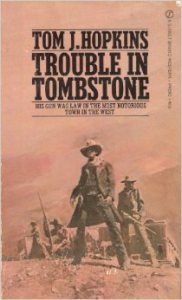 This breezy western from 1951 is set against the backdrop of the infamous ‘Gunfight at the O.K. Corral’. Wyatt Earp makes an appearance as does Doc Holiday along with several of their opponents in the well-known street battle which only takes up a couple of pages. The fictional protagonist is Sam Chalmers who, after a run in with cattle-rustler, Bigelow Newman, heads to Tombstone to set up his own ranch and to woo the beautiful Jean. Trouble is that Newman has also set up shop in Tombstone and has secretly wed Jean’s sister who he intends to employ as an actress in his new theater. With the bitter enemies set to become brothers-in-law, and tensions rising between the ‘Cowboys’ and the new lawman, Earp and his brothers, Tombstone looks set to live up to its name.
Tombstone, Arizona sprung into existence in 1879 after prospector Ed Scheiffelin struck silver in the vicinity. It was the very definition of a boom-town, its population exploding in a short period of time, and with it came the trouble. Cattle rustlers, whores, bandits and other unsavory types walked its streets with ease, several of whom were members of a loosely organized gang called the ‘Cowboys’. Headed by Ike Clanton, the Cowboys enjoyed robbing stagecoaches and stealing and smuggling cattle in from Mexico. It wasn’t long before help was hired in to clean up the town. This help came in the form of the Earp brothers who had recently made names for themselves in whipping Dodge City into some sort of order. They were instantly unpopular with Ike Clanton and his boys. Insults were traded and threats tossed about, culminating in a street confrontation which took the lives of three Cowboys. The Gunfight at the O.K. Corral has gone down in history as a symbol of the lawlessness of the old west, where outlaws could walk the streets of frontier towns under the nose of the law who, if they wanted to resist, could expect a hard, bloody battle.
The gunfight took place in 1881 but in my alternate history of Golden Heart and its prequel short story On Rails of Gold, I have pushed this back to 1885. My reasoning for this is that as Wyatt Earp and his family supported the Union, they probably wouldn’t have become lawmen had the Civil War gone differently. With the Confederacy still in control of the Southwest by 1885, the Earp brothers may have been killed during the course of the war or simply gone in different directions. Thus the Clanton gang would never had encountered them in the gunfight in 1881 and would have gone unchallenged for several more years, maybe even bcoming lawmen themselves.


April 1, 2015
Steampunk Wednesdays #7 – Van Helsing (2004)
 Dracula, Frankenstein’s monster and the Wolfman in one movie? This isn’t the first time horror icons from Universal’s monster menagerie have teamed up on screen. Frankenstein Meets the Wolf Man (1943), House of Frankenstein (1944) and House of Dracula (1945) all featured monster mash-ups not to mention homages in the 70s and 80s like The Monster Squad TV series and the unrelated 1987 movie of the same name. Here the idea gets the big budget treatment from Stephen Sommers (director of 1999’s The Mummy).
This isn’t old Abraham Van Helsing from Bram Stoker’s novel, but Gabriel Van Helsing (any family connection is unexplained) a secret agent for an underground society called the Knights of the Holy Order based in the Vatican. Sent to Transylvania, Van Helsing’s mission is to kill Dracula who is waging war on the Valerious family who, due to a centuries-old curse, cannot enter heaven until Drac is dead. The vampire count and his three brides are hatching a scheme to bring life to their children by using the recently bitten Velkan Valerious (now a werewolf) as a power source for the equipment Dracula appropriated from Victor Frankenstein. Why a werewolf is needed for this is anyone’s guess. Teaming up with Anna Valerious (Velkan’s sister), Van Helsing finds Frankenstein’s monster (also wanted by Dracula after his scheme with the werewolf fails) and tries to take him to Rome so he cannot be used in the count’s dastardly plans.
If all of this seems hard to follow, you’re not alone. The film’s main failing is a near incomprehensible plot. I don’t set out to review films on this blog but I can’t help but share my feelings of a wasted opportunity here. It’s not the most solid example of Steampunk put on screen but it is perhaps one of the more well-known entries. There’s plenty of cool gadgets such as Van Helsing’s semi-automatic crossbow, grappling hooks and other gear. But the main ‘steampunky’ thing is the film’s take on Frankenstein’s monster which is part sewn-together creature and part steam-powered automaton.


March 30, 2015
Inventions and Discoveries of the 19th Century #3 – Firearms
Just about any writer of historical adventure set in the nineteenth century needs to know what’s what with guns. Even if guns are not central to the plot, chances are they will crop up at some point and the writer should at least know the difference between percussion caps and metallic cartridges, muzzle-loading and breech-loading mechanisms and bullets and cartridges as well as having a passing knowledge of some of the makes and models of firearms in use at that time. I’m no gun enthusiast, but in the writing of Golden Heart and On Rails of Gold I realised just how little I knew and panicked at the amount of research I had to do just to reach a passable level of authenticity in my gunfights. So in this post I’ll take a look at the evolution of firearms through the nineteenth century as well as picking out a few examples of weapons I placed in the hands of my characters.
Evolution of the Firing Mechanism
Guns have been around since the fourteenth century but it wasn’t until the nineteenth century that great leaps forward were made in the firing mechanisms that revolutionised the industry. Guns and Ammo lists three huge developments responsible for this dramatic shift. The first is the replacement of the spherical ‘musket ball’ with the ‘Minié ball’ which tapered at the front and had a concave bottom. Much more aerodynamic, the Minié ball was the first ‘bullet-shaped’ projectile. Then came the replacement of the flint and steel mechanism with percussion caps. After around 1830 it became more common for armies in particular to use these tiny metal cylinders which were filled with friction sensitive explosives. These would be fitted to a little peg or ‘nipple’ and the ‘hammer’ of the gun would slam down on them creating a spark. The third development was the introduction of cartridges. When I first began writing gunfights I made the mistake of referring to the things my fighters slid into their guns as ‘bullets’. In the nineteenth century the bullet was only the tip of the cartridge – a paper tube filled with a charge of powder – which replaced the laborious process of measuring out powder, pouring it down the barrel of the gun and following it with wadding and a bullet. In 1847 M. Houiller invented the first fully contained all-metal cartridge. These are the ‘bullets’ you see Clint Eastwood sliding into his revolver. It was a huge advantage over the paper cartridges which could be ruined by water. Also, the metal bullet cartridge contained a primer in its bottom which skirted the need for percussion caps. Its use in America began after the Civil War and its design remains more or less unchanged to this day.
Revolvers
Ideas for a quick loading firearm had been around as long as the firearm itself. In 1818 Bostonian Elisha Collier patented a design for a flintlock revolver in Britain but it wasn’t until 1835/6 that Samuel Colt introduced his revolver which led to its widespread use. With most revolvers, cartridges are inserted manually into the chambers of the cylindrical block, which on some revolvers are replaceable, cutting down on loading time even more. Most revolvers have swing out cylinders for reloading while some are ‘top-break’ revolvers requiring the user to ‘break’ them open like a shotgun. There are also ‘tip-up’ revolvers like Smith and Wesson’s first model (S&W Model 1). Most revolvers have six chambers hence the slang term ‘six-shooter’. Single-action revolvers require the shooter to cock the hammer manually between each shot. In the self-cocking or ‘double-action’ revolver the hammer is cocked automatically by the squeezing of the trigger. Revolvers are still popular today and are preferred over auto-loading pistols by hunters and those interested in self defense due to their durability outdoors and their more powerful rounds.

A British Enfield Mk II and an American Colt ‘Peacemaker’
Lazarus Longman’s original gun of choice is the Enfield Mark II; the official British military sidearm from 1880 to 1887. It was a top-break single or double action pistol that fired .476 rounds. I tried to match the weapons of my characters to their personalities; in Longman’s case I needed something thoroughly British, reliable and sturdy if a little old fashioned. The Enfield eventually received complaints of loosening barrels resulting in inaccuracy. Early on in Golden Heart Lazarus looses his Enfield in the Colorado River and replaces it with the Colt Starblazer. This is steampunk after all, and an alternate history, therefore fictional weapons are occasionally required. As Lazarus is in the American Southwest I felt that a Colt was a good choice for him (known as the ‘gun of the Wild West’), showing his adaptability to situations. Samuel Colt received phenomenal success in manufacturing and marketing revolvers in America, thriving during the Civil War in which the Colt Army Model 1860 attained great popularity. Sam Colt died during the war and the company found themselves in trouble as metallic cartridges were gaining popularity and the patent for the guns that fired them was owned by rival company Smith and Wesson. When the patent expired, Colt began making metallic cartridge firing guns in the 1870s eventually resulting in their masterpiece; the Colt Single Action Army known as the ‘Peacemaker’ or the Colt .45. I see the fictional ‘Starblazer’ as a more powerful follow up to the ‘Peacemaker’, invented during the elongated conflict from the need for better and more brutal firepower. Although Colt sold exclusively to the Union after the firing on Fort Sumter, they did sell to England which is how Lazarus got hold of one.

Smith and Wesson Model 3 Russian
For Katarina, I wanted something a bit special. Most women of this era, if they packed any heat at all, it would be a little snub pistol concealed in their handbags. I didn’t want Katarina to have to put up with that indignity (she’s already in a long dress and corset) so I went for the Smith and Wesson Model 3 which was ordered in large quantities by the Russian army. Before the Civil War Smith and Wesson were the sole manufactures of the new metallic-cartridge firing revolvers making them serious competition to Colt. Although Colt began making their own versions of the new technology after the war, S&W found success in selling to foreign markets such as Russia. But the Russian government began copying the revolver at their own factories at Tula on the cheap, either cancelling orders with Smith and Wesson or delaying payment resulting in huge losses for the American gunsmith. Wyatt Earp also favored the S&W Model 3. I like its smoother curves and imagined a few modifications for the alternate history version wielded by Katarina such as a longer barrel and intricate engravings on the barrel and cylinder. Like its owner it is exotic, pleasing to the eye and extremely deadly.

LeMat Revolver
Gerrard Vasquez, being a half-Mexican bandit, an ex-Confederate dirigible captain and steampunk’s answer to Han Solo, needed something a little special in his holster. As he was in the Confederate Army and hails from the South, a Colt would never do. During the Civil War an interesting sidearm for the Confederates was the LeMat Revolver. Developed by New Orleans-born Jean Alexandre LeMat, the gun has a surprising nine chamber cylinder and a secondary barrel that functioned as a 20 gauge shotgun. This led to it being dubbed the ‘Grape Shot Revolver’. Originally manufactured in Philadelphia, production moved to France and the guns had to be shipped through the Union Blockade to the Confederate States via England. Like most Civil War era pistols it was a percussion cap pistol aside from a few rare pinfire versions that appeared late in the war. Production was more or less halted by the Confederate defeat in 1865. In the alternate history of Golden Heart, the Confederacy holds the upper hand in the twenty-four year-long Civil War and so by 1885 the LeMat company has grown vastly succesful and rivals Colt in its production of firearms. The fictional LeMat in Golden Heart is an upgraded metallic cartridge firing pistol retaining its shotgun barrel which is now a larger 18 gauge. The LeMat is a lot like Vasquez; a wild card; unpredictable but deadly at close range.
Rifles
The word ‘rifle’ comes from the process of ‘rifling’ which is the carving of the inside of the barrel in a spiral pattern which gives a spin to the bullet it fires. This was an advancement on the ‘smoothbore’ design of the earlier musket which fired balls. Flintlock muzzle-loading rifles were adopted by the British during the Napoleonic wars. Muzzle-loading refers to the pouring of powder down the muzzle of a long gun and following it with wadding and a shot. This was replaced by breech-loading where shot and powder (and later cartridges) were pushed into a chamber at the rear of the barrel. This in turn was replaced by the repeating rifle which refers to any rifle that contains several rounds of ammunition where the next cartridge is loaded by a manual action.

Springfield Model 1861 Rifle-Musket
The Springfield Rifle – the most widely used weapon by the Unionists during the Civil War – fired .58 caliber Minié balls and was muzzle-loaded. A later Springfield used in the earl part of the twentieth century was the M1903 which was a bolt-action rifle that used clips of five rounds. My Unionist partisans in Golden Heart still use Springfields, although updated bolt-action versions that fire metallic cartridges, smuggled south of the Confederate line by airship drops.

Pattern 1853 Enfield
Despite being nearly ten years old, the British Enfield Pattern 1853 Rifle-Musket was the second most used rifle during the Civil War. The Confederates were the main buyers, purchasing them from gunrunners who slipped them through the blockade. Used by the British Empire during the Crimean War and in India, the Enfield fired .577 Minié balls and was muzzle-loaded. After about 1867 most Enfields were converted or replaced by the Snider-Enfield which was a breech-loading rifle that fired metallic cartridges. I retained the Enfield (albeit an updated one like the Snider-Enfield) for my Confederate troops in Golden Heart.
Machine Guns
The definition of a machine gun is any mounted or portable gun that is fully automatic i.e. rounds will continue to fire so long as the trigger is depressed. An early machine gun that saw action in the Civil War was the Agar Gun, also known as the ‘coffee-mill gun’ due to its hand crank and ammo hopper. The Agar fired standard paper cartridges which were placed within reusable metal containers fitted with percussion caps. The hand crank would feed the rounds into the weapon which would fire them from its single barrel and drop the empty metal tubes into a tray beneath. The gun crew would struggle to refill and reload these cartridges before the hopper ran empty. President Lincoln was so impressed by a demonstration of the Agar Gun that he purchased ten on the spot with the Union ordering fifty more later in the war.
More famous is the Gatling Gun, invented by American Dr. Richard J. Gatling which also saw limited use in the Civil War on the side of the Unionists. Like the Agar Gun, it relied on a hand crank but was less prone to overheating due to rotating six barrels instead of one. Strictly speaking, neither the Agar or Gatling Gun were fully automatic as they required somebody to crank them. The first true machine gun was the Maxim Gun, invented in 1883 by Sir Hiram Stevens Maxim. It used the gun’s recoil to eject spent cartridges and allow new ones to be inserted from the ammunition hopper. In Golden Heart, I went with the Gatling concept, but introduced a newer model known as the ‘Jericho’. Fitted on rotating carriages or on the arms of ‘mechanicals’, the Jericho Gatling Gun is fully automatic and extremely deadly.

1865 Gatling Gun


March 27, 2015
Vintage Reads #6 – The Lost World
 I’m rounding up my ‘lost world’ series with the novel that gave the genre its name. Written by Sir Arthur Conan Doyle, The Lost World was published in the Strand Magazine (which had previously published his Sherlock Holmes stories) in 1912 and stands as the archetypal entry in the genre.
Trading the Africa of H. Rider Haggard’s novels for the jungles of South America, The Lost World tells of journalist Edward Malone who is sent to interview curmudgeonly oddball Professor George Challenger who has been ridiculed in the press for claiming the existence of dinosaurs on a secluded South American plateau.
Convinced to accompany the professor on an other expedition to the plateau, Malone and some other intrepid explorers set out for South America. Betrayed by their native guides who cut the rope bridge, stranding them, the company delve into the plateau and encounter pterodactyls, an allosaurus and primitive ape-men who are at war with a tribe of humans.

The lost world genre was continued in the 20th century, most notably by Edgar Rice Burroughs who had experimented with lost cities in his Tarzan novels and went full genre in 1918’s The Land That Time Forgot. But Burroughs’s other novels had a far deeper effect on fantastic fiction. The world had been changed by its first great war. The days of imperialism were numbered and blank spaces on maps were getting smaller and smaller. Suddenly the world didn’t seem so big anymore. Writers of adventure fiction turned to the stars for inspiration and Burroughs’s A Princess of Mars (1912) became the blueprint for a new breed of fantastic fiction. The lost world genre evolved into the ‘planetary romance’ adventure where the crumbling ruins of lost civilizations appeared against the backdrop of alien planets.


March 25, 2015
Steampunk Wednesdays #6 – Lindsay Buroker’s Flash Gold Chronicles
 If you’re looking for a breezy Steampunk series to read, you could do a lot worse than Lindsay Buroker’s Flash Gold Chronicles. I’ve followed her blog for a long time now and it’s a fantastic resource for anybody looking to get into the ebook market. Her own contribution to Steampunk is this fantastic little series (each volume is a novella) centered around eighteen-year-old Kali McAlister; an orphaned and ostracized tinkerer trying to scratch a living in the frigid Yukon. He late father was the scientist who discovered the eponymous ‘flash gold’ – a powerful energy source – which makes her a target for hustlers and hoodlums in this snowy western Steampunk yarn.
Aimed at young adults, this series moves at a cracking pace and is filled with airship battles, steam-powered dogsled races and colorful characters out for revenge or profit in the style of many a Spaghetti Western. Definitely worth checking out, especially as the first book is free!