
P.J. Thorndyke's Blog, page 4
September 2, 2020
Greatest Ever Pulp Stories #11 – Black God’s Kiss
[image error] By: C. L. Moore
Appeared in: Weird Tales (October, 1934)
In what seems to be an alternate medieval France, Jirel, ruler of Joiry, is dragged before her conqueror, Guillaume, who has just taken her castle and is lolling on its dais, surrounded by the corpses of its defenders. Red-haired and yellow-eyed, Jirel is a fearsome warrior woman who radiates defiance. Guillaume forces himself upon her and she responds by attempting to tear out his throat. He knocks her out and has her imprisoned in her own dungeon.
That’s not going to hold our heroine of course, so, after braining her guard with a stool, Jirel sets off on her mission of revenge. With the help of her confessor, Father Gervase, she goes down “into hell tonight to pray the devil for a weapon, and it may be I shall not return.” There is a stairway, you see, beneath the castle that leads to a nightmarish alternate dimension. Jirel and Father Gervase discovered this previously but we are given little detail of this first visit or any idea as to who built it and why. As Jirel descends into a world where time and space do not follow the regular laws, she encounters Lovecraftian beings and her own doppelganger before finally encountering the titular deity and its terrible curse.
Without giving too much away, the weapon Jirel seeks is no ordinary weapon and there is a price to be paid for its use resulting in an ending that some readers have found distasteful. Personally, I found it an interesting (if tragic) idea that ditches the predictability of a happy ending for something deeper making Black God’s Kiss a cut above the average hack-and-slash adventure story. Jirel isn’t just Conan with a sex change. Her battles tend to be more emotional rather than physical. The obstacles she overcomes are psychological in nature rather than actual monsters and her greatest strength lies not in her sword arm but in her ferocious willpower.
It was a while before the readers and contributors of Weird Tales pegged that ‘C. L. Moore’ stood for Catherine Lucille Moore. Women writing for the pulps were rare and most assumed Moore was a man. She had already made a name for herself with her tales of intergalactic smuggler and Han Solo prototype, Northwest Smith, and enjoyed regular praise from H. P. Lovecraft with whom she corresponded as part of his literary circle of ‘weird’ authors. Four more Jirel stories would appear in Weird Tales as well as a cross-over with Northwest Smith in the tale Quest of the Starstone. This was a collaboration with fellow Lovecraft Circle member Henry Kuttner. In 1940, Moore and Kuttner married and the couple would collaborate on many stories and novels until Kuttner’s death in 1958.
Jirel is one of the first examples of the ‘warrior woman’ character that has become a mainstay in sword and sorcery fiction. Conan creator, Robert E. Howard, had penned similar characters like Belit the pirate queen in Queen of the Black Coast as well as The Shadow of the Vulture‘s Red Sonya of Rogatino (who would lend her name to one of the genre’s most famous warrior women; Marvel Comics’ Red Sonja). Moore certainly picked up the sword and sorcery torch after Howard’s suicide in 1936, but even Howard had taken a few pointers from Moore. The two were in correspondence in 1935 and Howard sent her the typescript for his story Sword Woman; a tale of a strikingly similar character called Dark Agnes de Chastillon set in 16th century France. He had apparently written this after the publication of Black God’s Kiss and it is notable that, like Jirel of Joiry, Dark Agnes has flame-red hair. But then, so too did Red Sonya of Rogatino (who appeared several months before Black God’s Kiss), suggesting an interesting cycle of influence between the two authors.
The legacy of the warrior woman owes a great deal to C. L. Moore’s Jirel tales and it’s a shame she doesn’t receive more recognition for her influence on the genre. Howard would pen two more Dark Agnes tales but they were never published in his lifetime. His other warrior woman was Valeria in the Conan tale Red Nails who (unlike most of Howard’s material) actually made it into the movie Conan the Barbarian (1982) in which she was played by Sandahl Bergman. A Red Sonja movie followed in 1985 as well as various imitators like the Barbarian Queen movies starring Lana Clarkson whom producer Roger Corman called “the original Xena Warrior Princess”. Sure, Xena is more famous and Red Sonja was inspired by a tale written before Black God’s Kiss but there is no denying the effect Moore and Jirel had on the evolution of the sword woman. Not only that, Moore was by far one of the better writers to continue sword and sorcery and the spirit of Howard’s writing in the immediate aftermath of his tragic departure from the world.
[image error]


August 31, 2020
New books!
Some time ago, I started work on a project of passion that quickly evolved into two separate but connected books. One is a non-fiction book about sword and sorcery movies of the 1980s and the other is a novel inspired by those very movies. You know the ones; Conan the Barbarian (1982) and The Beastmaster (1982) and all the low-budget cash-ins like the Roger Corman-produced Deathstalker (1983) and Barbarian Queen (1985). There was also a ton of Italian entries like Conquest (1983) and Ator the Fighting Eagle (1982). These movies have long fascinated me – even the really terrible ones – and I always wanted to write a book in that vein.
Barbarians at the Gates of Hollywood: Sword and Sorcery Movies of the 1980s is out now and takes a comprehensive look at over 40 movies of the decade. What started as a planned series of blog posts soon blossomed into a full-blown book. It’s been an immense pleasure to research and write and I’m very pleased with the end result.
Bladereaper and the Game Zone of Fate is available for pre-order and is partly a sword and sorcery novel about the titular warrior Bladereaper and his fight against an evil sorceress in the distant land of Skaldheim. Simultaneously, it tells the story of Billy, a troubled teen in the America of 1987; a kid who finds solace in fantasy movies, comic books and video games. And he’s becoming obsessed with one game in particular; a new side-scrolling adventure game called Bladereaper. In the vein of Stranger Things and Ready Player One, Bladereaper and the Game Zone of Fate is my love letter to barbarian movies, ’80s arcade games and heavy metal.
So if any of this sort of thing is your bag, head on over to Amazon and take a look!


Buy Barbarians at the Gates of Hollywood: Sword and Sorcery Movies of the 1980s here.
Pre-order Bladereaper and the Game Zone of Fate here.
March 2, 2020
Greatest Ever Pulp Stories #10 – Rider from Nowhere
[image error]By: Jack Schaefer
Appeared in: Argosy (July – September, 1946)
Narrated by a boy called Bob Starrett, Rider from Nowhere tells of the mysterious stranger known only as ‘Shane’ and the effect he has on the Starrett family during a tense period of friction between a group of homesteaders and the open range cattle baron Luke Fletcher.
Anyone who has seen the 2003 film Open Range will find, as I did, an interesting switch in points of view. Here, the free-spirited open range cowboys are represented by the tyrannical Luke Fletcher and the threat to the open range way of life is the peaceful Starrett family and their neighbors who are simply trying to eke out a living by farming. This reminds us that the various Homestead Acts of the late 19th century, as with all things, had more than one side to them.
Shane himself is the archetypal western hero; a man with no name (or rather, only a first name and a dubious one at that), an unspoken past and a strict set of morals that make him a medieval white knight transplanted into the old west. He cuts an inspiring figure to the young Bob Starrett who idolizes him.
It’s a straightforward story but it packs an emotional wallop and is written in a reserved style that defies its pulpy origins. Republished as ‘Shane‘ in 1949, Schaefer’s classic has topped many a ‘greatest western novels’ list in the last seventy years and is mostly remembered for its 1953 film adaptation starring Alan Ladd which itself is a classic of the Western movie genre.
June 11, 2019
Greatest Ever Pulp Stories #9 – The Mighty Manslayer
[image error]By: Harold Lamb
Appeared in: Adventure (October 18th, 1918)
Character/Series: Khlit the Cossack
An aging Cossack wanderer called Khlit is exploring the bazaars of Samarkand. He spots two ivory and gold elephants and tries to buy them but is refused by their owner; the merchant Mir Turek. Instead, Turek has a proposition for Khlit; to accompany him and his entourage across the Gobi desert to Karakorum in the land of the Tatars. There, according to legend, lies the fabled tomb of Genghis Khan and its untold treasures. So begins a thrilling adventure in which everybody it seems, has an ulterior motive.
Before setting out, Khlit buys the slave girl Kerula from Mir Turek to stop him from abusing her further. Kerula has visions and is plagued on their journey by the spectral form of the monstrous ‘Kotwan’ which may not be quite what it seems. And it’s not just ghouls trying to foil their quest. When the Chinese, who are currently besieging the Tatar city of Altur Haiten, learn of the quest for Genghis Khan’s tomb they naturally want in on it.
The hidden tomb of Genghis Khan has fascinated people for centuries. According to legend, his body was returned to his homeland (the Khentii province of Mongolia) and buried in an unmarked tomb. A river was diverted to conceal the entrance and all who knew of its whereabouts were massacred. Archaeologists have searched various spots without much success although a tumulus atop the mountain Burkhan Khaldun is a popular candidate. The area is still sacred and expeditions are considered invasive. Genghis Khan is a popular national figure to this day in Mongolia and many want to see his wishes upheld and his tomb to remain undiscovered.
New Jersey native Harold Lamb wrote tons of historical adventure stories for the pulps (primarily Adventure) featuring Cossacks, Crusaders and Middle-Eastern warriors. Fluent in Persian, Arabic and a smattering of Manchu-Tatar, Lamb was an authority on Middle-Eastern and East Asian history. The success of his biography of Genghis Khan prompted him to pen more non-fiction books including Alexander of Macedon: The Journey to World’s End and Hannibal: One Man against Rome. He collaborated with filmmaker Cecil B. DeMille on several movies as a technical advisor and screenwriter before his death in 1962.
[image error]
Ironically this 1969 paperback collection did not contain The Mighty Manslayer – that was included in the previous volume The Curved Saber (1964)
For whatever reason, Khlit the Cossack has failed to achieve the renown of other pulp alumni such as Conan or Tarzan and it seems a little unfair. Harold Lamb wrote nearly twenty Khlit tales and they are some of the best adventure fiction around. But even if Khlit has faded into obscurity, his influence resounded in the writing of subsequent pulp greats. Robert E. Howard was a massive fan and not only did Conan have his own ‘Kozaki’ adventures in The Devil in Iron and Iron Shadows in the Moon but Howard’s story People of the Black Circle bears many similarities to The Mighty Manslayer.
Greatest Ever Pulp Stories #10 – The Mighty Manslayer
[image error]By: Harold Lamb
Appeared in: Adventure (October 18th, 1918)
Character/Series: Khlit the Cossack
An aging Cossack wanderer called Khlit is exploring the bazaars of Samarkand. He spots two ivory and gold elephants and tries to buy them but is refused by their owner; the merchant Mir Turek. Instead, Turek has a proposition for Khlit; to accompany him and his entourage across the Gobi desert to Karakorum in the land of the Tatars. There, according to legend, lies the fabled tomb of Genghis Khan and its untold treasures. So begins a thrilling adventure in which everybody it seems, has an ulterior motive.
Before setting out, Khlit buys the slave girl Kerula from Mir Turek to stop him from abusing her further. Kerula has visions and is plagued on their journey by the spectral form of the monstrous ‘Kotwan’ which may not be quite what it seems. And it’s not just ghouls trying to foil their quest. When the Chinese, who are currently besieging the Tatar city of Altur Haiten, learn of the quest for Genghis Khan’s tomb they naturally want in on it.
The hidden tomb of Genghis Khan has fascinated people for centuries. According to legend, his body was returned to his homeland (the Khentii province of Mongolia) and buried in an unmarked tomb. A river was diverted to conceal the entrance and all who knew of its whereabouts were massacred. Archaeologists have searched various spots without much success although a tumulus atop the mountain Burkhan Khaldun is a popular candidate. The area is still sacred and expeditions are considered invasive. Genghis Khan is a popular national figure to this day in Mongolia and many want to see his wishes upheld and his tomb to remain undiscovered.
New Jersey native Harold Lamb wrote tons of historical adventure stories for the pulps (primarily Adventure) featuring Cossacks, Crusaders and Middle-Eastern warriors. Fluent in Persian, Arabic and a smattering of Manchu-Tatar, Lamb was an authority on Middle-Eastern and East Asian history. The success of his biography of Genghis Khan prompted him to pen more non-fiction books including Alexander of Macedon: The Journey to World’s End and Hannibal: One Man against Rome. He collaborated with filmmaker Cecil B. DeMille on several movies as a technical advisor and screenwriter before his death in 1962.
[image error]
Ironically this 1969 paperback collection did not contain The Mighty Manslayer – that was included in the previous volume The Curved Saber (1964)
For whatever reason, Khlit the Cossack has failed to achieve the renown of other pulp alumni such as Conan or Tarzan and it seems a little unfair. Harold Lamb wrote nearly twenty Khlit tales and they are some of the best adventure fiction around. But even if Khlit has faded into obscurity, his influence resounded in the writing of subsequent pulp greats. Robert E. Howard was a massive fan and not only did Conan have his own ‘Kozaki’ adventures in The Devil in Iron and Iron Shadows in the Moon but Howard’s story People of the Black Circle bears many similarities to The Mighty Manslayer.
March 18, 2018
Vintage Reads – The Sword of Rhiannon
[image error]Firmly in the Edgar Rice Burroughs tradition of sword and sorcery adventures on Mars, Leigh Brackett flips the John Carter story on its head by making her hero, Matthew Carse, an interplanetary archaeologist in the distant future who, through some mystical force, is transported millions of years into the past. The Mars he winds up in is vastly different from the dusty world of dry sea beds and ruined cities he knows. Here, the seas of Mars are brimming and roamed by slave galleys while the empire of Sark and the realm of the Sea-Kings are locked in an uneasy stalemate.
Matt Carse winds up in this ancient world after being guided to the tomb of the legendary Rhiannon, a renegade god who was walled up for giving advanced technology to mortals. Carse is sucked through space and time and finds himself in a savage age with only Rhiannon’s fabled sword to defend himself with. Falling in with a rotund thief called Boghaz, the pair are soon captured and placed on the slave galley of Lady Ywain of Sark. Recognizing the sword, Ywain demands to know where Carse got it. He responds by initiating a mutiny and taking her hostage, thus upsetting the fragile balance of power between the Sarks and the Sea-Kings. Things are further complicated by the revelation that Carse has been possessed by the spirit of Rhiannon who seeks to right the wrongs done an age ago.
Originally published as ‘Sea-Kings of Mars’ in Thrilling Wonder Stories in June, 1949, the story was retitled for paperback release in 1953 as an Ace Double D-36 along with Robert E. Howard’s Conan the Conqueror. An individual Ace paperback followed later that year. Leigh Brackett’s career was an interesting mix of planetary romance and hardboiled noir. Her first novel was the 1944 Chandler-esque detective story No Good from a Corpse which earned her a job helping adapt Chandler’s The Big Sleep to the screen. Other screenwriting credits include Rio Bravo (1969) and The Empire Strikes Back (1980). Unfortunately her death in 1978 prevented her from seeing the Star Wars sequel to fruition and it is debatable how much of her work ended up on screen.
Borrowing as much from Robert E. Howard as Edgar Rice Burroughs, The Sword of Rhiannon is a breezy 128 pages of fast-paced action and vivid settings although not without the occasional moments of deep contemplation. Published in the post-war wasteland between the end of the pulp era and the beginning of the sword and sorcery renaissance spearheaded by Lin Carter, L. Sprague de Camp and the other members of SAGA, The Sword of Rhiannon harkened back to the planetary romances of Burroughs while heralding a new era of sword and sorcery writing.
Advertisements
March 7, 2018
Vintage Reads – The Tritonian Ring and Other Pusadian Tales
[image error]First published along with H. G. Wells’ The Time Machine in Two Complete Science Adventure Books in 1951, The Tritonian Ring was later collected with three other ‘Pusadian’ tales for paperback release in 1953. It was this book that was de Camp’s credential when he, Lin Carter and John Jakes formed SAGA; the Swordsmen and Sorcerers Guild of America (SAGA) in the 1960s.
Set in a prehistoric world much in the style of Robert E. Howard’s Conan tales, L. Sprague de Camp approached his sword and sorcery series with a more academic mindset. Ever the rationalist, de Camp had thoroughly researched the legend of Atlantis and other lost worlds and was much praised for his 1948 study Lost Continents: The Atlantis Theme in History, Science, and Literature. As a result, his ‘Pusadian Age’ is a believable antediluvian world where Eurasia and Africa are joined and its various peoples are remembered in the mythology of Ancient Greece. For example, the myth of Atlantis is a faded memory of the flood that separated Europe from the Atlas Mountains, the Gorgons are a warlike tribe and the continent of Pusad is remembered in the name of Poseidon, the sea god.
The titular story is a novel-length yarn which starts much in the style of 1981’s Clash of the Titans with the gods arguing about prophecies and meddling in the affairs of mortals. Prince Vakar, heir to the throne of Lorsk (part of the continent of Pusad) is apparently a great threat to them and the gods decide to destroy Pusad. This prompts a quest to find ‘the thing which the gods most fear’. Prince Vakar and his thieving and long-suffering slave Fual head south to lands of crocodiles, sorcerers, amazons and headless slaves. Meanwhile, Vakar’s villainous brother has allied himself with the Gorgons and is planning to steal the throne in his absence.
The novel is followed by three short stories set several centuries after the events in The Tritonian Ring. The first is The Stronger Spell, first published in Fantasy Fiction in 1953. It’s a bar-room brawl type of tale where a druid bearing a powerful weapon reminiscent of an early pistol is set upon by various characters. The second tale – The Owl and the Ape (first published in Imagination Stories of Science and Fantasy in 1951) has a sorcerer dispatch his slave, Gezun, to bid at an auction for an ancient manuscript of spells which could either slow or accelerate the gradual flooding of Pusad (as initiated by the events of The Tritonian Ring). Matters are complicated by a rival sorcerer who also wants the manuscript. In the third and last tale – The Eye of Tandyla (first published in Fantastic Adventures in 1951) King Vuar of Lorsk dispatches his sorcerer Derezong and apprentice Zhamel Seh to steal a jewel from a statue of the goddess Tandyla.
Belting along at a fast pace and with well-written action scenes, it’s easy to see why de Camp went on to edit Robert E. Howard’s Conan tales for various publishers over the years (although his ‘butchering’ of Howard’s texts has angered many). I think his own work holds up and, in this book at least, he proves himself to be a worthy successor to Howard, if something of an antithesis to him. Where Howard reveled in barbarism and regularly sneered at civilization, de Camp was all for progress. Prince Vakar represents change and is more interested in science and philosophy than superstition (no wonder the gods don’t like him). However, he is not particularly likable. He is arrogant and regularly beats his slave Fual, only questioning this when he is flogged himself at the hands of an angered chieftain. I enjoyed spotting the mythological references throughout the book and the reality of the titular Tritonian Ring is an interesting foreboding deeply connected to human history but I won’t give it away here (HINT: the book’s setting is PRE-Iron Age).
March 1, 2018
Vintage Reads – The Dying Earth
[image error]In a post apocalyptic Earth, civilization is a thing of antiquity and the world is populated by strange creatures and homicidal wizards who constantly steal from and try to kill one another. The dying sun is an ever dimming red disc in the sky and the line between magic and science is blurred. The aforementioned wizards primarily concern themselves with creating life in their laboratory ‘vats’.
Published in 1950, the narrative takes the form of six interrelated stories, each focusing on a particular character. A bit like Pulp Fiction but with swords, sorcery and lizard men. In the first story – Turjan of Miir – the titular wizard Turjan seeks perfection in his experiments and journeys to the world of Embelyon where he creates the beautiful T’sain; a twin of the flawed artificial human T’sais. These twins appear in subsequent stories with T’sain attempting the rescue of her creator Turjan from a rival in Mazirian the Magician while T’sais seeks the meaning of beauty in her own eponymous tale. During her adventures she encounters the villainous Liane who is the subject of Liane the Wayfarer and the book concludes with two novella-length quest stories; Ulan Dhor, who seeks two halves of a fabled tablet and Guyal of Sfere whose quest for knowledge leads him to an appointment with the mysterious ‘Curator’.
Vance paints a wonderfully descriptive vision of a doomed world full of crumbling, mossy ruins overgrown by exotic plants of all hues. This is primarily a fantasy book in the sword and sorcery vein but there is some crossover with science fiction. The final story does veer into some very surrealist territory that had me re-reading some pages in desperation but the book is an excellent and highly influential entry in the S&S genre which earned Jack Vance his membership in the rather tongue-in-cheek Swordsmen and Sorcerers Guild of America (SAGA).
Jack Vance went on to write several Dying Earth short stories for The Magazine of Fantasy and Science Fiction which (along with one original story) formed the novel The Eyes of the Overworld in 1966. Another novel – Cugel’s Saga – appeared in 1983 as well as a short story collection – Rhialto the Marvelous – in 1984.
Dungeons & Dragons creator Gary Gygax listed The Dying Earth as an influence in his legendary ‘Appendix N’. The book shows a clear influence on the rules of the game in that spells are used up once cast (and need to be relearned) and a wizard only has the capacity to carry a few around in his head at any given time.
February 24, 2017
10 Great Neo Noir Movies
‘Neo noir’ and ‘noirish’ are terms that get thrown around a lot these days and tend to be applied to just about any movie with a crime in it. In my opinion, a neo noir needs to have some relevance to classic noir. It doesn’t have to replicate the black and white style of the original noirs, nor does it have to use 100% noirish themes but here are some great movies that consciously channel classic noir in some form or other and are truly deserving of the label.
 Chinatown (1974)
Film Noir in colour. That’s the basic idea behind Chinatown and it hadn’t been done before. The plot is a complex web of conspiracies and corruption within the Department of Water and Power where a plan to rob the tax payer of millions is being put into effect. Jack Nicholson plays gumshoe Jake Gittes who, initially hired to expose an adulterer, finds himself set up and drawn into the labyrinthine tangle that masks the rotten core of a wealthy family with more than a couple of skeletons in its closet. Director Roman Polanski didn’t bother aping the noir aesthetic, instead striking a contrast between the dark subject matter and bright, sunny streets. There’s no parody or satire here, just a damn good noir movie made well outside of noir’s classic era.
Taxi Driver (1976)
A big theme in Film Noir is the returning WWII vet struggling to find his place in a world he no longer feels a part of. In Taxi Driver the war is Vietnam and the vet is Travis Bickle (Robert De Niro); a seriously disturbed loner desperate to leave his mark on the world in some shape or form. The depiction of his plan to assassinate a presidential candidate is all the more chilling in a decade that saw five different attempts on presidents’ lives. Abandoning this plan, Bickle develops an obsession with an underage prostitute (controversially played by a thirteen-year-old Jodie Foster) and turns his attention on ridding the world of her pimp (Harvey Keitel) and his associates. The rainy, neon-lit underbelly of 1970s New York is a superb noirish backdrop as is Bernard Hermann’s sleazy saxophone-infused score.

Body Heat (1981)
Sex was often a driving force in Film Noir but due to the strict limitations of the Hays Code little more than sly innuendo could be used in its portrayal. Not so at the dawn of the 1980s, widely regarded as the decade of excess in terms of money, materialism and sex. Lawrence Kasdan’s erotic thriller has womanizing lawyer Ned (William Hurt) hook up with rich housewife Matty (Kathleen Turner). Their greed and lust for each other prompt them to do away with Matty’s obnoxious husband and score big on the will. But Ned soon learns that he is being played in true femme fatale fashion. The plot is nothing we haven’t seen before (Double Indemnity immediately springing to mind) but Kasdan gives the noir tropes a thoroughly ’80s update and capitalizes on the slackening of censorship laws to give us a steamy neo noir of the highest order.
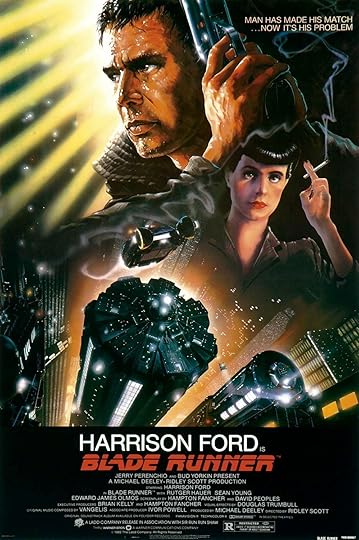 Blade Runner (1982)
At some point in the bringing of Philip K. Dick’s classic science fiction novel Do Androids Dream of Electric Sheep? to the screen, the decision was made to film it as a noirish detective movie. 1940s style clothes, cigarette smoke and Venetian blinds galore provide the visual cues and the developing identity crisis of android hunter Rick Deckard (Harrison Ford) is noir to a tee. Composer Vangelis uses saxophones and synthesizers to create the perfect mood as Deckard stalks the rain-slicked streets of 2019 Los Angeles; a multi-cultural mixing pot of sleaze and crime, looking for his psychopathic quarry.
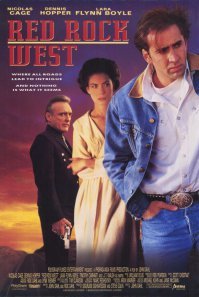 Red Rock West (1993)
Very much in the vein of Dashiel Hammett and echoing small town noirs like Out of the Past (1947) and Detour (1945), Red Rock West introduces us to Michael (Nicholas Cage); a down-on-his-luck drifter who wanders into the titular Texan town looking for work. A local man mistakes him for the hit-man he has hired to kill his wife (Lara Flynn Boyle). Desperate for cash, Michael plays along but rather than carrying out the hit he warns the unsuspecting wife and splits town with the cash. Unfortunately, he runs down a man on the road and is forced to return to Red Rock West where the real hit man (Dennis Hopper) has turned up and the employer he cheated turns out to be the local sheriff. Bad times.
 Lost Highway (1997)
Madness, sexual obsession and disorientation have long been associated with Film Noir and that pretty much sums up this bizarre and mesmerizing entry by David Lynch. Like watching somebody’s nightmare in which the point of view changes without warning, we are introduced to Fred Madison (Bill Pullman) who, after an alarming introduction, winds up on death row for murdering his wife Renee (Patricia Arquette). Awaiting his execution, he dreams up a secondary life in which he is a young mechanic called Andy who has an affair with Alice; a gangster’s girlfriend (also played by Patricia Arquette). But even this is too simple for David Lynch and the film soon spirals into a delirious nighttime road trip of sex and surrealism.
A lot of it is filmed in pure noir style with car headlights providing much of the illumination and the shadows so deep and malevolent that anything could appear from them. Patricia Arquette in her dual roles of Renee/Alice is a blatant femme fatale and the shifting face and motivations of the protagonist is one of the most disorientating things on film. If you try to understand the plot you’ll only go round in circles, much like the protagonist(s). Maybe that’s the point.
 Memento (2000)
Disorientation and paranoia are cornerstones in Film Noir and what could be more disorientating and terrifying than anterograde amnesia (the loss of the ability to create new memories)? Leonard (Guy Pierce) is hunting down the man who murdered his wife and leaving himself clues in the form of post it notes and body tattoos so he won’t forget them. The rub is that if he is successful, he won’t even remember it. This existential conundrum is compounded by the sneaking suspicion that he may have already killed his man and is doomed to forever chase his own clues.
 The Man who Wasn’t There (2001)
Ever since their 1984 debut Blood Simple (which took its title from a line in Dashiel Hammett’s pulp novel Red Harvest) the Coen Brothers have been synonymous with neo noir. Their prohibition-era gangster flick Miller’s Crossing (1990) could have been written by Hammett himself and Fargo (1996) mixed the noir crime caper with black comedy. The Man Who Wasn’t There is perhaps their most overt homage to Film Noir with its gorgeous black and white cinematography and exquisite 1949 setting.
It begins with a classic noir set-up reminiscent of James M. Cain. Disassociated barber Ed (Billy Bob Thornton) is trapped in a loveless marriage and decides to blackmail his wife’s boss when he learns of their affair. Naturally things don’t go to plan and the film delivers twist after twist. Ed has to help his wife beat a murder rap without drawing any attention to his own guilt while simultaneously falling for a teenage piano prodigy (played by a baby-faced Scarlett Johansson). The Coens even work in UFOs which seems so left-field that one can’t help but wonder if they are sneakily inviting the viewer to adhere to one of the film’s central themes; the more you look, the less you really know.
[image error]Brick (2005)
High School Noir never really became a thing but not for want of trying on the part of Rian Johnson’s independent cult classic. Channeling Hammett, the hard boiled dialogue rattles from the mouths of teenagers and the noir archetypes translate surprisingly well to the setting. The jilted loner (Joseph Gordon-Levitt) on the trail of his ex girlfriend’s killer is the obsessed private detective. The rich popular girl is the femme fatale. The school principal stands in for the police commissioner trying to reel in the wayward PI while simultaneously trying to use him for his own ends. The local dropouts-turned drug dealers represent the figures of organised crime to be pumped for information in any good detective yarn.
[image error] Sin City (2005)
This is an example of the noir aesthetic taking precedence over plot and theme. The action is ludicrously over-the-top comic book fare and with four separate story lines, the characters never really get a chance to tell us much about themselves, but it’s all about the eye candy. Shot entirely on greenscreen, the monochrome pallet of inky shadows and blinding highlights is occasionally stained by the red of blood or the flicker of a cigarette lighter. Almost a parody of Film Noir rather than an honest neo noir, this religiously faithful adaptation of Frank Miller’s graphic novels is so damned beautiful that it could only have come from the mind of somebody who understood the noir style through and through.


February 19, 2017
Shades of Black: Subgenres in Film Noir Part 4 – The Drama
The aforementioned Laura (1944) is as much a drama as a detective movie and as Film Noir is not a genre bound by plot or setting many of its entries are genre pictures with noirish attributes. The interest in ordinary people in extraordinary situations was the stomping ground of author James M. Cain whose novels The Postman Always Rings Twice, Mildred Pierce and Double Indemnity all became classic films noir. Eschewing the intricacies of the crime caper or the mystery of the detective or psychological thriller, dramas focus solely on the relationships of their characters. The dual nature of mankind and the light and the dark within every person makes for plenty of dark tales of jealousy, resentment and obsession.
[image error]
“I’m ready for my close-up” – Gloria Swanson as the deranged has-been in Sunset Boulevard (1950)
Mildred Pierce (1945) was a bold adaptation of James M. Cain’s tale of the titular single mother (Joan Crawford) struggling to provide for her two daughters. One of them – Veda (Ann Blyth) – is a complete brat who resents her mother’s blue collar status and ends up in a relationship with Mildred’s second husband. Despite Mildred’s desperate attempts to always do right by her children, the viewer can tell from the opening scene that murder is on the cards. In spite of the California beach houses and apple-pie restaurants, Michael Curtiz’s expressionistic direction provides a decidedly dark overtone for what is essentially a domestic drama.
The Postman Always Rings Twice (1946) was another James M. Cain adaptation and, as in Double Indemnity (1944), the plot focuses on the doomed relationship of a man and a woman who plot to murder the latter’s dull husband. Where it differs from Double Indemnity is in the smoldering chemistry between drifter Frank (John Garfield) and roadside waitress Cora (Lana Turner). The title is a clever allusion to the inescapability of fate. It is more than the Hayes Code at work here preventing the protagonists from getting away with murder.
Narrated by a dead man, Sunset Boulevard (1950) tells of down on his luck scriptwriter Joe (William Holden) who befriends faded actress Norma Desmond (played by real silent star Glora Swanson). Persuaded to aid in her futile comeback attempt, the penniless Joe moves into Norma’s crumbling mansion and a twisted and doomed relationship develops. As well as being a darkly tragic tale of loneliness and alienation, Sunset Boulevard is also a snide attack on the new Hollywood system and its treatment of yesterday’s fading stars.
My new novel – Curse of the Blood Fiends – blends Film Noir with the monster movies of the 1940s. Set in wartime Los Angeles, it features Rosa Bridger; a private detective on the trail of a drug-addled starlet. But as she delves deep into the shadows of the City of Angels, Rosa uncovers something much more sinister than the hoodlums and hop pushers she is used to dealing with. Available from Amazon and Amazon UK.





![[image error]](https://pjthorndyke.files.wordpress.com/2015/10/taxidriverposter.jpg)
![[image error]](https://pjthorndyke.files.wordpress.com/2015/10/sin-city-movie-poster-01.jpg)