P.J. Thorndyke's Blog, page 8
May 15, 2015
Inventions and Discoveries of the 19th Century #7 : The Deir el-Bahari Mummy Cache
The second Lazarus Longman novel – Silver Tomb deals with Egypt both ancient and nineteenth century. Despite being fiction, it does touch on a real event which was vastly important to the burgeoning field of Egyptology. By the 1880s, the practice of rooting about ancient Egyptian sites for treasure or purchasing it from antique dealers and shipping it out of the country to private collections in Europe and America was outlawed. The study of the country’s past and preservation of its antiquities became a national concern thanks to the likes of Amelia Edwards and the renowned scholar and founder of the Egyptian Department of antiquities, Auguste Mariette.
But in 1881 items began appearing on the black market which clearly came from tombs undiscovered by Egyptologists. Mariette, now nearly blind and approaching death, desperately hoped to discover the source of these artifacts but it was to be under the authority of his successor – Gaston Maspero – that the discovery was to be made.
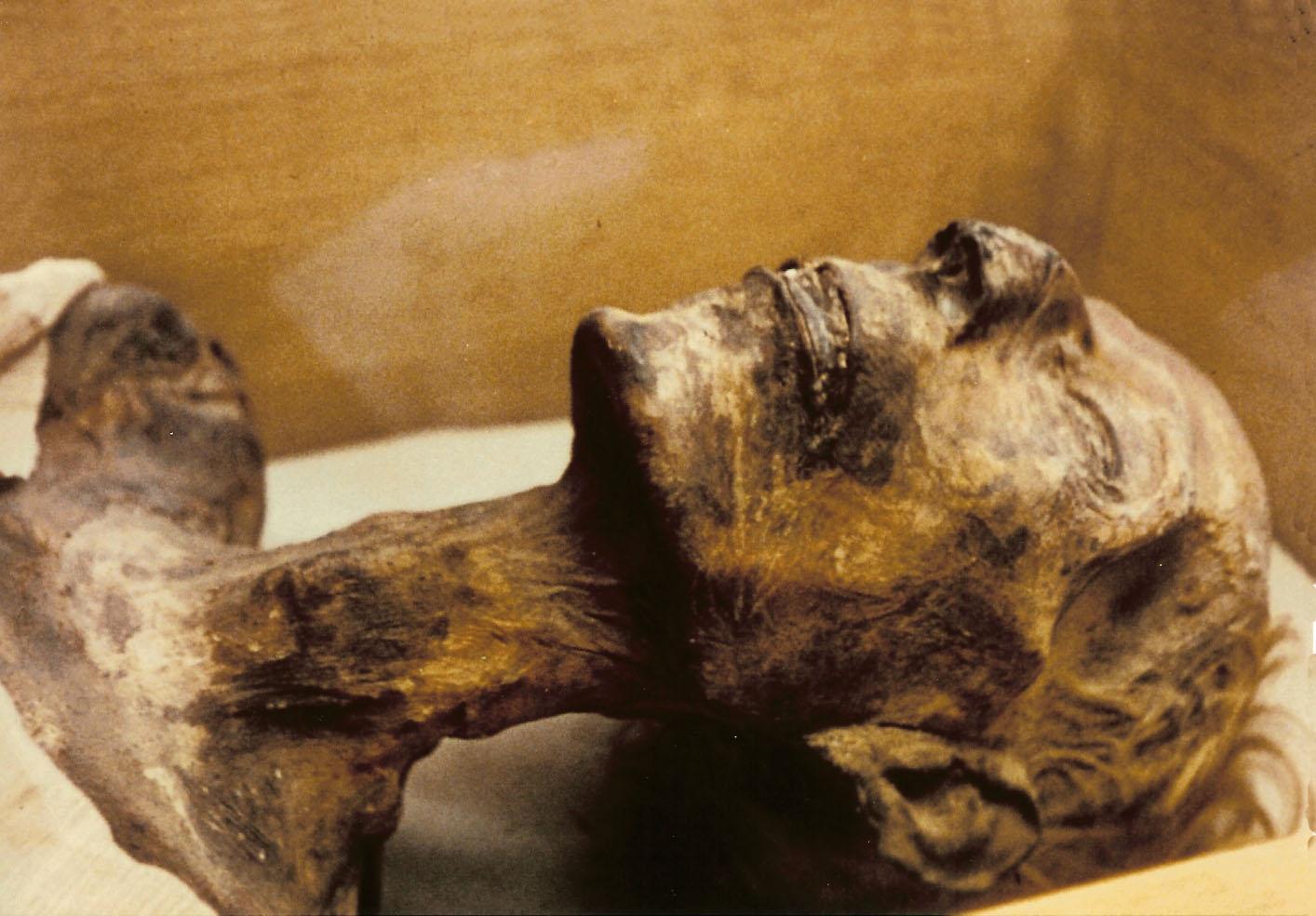
 The source was a single tomb accessible by a vertical shaft located in the vicinity of Deir el-Bahari (northern monastery) of the Theban Necropolis. Most likely it had been the tomb of the High Priest Pinedjem II but had been used as a cache by other priests in antiquity to conceal the mummies and funerary equipment of more than fifty pharaohs and nobles to protect them from grave robbers. A local family from the three villages known collectively as Kurna/Qurna had discovered the tomb some years prior to 1881 and had been steadily selling off artifacts piece by piece. Some internal dissention within the Abd el-Rasoul family led one of their members to talk to the authorities.
Émile Brugsch – assistant curator of the Bulaq Museum – was led to the tomb by one of the Abd el-Rasouls and made the discovery of a lifetime. Among the mummies were the remains of Ramses II; Egypt’s most renowned and, until then, sought after pharaoh. In order to secure the items quickly and avoid any more being stolen, Brugsch cleared the tomb within forty-eight hours. But upon the procession’s arrival in Cairo, word had got around and people turned out in droves to welcome the returning pharaohs.
In my alternate history novel Silver Tomb, I have played around with the dates of these events, pushing them back to 1886. Émile Brugsch is still the one who discovers the Deir el-Bahari cache with the help of Flinders Petrie, Lazarus Longman and of course, the disgruntled member of the Abd el-Rasoul family.
The Egyptian film The Night of Counting the Years (1969) is based on the discovery of the Deir el-Bahari cache. Also known as Al-Mummia, it is a surreal, dreamlike piece and is considered by many to be Egypt’s finest film. It fictionalises the Abd el-Rasoul family and focuses on Wanis who begins to question the morality of robbing their ancestors in order to sustain themselves.


May 11, 2015
Vintage Reads #12 – Arthur Conan Doyle’s Mummy Stories
 Renowned spiritualist, Sir Arthur Conan Doyle wrote in a variety of genres, not least of which were his tales of the supernatural. As well as taking part in seances and claiming to be able to communicate with the dead, he lent support to various reported phenomena (later revealed as frauds) such as the Cottingley Fairies. Naturally the mysteries of Egypt appealed to him. He strongly believed in ‘elementals’ created by the priests of ancient Egypt to protect the tombs of the pharaohs in the form of curses. He attributed the death of his friend Bertram Fletcher Robinson, who had been studying a female mummy in the British museum, to these elementals. When asked by a reporter in 1923, he also put the death of Lord Carnarvon (discoverer of Tutankhamun’s tomb) down to his tempting fate, thus fuelling the sensational rumours of ‘King Tut’s Curse’ further. But it was his two short stories dealing with ancient Egyptian magic and mummies that had the biggest effect on popular culture.
Published in the Cornhill Magazine i n 1890, The Ring of Thoth tells of an Egyptologist named John Vansittart Smith who, on a visit to the Louvre museum, comes across a haggard-looking caretaker who catches his imagination. Convinced that the fellow is an Egyptian of the oldest order, Smith is unable to concentrate on his studies and eventually drifts off to sleep only to awaken to find that he has been locked in the museum for the night. Wandering the lonely and shadow-haunted rooms of the Louvre, Smith comes across the strange caretaker removing a mummy from its case and unwrapping it to reveal a beautiful woman. Startled by the Englishman’s approach, the attendant eventually agrees to tell his story; a tale of love, rivalry and a quest to find the Ring of Thoth which is the only thing that can break the spell of immortality and reunite him with his loved one.
 Lot No. 249 is perhaps the most influential of Doyle’s mummy tales in that it was the first story ever to feature a reanimated mummy as a figure of horror. Jane Webb wrote the first mummy story in her science fiction tale of the future The Mummy!: Or a Tale of the Twenty-Second Century in 1827 and Edgar Allen Poe had reanimated a mummy in his satire Some Words with a Mummy (1845) but it was Conan Doyle who can truly be said to be the root of the modern ‘mummy monster’ popularised by the movies. Published in 1892, Lot No. 249 regards medical student Abercrombie Smith who, after moving into his rooms in a crumbling tower at Oxford, begins to have suspicions about his neighbor on the floor below. Edward Bellingham is an Egyptologist who has an array of weird artefacts in his room, weirdest of all is a mummy in a glass case. Smith begins to think that Bellingham is not alone in his rooms at night as the footsteps of a second individual are often heard. Then attempts are made on the lives of Bellingham’s rivals by an unknown assailant…
Whereas The Ring of Thoth undoubtedly influenced Universal’s The Mummy (1932) Lot No. 249 was a definite inspiration for most mummy movies that followed it, notably Universal’s second mummy feature The Mummy’s Hand (1940) which began the cinematic tradition of big, shambling mummies lurching after their victims under the command of wicked individuals. The idea of burning special leaves to control the mummy (a plot device used in most of Universal’s mummy movies) may also have come from Lot No. 249 as strange leaves are found in Bellingham’s room at the end of the story.


May 8, 2015
Inventions and Discoveries of the 19th Century #6 – The Work of Flinders Petrie
 The 1880s was when things started getting serious in Egyptology. The days of looting and exporting antiquities based on their material value and trampling over everything else was coming to a close and men like Flinders Petrie heralded a new age of respect for Egypt’s heritage and a wish to preserve it.
Born in Kent, England in 1853, Petrie never let his lack of formal education stand in the way of his love of archaeology. Even at age eight he expressed horror at the rough shovelling of earth that was going on at the excavation of a Roman villa on the Isle of Wight and exclaimed that earth should be removed slowly and systematically to avoid damaging what might lie beneath. His career began with the study of British sites and at the age of nineteen he conducted the most accurate study of Stonehenge by that point. Egypt followed in 1880 and he produced the first real study of how the pyramids at Giza were constructed.
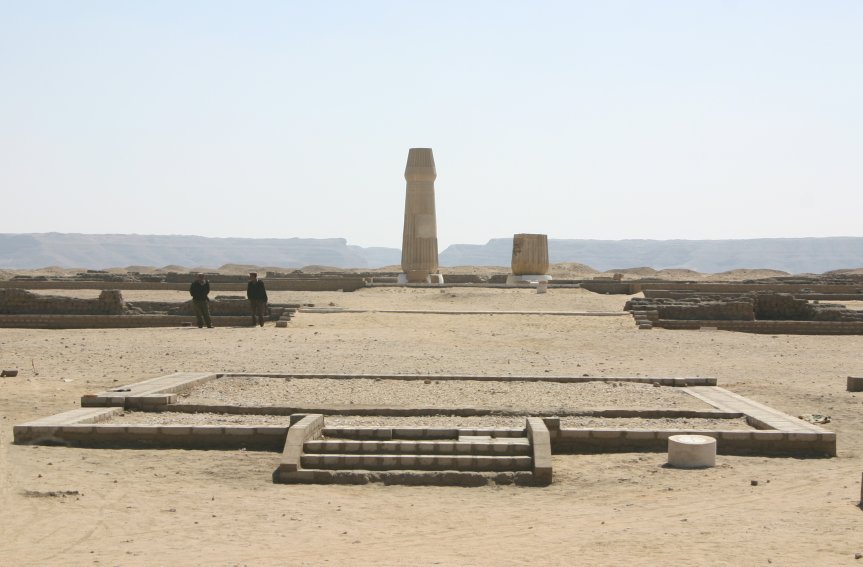
Small temple of the Aten at Tell el-Amarna as seen today
His studies were brought to the attention of Amelia Edwards (patron of the Egypt Exploration Fund) who was impressed by the young man and funded his further digs in Egypt. Commencing in 1884, Petrie embarked on a series of excavations of Egypt’s sites including Tanis and Tell Nebesheh. He developed a reputation for ‘cutting out the middle man’ by acting as foreman and for giving cash rewards for artifacts found, thus ensuring that they were not stolen or handled carelessly. In 1891 he worked at Tell el-Amana (known in antiquity as ‘Akhetaten’ – city of the heretic pharaoh Akhenaten) and discovered a very attractive painted pavement depicting many scenes of farming and hunting life.
His later career focused primarily on Palestine where he continued to implement his painstaking methods which set new standards in archaeology. His contribution to Egyptology was immense; a field in which he was the first to use seriation – a method of dating layers of earth based on pottery fragments. I found him such an interesting character that I used him as a supporting character in my novel Silver Tomb. In it I refer to his excavations at Tanis and Tell Nebesheh but as it is an alternate history novel, there are some changes. The novel opens in 1886. Petrie is finished at Tell el-Nebesheh and is currently working at Tell el-Amarna (which he didn’t excavate until 1891 in reality). I have also involved him in the discovery of the mummy cache at Deir el-Bahari which in reality that was discovered in 1881 while Petrie was still in England.


May 4, 2015
Vintage Reads #11 – The Jewel of Seven Stars
 Although not technically a mummy story (there’s no real reanimated mummy in it, but we’ll get to that) Bram Stoker’s tale of ancient Egyptian evil and mysticism has had a big effect on the genre resulting in at least three movies based on its plot and characters. Dracula author Bram Stoker had always been intrigued by Egypt’s ancient brand of spiritualism. At a young age Stoker was a visitor to the house of fellow Irishman Sir William Wilde (father of Oscar Wilde). Wilde was an amateur archaeologist whose house (like the Trelawny house in the novel) was filled with Egyptian antiquities and the stories of his expeditions and digs in that far off land clearly influenced the young writer. In a time when fascination with Egypt’s mysteries was spawning various secret societies and the occult dabblings of Alistair Crowley, Stoker was not alone in his pursuit for mystic knowledge and his descriptions of artefacts and spiritual ideas are layered with authenticity.
 Malcolm Ross – a young barrister – is the story’s protagonist who finds himself neck-deep in a mystery plot at the Trelawny house in Notting Hill. Abel Trelawny is an Egyptologist who has been found unconscious and wounded on the floor of his bedroom study. Among Abel’s Egyptian collection is a mummified cat, a human mummy (missing a hand) and a perfectly preserved severed hand with seven fingers. Adorning one finger is carven ruby ring set with seven points resembling the plough constellation. Ross is in love with Trelawny’s daughter Margaret, who reveals a mysterious letter penned by her father stating that his body should not be moved from his room and must be watched until he wakes up. Eugine Corbeck, another Egyptologist, who worked with Abel turns up at the house and tells Ross of his and Abel’s trip to Egypt years previously and their discovery of the tomb of Queen Tera, an ancient sorceress. The moment they cracked open Tera’s sarcophagus, Abel’s wife back in England died giving birth to Margaret; a coincidence vital to the plot. When Abel awakens from his state he begins to put in motion his plans for a ‘great experiment’ which will give him vast insight into the spiritual plains of the ancient Egyptians by returning the spirit of Queen Tera (that has been residing in the mummified cat) to its proper corporeal vessel. But the spirit of Queen Tera is already trying to enter Margaret’s body causing her to display alarming shifts in personality.
As well as showcasing the Victorian fear of the rise of the ‘New Woman’ in Margaret’s gradual transformation from a timid, non-threatening love interest to a strong, sexually powerful and independent woman, Tera’s threat to civilisation and her plans to rule the modern world make the novel an example of Imperial Gothic, a subgenre marked by the fear that the civilised world had reached its peak and the only way left was down, back to barbarism. This idea was mirrored by the French notion of Fin de siècle’ (end of the century) and the idea that all will eventually degenerate to decadence. 


May 1, 2015
Silver Tomb – Cover and Blurb
Judging by my recent posts, you may have guessed the location of the second Lazarus Longman novel which should be out in about a month. Yep, we’re heading to Egypt this time.

His mission was to bring home the wayward fiancé of a British politician who just might be a French spy. But for Lazarus Longman – former explorer and secret agent for the British Empire – things are never that simple. The politician in question was once his friend but is now his bitter rival. The fiancé is France’s leading Egyptologist, a woman whose dealings with a renegade Confederate scientist have drawn the attention of more than the British Secret Service.
From the seedy dens of Cairo’s black market to the backwater villages of the Nile where the burst of Gatling Gun fire is the nationalist war cry, Lazarus finds himself up to his neck in sinister plots, political machinations and the stench of the dead given frightful mobility by modern science. But an unlikely ally blows in on the desert wind – Katarina Mikolavna; an old acquaintance and the Russian Tsar’s deadliest weapon.
Once again the two agents find themselves on opposing sides in a clandestine war of empires that casts its dirigible-shaped shadow over the burning sands of North Africa.


April 28, 2015
Vintage Reads #11 – The Mummy!: Or a Tale of the Twenty-Second Century
Ancient Egypt has given us many things, not least of which the idea of mummies resurrected to fulfil some terrible curse or to pursue the sinister ambitions of those who raised them. Nevermind that such a concept was far from the mythology of the Ancient Egyptians themselves, the mummy is as iconic a figure of horror as Dracula and Frankenstein’s monster. But unlike those stars of cinematic terror, the mummy lacks a single literary root. There is no novel called ‘The Mummy’ that was the single inspiration for the slew of movies featuring bandaged terrors resurrected from their tombs. But then, there is this novel from the pen of Jane C. Loudon (born Jane Webb) which is the first real story to feature a reanimated mummy, albeit in a futuristic setting with a plot dominated by ideological philosophizing and political intrigue than horror.
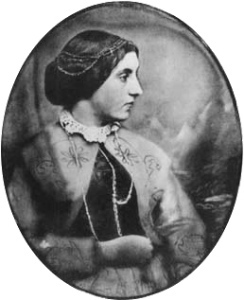
English born author Jane Webb published her story in 1827 to financially support herself after her father died penniless. It’s a fantastically bizarre story of the future, showing the world as it may appear in 2126, a world that has made great leaps in technology but is morally bankrupt. Women wear trousers and headdresses made of flames. Airships prowl the skies, letters are sent via cannonball and steam-powered automatons serve as surgeons and lawyers. Ladies and gentlemen, meet Steampunk. Egypt was all the rage at the time of writing thanks to Napoleon’s looting of the country during his invasion and the discovery and translation of the Rosetta Stone. Mummies were being unwrapped before audiences in Piccadilly. And another novel by a female author had been published in 1818 which had thrilled and disgusted the public with the idea of reanimating the dead.
Mary Shelly’s Frankenstein is an obvious influence on Webb’s The Mummy!. Much like Victor Frankenstein, the main character, Edric, becomes obsessed with the God-like power he would receive should he be able to reanimate the dead. Instead of sewing together corpses, Edric is more interested in returning the soul to its mortal vessel and sets out for Egypt with his professor, Dr. Entwerfen, with the aim of reviving Cheops (Khufu) in his Great Pyramid at Giza with a portable galvanic battery. Immediately regretting his actions once the mummy is up on his feet, Edric and his companions soon find their airship stolen by the renegade pharaoh who promptly sails to London and lands on Queen Claudia, killing her. Spread over three volumes published anonymously, the story goes on to include political intrigue, murderous rivalry and conspiracy, with Cheops playing his role in all, dispensing political and moral advice along the way. 


April 24, 2015
Vintage Reads #10 – A Thousand Miles up the Nile
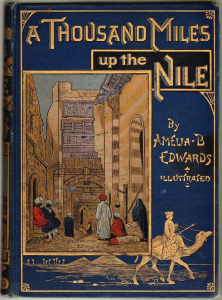 I wasn’t sure whether to include this book in my ‘Vintage Reads’ series or my ‘Inventions and Discoveries of the 19th Century’ series. I opted for the former because it is, after all, a book, but it would fit well in the latter due to the effect its publication had on the wave of ‘Egyptomania’ that hit Britain and the US in the late nineteenth century. Egyptology was in its infancy in the 1870s. Interest and tourism in Egypt had boomed since the publication of Napoleon’s Description de l’Égypte and the deciphering of the Rosetta Stone. But the ancient monuments and tombs that had weathered so many centuries soon came under threat by waves of tourists trampling all over them, digging for treasure and casting aside anything that did not have material value despite the contributions they might make to our understanding of Ancient Egyptian culture.
English writer Amelia Edwards arrived in Egypt in the winter of 1873 almost by accident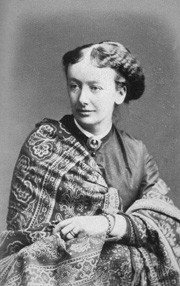 . It was poor weather that deterred Edwards and her companion from their sketching holiday in Europe. They went to Egypt instead and rented a ‘dahabeeyah’ (a riverboat) and crew to take them up the Nile. Edwards had always been fascinated by Egypt but she was appalled by the casual pilfering and vandalism going on and felt compelled to do what she could to preserve Egypt’s heritage. No only does Edwards thoroughly describe each and every site in painstaking detail, she also gives us a fascinating look into the lives of the nineteenth century Egyptians. What is most striking is the abject poverty of the people who dwell among these ruins that attract so many wealthy Europeans. The state of the villages is practically medieval including children with horrendous eye infections, wild superstition and lives of toil and privation that ensure few reach the age of forty.
The book is also an invaluable insight into the mindset of Victorian travel, exploration and attitudes towards other nationalities. While Amelia Edwards was certainly a woman ahead of her time, the same can’t be said of her peers who display attitudes and behaviours which are at times uncomfortable for the modern reader. The British lord it over the natives who will do anything for ‘baksheesh’ (charity). The men on the trip are of course ‘sportsmen’ which means they shoot at anything in sight and even the author remarks on the tragedy of crocodiles being shot nearly into extinction. One stomach-churning episode details the near killing of an Egyptian child by the carelessness of one of these gunmen. When the relatives of the child assail the blundering ass, they are arrested and threatened with brutality by the police who claim that the whole village will be bastinadoed (caning of the soles of the feet) should the ‘Ingleezeh’ wish it.
Amelia Edwards fell so in love with Egypt and its history that she joined forces with Reginald Stuart Poole in 1882 and set up the Egypt Exploration Fund (now known as the Egypt Exploration Society) dedicated to raising awareness and enthusiasm for Egypt’s past and to help preserve what is left of it. Edward’s depiction of nineteenth-century Egypt with its fellahs, dahabeeyahs and rural villages has been an indispensable resource for so many people, not least Elizabeth Peters who wrote the Amelia Peabody series of historical mystery novels whose protagonist has a lot more in common with Edwards than her first name. In the writing of Silver Tomb, I found myself dipping into A Thousand Miles up the Nile many times over since having read it cover to cover before I began writing the novel. 


April 20, 2015
Inventions and Discoveries of the 19th Century # 5 – The Rosetta Stone

The mysteries of Ancient Egypt were more or less unknown to Europeans at the start of the 19th century. It was understood that this backward province of the Ottoman Empire had once been a fabulously wealthy kingdom with a rich mythology, outstanding architecture and bizarre burial customs, but because nobody could understand the written hieroglyphic language of the ancient Egyptians, knowledge of their culture more or less ended there. Then the Rosetta Stone was discovered.
Napoleon invaded Egypt in 1798 with the aim of disrupting Britain’s trade with India. The coastal city of Rashid came to be called ‘Rosette’ by the occupying French and it was during the rebuilding of the nearby Fort Julien that some of Napoleon’s soldiers found a chunk of the rubble marked with mysterious script. This shattered block of granodiorite appeared to have the same passage of text copied in three languages later identified as ancient Egyptian hieroglyphs, a later form of Egyptian called Demotic and ancient Greek. As ancient Greek could be read it became possible for the first time in history to decipher the hieroglyphs of the ancient Egyptians.
Napoleon’s forces were pushed out of Egypt by the British in 1802 and the French army signed over their collection of Egyptian antiquities (including the Rosetta Stone) to the British. Prints and casts had already been made of the stone and now scholars all over Europe took part in the competition to decipher the text. It was the French Orientalist Silvestre de Sacy who suggested that, as in Chinese, some of the hieroglyphs might be written phonetically especially those encircled by ‘cartouches’ (ovals) which could contain Greek names (as the stone dated from the Ptolemaic Period). Thomas Young, foreign secretary of the Royal Society of London used this idea to list eighty similarities in the three texts. It was another Frenchman – Jean-François Champollion – who compiled an alphabet of phonetic hieroglyphs and published the first translation of the Rosetta Stone in 1822.
So what is written on the stone? It seems to be part of a stele (a standing stone erected for commemorative purposes) during the reign of King Ptolemy V (204 – 181 BC). The third in a series of decrees issued at Memphis by the Hellenistic rulers of the Ptolemaic Period, it records the king issuing a tax exemption to the priesthood as well as a gift of silver and grain to the temples. The priests who issued the decree thank the king by promising to celebrate his birthday and coronation days annually and to worship him alongside the other gods across the land. Wikipedia has an illustration of how the stele may have looked in its complete form.

The Rosetta Stone still resides in the British Museum in London. The term ‘Rosetta Stone’ has come to mean a key to unlocking, usually in a linguistic context, secrets inaccessible in any other way.


April 18, 2015
Golden Heart Released
 I’m pleased to announce the release of Golden Heart, the first novel in the Lazarus Longman Chronicles; a Steampunk adventure series set in an alternate 19th century. It’s available from Amazon, Amazon UK, Barnes and Noble, and Smashwords. Sequels are on the way.
Steampunk and the lost world genre collide as a thrilling adventure is set in motion that will decide the fate of America.
The North American continent has been torn apart by civil war. Steam-powered behemoths stalk the landscape, dirigibles prowl the skies and society stands on the back of a new class of slaves known as ‘mechanicals’. The conflict between the Union and the Confederacy has dragged on for twenty-five years with neither side coming close to victory. Something is needed to tip the balance…
Lazarus Longman – antiquarian, explorer and treasure hunter for the British Empire – had heard of the Seven Golden Cities of Cibola, but he never believed they really existed. So when he was ordered to track down the only two men rumored to have seen the fabled land he was skeptical to say the least. His skepticism turned to desperation when he found out that his quarry was Gerard Vasquez; a degenerate gambler, drinker and pistoleer and his companion, Hok’ee; a towering Navajo with a ferocious temper and a mechanical gun-arm.
The British want these men delivered into the hands of the Confederacy so that the war can be brought to a swift resolution. But not everybody wants the Confederacy to win. Especially not Tsar Alexander III who has dispatched his own deadly assassin to ensure the Confederates never get their hands on America’s golden heart.


April 17, 2015
Vintage Reads #9 – The Delight Makers
 The Swiss explorer, archaeologist and anthropologist Adolf F. Bandelier grew up in America and devoted his studies to the American Southwest, Mexico and South America. He was the leading authority on the pueblo peoples of the so-called ‘four corners’ (Utah, Arizona, New Mexico and Colorado). His 1890 historical novel concerning the pre-Columbian peoples of this area (called ‘Anasazi people’ by their Navajo neighbors) is a gold mine of valuable information and I found it incredibly useful in constructing the ‘Cibolan’ civilization for Golden Heart.
The story is an intimate look at family life within the pueblos of the Anasazi. It opens with a young boy called Okoya who is destined to join the ranks of the Koshare; a class of medicine men and women who are the Delight Makers of the title. His faith in them is shaken by his mother, Say Koitza, who dislikes one in particular, a powerful Delight Maker called Tyope. But when Okoya falls in love with Tyope’s daughter, Mitsha, he begins to question his mother’s motives.
 It’s not an easy read. Bandelier’s writing style at times seems more suited to a text book and he leaves many terms unexplained, assuming the reader already has some knowledge of this civilization. This isn’t helped by the dizzying array of characters with unfamiliar names which had me on the verge of making notes throughout. Plenty more is explained however and, although Bandelier is the first to admit that in the absence of hard evidence, one must infer a little, the level of detail and believe-ability of the civilization and customs of his characters is top notch. Using archaeology and observations of current pueblo peoples such as the Hopi and the Zuni, Bandelier has constructed a world that is totally immersive and utterly convincing.