
Kenneth C. Davis's Blog, page 36
August 7, 2020
The Month That Changed The World: 1945, 75 Years Ago
[Revised and updated repost of 2016 essay]
From “Trinity” to V-J Day
The Month That Changed the World

The Atomic Bomb Dome-Hiroshima (Photo Courtesy of Hiroshima and Nagasaki Remembered)
On August 6, 1945, the New York Times asked:
“What is this terrible new weapon?”
(New York Times, August 6, 1945: “First Atomic Bomb Dropped on Japan”)
The story followed the announcement made by President Harry S. Truman:
“SIXTEEN HOURS AGO an American airplane dropped one bomb on Hiroshima, an important Japanese Army base. That bomb had more power than 20,000 tons of T.N.T. It had more than two thousand times the blast power of the British ‘Grand Slam’ which is the largest bomb ever yet used in the history of warfare.”
August 6, 1945
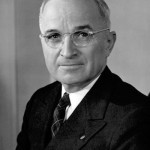
President Harry S. Truman
(Photo: Truman Library)
(“Statement by the President Announcing the Use of the A-Bomb at Hiroshima”: Truman Library and Museum)
ON July 16, 1945, the first atomic device, nicknamed “the Gadget,” was detonated in the “Trinity” test at Alamogordo, New Mexico. Read this excellent account of the test in National Geographic.
In the course of the next weeks, the world would be transformed, with the arrival of the Atomic Age, Japan’s surrender, the end of World War II, the charter of the United Nations, and the beginning of the Cold War.
July 17: In Potsdam, near Berlin in defeated Germany, Harry S. Truman came face to face with the Soviet dictator Joseph Stalin. Truman had taken office upon the death of President Roosevelt on April 12 without knowledge of the Manhattan Project or the atomic bomb’s existence. After he was told about the potential weapon, he was informed of the successful “Trinity” test while meeting with Churchill and Soviet Union leader Joseph Stalin at the postwar conference in Potsdam.
“I told Stalin that I am no diplomat but usually said yes or no to questions after hearing all the argument.”
Following the successful detonation in New Mexico, the components of the atomic bomb were loaded on the USS Indianapolis and transported to an airbase on Tinian Island in the Pacific. Many of the crew of nearly 1,200 men had no idea what the ship was carrying.
Jul7 24: Truman informed Stalin of a “new weapon of unusual destructive force.” But Stalin already know about the atomic bomb because of a network of spies inside the Manhattan Project.

The Hidden History of America At War (paperback)
(The race to Berlin by the Soviet Red Army was motivated in part by Stalin wanting to secure German scientists working on the atomic bomb and tons of uranium held in a Berlin lab. This episode is recounted in the “Berlin Stories” chapter of The Hidden History of America at War.)
July 26: Prime Minister Winston Churchill was defeated in the general election and replaced by Clement Attlee as Prime Minister.
“The landslide victory comes as a major shock to the Conservatives following Mr Churchill’s hugely successful term as Britain’s war-time coalition leader, during which he mobilised and inspired courage in an entire nation.”
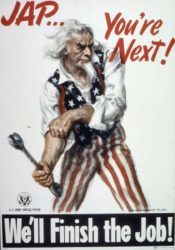
U.S. Propaganda poster (Source National Archives https://catalog.archives.gov/id/513563)
–BBC
At the Potsdam Conference, the Potsdam Declaration demanded “Unconditional surrender” by Japan. It threatened:
“The alternative for Japan is prompt and utter destruction.”
The Indianapolis reached Tinian that day.

USS Indianapolis 10 July 1945, after final overhaul and repair of combat damage. Photograph from the Bureau of Ships Collection in the U.S. National Archives (Naval History and Heritage Command https://usnhistory.navylive.dodlive.m...)
“Indianapolis departed San Francisco on 16 July 1945, foregoing her post-repair shakedown period. Touching at Pearl Harbor on 19 July, she raced on unescorted and reached Tinian on 26 July, covering some 5,000 miles from San Francisco in only ten days.”
After the delivery of the atomic bomb components, the ship sailed for Guam and the Philippines. On July 30, the ship was torpedoed by a Japanese submarine and sank in twelve minutes.
“What followed was an ordeal of hell on earth for those who survived the sinking. For a whole host of reasons, many related to the secrecy of her atom bomb mission, the rest of the Navy did not know that Indianapolis was missing.”
— Sam Cox (Rear Adm., USN, Ret.), “Lest We Forget: USS Indianapolis and her sailors”
July 29: The Japanese government rejected the surrender demand.
July 31: The assembly of the atomic bomb, code named “Little Boy,” was completed. The final arming of the bomb would be done in-flight.

In Potsdam, President Truman was notified of the bomb being ready. He wrote a message that concluded:
“Release when ready, but not sooner than August 2. HST”
According to the Truman Library:

The actual reply that President Truman wrote on July 31, 1945 (Photo taken by Dawn Wilson at the Harry S. Truman Presidential Library)
“No known written record exists in which Harry Truman explicitly ordered the use of atomic weapons against Japan. The closest thing to such a document is this handwritten order, addressed to Secretary of War Henry Stimson, in which Truman authorized the release of a public statement about the use of the bomb. It was written on July 31, 1945 while Truman was attending the Potsdam Conference in Germany. In effect, this served as final authorization for the employment of the atomic bomb, though the expression ‘release when ready’ refers to the public statement.”
August 1: the atomic bomb was ready and flight orders were prepared. But weather delayed the mission. Of four potential target cities, Hiroshima was chosen as the primary target.
In Potsdam that day, the Big Three were wrapping up their meetings and discussed plans for the trials of war criminals that later become known as the Nuremberg Trials.
In the Pacific, hundreds of survivors from the Indianapolis were desperately trying to stay afloat in the shark-infested waters.
“In that clear water you could see the sharks circling. Then every now and then, like lightning, one would come straight up and take a sailor and take him straight down.” – Survivor of the Indianapolis sinking to the BBC.
August 2: The U.S. Navy was still unaware that the Indianapolis had gone down. About 800 men had gone into the water and the survivors were spotted by a reconnaissance plane four days after the sinking; 317 survivors were rescued.
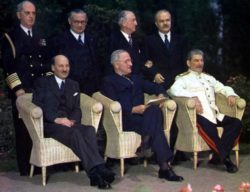
The Big Three at the end of the Potsdam Conference: Front row (Left to Right) Prime Minister Attlee, President Truman, Generalissimo Stalin. Source: Army Signal Corps Collection in the U.S. National Archives.
Shortly after midnight on August 2, the Potsdam Conference concluded with a joint communique. It included reference to the United Nations, whose organization and charter had been completed on June 26 at a conference in San Francisco.
Truman spoke of a future Washington meeting, but he and Stalin never met again.
What was clear was that the Conference had solidified the Soviet Union’s domination over much of Eastern Europe, including the eastern half of a divided Germany. Admiral William D. Leahy, Truman’s Chief of Staff, later wrote:
“The Soviet Union emerged at this time as the unquestioned all-powerful influence in Europe….”
August 4: Colonel Paul Tibbets briefed the men of the 509th Composite Group -the weapon delivery arm of the Manhattan Project. Tibbets was the commander of the unit. His men do not know the nature of the bomb they will carry.
August 5: The bombing mission was confirmed and Colonel Paul Tibbets announced he would pilot the plane which he named “Enola Gay,” after his mother. “Little Boy” was loaded on the plane.

Colonel Paul W. Tibbets, Jr., Pilot of the Enola Gay, the Plane that Dropped the Atomic Bomb August 6, 1945 (National Archives https://catalog.archives.gov/id/535737)
August 6 8:15 AM local time: The first atomic bomb was detonated over Hiroshima.
“In less than one second, the fireball had expanded to 900 feet. The blast wave shattered windows for a distance of ten miles and was felt as far away as 37 miles. Over two-thirds of Hiroshima’s buildings were demolished. The hundreds of fires, ignited by the thermal pulse, combined to produce a firestorm that had incinerated everything within about 4.4 miles of ground zero.”
Source: Hiroshima and Nagasaki Remembered.
“In the street, the first thing he saw was a squad of soldiers who had been burrowing into the hillside opposite, making one of the thousands of dugouts in which the Japanese apparently intended to resist invasion, hill by hill, life for life; the soldiers were coming out of the hole, where they should have been safe, and blood was running from their heads, chests, and backs. They were silent and dazed.
Under what seemed to be a local dust cloud, the day grew darker and darker.”
–John Hersey, “Hiroshima,” New Yorker (August 24, 1946)
In Hiroshima, the estimated death toll was eighty thousand people killed instantly; as many as 90 percent of the city’s nurses and doctors also died instantly. By 1950, as many as 200,000 had died as a result of long-term effects of radiation.
In his official announcement, President Truman said,
It was to spare the Japanese people from utter destruction that the ultimatum of July 26 was issued at Potsdam. Their leaders promptly rejected that ultimatum. If they do not now accept our terms they may expect a rain of ruin from the air, the like of which has never been seen on this earth. Behind this air attack will follow sea and land forces in such numbers and power as they have not yet seen and with the fighting skill of which they are already well aware.
Read Don’t Know Much About Hiroshima for more details about the bombing and its aftermath.
August 7: On Guam, the decision to use a second device is made and the mission date is set for August 10, then moved to August 9 over weather concerns.
August 8: The Soviet Union declared war on Japan and invaded Manchuria the next day, sending more than one million troops into the Japanese-held territory.
August 9: A second device, a plutonium bomb code named “Fat Man,” was used against the city of Nagasaki.
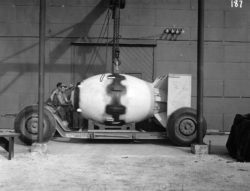
Fat Man being lowered and checked on transport dolly for airfield trip Image Source: Heritage Foundation https://www.atomicheritage.org/histor...
The death toll in Nagasaki also reached 80,000 by the end of 1945.
August 14 (August 15 in Japan): Japan announced its surrender. At a White House conference, according to United Press International, Truman said:
“This is the day when Fascist and police governments cease to exist in the world. This is the day for democracy.”
-Source: “Japan Surrenders Unconditionally, World At Peace” UPI archives

Truman announces Japan’s surrender to reporters in Oval Office.
Credit: Rowe, Abbie National Park Service Harry S. Truman Library & Museum.
Across America and England, jubilant crowds filled the streets once more for an unofficial V-J (Victory over Japan) Day, as they had on VE Day, May 8,1945, after Germany’s surrender ended the war in Europe.

V-J Day Times Square August 14, 1945 Library of Congress Prints and Photographs Division. New York World-Telegram and the Sun Newspaper Photograph Collection. http://hdl.loc.gov/loc.pnp/cph.3c19650
September 2, 1945: A formal surrender ceremony was performed in Tokyo Bay and that date is also referred to as V-J Day.
Almost since the day the first atomic bomb was dropped on Hiroshima, critics have second-guessed Truman’s decision and motives. A generation of historians and commentators have defended or repudiated the need for unleashing the atomic weapon. Admiral William D. Leahy, who was with Truman at Potsdam, later wrote in a memoir:
Once it had been tested, President Truman faced the decision as to whether to use it. He did not like the idea, but he was persuaded that it would shorten the war against Japan and save American lives. It is my opinion that the use of this barbarous weapon at Hiroshima and Nagasaki was of no material assistance in our war against Japan.
–William D. Leahy, I Was There (1950)
You can read more about Hiroshima and the dropping of the atomic bombs in Don’t Know Much About Historyand more about President Truman in Don’t Know Much About the American Presidents and in The Hidden History of America At War.
Read more about Mussolini, Hitler, and Stalin in STRONGMAN which will be published on October 6, 2020.




August 6, 2020
Don’t Know Much About® Hiroshima
Seventy-five years ago on August 6, 1945, the atomic bomb was dropped on Hiroshima. At 8:15 local time, the first atomic bomb was detonated 1,986 feet above the city.
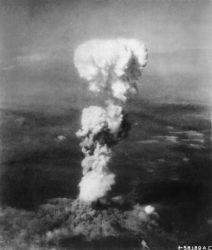
The atomic bomb cloud over Hiroshima Source: National Archives https://catalog.archives.gov/id/542192
Hiroshima before the war was the seventh largest city in Japan, with a population of over 340,000, and was the principal administrative and commercial center of the southwestern part of the country. As the headquarters of the Second Army and of the Chugoku Regional Army, it was one of the most important military command stations in Japan, the site of one of the largest military supply depots, and the foremost military shipping point for both troops and supplies.
Shortly afterwards, the White House released a statement from President Harry S. Truman that had been drafted while he was attending the Potsdam Conference. Truman called Hiroshima “an important Japanese army base.”
We are now prepared to obliterate more rapidly and completely every productive enterprise the Japanese have above ground in any city. We shall destroy their docks, their factories, and their communications. Let there be no mistake; we shall completely destroy Japan’s power to make war.
It was to spare the Japanese people from utter destruction that the ultimatum of July 26 was issued at Potsdam. Their leaders promptly rejected that ultimatum. If they do not now accept our terms they may expect a rain of ruin from the air, the like of which has never been seen on this earth. Behind this air attack will follow sea and land forces in such numbers and power as they have not yet seen and with the fighting skill of which they are already well aware.
Read: The Month That Changed the World for a timeline of events leading up to the end of World War II.
By June 1, Truman had apparently made his decision to use the atomic bomb to end the war with Japan. But the bomb had not yet been tested. Once the bomb had been successfully detonated in the New Mexico desert, the decision to use it moved forward, a fateful choice that was set against the recent American experience on Okinawa, where more than 12,500 Americans and more than 100,000 Japanese had died in brutal combat.
When the Japanese said they would fight to the death rather than make an unconditional surrender, the final decision was cast. Winston Churchill later summarized the decision: “To avert a vast, indefinite butchery.”
-From Don’t Know Much About the American Presidents
After the war, a United States survey team assessed the impact of the Hiroshima bomb.
“Practically the entire densely or moderately built-up portion of the city was leveled by blast and swept by fire. A ‘fire-storm’, a phenomenon which has occurred infrequently in other conflagrations, developed in Hiroshima: fires springing up almost simultaneously over the wide flat area around the center of the city drew in air from all directions. The inrush of air easily overcame the natural ground wind, which had a maximum velocity of 30 to 40 miles per hour two to three hours after the explosion. The ‘fire-wind’ and the symmetry of the built-up center of the city gave a roughly circular shape to the 4.4 square miles which were almost completely burned out.
The surprise, the collapse of many buildings, and the conflagration contributed to an unprecedented casualty rate. Seventy to eighty thousand people were killed, or missing and presumed dead, and an equal number were injured. (Emphasis added)
What history has confirmed is that some of the men who created the bomb didn’t understand how horrifying its capabilities were. Of course, they understood the destructive power of the bomb, but radiation’s dangers were far less understood. As author Peter Wyden tells it in Day One, an account of the making and dropping of the bomb, scientists involved in creating what they called “the gadget” believed that anyone who might be killed by radiation would die from falling bricks first.
“The survivors, known as hibakusha, sought relief from their injuries. However, 90 percent of all medical personnel were killed or disabled, and the remaining medical supplies quickly ran out. Many survivors began to notice the effects of exposure to the bomb’s radiation. Their symptoms ranged from nausea, bleeding and loss of hair, to death. Flash burns, a susceptibility to leukemia, cataracts and malignant tumors were some of the other effects.
–“The Story of Hiroshima,” Hiroshima and Nagasaki Remembered
The heat was tremendous . And I felt like my body was burning all over. For my burning body the cold water of the river was as precious as the treasure. Then I left the river, and I walked along the railroad tracks in the direction of my home. On the way, I ran into an another friend of mine, Tokujiro Hatta. I wondered why the soles of his feet were badly burnt. It was unthinkable to get burned there. But it was undeniable fact the soles were peeling and red muscle was exposed.
—Mr. Akihiro Takahashi, who was 14 years old, when the bomb was dropped
On August 9, a second bomb, code named Fat Man, was detonated above Nagasaki.
Like Hiroshima, the immediate aftermath in Nagasaki was a nightmare. More than forty percent of the city was destroyed. Major hospitals had been utterly flattened and care for the injured was impossible. Schools, churches, and homes had simply disappeared. Transportation was impossible.
Many historians contend that preventing death and casualties in an invasion of Japan was only a partial explanation for the use of the two atomic bombs. The United States was already wary of Stalin and his designs on Japan’s wartime territory. They argue that the use of the two devices was meant to end the war quickly to prevent Stalin from capturing territory held by Japan. It may have also been a signal to Stalin and the Soviet Union –which had declared war on Japan and moved troops into Manchuria– that the United States possessed these weapons and was willing to use them.
In other words, the dropping of the atomic bombs became the first volley in the Cold War.
August 6 and 9 should not be days to argue about the politics of the bomb. They should be days of solemn remembrance of the victims. And of contemplating the horrific power of the weapons we create.
The City of Hiroshima Peace Memorial Park and Museum offers an English language website with a history of Hiroshima and the effects of the bombing.
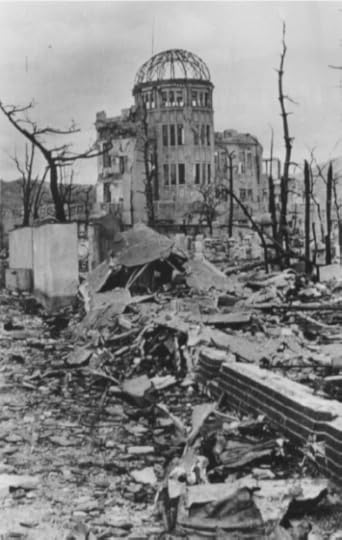
Photo of what became later Hiroshima Peace Memorial among the ruins of buildings in Hiroshima, in early October, 1945, photo by Shigeo Hayashi. (Source Wikimedia Commons)
In 1939, physicist Albert Einstein had written a letter to President Franklin D. Roosevelt that resulted in the creation of the Manhattan Project that developed the atomic bomb. In 1948, Einstein was quoted by an interviewer as saying:
If I had foreseen Hiroshima and Nagasaki, I would have torn up my formula in 1905.
-Quoted in Einstein and the Poet : In Search of the Cosmic Man (1983) by William Hermanns
August 5, 2020
Who Said It? (8/5/2020)
I deem this reply a full acceptance of the Potsdam Declaration which specifies the unconditional surrender of Japan. In the reply there is no qualification.
–President Harry S. Truman, August 14, 1945 (Source: Harry S. Truman Library and Museum)
After the official statement announcing the surrender of Japan, Truman added:
“This is the day when Fascist and police governments cease to exist in the world. This is the day for democracy.”
“Japan Surrenders Unconditionally, World At Peace”
Truman announces Japan’s surrender to reporters in Oval Office.
Credit: Rowe, Abbie
National Park Service
Harry S. Truman Library & Museum.
For more on these events, see the post: “The Month That Changed the World”
July 27, 2020
First Trade Review is a * Star from Kirkus
“A pitch-perfect balance of nuanced reflection and dire warning.” (Kirkus Reviews)
The first pre-publication review of Strongman: The Rise of Five Dictators and the Fall of Democracy is a Starred Review from Kirkus Reviews (August 15, 2020). Read the complete review here.
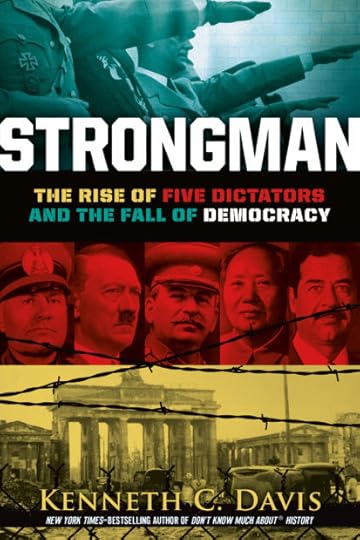
“History’s warnings reverberate in this gripping read about five dictatorial strongmen.”
—Kirkus Reviews
Scheduled for publication on October 6, 2020, Strongman is also a selection of the Junior Library Guild. Read more about the book here.

Strongman-First Review is a * Star from Kirkus
History’s warnings reverberate in this gripping read about five dictatorial strongmen.
This complex yet accessible title examines the lives and deeds of Benito Mussolini, Adolf Hitler, Joseph Stalin, Mao Zedong, and Saddam Hussein. This is no dry textbook; rather, the author presents deep personal and historical context with an eye toward explaining depravity. By reading these accounts, readers come to better understand how such rulers rise to power—and how we might act to avoid future evils. This book does not minimize atrocities or humanize tyrants, nor does it shy away from uncomfortable questions about ordinary citizens’ complicity. Instead readers are asked to ponder how contemporary democracies actually create the conditions for such individuals to come to power. The chilling final chapter asks, “Never Again?” as Davis emphasizes the need for vigilance as the democratic protections many contemporary citizens of democratic nations embrace are not inviolable. Timeline graphics put the individual cases into larger historical context, and key terms are explained in sophisticated depth. The author draws from an extensive lineup of thinkers and writers, from Primo Levi, Thucydides, Madeleine Albright, and Lord Acton to George Orwell and more. The book concludes with an impressive bibliography and endnotes. This powerful overview, enhanced with photographs, hinges on the idea that autocratic power is only possible with the complicity of ordinary others and that those who resist are the rare heroes of a terrifyingly timely story.
A pitch-perfect balance of nuanced reflection and dire warning. (Nonfiction. 12-18)
Strongman is also a selection of the Junior Library Guild. Read more about the book here.
The Month That Changed The World: 1945, 75 Years Ago
[Revised and updated repost of 2016 essay]
From “Trinity” to V-J Day
The Month That Changed the World
The Atomic Bomb Dome-Hiroshima (Photo Courtesy of Hiroshima and Nagasaki Remembered)
On August 6, 1945, the New York Times asked:
“What is this terrible new weapon?”
(New York Times, August 6, 1945: “First Atomic Bomb Dropped on Japan”)
The story followed the announcement made by President Harry S. Truman:
“SIXTEEN HOURS AGO an American airplane dropped one bomb on Hiroshima, an important Japanese Army base. That bomb had more power than 20,000 tons of T.N.T. It had more than two thousand times the blast power of the British ‘Grand Slam’ which is the largest bomb ever yet used in the history of warfare.”
August 6, 1945
President Harry S. Truman
(Photo: Truman Library)
(“Statement by the President Announcing the Use of the A-Bomb at Hiroshima”: Truman Library and Museum)
ON July 16, 1945, the first atomic device, nicknamed “the Gadget,” was detonated in the “Trinity” test at Alamogordo, New Mexico. Read this excellent account of the test in National Geographic.
In the course of the next weeks, the world would be transformed, with the arrival of the Atomic Age, Japan’s surrender, the end of World War II, the charter of the United Nations, and the beginning of the Cold War.
July 17: In Potsdam, near Berlin in defeated Germany, Harry S. Truman came face to face with the Soviet dictator Joseph Stalin. Truman had taken office upon the death of President Roosevelt on April 12 without knowledge of the Manhattan Project or the atomic bomb’s existence. After he was told about the potential weapon, he was informed of the successful “Trinity” test while meeting with Churchill and Soviet Union leader Joseph Stalin at the postwar conference in Potsdam.
“I told Stalin that I am no diplomat but usually said yes or no to questions after hearing all the argument.”
Following the successful detonation in New Mexico, the components of the atomic bomb were loaded on the USS Indianapolis and transported to an airbase on Tinian Island in the Pacific. Many of the crew of nearly 1,200 men had no idea what the ship was carrying.
Jul7 24: Truman informed Stalin of a “new weapon of unusual destructive force.” But Stalin already know about the atomic bomb because of a network of spies inside the Manhattan Project.
July 26: Prime Minister Winston Churchill was defeated in the general election and replaced by Clement Attlee as Prime Minister.
“The landslide victory comes as a major shock to the Conservatives following Mr Churchill’s hugely successful term as Britain’s war-time coalition leader, during which he mobilised and inspired courage in an entire nation.”
U.S. Propaganda poster (Source National Archives https://catalog.archives.gov/id/513563)
–BBC
At the Potsdam Conference, the Potsdam Declaration demanded “Unconditional surrender” by Japan. It threatened:
“The alternative for Japan is prompt and utter destruction.”
The Indianapolis reached Tinian that day.
USS Indianapolis 10 July 1945, after final overhaul and repair of combat damage. Photograph from the Bureau of Ships Collection in the U.S. National Archives (Naval History and Heritage Command https://usnhistory.navylive.dodlive.m...)
“Indianapolis departed San Francisco on 16 July 1945, foregoing her post-repair shakedown period. Touching at Pearl Harbor on 19 July, she raced on unescorted and reached Tinian on 26 July, covering some 5,000 miles from San Francisco in only ten days.”
After the delivery of the atomic bomb components, the ship sailed for Guam and the Philippines. On July 30, the ship was torpedoed by a Japanese submarine and sank in twelve minutes.
“What followed was an ordeal of hell on earth for those who survived the sinking. For a whole host of reasons, many related to the secrecy of her atom bomb mission, the rest of the Navy did not know that Indianapolis was missing.”
— Sam Cox (Rear Adm., USN, Ret.), “Lest We Forget: USS Indianapolis and her sailors”
July 29: The Japanese government rejected the surrender demand.
July 31: The assembly of the atomic bomb, code named “Little Boy,” was completed. The final arming of the bomb would be done in-flight.
In Potsdam, President Truman was notified of the bomb being ready. He wrote a message that concluded:
“Release when ready, but not sooner than August 2. HST”
According to the Truman Library:
The actual reply that President Truman wrote on July 31, 1945 (Photo taken by Dawn Wilson at the Harry S. Truman Presidential Library)
“No known written record exists in which Harry Truman explicitly ordered the use of atomic weapons against Japan. The closest thing to such a document is this handwritten order, addressed to Secretary of War Henry Stimson, in which Truman authorized the release of a public statement about the use of the bomb. It was written on July 31, 1945 while Truman was attending the Potsdam Conference in Germany. In effect, this served as final authorization for the employment of the atomic bomb, though the expression ‘release when ready’ refers to the public statement.”
August 1: the atomic bomb was ready and flight orders were prepared. But weather delayed the mission. Of four potential target cities, Hiroshima was chosen as the primary target.
In Potsdam that day, the Big Three were wrapping up their meetings and discussed plans for the trials of war criminals that later become known as the Nuremberg Trials.
In the Pacific, hundreds of survivors from the Indianapolis were desperately trying to stay afloat in the shark-infested waters.
“In that clear water you could see the sharks circling. Then every now and then, like lightning, one would come straight up and take a sailor and take him straight down.” – Survivor of the Indianapolis sinking to the BBC.
August 2: The U.S. Navy was still unaware that the Indianapolis had gone down. About 800 men had gone into the water and the survivors were spotted by a reconnaissance plane four days after the sinking; 317 survivors were rescued.
The Big Three at the end of the Potsdam Conference: Front row (Left to Right) Prime Minister Attlee, President Truman, Generalissimo Stalin. Source: Army Signal Corps Collection in the U.S. National Archives.
Shortly after midnight on August 2, the Potsdam Conference concluded with a joint communique. It included reference to the United Nations, whose organization and charter had been completed on June 26 at a conference in San Francisco.
Truman spoke of a future Washington meeting, but he and Stalin never met again.
What was clear was that the Conference had solidified the Soviet Union’s domination over much of Eastern Europe, including the eastern half of a divided Germany. Admiral William D. Leahy, Truman’s Chief of Staff, later wrote:
“The Soviet Union emerged at this time as the unquestioned all-powerful influence in Europe….”
August 4: Colonel Paul Tibbets briefed the men of the 509th Composite Group -the weapon delivery arm of the Manhattan Project. Tibbets was the commander of the unit. His men do not know the nature of the bomb they will carry.
August 5: The bombing mission was confirmed and Colonel Paul Tibbets announced he would pilot the plane which he named “Enola Gay,” after his mother. “Little Boy” was loaded on the plane.
Colonel Paul W. Tibbets, Jr., Pilot of the Enola Gay, the Plane that Dropped the Atomic Bomb August 6, 1945 (National Archives https://catalog.archives.gov/id/535737)
August 6 8:15 AM local time: The first atomic bomb was detonated over Hiroshima.
“In less than one second, the fireball had expanded to 900 feet. The blast wave shattered windows for a distance of ten miles and was felt as far away as 37 miles. Over two-thirds of Hiroshima’s buildings were demolished. The hundreds of fires, ignited by the thermal pulse, combined to produce a firestorm that had incinerated everything within about 4.4 miles of ground zero.”
Source: Hiroshima and Nagasaki Remembered.
“In the street, the first thing he saw was a squad of soldiers who had been burrowing into the hillside opposite, making one of the thousands of dugouts in which the Japanese apparently intended to resist invasion, hill by hill, life for life; the soldiers were coming out of the hole, where they should have been safe, and blood was running from their heads, chests, and backs. They were silent and dazed.
Under what seemed to be a local dust cloud, the day grew darker and darker.”
–John Hersey, “Hiroshima,” New Yorker (August 24, 1946)
In Hiroshima, the estimated death toll was eighty thousand people killed instantly; as many as 90 percent of the city’s nurses and doctors also died instantly. By 1950, as many as 200,000 had died as a result of long-term effects of radiation.
In his official announcement, President Truman said,
It was to spare the Japanese people from utter destruction that the ultimatum of July 26 was issued at Potsdam. Their leaders promptly rejected that ultimatum. If they do not now accept our terms they may expect a rain of ruin from the air, the like of which has never been seen on this earth. Behind this air attack will follow sea and land forces in such numbers and power as they have not yet seen and with the fighting skill of which they are already well aware.
August 8: The Soviet Union declared war on Japan and invaded Manchuria the next day, sending more than one million troops into the Japanese-held territory.
August 9: A second device, a plutonium bomb code named “Fat Man,” was used against the city of Nagasaki.
Fat Man being lowered and checked on transport dolly for airfield trip Image Source: Heritage Foundation https://www.atomicheritage.org/histor...
The death toll in Nagasaki also reached 80,000 by the end of 1945.
August 14 (August 15 in Japan): Japan announced its surrender. At a White House conference, according to United Press International, Truman said:
“This is the day when Fascist and police governments cease to exist in the world. This is the day for democracy.”
-Source: “Japan Surrenders Unconditionally, World At Peace” UPI archives
Truman announces Japan’s surrender to reporters in Oval Office.
Credit: Rowe, Abbie National Park Service Harry S. Truman Library & Museum.
Across America and England, jubilant crowds filled the streets once more for an unofficial V-J (Victory over Japan) Day, as they had on VE Day, May 8,1945, after Germany’s surrender ended the war in Europe.
V-J Day Times Square August 14, 1945 Library of Congress Prints and Photographs Division. New York World-Telegram and the Sun Newspaper Photograph Collection. http://hdl.loc.gov/loc.pnp/cph.3c19650
September 2, 1945: A formal surrender ceremony was performed in Tokyo Bay and that date is also referred to as V-J Day.
Almost since the day the first atomic bomb was dropped on Hiroshima, critics have second-guessed Truman’s decision and motives. A generation of historians and commentators have defended or repudiated the need for unleashing the atomic weapon. Admiral William D. Leahy, who was with Truman at Potsdam, later wrote in a memoir:
Once it had been tested, President Truman faced the decision as to whether to use it. He did not like the idea, but he was persuaded that it would shorten the war against Japan and save American lives. It is my opinion that the use of this barbarous weapon at Hiroshima and Nagasaki was of no material assistance in our war against Japan.
–William D. Leahy, I Was There (1950)
You can read more about Hiroshima and the dropping of the atomic bombs in Don’t Know Much About Historyand more about President Truman in Don’t Know Much About the American Presidents and in The Hidden History of America At War.
Read more about Mussolini, Hitler, and Stalin in STRONGMAN which will be published on October 6, 2020.
“Two Societies, One Black, One White”
(Revised post 7/27/2020; originally published on February 29, 2016)
–What happened?
–Why did it happen?
–What can be done to prevent it from happening again and again?
-President Lyndon B. Johnson in announcing the formation of a commission to investigate urban violence in 1967.
As a series of “strident new protests over police misconduct rattled cities across the country over the weekend,” (New York Times, July 27, 2020), once again, it is necessary to revisit the Kerner Commission, formed fifty-three years ago to address violence in American cities.
On July 27, 1967, President Lyndon B. Johnson established an 11-member National Advisory Commission on Civil Disorders. He was responding to a series of violent outbursts in predominantly Black urban neighborhoods in such cities as Detroit and Newark.
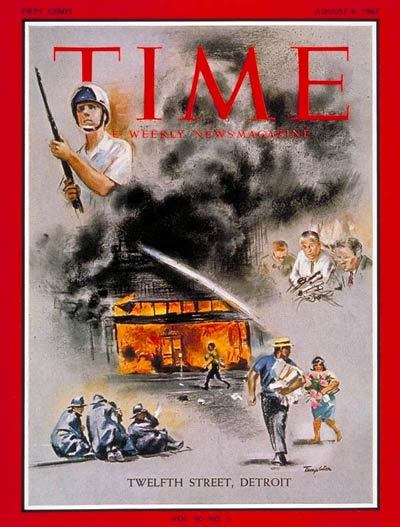
Time Magazine cover August 4, 1967
On July 29, 1967, President Johnson made remarks about the reasons for the commission:
The civil peace has been shattered in a number of cities. The American people are deeply disturbed. They are baffled and dismayed by the wholesale looting and violence that has occurred both in small towns and in great metropolitan centers.
No society can tolerate massive violence, any more than a body can tolerate massive disease. And we in America shall not tolerate it.
But just saying that does not solve the problem. We need to know the answers, I think, to three basic questions about these riots:
–What happened?
–Why did it happen?
–What can be done to prevent it from happening again and again?
Source:Lyndon B. Johnson: “Remarks Upon Signing Order Establishing the National Advisory Commission on Civil Disorders.,” July 29, 1967. Online by Gerhard Peters and John T. Woolley, The American Presidency Project.
On Feb. 29, 1968, President Johnson’s National Advisory Commission on Civil Disorders, later known as the Kerner Commission after its chairman, Governor Otto Kerner, Jr. of Illinois, issued a stark warning:
“Our Nation Is Moving Toward Two Societies, One Black, One White—Separate and Unequal”

Governor of Illinois Otto Kerner, Jr., meeting with Roy Wilkins (left) and President Lyndon Johnson (right) in the White House. 29 July 1967 Source LBJ Presidential Library
The Committee Report went on to identify a set of “deeply held grievances” that it believed had led to the violence.
Although almost all cities had some sort of formal grievance mechanism for handling citizen complaints, this typically was regarded by Negroes as ineffective and was generally ignored.
Although specific grievances varied from city to city, at least 12 deeply held grievances can be identified and ranked into three levels of relative intensity:
First Level of Intensity
1. Police practices
2. Unemployment and underemployment
3. Inadequate housing
Second Level of Intensity
4. Inadequate education
5. Poor recreation facilities and programs
6. Ineffectiveness of the political structure and grievance mechanisms.
Third Level of Intensity
7. Disrespectful white attitudes
8. Discriminatory administration of justice
9. Inadequacy of federal programs
10. Inadequacy of municipal services
11. Discriminatory consumer and credit practices
12. Inadequate welfare programs
Source: “Our Nation is Moving Toward Two Societies, One Black, One White—Separate and Unequal”: Excerpts from the Kerner Report; American Social History Project / Center for Media and Learning (Graduate Center, CUNY)
and the Roy Rosenzweig Center for History and New Media (George Mason University).
Issued half a century ago, the list of grievances reads as if it could have been written today.
July 24, 2020
Don’t Know Much About Executive Order 9981
[Repost; originally posted 7/26/2013]
This is how a president, who actually served in the military (World War I) dealt with discrimination.
On July 26, 1948, President Harry S. Truman issued an Executive Order that ended official discrimination in the United States military.
[image error]
After Truman’s order. the U.S. military was desegregated and integrated units fought in Korea. (Photo: U.S. Army-November 1950)
It is hereby declared to be the policy of the President that there shall be equality of treatment and opportunity for all persons in the armed services without regard to race, color, religion or national origin. This policy shall be put into effect as rapidly as possible, having due regard to the time required to effectuate any necessary changes without impairing efficiency or morale.
Coming in an election year, it was a daring move by Truman, who still needed the support of southern segregationists. It was also a controversial decision that led to the forced retirement of the Secretary of the Army when he refused to desegregate the Army.
As historical documents go, “Executive Order 9981” doesn’t have quite the same ring as “Emancipation Proclamation” or “New Deal.” But when President Harry S. Truman issued this Executive Order, he helped transform the country. This order began the gradual official process of desegregating America’s armed forces, which was a groundbreaking step for the American civil rights movement.
It is worth noting that many of the arguments made at the time against integration of the armed services — unit cohesion, morale of the troops, discipline in the ranks– were also made about the question of homosexuals serving in the military, a policy effectively ended when “Don’t Ask, Don’t Tell” was overturned in 2011.
In a Defense Department history of the integration of the Armed Forces, Brigadier General James Collins Jr. wrote in 1980:
The integration of the armed forces was a momentous event in our military and national history…. The experiences in World War II and the postwar pressures generated by the civil rights movement compelled all the services –Army, Navy, Air Force, and Marine Corps — to reexamine their traditional practices of segregation. While there were differences in the ways that the services moved toward integration, all were subject to the same demands, fears, and prejudices and had the same need to use their resources in a more rational and economical way. All of them reached the same conclusion: traditional attitudes toward minorities must give way to democratic concepts of civil rights.
Integration of the Armed Forces: 1940-1965 (U.S. Army Center of Military History)
Here is the text of the Executive Order 9981 (Source: Harry S. Truman Library and Museum; dated July 26, 1948)
July 23, 2020
Who is “An Enemy of the People?”
Originally posted May 12, 2020. Today, July 24, 2020, “The government reported on Thursday that more 1.4 million workers filed new claims for state unemployment benefits last week, the first time that the weekly tally has risen in more than three months.” New York Times.
We have reached our Dr. Stockman moment.
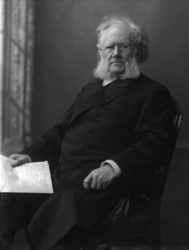
Henrik Ibsen by Gustava Borgen (public Domain via Wikimedia)
In Ibsen’s classic drama, An Enemy of the People, Dr. Thomas Stockman has discovered that the waters in his town’s famed spa are poisoning the guests. He pleads with his brother, the Mayor, to close the lucrative attraction. But Mayor Peter Stockman refuses to shut down and repair the toxic baths.
“Have you taken the trouble to consider what your proposed alterations would cost?” the Mayor asks his brother. “And do you suppose anyone would come near the place after it had got about that the water was dangerous?”[1]
And there it is. Ibsen brings us to that place where economic health trumps public health.
Sound familiar? It should. Because we face a similar conflict today. A president and his administration are pushing to “reopen” the economy despite express warnings from medical experts about the perils of premature action.[2]
We have been down this road before. This is not the first time that the common good and the bottom line have faced off. In the midst of one pandemic, we need only look to the history of the 1918 pandemic, a story told in my book More Deadly Than War.
What was later called the Spanish flu emerged in March 1918, blossoming into an epidemic on army bases where young Americans were training for Europe’s trenches. After slacking in summertime, the outbreak returned in a second wave, even more swift and lethal, hitting American ports like Boston in September 1918. Striking down soldiers and sailors by the thousands, it jumped from the military to the civilian population. Seeing “bodies stacked like cordwood,” army doctors wondered if they were witnessing a new plague. The Spanish flu was carried to other ports and military bases, including those near Philadelphia.
But to Philadelphia’s civil authorities, it was “just the flu.” And Philadelphia was planning a parade – a grandiose show of patriotism and pride to promote the sale of Liberty Loans. These war bonds were marketed through an intense nationwide propaganda campaign that made buying these bonds an act of allegiance. Woe to those “slackers” who didn’t “do their part.”
Read Philadelphia Threw a WWI Parade That Gave Thousands of Onlookers the Flu
As Philadelphia planned its spectacle, the city’s director of public health knew better. A gynecologist, and an appointee loyal to Philadelphia’s notoriously corrupt political machine, Dr. Wilmer Krusen was warned to cancel the parade. But Dr. Krusen allowed the show to go on. He assured the public that recent military deaths were from “old-fashioned influenza or grip.”[3] His words were a harbinger of the president’s in January. “It’s one person coming in from China, and we have it under control. It’s going to be just fine.”[4]
It wasn’t. As the parade got underway on September 28, 1918, some 200,000 people jammed Philadelphia’s main street, packed eight deep on the sidewalks. Within seventy-two hours of that parade, every bed in Philadelphia’s hospitals was filled.[5]
On October 3, most public spaces –schools, churches, theaters, and pool halls –were officially closed.[6] The delayed lockdown to “flatten the curve” was too little, too late for many in the City of Brotherly Love. Within weeks, more than 12,000 people died in Philadelphia before the epidemic crested there.
Dr. Krusen was aware of the risks posed when he allowed the parade to step off. But he was answering to political and economic concerns, much like the Mayor in Ibsen’s play, and so many economists and administration officials echoing the president’s call to reopen the economy.
History is replete with Dr. Krusen’s counterparts—those scientists and other people who dared challenge authority. Take Giordano Bruno for example. Born in 1548, Bruno became a priest and a learned mathematician. But he was also a free thinker and, in 1584, published his concept that the sun, not the earth, was at the center of Creation.
Bruno was arrested and tried for this and other heresies during the Inquisition. Refusing to recant, the rebellious priest was sentenced as an impenitent heretic on papal orders. In February 1600, he was taken to the Campo de’ Fiori, an open market in Rome, his tongue in a gag, and burned alive.
Today, there is a statue honoring Giordano Bruno in the Campo de’ Fiori. There are no statues of Dr. Krusen. In modern parlance, Bruno was an “Upstander,” Dr. Krusen a “Collaborator.”
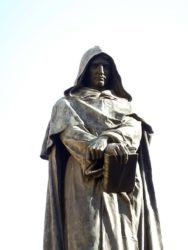
Close up of the statue of Giordano Bruno in the Camp de Fiori, Rome (Public Domain Wikipedia Commons)
Giordano Bruno would not serve a master who demanded that he deny the science that contradicted faith. He served the truth. Dr. Stockman refused to serve a master who placed profits over life and was ultimately branded “an enemy of the people.” Dr. Krusen chose instead to answer to his political masters.
This is the essential question now facing both American leadership and every individual. If we are to survive the current coronavirus, we need to carefully choose and serve a worthy master.
UPDATE: It is increasingly and painfully clear that the failure of the Trump administration to deal competently with the coronavirus pandemic is costing both lives and the nation’s economic health. The approach of many European Union nations to deal more aggressively with the pandemic with widespread shutdowns, wide testing, isolation, and other techniques was far more successful in allowing a reopening of their economies.
TEACHERS: If you would like a virtual visit to discuss this topic or any of my work, please get in touch with me. Here’s the link: Contact page.
[1] Henrik Ibsen, An Enemy of the People, Act II.
[2] https://www.washingtonpost.com/nation...
[3] John M. Barry, The Great Influenza, p. 204
[4] https://www.nytimes.com/2020/03/15/op...
[5] Gina Kolata, Flu, p. 20.
[6] Barry, p. 220.
July 20, 2020
STRONGMAN: The Rise of Five Dictators and the Fall of Democracy
First pre-publication review is in. A “starred” review from Kirkus Reviews
“A pitch-perfect balance of nuanced reflection and dire warning. . . .
History’s warnings reverberate in this gripping read about five dictatorial strongmen.
This complex yet accessible title examines the lives and deeds of Benito Mussolini, Adolf Hitler, Joseph Stalin, Mao Zedong, and Saddam Hussein.”
On October 6, 2020, my new book, STRONGMAN: The Rise of Five Dictators and the Fall of Democracy, will be published (Preorder from Holt Books) (An audiobook edition will be released by Penguin Random House)
In it, I recount the story of the rise to power of five of the most deadly dictators of the 20th century — Mussolini, Hitler, Stalin, Mao Zedong, and Saddam Hussein.
In addition to telling how these men took unlimited power, brought one-party rule to their nations, and were responsible for the deaths of millions of people, the book offers a brief history of Democracy and discusses the present threat to democratic institutions around the world. In a time when Democracy is under assault across the globe, it is more important than ever to understand how a Strongman takes power and how quickly democracy can vanish –even as millions cheer its death.
ADVANCE PRAISE FOR STRONGMAN
“I found myself engrossed in it from beginning to end. I could not help admiring Davis’s ability to explain complex ideas in readable prose that never once discounted the intelligence of young readers. It is very much a book for our time.”
—Sam Wineburg, Margaret Jacks Professor of Education & History, Stanford University, author of Why Learn History (When It’s Already on Your Phone).
“Strongman is a book that is both deeply researched and deeply felt, both an alarming warning and a galvanizing call to action, both daunting and necessary to read and discuss.”
—Cynthia Levinson, author of Fault Lines in the Constitution: The Framers, Their Fights, and the Flaws That Affect Us Today
“A wake-up call to democracies like ours: we are not immune to despots . . . Strongman demonstrates that democracy is not permanent, unless it is collectively upheld. This book shakes that immortality narrative.”
—Jessica Ellison, President of the Minnesota Council for the Social Studies; Teacher Education Specialist, Minnesota Historical Society
Rarely does a history book take such an unflinching look at our common future, where the very presence of democracy is less than certain; even rarer is a history book in which the author’s moral convictions incite young readers to civic engagement; rarest of all, a history book as urgent, as impassioned, and as timely as Kenneth C. Davis’ Strongman.
—Eugene Yelchin, author of the Newbery Honor book Breaking Stalin’s Nose.
NEWS of STRONGMAN – This book has been made a selection of the Junior Library Guild.
Watch for more news about STRONGMAN here in the coming months.


