Jamie Parsley's Blog, page 47
March 25, 2018
Palm Sunday
 Photo of a palm I took in Miami Beach, FL, February 2017 March 25, 2018
Mark 15.1-39
+ I have to admit—and I don’t like admitting this:This coming Holy Week is going to be a hard one for me. And I’m not talking about the work that’s involved in this week. I don’t dread that at all. I’m a church nerd, after all. I like doing church services and visitations and all the things involved with Holy Week.
I dread this coming week for one big reason: This coming week is going to be hard for me because of the emotional toll it will take.
As most of you know, I’ve been through a difficult Lent, to say the least, with my mother’s death in January. And now to have to emotionally face all that Holy Week commemorates is not something I can say I am looking forward to.
I think it is emotionally difficult for all of us who call ourselves followers of Jesus. How can it not, after all? We, as followers of Jesus, as people who balance our lives on his life and teachings and guidance, are emotionally tied to this man. This Jesus is not just mythical character to us. He is a friend, a mentor, a very vital and essential part of our lives as Christians. He is truly “the Messiah, the son of the Blessed One,” that we heard in our Gospel reading for today.
So, to have to go through the emotional rollercoaster of this coming week in which he goes through his own death throes is hard on us, especially those of us walking through our own grief. And today, we get the whole rollercoaster in our liturgy and in our two Gospel readings.
Here we find a microcosm of the roller coaster ride of what is to come this week. What begins this morning as joyful ends with jeers. This day begins with us, his followers, singing our praises to Jesus, waving palm branches in victory. He is, at the beginning of this week, popular and accepted. For this moment, everyone seems to love him.
But then…within moments, a darkness falls. Something terrible and horrible goes wrong. What begin with rays of sunshine, ends in gathering dark storm clouds.
Those joyful, exuberant shouts turn into cries of anger and accusation. Those who welcomed Jesus into Jerusalem have fled. They have simply disappeared from sight. And in their place an angry crowd shouts and demands the death of Jesus.
Even his followers, those who almost arrogantly proclaimed themselves followers of Jesus, have disappeared. Their arrogance has turned to embarrassment and shame.
Jesus, whom we encounter at the beginning of this liturgy this morning surrounded by crowds of cheering, joyful people, is by the end of it, alone, abandoned, deserted—shunned. Everyone he considered a friend—everyone he would have trusted—has left him. And in his aloneness, he knows how they feel about him. He knows that he is an embarrassment to them. He knows that, in their eyes, he is a failure. See, now, why I am not looking forward to this week?
But, we have to remind ourselves that what we encounter in the life of Jesus is not just about Jesus. It is about us too. We, in our own lives, have been to these dark places—these places wherein we have felt betrayed and abandoned and deserted, where we too have reached out and touched the feather-tip of the angel of death, so to speak.
It is a hard place to be. And it is one that, if we had a choice, we would not willingly journey toward.
But this week is more than dealing with darkness and despair. It is a clear reminder to us that, yes, we like Jesus must journey roads we might not want to journey, but the darkness, the despair, death itself is not the end of the story.
Palm Sunday is not the end of the story.
Maundy Thursday and Good Friday are not the end of the story.
What this week shows us is that God prevails over all the dark and terrible things of this life. And that God turns those things around again and again. That is what we see in Jesus’ betrayal and death. What seems like failure, is the actually victory.
What seems like loss, is actually gain.
What seems like death, is actually life unending.
Now, in this moment, we might be downcast. Now, in this moment, we might be mourning and sad.
But, next Sunday at this time, we will be rejoicing. Next Sunday, we will be rejoicing with all the choirs of angels and archangels who sing their unending hymns of praise to him. We will be rejoicing in the fact that all the humiliation experienced this week has turned to joy, all desertion has turned to rewarding and wonderful friendship, all sadness to gladness, and death—horrible, ugly death—will be turned to full, complete and unending joy and life. That is how God works. And that is what we will be rejoicing in next week.
So, as we journey through the dark half of our liturgy today, as we trek alongside Jesus during this Holy Week of betrayal, torture and death, let us keep our eyes focused on the Light that is about to dawn in the darkness of our lives. Let us move forward toward that Light. Even though there might be sadness on our faces now, let the joy in our hearts prompt us forward along the path we dread to take. And, next week at this time, we will be basking in that incredible Easter Light—a Light that triumphs over the darkness of not only Jesus’ death, but ours as well.


March 18, 2018
5 Lent
 March 18, 2018
Jeremiah 31.31-34; John 12.20-33
+ For any of you who became a member of St. Stephen’s during my time here, you probably took my “Episcopal 101” class. I love teaching that class. And, I think, it’s been a fun class.
One of the aspects of that class that people always love—and this is something I used to do when I taught at the University of Mary—was offer a “Stump Fr. Jamie” time. To “Stump Fr. Jamie” the students can ask any question they would like regarding theology or spirituality or the Church.
Let me tell you, occasionally I had people who did a very good job of trying to actually stump me. And once or twice, maybe—just maybe—they came close to actually stumping me.
Now, that’s not really fair. Because any time I might not be able to answer their questions, I just concede to that wonderful thing in the church we have called “mystery.” Some things are just mysteries and we should accept the mysteries of our faith.
I know. I know. What a rotten thing for a priest to say. What a cop-out, right? But what I have discovered every time a student asks questions is that, in actuality, they really are seeking. And they are sometimes surprised to find their priest himself is a seeker as well.
The fact is, I have never made a secret of the fact that I am also a seeker, just like all of us this morning. We’re all seekers. We’re here this morning seeking something. People who aren’t seekers don’t need to come to church.
They don’t need to listen and ponder the Word. They don’t need to feed on and ponder the mysteries of the Eucharist that we celebrate at this altar. People who don’t seek, don’t come following the mysteries of their faith.
I have discovered in my own life as a seeker, that my seeking, my asking questions and my pondering of the mysteries of this life and my relationship to God, are what make my faith what it is. It makes it…faith. My seeking allows me to step into the unknown and be sometimes amazed or surprised or disappointed by what I may—or may not—find there.
In our Gospel reading for today, we also find seekers. In our story, we find these Greeks seeking for Jesus.
“Sir, we wish to see Jesus,” they say.
This one line—
“we wish to see Jesus”
—is so beautifully simple. There’s so much meaning and potential and…yes, mystery, to it that I don’t think we fully realize what it’s conveying. And what I doubly love about it is that as beautiful and as simple as the petition is—
“we wish to see Jesus”
—we never, if you notice, find out if they actually get to see him. The author doesn’t tell us. We find no resolve to this story of the Greeks seeking Jesus.
However, despite it being a loose end of sorts, it does pack some real meaning. What’s great about scripture is that even a loose end can have purpose.
One interpretation of this story is that that the Greeks—as Gentiles—were not allowed to “see” Jesus until he was lifted up on the Cross. Only when he has been “lifted up from the earth,” as he tells us this morning will he “draw all people to [himself].”
Jesus’ message at the time of their approaching the apostles is still only to the Jews.
But when Jesus is lifted up on the Cross on Good Friday, at that moment, he is essentially revealed to all. At that moment, the veil is lifted. The old Law has in essence been fulfilled—the curtain in the Temple has been torn in half—and now Jesus is given for all. It’s certainly an interesting and provocative take on this story.
And it’s especially interesting for us, as well, who are seeking to “find Jesus” in our own lives. Like those Greeks, we are not always certain if we will find him—at least at this moment.
But, I am going to switch things up a bit (as I sometimes do). Yes, we might be seekers here this morning. But as Christians, our job is not only to be seekers. Our job, as followers of Jesus, as seekers after God, is to be on the receiving end of that petition of those Greeks. Our job, as Christians, is to hear that petition—“show us Jesus”—and to respond to it. This is what true evangelism is.
Some might say evangelism is telling others about Jesus. Possibly. But true evangelism is showing people Jesus. And, let’s face, that’s much harder than telling people about Jesus.
So, how do we show Jesus to those who seeking him? Or, maybe, even to those who might not be seeking Jesus?
We show people Jesus by doing what we do as followers of and seekers after Jesus. We show people Jesus by being Jesus to those around us. Now, that sounds impossible for most of us. The fact is, it isn’t.
This is exactly what Jesus wants us to be. Jesus wants us to be him in this world. We, after all, are the Body of Christ in this world. He wants to be our hands, helping others. He wants to speak through our voices in consoling others, in speaking out against the tyrants and despots and unfairness of this world. He wants to be our feet in walking after those who have been turned away and are isolating themselves.
When we seek to bring the Kingdom into our midst, we are being Jesus in this world. We might not always succeed in doing this. We might fail miserably in what we do. In fact, people might not find Jesus in us, at all. Sometimes, whether we intend it to or not, we in fact become the “Anti-Jesus” to others. But that’s just the way it is sometimes. In seeking Jesus and in responding to others who are also seeking him, we realize the control is not in our hands.
It doesn’t depend on any of us. Which, trust me, is comforting. I personally don’t want all that responsibility. Nor, I’m sure, do any of you. Who would?
In today’s Gospel, we find Jesus saying:
“Very truly I tell you, unless a grain of wheat falls on the earth and dies, it remains just a single grain; but if it dies, it bears much fruit.”
In those moments in which we seem to have failed to be Jesus to those around us, when those who come to us seeking Jesus find, rather, nothing, or, worse, the “Anti-Jesus,” we find that even then, fruit can still come forth.
God still works even through the negative things life throws at us. God still works event through our failures and our shortcomings. Jesus can still be found, even despite us. Jesus can still be found, even when we might not even be seeking him. Jesus can be found, oftentimes, when we are least expecting to find him.
Certainly, Jesus is here this morning in our midst. He is here in us. He is here when we do what he tells us to do in this world He is here when we open ourselves to God’s Spirit and allow that Spirit to speak to us in our hearing of the Word.
Jesus is here in the Bread and Wine of our Eucharist.
Jesus is here in us, gathered together in Name of Jesus.
And let me tell you, Jesus is definitely out there, beyond the walls of this church, waiting for us to embody him and bring him to them.
He is never far away.
So, let us, together, be Jesus to those who need Jesus, who are seeking Jesus. Let us show them Jesus. Let us together search for and find God, here, in the Word where we hear God speaking to us. Let us search for and find Jesus in this Holy Eucharist, in which we feed on his Body and Blood.
As we near the end of this Lenten season and head into Holy Week, let us to heart those words we heard God speaking to the prophet Jeremiah:
“I will forgive their iniquity and remember their sin no more.”
Let us, a people whose iniquity has been forgiven and whose sin is remembered no more, search for God. In going out from here, let us encounter those people who truly need God. And, in encountering them, let us also help those who are seeking.
“We wish to see Jesus,” the Greeks say to the disciples.
And people still are saying that to us as well.
“We wish to see Jesus.”
Let us—fellow seekers of Jesus—help them to find him in us.
March 11, 2018
4 Lent
 Lataere
March 11, 2018
Numbers 21.4-9; John 3.14-21
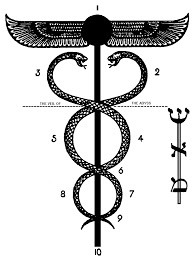
+ Today is Laetare Sunday, also known as “Rose Sunday.” Laetare, as I remind everyone every year on this Sunday, is Latin for “joyful” and it is called this because on this Sunday, the traditional introit (or the psalm that was said by the priest in the old days when he approached the altar in the old Latin Mass) was “Laetare Jerusalem”—“rejoice Jerusalem.” It’s also known by other names. “Mothering Sunday” or “Refreshment Sunday.” It is, of course, traditional on this Sunday to wear the rose or pink vestments. And to have simnel cake, which we will have at coffee hour, thanks to Sandy Holbrook.
It’s a special Sunday. It is sort of break in our Lenten purple, so to speak. We don’t normally do things during Lent like bless new stained glass windows. But we can on this Sunday. We can, because we are rejoicing a bit today. Notice how I said, rejoicing “a bit.” It’s a subdued rejoicing. We’re still in Lent after all. We might get a break from the Lenten purple. But we don’t get a break from Lent. After all, the purple returns tomorrow.
But this Rose Sunday is a reminder to us. We are now passing into the latter days of Lent. Palm Sunday and Holy Week are only two weeks away and Easter is three weeks away. And with Easter in sight, we can, on this Sunday, lift up a slightly subdued prayer of rejoicing.
No, we’re not saying the A-word yet. We’re not allowed to be quite thatjoyful today. But, we’re close. The Easter light is within in sight, though it’s still pretty far off.
Now, I know Lent can be a bummer for us. I know we don’t want to hear about things like sin. I don’t want to hear about sin. I don’t want to preach about sin. Most of us have had to sit through countless hours listening to preachers go on and on about sin in our lives. Many of us have had it driven into us and pounded into us and we just don’t want to hear it anymore. Yes, we know we’re sinners sometimes.
But the fact is, we can’t get through this season of Lent without at least acknowledging sin. Certainly, I as a priest, would be neglecting my duty if I didn’t at least mention it once during this season. As much as we try to avoid sin and speak around it or ignore it, for those of us who are Christians, we just can’t. We live in a world in which there is war and crime and recession and sexism and homophobia and horrible racism and blatant lying and morally bankrupt people and, in looking at all of those things, we must face the fact that sin—people falling short of their ideal—is all around us.
And during this season of Lent, we find ourselves facing sin all the time. It’s there in our scripture readings. It’s right here in our liturgy. It’s just…there. Everywhere.
I certainly have struggled with this issue in my life. As I said, I don’t like preaching about sin. I would rather not do it. I’d rather be preaching about peace and all that our new window represents. But…I have to. We all have to occasionally face the music, so to speak.
The fact is, people tend to define us by the sins we commit—they define us by illness—the spiritual leprosy within us—rather than by the people we really are underneath the sin. And that person we are underneath is truly a person created in the holy image of God.
Sin, if we look it as a kind of illness, like leprosy or any other kind of sickness, truly does do these things to us. It desensitizes us, it distorts us, it makes us less than who were are. It blots out the holy image of God in which we were created. And like a sickness, we need to understand the source of the illness to truly get to heart of the matter.
Alexander Schmemann, the great Eastern Orthodox theologian, (and I believe he’s echoing the Protestant theologian Karl Barth here) wrote,
“Essentially all sins come from two sources: flesh and pride.”
And if we are honest with ourselves, if we are blunt with ourselves, if we look hard at ourselves, we realize that, in those moments in which we have failed ourselves, when we have failed others, when we have failed God, the underlying issues can be found in either our pride or in our flesh.
This season of Lent is a time when we take into account where we have failed in ourselves, in our relationship with God and in our relationship with each other.
But—and I stress this—Lent is never a time for us to despair. It is never a time to beat ourselves up over the sins we have committed. It is rather a time for us to buck up. It is a time in which we seek to improve ourselves. It is a time in which, acknowledging those negative aspects of ourselves, we strive to rise above our failings. It is a time for us to seek healing for the “leprosy” of our souls. The church is, after all, according to the early Christians, a Hospital. And, in seeking, we do find that healing.
In our reading from Numbers today, we find a strange story, that also is about healing. The Israelites are complaining about having the wander about in the desert. I guess sometimes it’s not a good thing to complain to God, especially when God, in reality, provided everything you need. So, according to the story, God sent poisonous serpents on the poor, ungrateful people. The people acknowledge their sin—the fact that they maybe shouldn’t complain when things weren’t really so bad. So, God tells Moses to “make” a snake, put it on a pole, and raise it up so all the Israelites can see it. And in in seeing it, they will live.
Now, in case you missed it, for us Christians, this pole is important. For us, this is a foreshadow of the cross. If you don’t believe me, then you weren’t playing attention when I read our Gospel reading for today, which directly references our reading from Numbers. Jesus then, in that way, turns it all around and makes something very meaningful to his followers—and to us—from this “raising up.” Just as the poisonous snake was raised up on a pole, and the people were healed, so must Jesus be raised up on the cross, and the people also would be healed.
As you have heard me preach many times, the Cross is essential to us. And not just as some quaint symbol of our faith. Not as some gold-covered, sweet little thing we wear around our necks.
The Cross is a very potent symbol for us in our healing. Gazing upon the cross, as those Israelites gazed upon the bronze serpent that Moses held up to them, we find ourselves healed. And as we are healed, as we find our sins dissolved by the God Christ knew as he hung the cross, we come to an amazing realization.
We realize that we are not our sins. And our sins are not us. Our sins are no more us, than our illnesses are. Our sins are no more us than our depressions are us, or our disappointments in life are us.
For those of us who have had serious illnesses—and as many of you know, I had cancer once—when we are living with our illness, we can easily start believing that our sickness and our very selves are one and the same. But that is not, in reality, the case.
In this season of Lent, it is important for us to ponder the sickness of our sins, to examine what we have done and what we have failed to do and to consider how we can prevent it from happening again. But, like our illnesses, once we have been healed, once our sins have been forgiven and they no longer have a hold over us, we do realize that, as scarred as we have been, as deeply destroyed as we thought we were by what we have done and not done, we have found that, in our renewal, we have been restored.
In the shadow of the cross, we are able to see ourselves as people freed and liberated. We are able to rejoice in the fact that we are not our failures. We are not what we have failed to do. But in the shadow of the cross we see that we are loved and we are healed and we are cherished by our loving God. And once we recognize that, then we too can turn our selves toward each other, glowing with that image of God imprinted upon us, and we too can love and heal and cherish.
See, sin does not have to make us despair. When we despair over sin, sin wins out. Rather, we can work on ourselves, we can improve ourselves, we can rise above our failings and we can then reflect God to others and even to ourselves.
So, on this Laetare Sunday—this Sunday in which we rejoice that we are now within the sight of that glorious Easter light—let us gaze at the cross, held up to us as a sign of our healing God. And there, in the shadow of that Cross, let us be truly healed. And, in doing so, let us reflect that healing to others so they too can be healed.
See, it is truly a time for us to rejoice.
March 10, 2018
The 40th Day
Today is the 40th day since my mother died. In the Eastern Orthodox Church, the 40th day is the official end of the mourning period, referencing the Ascension occurring 40 days after Easter. For the 40 days following death, it is believed the person has not officially left this world completely, and may still visit their homes, their graves and their loved ones. After this day, the deceased has now officially moved on. Clothes can be given away to the poor and the house cleaned out.

The 40thDay
No more visitsto the urn,to the frozen grave, still undug,
to the closetwhere the clothes still hang,to the shoes and belt
still laid outfor the next daythat never came,
to the bed on which she laid downthat morning
and from whichshe never rose again.Now is the time
to rise up,to go onwarddeeper into
the mysterious colorthat deepens and shimmersand goes on and on.
It is time to shut the door, to turn out the light,to turn away
and move onfrom what was oncefamiliar
and is now awkwardand strange.It is time
to goand leave behindthe urn
the closetthe bedthe shoes and belt
the one whostands thereempty-handed
and bewildered and staringblankly
into the gathering duskand all it holds.
—Jamie Parsley

The 40thDay
No more visitsto the urn,to the frozen grave, still undug,
to the closetwhere the clothes still hang,to the shoes and belt
still laid outfor the next daythat never came,
to the bed on which she laid downthat morning
and from whichshe never rose again.Now is the time
to rise up,to go onwarddeeper into
the mysterious colorthat deepens and shimmersand goes on and on.
It is time to shut the door, to turn out the light,to turn away
and move onfrom what was oncefamiliar
and is now awkwardand strange.It is time
to goand leave behindthe urn
the closetthe bedthe shoes and belt
the one whostands thereempty-handed
and bewildered and staringblankly
into the gathering duskand all it holds.
—Jamie Parsley
March 8, 2018
A very nice write-up in today's Fargo Forum about tonight...
 A very nice write-up in today's Fargo Forum about tonight's reading. I'm especially happy my mother and St. Stephen's were mentioned.
March 6, 2018

March 5, 2018
It's great to see the publication reading of my new book ...
 It's great to see the publication reading of my new book in the latest issue of The High Plains Reader. And it's nice to to be known as one of the "best known regional poets."
March 4, 2018
3 Lent
 3 Lent
March 4, 2018
John 2.13-22
+ It took me five weeks, but I’ve been going through my mother’s things this last week. I finally worked up the courage to do so. It’s been slow going, though. But I need to do it.
One of the things I found in going through her things was something I was looking for the night she died. Before she was cremated the day after she died, I planned on making sure she was cremated with my maniturgium.
What is that, you’re probably asking? Well, it comes from the Latin words Manior hand and turgium, which means towel. So, it’s a hand towel. But in this case it’s more than that.
In the Roman Catholic and in the Anglo-Catholic tradition of Anglicanism, when a priest is ordained, their hands are anointed with chrism by the Bishop. Chrism is that special oil consecrated by a Bishop, smelling of nard.
As they are anointed, the Bishop prays this prayer:
Grant, O Lord, to consecrate and sanctify these hands by this unction, and by our blessing; that whatsoever they may bless may be blessed, and whatsoever they consecrate shall be consecrated and sanctified in the name of our Lord Jesus Christ. Amen.
The maniturgium is them wrapped around the chrism-covered hands to wipe them.
Well, my maniturgium is nothing fancy. It’s simply an old corporal—a white altar cloth—that was about to burned. And my hands actually weren’t anointed at my priestly ordination fourteen years ago. They were anointed a few years later.
The reason they weren’t anointed at the ordination is more complex than I want ot get in here. But a few years later, let’s just say, they were in fact anointed and the old corporal that was being discarded and burned was rescued to wrap my hands after the anointing.
Later, I presented this cloth to my mother, which is the tradition. That tradition
 states that the priest is to present the maniturgium to their mother. The maniturgium is then usually buried in the hands of the mother of a priest when she dies.
Why? You may ask. Well, the tradition states that when the mother of a priest comes before Jesus, he will as her, “I have given you life. What have you given me?”
And the mother is to reply, “I have given you my child as a priest” and then hands him the maniturgium.
At this, the story goes, Jesus grants her entrance into heaven. (Let’s not even begin to unpack some of the really bad theology behind all of that!)
But it’s a great story. And it is one my mother really loved! (I think she liked the guarantee to get into heaven)
Let me tell you: there was no one prouder to have a child for a priest than my mother. So, you can imagine why I was a bit upset not having that maniturgiumthere for her when she was cremated. I searched through her dresser and her closet looking for it. I then concluded that at some point, maybe she had just accidentally thrown it out. Which would have been fine. So, I shrugged it off and just let it go (though I do admit I really had hoped it would’ve been in her hands when she was cremated)
Well, on Friday night, I happened to open her cedar chest, and guess what? There it was, right on the top, neatly folded, still stained with chrism, still smelling of nard (and cedar). So, I will place it in her urn before I seal it and its buried.
I also have to believe that that poor corporal really did not want to get burned!
So, cleaning out the clutter is a good thing. A really good thing. Because in doing so, we might find important things. Because if I held off, I might not have found it until after we buried her ashes.
I think this story is good for us during Lent. Lent, as you have heard me say over and over again, is a time for us to sort of quiet ourselves of course. But it is also a time to get rid of whatever clutter we might have knocking around inside us or in our lives.
Clutter is that stuff in our lives—and “stuff” is the prefect word for it—that just piles up. If you’re anything like me, we sometimes start ignoring our clutter. We sort of do that too with our own spiritual clutter. We don’t give it a second thought, even when we’re tripping over it and stumbling on it.
In fact, often we don’t fully realize how much clutter we have until after we’ve disposed of it. When we see that clean, orderly room, we realize only then how clutter sort of made us lose our appreciation for the beauty of the room itself.
In Lent, what we dispose of is the clutter of our spiritual lives. And we all have spiritual clutter. We have those things that “get in the way.” We have our bad habits. We have those things that we do without even thinking we’re doing them. And oftentimes, they’re not good for us—or at least they don’t enhance our spiritual lives.
Often the clutter in our spiritual lives gets in the way of our prayer life, our spiritual discipline, our all-important relationship with God. The clutter in our spiritual life truly becomes something we find ourselves “tripping” over. The clutter in our spiritual life causes us to stumble occasionally. And when it does, we find our spiritual life less than what it should be. Sometimes it’s just “off.”
During Lent, it is an important time to take a look around us. It is important to actually see the spiritual clutter in our lives and to clear it away in whatever ways we can.
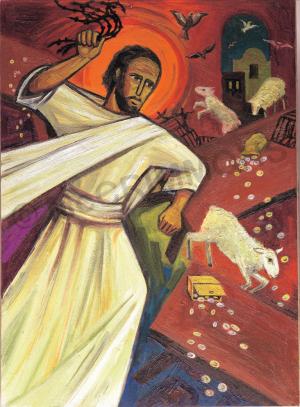
In our Gospel reading for today, we find Jesus going into the temple and clearing out the clutter there. He sweeps the Temple clean, because he knows that the clutter of the merchants who have settled there are not enhancing the beauty of the Temple.
“Stop making my Father’s house a marketplace!”
They are not helping people in their relationship with God. Rather, these merchants are there for no spiritual reasons at all, ultimately. They are there for their own gain and for nothing else.
In a sense, we need to, like Jesus, clean out the “merchants” in our lives as well. We need to have the Temple of our bodies cleaned occasionally. We need to sweep it clean and, in doing so, we will find our spirituality a little more finely tuned. We will find our prayer life a more fulfilling. We will find our time at Eucharist more meaningful. We will find our engaging of Scripture to be more edifying. We will find our service to others to be a bit more selfless and purposeful than it was before. We will see things with a clearer spiritual eye—which we need.
It is a matter of simplifying our spiritual lives. It is matter of recognizing that in our relationship with God and one another, we don’t need the clutter—we don’t need those things that get in the way.
We don’t need anything to complicate our spiritual lives. There are enough obstacles out there. There will always be enough “stuff” falling into our pathways, enough ”things” for us to stumble over. Without the clutter in our lives, it IS easier to keep our spiritual lives clean. Without the clutter in our life, we find things are just…simpler.
In our Gospel reading, we also find that the Temple Jesus is cleaning out and cleansing serves its purpose for now, but even it will be replaced with something more perfect and something, ultimately, more simple. In a sense, our own bodies become temples of this living God because of what Jesus did. Our bodies become the house of God, of Abba. Our bodies also become the dwelling places of that one, living God. We will become the Temples of the living God.
Which brings us back to Lent. In this season of Lent, we become mindful of this simple fact. Our bodies are the temples of that One, living God. God dwells within us much as God dwelt in the Temple. Because God dwells in us, we have this holiness inherent within us.
We are holy. Each of us. Because of this Presence within us, we find ourselves wanting to cleanse the temple. We find ourselves examining ourselves, looking closely at the things over which we trip and stumble. We find ourselves realizing that the clutter of our lives really does distract us from remembering that God dwells with us and within us. And when we realize that, we really do want to work on ourselves a bit.
We work at trying to simplify our lives—our actual, day-to-day lives, as well as our spiritual lives. We want to actually spend time in prayer, in allowing that living God to dwell fully within us and to enlighten us. We fast—emptying our bodies and purifying ourselves. We recognize the wrongs we have done to ourselves and to others. We realize that we have allowed this clutter to build up. We realize we have not loved God or our neighbors. Or even ourselves. Or we have loved ourselves too much, and not God and our neighbors enough.
Once we have eliminated the spiritual clutter of our lives, we do truly find our God dwelling with us. We find ourselves worshipping in that Body that cannot be cluttered. We find a certain simplicity and beauty in our lives that comes only through spiritual discipline.
So, as we continue our journey through Lent, let us, like Jesus, take up the cords and go through the temple of our own selves. Let us, like him, clear away the clutter of our lives. Let us cleanse the temple of our own self and make it like the Temple worthy of God. And when that happens, we will find ourselves proclaiming, with Psalm 69,
“Zeal for your house will consume me.”
For it will.
February 25, 2018
2 Lent
 February 25, 2018
Mark 8.31-38
+ Every week, without fail, I stand here and talk about “following Jesus.” After all, it’s the basis of everything I believe as a Christian. For me, as you hear me say again and again, being a Christian equals “following Jesus” or being a “disciple of Jesus”
And I believe that with all my heart.
But…but…what I don’t share with you is how difficult it is for me to say that. Because, in fact, it is not easy for me to “follow.” I’m not used to following. I find it difficult to follow.
Following, for me anyway, means having to humble myself, having to slow down. To breath, and to let someone else lead the way. And I don’t really enjoy that.
I’ll be honest: I kind of like doing my own thing.
It’s like being so used to driving all the time and then finally having to allow someone else to drive you. You find yourself sitting in the passenger seat being critical of the speed of their driving, how they come up a little too quickly to a stop sign, how they don’t make the turn signal at the right time. When I let someone else drive, I often find myself pumping that invisible break on the passenger side sometimes.
For me, that is often the way I feel about following Jesus. I often, when following Jesus and trying to live out his teaching, find myself pumping the invisible break on the passenger side.
I often find myself thinking, well, I wouldn’t do it this way. There are plenty of examples in the Gospels.
Turning the other cheek? I wouldn’t normally be all right with that.
Loving my neighbor as myself? If I had the choice not to, I’m not sure I would. Not that one, anyway.
But this is what it means to follow. It means that, pump that invisible break as much as we want, it is not up to us.
We are the followers. We are the ones who must bring up the rear. And doing so is humbling and difficult and hard at times.
In today’s Gospel, we find Jesus explaining to us in very blunt words what it means to be a disciple. For him, being a disciple, means being a follower. A follower of him. And, as we know, because we’re not the ones in control when it comes to following Jesus, being a Christian—being a follower of Jesus—means that we are sometimes being led into some unhappy circumstances.
Being a follower of Jesus doesn’t mean closing ourselves up intellectually. It doesn’t mean we get to stop thinking. Trust me. We all know too many of these kind of Christians! These are the people who think being a Christian means not having to think anymore. Just believing that all will be well and there aren’t any problems.
I think we all, at times, find ourselves lulled into a false sense of what it means to be a followers. We think that being a follower of Jesus means that everything is going to be happy-go-lucky and wonderful all the time. We think that following means not really having to think about bad or difficult things anymore.
It’s easy, after all, to be a lemming. But that isn’t the kind of following Jesus wants us to do. The kind of follower Jesus wants us to be is not easy.
For me, personally, I am not a comfortable follower. It’s hard to have someone else’s standards essentially be my standards. It can be depressing.
Now that doesn’t mean we shouldn’t be joyful in our following of Jesus. Yes, we should be filled with a deep and sincere joy. But, as the old song goes, no one promised us a rose garden. Nowhere in scripture have we been promised that life is going to be rosy and sweet all the time. Being a follower is not always so much fun. Being a Christian means not always strolling around in comfort and joy all the time.
As we are reminded in this season of Lent and especially in that week preceding Easter, being a Christian means following Jesus wherever he goes. And where he goes is not to the rose garden. It is to the garden of Gethsemane—to that place where he too would be feeling anguish, where too would sweat blood, where he too would cry out in anguish to God.
Following Jesus means essentially being like him. And being like him, means having the same relationships he had. And when we look at the relationships he had, we realize they were not normal relationships.
His relationship with God was intense. For Jesus, God was a parent. God was “Father,” “Abba.!
But the relationship was even more than that. It was also almost like lovers. Jesus loved God. God loved Jesus.
And that, too, is what our relationship with God should be like, as followers of Jesus. We should love God. Our relationship with God should be intense as well. It should be intensely intimate. It should be so intense and intimate that other people will say, “That’s really weird!”
But it should be that intense, because God loves us. Deeply and intensely.
But it doesn’t end there. There is also the relationship Jesus had, because of his intense and deep love of God, with others. Jesus loved others. Intensely. Deeply. He cared for them.
And because he did, so should we. In everything we do as followers of Jesus, we should let love always be our driving force. It is that love that makes us feel the anguish he feels. It is that love that makes us suffer with him. It is that love that makes us bleed with him.
One of the biggest—and hardest—lessons I’ve learned since my mother died four weeks ago today is that there is a price for loving someone. A BIG price. And it’s a hard price to pay! Following Jesus means not just following him through the moments of teaching ministry, not just through the miracles he performed. It means following him through the dark days of his last week, through the blood and excruciating moments of his dying. It means that, like him, our love for him causes us take up our crosses and follow him wherever he might go.
It means paying the anguished price for love!
Jesus knew, as we find in our Gospel reading for today, that he there were certain things he had to do. He had to “undergo great suffering,” He had to be killed. He understood that fully.
He in turn tells us that we too must realize that we will have to bear our share of suffering in this life. We too will have to take up our own crosses.
Now, to be fair, this statement about taking up our crosses needs to be examined a bit. The cross being referenced here might not be what we instantly think it is.
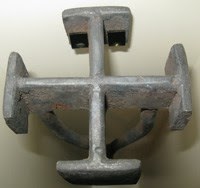
Reginald Fuller, the great Anglican theologian, believed that the Greek word used for cross here—stauros—actually might not necessarily have meant the cross on which one was executed.
Rather, he believed that it might actually mean the tau (the T) and chi (the X) that was used as a sign of ownership to brand cattle. This adds a very interesting dimension to this scripture. The brand of the cross that we must bear becomes God’s seal upon us. And when we look beyond the events of Good Friday, we realize that the cross on which Jesus died truly does become the brand we must bear upon ourselves as followers of Jesus.
Even the thought of a brand is not a pleasant thought. Brands are painful, after all.
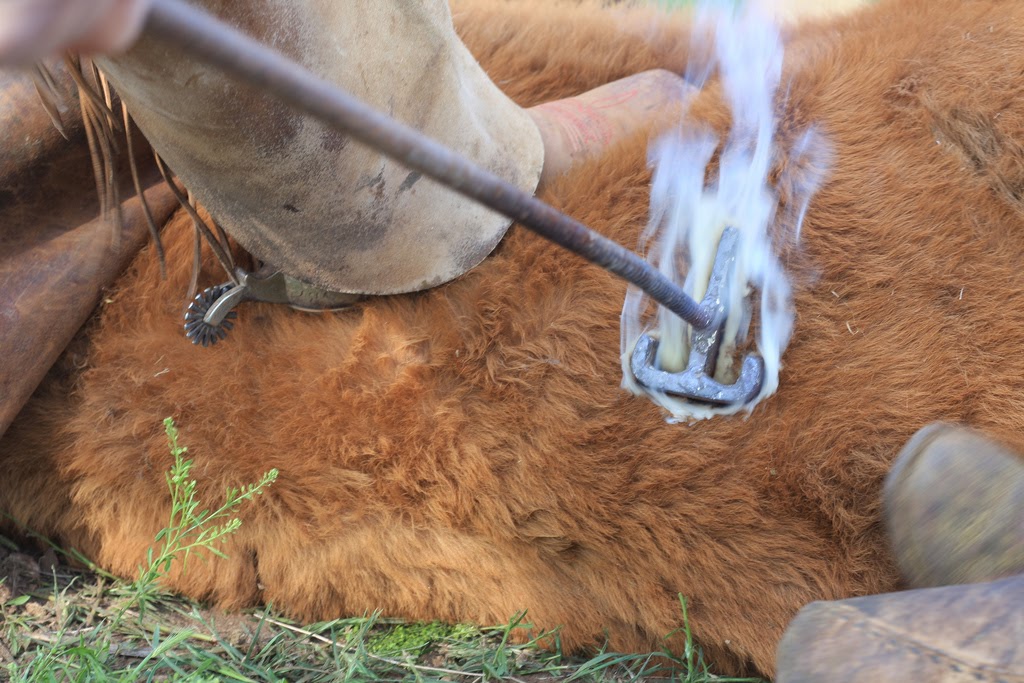 Brands really hurt. And brands cannot be undone. They mark us forever. And that is what the cross does to us.
The cross is the reminder to us that following Jesus doesn’t just mean following him through the rose gardens of our lives. It means, following him all the way to that cross. It means taking up our own crosses and staggering with him along that path. It means sweating blood with him in the garden of Gethsemane. It means crying out with him in anguish. It means feeling with him the humiliation and loneliness of being betrayed—yes, even by one’s own friends and followers.
But, it also means following him to the very end. Just as the cross is a symbol of death and torture and pain—it is, for us Christians, also the symbol of the temporal nature of those things. The cross is the doorway to the glory that awaits us beyond the cross. The cross is the way we must travel, it is what we must carry, it is what we must be marked with, if we wish to share in the glory that awaits us beyond the cross.
I said earlier that no one promised us a rose garden in scripture. I should revise that. While we might not have been promised a rose garden, we have been offered glory. Glory comes to us, when we follow Jesus. It comes to us when we let our love for God lead us through the dark and frightening places this world can throw at us. If we let that love guide us, if we let ourselves be led by Jesus, we will find true and unending glory awaiting us.
So, as we encounter the crosses of our lives—and we will—as we allow ourselves to branded with the cross, as we allow our love for God to lead us into places we might not want to go, let us do so with the realization that glory has been offered to us. Just because we have been branded with the cross, we know that, in our branding, there will be no shame for us.
But that, one day, what seems to be a brand, what seems to us a symbol of pain and loss and failure, will be transformed. It will be transformed into a crown upon our heads. And, on that day, there all our pains, all of our sorrows will, once and for all, be replaced with joy.
February 24, 2018
The funeral for Lois Hokana
 Lois Hokana(July 23, 1924 - February 18, 2018)
Grace Lutheran Church
Oakes, North Dakota
February 24, 2018
+ It is a true honor for me to officiate at this service. I am very grateful to celebrate the truly wonderful life of Lois Hokana.
And it was a wonderful and beautiful life! There is much to be thankful for today.She was an incredible and lovely person. Actually, that’s very much an understatement. But you get the idea here…
I am very fortunate to say that I knew Lois many years. I knew her mostly through the work we did in the Episcopal Diocese of North Dakota. I was also very fortunate to visit her in the hospital in Fargo last September and to pray with her and spend some time with her. And I certainly enjoyed greatly those years I knew her. As all of us here did as well.
I can say, this afternoon, that, like everyone here this afternoon, I will miss Lois dearly. I will miss all that she was. I will miss her gentleness, her kindness, her fierce independence, her exuberant joy. I will miss the witness of her faith—her very strong faith. I will just miss…her!
I know today is hard for those of us who loved her and admired her and were fortunate enough to know to say goodbye to her. And it is a goodbye, yes. But…it is only a temporary goodbye. It is a goodbye until we see each other again. Lois, I know, had a very deep faith and belief that we would, one day, all see each other again. She had a deep faith in her God, who was with her and remained with her until the end. She had a deep faith in Christ, as her Savior.
Now, I say that, but I should also say that she probably wouldn’t like me to make her to be some kind of saint here. She would not doubt not appreciate my getting up here and making too much of all the good things she did. She was an Episcopalian after all. Most Episcopalians don’t feel the need to go on too strongly about their faith. But I can assure you, her faith was strong. She was always, to the very end, a good Episcopalian and a faithful follower of Jesus.
Certainly, she loved her church of Sts. Mary and Mark. It is sad today that this funeral cannot be held there today. But, you know, it’s all right. It all works out in the end. And where she is right now, church buildings no longer matter. She is now part of the larger Church, the unending worship that goes on , without end, before the Throne of the Lamb of God. And she is there. And it is glorious!
Now, people often ask me, “so, what is it you Episcopalians believe?”
I always say, “We believe what we pray.” (that answer doesn’t always go over so well, but it’s the truth)
We’re not big on dogmas. We’re not big on saying we must believe this or we must believe that. If you want to know what we believe, just pray with us. Worship with us. And then you’ll know what it is we believe.
We’re not big on definite answers to the mysteries of faith and life. And death. But we are big on prayer and worship. Our liturgy—what we find contained in our Book of Common Prayer—encompasses our beliefs very well.
And, I can tell you, that it certainly did for Lois Hokana. If you asked her, “Lois, what do you believe?” she would quick to point you to the Book of Common Prayer.
This service we are celebrating together today from the Book of Common Prayer is a great summary of what it is we as a whole—and Lois in particularly—believed regarding life and death and what comes afterward. The scripture readings we have today are particularly apt.
In our reading from Lamentations, we find a beautiful summary of Lois’ faith. In our reading, we hear,
The Lord is good to those who wait for [God],
to the soul that seeks [God].
It is good that one should wait quietly
for the salvation of the Lord.
“It is good that we wait quietly for the salvation of God.”
That is very clearly what Lois did in her life. And that is not a bad way to live out one’s faith. It is good that we wait quietly for the salvation of our God.In our reading from Paul’s Second Letter to the Corinthians, we hear St. Paul saying to us,
For in this tent we groan, longing to be clothed with our heavenly dwelling
Or to put in our own terms, in these bodies, yes, we groan, waiting to be clothed in that heavenly body—to be clothed in spirit and light and life unending. Last Sunday, Lois was finally clothed with that spiritual body, in a glory that we can only, in this moment, imagine. And in this service, in the words we pray together today, we get a beautiful summary of all that awaits us.
Probably some of the best of these beautiful words is at the end of our service today. At that time, I will lead us in what is called “The Commendation.” The Commendation no doubt meant the world to Lois, as it does to all of us who hear it, and more importantly, to those of us who believe it.
Now for many of us, we have heard the words of the Commendation hundreds of times. But that, as Lois would no doubt would tell us, that is no excuse to not pay attention. Because if you do pay attention, you will find the heart of Lois Hokana’s faith.
In the Commendation, we will say,
Give rest, O Christ, to your servant with your saints,
where sorrow and pain are no more,
neither sighing, but life everlasting.
And it will end with those very powerful words:
All of us go down
to the dust; yet even at the grave we make our song: Alleluia,
alleluia, alleluia.
Those are defiant words, if you notice. They are words that someone like Lois, who was so fiercely independent, who was such a maverick, who was so cutting edge at a time when women were not very independent, who were not defiant—these are now her words. Those words in which, even in the face of all that life—and yes, even death—throws at us, as it did to Lois at times, we, like her, can hold up our heads with dignity even then, with an integrity like her integrity, and a grace like her grace, bolstered by our faith in Christ.
Even in the face of whatever life may throw at me, we can almost hear her say, I will not let those bad things win.
“…yet even at the grave we make our song: Alleluia,
alleluia, alleluia.”
Even you, death, will not win out over me. Even in the face of the awful things life and death can throw at us, I will hold up my head with strength and I will face you, o death, without fear. And, because I have faith in my God, you, death, will not defeat me.
Death has not defeated Lois Hokana! That is how Lois faced the death, and the glory that was revealed to her following that death.
Today, all the good things that Lois Hokana was to us—that woman of strength and character and integrity—all of that is not lost. It is not gone. Death has not swallowed that up.
Rather all of that is alive—vibrantly and wonderfully alive!—and dwells now in Light inaccessible. All of that dwells in a place of peace and music and joy, where sorrow and pain are no more, neither sighing, but life everlasting. In a place in which, there never again be any more tears. Except, maybe, tears of joy. And for us who are left, we know that that place awaits us as well. That place of light and joy awaits each of us as well. And we to will have the opportunity to dwell there.
I will miss Lois. We will all miss her and will feel her loss for a long time to come. But, on this day in which we bid her this very temporarygoodbye, let us also be thankful. Let us be thankful for this woman whom God has been gracious to let us know and to love. Let us be thankful for her grace and her beauty and her strength and her independence.
Let us be thankful for that smile that she had. Let us be thankful for herand all she was to us. Let us be thankful for her example to us. Let us be thankful for all that she has taught and continues to teach us. And let us be grateful for all she has given us in our own lives.
Let us be thankful to our God for Lois Hokana!
Into paradise may the angels lead you, Lois. At your coming may the martyrs receive you, and bring you into the holy city Jerusalem. Amen.