
Kathy Howard's Blog: Unshakeable Faith for Life, page 9
April 17, 2023
Don’t Ask “What Does this Passage Mean to You?”

“What does this Bible passage mean to you?” This question is often asked in many Bible study groups. Unfortunately, it’s a dangerous question. It can easily lead us far away from God’s truth.
Why Shouldn’t We Ask “What does this passage mean to you?”The question itself implies that God’s truth is relative. That it’s okay for a Bible verse or passage to mean one thing to one person and something different to another. But God’s truth is not relative. It is absolute because the Bible reflects the perfect character of its Author.
The Bible is true and unchanging because God is true and unchanging. Sanctify them in the truth; your word is truth (John 17:17). The times and our culture change constantly, but God’s Word never changes. It is just as relevant today as when it was first written. Every good gift and every perfect gift is from above, coming down from the Father of lights, with whom there is no variation or shadow due to change (James 1:17).
God’s Word has just one, true meaning – what God meant when He inspired it to be written. While, there is but one meaning of any Bible passage, there is endless application.
Keep reading to see what questions we should ask.
What Question Should We Ask First?So, where do we begin? Let’s start with: “What does this passage mean?” Our first goal in Bible study is to discover God’s one, original meaning. It may sound daunting, but with the proper tools we can understand the Bible. In fact, God wants us to understand His Word. And it doesn’t have to be hard.
There are lots of great Bible study methods and tools that help us approach and study God’s Word correctly. (For instance, see “4 R Bible Study Method” and “Video Teaching on the 4 R Bible Study Method.” for a little hands on demonstration!)
Yes! We can understand God’s Word when we handle it correctly! Just be careful. It is also easy to fall into some common ways of incorrectly approaching Scripture. “Do your best to present yourself to God as one approved, a worker who does not need to be ashamed and who correctly handles the word of truth” (2 Timothy 2:15). (See also “Do You Read the Bible All Wrong?“ and “4 Tips to Help You Understand God’s Word.”)
What Question Should We Ask Last?After using correct Bible study tools to understand what the Scripture means, we can apply God’s truth to our lives. Now, instead of asking, “What does this passage mean to you?” we can ask “What does this passage mean for you?” (For more on applying God’s Word see “4 Ways You can Apply Scripture to Your Life.“)
The Bible is a book by God and about God. (See also “Do You Look for God When You Read the Bible?“) It reveals God’s character, plans, purposes, and ways. Again, the Bible is by God and about God. But the Bible is God’s Word for us. Every spiritual truth we find in the Bible has real-life application for our lives today. And the way God shows us to apply His truth will change with time, the circumstances, and our need.
One meaning. Same truth. Endless application.
What Bible study method do you use? Was today’s post helpful?
Don’t Ask “What Does this Passage Mean to You?” by Kathy Howard.


April 3, 2023
How Biblical Literary Context Aids Our Understanding
Have you ever watched an hour and a half of a movie by yourself then someone else joined you part-way through? They may have begun asking lots of questions like “Who is that?” or “Why are they so upset?” Your response may have been something like “You really need to see the whole thing…”
We all know we can’t start in the middle of a movie and really understand it. And yet, we often try to do that with the Bible. We fail to consider the biblical literary context. For instance, it is so tempting to pull a verse we like out by itself then examine it. But when we do, it’s easy to misunderstand it and thus misapply it.
Consider Philippians 4:13. It is one of the most-loved, but sadly most misused, verse in all of the Bible. Often, when it’s pulled out of context, it’s used as a proof text to say “I can do big and great things for God because He will strengthen me to do it.” But, in the surrounding passage Paul recounts how he learned to be content whether he had enough to sustain his physical needs or not. He found contentment in every circumstance because Jesus gave his strength. This actual meaning is far different than the popular, misguided understanding. (Also see “Do You Misuse Philippians 4:13?“)
Circle of Biblical Literary ContextIn order to correctly understand the Bible, no matter how large or small the passage, we must keep it in the right context. (Also see “4 Things to Consider for Biblical Context” and “4 R Bible Study Method.”) Every sentence is part of a paragraph. Every paragraph is part of a larger passage. Every passage is part of an entire book. We cannot assign meaning to a verse without considering the greater context. Here is this expanding “circle of context:”
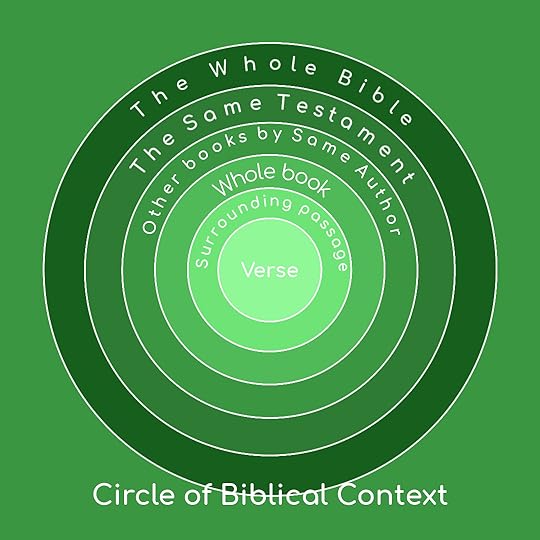
Just like the surrounding passage shapes the meaning of one verse, the whole book shapes the meaning of each passage. Books, particularly the New Testament epistles, contain running arguments, consistent themes, and repeated literary devices. For instance, the book of Galatians has one major running theme – “Follow the Spirit, not the Law” – that helps us better understand individual pieces of the letter.
It also helps to consider other books by the same author. Their doctrinal views will be consistent from book to book. So, for instance, if we’re struggling with the topic of grace in Romans, we can also read Paul’s writings on the topic in Ephesians. (See also, “Who Wrote the Bible and Why Does it Matter?“)
Amazingly, although the Bible was written by more than 40 different God-inspired authors over roughly 1,500 years, both Testaments and the whole Bible contain one, consistent message. All the individual books and stories within the Bible join together to tell one big story: the rule, reign, and redemptive purposes of God. This big story is also known as the meta-narrative.
Every part of the Scripture fits within God’s big story. Keeping this in mind helps us understand the Bible and all the parts. We can ask: “Where does this fit in the Big Story? What does this teach us about God’s rule, reign, and redemption? No individual story will contradict the Big Story.
A Few Practical Tips for Literary ContextIf possible, read the entire book in one sitting, particularly the New Testament letters.Remember that chapter and verse divisions were added later and sometimes interrupt the natural flow of the author’s thought.No matter where you start – one verse or a larger passage – pull back and consider the larger context.Look for big themes and running arguments that impact the way we should understand the individual pieces of a book.Don’t forget the meta-narrative. Does your understanding of a verse or passage agree with the big story of Scripture?Have you ever misunderstood a Bible verse or passage because you didn’t consider the literary context?
How Biblical Literary Context Aids Our Understanding by Kathy Howard.
March 20, 2023
How is the Bible Organized?

It’s not only those who are new to the Bible that have questions about how it’s put together. With a little looking some things seem to make sense. Like the story of creation being at the beginning and the end of human history coming at the end. But other things just don’t seem logical.
So, just how is the Bible organized? And how do we find what we’re looking for? In the following sections we will work our way down from the largest divisions to the smallest.
The Bible is Organized into Two TestamentsThe Bible is divided – not evenly mind you – into two primary sections. The Old Testament and the New Testament. There are 66 books in the Bible – 39 in the Old Testament and 27 books in the New Testament. Historically, there is a break of 400 years between the Old and the New Testaments.
The English word “testament” means “covenant” or agreement. The books of the Old Testament cover God’s covenant agreement through Moses with the people of Israel. But they also point to the new covenant to come through the Messiah. The books of the New Testament share the new eternal covenant of salvation God provides through Jesus. (Also see “6 Reasons to Read and Study the Old Testament.”)
Categories of the Old TestamentIt might seem logical for the Old Testament to be arranged chronologically. But instead it is arranged categorically, by the type of literary genre of the books. (For more on biblical genre see “8 Tips for Handling Different Biblical Genres.”) The 39 books of the Old Testament are divided into five categories:
Law (or Pentateuch) – The five books in this group, from Genesis through Deuteronomy, include the story of creation, the Jewish patriarchs, the Exodus, and the giving of the Law.History – The twelve historical books (Joshua through Esther) covers Israel’s entry into the Promised Land, the periods of the judges and kings, the time of the exile, and the re-establishment of the Jews in Jerusalem.Poetry and wisdom – These five books are Job, Psalms, Proverbs, Ecclesiastes, and Song of Solomon.Major Prophets – The five books of the major prophets – Isaiah through Daniel – are categorized as “major” because of their length, not their importance.Minor Prophets – Conversely, the twelve books of the minor prophets – Hosea through Malachi – are just shorter, not less significant!The ministry of the various prophets spanned a period of more than 300 years, from the time of the kings through the post-exilic period. Some overlapped each other. (For a bit more explanation of the organization of The Old Testament see “How is the Old Testament Organized?”)
Categories of the New TestamentLike the Old Testament, the New Testament is organized by categories instead of chronologically. But these categories are a bit different.
Gospels – The four Gospels – Matthew, Mark, Luke, and John – tell the story of Jesus. His incarnation, His ministry and teaching, and His work on the cross. The Gospels are a unique blend of history and Jesus’ theological teaching. (See also “Four Tips for Understanding the Gospels.”)History – The book of Acts tells the history of the beginning of the church and the spread of the Gospel.Pauline Epistles – These 13 letters, written by the apostle Paul, includes letters to 9 churches and 4 individuals. General Epistles – These 8 letters were written by a variety of biblical authors including the apostle Peter and John. Apocalyptic – The book of Revelation is an exciting and fitting end to the canon of Scripture. But its literary genre does make it notoriously difficult to understand.(For more on the organization of the New Testament see “How is the New Testament Organized?”)
The Bible is Organized by Chapters and VersesEvery Bible book is divided into chapters, then each chapter is further divided into verses. With this reference system we can go directly to any specific point in the Bible. For instance, the reference John 3:16 takes us to the Gospel of John, chapter three and verse 16. There we read the well-loved verse: “For God so loved the world, that He gave His only Son, the whoever believes in Him should not perish but have eternal life.”
But this reference system did not always exist. The biblical authors did not include divisions of any kind when they wrote. Over time, different individuals began to develop divisions to make specific sections easier to find. But the full reference system we conveniently use today -chapter and verse – wasn’t fully developed in the English Bible until 1560 AD. (For more on the history of references see “The Origin of Verse Divisions.”)
This reference system is necessary for navigation. But, it’s important to remember that chapter and verse division weren’t divinely inspired like Scripture. Sometimes they interrupt the flow of thought. Sometimes, in order to get the right context of a passage we need to look past these divisions.
What’s your favorite part of the Bible?? (Also, if you found this post helpful, I’d love for you to share it!)
March 13, 2023
How I Read and Study the Bible

When I first began to read and study the Bible regularly, about 35 years ago, I did not know about proper study techniques. Since I lacked confidence in doing Bible study on my own, for years I depended on the wonderful resources of reliable Bible teachers like Beth Moore, Kay Arthur, and others. Those studies help me foster a regular habit and further developed my passion for God’s Word.
But I wasn’t reading the Bible on my own without a “guide.” Those studies became a crutch rather than a tool, my primary go-to rather than enriching supplemental material. Then God began to prompt me to read and study the Bible on my own – just me and Him.
Shift from Big Picture to Bite-SizedAt that time, I had never read through the entire Bible, so I did that a number of times over several years. If you’ve never done this, I highly recommend it. Whether you do it in 3 months, a year, or a little longer, it will help you grasp the Bible’s “meta-narrative.” The Bible tells one, big story from Genesis to Revelation. It’s all about the rule, reign, and redemptive purposes of God.
For a while, I mixed in some topical, year-long reading plans with my “read the Bible through” years. But in recent years, I’ve focused on one Bible book at a time. The only problem I found with reading through the Bible in a year is that the quantity of reading each day didn’t leave me enough time to really dig deep. And while topical reading plans provide a solid broad understanding of an individual topic – like grace or a Bible character – it’s sometimes hard to keep individual passages in their overall literary context.
The Current Way I Read and Study the BibleFor about the last 5 years, I’ve been reading and studying my way through one Bible book at a time. I read an average of 20 verses a day – sometimes a little more and sometimes a little less depending on the natural breaks in the book. At this pace, I’ll get through the entire Bible in about 6 years.
Every December I develop a year-long plan for the new year. It’s easier to keep going every day if I know where I’m headed and what I’m reading next. I started January 2023 in Romans. By December 31st, I will have read through 15 books of the Bible.
Each morning – after my coffee is ready! – I start my time with God in prayer. Some days I journal, but not every day. The following outline is how I go about my time in God’s Word:
Read that day’s passage in the ESV – You don’t have to use this translation, but a word-for-word translation is best for study. (See “Why are there so Many Bible Translations?”) Reread the passage in the NLT – A thought-for-thought translation like this one enhances our understanding.Record my observations – I love my large font, wide-margin ESV journaling Bible for marking and taking notes. But you can also record your observations in a journal or notebook. (See “10 Observation Tips for Better Bible Study.”)Reflect on the meaning – After I see what the passage says through observation, I use solid techniques to identify spiritual principles and eternal truths. (See “4 Tips to Help You Understand the Bible.”)Respond to God – God wants us to apply His Word to our lives, not just read it. I will admit, I don’t always respond immediately or fully. I am still a work in progress. But I long to be the woman God wants me to be. (See “4 Ways to Apply Scripture to Your Life.”)Note: Whenever I begin a new Bible book I do a little research into its background so I keep it in the right context. Things like the author, audience, historical setting, and purpose of the book helps me better understand it.Studying the Bible the “right” wayWhether you read the Bible through in a year, do a topical study, or focus on one Bible book at a time isn’t super important. The main thing is that you get into God’s Word and handle it correctly.
Doing Bible study “right” might feel intimidating. But here’s the thing – the basic principles are not hard. You just have to know what they are. My daily Bible reading and study method is a simple inductive method I refer to as the 4 Rs because it’s easy to remember. I use this “4 R Bible study method” with the Facebook group “Reading the Bible Together.” It is also the format for the “Deep Rooted” devotional series and I teach it at women’s events. (By the way, the Bible Reading Group is open to all women! Right now, we are finishing a study of Daniel but will begin Colossians on March 27th and then Ezekiel on April 3rd.)
If you’d like to see how the 4 R Bible study method helps you study a Bible book, check out one of the Deep Rooted devotional books. I designed these resources to help you get into God’s Word for yourself. You can take the tools you learn and use them on your own! Check out Deep Rooted Mark, Deep Rooted Acts, or Deep Rooted Romans.
What is your current method for reading God’s Word?
February 27, 2023
10 Online Bible Study Resources

The internet can be both dangerous and wonderful. It’s filled with many things that are not emotionally or spiritually healthy for us. BUT, it also provides us with some great online Bible study resources and tools. And many of them are FREE!
I still love printed resources and I have quite a few. But, I also supplement my study with online resources, tools, and writings. Just keep in mind that everything you find on the internet will not necessarily be biblical. Check everything you find against the truth of God’s Word.
A Word about ResourcesYou don’t HAVE to use extra resources to study God’s Word. These are supplemental. All Christians have the indwelling Holy Spirit that help us understand Scripture. With the proper study techniques we can do rich, meaningful Bible study on our own. (For a solid Bible study method see “The 4 R Bible Study Method for Everyday Use.”)
A Few Online Bible Study Resources to TryThe following are a few online resources to investigate. (If you’re interested knowing how to look up the original languages see “Resources to Study the Bible’s Greek and Hebrew Words.”)
20 English versions of the Bible with keywords and topical indexSeveral commentaries, dictionaries, lexicon, and moreHarmony of the GospelsEaston’s Bible DictionaryNave’s Topical BibleSeveral commentaries and dictionariesOutlines, charts, maps, Strong’s, Commentaries, Lots of misc.Original language4. The Bible Project– This video-driven resource has word studies, Bible book overviews, visual commentaries and more.
11 Bible versions connected to reference toolsLots of apologetic info, History and more6. Bible Hub
Search and study tools including parallel textsCross referencesTreasury of Scripture and commentaries plus access to topical studies, interlinears, sermons, Strong’s and many more resources7. Study Light
Bible commentariesEncyclopediasDictionariesLexiconsOriginal language toolsDrawings and photosTimelines and calendarsArcheology9. Christian Classics Ethereal Library – Writings of the old Church Fathers
10. A Group Study Opportunity – The Book of DanielI lead an ongoing women’s Bible reading and discussion group on Facebook. We work through one Bible book at a time.
We begin 4 weeks in Daniel on Monday, February 27th. The doable-sized daily readings and questions post Monday through Friday at 5am CT so it’s ready when you are. Schedule your time in God’s Word and drop in to leave a comment when it works for you.
This closed group is a safe place for women to discuss Scripture and encourage each other in our lives of faith. To join, visit “Reading the Bible Together,” request to join, and answer the three quick questions.
February 13, 2023
Can You be a Christian without being a Disciple?

When Jesus called people to follow Him, He called them to be His disciples. He also commanded His disciples to go and make other disciples, not to make “Christians” (Matthew 28:19-20).
In fact, Jesus never used the word “Christian.” In the gospels, the followers of Jesus were always called disciples. The word “disciple” wasn’t just used to describe that specific group of twelve men Jesus chose. It indicated anyone who followed, listened to, and learned from Jesus.
The Greek word translated “disciple” means student or learner. Disciples not only followed a teacher around to learn from them, they also put his teachings into practice. (See also “What is a Disciple?”)
It was almost two decades after Jesus’ death and resurrection before disciples of Jesus were first called “Christians.” The term was first used in Antioch to describe the disciples there. The word “Christian” means “one who follows Christ” or “one who is like Christ.” Scholars think the nickname “Christian” may have originally been used as derogatory term to describe those “foolish” people who followed a crucified Savior and modeled their lives after His.
The name “Christian” is only used three times in the Bible and two of them were probably derogatory (Acts 11:26, Acts 26:28, and 1 Peter 4:16). The New Testament Scriptures most often use a few other words to refer to those who chose to follow Jesus – disciples, saints, brothers/sisters. (See also “Are you a Christian or a Disciple?” by J.D. Greear.)
The Bible never presents discipleship as a deeper, but optional level of Christianity. Instead Scripture equates those who put their faith in Jesus as Savior and Lord with discipleship. Those who are saved are disciples.
3 Essential Characteristics of a DiscipleSo, what does it mean to be a “disciple” of Jesus? What does it look like in our daily lives? We don’t have to wonder. Jesus described it for us. One day Jesus turned to the crowds around Him and declared:
“And he said to all, ‘If anyone would come after me, let him deny himself and take up his cross daily and follow me.'” Luke 9:23 ESV
Jesus’ call on our lives is not an easy or passive one. While salvation costs us nothing, living it out day to day can be very costly.
This call is not just for the super spiritual or the full-time minister. Jesus calls anyone and everyone to discipleship. He asks the same from anyone who wants to “come after” Him.
We see three specific components in Jesus’ call to discipleship: Surrender – The Greek word translated “deny” means “to forget one’s self, lost sight of one’s self and one’s own interests.” When we “deny” ourselves, we surrender fully and completely to the will and way of God in our lives.Obedience – The “cross” represents complete obedience to God no matter where it takes us or what He asks of us. Jesus’ complete obedience to the Father took Him to the cross. (See also “What is Your Cross to Bear?“)Pursuit – The Greek word translated as “follow” means “to go after, emulate, stand with.” Following Jesus is active, deliberate, and often costly. We must purposefully and repeatedly choose to pursue Jesus in everything. (See “Free Discipleship Tools to Encourage Spiritual Growth.“)So, can we be a Christian without being a disciple? The short answer is “no.” We cannot be a Christian without being a follower of Jesus. A follower of Jesus is a disciple. So, to be a true Christian is to be a disciple – one who surrenders, obeys, and purposefully pursues Jesus.
What does this mean for us?
If truly being a Christian means to be a disciple of Jesus, that means serious implications for our daily lives. First, our faith is not an “addition” to our lives. We can’t keep Jesus in one compartment of our life like family, work, or recreation. Our faith in Jesus is our life. Following Jesus is our foundation. It shapes and dictates everything else in our lives.
Have you been taught that you can be a Christian without being a disciple?
Can You be a Christian without being a Disciple? by Kathy Howard.
February 6, 2023
8 Tips to Foster Consistency in Your Quiet Time

When I first committed to prayer and Bible reading as a young mom I was pretty consistent in my quiet time. However, it was only because I fully embraced legalism. My personality makes me prone to it. I love to check the boxes and feel that sense of accomplishment.
Although I did gain some head knowledge, I can’t honestly say I fostered a closer relationship with God or grew to be more like Jesus. In fact, I probably even developed a little pride and self-righteousness.
Then something happened and I missed a few days. Then a few days turned into a few weeks and a few weeks turned into six months. Six months without not only consistency in my quiet time, but six months without a quiet time. (If you struggle to find the time because you’re a mom to small children see “8 Tips for Moving Quiet Time from “Want To” to “Get To.”)
I felt guilty and overwhelmed at the thought of starting again.
A Turning PointBut then God began to whisper to my heart. I missed Him. I grew hungry for His Word. So, I began again. The first day was the hardest because I had broken the habit and filled that daily space with other things. But I took it one day at a time.
That was more than twenty years ago. And “yes,” I’ve been consistent ever since. But, “no” that doesn’t mean I don’t miss a day. Or two or even on the rare occasion three. The difference is now I don’t feel guilty. I give myself grace. And because I’ve been consistent, I love the time with God enough that the relationship always pulls me back.
So, what about you? Do you struggle with consistency? Maybe it’s been a really long time since you spent focused time with God in prayer and His Word. It is never too late to start again. And there is no limit to how many times you can start again. (See also “11 Tips for Spending Quality Quiet Time with God.”)
I did learn a few things through my own experience. Maybe the following tips will help you. First and foremost, I had to make my time with God a priority. I had to understand the necessity of it. Everyone has the same amount of hours in a day. The way we spend it reveals what is really important to us, not what we say is important.
Once that’s settled in your heart and mind, try the following tips to help with consistency.
8 Tips to Help You Find Consistency in Your Quiet TimeGive yourself grace – Life WILL interrupt. Acknowledging that will cut down on guilt. Simply pick up where you left off. Stay prepared – Establish a regular time, designate a specific spot, and keep your “tools” (Bible, reading plan, journal, pen) together. This builds the habit. If a quiet time is new for you, start small, commit to it and God will grow it. Have a plan – I’ve found having a reading plan greatly increases my consistency. Without a plan, reading stays haphazard at best. Plus, a plan – whether it’s through a Bible book or a specific topical plan helps keep things in context. (You may find one of my Deep Rooted devotionals helpful. Check out the most recent, “Deep Rooted: Growing through the Book of Romans.”)Build in margin – My reading plan is just 5 days a week. I’ve got 2 grace days! Those weeks I do get 6 or 7 days with God I often turn to the Psalms or one of my favorite books like Philippians. Establish a routine – I focus best in the morning routine. But, you set a time when you’re most likely to find consistency in your quiet time. Make it part of your daily routine like making coffee or brushing your teeth. Your mind will begin to expect it!Set a pace for relationship – Depending on your daily schedule, you may not want to try to read the Bible through in a year. You’ll have little time to process and pray. Pick a reading plan that gives you time to mediate on the passage and talk to God about it.Find an accountability partner – Find a friend who wants to grow in consistency in their quiet time. Keep each other moving forward.Start over as many times as it takes – Spending time with God is a lifetime endeavor. We’re practicing for heaven! So don’t give up!What about you? What are your biggest obstacles to a consistent quiet time?
8 Tips to Foster Consistency in Your Quiet Time by Kathy Howard.
January 30, 2023
Finding Treasure in the Boring Parts of the Bible

Okay, I admit it. I used to avoid reading the boring parts of the Bible. Sections like genealogy lists, the greetings at the end of epistles, and many parts of the Old Testament law. Particularly those civil laws like what to do if a neighbor’s ox falls in your pit or if your ox gores someone to death. After all, how many people own an ox these days.
But my attitude has changed over time. For one reason or another, I finally began to read those sections I considered boring. And not just read quickly through to check a box. I actually took time to see what was there and consider why it was significant.
Think about it. The Bible is the very words of God. (See also “Who Wrote the Bible and Why Does it Matter?“) It is divinely inspired AND divinely designed. God intentionally included every part, every word, every truth. Every “hello,” list of unpronounceable names, and law has spiritual value.
What about you? Are there parts of Scripture you avoid? Let’s see if I can win you over!
My Top 3 Boring Parts of the Bible1. Genealogy listsMy attitude changed about these lists when I studied Jesus’ lineage for one of the devotions in my book “Heirloom.” I read a little about ancient genealogies and why they were so important.
Ancient cultures regularly talked about their ancestors and Israelites particularly valued their ancestry records. Some genealogies were written and others were transmitted orally. Sharing the genealogies verbally made them very personal to the families.
Genealogies also served useful purposes such as establishing claims to the throne, who could serve as priests. Additionally, the family relationships they revealed determined important matters like marriage, inheritance, and social obligations.
In addition to the 25 genealogical lists in the Old Testament, the New Testament contains two separate accounts of Jesus’ ancestry – one in Matthew and one in Luke. I learned they reveal important truths about Jesus. For instance, Jesus descended from David, fulfilling God’s promise of an eternal King (Matthew 1:6). I also saw how the presence of Gentile women in Jesus’ line – like Rahab and Ruth (Matthew 1:5) – highlights the all-inclusive nature of Jesus’ salvation.
Genealogies are not dry lists, but exciting roadmaps. They show fulfillment of God’s promises and how He has worked through families over time. Don’t skip these rich treasures in the Bible.
2. GreetingsMost of the epistles (letters) in the New Testament include some kind of personal greetings, where the author of the letter mentions individuals by name. Some of these greeting include a personal note. Many of these individuals are not mentioned anywhere else in Scripture. So, it’s tempting to just skip right over this part!
But, like a genealogy list, the greetings can be a goldmine of interesting information. For instance, Paul’s greetings in Romans, yields fascinating insight to both the Roman church and Paul’s ministry. First, Paul mentioned as many as five separate house church leaders and even more likely existed. Rome was a huge city and the church didn’t have a building! Second, the inclusion of so many women in Paul’s greetings show that women occupied a prominent place in the church and in Paul’s ministry. (Want to know more about Romans? See the 40-day meaty devotional book “Deep Rooted: Growing through the Book of Romans.”)
Even though we may struggle to pronounce the names, the facts and clues we find in the greetings will enrich our understanding of what God was doing in the early church. Here are a few quick tips to help get the most out of greetings:
Check cross-References – Check to see where else in Scripture these individuals are mentioned.Record facts – Record every fact you discover about the individuals, events, or the church.Note relationships – Note how these individuals are connected to the author.Recognize impact – Consider what impact these individuals had on the church and God’s work.3. LawThis may be the most boring of the boring. Why? Because so much of it is far removed from us by time and culture. But, about a year ago, I led a Bible reading group through the book of Exodus. Of course, the plagues and the crossing of the Red Sea are pretty exciting. And the 10 Commandments are obviously so relevant. (See also “6 Reasons to Read and Study the Old Testament.”)
Then we got to all those civil laws which are so rooted in the ancient agrarian society. But I gave it a real chance. (Maybe that’s because I had to since I was leading!) I didn’t hurry through it and genuinely sought the Holy Spirit’s guidance. And He faithfully began to show me God’s eternal principles behind those ancient laws that should guide our behavior and relationships – even if we don’t own an ox.
Now WhatYou might include different parts of Scripture on a “boring parts of the Bible” list. And I could add to mine. Like all the land allotments for the tribes in the book of Joshua. However, I know this too is very valuable and I trust that the next time I read and study this God will show me what I have missed in the past.
I’m not saying that the “boring” parts of the Bible should become your favorites. But, I’m asking you to take time to see the value. Because all of it is rich, true, and relevant.
What parts of Scripture do you struggle to get excited about?
Finding Treasure in the Boring Parts of the Bible by Kathy Howard.
January 23, 2023
The First Thing to Look For When You Read the Bible

One of the most common mistakes we make when we study or read the Bible is that we try to make it about us. We turn the pages looking for ourselves. We want to know what to do or how to grow. We need peace or assurance or strength.
Don’t get me wrong. God’s Word does all that for us and more. But those things are a beautiful, gracious byproduct. (See “Do You Read the Bible All Wrong?”)
Yes, God’s Word is for us, but it is not primarily about us. Going to the Bible with a me-centered perspective not only hinders us from understanding God’s true meaning it also causes us to miss the main point of Scripture – to know the Author. If we only do one thing when we read the Bible it must be this: Look for God.
The Bible is first and foremost a book by God about God. The Bible’s objective is to reveal God. To teach us His character, His purposes, His plans, and His ways, including His provision for salvation through Jesus.
God is the hero of every story. David and Goliath (1 Samuel 17:1-49). Daniel in the lion’s den (Daniel 6:1-24). Paul and Silas in the Philippian jail (Acts 18:16-40). Even in the story of Esther, where God’s name is never mentioned, He is the hero. His providential hand is evident in the salvation of His people.
So, let’s see how we can study and read the Bible with a God-centered perspective. (Check out this great resource to help you do this: “Women of the Word” by Jen Wilkin.)
Look for God as You Study and Read the BibleWhile, there are a lot of things to observe in a passage, God should be the first thing we look for. Let’s approach Scripture looking for truths that elevate and glorify God. When I read a Bible passage, I use a purple highlighter to mark every truth I see about God. (See “Bible Highlighting for More Effective Study” and the “4 R Study Method for Everyday Bible Study” for more information on how to study the Bible. Also see the “Deep Rooted” devotional series. Each volume is formatted around the 4 R Bible study method.)
Here are a few specific things you can look for about God:
His character – What does the passage teach about God’s divine nature?His purposes – What do you learn about God’s plans for the world, His people, the lost, His plan of salvation?His ways – How does God relate to people? How does He communicate His will?His actions – What did God do in the world, through His people?Respond to What You Learned about GodWhen we read the Bible, we encounter the God of the universe. That experience should shape us. Redirect us. Drop us to our knees in worship and surrender. But far too often, we add what we learned about God to our knowledge bank without allowing it to change us, to transform us. Our end goal of Bible study is not simply increased knowledge. God wants us to respond to what we learn. But what does that look like?
Here are a few ways we can respond to what we learn about God in His Word:
Repent – Encounters with a holy God reveals our sin. What do you need to turn away from?Worship – The more you learn about God, the more you realize He deserves your praise.Believe – Did you learn something about God that you didn’t know before? Adjust the way you view Him.Obey – Does new knowledge of His purposes and will prompt a certain action He wants you to take?What about you? Do you struggle to keep a “God-centered” focus when you read Scripture?
The First Thing to Look For When You Read the Bible by Kathy Howard.
January 16, 2023
Resources to Study the Bible’s Greek and Hebrew Words
I loved my time in seminary, but I regret one thing. I wish I had studied Greek and Hebrew. Although they were not required for my Masters in Christian Education, I could have taken them as electives. However, I have learned how to use the invaluable tools available to us “English only” speakers to enrich my Bible study. You can use them too!
The Old Testament was written primarily in Hebrew with a smattering of Aramaic. The New Testament was written in Greek. Having the tools to look deeper into the meaning of the original words God chose to use can deepen our understanding of His Word. The good news is, these tools are available to everyone. And many of them are free!
Word of Caution about Greek and HebrewLike any two languages, when translating from Hebrew or Greek to English there is often not just one equivalent English word. Choices have to be made by educated scholars based on the word’s usage and context. We see this reality reflected in different Bible translations. (Also see “Why are there so Many Bible Translations?”)
The reverse is true as well. For instance, in English we use the word “love” to cover a wide range of feelings and actions towards others. The New Testament primarily uses two different Greek words that have significant differences in meaning. It’s important to know which Greek word is translated “love.”
When studying definitions of the Bible’s original language, we need to assure we are dealing with the correct Greek or Hebrew word. That is easily accomplished by using an index or interlinear Bible. These are briefly explained below.
Different Types of ResourcesBible Lexicons – A linguistic resource similar to a dictionary that provides etymology, definitions and more of the original language of the Bible. See “What is a Lexicon?” for more information and suggested lexicons.Interlinear Bible – This resource shows the original Greek or Hebrew alongside the English translation. For a great definition of an interlinear Bible and how to use it see “How to Use an Interlinear Bible”Expository Dictionary – Defines major and key words of the Bible. Good ones will include an index so you can confirm you’re dealing with the right word. See “What is a Bible Dictionary” for more information.Strong’s Numbers – An index of every word in the Bible’s original languages. For more information about Strong’s Index, including its limitations, see “What are Strong’s Numbers?”Exhaustive Concordance – This alphabetical listing of every English word in the Bible cites every passage in the Bible where it appears.Free Online ResourcesThere are quite a few free online sites where you can look up the original language. The following three all include lexicons, dictionaries, and concordances.
Study Light Bible Hub Blue Letter BibleI most often use Blue Letter Bible. This site has multiple language resources. Below, I’ve bulleted the best way I’ve found to utilize them:
From the home page, look up the Bible book and chapter you’re studying.To access Strong’s, use the KJV translation. When you are on the passage page, click the “Strong’s” button in the middle of the narrow tool bar near the top of the page. The blue Strong’s numbers, which come from an index of the Bible’s original language are hyperlinks to a lexicon page full of helpful information for that word.However, you can also access the Interlinear Bible from any translation by clicking on the small “Tools” button next to each verse in the left column.You can also access the Interlinear Bible from any verse in the Blue Letter Bible app!My Favorite Printed ResourcesComplete Word Study – These resources include the Strong’s numbers over the KJV translation of the Scripture. Definitions are included in the back. It comes in two volumes:The Complete Word Study Old Testament See on AmazonThe Complete Word Study New Testament See on AmazonVine’s Complete Expository Dictionary – This has sections on both the Old and New Testaments plus an index. See it on Amazon.Mounce’s Complete Expository Dictionary- This resource includes the Hebrew and Greek dictionaries and a Scripture index. See it on ChristianBookCom.Strong’s Expanded Exhaustive Concordance – Every word in KJV translation is indexed and includes Strong’s numbers. Includes Greek and Hebrew dictionaries, a topical index, and more. See it on Amazon.I hope one or more of these resources will enrich your Bible study!
Resources to Study the Bible’s Greek and Hebrew Words by Kathy Howard.


