
Kathy Howard's Blog: Unshakeable Faith for Life, page 7
October 3, 2023
Americans’ Top 6 Frustrations with Bible Reading

Does Bible reading frustrate you? Do certain issues, roadblocks, or questions keep you from reading the Bible more often than you do?
In the 2023 State of the Bible report, “Bible users” were asked about their top frustrations with Bible Reading on their own. (Note: This annual report is compiled by the American Bible Society. They define “Bible Users” as adults who read the Bible at least 3 times a year outside church.)
Here’s a quick breakdown of the 6 specific frustrations by percentages:
26% said “Not enough time”17% said “Don’t know where to start”16% said “Lack of excitement about reading the Bible”15% said “Difficult relating to language” of the Bible9% said “Layout (of Bible) difficult to navigate8% said “Stories are confusing”Some Practical Help for these FrustrationsYou may experience some of these same frustrations. I want to help by sharing some resources and direction for each of the frustrations named in the list. (We will save “not enough time” for last!) The Bible can be difficult to understand, but the good news is, with just a few practical tools and basic resources you can approach the Bible with confidence.
If you struggle with a “lack of excitement,” you may find this frustration falls away when you handle the other frustrations. Because, the more you understand Scripture, the more you’ll experience God. And that my friend, is exciting! So, here we go:
Where to start – If you’ve never read the Bible before or read very little, I suggest you start with the Gospel of Mark. It’s action-filled and fast-paced and All about Jesus! (If you’d like a little guidance for reading this book, see the meaty devotional book “Deep Rooted: Growing through the Gospel of Mark.“) I also highly recommend you find and use a Bible Reading Plan. You can find a variety of them on BibleGateway, You Version Bible App, and BibleStudyTools . But, I also have READING PLANS on my website. Go to the FREE RESOURCES page, click on “Bible Reading Plans” to expand the drop down menu and see the options. I have lots of year-long reading plans and a couple of short-term thematic ones. If you aren’t ready to commit to a year, each of the “Book-by-Book” year-long plans are comprised of multiple books. You can simply choose one book to read through.Language of the Bible hard to understand – This is an easy fix. There are a wide variety of Bible translations. (See “Why Are There so Many Bible Translations?“) My favorite easy-to-understand translation is the New Living Translation (NLT). If you’ve been reading the KJV, ESV, NASB, etc. then you would benefit from a less formal and more dynamic translation like the NLT. If you find the NLT still a bit difficult, try a paraphrase like The Message. Although not technically a translation, it will help you understand!Bible layout difficult to navigate – For many of us, the Bible is not organized in a logical manner. Most books are chronological in nature. They tell us a story in order. But the Bible is arranged more in categories. See “ How is the Bible Organized ” to find out more about how it’s put together. But, even thought the Bible isn’t arranged chronologically you can still read it in chronological order. Here is my year-long “Chronological Reading Plan” free to download. Or, you can buy a Chronological Bible! Check out this large-print NLT Chronological Bible on Amazon! Stories of the Bible are confusing – The stories in the Bible can be confusing and strange. Not only has a lot of time passed since the events of the Bible occurred, but we live in a very different culture. However, there are tons of resources to help us understand the differences of time and culture. My favorite print resource is the IVP Bible Background Commentary. Check out the New Testament volume and the Old Testament volume. But a tremendous FREE resource is the Bible Project. This site has video overviews for every book of the Bible, (see this one on the Gospel of Mark ), videos on themes of the Bible, and more! Use Solid Bible Study TechniquesThere are some general reading/study principles that apply no matter where in the Bible you plan to read. If you arm yourself with the basics you will quickly discover you not only understand the Bible more, but that you also enjoy it! I have tons of resources on my website that can equip you with solid Bible study principles and tools. But the best place to begin is to take a look at the basic inductive Bible study method I teach, the “4 R Bible Study Method for Everyday Use.“
“Not enough time” for Bible Reading“Insufficient time” was the single most prevalent frustration. This is a very real problem. We live in a culture that idolizes busyness and encourages us to overly commit ourselves and our children. It’s okay to say “NO” sometimes. It really is.
I acknowledge that there are some limited busy seasons in our lives when all the activity is from God. But this will be the exception rather than the rule. From beginning to end in Scripture, God calls us to know Him, to meditate on His Word, to sit in His presence. If we are too busy to obey His call then our priorities need to be re-evaluated. In the end, we usually make the time to do the things that mean the most to us.
So, what is your biggest frustration in Bible reading and study? Let’s talk about it!
Americans’ Top 6 Frustrations with Bible Reading by Kathy Howard.


September 26, 2023
6 Ways God Uses Trials in a Christian’s Life

Many of us have experienced a lot of grief and difficulty in the last few years. We’ve lost loved ones. We’ve experienced illness, job loss, and financial strain. About now, you may be wondering how much more you can take. But I do have some good news. God doesn’t waste anything He allows into your life – particularly trials and difficulties.
God knows every loss and heartache in your life, every detail. He sees every need and cares deeply about each one. However, as much as He cares about your physical needs, He cares even more about your spiritual needs. His primary purpose for His children is that we become more and more like Jesus. (See Romans 8:29.) The spiritual and eternal take priority over the physical and temporary. But how does God do the work?
Trials “Work” Our FaithLet’s consider a physical analogy. If we want to strengthen our muscles we must add “stress.” When we lift a heavier load than our muscles have lifted before, a physical process begins to adapt the needed muscles to the new load. Without stress, our muscles are content with their current size and strength. Add stress, and our muscles begin to change to meet the need.
Our spiritual strength and character are similar. The difficulties of life “stress” our faith. Trials give our faith a work out like heavy loads work our muscles. As we faithfully endure, we grow spiritually stronger. Without difficulty, our faith tends to stagnate. Do you want stronger faith? You need stress. (Also see “6 Steps for Standing Firm on God’s Truth When Everything Around You is Shaking.“)
#Trials are a #SpiritualWorkout for a Christian’s #faith
Click To Tweet
Trials work our faith. Like using our muscles to carry heavier loads make them stronger, the trials of life give our faith a workout. God will use them to grow and develop our faith so we will be spiritually mature, not lacking anything!
God never wastes a #trial He allows into a #Christian’s life
Click To Tweet
Our gracious God never wastes a trial He permits to enter our lives. If we will cooperate, He will use every difficulty, heartache, and hardship for our good and His glory. (The apostle Peter is a great example of someone who grew strong through trials. Find out more about Peter in “7 Things You Might Not Know about the Apostle Peter” or check out my Bible Study about Peter called “Unshakeable Faith.” See a description and introductory video on my website or check out the book on Amazon.)
6 Ways God Uses Trials in Our LivesGod uses trials to break our independence and foster our dependence on Him (2 Corinthians 1:8-9).God uses trials to purify our faith and develop our moral character (Romans 5:3-5).God uses trials to test, prove, and strengthen our faith in Him (1 Peter 1:6-7).God uses trials to prepare us for His purposes (Romans 8:28-29).God works through trials to prove Himself powerful and reliable (2 Corinthians 12:8-10).God uses trials to prove our faith works (2 Corinthians 4:7-10).Consider it pure joy, my brothers and sisters, whenever you face trials of many kinds,F)" data-cr="#cen-NIV-30269F"> because you know that the testing of your faith produces perseverance. Let perseverance finish its work so that you may be mature and complete, not lacking anything. James 1:2-4, NIV
God is not finished with you yet. And He is definitely not finished with me. I know more difficulties lie ahead. Honestly, I wish God had chosen to work another way. But I will choose to trust His infinite wisdom and submit to His refining process. I don’t know about you, but I don’t want to waste any trial or difficulty!
In what ways has God used trials in your life to refine your faith and character? To make you more like Jesus!?
6 Ways God Uses Trials in a Christian’s Life by Kathy Howard.
Bible Study Bundle: Huge Value for Low Cost

Love Bible study? Love a bargain? This Bible Study Bundle is all about both! This big Bible Study Bundle is for anyone who loves to dig into God’s Word, loves Bible study resources, or needs a little help and encouragement to learn more. Katie Orr, founder of the Bible Study Hub and author of Focused 15 Bible studies is the gal who put all this together. She reached out to a bunch of her Bible teacher and author friends – including me! – and asked us to join in.
I am excited to get to be a part of this incredible offering. My contribution to this bundle is 3 Deep Rooted Daily Enhanced Bible Reading Guides. These resources are expanded Bible reading plans with questions and prompts designed to guide you to understand and apply what you read. Some readings have brief commentary that shares helpful information. The three guides I’ve included in the Bundle are for Ruth, 1 & 2 Thessalonians, and Daniel. And this is just ONE of the 30 resources in this BUNDLE! These resources alone are a $20 value! (Read more about the Deep Rooted Daily Enhanced Reading Guides.)
What IS the Bible Study Bundle?Katie always works to provide Christian women with tools, helps, and practical encouragement to read, study, and apply God’s Word. The Bible Study Bundle is all that and more! This amazing Bundle is a collection of more than 30 different resources including Bible studies, guides, courses, conferences, memberships, coupons, and more from 25 conservative Christian contributors. And it’s all pulled together in one big bundle for one low price!
This Bible study Bundle is worth more than $700… but you can get it all for just $49!What are the Details?When: The Bundle is only available Tuesday, September 26th through Saturday, September 30th.
Where: You can get more information about all the resources and/or purchase your Bible study bundle on Katie Orr’s site.
How: When you purchase you’ll receive an email with all the details for accessing and downloading all the resources.
GET MORE INFORMATION Don’t miss out! Get your bundle today for just $49! FREE Extras: 4 Live Bible Study EventsTuesday, September 26, 2PM Eastern: Fighting Bible Study Overwhelm– I will be Joining Katie Orr and high school teacher Christie Connatser in a conversation on how to fight OVERWHELM when it comes to opening, studying, understanding, and applying the Bible. This live event is FREE for all. I’d love for you to drop in! It happens RIGHT HERE! Hope to see you there!
Wednesday, September 27, 2PM ET: Bible study live – Katie Orr will walk us through dissecting Hebrews 11:1-5!
Thursday, September 28, 2PM ET: Enjoy God’s Word Conference Watch Party – Learn how to study the New Testament epistles with Katie Orr and Natalia Drumm.
Friday, September 29, 2PM ET: Thinking Outside the Bible Study Box – Get some creative Bible study ideas in this chat with Katie Orr and Brittany Ann of Equipping Godly Women and Danna of Lean, Healthy, Ageless.
What is your biggest Bible study challenge?? Let’s share ideas here!
Bible Study Bundle: Huge Value for Low Cost by Kathy Howard.
September 19, 2023
Did the Apostle Paul Struggle with Sin?

The apostle Paul was not perfect. He did sin. But, did he constantly struggle with sin and regularly lose the battle? Some think that’s what Paul meant in Romans 7:14-25. For instance, Paul wrote:
For I do not understand my own actions. For I do not do what I want, but I do the very thing I hate. (Romans 7:15 ESV).
And…
For I have the desire to do what is right, but not the ability to carry it out. For I do not do the good I want, but the evil I do not want is what I keep on doing (Romans 17:18b-19 ESV).
When we pull these verses out on their own, it certainly sounds like Paul lacked victory over sin. In fact, Christians often cite Romans 7:14-25 as Scriptural backup to support our own defeat. After all, if Paul battled sin on a daily basis and lost more than he won, our lack of power to resist temptation is somehow justified.
But, is that what Paul meant? Was Paul even talking about himself?
Sincere biblical scholars differ in their understanding of Romans 7:14-25. The ongoing discussion over this passage deals primarily with two questions:
Who is the “I?”Is the “I” a Christian or a non-Christian?The predominant understanding has shifted back and forth since Paul penned this letter to the believers in Rome. The early church held that Paul used “I” as a rhetorical device to describe a non-Christian, an unregenerate person who struggled under the guilt of trying to follow the law. Then, more than a millennium later, the reformers held the view that Paul described the normal Christian experience. Today scholars are divided.
The Trouble is in Our InterpretationEvery passage in the Bible has one right meaning – what God originally meant when He inspired it to be written. Our job as students of Scripture is to properly observe and interpret the text so that we can understand God’s truth and apply it to our lives. God wants us to know His truth.
So why do Christians sometimes disagree over the meaning of a particular passage? The problem is in our understanding, not in the Scripture. Sometimes we handle a passage incorrectly. We may come with preconceptions about the passage or the topic that skew our understanding. And sometimes the passage is unclear for us. The distance created by time and culture and a lack of all the information known by the original recipients can limit our understanding. (See also “4 Tips for Handling Difficult Bible Passages.”)
Proper Bible study is not hard, but without the right tools and approach it is easy to incorrectly understand a passage. Here’s a few things we want to keep in mind when we study any Bible passage:
The larger literary context of the particular passageThe historical and cultural context of the author and original recipients (See also “4 Things to Consider for Biblical Context.“)Literary genre of the Bible bookOther Scriptures in the Bible on this same subject (See also “4 Tips to Help You Understand the Bible.“)The overall meta-narrative (big story) of the BibleThe larger literary context will particularly help us best understand Romans 7:14-25.
Why does our understanding of this passage matter?What we believe about the spiritual status of the person described in Romans 7 directly impacts how we understand the daily life of the believer and our ongoing struggle with sin. Is victory over sin by following the Spirit merely “positional” or is it practical for our everyday lives? Should we expect to constantly lose our battle with temptation or does the indwelling Holy Spirit provide the power we need to say “no” to sin and “yes” to a godly life that pleases God?
For years, I held to the view that Paul described his own life as a believer – a constant struggle with sin and little to no power to choose righteousness. Then once after reading through the entire book of Romans over a couple of weeks, I noticed some themes and running arguments that didn’t jive with that understanding. So, I reread chapters 6-8 in one sitting and my perspective shifted.
You don’t have to agree with the conclusions I detail below, but I do encourage you to take a fresh and objective look at the passage. This post is a great example of how we as believers can approach Scripture and dig into it on our own!
Who was “I” and what was his spiritual condition?Scholars are divided today. Some think Paul was talking about himself and others think he used “I” to represent someone else. Ancient writers often used a rhetorical device like Paul’s “I” to adopt the character of someone else. Based on the literary context and other Scriptures, I believe Paul used this tool to represent all who had tried to please God by attempting to follow the Jewish law. That includes himself, the Jews, and God-fearing Gentiles.
But does this representative “I” describe the normal Christian experience? Paul tells us that “I” agrees with the law (7:16), desires to do what’s right (7:18), and delights in God’s law (7:22).
However, these characteristics are not exclusive to Christians. They would also describe any Jews and God-fearing Gentiles who tried to please God by following the law.
Evidence from the Larger ContextBased on my study, far more evidence exists to support the view that “I” describes an unregenerate person. (I encourage you to read chapters 6-8 in one sitting to keep 7:14-25 within the larger context.) The following key points, based on the larger context, are just a few of many supporting the view that Paul’s “I” describes a non-Christian trying to please God by adhering to the law:
Believers are dead to sin and alive to Christ (6:2, 11), yet “I” is “sold under sin” (7:14)Believers are no longer slaves to sin (6:6-7), but “I” is captive to the law of sin (7:23)God commands Christians to not yield ourselves to sin, but instead give ourselves to God as instruments of righteousness (6:11-13)Sin has no power over believers because we are under God’s grace, not the law (6:14)Believers are dead to the law/sin so we can serve the Spirit/righteousness (7:4-6)Those without the Spirit are powerless against sin (8:5-7)The indwelling Spirit, present in every believer, gives us the power to say “no” to sin and “yes” to righteousness (8:8-10)Believers are obligated to follow the Spirit (8:12-14)What is the conclusion?Do believers have to regularly struggle with sin? I strongly believe Paul described a non-Christian, an unregenerate person in Romans 7:14-25. This person is completely powerless over sin. The Holy Spirit is not at work in her life. She is defeated, held captive by sin and the law.
This friend, is not our life in Christ Jesus. Although we will not be perfect this side of heaven, our struggle with sin is not the helpless, hopeless struggle depicted in the seventh chapter of Romans. We do not have to yield to temptation (1 Corinthians 10:13). The indwelling Holy Spirit gives us the power to say “no” to sin and “yes” to godliness. (For articles on both sides of this passage see “Paul’s Fight with Sin?” and “Does Romans 7 Describe a Christian?”)
How have you understood Romans 7:14-25 in the past? Are you up to the challenge to take another look?Want to learn more about Romans?The newest volume in the Deep Rooted devotional series walks through Paul’s letter to the believers in Rome. Recapture the awe of your life in Christ with this 40-day pilgrimage through the book of Romans. In this volume of Deep Rooted you will:
Gain a fresh awareness of God’s lavish, saving graceSit and soak in the deep truths of the gospelFind practical help for living a victorious, Spirit-empowered lifeDevelop a burden for the spiritually lostCultivate a gospel-soaked faithFind out more about the book here on my website or check it out on Amazon.
September 5, 2023
Odd Biblical Texts Names in Your Bible’s Footnotes
You’ve seen those odd biblical texts names in the footnotes of your Bible and wondered what they are. Names like Septuagint, Vulgate, and Masoretic Text keep popping up at the bottom of the page in tiny little print. But what are they? They are all either translations, versions, or collections of biblical text. Keep reading for a quick definition of several names you’ll want to know!
SeptuagintDuring the time of Alexander the Great, many Jews lived outside Palestine. Since the Greeks imposed their language in the areas under their control, Greek became the common language for many Jews living outside Palestine. So, about 200 B.C. a group of 70 Jewish scholars produced a Greek translation of the Hebrew Scriptures known as the Septuagint. You may see it referred to as “LXX” (70) in Bible footnotes and commentaries. (Also see “3 Reasons We Can Trust the Bible.” and “Who Wrote the Bible and Why Does it Matter?”)
Masoretic TextAncient Hebrew was written without vowel sounds or punctuation making the Old Testament text difficult to read. So, between the 7th and 9th centuries, Hebrew scholars known as the Masoretes, worked to incorporate the vowels, punctuation, and stress that was known through oral tradition, into the written text of the Scripture. The text they produced, which is known as the Masoretic Text, was based on the best Hebrew manuscripts and meticulously preserved oral tradition. The oldest copies we have today of the Masoretic Text are from the 9th century. It is the traditional authoritative Hebrew version of the Old Testament on which most of our English translations are based. It’s commonly abbreviated as “MT” in Bible footnotes and commentaries. For a thorough explanation of the Masoretic text and its importance see “Following the Footnotes: The Masoretic Text” and “What is the Masoretic Text?”)
Dead Sea ScrollsIn 1947, a teenage Bedouin shepherd found a collection of clay jars in a cave along the northwestern shore of the Dead Sea. Those jars contained ancient manuscripts and manuscript fragments. Between his discovery in 1947 and 1956, close to 1,000 scrolls and scroll fragments were found in eleven caves in that area. About 230 of them are biblical scrolls. These Dead Sea Scrolls include complete or partial copies of every book in the Old Testament except Esther.
Experts say most of the scrolls date to between 2,000 BC – 2,000 AD. These scrolls are the oldest existing copies of the biblical texts. That’s about a millennium older than the oldest existing copy of the Masoretic Text. What’s more amazing is there’s only a 5% variation between the Dead Sea Scrolls and the Masoretic Text. That’s solid proof of God’s miraculous preservation. (For more on the Dead Sea Scrolls, see “9 Things You Should Know about the Dead Sea Scrolls.”)
VulgateThe Vulgate is a Latin version of the Bible commissioned by Pope Damasus I. The scholar, St Jerome, finished his translation in 400 A.D. He used the Septuagint, the Hebrew Old Testament, the Greek New Testament, and the Apocrypha. The Vulgate became the official Bible of the Church and dominated Christianity for 1,000 years before King James VI authorized a new English translation based on the best Hebrew and Greek manuscripts.
ApocryphaThe Apocrypha is a collection of fifteen books written during the time between the testaments. They are accepted as authoritative by the Catholic Church and Eastern Orthodox Christians, but not by Protestant Christians or Judaism. Although they had been used by Catholics for centuries before, they were not officially included in the Catholic Bible until A.D. 1546. It’s believed their acceptance by the Catholic church was an attempt to counter Martin Luther and John Calvin’s criticism of these books during the reformation.
Based on historical evidence, conservative biblical scholars don’t believe Judaism ever accepted these books to be inspired and authoritative like the other 39 Old Testament books. The Jews believe that divine prophecy ended with Haggai, Zechariah, and Malachi who were God’s prophets during the time of Ezra and Nehemiah. (See also “What is the Post-Exilic Period of the Bible?“) So, they don’t accept any books dated after about 450-400 B.C. However, Jewish and Christian scholars find both historical value and insight on how theology developed between the testaments in the Apocryphal books. (See also “What is the Apocrypha?“)
Had you heard of these? Are there any other biblical texts names you’ve seen in the footnotes?
by Kathy Howard.
August 29, 2023
Confused by the Timeline of the Bible?

Do you feel you have a grasp of the overall timeline of the Bible? Since the books in the Bible are not organized chronologically, it’s easy to get confused about where the different Bible books fall historically. Since it helps me to step back and see the big picture, I thought you might like an overview too. (You may also be interested in “How is the Bible Organized?”)
Dates for biblical events before the time of Israel’s monarchy are only approximates. These dates are educated guesses based on biblical clues and what we know of ancient history. That’s why you’ll see slightly different dates for the life of Abraham, the exodus from Egypt, and the conquest of the Promised Land depending on what you read. (The dates I share in the chart are considered to be the more traditional dates.) Dates become more firm beginning around the time of King David because we have more details to ground the timeline of the Bible in world history.
DOWNLOAD THE BIBLE TIMELINE PRINTABLEMajor Periods in the Timeline of the BibleTo aid our grasp of the Bible, its scope is often divided into major historical periods. These periods trace God’s rule, reign, and redemptive purposes in the world as carried out through His chosen people and ultimately through Jesus Christ.
I used a number of resources to put together the Bible Timeline printable in this post. You can download it, print it, and keep it your Bible for quick and easy reference. Notice the chart includes the historical period, the dates, and the time relevant Bible books. (See “What is the Bible’s Post-Exilic Period?“)
The events of some historical Bible books fall in more than one time period so you’ll see them listed twice. Psalms falls in more than one time period because the individual psalms were written and collected over centuries. Many scholars think that Job lived during the time of the patriarchs, but they don’t know who wrote it or when.
CHECK OUT THESE OTHER GREAT TIMELINES OF THE BIBLE
http://timeline.biblehistory.com/home
Click to access historicalperiodsinthebible.pdf
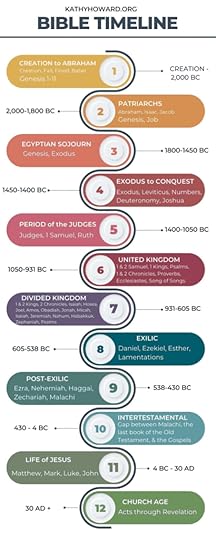 Major Events within the Historical Periods
So many major events happened within each historical period on the timeline. There simply wasn’t room to include everything. But a few events were so significant, I thought I should at least mention them here.
PATRIARCHS
Call of Abraham (Genesis 12)Abrahamic Covenant (Genesis 15)EXODUS TO CONQUEST
Call of Moses through burning bush (Exodus 3)Exodus of Jews from Egypt (Exodus 12-14)Establishment of the Old Covenant/10 Commandments (Exodus 19-24)Jews enter the Promised Land (Joshua 3)UNITED KINGDOM
Anointing of David by Samuel (1 Samuel 16)Dedication of Solomon’s Temple (1 Kings 8 & 2 Chronicles 7)DIVIDED KINGDOM
Fall of the northern kingdom of Israel to Assyria in 722 BC (2 Kings 17 & Final deportation of southern kingdom, fall of Jerusalem, and destruction of the temple by Babylon in 586 BC (2 Kings 25 & 2 Chronicles 36)EXILIC/POST-EXILIC
Persia’s king Cyrus’ degree to send Jews back to Jerusalem in 538 BC (2 Chronicles 36 & Ezra 1)Completion of 2nd temple in 515 BC (Ezra 6)LIFE of JESUS
Birth of Jesus in 4 BC (Matthew 1, Luke 2)Death and Resurrection of Jesus in 30 AD (Matthew 27-28, Mark 15-16, Luke 23-24, John 19-20)CHURCH AGE
Arrival of the Holy Spirit on Day of Pentecost (Acts 2)Conversion of Saul of Tarsus (Acts 9)Destruction of 2nd Temple by Rome in 70 AD (This event is not described in a historical account in the Bible. However, it was prophesied in Scripture and many scholars believe its rebuilding holds a significant place in end time events.)Have you been confused over the Bible’s timeline? Is so, what part has been most confusing?
August 22, 2023
What is the Post-Exilic Period in the Bible?

The term “post-exilic” refers to a specific time frame in the history of the ancient Jews. It includes their return to Judah after their exile in Babylon and the restoration of Jerusalem, which was destroyed by Babylon’s King Nebuchadnezzar.
You may not be familiar with this part of Old Testament history, but it’s my favorite. First, God showed Himself to be a Restorer and a Faithful Promise-Keeper. And second, we get to see how God made His final preparations for the Savior’s earthly arrival. (See also “6 Reasons to Read and Study the Old Testament.“)
Why did God Exile His People?For centuries, the Jews had wandered far away from God. Through His prophets, God had repeatedly called them to repent from their idolatry and disobedience, but they refused. So, God used the nation of Babylon as His tool of discipline. In 586 BC, after two earlier deportations of select Jews (605 BC and 597 BC), Babylon destroyed the temple and much of the city and carried Judah’s King Zedekiah away to Babylon on chains. (If you’re interested in learning more about the Jews’ time of exile in Babylon read the books of Esther and Daniel. I also have an enhanced reading guides available for DANIEL at a small cost. Check out DANIEL here .)
Although God’s people had rebelliously rejected Him, He still had a plan for them. But they needed to be refined for His purposes. That preparation required seventy years of exile in a foreign land.
What did God Promise for the Future?Although God disciplined His people, He was not finished with them. He had a future plan and purpose for them. Through the prophet Jeremiah, God promised restoration. After 70 years of exile, God would gather them from their places of exile and return them to Jerusalem. He would once again establish His people in His land, and carry out His good purposes through them. (See Jeremiah 29:1-23 for this prophecy.)
How did God Accomplish the Return?
God moved the heart of a pagan king to return His people to Jerusalem (See Ezra 1:1). In 538 BC, after the Medes and Persians conquered Babylon, King Cyrus of Persia issued an edict encouraging the Jews to return to Jerusalem and rebuild the temple.
Although Babylon destroyed religious shrines and temples, confiscated valuable sacred items, and carried the people away from their homeland to Babylon, Cyrus had a different policy.
Cyrus believed in preserving the various native cultures, beliefs, and religions. He helped the conquered peoples repair or rebuild their temples. He returned sacred items and encouraged the exiled people to return to their own land and own laws. This policy helped maintain order and reduced rebellion against Persian.
What Bible Books Cover the Post-Exilic Period?Five Bible books – two historical and three prophets – are considered to be “post-exilic.” The Jews’ return from exile is recorded by the historical Bible books of Ezra and Nehemiah. (See also “5 Tips for Understanding Biblical Narrative.“) They describe the rebuilding of the temple and the wall in Jerusalem, the re-settlement of God’s people in the city and surrounding areas of Judah, and the re-establishment of the Jews’ religious life. (See also “How is the Bible Organized?“)
God also sent prophets during this post-exilic period. Three of them are included in the biblical canon – Haggai, Zechariah, and Malachi. (Also see”The Post-Exilic Prophets” and “Surprised by an Old Testament Prophet.“)
What Happened During this Time Frame?In case you like history, or just want to know… The following timeline gives the historical perspective of the events leading up to the exile, the Jews’ return to Jerusalem, and the restoration of the nation:
586 BC – Babylon burned Jerusalem, destroyed the temple, and executed the third and final exile of God’s people to Babylon 539 BC – Persia conquered Babylon538 BC (Ezra 1) – Degree of King Cyrus of Persia which allowed the Jews to return to Palestine and provided resources for rebuilding 536 BC (Ezra 3) – Temple construction began under leadership of Zerubbabel530 BC (Ezra 4) – Temple construction halted due to opposition 522 BC (Ezra 4) – Darius the first becomes king of Persia 520 BC (Ezra 5) – Haggai and Zechariah began their prophetic ministry520 BC (Ezra 5) – Temple construction resumed 516 BC (Ezra 6) – Temple completed458 BC (Ezra 7) – Ezra led second group of exiles from Babylon to Jerusalem from Babylon during the 7th year of King Artaxerxes to renew God’s law with the people445 BC (Nehemiah 2) – Nehemiah traveled to Jerusalem from Babylon to rebuild the wall of Jerusalem433 BC (Nehemiah 13) – Nehemiah returned to Babylon for a time432 BC (Nehemiah 13) – Nehemiah returned to Jerusalem and undertook final reforms430 BC (Malachi 1) – Malachi began his prophetic ministryWant to join me in a study of Ezra?This Saturday, August 26th, I will be starting a 4-week study of Ezra. It all happens on the closed Facebook group “Reading the Bible Together.” To join this FREE group, follow the link, request to join, and answer the 3 easy questions. Here are the details of this FREE group.
What is the Post-Exilic Period in the Bible? by Kathy Howard.
August 15, 2023
10 Promises of God for His Children

When my kids were young, I learned the hard way to be very careful about making promises. Why? Because sometimes, no matter how much I may have wanted to keep the promise, the circumstances were beyond my control.
For instance, a promise of a trip to the park could be quickly shattered by a thunderstorm. A promise that daddy would be home soon could be easily derailed by a traffic jam. Broken promises like these didn’t do much for the mother-child relationship. And one of my children was particularly sensitive to any breech.
Unlike the promises of earthly parents, we can completely trust the promises of our heavenly Father. (For more on this Father/Child relationship see “We are Not all God’s Children.“) We can hold tight and hope fully because our God will always keep His promises (Hebrews 6:17-19).
God, the Promise-KeeperGod does not break promises. Period.
He keeps promises because He is good and faithful. He keeps promises because there are never circumstances beyond His control, never situations He did not foresee.
The absolute security of the promises of God is like an anchor for our souls in times of trouble (Hebrews 6:19). This anchor produces hope that holds us fast and sure as the waves of life toss us about. We may get a little seasick, but we won’t drift away in the current. We won’t sink in the waves.
Your life may be filled with hardship and heartache. But whatever you’re facing today, God knows and He is able. You can trust in His presence and hold fast to His promises. Find comfort and peace today in His Word. (One thing to keep in mind: Sometimes we mistakenly claim proverbs as promises. But, proverbs are principles for wise living, not promises. See “3 Tips to Help You Understand Proverbs” for more on this.)
10 Promises of GodThe following Scriptures are just a sample of the many promises God makes in HIs Word. (Check out this post for a few more.) These promises are not for the world, but for God’s children, those who have entered into a saving relationship with Jesus. (If you aren’t sure, see “How to Know Jesus.”)
God will be present with you (Isaiah 43:1-2) – God does not promise His people that we won’t go through trouble. But He does promise He will go through it by out side.God will provide for your needs (Matthew 6:25-33) – Jesus assured us that the Father knows our every need and will meet it. Sometimes His provision doesn’t look exactly like what we expected. So, although we cannot trust in a specific provision, we can trust in our divine Provider.God loves you (Romans 8:39) – No matter the quality of your other relationships, as a child of God, we can always depend on our heavenly Father’s love for us.God will ease your fears (Psalm 34:1-7) – God is greater than anything that can hurt or harm us. He can deliver us from trouble and whatever He does allow into our lives He will deliver through it, even if it’s all the way to glory. We have no need to fear what today or tomorrow holds because God hold us.God will trade His peace for our anxiety (Philippians 4:4-10) – When we bring our anxious thoughts to God and meditate on His good things, He will trade our anxiety for His peace.God will give you soul rest (Matthew 11:28-30) – This world gives us lots of burdens to carry. But God invites us to lay them down and experience His rest.God gives us spiritual protection (1 Peter 1:3-5) – When we enter into a saving relationship with Jesus, we never have to wonder if we will “get to heaven.” God spiritually shields and protects those who belong to Him.God will always provide a way to say no to temptation (1 Corinthians 10:13) – We do not have to give in to temptation. God promises to show us a way out and the strength to say “no.God gives contentment in any situation (Philippians 4:10-13) – No matter our physical circumstances – plenty or need – Jesus will give us the strength to be content.God will make all things right (Revelation 21:1-4) – At the end of history, when Jesus comes again, God will abolish all sin, grief, death, and mourning!Which one of these passages spoke to you today? What promise of God do you need to hold tight to?
August 8, 2023
10 Characteristics from Philemon We All Need

The book of Philemon may be short, but it packs a powerful spiritual punch. Paul’s letter to his Christian brother Philemon gives us a window into Paul’s personal life and relationships, showing us how the apostle lived out his faith in real life. We see a side of Paul we sometimes miss. Paul wasn’t just the bold evangelist and fierce protector of the truth of the Gospel. This letter reveals Paul’s compassion for others and the joy he experienced in relationships. (See this article for a brief summary of Philemon.)
Although the letter doesn’t give us all the particulars, we can grasp the basic situation. The slave Onesimus, ran away from his master Philemon, then encountered Paul in prison and accepted Jesus through Paul’s efforts. Paul wrote to his friend and fellow believer Philemon to urge him to treat his slave in a Christlike manner.
At first read, this particular situation may feel foreign to us. The epistles in the Bible were written thousands of years ago by a particular person to a particular group/individual with a particular purpose. However, these divinely-inspired letters also teach eternal, spiritual principles that are just as applicable to our lives today.
For instance, Paul’s letter to Philemon strongly demonstrates faith principles and personal characteristics we should emulate in our own lives today. This personal epistle specifically teaches godly principles for our personal relationships and within the church (See “8 Tips to Help You Understand the Epistles.“)
Ten characteristics to Emulate from PhilemonEncouragement – Sometimes we have an unbalanced view of the apostle Paul. We tend to highlight the much-needed correction and rebuke often found in his letters and miss the words of encouragement and affirmation he also liberally gave. Paul was indeed an encourager. In his letter to Philemon, Paul acknowledged the Christ-like qualities Philemon exhibited (Philemon 1:5, 7). The life of faith is not easy. We all need to hear that our efforts make a difference. The purpose is not to build self-esteem or instill pride, but rather motivate to keep pressing on. Even a small amount of encouragement goes a long way.Prayer – Paul didn’t merely pray for Philemon; he also told Philemon exactly how he was praying for him (Philemon 1:4-6). Paul thanked God for Philemon and asked God to make him even more effective in his service. Like Paul, let’s faithfully pray for our fellow believers and also tell them we are praying. The knowledge of our prayers is not only another source of encouragement, but they can also anticipate God’s answer! (See “1 2 Scripture Prayers to Pray for Others.” )Service – God can use us for His purposes no matter our circumstances. Paul was in prison. Yet his chains were not a problem for God. Paul continued to mentor and evangelize. His obedience to God resulted in spiritual fruit, including the salvation of the fugitive slave, Onesimus (Philemon 1:8-10). Likewise, our circumstances, no matter how trying or limiting, are not obstacles for God. He can and will continue to use us, as we seek His will and step out in obedience.Mentoring – Paul didn’t merely lead Onesimus to salvation in Christ. Paul also set him on the path to spiritual growth and helped equip him for service (Philemon 1:10-13). The once “useless” Onesimus, was now “useful” to Philemon, Paul, and the Kingdom of God. As members of God’s household, we all have the same responsibility – to help others along in their walk with Christ. No matter where we are in our spiritual journey, there will always be someone who can benefit from our experience and encouragement.Relationships – The reconciliation of the broken relationship between Onesimus and Philemon was a top priority for Paul (Philemon 1:10, 15-16). These two men – master and slave – had become spiritual brothers. Unity and peace were not only vital to their well-being and spiritual health, but it was also vital for the health of the church. Our relationship with Christ changes and impacts our human relationships. Being God’s child makes us brothers and sisters together with all other believers. We have the responsibility of treating each other with love and respect. We are obligated to do all we can to heal broken relationships and lovingly rectify problems and disagreements.Equality – In that day and culture, the slave Onesimus held the lowest status possible. Society viewed slaves as something less than fully human. Philemon, the slave owner, had been inundated with this prevalent attitude his entire life. So, to Philemon, Paul’s request to receive Onesimus “as a beloved brother” was truly radical (Philemon 1:15-17). This countercultural equality is true for us today. Our equality in Christ leaves no room for favoritism, racism, or prejudice (Galatians 3:28).Forgiveness – Although we don’t know the specifics of the circumstances, it’s clear Onesimus wronged his master Philemon. Traditionally, scholars believe Onesimus ran away and by divine providence encountered Paul in prison, who then led Onesimus to Christ. Whatever the particulars, Paul called Philemon to forgiveness. Philemon had every legal right to severely punish a runaway slave. Yet, Paul asks Philemon to set aside his “rights” and forgive (Philemon 1:17-19). While forgiveness is rarely easy, it’s helpful to remember this truth – we owe our very lives to the forgiveness of Christ. We did not deserve His forgiveness, yet it was freely given.Grace – As a runaway slave, Onesimus had no legal protection, no rights. If caught, revenge and retribution by the slave owner was expected. The law and the culture gave Philemon the right to beat, brand, or even kill the captured slave. “Right” was on Philemon’s side. Yet Paul urged Philemon to respond with grace. Onesimus did not deserve grace. But neither did Philemon. And neither do we. Yet Jesus freely pours out His grace to us, in salvation and every day. And He calls us to extend His grace to others. (See also “ 15 Characteristics of Grace” and Kathy’s 9-week study “ Lavish Grace. “)Accountability – Paul had a God-given responsibility to help his Christian brother Philemon live a life that honored God. We have the same mutual responsibility. Over and over, the Bible calls believers to encourage, exhort, and build up one another in our lives of faith. (See Hebrews 3:13, 1 Corinthians 5:12, and 1 Thessalonians 5:14 for examples.) As we practice accountability, let love and grace be our guide and the spiritual well-being of the body and the individual be our goal.Peacemaker – Why did Paul care about someone else’s relationship issues? Paul desired not only for the problem to be resolved and the relationship between the two be restored, he also longed to see them enjoy a deeper bond as brothers. As Paul modeled, peacemaking is our responsibility as believers. Disunity, strife, and disagreement – even between two – impacts the entire church (Philippians 4:2-3). God desires us to live at peace with others as much as is in our power to do so (Romans 12:18), and to be peacemakers. (Also see “4 Steps to be a Peacemaker.”)Which of these characteristics do you find it the hardest to emulate? Why?
Want to learn more about grace? You can learn about Paul’s experiences with grace and his teachings about grace in Kathy’s 9-week Bible study “Lavish Grace!” For more info see the book’s page. Kathy also regularly speaks on the topic of grace at women’s retreats and conferences.
10 Characteristics from Philemon We All Need by Kathy Howard.
August 1, 2023
Surprised by an Old Testament Prophet

Many of us tend to avoid reading an Old Testament Prophet. I can think of lots of reasons NOT to read them. For instance, they lived thousands of years ago in a land far, far away. Usually, the specifics of their God-given messages were for the people of their day or for the not-too-distant future. And very often, their messages are hard for us to understand or just, well, strange.
(Also see “Tips to Help You Understand the Prophets.”)
Recently though, a prophet named Haggai reminded me how very valuable every part of God’s Word is for believers today – including biblical prophecy.
You know, people haven’t changed much since Adam and Eve got locked out of the Garden of Eden. We still want to do things our own way. We still cling to pride. We still put ourselves, our own goals and our own desires first. We still struggle to honor and obey God.
So, I shouldn’t be surprised when an Old Testament prophet says something that steps on my toes and gives good spiritual direction. Sure, they can call out those ancient Jews all day long. But when I see myself in the prophet’s words…
It happened again just this morning when I was reading the first chapter of Haggai. Let me take a minute to set the stage.
Yes, an Old Testament Prophet is Interesting!The prophet Haggai spoke for God during the “post-exilic” period in Jerusalem. The Jewish remnant had only been back in Judah from exile in Babylon about 18 years.
They first arrived back in Jerusalem in 538 BC under God’s command to rebuild the temple Babylon had destroyed. They quickly got to work. They built the altar and started on God’s house. But in 530 BC, when the surrounding peoples strongly opposed the re-building of the temple, God’s people stopped the work. When things got hard they just gave up, turned away from God’s purposes, and took up their own activities.
Then a decade later, God called Haggai to be His prophet.
On August, 520 BC the prophet Haggai received a message from God to give to the governor, the high priest, and the people in Jerusalem. Here’s my paraphrase of parts of Haggai 1:
“Why are you relaxing in your nice, comfortable houses while MY house is still just rubble? You’ve spent all your time pursuing your own agenda. But pretty much everything you’ve invested in hasn’t paid off. I withheld my blessings because you didn’t obey me. You put yourself and your desires before Me. You need a heart check, to give some serious thought to how you’re living your life. Will you obey me or not?”
Find the eternal, timeless spiritual principleWhen we read and study Scripture, part of our task is to find the foundational spiritual principles on which the details and the time-bound events rest. (For more about solid Bible study see “4 R Bible Study Method.”)
No, we aren’t living in ancient Jerusalem. God has not commanded us to build His temple. But we have a lot in common with the people described in the first chapter of Haggai. The underlying principles of God’s message are just as applicable to us today.
For instance, twice God told the people to “consider your ways” (Haggai 1:5, 7). The Amplified version reads “thoughtfully reflect on your conduct.” The original Hebrew contains the concept of the inner most person, our heart.
Essentially, God asked them to examine their hearts and minds, to evaluate their spiritual condition and their priorities. He called them to reflect on their lives and where they were going. Would they continue in rebellion and stay out of God’s favor? Or would they choose obedience and experience God’s favor (Haggai 1:13-14)?
The message of Haggai hit me right between the eyes. God calls me to “consider my ways,” to keep my priorities straight. He wants me to put Him and His purposes ahead of my own. To obey His commands. Only then can I fully experience His presence and favor.
Let’s not neglect any part of God’s Word. Every piece has value for us today. (Also see “6 Reasons to Read and Study the Old Testament.“)
Want to study a couple of Old Testament Prophets with me?I lead an ongoing Bible reading group on Facebook. On Monday, August 7th, we start 3 weeks in Haggai and Zechariah. All women are invited to join in! By the way, the introduction to the books will post Saturday, August 5th.) We keep a doable pace, an average of about 20 verses a day, 5 days a week. Each day’s post includes the reading, some commentary, and discussion questions. It’s come and go. Pop in when you can. The posts are scheduled for 5am central each day so it will be there when you’re ready. To join, follow link to “Reading the Bible Together,” request to join, and answer the 3 easy questions!
Have you ever read Haggai or Zechariah?


