
Kathy Howard's Blog: Unshakeable Faith for Life, page 10
January 2, 2023
5 Facts about Romans You May Not Know

Romans may be one of your favorite Bible books. It certainly holds a significant place in my own faith journey. (See “I’d Love to Tell You My Story with Jesus.”) Although the book of Romans is widely loved among Christians, there may be some things about Paul’s longest letter that you did not know. The following five facts about Romans will help build a solid foundation for your next reading or study of this beautiful book. (See also “First Steps to Study a Bible Book.”)
You’re invited to study Romans now!By the way, if you’d like to study Romans now, I am beginning a study on Monday, January 2, 2023 in the private Facebook group “Reading the Bible Together.” All women are invited to join! Although not required for the study, some in the group will be using my new meaty devotional, “Deep Rooted: Growing through the Book of Romans,” as an extra resource.
5 Little-known Facts about Romans1. Paul had not met the believers in RomeAlthough Paul knew a handful of the Roman Christians from other places, he had not yet traveled to Rome. Paul had planned to visit the city for some time, however, one hindrance after another had prevented it (Romans 1:13). But, when Paul wrote this letter, a visit to Rome finally felt within his grasp.
Paul likely wrote Romans around 57 AD, near the end of his third missionary journey during a three-month stay in Corinth (Acts 20:1-3). After he left Corinth, Paul planned a quick trip to Jerusalem to deliver an offering he’d collected for the believers there, then he would head to Rome (Romans 15:25-28). But Paul was arrested in Jerusalem. So, when he finally made it to the city two years later, he was in chains.
2. The Bible doesn’t tell us how the church in Rome beganIn the first few decades after Jesus’ return to heaven, Scripture records the establishment of many churches across the Roman empire. But, the church in Rome is not one of them. However, when Paul wrote his letter in 57 AD, the Roman church was firmly established. Although we can’t know for sure, it’s possible Roman Jews in Jerusalem for Pentecost carried the gospel home with them. We do know that Jews “from Rome” were there (Acts 2:10). Perhaps they even heard Peter’s mighty sermon the day the Holy Spirit arrived with power.
3. The letter was delivered by a womanWe may not be certain how the gospel got to Rome, but we do know how Paul’s letter arrived. In his greetings, Paul’s high commendation of a female believer named Phoebe seems to indicate her as the letter carrier (Romans 16:1-2).
Phoebe was a deaconess in the church in Cenchreae, a Greek seaport just two miles east of Corinth. If Paul wrote the letter during a stay in Corinth, perhaps Phoebe stopped by on her way to Rome to pick it up. Phoebe had also significantly participated in Paul’s ministry.
In fact, women occupy a prominent place in Paul’s list of greetings in Romans and represent various walks of life – single, married, mothers. The descriptions also confirm women held significant roles in the early church: Priscilla the teacher and discipler (Romans 16:3-4); Junia a prisoner for Christ (Romans 16:7); and the unnamed mother of Rufus who also mothered Paul (Romans 16:13).
4. Paul worked to foster unity between the Jews and Gentiles in the Roman churchAlthough likely founded by Jewish believers, by the time Paul wrote, the church included a significant Gentile population (Romans 1:13). Sadly, the Jews and Gentiles had trouble getting along. Many of the Jewish believers felt as though they should continue to follow certain aspects of the Law and struggled to step away from the long-held traditions (Romans 14:5-6). But the Gentile Christians understood that their standing in Christ freed them from these legalistic regulations. Paul encouraged believers on both sides to stop quarreling over “opinions” or “disputable” matters (Romans 14:1) and put their fellow believers ahead of their own desires.
5. Paul expected the Roman Christians to partner with him in ministryThe apostle Paul was both a minister of the gospel and a pioneer. For more than two decades he had carried the Good News of Jesus from Jerusalem to Greece, traveling almost 7,000 miles. Now he longed to take the gospel to new territory, to places where the name of Jesus had not yet been proclaimed. For Paul, this meant Spain (Romans 15:24). And Rome was on the way.
But Rome would not simply be a quick stop. He needed time to rest and fellowship with believers (Romans 15:24). He desired to encourage them and be encouraged by them (Romans 1:12). Paul also longed to preach the gospel in Rome (Romans 1:15). But then, Paul planned to take the gospel westward and he needed the help of the Roman Christians (Romans 15:24-28). Their help might include funds, Latin translators, and even a base of operations for ministry to the west.
Did Paul make it to Spain?Although the last biblical historical account ends with Paul under house arrest in Rome (Acts 28:30-31), Paul’s letters and early church tradition offer clues. Likely, Paul was released from this first Roman imprisonment (Philemon 22, Philippians 1:19-26, 2:24) and continued his evangelistic work for a few more years (1 Timothy 1:3, Titus 3:12). Then, based on Scripture (2 Timothy 4:6-7) and tradition, Paul was arrested a second time in the mid-60’s AD and beheaded by order of Emperor Nero. He declared Christ to the end. (To learn more about Paul’s life and ministry, see “Deep Rooted: Growing through the Book of Acts.”)
Did you learn anything new facts about Romans? What is your favorite part of this amazing letter?


December 26, 2022
Help to Read the Bible in the New Year

Most of us start the new year with good intentions. We want to read the Bible more than we did the year before because we long to know God better. So, we start off pretty good. We read consistently for a few days or even a few weeks. Then life starts to get in the way. We miss a day here and there, then the next thing we know we are only reading occasionally.
Have you ever experienced this? I think most Christians have. But it doesn’t have to be this way. With a little help and encouragement, you CAN read the Bible consistently in the year ahead.
3 Tips to Help You Read the Bible More RegularlyHave a plan – Haphazard reading only sets you up for failure. You are more apt to read if you know in advance where you’ll be reading. Your plan can be as simple as choosing a book of the Bible to read through. Or you can choose a reading plan. I have several on my Free Resources There are also apps – like BibleGateway and BlueLetterBible – that offer reading plans and even Bibles that include reading plans. Stay prepared – If you are always prepared to spend time with God, it will be easier to carve out the time each day. For instance, if you keep your Bible and other supplies together and waiting in your regular quiet time spot, you wont waste any time. (For more tips see “11 Tips for a Quality Quiet Time.”)Join a Group – The right kind of group will provide both accountability and encouragement to keep reading. AND of course I have a suggestion…Reading the Bible TogetherFor more than 5 years, I’ve been leading the ongoing, private Facebook group “Reading the Bible Together.” This encouraging, active community includes women of all ages and walks of life who want to be in God’s Word. The members pray for one another and welcome all.
We read through one Bible book at a time, maintaining a pace that allows us to go a little deeper than trying to read through the Bible in a year. I have developed a long-range plan that will take us through the whole Bible in 6 years.
The group fits any schedule. The daily readings and discussion questions post in the group at 5am CT each morning. But, you can stop in anytime. We have women from all over the world so everyone reads and comments when it works best for them.
Here are a few of the highlights of the 2023 reading plan:
52 weeks, 5 days a week 2 “grace” days each week14 full Bible books plus Psalms 42-72Slower reading pace for time to dig deeperAverages 20-30 verses a dayNew “starting” or “re-starting” points with each bookJoin Me for Romans Starting 2ndThe first book of 2023 in Reading the Bible Together is Romans. I’d love for you to join me in an eight-week journey through this incredible letter. Although originally written by Paul to the first-century believers in Rome, Romans is for all Christians. This rich Bible book systematically declares the most foundational truths of our faith. Knowing and understanding these truths is vital for Christians, especially in today’s cultural climate.
All you NEED is your Bible. BUT, you can enhance your study with a copy of my newest meaty devotional “Deep Rooted: Growing through the Book of Romans.” (Available on Amazon.)
I will post the introduction to the book on Saturday, December 31st. The readings and discussion will begin Monday, January 2nd. TO JOIN “Reading the Bible Together,” follow the link, request to join, and answer the 3 questions.
Devotional Study Guides to Help Deeply Root You in God’s Word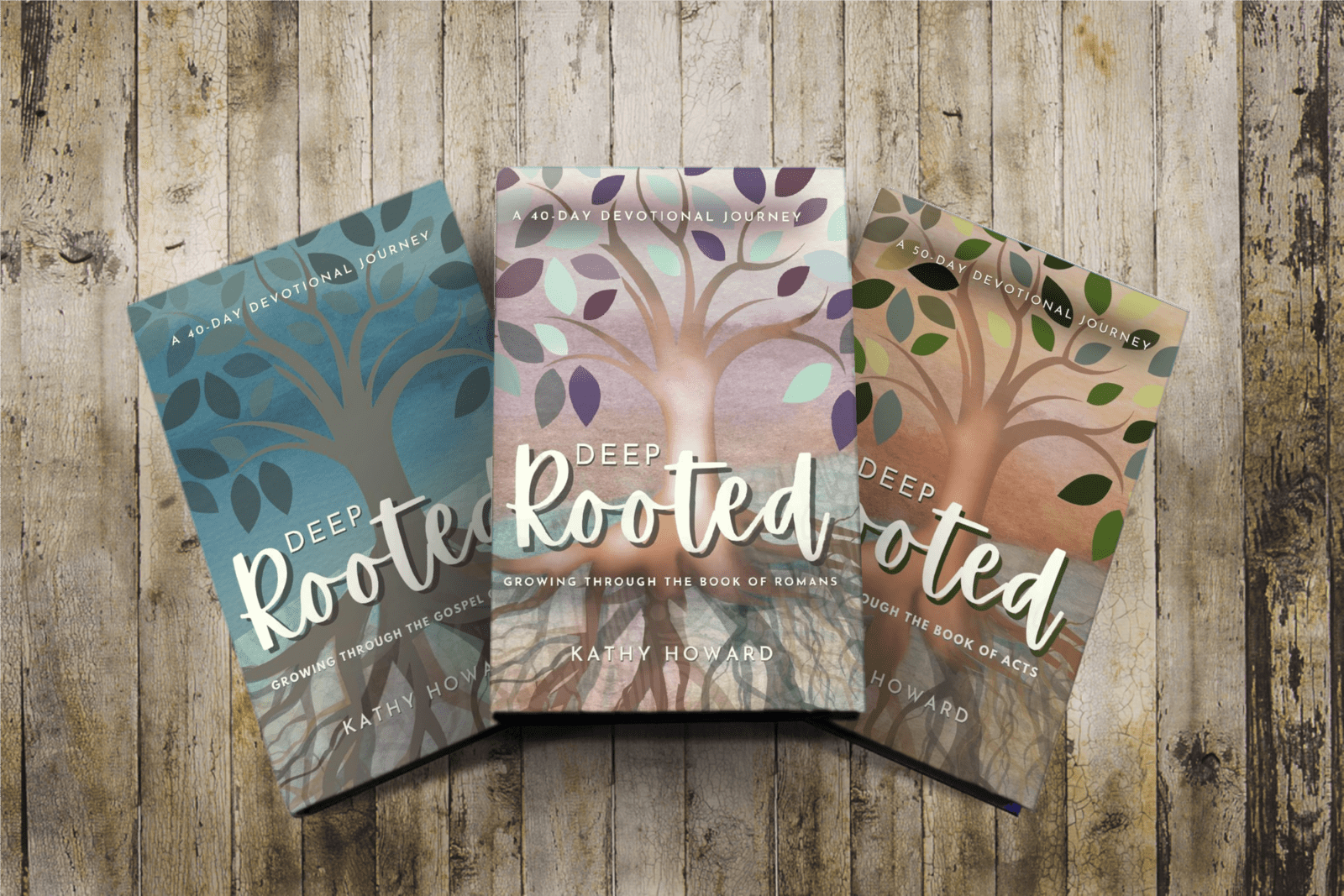
I designed the Deep Rooted devotional series to point you first to Scripture. Each one journeys through one book of the Bible. These “meaty devotional” guides help you learn how to interact with and apply Scripture, not just read it. They are formatted around the 4 R Bible study method which is simple enough to use every day. This inductive method guides you to Read, Record, Reflect, and Respond to God’s Word. If you’d like a little help with your time in the Bible one of these may be just one you need! Check out Deep Rooted Mark, Deep Rooted Acts, or Deep Rooted Romans.
I pray you will get to know God more through His Word in 2023!
What are your Bible reading plans for 2023?
December 19, 2022
Merry Christmas from Ponder

As I write this letter from my home office, I’m wearing red plaid pajamas and a sling. Ten days ago, I had shoulder surgery to repair my left rotator cuff. Therefore, this year has looked far different than usual in the days leading up to Christmas. The surgery forced me to slow down. Essentially to stop. (I will confess though that beforehand I ran crazily around, working to get everything done for Christmas in advance.)
The demands of this season often leave us with little time to ponder what we celebrate. Parties, shopping, cleaning, cooking and more leave us tired and frazzled. I honestly don’t think we should throw it all out, but we do need to make some choices and prioritize, so we can focus on what’s important.
Five years ago, after my husband retired, we moved from Houston to be near our grandchildren. Ponder is the name of the little town in North Texas where we now live. The word “ponder” means “to consider something deeply and thoroughly; to meditate.”
Beautiful irony, right? The gal who thrives on “to do” lists and a full calendar lives in Ponder. My address regularly reminds me to slow down and meditate on the things of God. We can even do that in the middle of the busiest time of year.
Mary Pondered God’s MiracleThe stable was certainly a busy place the night Jesus was born. On the heels of Mary’s labor and delivery a bunch of shepherds straight from the fields rushed in to visit. But Mary didn’t get all worked up. In fact, Scripture tells us she took the time to deeply consider everything God was doing.
But Mary treasured up all these things and pondered them in her heart. Luke 2:19 NIV
We can do the same. Even in the bustle of Christmas we can take a few moments to ponder God’s gracious gift to us in Jesus. Though He was God, He humbled Himself to become man. He willingly on a cross to pay the price for our sins so that we could be made right with God. Jesus came to change our lives, now and eternally.
I came that they may have life and have it abundantly. John 10:10 ESV
Small challenge to PonderI encourage you to make some space this week to ponder the greatest gift ever given. The following Scriptures make great passages for reflection and prayer. Choose one to read and ponder sometime this week. Or ponder them all between now and Christmas day:
Isaiah 9:6-7John 1:9-18Philippians 2:5-8Romans 5:6-112 Corinthians 5:17-21A Little News from the Howards
We’ve had a wonderful, but active year. I wrote and launched a new devotional book through Romans and had a busy speaking calendar. Wayne and I traveled to visit friends and even took a family vacation to the beach! (Thus, the pink flamingo themed family pic!) AND, Wayne and I both had surgery. Believe it or not, he had arm surgery to repair two torn triceps tendons four weeks before my shoulder surgery. He is still wearing a brace so the two of us together make quite a sight.
So, although the surgery was not welcome, I am grateful for the forced pause. I have slept in, rested, and watched corny Christmas movies. I have contemplated God’s blessings. I have woken in the night and heard God’s prompt to pray for others.
This week, I plan to spend some time evaluating my spiritual health and setting some goals for the new year. (If you’d like to know more about this, see “Plan for Spiritual Growth in the New Year.”) We will also spend Christmas Eve and Christmas Day with our family. AND this year, I don’t have to do a thing. That’s one plus of the sling – our daughters are doing all the cooking!
May you have a beautiful holiday celebrating the birth of our Savior,
Kathy
December 12, 2022
How Can I Help?

Want to know God more in the year ahead? How can I help you experience that?
The best way to deepen your relationship with God is through deepening your relationship with His Word. God has revealed Himself, His will, and His ways to us through Scripture. God wants us to know Him and the way He has provided is the Bible. Yet, according to the 2022 study, “State of the Bible,” only about 20% of Americans read the Bible more than once a week.
If we come to know God through His Word, why don’t we read it more? According to this same study, the two biggest frustrations for people in regard to trying to read the Bible are “not enough time” and “don’t know where to start.”
I love to see God’s people regularly reading the Bible, growing in their confidence of rightly handling Scripture, and then intentionally applying its truths to their lives. I certainly don’t have all the answers, but I do have some tips and resources to help. These have been developed from study, my own experience, and years of listening to and encouraging others.
A Few Tips to Make Best Use of Your TimeWhile we all have the same amount of time in the day, some of us have more demands on our time than others. Some have said “yes” to too much. With some honest evaluation we can build more margin in our lives by letting go of over-commitments.
Others of us are in a season of life in which we have little control over our own calendars. For instance, mothers of young children and caregivers often are just doing what they can to get through another day.
Many more of us have simply allowed our time with God to fall in our priorities. Here, a fresh commitment and a plan can give us the help we need.
If time is a frustration for you, the following articles and resources can help:
8 Tips for Moving Quiet Time from “Want To” to “Get To” Only Have 15 Minutes for a Quiet Time 7 Tips to Start of Restart a Quiet Time with God 9 Tips to Help You Stay Focused during Your Quiet Time The Sacred Cow of Busyness – Old post but still relevant!A Few Tips to Help You Get Started in ScriptureBible reading and study can be overwhelming. Many don’t know where to start reading. Others read but don’t feel confident in understanding what they read. First, if this is you, you are not alone! Second, help is on the way!
In the following list, you’ll find resources like Bible reading plans and Bible study tips. I teach a simple Bible study method that is easy enough to use every day, so links to that is in the list below. I even lead an ongoing daily Bible reading group for women that provides structure, help, and encouragement. That’s there too. (By the way, we will be starting the book of Romans in January!)
4 R Bible Study Method for Everyday Use – This post is also packed with additional links that will help you get the most out of your Bible reading and study time, like Bible Highlighting Tips. Video Teaching of the 4 R Bible Study Method 9 Tips to Help You Interpret the Bible Reading the Bible Together Facebook Group Free Discipleship Resources including Bible Reading Plans, Scripture Memory Tips, and More “Deep Rooted” Devotionals – These meaty devotional books take you through one book of the Bible at a time and helps you dig in for yourself. If you are new to Bible reading/study or making a re-commitment, this is a great place to start..For Women’s Ministry LeadersPlanning for the year ahead? I’d be honored to partner with you in ministering to the women God has placed in your care. Retreats, conferences, and workshops are a great way to encourage and equip the women. My favorite event this past year was a one-day conference to help the women get into and study God’s Word! I’d be happy to chat with you about your church and your women’s needs and how I might be able to help. (See the About page for more on my education and experience or the Speaking page for ideas.)
How Can I Help?Still have questions not addressed above? I’d love to try to help or point you to someone who can. Leave a comment or contact me privately.
December 5, 2022
Plan for Spiritual Growth in the New Year
I have two grandsons that are 10 weeks apart in age. These cousins are constantly measuring themselves against each other to see who is taller. They both want to be the tallest one, but of course they don’t have any control over their height.
Thankfully, spiritual growth is not like physical growth. We do have some control over our spiritual maturity. Although only the Holy Spirit can bring about spiritual transformation in our lives, He won’t do it without our obedient cooperation.
As this year ends, it’s a good time to look at where we’ve been and evaluate our current condition. Then we can set some goals and plan for spiritual growth to take us purposefully into the new year.
Why We Should Plan for Spiritual GrowthYou may think this sounds a bit too analytical to be “spiritual.” But Scripture is full of directives for us to be purposeful in our spiritual growth and discipleship. For instance, Paul told Timothy to “train” himself for godliness (1 Timothy 4:7-8). Planning and goal setting doesn’t mean God is not in it.
Haphazard discipleship will always yield haphazard results. But purposeful discipleship, guided by God, will yield spiritual growth and deeper intimacy with God.
I’ve personally done this for several years now. First, I do a spiritual year-end review. I evaluate my progress – or lack of progress – and think about where I wanted to be. Then I set some goals and strategies to get there.
I’ve developed a couple of resources to help with this process. I’d love to share them with you!
Look Back and EvaluateBefore we can plot a course ahead, we need to know where we are. We can start by asking ourselves some general questions about our current spiritual health and the quality of our relationship with God and others. Questions like these:
What did I learn about God?In what ways did my faith grow?How did I purposefully cultivate my relationship with God?Was I disciplined in Bible study?Was I vitally connected to my local church?In what ways did I serve and minister to others?Do I have relationships that are strained or need to be repaired?Use this evaluation form to help with this process:
Set Goals for the New YearAfter we get a good idea of where we are, we can purposefully plan for spiritual growth in the new year. It is not “unspiritual” to set goals and develop strategies to meet those goals. In fact, it’s being good stewards of God’s calling on our lives.
Word of Caution: It’s easy to set unrealistic goals or to try to tackle too much in one year. We want to experience some success in our discipleship. So, check our “5 Tips for Setting Spiritual Growth Goals” for some direction.
The “Spiritual Goals Worksheet” is a great planning tool. It includes tips for goal-setting and lists many specific disciplines under broader categories like “Bible intake.”
A Glimpse at My Goal-SettingThese resources are just tools. Spiritual growth is not a science. Each year I meet some goals and fall short of others. But, the missed goals give me a good starting place for the new year.
One area where I really struggle is Scripture memory. I know it’s important for my spiritual health, but I’d always been very sporadic with the discipline because it takes time, purposeful effort, and determination. (Why bother with memorizing Scripture when we have such easy access to God’s Word? See “Why I Tackle Scripture Memory & How I Do It.”)
A few years ago, God prompted me to memorize part of Philippians 4 to prepare for a conference where I would be teaching from that chapter. I worked hard and memorized Philippians 4:4-13 by the end of January.
Memorizing the passages blessed me by solidifying God’s truth in my heart and mind. So, I committed to memorize the rest of Philippians by the end of that year. I did not reach that goal, but I did make progress. And through what I did memorize, God ministered to me in new ways. The truths of Philippians came alive for me like never before.
So, for the next year I recommitted to finish memorizing the book of Philippians. And I did it! What had originally been a 12-month goal turned into a 20-month goal. And that’s okay! Again, the evaluation and goal-setting are just tools to keep us moving forward.
What about you? What is the number one area in which you’d like to grow spiritually in the year ahead?
November 28, 2022
5 Gift Ideas for the Bible Study Lover on Your List

The Christmas season has officially started! That means carols, decorating, and shopping. It’s a busy time, but I’d love to help! Check out the following gift ideas for that person on your list who loves to read and study the Bible.
There are a couple of great things about the following ideas. First, depending on your budget, you can give one item or bundle them for a bigger gift. Second, since these gifts are tools for spiritual encouragement and growth, they offer great benefit to the recipient.
5 Gift Ideas for the Bible Study Lover“How to Read the Bible for All Its Worth“ – This easy-to-read book, written by Gordon Fee and Douglas Stuart, lays out the basic techniques for proper Bible study. It’s helpful for the beginner or the longtime student. I refer to this book regularly. Every Bible lover should have this book on their shelf. Journaling Bible – When I began using a single-column, wide-margined journaling Bible my Bible reading/study time took a big leap forward. Marking right in the passage and then having the space to make notes right on the page helped me engage with the text like never before. (Note: Journaling Bibles have heavier paper for less bleed through!) The one I use is the ESV Single Column Journaling Bible, large print edition. Observation/Writing Tools – I use highlighters and archival ink pens to help me mark my observations in a Bible passage. I use the Pigma Micron 05 Blue pen to underline and make notes. (Here’s a set of 6 in various colors.) I also use a variety of colors of highlighters to mark different types of things in the text. (For more on observation and highlighting, see “10 Observation Tips for Better Bible Study” and “ Bible Highlighting for More Effective Study .”)The “IVP Bible Background Commentaries” – These two volumes give historical and cultural background on every passage in the Bible. I use one or both of them almost every day. You can get the New Testament volume or the Old Testament volume . Or get them both!Deep Rooted Devotionals – Each volume of the Deep Rooted devotionals guides the reader on a deep walk through a Bible book. They help foster a daily habit of Bible study and work to equip the reader with solid Bible study techniques. There are volumes on the Gospel of Mark , the Book of Acts, and the Book of Romans . (By the way, beginning Monday, January 2nd, my women’s Bible reading group on Facebook will be studying Romans. We will use Deep Rooted Romans as an optional resource.)NOTE: Amazon links are affiliate links.
One more opportunity for Bible Study LoversThis may be for YOU instead of for a gift! Consider giving yourself the gift of the Titus Deep Dive ONLINE BIBLE STUDY CONFERENCE. Here’s a few highlights of this 3-day conference:
December 1-3, 2022All online. Watch from the comfort of your couch!$49 ticket gets you lifetime access to videosBible teachers take you verse-by verse through Titus (I’m honored to be one of the Deep Dive teachers!)Plus, more than a dozen breakouts to encourage and equip you!Hosted by Bible study teacher Katie Orr!Get more info on BIBLE STUDY CONFERENCEDo you have any suggestions for the Bible study lovers on our gift list? I would love to know your go-to study help or resource!
5 Gift Ideas for the Bible Study Lover on Your List by Kathy Howard.
November 14, 2022
9 Tips to Help You Interpret the Bible

When you read Scripture are you confident that you interpret the Bible correctly? Although we will always be growing in our knowledge of God and His Word, with the right tools and approach, we can understand the meaning of Scripture. This post gives 9 practical tips to help you “rightly handle the word of truth” (2 Timothy 2:15).
The need to interpret the BibleEvery Bible passage has just ONE MEANING. (See also “Don’t Ask What This Bible Passage Means to You.”) That’s the one God originally gave it when He inspired it to be written. The original meaning is still it’s current and only meaning. Our task as students of the Bible is to seek to understand that meaning and then apply it to our lives.
So why isn’t that meaning always crystal clear for us? Why do we need to do the work of interpreting what we read?
I can sum it up in one word: DISTANCETwenty-first century, western believers are separated from the original meaning of Scripture by language, time, and culture. The Bible was written in Hebrew, Greek, and a little Aramaic. And it was written thousands of years ago in a cultural and historical setting very different from ours today. All of this separates us from an immediately clear meaning of a Bible passage.
Good, solid translations help a lot but they cannot fully bridge the distance gap. That’s why good study techniques are vital. Understanding the Bible doesn’t have to be hard. It just has to be done correctly. (See also, “Why are there so Many Bible Translations?”)
Before you read1. Set aside preconceptions– None of us come to Scripture like a clean slate. We all have previously held understandings, preconceived ideas, and biases. These can hinder or alter a correct understanding of the passage. So, before you begin to read set all these aside and ask God to help you understand His meaning.
2. Recognize the literary genre – The Bible is comprised of different types of literature. We cannot read and understand historical narrative the same way we do poetry or wisdom literature. (For more information see “Quick Tips for Handling 8 Different Literary Genres.”)
3. Know the background – Finding facts like the author, original audience, and the author’s original purpose for writing lays the right foundation for right understanding. This doesn’t always need to take a lot of time. Check the notes of a study Bible or keep a good Bible handbook close by. (Take a look at “Talk Thru the Bible” by Wilkinson and Boa.)
As you read4. Observe the text – Before we can know what a passage means, we must first know what it says. Observation is the first step of inductive Bible study. (Find out more about my 4R Inductive Bible Study Method.) Recording things like facts, commands, lists, key words, and comparisons helps us determine what it says. (For more about observation see “10 Observation Tips for Better Bible Study.”)
5. Identify any figurative language – The Bible uses many literary tools like metaphors, similes, and hyperbole. For instance, Jesus said, “If anyone comes to me and does not hate his own father and mother and wife and children and brothers and sisters, yes, and even his own life, he cannot be my disciple” (Luke 14:26 ESV). Jesus used hyperbole here to show that He alone is first in our lives.
6. Keep the passage in context – Taking a verse or passage out of its original context may be the most common mistake we make as Bible students. We should consider a passage’s literary, historical, and cultural contexts. (For more on context see “4 Tips to Help You Understand the Bible” and “How Literary Context Helps You Understand the Bible.”)
After you read7. Use cross-references to clarify – One of the best ways to add insight or clarify a confusing passage is to look up other passages that deal with the same topic. You can find cross-references for every passage in a study Bible or a concordance. Good Bible students always interpret Scripture with Scripture!
8. Summarize, paraphrase, or outline the passage – This step will help you think through what you observed and give shape to your understanding.
9. Look for application – One reason we interpret the Bible is so we can apply its truths to our lives. Now identify things like spiritual truths, commands, and principles for godly living. God wants to use these to shape your beliefs, attitudes, and actions.
Did any of these tips surprise you? Which of them do you think will be most helpful to you? Why?
November 7, 2022
5 Tips for Understanding Biblical Narrative
I love to read. I read fiction and non-fiction. In fiction, I particularly like legal thrillers, biblical fiction, and historical fiction set in WW2. I also read lots of biblical commentary and theologically heavy non-fiction. I don’t handle all these types of books the same way.
For instance, I don’t use biblical fiction to shape my understanding of Scripture. When I read historical fiction, I can separate the historical facts from the fictional characters and story plots. I also understand that the commentaries I read are educated opinions on what the Scriptures say, but they are not inspired like the Bible.
The Literature Type Impacts Our UnderstandingThe type and form of the literature I read dictates how I should understand it. The same is true for the Bible. The Bible is literature containing multiple literary genres. Depending on how it’s broken down, God’s Word includes six to eight different genres. We cannot treat all these the same. The genre shapes how we should understand it. (See “How Biblical Genre Impacts Our Understanding” for an overview of the various biblical genres.)
Historical narrative is the most prominent form of biblical literature comprising about 40% of the Bible. It teaches us God’s truth through story. Biblical narrative includes the history books of the Old Testament, the book of Acts, and parts of the Gospels in the New Testament. (The Gospels are actually a unique blend of several literary forms – historical narratives, prose, parables, etc. For more info, see “4 Tips for Understanding the Gospels.“)
5 Tips for Understanding Biblical NarrativeLook for what the story teaches us about God’s character, nature, and ways – God is the hero of every Bible story. The human characters are secondary. They are flawed people. But God is the perfect central character of every story in Scripture. As you read, watch for what the story teaches you about God. How He relates to mankind. How He works through people to fulfill His will. How He works through the events of history to carry out His purposes.Narrative is descriptive, not prescriptive – Biblical narrative tells us what happened, not necessarily what should have happened. It tells what the characters did, not necessarily what we should do. For instance, in Judges 6, God called Gideon to deliver the Israelites from the Midianites. But Gideon was afraid and doubted God would do what He promised. So, Gideon asked God for a sign to confirm His word – not once, but twice! (See Judges 6:36-40.) He tested God and His word. God patiently confirmed His word through Gideon’s test, but that doesn’t mean we should do the same.Look for implicit meaning – Narrative often teaches indirectly. The plot of every story isn’t God’s direction for us. For instance, God told Noah to build an ark, but that doesn’t mean we should build an ark. However, through Noah’s story, we do learn that God wants us to obey Him even when His directions don’t necessarily make sense to us.Narrative should not be treated allegorically – Scripture does contain some allegory. Jesus’ parables are one example. And there are instances where another biblical writer gives allegorical meaning to historical events under the inspiration of God. For instance, in Galatians 4:22-26, Paul gives allegorical meaning to Abraham’s two sons Isaac and Ishmael. But those instances are exceptions under the inspiration of the Holy Spirit. We don’t have the authority to see allegory wherever we choose in Scripture.Don’t make assumptions about things God doesn’t tell us – The stories of biblical narrative don’t always give us all the information we’d like to have. But we cannot “fill in the gaps.” God has given us what He wants us to have. Sometimes we have to accept that we just don’t know.An Upcoming Chance to Study Biblical NarrativeI lead a daily Bible reading and discussion group for women on Facebook. On Friday, we will finish 10 weeks in Luke. Then we will begin the Old Testament historical book of 2 Samuel. The introduction to the book posts this Saturday, November 12th. Daily readings and discussion begin one week from today, Monday November 14th. I’d love for you to join in! The daily readings and discussion questions post at 5am central time so it’s available for whatever time works for you. Just pop in when you can during the day. Read the passage, think about the questions, read other’s comments, and comment only if you want. It is very casual, but also a very encouraging group! Here’s the link: “Reading the Bible Together.” Follow the link, request to join, and be sure to answer the three questions!
What’s your favorite story in Scripture? What does it teach you about God?
See also:
“4 Tips to Help You Understand the Prophets” “8 Tips to Help You Understand the Epistles” “Plot in Biblical Narrative”5 Tips for Understanding Biblical Narrative by Kathy Howard.
October 31, 2022
First Steps to Study a Bible Book

Want to study a Bible book but not sure how to begin? Before reading chapter one, verse one, doing a little investigation on the background of the book will lay the right foundation and expand your understanding.
Start with the BackgroundThe Bible was not written in a vacuum. It was written within a specific set of circumstances. Since the Bible has just one meaning – the one God originally gave it – the original circumstances surrounding the book can bring clarity. The context of the book impacts the way we interpret the meaning.
This is especially true for the epistles (letters) of the Bible. When I began my study of the book of Romans for a new devotional book I started with the background. I learned some important facts that laid a good foundation for my study. Some of these facts might surprise you. (For more, see “8 Things You Might Not Know about Romans.“) If you’d like to study Romans, my new 40-day devotional, “Deep Rooted: Growing through the Book of Romans,” would make a great guide! (See it now on Amazon.)
The circumstances of a Bible BookWhat background facts and circumstances should we consider? Although not an exhaustive list, the following items are relevant for most Bible books.
Author – God divinely inspired every book of the Bible, but He chose to work through human tools. Every book reflects the personality and background of the author. Knowing the author illuminates certain features of the book . (See also “Who Wrote the Bible & Why Does it Matter” & “Human Authors of the Bible.”) Audience – Every Bible book is ultimately for God’s people of all time. However, each one was originally penned for a specific, more narrow audience. Some books were written to individuals, some to churches, and some to the nations of Israel or Judah. In the New Testament, some were primarily for Jews and others for Gentiles. Knowing the original audience sheds light on the text and helps us determine what content was specifically for that audience and what has application for us today. Setting – Knowing the place, time, and purpose of the book adds depth to our understanding. For instance, the apostle John wrote his Gospel so that readers would experience saving faith in Jesus (John 20:30-31). This helps us understand why he included specific events. Knowing Paul wrote the book of joy (Philippians) from prison teaches us about the nature of true joy.Historical context – Knowledge of the world’s events and powers at the time of writing is very helpful. For instance, a little information about Assyria, Babylon, and Persia expands our understanding of the fall, exile, and return of God’s people in the Old Testament. (See also “4 Things to Consider for Biblical Context.”)Cultural context – Just as today, when God inspired the Scriptures, His people lived in a specific culture with specific values and norms. When a Bible book was written, both the author and the audience had a basic understanding of this culture. It wasn’t necessary to explain this context for the original audience. But we don’t have the same perspective. Without the culture context, it’s easy to misunderstand and thus misapply God’s Word. Things like idol worship, the status of women, religious customs, commerce, and trade all shade and shape the meaning of the biblical text.Places to Find Background InformationSome of this information can be gleaned from the book itself, but there is a wealth of excellent resources to help us with the rest. Here are a few:
Study Bible – Most translations publish a study version that includes brief introductions for each book and notes on the text.Bible Dictionary – The Holman Bible Dictionary is good one!Bible Handbook- Check out Halley’s Bible Handbook Bible Commentaries – You can get single commentaries for individual Bible books or sets that cover the whole Bible. For sets, I like the Expositor’s Bible Commentaries and the NIV Application Commentaries.The IVP Bible Background Commentary – This two-volume set is one of my favorite and most helpful resources for learning about the historical and cultural background of a text. (See the New Testament volume. See the Old Testament volumes.)Online resources – Sites such as BibleGateway.com and BlueletterBible.org provide multiple resources like dictionaries and commentariesWhat are your favorite resources?
October 10, 2022
The Roman Road to Salvation

Are you comfortable sharing the Gospel? Some of us hesitate because we fear how others will respond. And may of us would love to share the Good News of salvation through Jesus, but really aren’t sure how to share it. One helpful “road map” for equipping ourselves to tell others about eternal salvation is the “Roman Road.” This title – a cute nod to the ancient Romans’ extensive and well-maintained system of roads – describes a collection of verses from the book of Romans that outlines our sin problem and God’s solution.
Either memorizing or simply knowing how to find these verses is an easy way for every Christian to equip ourselves so we will always be ready to share the reason for the eternal hope we have in Christ (1 Peter 3:15). Jesus called all of us to tell others about Him, not just the preacher and the missionary. It doesn’t take a seminary degree or a weekend course or a special “calling.” All we need to share the truth is a handful of Scripture verses and a desire to see the lost come to know Jesus.
What is the “Gospel?”Before we hit the “Roman Road,” let’s remind ourselves of the gospel message. Scripture also often calls this the Good News of Jesus because it is the best news ever! In Paul’s first letter to the believers in Corinth, he summarized the gospel in just a few verses:
Let me now remind you, dear brothers and sisters, of the Good News I preached to you before. You welcomed it then, and you still stand firm in it. It is this Good News that saves you if you continue to believe the message I told you—unless, of course, you believed something that was never true in the first place. I passed on to you what was most important and what had also been passed on to me. Christ died for our sins, just as the Scriptures said. He was buried, and he was raised from the dead on the third day, just as the Scriptures said. 1 Corinthians 15:1-4, NLT
 That’s it! That’s the Gospel! Christ died for our sins and rose again to provide eternal salvation. Just like God said He would!
Of course the salvation message is all over the Bible. Everything in the Old Testament points to Jesus – the tabernacle, the sacrificial system, the Law, and the prophets. We could spend eternity talking about all Jesus has done for us and never reach the end of His mercy and grace.
However, when God gives us the opportunity to tell someone about Jesus, we often only have a moment, a small window of time. But a little advance preparation will not only equip us for the moment, it will also give us confidence to open our mouths and grab the God-given chance to share Jesus.
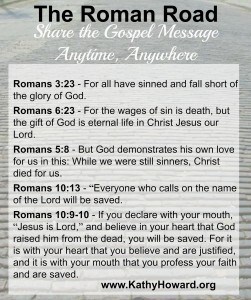
The Roman RoadIn his letter to the Christians in Rome, Paul crafted a beautiful exposition of the Good News. The gospel is the heart and soul of the book of Romans. But there are a handful of verses, that when shared together, present the gospel in a concise, clear way. The “Roman Road” is a short list of verses that show our need for salvation and how Jesus fills that need. I have seen variations of this list that includes 4 to 8 verses. My list below includes 5, easy-to-memorize verses.
Romans 3:23 – Every person has sinned, has done things contrary to God’s holy perfection.Romans 6:23 – Our sin has a cost. That cost is spiritual death or eternal separation from God.Romans 5:8 – Because God loves us, He paid our sin debt Himself. Sinless, perfect Jesus died in our place.Romans 10:13 – Anyone and everyone who accepts Jesus’ gift, or “calls on His name,” will receive God’s salvation.Romans 10:9-10 – Anyone who believes and confesses that Jesus died for us and rose from the dead will be saved!You can use the Roman Road anytime or anywhere. Here are 3 ways you can use and share:
Mark the verses in your Bible.Print this “printable” version of the verses and put in your purse or wallet.Memorize the verses so you are always prepared!Want to get Deep Rooted in Romans?The book of Romans is so very rich! If the Roman Road whet your appetite for more from this gospel-saturated book, check out my just-released 40-day devotional “Deep Rooted: Growing through the Book of Romans.” Check it out on Amazon!
Do you feel ready to share the Good News of Jesus anytime, anywhere? If not, why not?
Here are a few other resources you may find helpful:
How to Know JesusScripture Memory TipsSalvation Basics Scripture Verses

