
Kathy Howard's Blog: Unshakeable Faith for Life, page 6
December 19, 2023
Look for Jesus in the Old Testament

When you read the Bible, do you look for Jesus in the Old Testament? Everything in the first 39 books of the Bible points to Jesus and His saving work. From Genesis to Revelation, the Bible tells the one story (metanarrative) of God’s redemption through Jesus Christ. Jesus Himself declared that the Old Testament Scriptures “bear witness about me” (John 5:39). (Also see “What is the Metanarrative of the Bible?”)
For various reasons, Christians sometimes avoid reading the Old Testament. (Also see “6 Reasons to Read the Old Testament.“) But if we read it with our “Jesus glasses” on, we will find deeper understanding and greater significance. I am NOT suggesting that we allegorize everything in the Old Testament or add meaning that God did not originally give it. What I do urge is that we recognize Jesus where the Bible itself indicates Jesus is present. Let’s not miss any exciting truth.
Three Ways to Look for Jesus in the Old TestamentWhole classes are taught on this subject so this post can only scratch the surface. But I can give a few ways to spot Jesus in the Old Testament books.
Pictures of Jesus and His Redemptive Work – In the book of Hebrews, the author shows how the elements of the Old Covenant were a “copy and shadow of the heavenly things” (Hebrews 8:5). For instance, the high priest was just a shadow of our perfect High Priest and intercessor Jesus (Hebrews 8:1) and the sacrificial system was a depiction of the once-for-all perfect sacrifice of Jesus (Hebrews 10:12). And let’s not forget the rescue from slavery in Egypt, the Passover lamb, and God’s deliverance of Noah and his family in the ark (1 Peter 3:18-22). All these point to God’s ultimate salvation. (By the way, “Deep Rooted: Growing through the Book of Hebrews” is coming Spring 2024!) Promises of a Savior – Long before the birth of Jesus, God promised again and again that He would send a Savior. As early as Genesis 3:15, God promised that a Savior would defeat Satan. When God called Abraham, He promised that all the families of the earth would be blessed through his descendant (Genesis 12:3). God’s promise to David that He would establish David’s throne forever was a promise of our eternal King Jesus (2 Samuel 7:12-16). And those are just a sampling.Prophecies of Details about Jesus – It’s amazing how many details of Jesus’ birth, ministry, and sacrifice are foretold in the Old Testament. We can find facts from His ancestry and birthplace to His betrayal, death, and resurrection. (For a list of 39 prophecies fulfilled by Jesus see “Is Jesus the Promised Messiah?“)Keep Jesus in Your Bible StudyMy goal for this blog is solely to encourage you to look for Jesus wherever your are reading or studying in Scripture. We cannot properly understand any piece unless we remember that it’s all about Jesus. The redemption story provides the right lens for reading any passage in the Bible. I hope that focus will increase your desire to read the Old Testament and really expand your understanding of the whole of Scripture.
So Much MoreI feel inadequate to really do this subject justice. But I have found a few articles that can tell you lots more. These are far more in-depth and give you more specific direction. I hope you will check them out.
“Where is Jesus in the Old Testament?”“How to Find Jesus in the Old Testament““Christ in the Old Testament“What’s your favorite picture of Jesus in the Old Testament?


December 12, 2023
Free 8-Day Light of Christmas Devotional Guide
Christmas is less than two weeks away. You may be “not even started,” “all done!” or somewhere in between. But wherever you are in that process, it’s not too late to take some time to focus on Who we celebrate. And I want to help.
MY GIFT TO YOU – A CHRISTMAS DEVOTIONAL GUIDE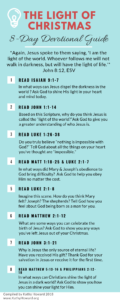 I know your list is long and the days are short, so I’ve put together a mini-devotional that will quickly guide you through a short Bible reading, a truth to consider, and a prayer to voice. These eight days focus on the Light of Christmas.
Ive been thinking a lot recently about the truth that Jesus is the Light of the World. In fact, this very morning I am at a women’s Christmas event teaching on this very thing. In his Gospel, John declared that Jesus is “the true light, which gives light to everyone.” Jesus came to bring the light of salvation to a very dark world.
I love that light is such an integral part of Christmas. The lights on our trees, our homes, and more all remind us of the “True light” (John 1:9). Jesus is the light of the world (John 8:12) who offers life to all people. This dark world certainly needs the light and life of Jesus right now.
DOWNLOAD THE BOOKMARK TO PRINT
DOWNLOAD A SIMPLE PDF TO PRINT
#FreePrintable 8 day #Christmas #devotional guide “The Light of Christmas”
Click To Tweet
I’ve prepared the devotional guide in two forms. You can print either the bookmark size or the full-sheet PDF, whichever you’re more comfortable with.
Stick the guide in your Bible for easy access.Use during your personal quiet time leading up to Christmas.Do the devotional with a spouse or friend, or use for a family devotional time.Record any responses and prayers in a journal or right in your Bible if there is room.A Few Other Resources You May Find HelpfulThe following are a few other resources and blog posts that might meet a need or encourage you or your family:
“l “Quiet Time Tips” to help you build a strong habit in the new year6 Ways to Impact Kids with the Real Meaning of Christmas5 Gift Ideas for the Bible Study Lover on Your ListI’d love to know if you plan to use this devotional and how!
Free 8-Day Light of Christmas Devotional Guide by Kathy Howard.
November 27, 2023
Christmas Ideas & a Cyber Monday Deal

Now that Thanksgiving is over our thoughts turn toward Christmas preparation and activities. I spent all day Friday decorating. Every other item I pulled from the Christmas boxes hit me with warm memories from years past. First I unwrapped the ceramic caroler set my mother painted when I was girl. Every year, nestled by fake snow, it occupied a place of honor on top of the large television console in the corner of our living room. Then I placed the lovely red bird with glittery white wings on a prominent place on our tree. A neighbor gave me the ornament when I was four after I admired an identical one on their tree.
Finally I hung my most treasured Christmas heirlooms on the mantle – fourteen beautiful cross-stitched stockings all in a row. My mother made the first five for me, Wayne, and our three children. She tried to make the next two, one for our first son-in-law and first grandchild. But by then, Alzheimer’s had begun to take hold, so she found someone to stitch them instead. A nice lady with an Etsy store made the next seven for us. Although Mom only made five, the whole collection reminds me of my mother and her love for us. Of her love for Christmas and Jesus. Those stockings are a physical token of my family legacy.
3 Gift Ideas to Encourage Family LegacyI wish I knew more about my parents’ childhood, family history, and faith journey. I really regret not asking them more questions, not spending more time just simply talking to them. Now that both my mother and father are gone, I’ve thought a lot about how I can insure my children and grandchildren don’t have the same regrets.
If you want to encourage legacy in your own family, check out the following gift ideas. I’ve used them myself and even given Storyworth! These also make great gifts for those “hard-to-buy” folks on your list.
Storyworth – Storyworth helps you or a loved one turn the stories of your life into a beautiful book, one question at a time. Each week for a year the recipient gets an email with a question to prompt the story flowing. You can even add photos. At the end of the year, the stories are bound into a hardback book. Ancestry – Discover, build, and preserve your family’s story one ancestor at a time! With a subscription, you can access Ancestry.com’s data banks to fill out your family tree. LegacyBox – Preserve your family’s precious memories! LegacyBox digitizes your film, videotapes, and photos.My kids gave both me and my husband the gift of Storyworth. I took the opportunity to share about my faith journey as often as I could. I want my kids and grandkids to know about my faith. With that in mind, I created a FREE PDF called “Write Your Faith Story.” This resource gives question prompts in several categories to help you write about your spiritual journey with Jesus. These details – your feelings, your spiritual highs and lows will help pave a path of faith for those who come after you. Get this FREE RESOURCE now.
HEIRLOOM Cyber Monday DEALMy devotional book, Heirloom: Living and Leaving a Legacy of Faith, is a beautiful, hardbound book. It’s beauty alone makes it a lovely gift. But the content makes it an impactful one. Heirloom tells stories of the past that still impacts our faith today. These 52 heart-felt reflections reveal the seeds of our faith―seeds that sprouted and took root, growing through the centuries to touch our lives today. Heirloom weaves these stories of faith and family history with Scripture, beautiful artwork, and ancestry research tips and techniques. Through these stories of persevering faith you’ll discover the potential your story has to impact future generations. (Find out more about Heirloom on my website’s book page.)
A copy of Heirloom is also a great way to package a gift like Ancestry, Storyworth, or LegacyBox that’s not a physical item.
I have a big inventory of these books at home, so I want to offer you a GREAT DEAL! If you order at least FIVE COPIES, I will mail them to you at just $10 each! You must order them by Monday, December 4th and have a mailing address within the 48 continental states. Here’s how it works:
1. Email me at Kathy@kathyhoward.org and tell me how many copies you want.
2. I’ll send you a PayPal invoice for the total.
3. When the invoice is paid, I’ll ship them out to you! It’s that easy!
You can order less than 5 copies on Amazon!
How are you doing on your Christmas shoppin g? What gift are you most excited about giving this year?
November 20, 2023
The Gratitude Whistle Stop

This post about gratitude is adapted from “Heirloom: Living and Leaving a Legacy of Faith,” Kathy Howard’s unique devotional that combines stories of faith with practical tips for spiritual legacy and helps for genealogy research.
A train whistle always stops Lloyd in his tracks. No matter where he is or what he’s doing, when he hears the whistle blow, Lloyd pauses to thank God. Sometimes, his prayer is a simple “Thank You, Lord.” Other times, he pauses longer to praise God and thank Him for specific acts of mercy and grace in his life. (Also see “Gratitude is Essential to Peace.”)
The seed for Lloyd’s “gratitude prompt” was planted long ago during happy childhood days spent on his grandfather’s Arkansas farm. One of Lloyd’s most vivid memories of that time was the sound of the logging train that regularly chugged across the property. Thankfulness filled those days. Thankfulness for his strong, gentle grandfather and his example of love and family devotion. Lloyd naturally connected those feelings of gratitude with the sound of the train.
Now, decades later, there’s another train that cuts a path across Lloyd’s Wyoming ranch in the foothills of the Bighorn Mountains. Everyone that visits the ranch hears the story of the train, its whistle, and the reminder it provides to stop and thank God. From family and friends to neighbors and the Wounded Warrior veterans Lloyd often hosts, everyone pauses to thank God when the whistle blows.
King David Practiced GratitudeOh give thanks to the Lord; call upon his name; make known his deeds among the peoples! Sing to him, sing praises to him; tell of all his wondrous works! 1 Chronicles 16:8-9, ESV
After King David triumphantly brought the Ark of the Covenant back to Jerusalem, he encouraged the people of God to express their gratitude. He urged Israel to remember everything God had done and to thank Him for all His wondrous works. Like David, Lloyd knows that continuous gratitude fosters a deeper awareness of God and greater joy in the worshipper’s heart.
A Gratitude Prompt for Our Family God still deserves our praise and gratitude. David’s and Lloyd’s examples encourage us not only to stop and thank God for His marvelous works and good blessings, but to also encourage our loved ones to express gratitude to God. Develop a “gratitude prompt” for your own family by identifying an everyday sight or sound as a reminder to thank God for His many gifts. You could also set a regular time for our family – perhaps around the dinner table – to share these “wondrous works” with each other.
Although thanking God is not hard, Lloyd knows how easy it is to forget. “People don’t take time to stop and thank God for all He’s done. We all need a little reminder.” Lloyd’s reminder is as faithful as the train.
Let’s Talk: What do you do in order to be intentional about gratitude? What are some ways you also encourage your family to express thanksgiving to God?
More about “Heirloom”“ Heirloom: Living and Leaving a Legacy of Faith ” tells stories of the past that will impact our faith today. These 52 heart-felt reflections reveal the seeds of our faith―seeds that sprouted and took root, growing through the centuries to today. Heirloom weaves these stories of faith and family history with Scripture, beautiful artwork, and ancestry research tips and techniques. Through these stories of persevering faith you’ll discover the potential your story has to impact future generations. “Heirloom” makes a lovely gift! (See “ Heirloom” on Amazon .)
November 14, 2023
8 Activities to Help You Memorize Scripture
I 
You’re right. For most of us – me included – it’s hard to memorize Scripture. It requires commitment, time, and purposeful effort. I’ll be honest, my own Scripture memory work has been sporadic. But I’ve experienced that the worth far outweighs the work.
A few years ago while preparing two messages for a women’s conference from the book of Philippians, the Spirit prompted me to memorize Philippians 4:4-13. The process deepened my understanding of the text, helped me embrace the spiritual truths, and personally connected me with that part of God’s Word. (See also “Why I Tackle Scripture Memory and How I Do It?”)
After the conference, I once again felt the Spirit’s prompting to memorize. This time, the whole book of Philippians! With a bit of apprehension, I said yes. It took me about two years, but I did it. Again, the process was hard, but I cherish the connection I have to God’s wonderful truths in Philippians. I want to jump into another large section of Scripture. I’m considering the Sermon on the Mount… or I’m also taking suggestions. What do you think? Leave me suggestions in the comments!
So, if you decide to try memorizing Scripture, how should you go about it? There’s no one right way to do it. Everyone learns a little differently. Keep reading to find out how I do it and to get some other ideas.
My Scripture Memory CardsI’m really old school. First, I write out the verses on 5×8 index cards. Even though I now use other translations for study and devotional reading, I use the NIV 1984 for memory because I have other passages memorized from this translation. Use the translation you are most familiar with. (If you prefer a digital system, check out the BibleMemoryApp!)
Sometimes, when I know I’ll have a few minutes of downtime somewhere along the way, I carry the cards with me. But I also take photos of each card and put them in a folder on my phone. That way, if I’m out and have an unexpected few minutes to review and I get stuck, I simply look on my phone.
I work on a verse – or a thought if it carries over to another verse – at a time. After I read it out loud repeatedly, I begin to say it back from memory. I start phrase by phrase, working up to the entire verse with the reference. When I feel comfortable with that, I add the next verse.
I can summarize my basic memory method with three R’s – Read, Recite, Review. (If you need some direction on where to start memorizing, check out the various Scripture Memory Plans on my resources page.)
8 Helpful Activities to Help You Memorize ScriptureThere are other things you can add to those Three Rs to enhance the memory process. The first two are the most important. The exact benefit of the other suggestions will depend on your learning style. (Also see “Scripture Memory Tips.”)
Consider the context – We want to have a correct understanding of any verse or passage we memorize. Taking Scripture out of its context is probably the most often cause for misunderstanding. (Also see “ How Literary Context Aids our Understanding, “4 Things to Consider for Biblical Context” and “Do You Misuse Philippians 4:13?”)Reflect on Key Truths – Spend a few moments reflecting on the spiritual truths the verse teaches. This will help implant them in your heart and mind. (See also “The 4 R Bible Study Method for Everyday Use.”) For instance, what does the passage teach about God’s character, purposes, and ways? What does it teach about the nature of mankind or salvation or living a life that pleases God?Identify Anchor Words – Identify two to four key words or “anchor” words in the passage to help you remember it. For instance, in Psalm 46:1, three solid anchor words to remember could be “refuge,” “strength,” and “help.” Circle these words on the front of the Scripture card and then write them on the back. Use these words as prompts during the memorization process.Draw a Picture or Symbol – On the back of your Scripture card, draw a symbol or picture that visually represents the verse. For instance, for Psalm 46:1 you could draw a fort or castle. Along with your anchor words, this picture or symbol will be another prompt to remember the truths and content of the verse or passage.Record It (great for auditory learners) – Use your smart phone, computer, or another device to record yourself reading or reciting the passage. Play it back throughout the day to further reinforce it in your memory.Choose an Object (great for tactile learners) – Select an object around your home or office that will remind you of the verse or passage each time you see it. For instance, for Psalm 46:1, a rock or stone object would remind you that God is your refuge, a strong safe place.Use Multiple Cards – Write the verse on more than just your primary card. Place these extra cards wherever you will seem them throughout the day and can take a moment to review – the bathroom mirror, above the kitchen sink, your car visor, your computer monitor, above the washer and dryer, the refrigerator door.Reword it – Rewrite the verse in your own words. This will help you think about the meaning and how it should apply to your own life.Let’s talk! Is there another activity that helped you memorize Scripture in the past you’d like to share?
8 Activities to Help You Memorize Scripture by Kathy Howard.
November 7, 2023
Do You Misuse Philippians 4:13?

We see the verse on coffee mugs, t-shirts, and wall decor. It’s probably the most well-known and oft-quoted verse from Paul’s letter to the church in Philippi:
“I can do all things through Christ who strengthens me.” Philippians 4:13, NKJV
Unfortunately, it’s also one of the verses most often misunderstood and misused. We love that one verse so much we pull it out of its home in the surrounding verses. We hold it out on its own and say, “Jesus gives me strength to do all things.” But is that what it means?
Unfortunately, when we take it out of context we lose the original meaning. We even begin to assign meanings to it God never intended. (See “How Literary Context Helps Us Understand the Bible” and “What is the Metanarrative of the Bible?”)
Let’s say, for instance, I desire to do something big for the Kingdom of God. I have an idea, a vision, of what I’d like to do. But it’s big, really big! Well, if “Jesus gives me strength to do all things,” then doesn’t that mean He will give me the power and opportunities to not only pursue this dream, but also to succeed?
Is that what Philippians 4:13 means? Does it mean that Jesus will give me the power and strength to do whatever I desire to do for Him? Or maybe it means Jesus will give me the power and strength to do what He calls me to do?
Do you #misuse #Philippians 4:13? #context
Click To Tweet
We know from other Scriptures that God does gift and guide, equip and empower His children to carry out His purposes for our lives (2 Thessalonians 1:11; Ephesians 1:19-20; 1 Corinthians 12:7; Ephesians 4:11-13). But Philippians 4:13 does not promise us that God will give us strength to follow our desires or even to carry out His purposes.
So what does Philippians 4:13 mean?
Let’s drop Philippians 4:13 back into the verses immediately surrounding it and see what it means in light of its context. (For more on the “context” of a biblical passage, check out this post: “4 Things to Consider for Biblical Context.“) In Philippians 4:10-14, Paul thanked the Christians in Philippi for the financial gift they sent him. He appreciated their gift, but he was not in desperate need at the moment. In fact, he had learned to be content no matter his physical circumstances. Paul had discovered the secret of contentment whether he was in physical want or plenty.
And what was his secret of contentment, whether he was well fed or hungry? Paul had experienced Christ’s strength within him to endure any and every situation. He found total sufficiency in trusting Christ. Paul gained strength from Jesus to be content with whatever God provided for him.
“I can do all things through Christ who strengthens me,” never meant Paul could do anything because Jesus would give him the power to do it. It meant Paul could endure any difficult circumstance or physical need through the strengthening power of Christ.
#Philippians 4:13 does not obligate God to empower our #plans. #Context
Click To Tweet
Great, incredible truth. Philippians 4:13 does not obligate God to empower our plans. Oh no, it’s far better than that! Jesus will give us the strength we need to endure desperate need. His empowering presence will be with us through every difficult circumstance.
Have you gained a better understanding of Philippians 4:13? Does it encourage you today?
Want to learn more about the proper approach to Bible study? See “4 R Bible Study Method.“
Other posts you might find helpful:
“What do I do with Philippians 3:14?”“The Real Promise of 1 Corinthians 10:13”“The Delight and Desire of Psalm 37:4” “Why Philippians 4:13 doesn’t Mean What You Think”October 31, 2023
9 Tips to Help You Stay Focused during Your Quiet Time

“What are your top two challenges when it comes to prayer, Bible reading, and study?” That’s the first question I asked on Facebook last week. Distractions and trouble focusing overwhelming topped the list.
So, I asked a second question. “What do you do to stay focused during your quiet time?”
I got so many great suggestions, I decided I had to share them with you here. (For some good general tips for having a quiet time see “11 Tips for a Quality Quiet Time with God.”)
Ways to Stay Focused During Your Quiet TimeTake advantage of your natural rhythm – Give God the most alert time of your day. If your brain is the clearest and sharpest first thing in the morning then schedule your time with Him then. On Facebook, my friend Mike said: “Most people have a natural rhythm in terms of being mentally alert. I am most productive in the morning, so I make prayer and study a priority during that time to help me stay focused. I plan meetings and interactions with people in the afternoon and evening. A regular routine is a must for me!” But Teresa said that late afternoon is her best time. “I save study time for late afternoon or evening so I can deeply absorb what I read.”Distance yourself from known distractions – We must be purposeful in reducing any possible distractions. For instance, email and social media pull me in. I had to commit – to God and myself – that I would not open my laptop before I spent time with God first. One Facebook friend said she leaves her phone in another room and closes the door. Obviously, we can’t eliminate all distractions but we can reduce them. Julie gets up before anyone else in the house so she can have quiet for her quiet time. What distracts you the most? If it’s your kids, you may have to get up before them or have your quiet time during nap time. (If kiddos is your biggest distraction, see “How to Have a Quiet Time When You have No Time that’s Quiet.” and “8 Tips for Moving Quiet Time from ‘Want to’ to ‘Get to.’“)Make Jesus as real as possible – When we pray and read our Bibles we are communicating with God! He hears us. We hear Him. Yet we sometimes lose sight of that reality. My friend Trenda works to keep that truth in mind. “I picture Jesus sitting there beside me, talking and listening. Sometimes we have coffee or tea together.”Write it down – Lots of Facebook commenters mentioned journaling and note taking. This is something that helps me too! There’s something about using my hand that keeps my mind focused on what I’m doing. For instance, I bullet or sometimes write out my prayers in a journal to keep my focused. I also use highlighters as I read my Bible and take study notes in my wide-margin journaling Bible. (See “Bible Journaling for Beginners,” “Bible Highlighting for More Effective Study” and “10 Observation Tips for Better Bible Study.”)Get Creative – There are different learning styles. Many of us need a more hands on approach. For instance, Melissa includes lots of artwork and color in her prayer journal. Others artfully depict Scripture in their Bible margins as they meditate on God’s Word. This can also involve traced or drawn pictures, archival quality writing/coloring pens. (For more about creative, artful Bible journaling, see “How to Start Bible Journaling for Beginners.“)Be vocal – I talk to myself all the time. It helps me concentrate. So, I heartily agree with Shanda’s experience that reading the Bible out loud helps her concentrate on what she’s reading. That’s true for praying out loud as well! If you’re having trouble concentrating try reading Scripture and praying out loud. And don’t worry about what anyone else in the house might think!Try shorter, intense times of prayer – Sometimes the longer I pray, the more my mind wanders. My friend Lucille has the same trouble, so she prays more often for shorter periods. Short bursts of intense prayer times. In fact, she prays as often as the Spirit prompts. Pray, stop, repeat often! Brain dump – I first saw this term used by Amy Hale and I started using it right away. Whenever I sit down with God in the morning, the first thing I do is open my journal and write down the top things occupying my mind. It’s a way of freeing up the space for Him. Others use similar tactics. When Kimberly is spending time with God, if a needed task pops into her mind she writes it down. That way, she won’t continue to dwell on it or worry she’ll forget it. Sheila does the same thing. She keeps a blank piece of paper handy to write down any random thought or chore she forgot. Those items are recorded for later and can be set aside for the moment.Train your heart and mind – Georgia has learned that the more she contemplates God throughout the day, the better she can focus on Him during the time she sets aside for prayer and Bible reading. For instance, Georgia listens to sermons while she works and hymns while she cleans. She constantly trains her mind to dwell on God, so when it’s time to focus, her brain more naturally lingers on Him.Let’s talk! Do you struggle to stay focused? If so, what are some things you’ve tried to help? Which of these tips might be helpful to you?
9 Tips to Help You Stay Focused during Your Quiet Time by Kathy Howard.
October 24, 2023
4 Tips to Help You Understand the Prophets

I don’t know about you, but I tend to hesitate before jumping into reading or studying one of the prophets. In the past, I didn’t know how to correctly understand the prophets so I avoided them altogether. Now, I feel better equipped, but I also know I just can’t open up my Bible, read a short passage from one of the prophets and get an easy take-away. Of course, it’s not that easy with any Bible passage, but the nature of prophecy makes it a touch trickier. (Also see “6 Reasons to Read and Study the Old Testament.”)
For many of us, prophecy can be the most confusing type of literary genre. But the prophets are also filled with incredible spiritual truths we don’t want to miss. So, instead of shying away, let’s learn how to approach the prophets. (The Bible contains different forms of literary genres. For more on this see “Quick Tips for Handling 8 Different Biblical Genres.”)
What is “prophecy?”“Prophecy” is God’s word given through His messenger to people – usually His own people, but sometimes others. The important thing to remember is that prophecy is a specific message from God through a human messenger to a specific people at a specific time. The Old Testament includes 4 major and 12 minor prophets. The “major” and “minor” designations are strictly based on the length of the book, not the value of the prophecy. Basically, there are two kinds of prophecy:
“Foretelling” – Refers to a prophet’s predictions about the future. According to the book Introduction to Biblical Interpretation, only 5% of biblical prophecy refers to events in the New Covenant age. And less than 1% refers to events still to come. In other words, 99% of all prophecy in the Bible has already been fulfilled.“Forthtelling” – Indicates messages for the prophet’s own audience about their time or the near future. The prophets were God’s covenant enforcers. Most often, the prophets boldly revealed the ungodliness and idolatry around them. They warned of God’s pending judgment and urged the people to repent before it was too late.A Few Tips to Help You Understand the ProphetsThe following tips are just the tip of the iceberg. We could talk about each tip in great length. But, these tips will give you a good head start as you read the prophets.
Keep the context in mind – As we saw above, prophecy was given by God to a specific people at a specific point in history. If we pull the prophecy out of this context there is a good chance we will misunderstand it. Not all prophecy in the Bible has direct application to us today. However, we can apply the underlying spiritual truths of prophecy to our own lives. For more on context see “4 Things to Consider for Biblical Context.”Don’t get bogged down in symbolism – Symbolic language, word pictures, and poetry fill prophecy. Focusing on the symbolism can cause us to miss the big picture. Look for the major points and overall spiritual truths instead.Be aware of multiple levels of fulfillment – Prophecy often – if not usually – will be “fulfilled” more than once. First, near the prophet’s lifetime and again long after his life. Many of these “2nd fulfillments” are Messianic in nature. The first fulfillment in near history and the second finding its greater fulfillment in Jesus.Look for the “conditions” – Many prophecies are “if/then.” For instance, many of the prophets warned of God’s judgment and called people to repentance. If the people didn’t repent, God would bring His judgment. If they did repent, God would be merciful. The book of Jonah is a good example of this.Note: Apocalyptic prophecy – primarily Daniel and Revelation – presents even more challenges and is beyond the scope of this post.
Don’t be afraid to read and study the prophets! They have value for our lives today. The underlying truths and eternal spiritual principles have solid application for our lives today. Not long God used the prophet Haggai to point out something very specific in my life. (See “Surprised by an Old Testament Prophet.”) You just may be surprised by what God teaches you through the prophets!
Who’s your favorite Old Testament prophet? Why?
October 17, 2023
6 Things You May Not Know about Apostle Paul

I thought I knew him. I followed his ministry. And over the years, I have read and reread his writings. But not long ago, I realized I didn’t know as much about the Apostle Paul as I thought. (For more on how to study the Bible see “The 4 R Bible Study Method for Everyday Use.”)
While studying Paul and his life for the 50-day devotional “Deep Rooted: Growing through the Book of Acts,” I discovered several “new” things about the apostle to the Gentiles. Of course they were there all along; I had simply overlooked them. Maybe some will be new to you too.
6 little-known facts about the Apostle PaulPaul didn’t jump right into long-term ministry (Galatians 1:13-18) – In my mind, Paul met Jesus on a dusty road, spent three days fasting in Damascus, regained his eyesight, then jumped right into ministry to the Gentiles and never looked back. But a closer examination of Scripture tells a little different story. In his letter to the Galatians, Paul wrote he “went immediately into Arabia (Galatians 1:17).” In fact, he didn’t return to Jerusalem for three years (Galatians 1:18). What did Paul do during all this time in Arabia? Many scholars feel this may have been a spiritual retreat for Paul, a time to reconcile everything he knew from the Old Testament Scriptures with his new reality in Christ. In Arabia, Paul could immerse himself in the reality of his Savior and focus on learning and growing in preparation for ministry.Paul’s nephew saved his life (Acts 23:12-35) – After Paul’s arrest by a Roman commander in Jerusalem, 40 Jewish men bound themselves in an oath to not eat or drink anything until they had killed Paul. The Jewish leaders agreed to help them by petitioning the Roman commander to bring Paul before the Sanhedrin for questioning. The assassins planned to attack Paul during the transfer. But the son of Paul’s sister heard of the plot and reported it to Paul at the Roman barracks. When Paul told a centurion, the Roman commander ordered a detachment of almost 500 guards to move him to Caesarea under the cover of night.Saul’s name was not changed to Paul (Acts 13:6-9)– During the biblical account of Paul’s first missionary journey, Luke writes: “Then Saul, who was also called Paul…” (Acts 13:9). From this point forward, Luke only refers to the apostle as “Paul.” This shift does not reflect a name change, as has often been said, but rather a conscious decision on Paul’s part to use a name he already had. Since Paul was a Roman citizen, he was given three names at birth. The third – Paul’s Latin name – better fit the predominately Roman environment. “Saul the Pharisee” chose to be known as “Paul, citizen of Rome.”God gave Paul more than he could handle (2 Corinthians 1:8-11) – Paul and his companions suffered such extreme pressure during a particular situation in Asia they “despaired even of life.” Scholars aren’t sure what event Paul referred to in these verses, but the situation was so dire Paul believed he and his companions might die. He saw no way out of the life-threatening encounter. And indeed, without God’s miraculous intervention, they would have perished. When all human hope was lost God delivered them by His grace through the prayers of the believers (2 Corinthians 1:11). Note: For more about God giving us more than we can handle, see “The Real Promise of 1 Corinthians 10:13.”Paul visited heaven before his death (2 Corinthians 12:1-10) – God gave Paul a glimpse of heaven during his early years as a believer, perhaps during his time of spiritual retreat in Arabia (Galatians 1:17). Paul didn’t know if he had been physically transported or was there in spirit. But he saw and heard “inexpressible things.” Pride would be the natural sinful response to an experience like this, but pride and conceit have no place in God’s servant. Therefore, God allowed something into Paul’s life to foster humility – a “thorn of the flesh.”Paul felt deserted by everyone but God (2 Timothy 4:9-18) – Throughout Paul’s ministry he suffered trials and persecution for the sake of Christ. He was stoned, beaten, imprisoned, shipwrecked, and betrayed. He often went without food, sleep, and shelter. During his Roman imprisonment, he also felt alone with no other person to support or defend him. Demas left him because he loved the world. Alexander did him “a great deal of harm.” Yet through it all, the Lord stood with him. Paul was comforted and strengthened by God’s powerful presence.
6 facts about #ApostlePaul you may not know
Click To Tweet
#Saul did not CHANGE his name to #Paul and other little-known facts
I would love to sit down with Paul and hear all his stories, find out all those things not recorded in Scripture. Perhaps he would recount all the gospel victories and tell me more about the suffering he endured for the name of Christ. Pain and struggle may have marked his life, but God’s lavish grace sustained him every moment.
Want to learn even more about Paul’s life and ministry? I have two resources to help. Check out this 50-day devotional through the book of Acts: “Deep Rooted: Growing through the Book of Acts.” Also see the 9-week Bible study “Lavish Grace” which explores Paul’s writings and life experience with God’s grace.
Was one of these facts about Paul new to you? If so, which one? Do you know any other little-known facts about Paul? What would you like to know about Paul?
Kathy also speaks on the topic of grace and has an Acts retreat theme. She’d love the chance to share at your women’s retreat, conference, or event.
6 Things You May Not Know about Apostle Paul by Kathy Howard.
October 10, 2023
What is the Metanarrative of the Bible?

You may have heard this term in a number of different contexts. But, are you familiar with the metanarrative of the Bible? The term is not strictly a biblical term, but when used to talk about the Bible or Bible study it refers to the “Big Story” of Scripture. Sounds important, but what is it?
Metanarrative of the Bible is the overarching story that ties all the pieces together. Scripture’s Big Story runs from Genesis to Revelation like a bright red thread. This Big Story tells the one, unified story of Creation, Fall, Redemption, and Restoration all under God’s sovereign reign and rule. (For a great and more complete explanation see “Study with Purpose: Seeing the Big Story of the Bible” excerpted from “Women of the Word” by Jen Wilkin.)
An article on GotQuestions used the metaphor of a house to help explain metanarrative. When a house is under construction, various tradesmen like plumbers, electricians, and carpenters contribute their individual pieces towards the overall project. But without the blueprints we miss the big picture of the house. (See “What is a Metanarrative?”)
The Bible includes books of history, law, prophecy, wisdom, and letters. If we miss the metanarrative we might only see the Bible as a disjointed collection of individual books instead of the masterful, divinely-crafted unit it truly is. (See also “Who Wrote the Bible and Why Does it Matter?”) If we miss the Big Story, we might see two “Gods” in the Bible – the one justice in the Old Testament and the one of love and grace in the New. But viewed under the umbrella of the metanarrative, from beginning to end we see our one, holy God working out His divine plan for our redemption and restoration.
The Bible Emphasizes its MetanarrativeAll of Scripture links together to unfurl God’s one divine plan – mankind’s redemption through Jesus Christ. Consider these truths:
The Father planned for Jesus to provide for our salvation before Creation (1 Peter 1:20-21).God’s overarching purpose is to unite all things in heaven and earth to Himself through Christ (Ephesians 1:9-10).God sent Jesus at just the right time in history to carry out His plan (Galatians 4:4-5).God’s promise to Abraham was fulfilled in Jesus (Galatians 3:7-14).Everything God prescribed in the Old Testament was an earthly shadow of the spiritual realities fulfilled in Jesus (Hebrews 8:1-6, Hebrews 10:1-7).Jesus fulfilled specific Old Testament prophecy. (For a list of 39 fulfilled Old Testament prophecies see “Is Jesus the Promised Messiah?”)The Bible’s Big Story Aids Our Bible StudyEverything in the Bible comes into clearer focus when we keep the metanarrative in mind. (Also see “The 4 R Bible Study Method” and “4 Tips to Help You Understand the Bible.”) As you read and study the Bible consider the following:
Where does this story/passage fit in the Big Story?How does the Big Story help me understand this piece?The pieces won’t contradict the Big Story.The metanarrative of Scripture tells us all about God’s desire to have an eternal relationship with us and how He has worked it all out in history to make it possible. It is really the greatest love story of all time.


