Carissa Halston's Blog, page 7
March 5, 2013
The Next Big Thing Blog, brought to you by Gillian Devereux and Jen Michalski
Last October, Jen Michalski (fiction writer and editor extraordinaire) was kind enough to e-mail me to say that she was tagging me in the Next Big Thing Blog Hop and encouraged me to participate.
I thought, That’s so nice! I should say thank you!
I thought that, but I did nothing.
Then, a few weeks ago, Gillian Devereux (poet who may or may not be (read: probably is) magical), called me out on her blog and Facebook, saying, “I’m excited to find out about the next big thing in store for Carissa Halston,” so here I am, responding.
Note: I am an awful friend who only responds to public shame.

THE NEXT BIG THING (for me)
1. What is the working title of the book?
Conjoined States
2. Where did the idea come from for the book?
Among other things, this sentence from Italo Calvino’s novella, Invisible Cities (translation by William Weaver): “Also in Raissa, city of sadness, there runs an invisible thread that binds one living being to another for a moment, then unravels, then is stretched again between moving points as it draws new and rapid patterns so that at every second the unhappy city contains a happy city unaware of its own existence.”
I read that and thought it sounded exactly like living in America.
3. What genre does your book fall under?
Literary fiction.
4. What other books would you compare this to within your genre?
You know that novel you read once that was both funny and sad and made you think about emotional inheritance and the pursuit of finding home when you’re already there? It’s a lot like that.
5. What actors would you choose to play the part of your characters in a movie rendition?
The main character would be played by two different unknown character actors who looked alike, but not so alike as to be mistaken for each other. One occasionally is entirely bald. The other occasionally has short, stubby eyelashes.
6. What is the one sentence synopsis of your book?
We will always be who we are now–who we were then–promise in perpetuity.
7. How long did it take you to write the first draft of the manuscript?
Ten months, off and on.
8 . Who or what inspired you to write this book?
Since this is awfully close to the second question, I’ll instead tell you about what has influenced the drafts as I’ve written them (I’m on the fourth draft now). This quote from Lawrence Durrell’s Bitter Lemons, “We had become, with the approach of night, once more aware of loneliness and time—those two companions without whom no journey can yield us anything.” The we, specifically, set me thinking about how I could literally divide my narrator.
9 . What else about your book might pique the reader’s interest?
There is a chapter for every one of the contiguous United States. The protagonist gets a tattoo in each state. All the tattoo parlors he visits (all 48 of them) are real.
10. Who is publishing your book?
As soon as I know, so, dear reader, shall you.
I’m tagging writers whose work I love. I’m sorry if they’ve already done this, but here they are anyway:
Susan McCarty, Dolan Morgan, Randolph Pfaff


March 3, 2013
Things on the To Worry About list
1/I have a spreadsheet for what I want to do/see/buy at AWP. I’m worried about forgetting something.
2/Submissions just opened for the next print annual of apt. We mentioned it less than usual (since we’ll be talking to writers about it for three days straight this week). We’ve gotten slammed nonetheless.
3/John and Robin (the other two editors at apt) can’t make it to the conference because of a crazy emergency. By crazy, I mean crazy-inconvenient and crazy-sad and crazy-frustrating. I just want to lift them up with my mind and make everything better, but I can’t, so I’m fretting instead.
4/We’re moving this summer and there’s so much to do.
5/I have three library books due on Wednesday. I’ve read two of them, but have yet to start the third. I will start this evening, but I won’t finish by Wednesday. I cannot renew the book because there’s a hold on it. I have two options: return the book on Wednesday and request it again later or keep the book until I’m done reading it, pay the scant overdue fines, but be a jerk to a complete stranger who’s waiting to read this book. Decisions, decisions.
6/We’ve culled at least 250 books from our collection and now we need to get them to a used bookstore so we can sell them, which makes me feel bad (I’ve never sold a book before), but also pragmatic.
7/The woman who lives above me is vacuuming, but leaving her vacuum running in one spot so it sounds like she’s shaving the floor with an electric razor. I wish she’d let it go, then get sucked up inside it, but then the noise would never end.
8/I need to go to Dorchester and the post office and Back Bay and, despite those things being arguably near each other, they feel far apart and the entire trip will exhaust the afternoon.
9/When I type, my hands get very cold (blood going into the wrist and staying there, I think). I worry about poor circulation and, as a result, I sit on one hand and type with the other. After the typing hand gets cold and the sat on hand gets warm, they trade identities. This can’t be good for either hand.
10/I have an important phone call scheduled for tomorrow and I want to be ready. But its level of importance makes me feel like I could never really be adequately prepared. I am concerned about making a list of questions and then forgetting to bring them when the time comes. I am trying to mentally scale this concern because, if I don’t, I won’t make the list at all and then it won’t matter whether I would’ve forgotten it because it won’t be there to forget.
February 28, 2013
This morning
I saw a car blaring “Call Me Maybe.” But just the refrain and just once. Then it transitioned to a few seconds of music I didn’t recognize before segueing into the opening notes of “Every Breath You Take.”
The stuff theses are made of.
Or that driver was a DJ with a twisted sense of humor.
My headphones stopped working on one side, so under the sound of “St Louise Is Listening,” I could hear the bone and muscle noises of my head moving. Or the earphone grazing my ear while I walked noises.
I passed the footbridge where Quentin Compson offed himself in The Sound and The Fury. This probably sounds naive, but the Charles doesn’t look deep enough to drown in at that point. I considered, for a moment, jumping in (not a cry for help here–just a very morbid curiosity), but the water would be too cold and I’d never get the smell out of my coat.
February 22, 2013
How to Be Part of a Literary Community
My face behind a book. Really.
How to Be Part of a Literary Community:
What I’ve Learned about Literary Etiquette
As AWP is now less than two weeks away, the number of requests I’ve gotten from writers asking for help (with events, with venues, with readings, with everything) is both heartening and dismaying. I want to help writers in any way I can, but I’m only one person, so there’s only so much reach/pull I have and there’s only so much I’m willing or able to do.
The requests–some from writers I know, more often from writers I don’t know–got me thinking about the literary community, both local and online, and I want to put forth what I’ve learned as a writer who didn’t have what most people would consider a traditional literary background.
So, here are my thoughts on how to be part of a literary community. I will sometimes focus on Boston because that’s where I live, but I believe these observations are applicable regardless of location.
1/Pay attention (a note about submission guidelines).
This would seem obvious. We’re writers. We’re always paying attention, right? Well, no. We’re people before we’re writers. When people get overexcited or overwhelmed, we don’t necessarily behave as thoughtfully as we would otherwise. We go to readings and we don’t listen. We submit work to journals we’ve never read. We get excited about the idea of being a reader/writer without putting in the effort.
These are generalizations, yes, but I’m starting with a general point as based on the behavior I see most often. Also, I’ve been writing fiction since I was eighteen. I’ve been careless and stupid and thoughtless about my career and I’ve seen carelessness, stupidity, and thoughtlessness in other writers far older and more experienced than I.
I’ve received multiple e-mails from writers (some of them established) who want to read at Literary Firsts and, instead of sending work, they send me a list of writers who they’re friends with.
And, yes, I get it. I understand that nepotism exists. I understand that no system is based entirely on merit. However, when you want an editor or events coordinator to support your work, show them that you’re professional enough to follow guidelines and polite enough to offer them the respect you would offer a complete stranger.
In other words, if you want to get published somewhere or read at a series, read the submission guidelines before you submit. Every reading series and publication has submission guidelines that someone took time to write. If you read them and you don’t want to follow them, then don’t submit work to that journal or that series. But if you do decide to submit work, follow the guidelines.
2/Be patient and respectful.
As writers, we should all write more than we do. We should be writing or revising or thinking about one of the two.
But we get wrapped up in proving ourselves and having our work seen by as many people as possible, including all our friends and their friends’ friends, and everyone on the internet, and people who don’t even like to read.
Right?
Right??
So we send an e-mail to an editor or a curator. And we wait.
And that is where that should end.
However, that’s not always the case. I’ve received monthly correspondence from writers who just copy and paste the last e-mail they sent me, which I haven’t responded to because I haven’t had time to write a thoughtful response. Every editor/curator has their own pace in responding to e-mails, but if I don’t respond immediately to an e-mail, it’s not because I haven’t read it. It’s because I want to give it my full attention.
If you write to an editor or curator and he or she doesn’t respond in a timely fashion (let’s say, six months), feel free to send a follow-up note. Add a personal touch saying that you contacted before.
If that still doesn’t work, consider your best effort put forward and call it a day. Find something else to do (like writing something new or reading something new or reading something you loved the first time and will likely love the second time around). Be patient and show respect. Editors love both. I promise.
Patience and respect, by the way, should also be spent on yourself. Your current work-in-progress will feel like a fragile limb until it’s done (and, even then, it will feel like your offspring). Being patient and respectful with your own time and effort will make it easier to be patient and respectful with your hopefully soon-to-be collaborators.
3/Be reliable.
3a/If you can’t be reliable, accept that about yourself.
You want to talk about your work. Of course you do. And, as part of a community, people will want to hear about it. Eventually, someone will say they want to read what you’ve written.
You will be excited. You will be nervous. You will send them your work–
–or you won’t.
If this person is a friend, no sweat. They’ll understand.
If this person is an editor, you may consider sweating.
That is, when someone is relying on you for a project, be it a piece for a literary journal, a performance for a festival, or some more obvious form of collaboration, be forthcoming about your time constraints. If something comes up, that’s okay. That happens to everyone. But if you’re regularly late with things, don’t get upset if you get dropped from an issue or a project.
There will be other opportunities. By all means, when things go awry, communicate your interest in taking part in something later. Learning to say no (see point 4) means saying it to editors and collaborators. Saying no isn’t the same as saying never. And I guarantee that your cohorts will appreciate your honesty.
4/Remember that failure isn’t always failure.
You will miss a deadline. You will not read guidelines closely enough. You will screw something up. You will feel awful. You will feel excluded. You will receive rejections.
But the best thing you can do is learn from all of these drawbacks. Learn how to be a more critical editor of your own work. Learn how to manage your time more effectively. Learn how to say no when your back’s against the wall on a piece that’s due soon, but your friends are begging you to go out.
Learn what you’re willing to give up (and you will give things up, be it time, money, or both) in order to succeed.
And learn how to fail gracefully. The sooner you do, the sooner you can gracefully resume.
5/Be generous.
We all have the dour writer friend. Dour Writer Friend doesn’t send work out. Dour Writer Friend goes to a lot of readings and mopes in the back. Dour Writer Friend is almost always (annoyingly) an incredibly astute reader despite his or her dourness. Dour Writer Friend hates his or her own writing, even though it has glimpses of brilliance, because Dour Writer Friend compares his or her own writing to the best writers you can think of (and better).
Sometimes, you want to strangle Dour Writer Friend, but never more than when Dour Writer Friend gets pissy about your Hardworking Writer Friends’ successes.
Dour Writer Friend will say, “Where’s Dour Writer Friend’s interview in the local paper?”
Dour Writer Friend will ask, “Why hasn’t anyone published Dour Writer Friend’s amazing poetry/short story manuscript?”
Instead of saying, DOUR WRITER FRIEND, I HATE IT WHEN YOU’RE DOUR, remember that Dour Writer Friend never learned how to be generous, but you did. Remind Dour Writer Friend that all your Hardworking Writer Friends have been busting their respective asses to get their work seen. Gently encourage Dour Writer Friend to get off his or her own dour ass and do something to get published/chosen/other-positive-verbed.
You know how to do this. You’ll know what to say when the time comes.
And if you are Dour Writer Friend, see point 2 about patience and respect.
6/Allow yourself to be affected, but don’t resort to affectation.
Read and read and read until you find a story or poem or writer who knocks you over where you stand. Let a writer’s words get under your skin. Let them stick with you. Allow yourself to be moved by your contemporaries.
But don’t feign it if you don’t feel it. There are scads of writers whose work my friends love that I feel nothing over. There are tons of people I know who refuse to be moved by my favorite writers’ work, not even when I read what I consider to be the best of the best aloud to them, in my own apartment, with tea and snacks around.
Not even then.
But that’s okay. Honestly.
Because I refuse to take part in fakery. And you should too.
But when you do feel it, when you find something mind-blowing, send me an e-mail because I want to know.
7/Go to literary events.
You are part of a community whether you know it or not. And that community includes other people. So go meet them. If you’re new to the area, go to readings/release parties and introduce yourself. Readings are chatty. Parties moreso. You may not even have to mention that you’re a writer–people might automatically assume. Either way, just go and see what people are doing and working on. Meet other writers and compare processes. Meet other writers and don’t talk about writing at all. Meet other writers because it’ll make you feel like you’re part of something outside your own head (which is exactly what your work becomes once it’s published).
A warning: If you happen to meet someone who’s a jerk (and it will probably happen eventually), don’t let that experience stand for every potential writer you might meet. Writers are insightful, deep-thinking people. Some of them happen to use that insight for lesser reasons.
That is not your fault.
Be approachable, but don’t be a doormat. Have fun with your career (and be serious when the time/project calls for it). And, when you’re ready, see point 8.
8/Make your own opportunities.
I’m not from Boston. I’m from a valley about an hour north of Philadelphia (a very long hour). It’s not a booming land of opportunity, but I tried before I left to contact people and further my writing.
I was met with encouragement until people read my work (I was writing racy stuff back then). So, because I was so frequently faced with resistance, I left. I moved to a new place, a place I found inspiring and relaxing and, within a year, I’d founded a small press and literary journal. I moved to a bigger city (which I hated), but when I came back to Boston, I knew what I wanted to do–I wanted to found a reading series and move my online journal to print and publish more books, and write more books.
So I did. Do not be mistaken into thinking that I just waltzed up to life and said, “Hey, why don’t you hand me something?” I did this with help from amazing collaborators and the best partner a writer/editor could ask for. But it had to start with an idea.
So have a plan and see it through. You will suffer setbacks. You will host events that no one attends. Host them anyway. Love every minute, regardless of who shows up (see note 6). Keep doing what you do because someone will eventually notice and those someones will be your allies.
9/Learn how to discuss books you didn’t like
9a/Admit that you want something from the books you read.
Not everyone agrees on what, exactly, is worth reading. We’re all reading all the time and these things we call books are so full of ideas that give readers other ideas and, besides that, they give readers inspiration, not necessarily to write, but to live and to experience things and to make things happen (see point 8).
But we rarely talk about it. I’m not sure why. I have theories. I think it has to do with fear of exposing what you don’t know. Readers are a smart bunch. We don’t want to seem like we’re missing something; we don’t want to admit that we’ve potentially overlooked something brilliant, so we curb the issue, saying things like, “I didn’t finish that book” or “That book sucked” or “I didn’t even bother.”
We could instead say, “I hated that book because I expected it to be ______” or “I wanted the book to be more ________.”
We all have expectations about books. It’s okay to have them. It’s actually great to have them. It means you’re discerning. The sooner you admit to having expectations and guidelines on what you read, the sooner you can extend beyond them. I promise you’ll be happier you did. See below.
10/Read work that scares you.
This last part is about how to enrich the literary community you’re in all the time–literary community, party of one.
I have only one suggestion, but it’s mighty:
Read work you’re afraid of. Read work that makes you think. Read at least one book a year that sends you looking for a dictionary. Read work that expands what you thought was true. Read work that gives you great, swelling ideas.
Then impart them on the world. It’s the best thing you can do for your mental health. And it’s splendid literary etiquette.
January 26, 2013
Aforementioned at AWP
There’s a writing conference coming to Boston in March and it’s called AWP.
We’re going to have a table at their bookfair–M4!–and I’m co-hosting one event and solo hosting another. First, the co-hosting:
1/Randolph and I are sharing the helm responsibilities for the release party for the third issue of apt!
Readers include Michelle Cheever, Josh Denslow, Steven LaFond, Sarah Fawn Montgomery, Dolan Morgan, Lam Pham, Alexis Pope, and Denise Warren! We’ll be downtown at Lir! March 7! 8-10pm! Be there!
And now, the solo gig:
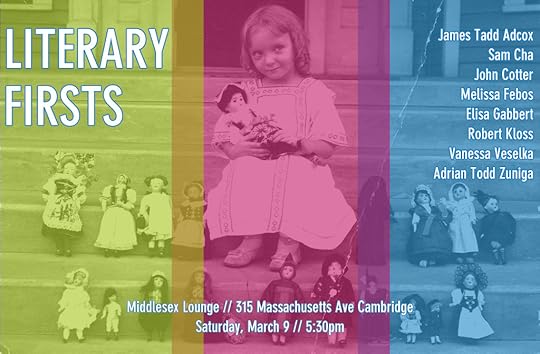
2/An extra special, double feature Literary Firsts!
Eight readers! James Tadd Adcox, Sam Cha, John Cotter, Melissa Febos, Elisa Gabbert, Robert Kloss, Vanessa Veselka, and Adrian Todd Zuniga!
Randolph and I made this thing to tell you about it! It’s creepy! It’s informative! In the context of the image, I worry that I am the girl and the dolls are the audience!
Let’s pretend I didn’t mention that!
January 25, 2013
Author as emcee
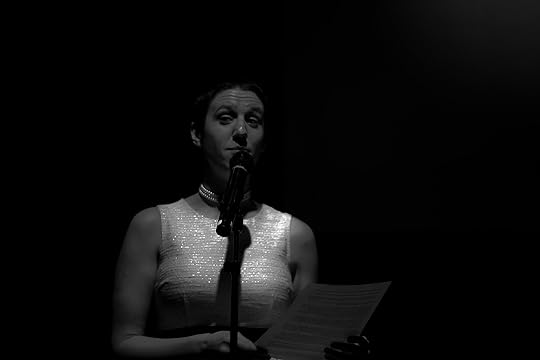
For those of you who live too far away to attend, this is what I look like when I host Literary Firsts. At least, this is how hosting Literary Firsts makes me feel. Photo credit, as always: Randolph Pfaff.
January 19, 2013
Word on the Street in the Boston Globe
Jan Gardner of The Boston Globe writes a column about New England writers called Word on the Street. She was kind enough to interview me about Literary Firsts for the latest installment. Just in case that link is hidden from you for paywall reasons, here’s a glimpse:
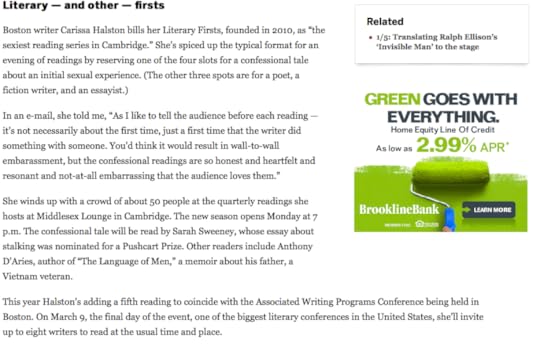 If you’re around on Monday, come to Middlesex Lounge and hear Anthony D’Aries, Danielle Jones-Pruett, Sarah Sweeney, and Michael Thurston!
January 18, 2013
Hacking and Packing
A while ago (early 2011), I wrote the first draft of a story wherein a girl ate herself to death. I don’t mean that she ate until she died. I mean that she starved herself and then ate her own body.
I wrote another few drafts and it got darker and I liked it for its darkness. Some editors showed interest, but not enough. No one took it. It was too abstract and didn’t work and there wasn’t enough information about the girl’s life outside of her starvation.
So I changed her name and gave her weird esteem issues and a dying father.
That wasn’t enough either.
Then I gave her a job in a slaughterhouse. And she didn’t eat herself at the end. She didn’t eat at all. Instead, she goes to work and stays there.
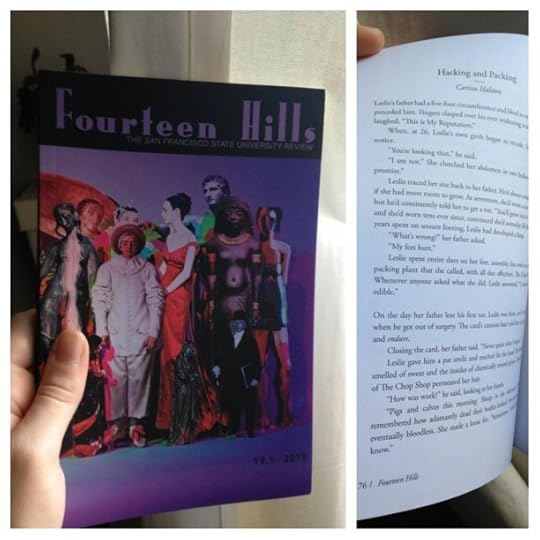
The story’s called Hacking and Packing and it’s in the latest issue of Fourteen Hills and I hope you’ll buy the issue and read it.
In fact, if you send me an e-mail (carissa AT aforementionedproductions DOT com), I’ll read the story, record it, and e-mail you an mp3. Or I’ll read it live. Up to you.
January 7, 2013
Just data
Some people have voiced outrage over Duotrope charging writers to use their services as of Jan 1.
Others have realized that very similar information is available elsewhere, as evidenced by our site statistics. Since the first of the year, apt hasn’t received a single referral from Duotrope. That’s the first time an entire week has passed during which none of our visitors have come from Duotrope since Duotrope began doing what they do.
Instead, we had 49 visits from pw.org. And seven from NewPages. And a handful from The Review Review.
I can only imagine those numbers will increase.
January 1, 2013
Looking at the past from the future
At the end of 2011, I somehow took time to go over everything I’d done that year, plus mention things I wanted to accomplish in 2012.
Among the highlights from 2011 were reading my work at bookstores, finishing the second draft of Conjoined States, and applying to graduate school.
In 2012, I was fortunate to do a dozen readings–a book launch at WORD, a reading at Moravian Bookshop (where I worked for three years), another reading at my very favorite local bookstore, Brookline Booksmith, a turn at Literary Death Match (which was hilarious and exciting), and a reading at Baltimore’s citywide Book Festival. The writers I read alongside were humbling and wonderful; some of my favorite people were among them: Jill McDonough, Gillian Devereux, Dolan Morgan, Michael Kimball, and Randolph Pfaff. I finished the third draft of Conjoined States (and have begun work on the fourth), thanks to a scholarship from the Wesleyan Writers Conference and grant from Turkey Land Cove Foundation.
I mentioned in 2011 that I was very happy to have two stories published at Wigleaf. I’m happier still to have had work published at the following journals/presses in 2012: Aqueous Books, Little Fiction, Untoward, Consequence, Newfound Journal, The Good Men Project, The Collagist, Curbside Splendor, The Lit Pub, The Massachusetts Review, and Fourteen Hills.
I mentioned also that I wanted to get my many unfinished short stories tidied up in 2012. I did that and found homes for some of them in the publications listed above. I am so grateful to their editors. I can only hope that 2013 will find me doing much of the same.
I talked about all the great writers I got to work with via Literary Firsts–that trend continues, thankfully. I worked with fifteen amazing writers who gave me the best of their best last year. I love Literary Firsts and I’m a huge fan of those writers. There will be sixteen more in 2013 (and, actually, more than that–keep your eyes on the LF site later this month for that news).
I finished my 2011 post by listing the things I wanted for 2012. I said I wanted to read at least forty-two books. I didn’t. But I broke thirty and wrote a big, big draft of my own book, so I still think that works.
I talked about working toward publishing a prose collection for AP’s next book. That didn’t happen either. But! We’re looking into distribution and will start pursuing that path again in 2013.
I applied to graduate school again in 2012 (as 2011′s attempt was met with rejection) and I’ve already received my first response–an acceptance. So that will happen in fall, 2013.
But this is my only modest wish for myself for 2013:
I want to finish the next two drafts of Conjoined States. This book is so important to me. It’s long and earnest and I need to get it to the point where I can let other people read it. It’s not there yet. But once it’s through the fifth draft, I sincerely hope it’s ready and I sincerely hope that happens this year.
And here’s my wish for you:
Great literature. I hope you read a book that knocks your doors off their hinges. I hope you encounter an author whose work moves you to tears of relief. I hope you find the words you need to help you wrestle through these times that are undeniably stressful. I hope that book convinces you that though we are often inhumane, intolerant, and insensitive, we as people have the capacity for enduring those trials for the better.
And, when you find your book, I hope you’ll let me know.